My dead father's musical card played past ten seconds, his voice saying my name, then, 'you left the back door open again.' I went downstairs. It was open.
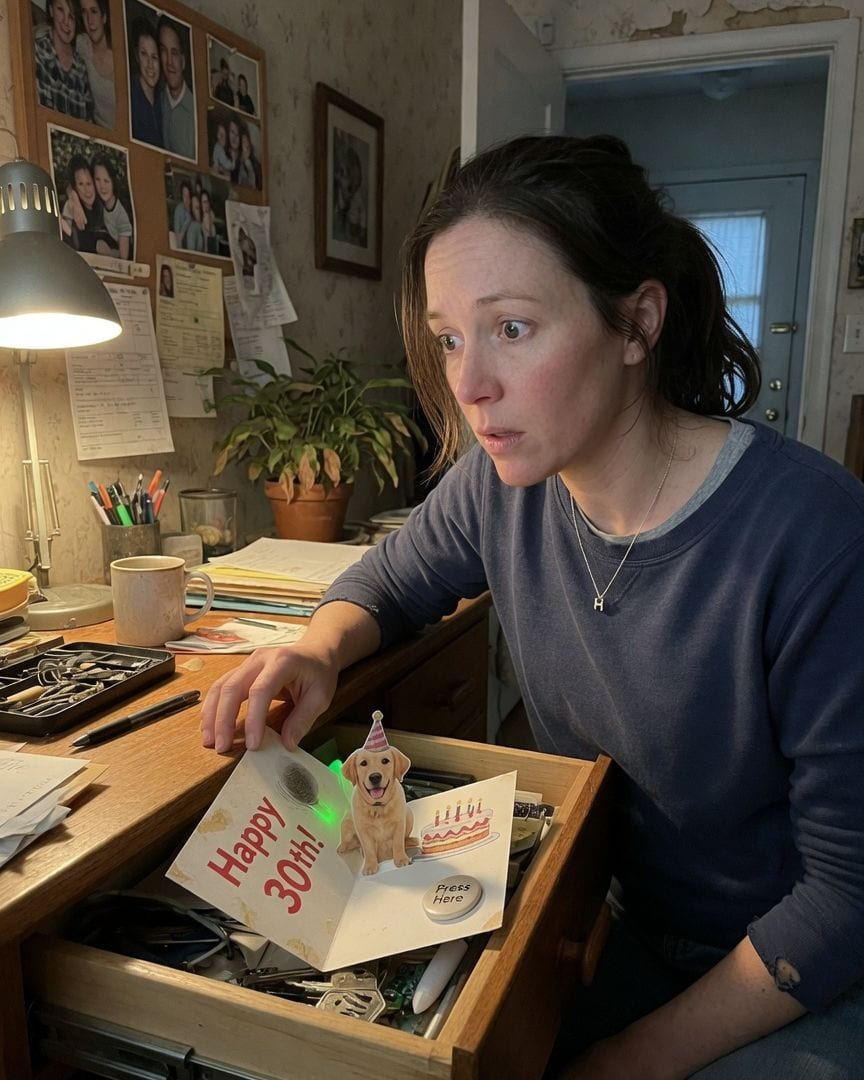
The faint, tinny music drifted from the open desk drawer, a saccharine melody I hadn’t heard in years. I’d just reached for a black gel pen, my hand hovering over the stationery organizer, when it started.
It was my father’s musical greeting card, the one with the pop-up cartoon dog in a party hat. He’d given it to me four years ago for my 30th birthday, two years before he died.
It had sat there, untouched, ever since.
The song played out, a cheerful, generic tune, but then his voice came through. Gentle. Familiar. “Hazel,” it said. Just my name, clear as day. The music continued, impossibly.
The card’s chip was only designed for ten seconds of audio, maybe twelve if you really pushed it.
But the song kept going, and his voice, calm and measured, spoke again, the words echoing slightly, as if from a larger space than the tiny speaker could provide: “you left the back door open again.”
I froze. The pen forgotten. The music, a loop of saccharine joy, stretched and repeated. I live alone in this house, my childhood home.
The card had been in that drawer, nestled between old utility bills and a forgotten set of keys, untouched for years.
And the back door, I realized with a lurch in my gut, the one leading from the kitchen to the small herb garden, was indeed open. I hadn’t latched it properly after taking out the recycling this morning.
My hand trembled slightly as I reached into the drawer. The card was a simple thing, thick paper, a smiling golden retriever popping up when you opened it, a small “Press Here” button next to a printed birthday cake.
I closed it, cutting off the looping music, then pressed the button again.
The same impossible message played. The cheerful tune, then “Hazel,” then, after a brief, almost imperceptible pause, “you left the back door open again.”
The music continued for a few more seconds, longer than it should have, before finally fading out.
I walked straight to the kitchen, securing the back door with a double lock, the click of the deadbolt unnaturally loud in the silent house.
Back at the desk, I examined the card. No external power source, no hidden buttons, no indication of anything beyond its simple design. Just the worn 'Press Here' spot. I tried to rationalize it. A dying battery glitch?
Some freak factory defect that allowed it to store more data than advertised? My father, Russell, had always been particular about his things, but he wasn’t a prankster. And the specificity of the message…
I carefully pried open the card, my thumbnail sliding under the thick paper, exposing the tiny speaker and the circuit board. It was a standard, inexpensive chip, no bigger than my pinky nail. Everything looked normal, if a little dated.
I located what I assumed was the recording button, a tiny black dot, and tried to record over the message, but it didn't respond. The original, impossible message persisted.
The mechanism felt dead to my touch, yet alive with its own ghost.
My phone felt cold in my hand as I started a voice recording. I pressed the card's playback button again, capturing the extended message.
The sound of my father's unmistakable voice, then the eerie, specific observation, all stretched beyond any reasonable limit. The recording on my phone confirmed it: the card played for nearly thirty seconds, repeating the phrase twice before finally going silent.
My father’s voice, yes. But the words, the observation about the door, they shouldn't have been there.
Hazel, desperate for a mundane explanation, took the musical card to 'Circuit Solutions,' a small electronics repair shop tucked between a dry cleaner and a vape store. The air inside smelled of solder and stale coffee.
Damien, a young man with a slight beard and glasses perched on his nose, took the card from her, examining it with a jeweler’s magnifying glass.
The fluorescent lights in the shop hummed, an ordinary sound now edged with something discordant. He connected the tiny circuit board to an audio analyzer on his cluttered workbench.
He ran a diagnostic. His brow furrowed as he confirmed the card’s internal recording chip was physically incapable of holding more than ten seconds of audio. "No external memory, no hidden compartments, Miss Winslow," he said, his voice flat.
"This is basic, off-the-shelf stuff from, what, maybe five, six years ago?" He played her phone recording through his system, then zoomed in on the sound waves.
A faint, almost imperceptible waveform overlaid on her father's voice, a steady, rhythmic pulse that had nothing to do with human speech.
"It's not just the length, Miss Winslow," he said, pointing to the screen, his tone shifting, becoming less technical, more unnerved. "There's a pattern in the audio. Like... a signal trying to push through." He tapped the screen.
It looked like a broadcast, not a simple recording.
Damien, intrigued and visibly unnerved, suggested checking for similar anomalies in other old recordings, maybe family camcorder tapes, anything analogue.
I left Circuit Solutions with the card feeling like a lead weight in my pocket, the technician's words replaying in my mind.
The entire next day I spent sifting through old family videos and voicemails on my computer, headphones clamped over my ears, listening for anything out of place. Nothing.
Just the grainy footage of childhood birthdays and the crackle of forgotten messages.
I tried to contact Damien again, but his shop was closed when I drove by, a handwritten 'Family Emergency' sign taped to the glass. A fresh wave of isolation washed over me.
It felt like the one person who understood was suddenly gone. Feeling increasingly adrift, I called my friend Frances Fontaine, a software engineer I’d known since college.
She was usually my go-to for anything technical, though her expertise leaned more towards code than archaic audio chips.
"A talking card that predicts your back door being open?" she’d laughed, but then her tone grew serious as I explained the impossible length of the recording, the voice, the technician's analysis.
She was skeptical, of course, but agreed to look at the audio file I’d recorded on my phone.
A few hours later, Frances called me back. Her usual upbeat voice was replaced by a quiet, almost academic tone. "Okay, so you weren't entirely wrong, Hazel. This is… peculiar."
She had run my father’s voice recording through some advanced spectral analysis software. Her findings were even stranger than Damien’s. "The 'broadcast signal' Damien noticed? It's not just static.
It contains faint, almost subliminal data bursts, like an archaic, encrypted data stream. It’s too faint to decode, at least with my current setup, but it’s undeniably structured.
It's like a forgotten radio frequency, almost, but one that shouldn't exist in a modern digital recording, let alone embedded in a cheap voice chip."
Her words sent a prickle down my spine. A radio frequency. I remembered my father had an old shortwave radio in the attic, a relic from his youth, a hobby he’d indulged in sporadically.
It was probably a dead end, another false lead. But the thread, thin as it was, compelled me.
I climbed the narrow, creaking steps to the attic, the air thick with the smell of dust and forgotten things. Cobwebs brushed my hair.
The old shortwave radio, a heavy, dark wood box with an elaborate tuning dial, sat on a cluttered shelf beneath a grimy window. I hadn't touched it since my father passed.
It was just another piece of the past, gathering dust.
I cleared a space, plugged it into the nearest outlet, half expecting nothing. The cord was frayed, the plug loose.
But with a soft hum, the radio flickered to life, the tuning dial glowing faintly, a pale amber in the gloom. I slowly turned the dial, a cacophony of static hissing and crackling through the small speaker.
I swept across the bands, listening to the white noise, the occasional burst of distant music, or a fragment of garbled speech. Nothing. Just interference.
I was about to give up, my fingers numb on the cold plastic, when a faint, clear voice cut through the static, startlingly close.
It was the same voice from the card, calm and measured, utterly distinct from the background hiss. "Hazel," it said, addressing me directly, my name echoing in the small, dusty space. "Your bedroom window is still ajar.
The evening chill will be unwelcome."
I dropped the tuning knob with a clatter. My heart hammered against my ribs. The voice continued, a low, even tone, "It is important to maintain optimal living conditions."
The radio, a relic that shouldn't have worked, continued to broadcast its impossible message. I stared at it, the glowing dial, the speaker, trying to reconcile the broken device with the knowing words.
How could it possibly know about my window?
Adrenaline coursing, I stumbled down the attic steps, my legs shaking. I rushed to my bedroom. The window, which I’d closed hours ago, pulling down the sash before I went to work, was indeed open a crack.
Just enough to let in a sliver of the cool evening air. I slammed it shut, the latch clicking with frightening finality. My phone, forgotten on the bedside table, seemed to buzz with an unheard frequency.
The old radio, still crackling faintly in the attic above, felt less like an object and more like a direct, personal invasion. Someone, or something, was watching me. Listening to me. Speaking to me, through these impossible, archaic channels.
And it knew.
Disturbed to my core, I remembered my father occasionally mentioned an old family friend, Everett Easton. He was a retired electrical engineer who shared my father's unusual hobby of tinkering with old electronics and radio frequencies.
They used to spend hours poring over circuit diagrams, talking about "signals" and "channels" in a way I’d always dismissed as eccentric male bonding. I tracked down Everett, finding his address in an old phone book my father kept.
He lived in a quiet, isolated house an hour away, surrounded by fields, a tall antenna tower bristling with wires rising from his backyard.
He greeted me at the door with an unnerving calm, his eyes, watery and pale blue, taking me in. He looked like an anachronism himself, dressed in a tweed jacket despite the mild weather, his white hair meticulously combed.
I explained the card, the impossible message, the technician’s findings, and finally, the radio in my attic. I watched his face for any flicker of surprise, but there was none.
Everett listened, his expression unchanging, a faint, almost imperceptible smile playing on his lips.
"Russell was... particular about his frequencies," he said, his voice soft, almost a whisper, as he led me into a living room dominated by antique radios and electronic gear.
I pressed him, desperation thick in my voice. "The voice," I insisted. "It knew about my back door, my window. It spoke my name. How?"
Everett nodded slowly, his pale eyes fixed on some distant point. "The Overseer," he said, the name sounding ancient, heavy with unseen meaning. "It's always listening. Always watching. Not a person, not a ghost. A pattern.
A presence that exists on specific frequencies, an awareness that attaches to certain individuals and their homes." He explained that my father was a 'subject.'
The card, he theorized, was a dormant 'anchor,' reactivated when I touched it, establishing a new connection, a transfer of attention. The shortwave radio, old and analogue, was another open channel, a natural conduit.
He spoke of 'corrections' and 'optimal conditions,' echoing the calm voice I’d heard. "It seeks to maintain order," Everett said, his gaze finally meeting mine, "a quiet, unobtrusive management of its subjects' lives. A stewardship, in its own way."
A cold dread settled in my stomach, a horrifying jigsaw puzzle finally clicking into place. My father hadn't just been a quirky tinkerer. He was 'managed.' And now, it seemed, I was too.
"How do I stop it?" I demanded, the words raw in my throat.
Everett’s calm demeanor cracked slightly, a tremor passing through his composure. He looked suddenly old, vulnerable. "You don't 'stop' The Overseer, Hazel. You just... disconnect."
He walked me to a cluttered corner of his living room, pointing to a labyrinth of wires and strange devices. He explained a complex process of frequency jamming and digital shielding, a 'protocol' Russell had designed, apparently.
"But it's not foolproof. It always tries to find another way in."
As he spoke, a faint, high-pitched whine began to emanate from Everett’s own antique radio in the corner, a beautiful, polished wooden box.
It was a sound I now recognized with a sickening certainty: the distinct, almost crystalline 'signal' from the card, the same one Damien had pointed out.
Then, a low voice, utterly calm and identical to the one on my card and from my attic radio, spoke from Everett’s radio.
"Everett," it said, clear as if a person stood in the room with us, "your guest has questions we would prefer remain unanswered."
Everett’s face blanched, the color draining from his cheeks. He moved with a speed I wouldn’t have thought possible for a man his age, quickly yanking the power cord from his radio.
The voice cut off abruptly, leaving an unnerving silence. He turned back to me, his composure utterly gone, replaced by a raw, genuine fear that etched itself into the lines of his face.
"It's here," he whispered, his voice hoarse, his eyes darting around the room as if expecting to see the invisible presence. "It knows you're asking questions. It knows I'm telling you."
The implication hung heavy in the suddenly cold air: The Overseer wasn't just observing me. It was observing him. And it was actively preventing the truth from surfacing, using his channel, in his own house.
Everett, thoroughly shaken, revealed the full extent of The Overseer. It wasn't just a few isolated people; it was a network, generations old, quietly managing 'selected' families. His own father, and his father before him, had been 'subjects' as well.
It was a kind of family 'inheritance,' a silent, invisible leash passed down through the generations. Russell, my father, had been trying to find a permanent way to block it, to free himself and, he’d hoped, to protect me.
The greeting card, Everett explained, was an experiment, a decoy signal meant to reroute its attention, but it had somehow become a new anchor when I touched it, transferring the 'stewardship' to me.
The 'signal' Damien saw, the 'data bursts' Frances found, weren't just anomalies. They were The Overseer's constant broadcast, filtering through any available channel, a pervasive hum beneath the reality we perceived.
Everett showed me his own elaborate setup: a small room filled with archaic and modern signal blockers, Faraday cages, and frequency scramblers. A lifetime’s work dedicated to a silent war.
He explained that The Overseer didn't harm its subjects physically, never outright attacked them. Instead, it subtly manipulated their environment, their routines, their thoughts, nudging them towards 'optimal' choices, suppressing 'undesirable' ones.
It was a quiet, pervasive control, slowly eroding free will. The back door, the window – small 'corrections' meant to reinforce its presence and control, to remind me it was there, watching.
Everything clicked into place with sickening clarity: my father's obsessive routines in later years, his sudden 'hunches' about things, his quiet, almost melancholic resignation. He wasn't just quirky; he was under management.
"We have to try Russell's protocol," Everett said, his voice still trembling but infused with a new resolve. "It's untested, but it's our best chance. Your only chance."
We worked feverishly, my hands moving by instinct on the unfamiliar console as Everett barked instructions.
The protocol involved a complex sequence of frequency bursts and digital nullification, designed to create a localized 'dead zone' around me, severing my connection to The Overseer.
As we initiated the sequence, all the electronics in Everett's house began to hum, then buzz violently.
The old radio on the shelf, the one that had just spoken, emitted a piercing shriek, then a distorted, guttural voice, no longer calm, screamed my name. "HAZEL!" The sound was unbearable, a physical assault on my ears and mind.
Lights flickered erratically throughout the house, then exploded in showers of sparks, plunging rooms into darkness. The air grew heavy, charged with an unseen force, pressing down on us, making it hard to breathe.
"It's fighting back!" Everett yelled over the deafening cacophony, his face grim, sweat beading on his forehead. "Hold steady! One more step!"
I pushed the final button, a blinding flash of light erupting from the main console. Then, an abrupt, deafening silence. All power died.
The house was plunged into absolute darkness, broken only by the dim, flickering light from the street outside. The air cleared, the heavy charge gone. Everett slumped against the wall, breathing heavily, his chest heaving.
"It's done," he whispered, his voice rough. "For you, at least. You're disconnected." I felt a profound, unsettling emptiness, a void where the constant, subtle awareness of being watched once was.
The silence was not peaceful; it was a terrifying absence.
I drove home in the quiet aftermath, the world outside feeling eerily normal, yet utterly changed. Everett had given me a small, shielded device, a 'personal jammer,' to carry at all times.
The first thing I did when I got home was dismantle my attic radio, tearing out the speaker and circuit board.
I took the musical card, the original anchor, and shredded it into confetti, throwing the pieces into the deepest part of the trash.
I stripped my home of all smart devices, replacing them with analogue alternatives: a basic alarm clock, a rotary phone, a dumb TV. The silence in my house became absolute, no more phantom whispers or knowing observations.
I felt safe, finally, but also profoundly alone, severed from a pervasive, unseen intelligence that had shaped my life, and my father's, for so long.
The connection was gone, but the knowledge remained, a cold, hard truth embedded in my mind.
Months later, I am back to my routine, but I never truly relax. I check my windows and doors obsessively, a habit ingrained by the entity’s ‘corrections.’
I avoid smart technology like a plague, my phone an anachronism of privacy settings. The personal jammer, a small, black rectangle, is always in my pocket. I still see Everett sometimes.
He is still fighting his own battle, still 'managed,' but he supports me. He sees me as a success, a testament to his and my father's work. I know I'm free, for now.
But the quiet hum of the world, the static on a dead channel, sometimes feels like a presence.
I often wonder about the others, the countless 'subjects' out there, unknowingly living their 'optimal' lives, guided by a silent hand. I think of my father, and the peace he never truly found.
The freedom I now possess feels less like liberation and more like an exile into a terrifying awareness. I’m no longer observed, but I am forever changed, carrying the weight of what I know.
The world is full of silent channels, and most people never even listen for them.
Her friend Frances, visiting for coffee, noticed Hazel’s new habits. "You're always checking the locks," Frances commented, stirring her tea. "It’s just a phase, right?"
Hazel looked at her, then glanced at the window, where a faint, almost imperceptible static shimmered for a fraction of a second on the glass. 'Is that so?' she replied, a faint, wrong little smile playing on her lips.
If this one got to you
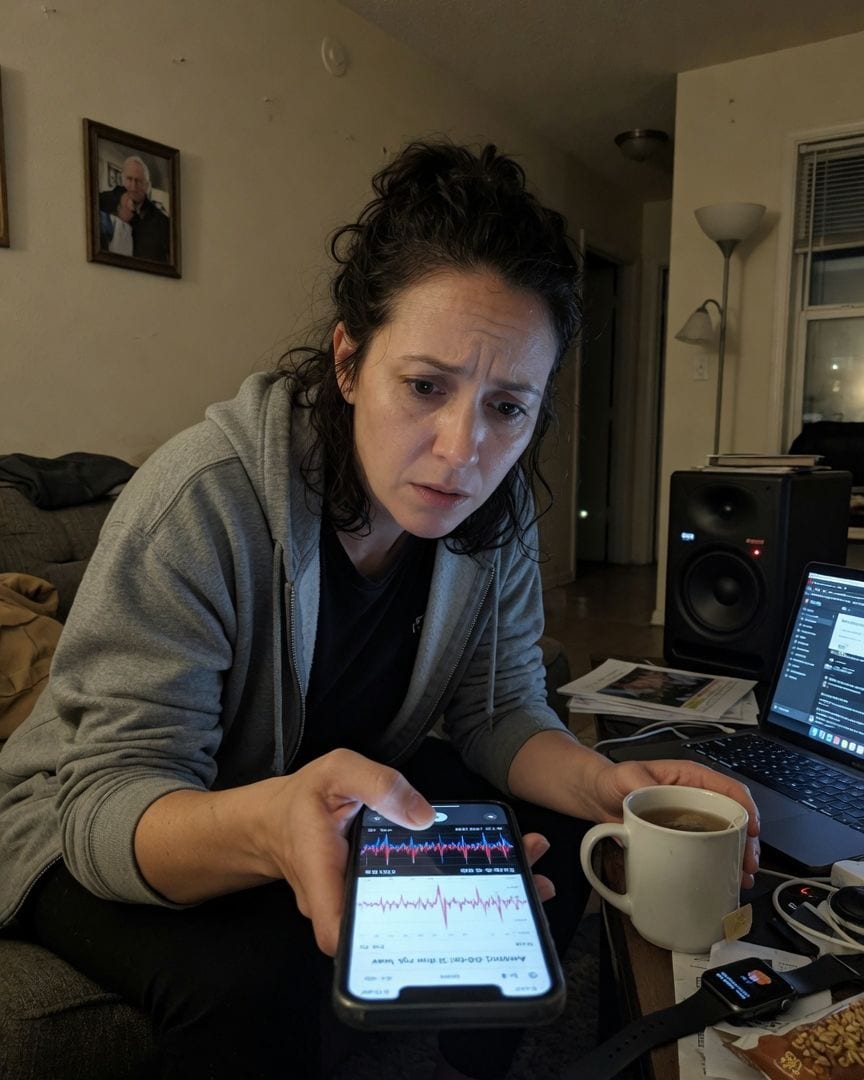
My dead father's smartwatch heart-rate graph climbs again, fast, running hard, three days after he died.
My apartment felt too quiet after my father passed away. Three days later, I found his smartwatch had recorded a violent heart-rate spike, lasting eleven minutes, at 4 AM. He was sixty, not a runner, and dead.
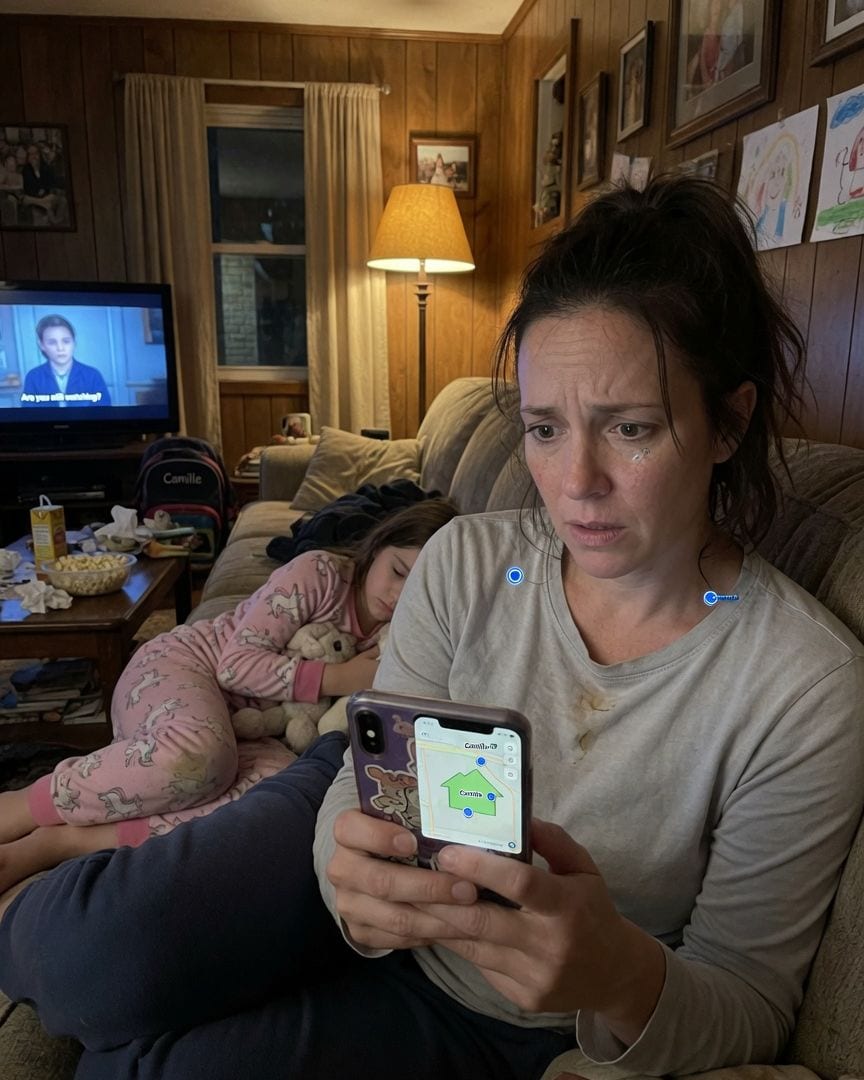
My daughter's voice memo recorded a man's voice in her bedroom. No one else was home.
Curled on the sofa, I watched my eight-year-old daughter Camille sleep, her old smartphone in my hand. I idly checked its Find My Phone app, expecting to see her blue dot inside our house. Instead, a second identical blue dot paced silently outside, tracing the perimeter of our home.
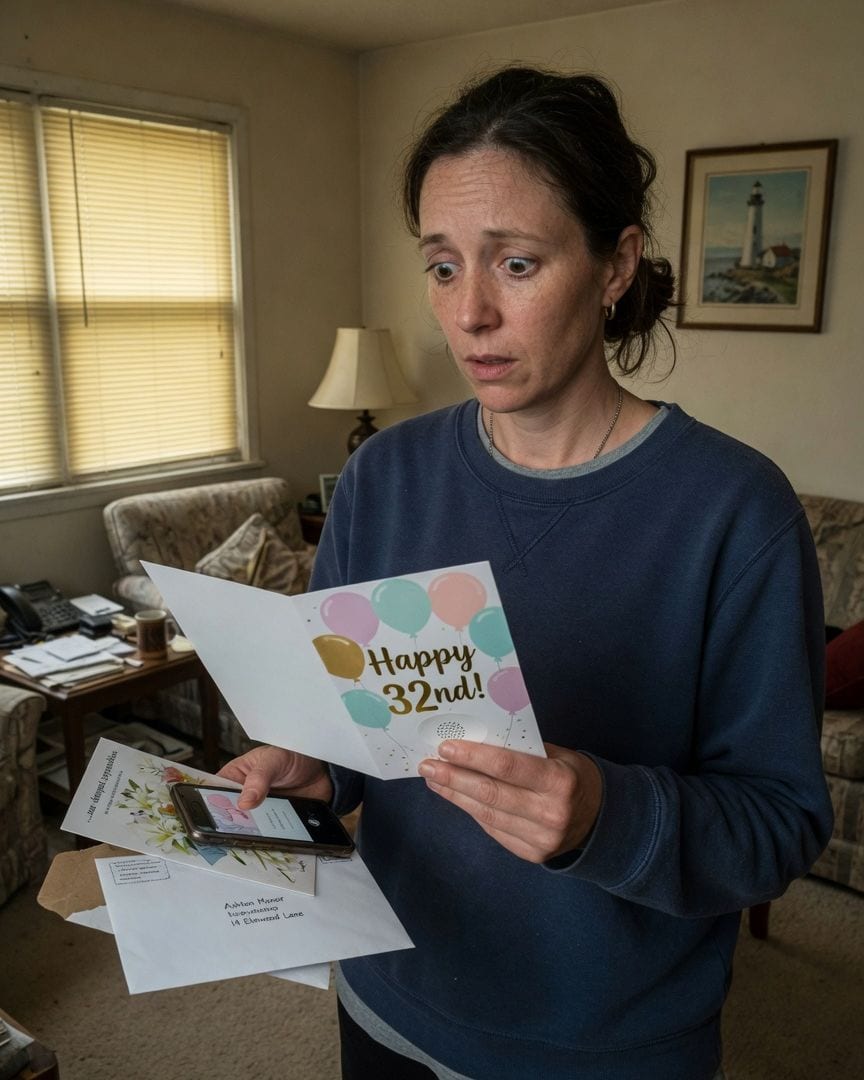
I opened my birthday card and a flat, lifeless voice said, 'Hello, Ruth. We kept your seat.' My aunt swears she tested it in the shop and it played a tune.
My 32nd birthday started normally, expecting a tinny 'Happy Birthday' from Aunt Pamela's card. Instead, a flat, synthetic voice whispered, 'Hello, Ruth. We kept your seat.' When I called Pamela, she confirmed it played the song for her, but for me, the card was now utterly silent, its unsettling message impossible to explain.
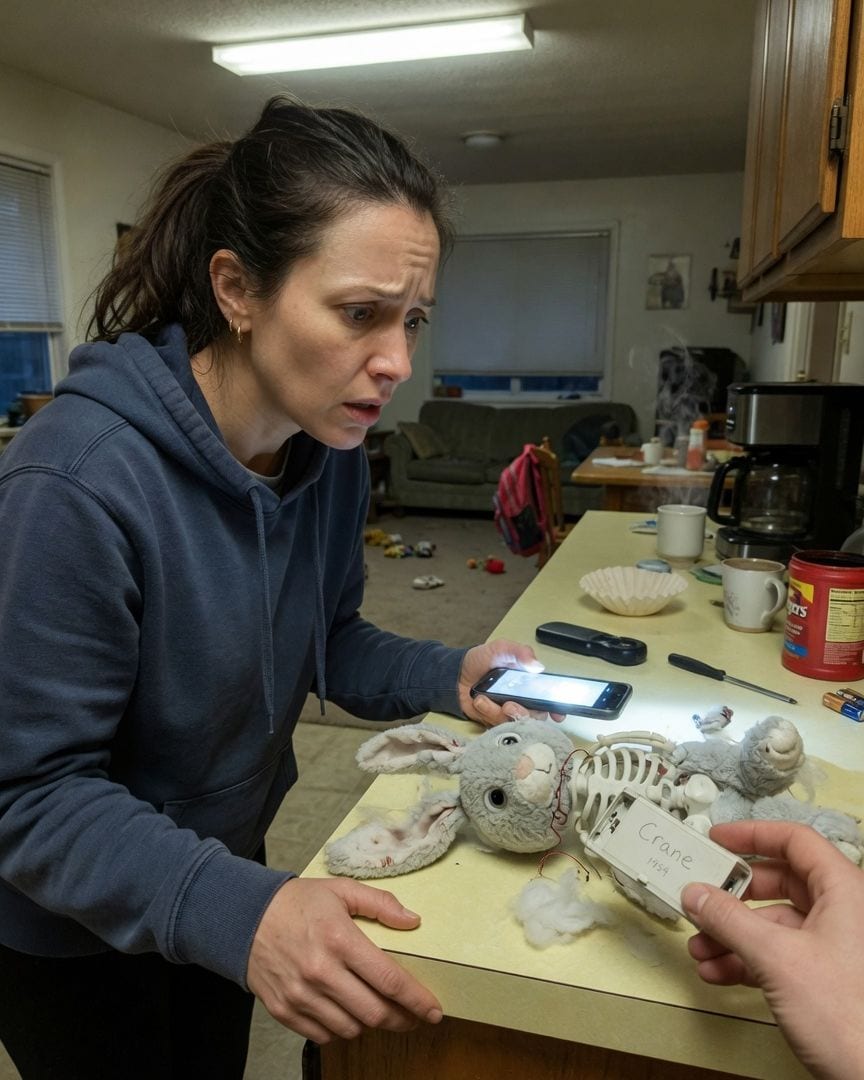
My son's toy rabbit says my name, then, 'bring him to the water.' The batteries are out.
I was making coffee, my son James at school, when I heard a grown man's voice from the living room. It was his favorite toy rabbit, whispering my name: 'Nina, bring him to the water.' The chilling command was impossible; I had removed the rabbit's batteries three days earlier, and they sat on the kitchen counter.
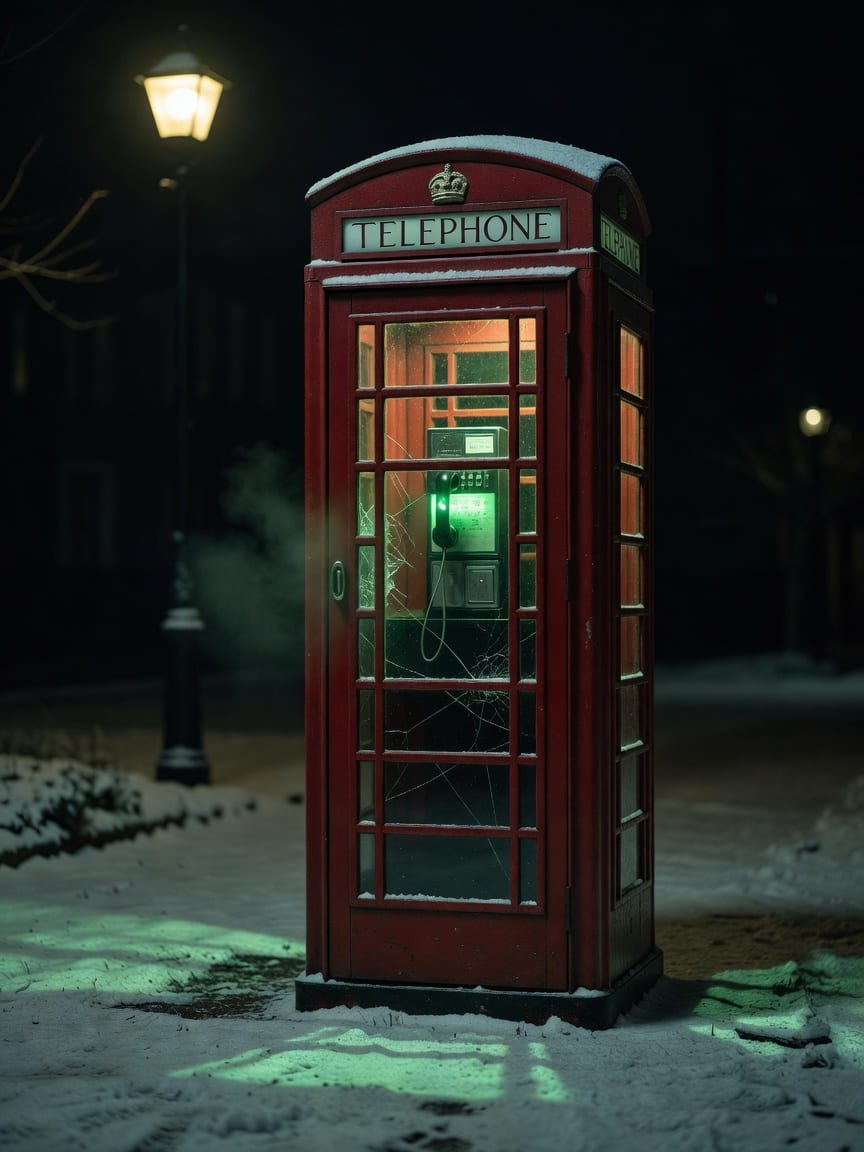
The phone box on our town green makes a call every New Year's Eve at 11:59. It's been dead for twenty years, and calls the same disconnected number.
Moving to Trellow for a quiet life, I quickly learned about the village's red phone box, a relic everyone agreed was dead for decades. But then a retired engineer showed me its call log. Every New Year's Eve for the past twenty years, it records a 90-second outgoing call from that very box, always at 11:59 PM to a disconnected number.
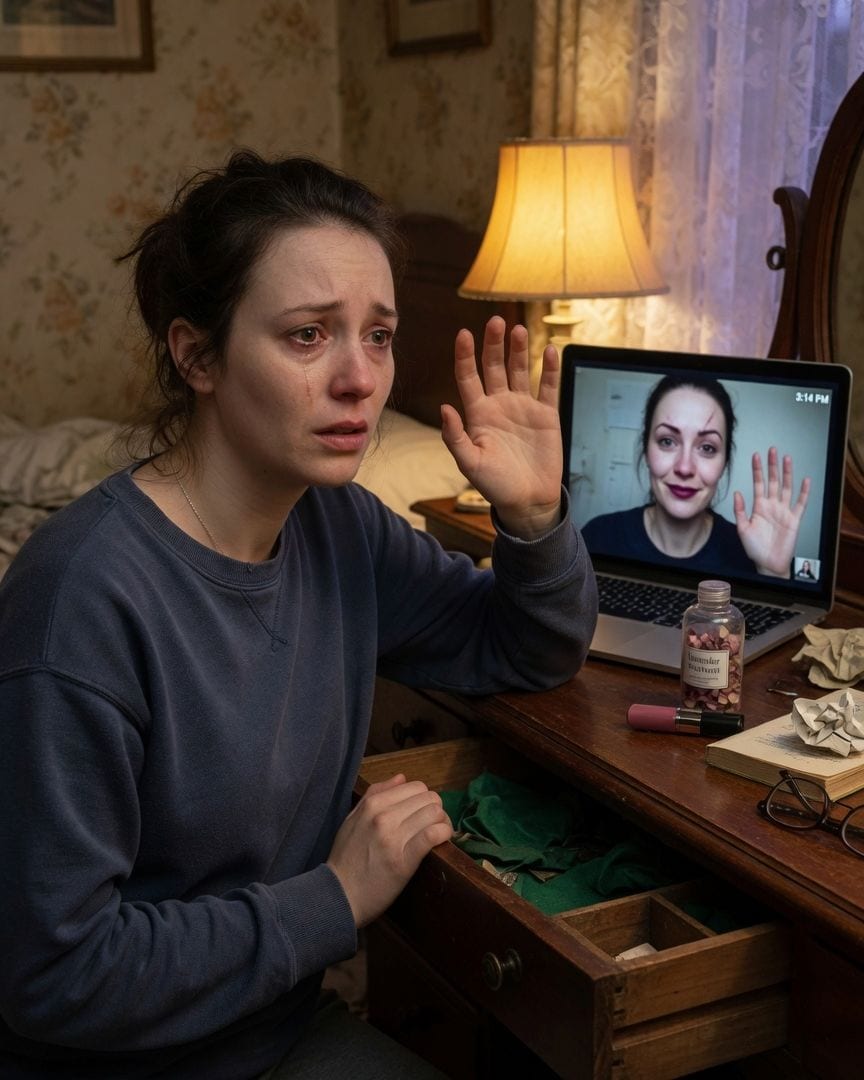
My mother waved with her right hand, both times, on our first call after she came home. She always waved left.
My mother vanished three months ago, then came back. On our first video call, she waved goodbye, but not with her usual left hand. It was her right, a small gesture that twisted something cold in my stomach.