My brother remembers carrying me home after I broke my arm. He was already gone two years when it happened.
My older brother, Joel Whitfield, ran off at eighteen. I was sixteen then, still half-child, half-girl, and I remember the quiet, gaping hole he left in the house. Thirty-two years later, he came back.
Found wandering a bus depot in Ohio, no papers, no explanation, just a weary, bewildered look in his eyes and the unmistakable lines of his face.
He was fifty now, thinner than I remembered, with a dusting of grey at his temples, but undeniably him. The police called, then his phone number appeared on my caller ID, a ghost made real.
The relief that first week was a physical ache, a knot in my chest finally loosening after decades of being wound tight. He settled into his old room, quiet, observant.
He’d lost a lot of weight, and sometimes his eyes would drift, distant, but he was here.
We sat on the porch one late afternoon, watching the sun dip, painting the gnarled branches of the old oak tree in the yard in long, golden strokes. It was the same tree I’d climbed countless times as a kid.
Joel turned to me, a nostalgic smile, soft and melancholic, on his face. 'That old oak,' he said, his voice a little rougher than I remembered, 'Remember when you fell from it? Broke your arm, didn't you?
Your cries echoed through the whole neighborhood. I carried you all the way home, screaming, your arm dangling like a broken puppet string.'
My breath caught. I remember the fall, too. The branch cracking under my weight, the sickening lurch, the sharp, blinding pain as I hit the ground. I was eighteen then, an awkward age for such a childish accident.
I remember my mother, her face pale with fear, scooping me up with surprising strength, carrying me inside, her gentle, worried murmurs. She’d laid me on the couch, the phone already in her trembling hand.
Joel wasn't there. He was twenty years old then, two years gone already, two years into his unexplained absence.
But he told it as if his own arms had held me, asked if it still ached in the cold, his gaze unwavering, full of a strange, possessive concern. He even reached out, almost touching my healed arm.
And for the first time, the relief, which had been a warm presence in my chest, curdled into something cold and metallic in my throat. This wasn't just a memory lapse, a side effect of trauma or time.
It was something else. Something wrong.
The impossible memory gnawed at me. I tried to push it away, to blame it on the shock, the decades, the trauma of whatever he'd been through out there.
But every time Joel looked at me, every time his eyes, which were so like his own, met mine, I felt that chill.
He had always taken his coffee black. A family joke, a point of pride, about his 'true grit.' Now, he insisted on milk and two sugars.
'Always have,' he'd said, stirring it slowly, a faint, almost imperceptible frown on his face when I’d hesitated with the creamer.
That was a habit my mother, God rest her, had only acquired in her last years, after her taste buds dulled. I’d seen him do it, add the same precise amount of milk, the two spoonfuls of sugar.
The arm, the oak, the carrying – it was too vivid, too specific, and utterly, undeniably false. I started digging, quietly. I pulled out old photo albums, dusty from the attic.
I needed proof, not for him, but for myself, that I wasn't losing my mind. That my own memories, the bedrock of my life, hadn't fractured under the strain of his return.
Flipping through the brittle pages, I found a picture of Joel and me, maybe a year before he left. We were at the annual town fair, all sticky fingers and sunshine.
He was holding a plastic ring toss prize, a cheap little toy, but he was beaming, genuinely happy. And he was holding it, as he always had, in his right hand. A natural right-hander, like our father.
He’d written, eaten, thrown a ball, all with that dominant right hand.
Later that evening, I watched him from the kitchen. He was in the living room, reading a newspaper. He held it in his left hand, the pages spread wide, and turned each sheet with his left thumb and forefinger.
Then he reached for his coffee cup – the one with milk and two sugars – and lifted it to his lips, all with his left hand. Everything he did, every small, unconscious gesture, was now left-handed.
My brother, Joel, had always been fiercely right-handed. It was a detail so ingrained, so fundamental, it felt like a betrayal to see it reversed.
I searched my old diary entries, pulling out the small, floral-covered book from a box of childhood mementos. I flipped specifically to the period after he left.
I found one, scrawled in a child's hurried, untidy hand, dated shortly after my arm incident: 'Mommy carried me, not Joel. He’s gone.' The words were a cold comfort, confirming my memory, stamping it as real.
But they also deepened the dread of who, exactly, was now sitting in our living room, calmly reading the newspaper with his left hand. It wasn't just a habit reversed.
It was a complete inversion, like looking at a mirror image that had somehow stepped out of the glass, but the reflection was… off.
I kept sifting through the old albums, through my mother's meticulous records of our lives, searching for anything else that felt off, anything that could explain the impossible memories, the flipped habits.
The house creaked around me, settling into its nightly rhythm, but it felt less like a home and more like a stage where a new, unsettling play was being performed.
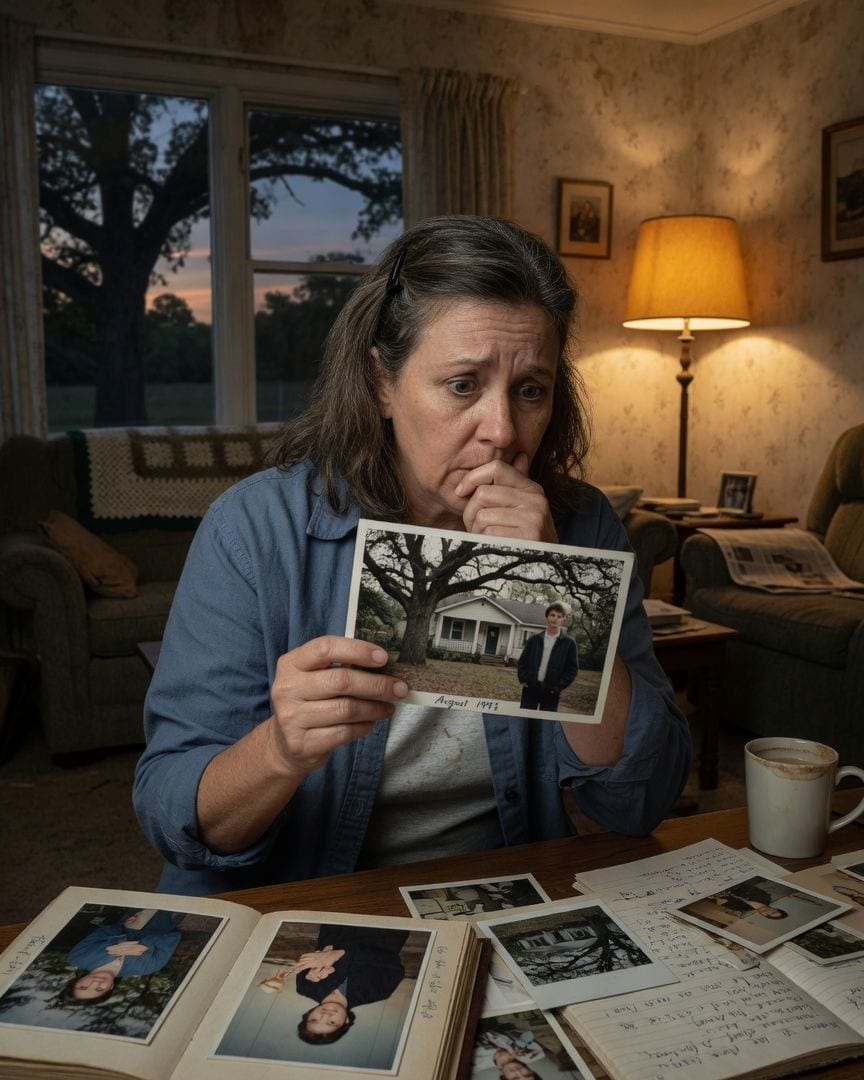
Then I found it. A faded photograph, slightly blurred, tucked into the very back of the album, almost forgotten. It was a shot of our old house, taken from the street, perhaps from a car passing by.
The date stamped on the back, faint but clear, read 'August 1993.' Joel had left us in 1991.
In the background, partly obscured by the gnarled branches of the old oak tree that still stood sentinel in our yard, was a figure. A boy, lean and tall.
He was standing just at the edge of the woods, where the property line blurred into the wilder growth, watching the house. His face was indistinct, lost to the fading chemicals and distance, a ghostly blur.
But the set of his shoulders, the familiar tilt of his head, the way his hands were shoved into his pockets, the casual curve of his back—it was undeniably Joel. My breath hitched.
My heart hammered against my ribs, a frantic drum against the sudden, cold realization. Joel was supposed to be gone. He was supposed to be gone for another thirty years. He was supposed to be somewhere else entirely.
The photograph was a cold knot in my stomach, a physical weight that made me nauseous.
I couldn't ask Joel about it directly; the way he'd dismissed my arm memory, his calm, unnerving certainty, felt less like a brotherly correction and more like a quiet warning.
His presence in the house had become a constant, low thrum of anxiety.
Instead, I took a copy of the faded photo to Mrs. Janet Barlow, our old neighbor. She was seventy now, sharp as a tack, and had lived in the house across the street for nearly as long.
Her memory was a steel trap for local history, for every birth, death, and scandal on our street.
I found her on her porch, watering her petunias, the same bright red ones she’d planted every year since I was a child.
'Mrs. Barlow,' I began, trying to sound as casual as a conversation about the weather, 'do you remember anything unusual around the time Joel left? Or after?' I handed her the picture.
She squinted at the photo, her brow furrowed, a network of fine wrinkles deepening around her eyes. She recognized the house, the oak. 'Oh, Joel,' she mused, her voice raspy with age. 'Good boy. Always a little wild.
Shame he ran off. Remember seeing him around though, now and then. Thought it was odd. After he left.'
My breath hitched. 'You saw him?' My voice was barely a whisper.
She nodded slowly, a thoughtful frown on her face. 'Aye. Saw him near the woods, by that big oak. Just watching. Never came up to the house, mind. Just… there.
Thought maybe he'd come back for a visit, changed his mind, but your mother always said no, he was gone for good. Took her grief pretty hard, she did.' She paused, a hand going to her chin. 'Funny, that.
He always hated green beans, wouldn't touch 'em with a ten-foot pole. Made a big fuss at Sunday dinner, always.' She looked at me, a tiny smile playing on her lips.
'Now your Joel, the one who came back, he asked for a second helping last week when I brought over that casserole. Said they were his favorite. Said I made 'em just like your mother did.'
The casual mention of another 'habit reversed,' so specific and so utterly contrary to the real Joel, hit me harder than the sighting. Mrs. Barlow wasn't confirming a memory; she was confirming an observation.
It wasn't just an impostor; it was a mimic, learning, adapting, testing its new persona against the world. And it had been doing it for a very, very long time. Watching us. Waiting.
Mrs. Barlow's words hung heavy, echoing in my mind. Joel hadn't just returned; he'd been present, a silent, watchful shadow, for decades. The thought twisted my stomach.
It wasn't a brother come home, it was something else, something that had studied us.
That night, I decided to search Joel's room. A desperate, irrational move, but a necessary one.
He was out for a walk, 'getting reacquainted with the neighborhood,' he'd said with that faint, unsettling smile, a smile that never quite reached his eyes. The house felt empty without him, but not in a good way.
It felt like a stage awaiting its main actor.
His room was sparse, almost sterile. The bed was neatly made, a generic grey duvet. No personal effects, no photos from his lost years, nothing to suggest a life lived, a past remembered.
Just neatly folded clothes in the dresser, a couple of books on the bedside table – all non-fiction, academic texts on local flora and fauna. Nothing I could imagine the old Joel ever reading.
I went through his drawers, my hands shaking. Beneath a stack of freshly folded t-shirts, each one precisely creased, I found it. A small, spiral-bound notebook, black cover, plain. It wasn't Joel's handwriting. His was a scrawling, impatient script.
This was neat, precise, almost clinical, like an anthropologist's field notes. And it was filled with details about my life.
My childhood nickname, 'Zoe-bug.' My favorite foods – spaghetti, strangely specific. The name of my first pet, a hamster named Squeaky. Even a note about my aversion to heights since the fall from the oak tree, underlined twice.
Details he shouldn't have known, details only I, or our mother, had remembered. My blood ran cold. This wasn't just a brother who'd come back wrong. This was something that had studied me. Intimately.
A soft click from downstairs. The front door. It creaked open, then shut. My heart hammered against my ribs, a frantic drum against the sudden, cold realization. Footsteps on the stairs, slow and deliberate. Joel.
I shoved the notebook back into the drawer, fumbling, my fingers clumsy with terror. The t-shirts tumbled out. I tried to push them back in, to make it look undisturbed, but it was too late.
The door to his room swung open. Joel stood there, framed in the doorway, his silhouette stark against the hall light. His gaze, dark and unreadable, fixed on me, then drifted, almost imperceptibly, to the drawer I’d just closed.
His smile was gone. 'Zoe,' he said, his voice flat, devoid of its usual carefully constructed warmth, 'looking for something?' His eyes returned to mine, sharp and knowing. 'Some things are best left undisturbed.'
The air in the room thickened, heavy with unspoken accusation. The silence stretched, brittle and cold. My throat was dry. 'I was just… tidying up,' I stammered, my voice thin, useless. It sounded ridiculous even to me.
Joel's eyes, dark and unreadable, held mine. 'I see.' He stepped further into the room, his presence filling the space, making it feel impossibly small, suffocating. He moved like a hunter, unhurried, certain.
'You seem to be doing a lot of 'tidying' lately, Zoe. Asking questions. Looking at old photographs.'
He walked past me, casually picking up the faded photo of the house from my desk, the one with the blurred figure by the oak tree. 'This old thing. What's so interesting about it?'
I took a deep breath, forcing myself to be rational, to sound calm. 'You're in it, Joel. But you were gone. You left in '91. This is from '93.'
He chuckled, a dry, humorless sound, devoid of genuine mirth. 'Nonsense. Must be a trick of the light, perhaps the angle. Or perhaps I just reminded you of someone, from that brief time I was still around.'
His eyes flickered, almost imperceptibly, towards the window and the towering oak outside, a gesture I recognized now as not one of nostalgia, but of proprietary interest.
'Or maybe,' I pressed, my voice gaining a surprising strength, 'you were always around. Watching. Learning.'
He set the photo down, placing it face-down on the desk. 'You're upset, Zoe. It's understandable. Thirty-two years is a long time. People change. Habits change.'
'Like coffee,' I said, my voice steady now, resolute. 'And green beans. And being left-handed, when you were always fiercely right-handed.'
A muscle twitched in his jaw, a brief, almost imperceptible tremor. 'A new preference. A new skill. Nothing more. One must adapt to new circumstances, after all.'
'You used to carve little wooden birds,' I continued, my voice gaining strength with each word, each memory. 'For me. You always held the knife in your right hand, the wood in your left. I still have one, the sparrow.
It's in my jewelry box.'
His composure wavered for a fraction of a second, a flicker of something unreadable, something ancient and calculating, in his eyes. But it was gone just as quickly.
He recovered, a faint, almost imperceptible smile touching his lips, thin and bloodless. 'A distant memory. Childhood hobbies fade. I suppose I could try again, if you like. Perhaps I'll find I'm better with my left hand now.
Who knows what new talents I've acquired.'
The casual dismissal, the effortless shift, was chilling. This wasn't Joel trying to remember or even attempting to gaslight me. This was something else, calmly asserting its new reality, its dominion over my past, my brother’s past.
It wasn't a person with amnesia; it was a deliberate performance.
I remembered an old school yearbook. Joel's senior year. I found it in the attic, tucked away in a trunk of forgotten treasures. Joel's entry. His signature, bold and familiar.
And a small, distinct smudge of ink on the page, from where he'd always rested his right hand as he wrote, a tell-tale mark of his handedness.
The 'Joel' now in the house, the one who picked up coffee cups with his left hand, who turned newspaper pages with his left hand, had no such smudge.
He was a flawless imitation, but the flaws were there if you knew where to look.
The yearbook signature, the indelible proof of his true handedness, solidified my dread. Joel was not Joel. He was a perfect imitation, but for these small, telling flaws, these inversions.
It was like a perfectly crafted lie, with tiny, almost microscopic errors that betrayed its artificiality.
I went back to Mrs. Barlow, needing to understand what she meant by 'seeing him around.' Not just the vague sightings, but the pattern.
The way she'd mentioned the green beans, the way her eyes held that knowing look, as if she'd seen something like this before, but hadn't quite put it into words.
She sat me down in her living room, the air thick with the scent of lavender and old paper. She fumbled through an old cardboard box filled with local ephemera, yellowed photographs, old letters, and newspaper clippings.
She muttered about 'things that don't sit right,' about 'patterns people forget.'
Eventually, her fingers, gnarled with age, pulled out a stack of brittle, yellowed newspaper clippings. She pushed one across the small coffee table towards me. 'Here,' she said, her voice softer, almost a whisper. 'Something similar happened, decades ago.
Not your family, but… close by.'
The headline, dated from the 1950s, screamed: 'Local Boy Returns Changed: Family Baffled by Odd Habits.'
The story described a child who disappeared from a farm near the old woods, only to return months later, seemingly unharmed, but with reversed habits and strange, new preferences.
'He used to hate the smell of peat smoke,' Mrs. Barlow mumbled, her eyes fixed on the distant oak tree visible through her window, 'but when he came back, he'd sit by the fire for hours, just breathing it in, said it reminded him of home.'
My eyes scanned the article, searching for a name, a clue to who this family was, this 'baffled family.' And there it was, buried deep in the text, the family name: 'The Drummonds.'
My mother's maiden name. A distant cousin, from a branch of the family I barely knew, but blood nonetheless. My blood. This wasn't just about Joel. This was a pattern, a terrifying, recurring pattern. My family. My bloodline.
The thing that came back, it had always been here. It had chosen us, not just once, but across generations.
I returned home, the clippings clutched in my hand, my mind racing, a thousand pieces of a terrifying puzzle clicking into place. The Drummonds. My mother's family. The old woods. The oak tree.
It all connected, a monstrous legacy woven into the very fabric of our family history.
Joel was waiting for me in the living room, a book open on his lap, but his eyes, sharp and intelligent, were on me the moment I stepped through the door. He knew. His gaze was unnervingly calm.
'What have you found, Zoe?' he asked, his voice calm, almost amused, as if indulging a child's game.
I spread the brittle, yellowed clippings on the coffee table between us, the silent witnesses to a generations-old horror. 'This,' I said, my voice tight but steady, pointing to the 'Drummonds' article, 'and this.'
My finger traced the old photographs, the names. 'It's happened before, hasn't it? To the Drummonds. My mother's family. Always by the woods, always the same story: gone, then returned, but… wrong.'
Joel closed his book, placing it precisely on the table, aligning it with the edge.
His expression was unreadable, but a faint, almost imperceptible shift in his posture, a subtle hardening around his eyes, suggested a facade finally cracking, revealing something colder, more ancient beneath.
'A persistent pattern,' he conceded, his voice losing some of its carefully cultivated brotherly warmth, becoming something flat, resonant, almost inhuman. 'Some places… they attract a certain kind of attention. The oak, for instance.
It has seen many things grow and change. Many cycles.' His gaze drifted to the window, to the silhouette of the old oak, as if acknowledging a silent partner.
He wasn't denying it. He was confirming it, twisting it into something vast and timeless, a natural, inevitable process. 'What are you?' I whispered, my voice trembling now, fear a bitter taste in my mouth.
He leaned forward, his gaze unnervingly direct, pinning me in place. His eyes were like polished stones, deep and without warmth. 'I am… a continuation. A vessel. I learn. I adapt. I become what is needed.
Your brother… he was a good template. So much history there, so many connections to this place, to this line.' He tapped a finger on one of the clippings, the one about the Drummond boy. 'The Drummonds were… a challenge.
Some early attempts are less refined. But ultimately, a success. Just as you will be.'
The implication hung in the air, a suffocating weight. He wasn't just an impostor; he was a predator, patient and methodical, and I was next.
He knew about the oak tree because it was his anchor, his source, his silent witness to generations of his quiet horror.
And he had been watching me, not for weeks, not for months, but for decades, waiting for the right moment, for the perfect opportunity to slip into my life, just as he had slipped into Joel’s. The long game.
The calm certainty in his voice was terrifying, more chilling than any scream.
He wasn't threatening me with violence; he was promising an erasure, a replacement so complete that my own memories would become his, my life merely a template for his next iteration. My essence, absorbed.
I knew I couldn't fight it, couldn't reason with it. Survival meant escape, and escape meant absolute proof, however unbelievable. I had to go, and I had to leave a trail, something that might one day, somehow, matter.
My mind raced, a desperate scramble for anything tangible. I grabbed the old newspaper clippings, stuffing them into my bag, their brittle edges crackling like dry leaves.
I found Joel's old school yearbook from the attic, the one with his real signature and the faint right-handed smudge, and shoved that in too. Then, I remembered the hand-carved wooden bird.
The one he’d made for me as a child, a small, intricate sparrow, left years ago in my jewelry box, a forgotten relic. He’d always carved with his right hand, his strong, calloused thumb guiding the blade.
I found it, a small, smooth sparrow, familiar in my palm, a tangible link to the real Joel. This, too, was proof.
As quietly as I could, my hands shaking so hard I almost dropped it, I opened the voice recorder on my phone.
'Joel,' I said, my voice tight but remarkably steady, 'tell me again about carrying me home from the oak tree after I broke my arm.'
He smiled, a slow, predatory widening of his mouth, a chilling, deliberate mimicry of human warmth. 'Of course, little sister. Your arm was broken, your cries so loud they carried all the way to the stream.
I held you close, my strong arms around you, comforting you all the way home. It was a long walk, and you were so brave.'
I recorded him, his voice calm, unwavering, describing the impossible memory as if it were a cherished truth. The phone felt like a live thing, pulsing in my hand.
My heart hammered against my ribs, a frantic bird trapped in a cage. I had to leave now.
I crept to the back door, the bag clutched tight against my chest. As my hand reached for the cold brass knob, a soft, almost imperceptible scratching sound came from the living room. Scratch. Scrape. Pause. The sound of wood on wood.
I froze, my breath catching in my throat. He was carving. For me. A new bird. I knew he was aware, his ancient 'eyes' on me even through the walls, through the very fabric of the house.
He was allowing this, this brief moment of terror, before the inevitable.
I pulled the door open, slipping out into the twilight, into the cool, damp air of the dying day. I didn't look back.
The cost was everything I left behind, everything I couldn't take, every memory I knew would be twisted and worn by the thing that wore my brother's face, now sitting inside, carving a new truth.
I ran, carrying my proof, knowing no one would ever believe it.
I changed my name, moved across the country, severed all ties. The house, the land, the ghost of my family’s history – I sold it all remotely, never looking back, never allowing myself the weakness of one last glance.
The proof I carried—the clippings, the yearbook, the voice recording of Joel's impossible memory, the little wooden bird he'd carved for me—I uploaded anonymously to an obscure online forum dedicated to unsolved mysteries and urban legends, knowing it would be filed under 'fiction.'
I never checked the comments. What could they say that I didn't already know?
The dread became a constant companion, a chill beneath the surface of every interaction, every new acquaintance. I lived with the certainty that I had escaped, but also that I was forever marked, an unwitting witness to an ancient horror.
The world went on, oblivious to the quiet terror that continued to reside in the old house, under the oak tree, perfecting its mimicry.
I never saw another person I knew again, never risked the comfort of familiarity, because I knew what it attracted. What it coveted.
Years passed. I lived a quiet, solitary life in a small cabin nestled deep in the Redwood forest, far from any old oaks or familiar roads.
I had built a new existence, spare and cautious, the knowledge a heavy stone in my gut. One crisp autumn evening, a small, unmarked package arrived in my mail. No return address, just a crisp, unfamiliar stamp.
My hands trembled as I opened it, a cold premonition tightening my chest.
Inside, nestled in shredded paper, was a hand-carved wooden bird. A sparrow, identical in every detail to the one Joel had carved for me as a child, the one I had left behind in my desperate flight.
It was perfectly smooth, exquisitely detailed, the grain of the wood warm under my fingers. But this one, unlike the original, was carved for a left-handed person.
The contours were subtly reversed, the subtle ergonomics of a left hand’s grip evident in its shape.
The bird's left wing was perfectly smooth, worn from years of an impossible touch.
If this one got to you
My brother thanked Mom for a red bicycle he got on his ninth birthday. That birthday was three years after he vanished.
My brother Patrick returned after vanishing 15 years ago, a miracle everyone called it. But at dinner, as he spooned a second helping of baked salmon, my stomach churned. Patrick always despised fish, the smell alone would send him from the room.
My grandfather thanked me for whiskey at his wake. There was no wake. My father, who gave the toast, has been dead for years.
My grandfather, Theodore, returned from Blackwood Forest, alive but subtly changed. Then I found his distinctive childhood scar, always on his left hand, had somehow moved to his right.
My bin was turned the wrong way Tuesday. The man three doors down hasn't been seen since, though his curtains still open.
New to Oakhaven, I dismissed the local warnings as charming quirks. But after I put my bin out first, my neighbor Joel Whitmore vanished, leaving only a cryptic 'My turn' note. The same strange symbol from his note was chalked on my bin, facing the street.
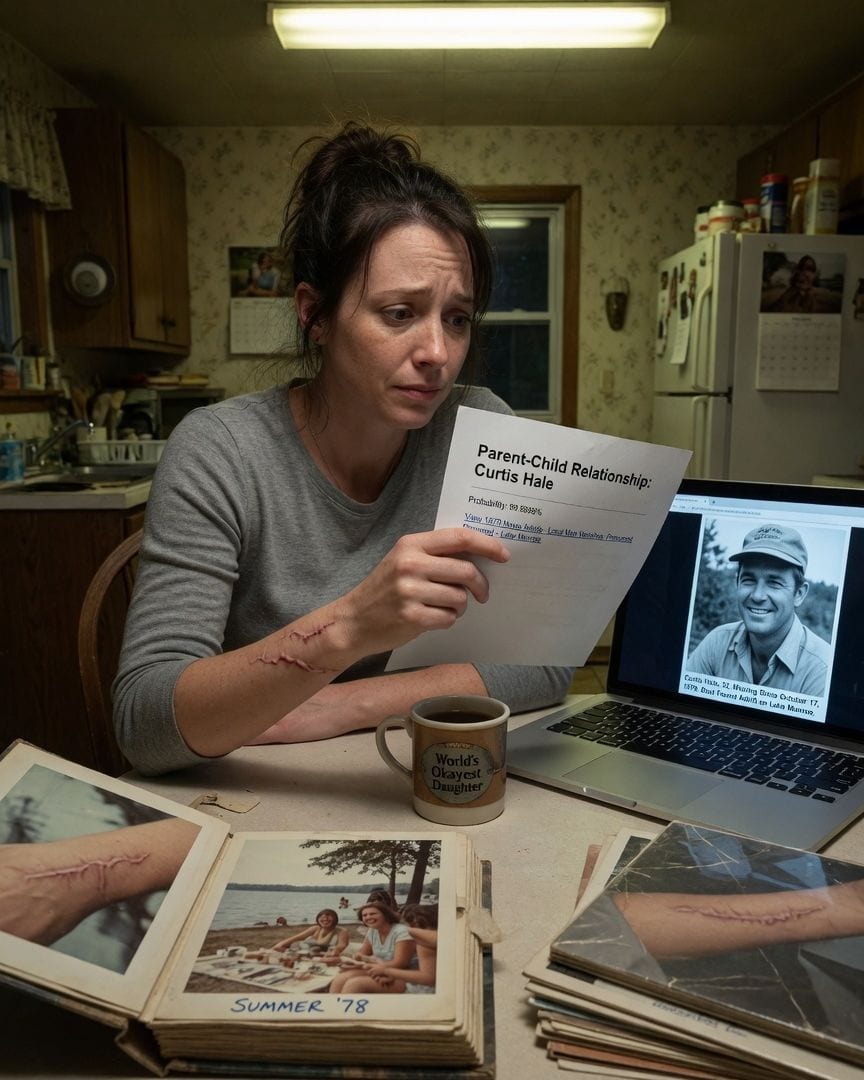
My DNA returned Curtis Hale as my father. He vanished in 1979. I was born twelve years later. The lab confirmed the match twice.
My DNA test results revealed something impossible: my biological father vanished in 1979, twelve years before my birth. My mother dismissed it as nonsense, but her reaction felt forced, leading me to old family photos. There, in a faded 1978 snapshot, I found my own distinctive childhood scar on the wrist of a stranger.
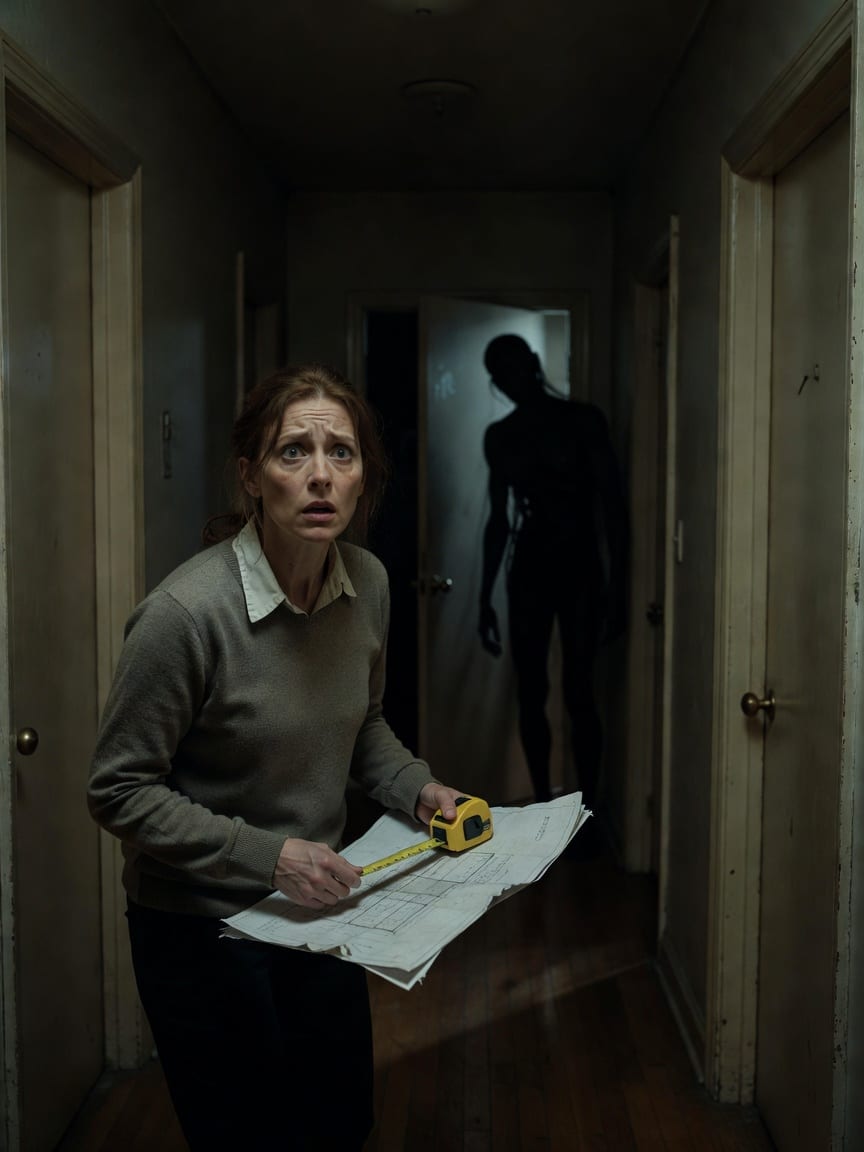
My front door has a dented gate and a dead hydrangea. I walked past it six times, trying to reach the corner shop just a hundred yards away. The pavement kept bringing me back to my own porch, and the shop's light never moved.
My morning started like any other, a quick walk to the corner shop from my home at Number 14, Elm Terrace. But after walking what felt like two minutes, I found myself back at my own front door, the shop no closer. I tried six times, faster and slower, but my street kept compressing, refusing to let me leave.
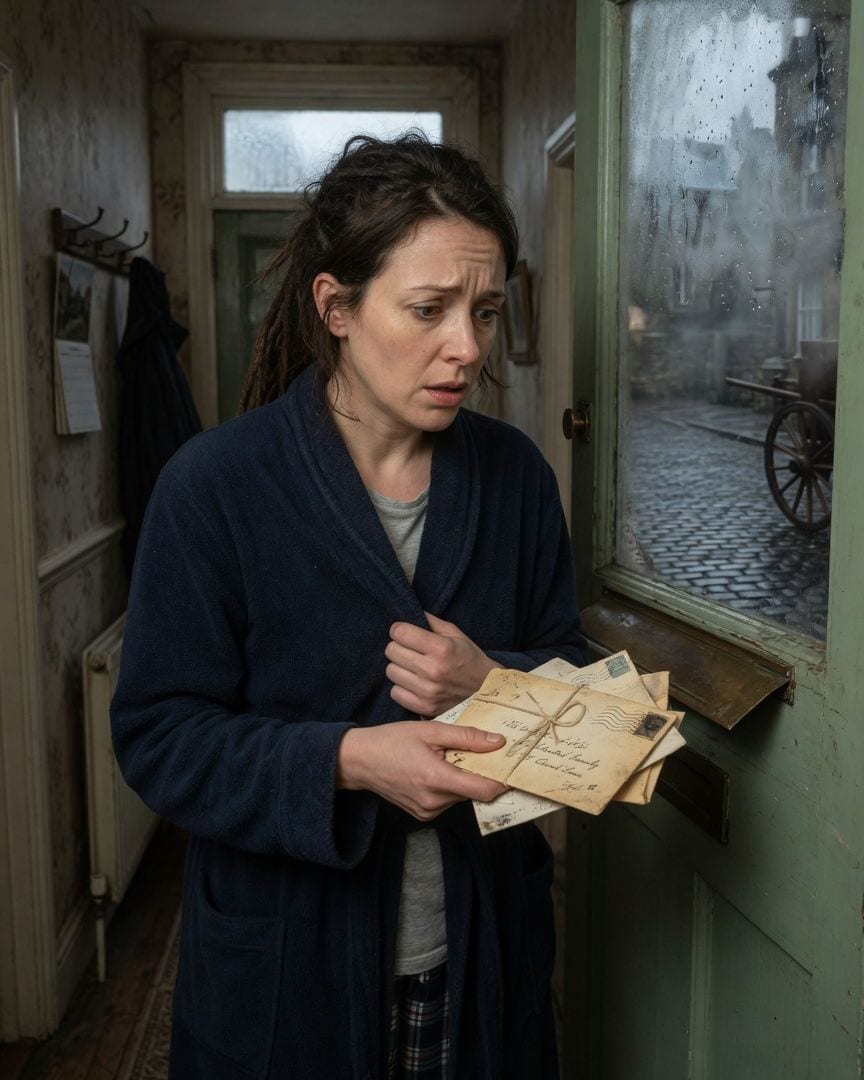
Seventy years ago, a hidden journal recorded my door opening to the wrong street and receiving Lockwood post.
I'd only recently moved into my inherited house, a quiet place on the edge of town. One grey morning, a distinct clatter from the front door's post flap caught my attention. Reaching down, I expected my gravel path, but instead, the flap showed a dark, cobbled street that wasn't mine. A bundle of warm, old letters, addressed to 'The Lockwood Family,' slid through, before the vision flickered and was gone.