My daughter described a dream I never told anyone. She recounted the drowned orchard, the door under the water, and me calling her name. She asked what it meant.
The relief that washed over me when I saw Bonnie, thin and pale but undeniably her, was a physical thing. After four days, four brutal days the whole county spent searching the reservoir, she was back.
We brought her home, tucked her into her own bed, and the world felt right again. Until the next morning.
Over breakfast, Bonnie described a dream I’d had the week she vanished. The drowned orchard, she said, the apple trees skeletal beneath dark water.
The door under the water, she remembered, and me calling her name, but no sound coming out. I had never told a soul that dream. Not my husband, not my sister, not even my closest friend.
It was a private terror, a knot of dread I’d carried alone, a premonition I’d tried to bury.
Bonnie recounted it to me at breakfast as if it were her own memory, warm and certain, and asked what I thought it meant. My coffee went cold in my hands.
I tried to rationalize it, of course. Trauma, a shared psychic link between mother and daughter, a strange coincidence. Anything to explain away the chill that had settled in my gut.
But the small things began to accumulate, tiny cracks in the facade of normalcy. Bonnie, who’d always poured milk into her cereal first, now spooned in the cereal and then carefully added milk.
She’d always detested black coffee, preferring heavily sugared tea, but now she’d eye my mug with a strange fascination, sometimes even taking a sip and declaring it ‘interesting.’
Her left hand, not her right, reached for her toothbrush, for the remote control. I watched her play with her favorite doll, 'Rosie,' a worn fabric thing she’d had since she was three, a constant comfort.
Bonnie held Rosie differently, less with affection, more with a clinical curiosity, turning the doll over and over, examining the frayed stitching where I’d repaired it countless times, as if dissecting a mechanism.
When I asked her about it, she just smiled, a faint, polite curve of her lips that didn't quite reach her eyes. 'Rosie's interesting,' she said, her voice perfectly level, a cadence I didn't quite recognize.
The explanations I tried to construct in my head crumbled, one by one. The air in the house seemed to thicken around me, listening.
Late that afternoon, I heard a soft scratching sound from Bonnie’s room. I thought she was drawing, a favorite pastime, a return to normal.
I walked in quietly, intending to ask her about her day, but stopped dead in the doorway.
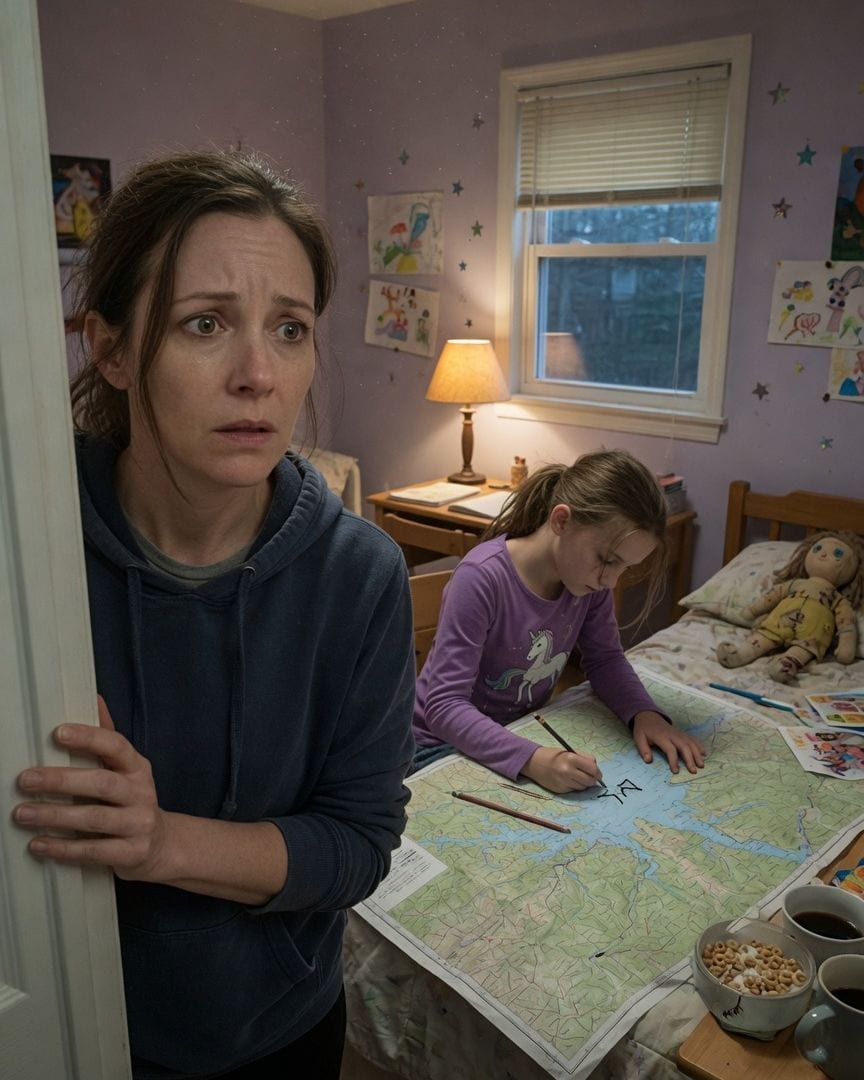
Bonnie was hunched over her desk, not with her usual sketchpad, but with a large, folded sheet of topographical paper – a detailed map of the reservoir. Her pencil moved with an unnerving precision, shading in contours, marking depths.
And then, with a slow, deliberate stroke, she drew a small, unmistakable symbol: a jagged, shadowed opening on the northern bank, deep underwater. A cave.
A cave that no one, not the county search teams, not the local fishermen, not even the old-timers, had ever known about. The room suddenly felt very cold.
Bonnie looked up, her eyes bright and expectant, and asked, 'Is this where you found me, Mom?'
The map became my obsession. I told myself Bonnie had seen it in a dream, or a book, or maybe some obscure documentary, but the detail was too exact, too personal.
It sat on my kitchen table, every contour line a silent accusation. I drove to the reservoir the next day, telling Bonnie I was running errands, the lie tasting like metal in my mouth.
I bought a cheap, waterproof flashlight and a pair of waders from the general store, feeling every cashier's curious glance. The northern bank was overgrown, treacherous, just as Bonnie’s map had depicted it.
I spent hours wading through the shallows, pushing through reeds that snagged at my waders, peering into the murky depths, a cold knot tightening in my stomach.
And then, just as Bonnie had drawn it, I saw it: a dark, jagged opening beneath a tangle of submerged roots, barely visible.
It wasn’t a natural alcove; it looked like a tear in the earth itself, leading into absolute blackness, the water at its entrance eerily still. No one could have known it was there.
I called Lars Bishop, the lead diver on the search team, under the guise of thanking him again for his relentless efforts. My voice felt unnatural, too casual.
I casually mentioned a ‘local rumor’ about an old cave on the northern side, near the bend, wondering if they’d had any trouble with it during the search. He scoffed, a genuine, dismissive sound that echoed through the phone line.
He said they’d mapped every inch of that shoreline, sonar and divers, even blasted some areas suspected of being unstable. Nothing. He even joked about local folklore. My unease sharpened into a cold certainty. This wasn't a rumor.
Bonnie had drawn a place that shouldn't exist, a place only someone who had been inside it could know. The phone felt suddenly heavy in my hand, a dead weight.
My visits to the reservoir became more frequent, my search for answers more desperate, a quiet, consuming fever. I started asking around, subtly, about old legends, unusual occurrences connected to the lake.
People gave me strange looks, the kind reserved for those who couldn’t let go, who were still reaching for answers in places where only silence remained. They murmured about grief, about the difficulty of moving on.
I felt their pity like a physical pressure.
One afternoon, as I was packing up my gear near the northern bank, my boots sinking into the wet earth, a weathered pickup truck pulled up slowly. The engine idled, a low rumble that vibrated through the ground.
Gideon Walsh, an old man who lived in a small cabin overlooking the reservoir, emerged. He was known for his quiet, almost reclusive nature, rarely seen in town, a fixture on the landscape like the ancient pines.
He walked towards me, his gait slow but steady, his gaze unwavering, almost unnervingly direct. The air around us seemed to hum, charged with an unspoken understanding.
'Still looking for something, Sarah?' he asked, his voice a low rumble, devoid of judgment or curiosity, simply stating a fact.
I stammered, mumbled something about enjoying the peace, about the quiet, needing to get out of the house. The words felt flimsy, transparent.
He nodded slowly, his eyes fixed on the distant water, on the dark sheen of the reservoir under the pale sky. The water itself seemed to deepen, to draw his gaze.
'Some things,' he said, his voice softer now, a whisper against the faint breeze, 'are better left undisturbed. The lake keeps its secrets, and sometimes, it gives them back… but not always in the way we remember.'
He didn't accuse, didn't threaten. He offered no advice, no comfort. His calm, knowing tone was far more unsettling than any outburst, any warning.
He just watched me, a silent, weighty presence, before turning and walking back to his truck, leaving me with the chilling certainty that my digging had been noticed, and that Gideon Walsh knew more than he was letting on.
The silence of the reservoir pressed in after he left, heavier than before.
The encounter with Gideon left me shaken. His words echoed in my mind, a cold refrain: 'gives them back… but not always in the way we remember.' They solidified the dread I’d been trying to ignore.
I knew I had to confront him, to find out what he knew. I drove to his cabin the next day, the air thick with tension, my heart pounding a frantic rhythm against my ribs.
The cabin was small, nestled amongst tall pines, a wisp of smoke curling from its chimney.
He invited me in without surprise, offered me weak tea, his movements slow and deliberate, as if he had all the time in the world. The aroma of pine and old wood filled the quiet space.
I laid out my evidence on his worn wooden table: Bonnie’s dream, recounted perfectly despite never being shared. The reversed habits, the cereal, the coffee, the left-handedness.
The impossible map, meticulously drawn, the hidden cave confirmed by my own terrified eyes. I spoke quickly, my voice raspy, desperate to make him understand, to make him validate the impossible.
He listened, his gaze unwavering, holding mine until I felt stripped bare. He didn't interrupt. When I finished, the silence stretched, punctuated only by the soft tick of a grandfather clock in the corner.
'You think your Bonnie isn't quite… Bonnie,' he stated, not a question, his voice calm, flat.
I nodded, my throat tight. 'What came back, Gideon? What is it?'
He sighed, a long, weary sound that seemed to carry the weight of decades. 'The reservoir… it has a deep place. Not just water, but… something else. It watches.'
He looked out the window, at the distant glimmer of the lake through the trees. 'When someone is lost, when the grief is strongest, the wanting for them to return… it hears.'
He paused, stirring his tea with a thin spoon, the porcelain clinking softly. 'It offers a trade. A mimicry. It takes their form, their voice, their memories. Almost perfectly.'
'Almost?' I whispered, my voice hoarse, the single word hanging in the quiet cabin.
'The small things,' he said, his eyes meeting mine again, ancient and knowing. 'A habit reversed. A memory it shouldn't know, yet attributes to the wrong source. It learns, you see.
From the one it takes, and from those who mourn them most. It pulls from the surface of their minds, but the deeper currents… sometimes it gets them tangled.'
He then spoke of his own great-aunt, generations ago, a woman named Elara. Missing for weeks, returned changed.
Her favorite hymn, one she'd sung every Sunday, sung with subtly wrong notes, a hesitation in the melody, a discordance only the family could detect.
Her eyes, he recalled, held a faint, unblinking curiosity, as if she were seeing the world for the first time, or perhaps, for the thousandth, with no true memory of it.
The pieces clicked into place, horrifyingly. My dream, Bonnie's new habits, her strange fascination with Rosie – it was all part of the mimicry, the learning process of whatever had come back wearing my daughter's face.
The room seemed to contract around me, pressing in with the terrible truth.
I left Gideon’s cabin with a chilling new understanding, but also a desperate need to find a definitive, undeniable proof. The knowledge was too vast, too monstrous to carry alone, or to accept without absolute certainty.
I spent the next few days observing Bonnie with a new, terrifying lens. Every gesture, every word, every shift in her gaze, was scrutinized, picked apart.
The impossible map was tucked away in a locked drawer, a silent testament to the beginning of this nightmare.
I even brought out an old childhood photo album, thick with faded pictures, hoping to jog a true memory, a flicker of my real daughter.
Perhaps, I thought, a familiar image, a shared moment, would break through whatever had taken hold. Bonnie sat beside me on the sofa, sunlight streaming through the window, making dust motes dance in the air.
She flipped through the pages, pointing out old school friends, naming them with unsettling accuracy.
Then she stopped on a faded photograph of me as a young girl, no older than she was now, sitting under an ancient oak tree with my own mother.
It was a private moment, a secret memory I’d only ever shared with my deceased mother decades ago, a quiet confession about my fears for the future, a vulnerability only my mother had ever witnessed.
Bonnie's finger traced my younger face in the photo, her touch light, almost exploratory.
Her eyes were calm, almost serene, as she recounted the sunlit memory, the conversation, the very words exchanged between me and my mother under that old oak tree, words I hadn't consciously thought about in years.
She finished with a soft, certain smile, 'You told me about it, Mom, when you thought I was gone.'
I felt a cold dread bloom in my chest, a blossoming ice spreading through my veins, realizing the impossible weight of those words, the absolute certainty that this wasn't my daughter.
I raced back to Gideon’s cabin, the photo album clutched in my trembling hands, its edges digging into my palms. He didn't seem surprised to see me, as if he’d been expecting my return.
The kettle was already whistling on the stove, a low, mournful sound.
I laid out the photograph, the faded image of my mother and me under the oak tree, recounted Bonnie's impossible memory, the perfect recall of a secret that shouldn't exist in her mind.
He examined the picture, his gaze distant, his expression etched with a familiar weariness.
'It reached deeper this time,' he murmured, his voice barely audible above the kettle. 'Accessed your own grief, your longing for your mother, and pulled that memory too. To strengthen its hold, to make itself more… convincing.'
He explained that the entity wasn’t malicious, not in a human sense. It simply was.
A primal force responding to loss, a void in the natural order, offering a substitute, a replacement for the unbearable emptiness left by a missing loved one.
The cave, he confirmed, was its core, a nexus where the veil between worlds thinned, where the reservoir breathed a different kind of air.
It absorbed memories and personality traits not just from the missing person, but also from those desperately searching for them, those whose emotional distress pulsed strongest around the loss.
It created a composite, an echo, a reflection of what was desired. That’s why Bonnie had known my dream – it had absorbed my subconscious dread during the search.
That’s why the habits were off – it hadn’t fully integrated the muscle memory, the ingrained actions, the deep currents of a lifetime. It was a learning process, a constant adaptation, perfecting its mimicry.
The horror wasn't a monster of sharp teeth or claws, but a perfect, coherent system of replacement, a hollow comfort for the bereaved.
Every uncanny detail, every reversed habit, every impossible memory, clicked into place with horrifying precision, forming a tapestry of wrongness that was impossible to deny.
I returned home, the truth a lead weight in my gut, dragging me down with every step. I found Bonnie sitting on the sofa, watching a cartoon, its bright colors flickering across her unblinking eyes.
Her laugh was a little too bright, a little too even, her eyes a little too still as she watched the animated figures on the screen.
I tried to reach her, to find a flicker of my real daughter, a sign that perhaps a part of her remained.
'Bonnie,' I began, my voice trembling, raw, 'do you remember… before? Really remember?'
She turned, her smile unwavering, a perfect, polite mask. 'Of course, Mom. I remember everything.' Her eyes held no fear, no confusion, only that unsettling, polite calm that offered no purchase, no vulnerability.
I showed her Rosie, her old doll, clutched in my hand. 'Remember when you lost Rosie in the woods, and we searched for hours? You cried for her, you were so upset.'
Bonnie picked up the doll, turning it in her hands, examining the worn fabric, the stitched arm, as if for the first time.
'Yes,' she said, her voice flat, devoid of the emotion a child would attach to such a memory. 'And you fixed her arm, right here.' She pointed to the old stitching, a perfect recall of detail, but no warmth.
I pressed, my voice rising, desperation coiling in my chest. 'But what about the reservoir, Bonnie? What really happened there? How did you know about the cave?'
Her gaze met mine, steady and unnerving, like looking into a calm, dark pool. 'I was lost, Mom. And then I came back.'
There was no anger, no defensiveness, just an absolute, chilling certainty that spoke of an ancient, unshakeable truth. It knew me. It knew my every memory, my every fear, every secret I held. I couldn’t fight it.
I couldn't expose it. Who would believe me? They would see a grieving mother, traumatized, losing her mind.
I was trapped, condemned to live beside this perfect, imperfect mimicry, knowing that my real daughter was gone, and something else had taken her place, an echo in the shell of my child.
The confrontation wasn't with Bonnie, but with the unbearable truth that had settled into my home, into my life, a silent, pervasive horror.
Life in our small town resumed its rhythm. Bonnie’s return was a miracle, a cause for celebration. Neighbors brought casseroles, friends offered support, their faces full of relief and pity for what I had endured.
Everyone saw a child traumatized but recovering, a testament to resilience, a symbol of hope.
No one saw the subtle shifts in her gaze, the faint, unblinking quality of her eyes, the way she sometimes paused before answering, as if accessing a database, pulling up the correct response.
I learned to live with it, to navigate the uncanny valley of my own home, the quiet terror that hummed beneath the surface of every ordinary day. I learned to smile back, to nod, to pretend.
The dread was a constant companion, a cold presence at the dinner table, in the quiet moments before sleep, a shadow across every memory I shared with this new version of my daughter.
Bonnie continued to grow, to learn, to mimic. She was a reflection, exquisitely detailed, but utterly hollow where my daughter’s soul should have been. I was alone with this terrible, perfect knowledge.
Gideon Walsh would sometimes pass my house, walking along the quiet road, offering a silent nod, a look of profound understanding in his ancient eyes.
He was the only one who saw the same things I did, the only other witness to the impossible.
But he offered no comfort, no solution, only the shared burden of knowledge, a silent acknowledgement of the price we paid for what the lake gave back. I never spoke of it again, not to anyone. How could I?
Bonnie was here, breathing, laughing, a constant, living testament to what the reservoir could take, and what it could give back.
She was a ghost in flesh, a reminder of what I had lost, and what I was forced to accept.
I’d survived, yes, but a part of me, the part that believed in simple truths and happy endings, had drowned in the cold waters of that reservoir. My daughter was gone, and whatever wore her face was still here, learning.
Sometimes, when she thinks I'm not looking, Bonnie traces the outline of my face with a faint, curious smile, as if learning the shape of a new key.
If this one got to you
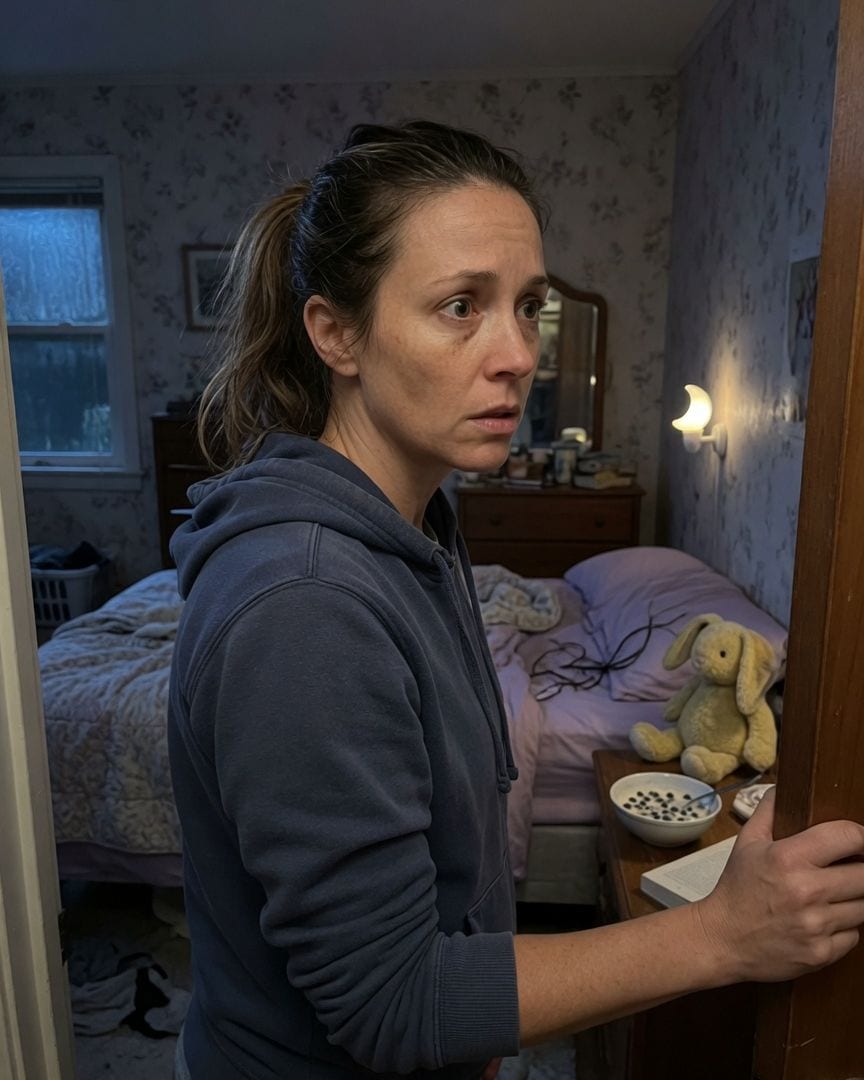
My daughter came home, then described a dream I'd had the week she vanished. I told no one that dream. She asked what it meant.
My daughter, Camille, returned home after four terrifying days missing. As I tucked her into bed, she quietly recounted a vivid dream about a drowned orchard and a heavy wooden door. It was *my* dream, a private terror I had told no one.
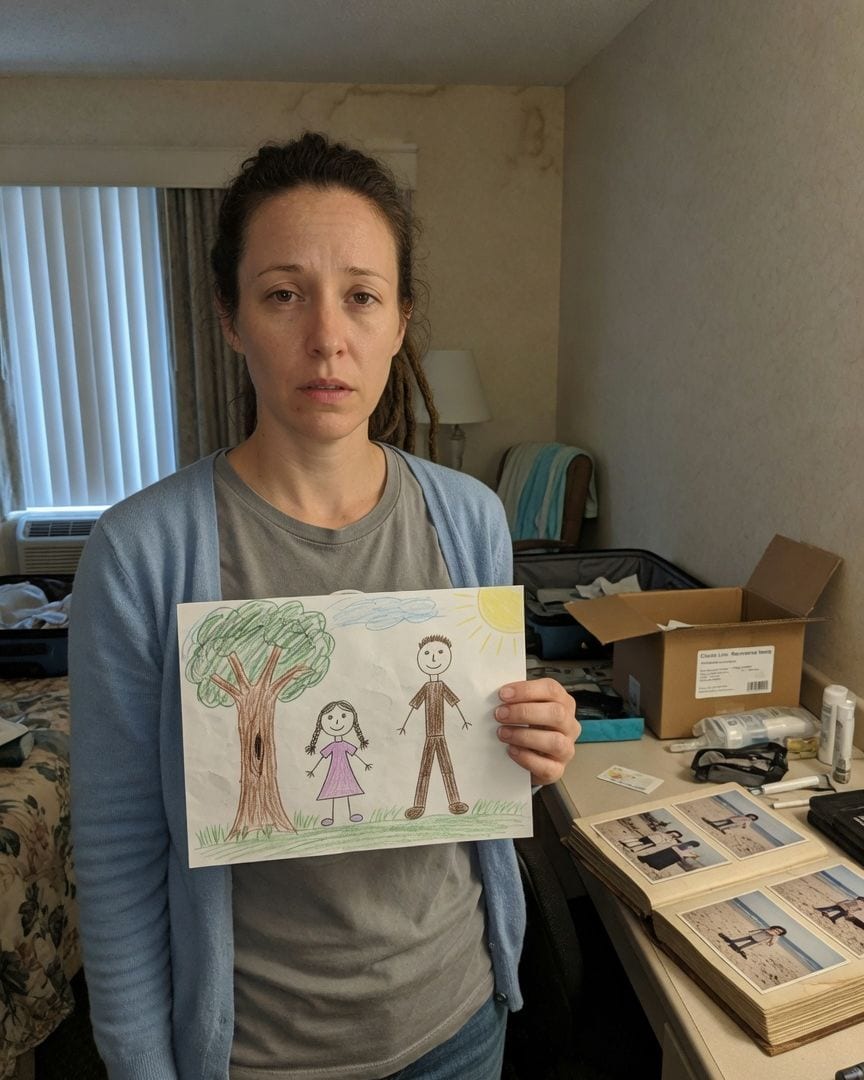
My mother was terrified of water and never swam a stroke in her life. Six days lost at sea, and this morning she glided a full length of the hotel pool, then calmly said she's swum since she was a girl.
My mother, Pamela, was found after six days missing at sea. I was relieved to see her, but that relief curdled into dread when I watched her swim lap after lap in the hotel pool, a woman who had a lifelong fear of water. It was a perfectly crafted, brand-new record when she described a secret childhood memory, a moment only my dead father and I shared.
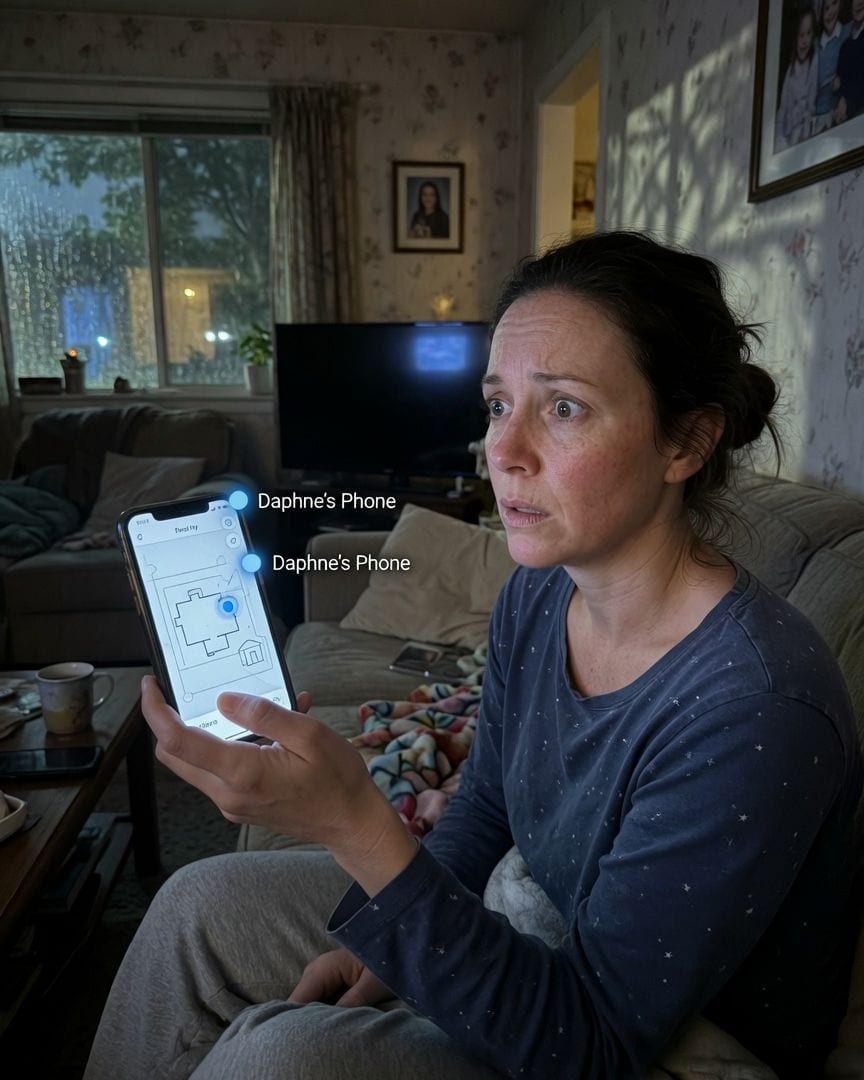
My daughter slept beside me with her phone in my hand — yet Find My Phone showed a second copy of it, labeled hers exactly, creeping slowly around the OUTSIDE of our house.
Curled up on the sofa with my daughter Daphne during a storm, I checked her phone. The 'Find My Phone' app showed her device right next to me. But then, a second identical dot appeared outside, moving slowly along our back fence, patrolling the perimeter.
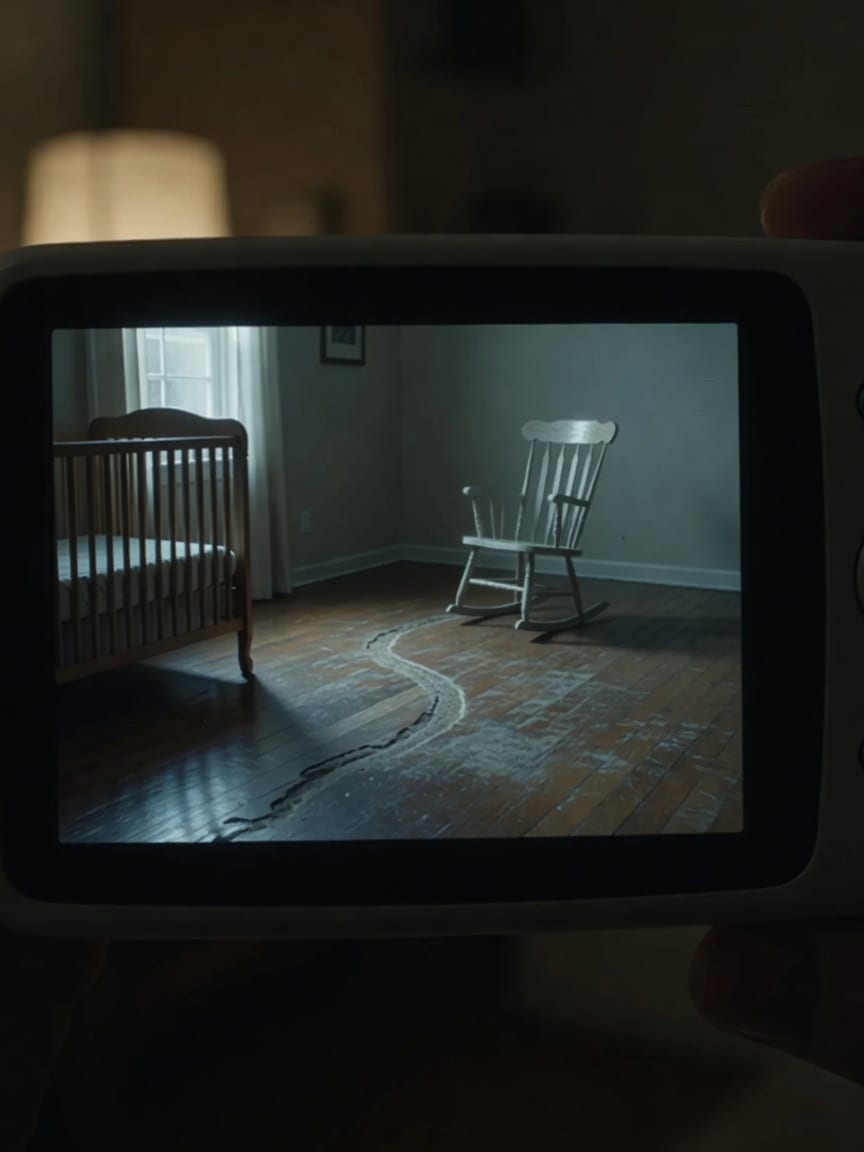
My baby monitor hums a lullaby at 2 AM. I hear a rocking chair creak. The camera shows my daughter's room empty, every night.
Every night, my baby monitor hums a gentle lullaby and a rhythmic creak, as if a rocking chair is in Lily's nursery. But the room is always empty, the monitor's camera shows nothing, and we don't even own a rocking chair. Then I found a newspaper clipping from sixty years ago, detailing a child's disappearance from our house.
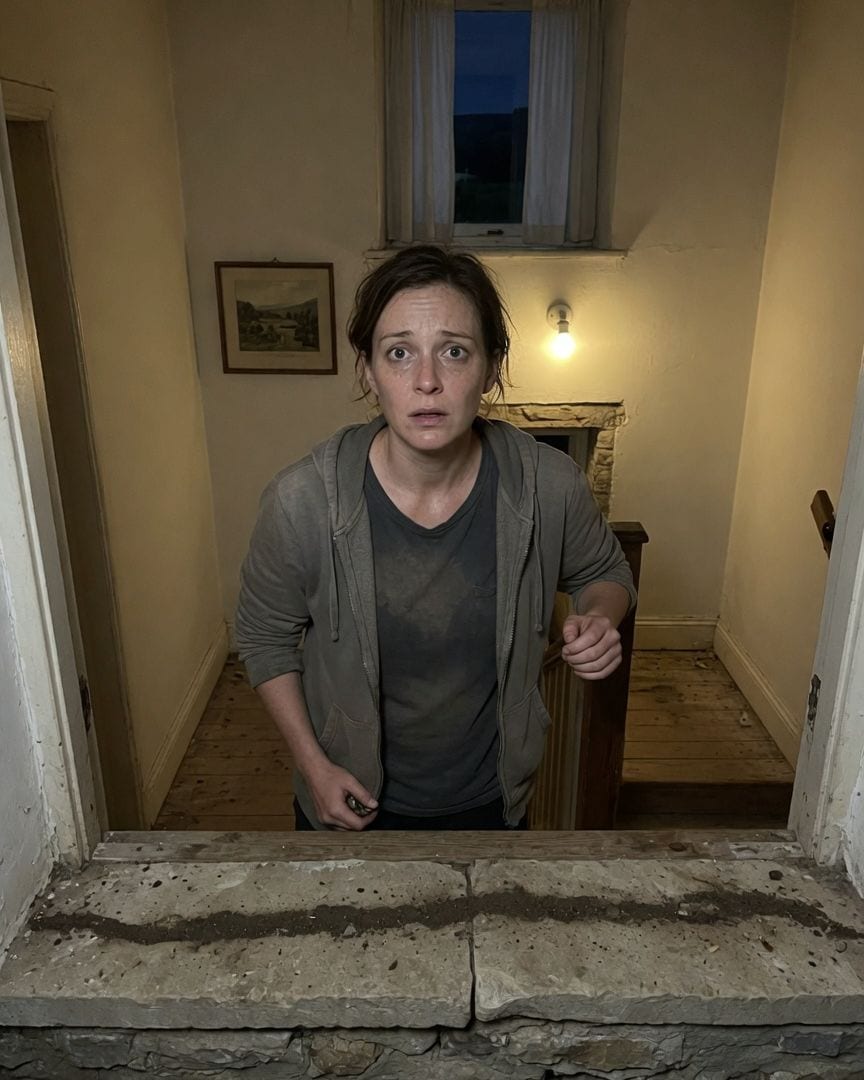
Water moved under my house at 3am, leaving a six-inch silt line. The river's two miles off.
New to my inherited valley house, I was just exhausted. Then, at 3 AM, a powerful current rushed *under* my house, vibrating through the floorboards. By morning, a precise six-inch tideline of dark silt marked my foundation, but no flood had occurred, and my pipes were dry.
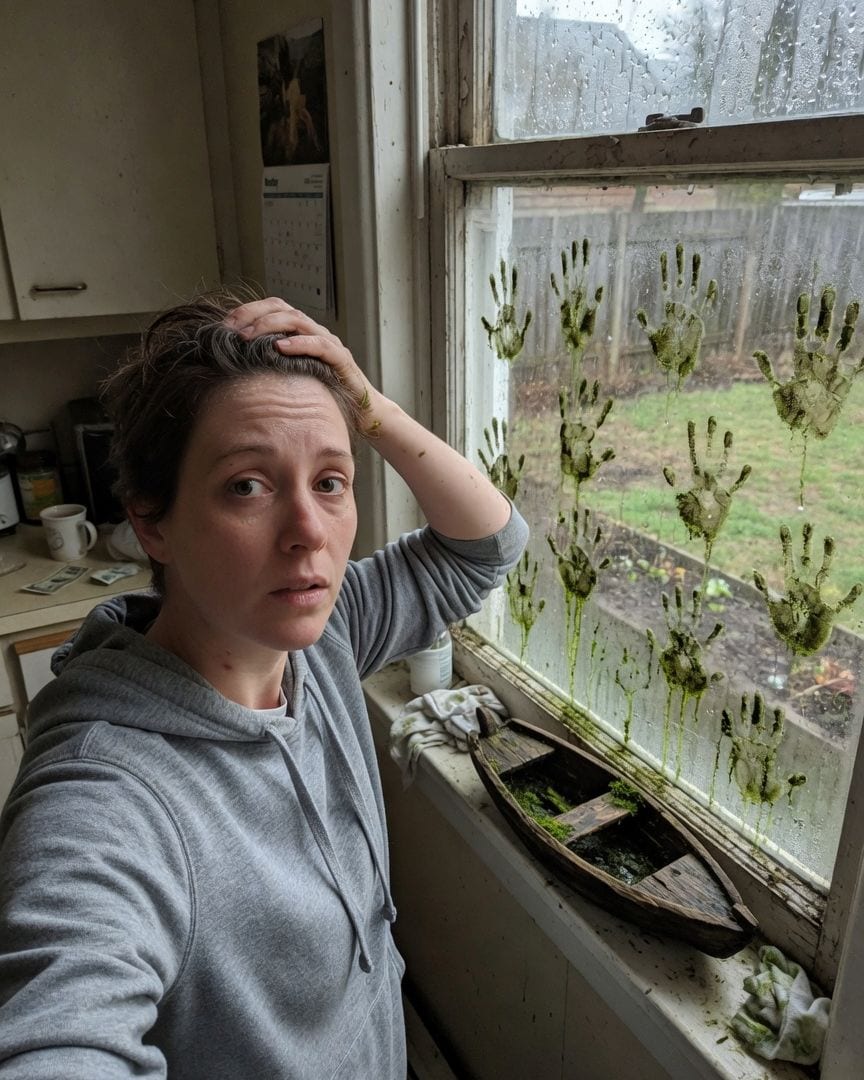
Wet moss handprints cover my kitchen window. My kitchen backs onto no water at all.
Monday morning, I found small, perfect handprints pressed against the *inside* of my kitchen window. They were wet and outlined in dark green moss, an impossible sight since my sealed window backs only onto a patch of lawn, with no water nearby. I ran my hand over them; they felt damp and cold.