My dead father's smartwatch recorded his heart racing, like a man running hard, for eleven minutes at 4 AM three days after he passed. Then it went flat for good.
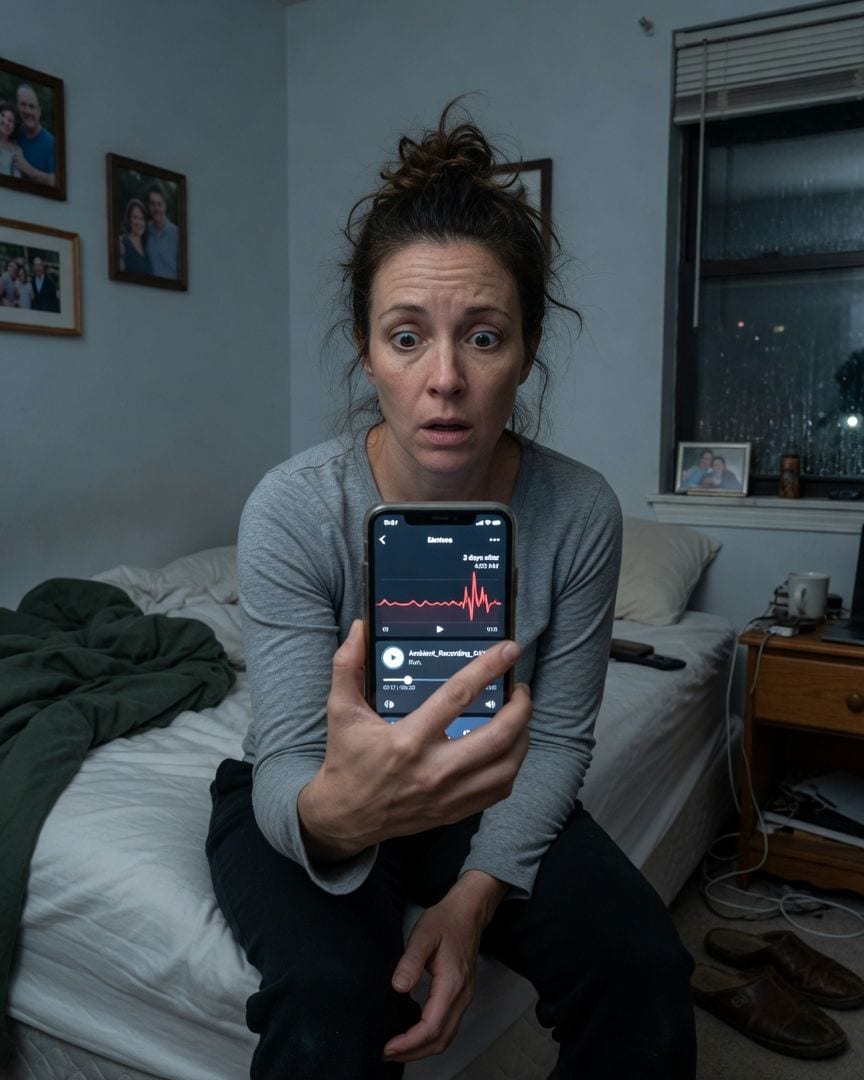
The silence in my apartment since my father, Richard, passed a week ago was a physical thing, a heavy blanket muffling the city noise. He’d gone peacefully in his sleep, the doctors said, a quiet end to a quiet life.
My current task was anything but peaceful: sifting through his digital footprint, a morbid inventory of a life suddenly cut short. Old emails, photo albums, banking apps.
The last item on the list was his smartwatch, a practical gift I’d given him last Christmas. It had sat on his bedside table, forgotten, until its battery finally gave out.
When I plugged it in and it synced its last data dump to my phone, most of it was exactly what I expected.
The usual sleep patterns, the steady step counts, and then, a precise flatline on the heart rate graph, marking the exact moment of his death.
I scrolled through the weeks leading up to it, a strange comfort in seeing the rhythmic pulse of his last days.
But then, the data continued. Three nights after he died, at precisely 4:00 AM, the line on the heart rate graph twitched. My breath hitched.
For eleven minutes, it climbed, fast, a jagged, frantic peak that pulsed with an impossible energy. It was the unmistakable pattern of a man running hard, pushing his heart to its limits, spiking and dipping with exertion.
Then, as abruptly as it began, it went flat again, this time for good, a final, definitive stillness.
I stared at the screen, my thumb tracing the impossible peaks. My father. Dead for three days. His heart, somehow, had been running.
I tried to rationalize it, desperately. A software glitch. A phantom signal from a dying battery, perhaps creating an electrical anomaly. A final, inexplicable surge of residual charge.
I unpaired the watch from my phone, deleted the tracking app, then re-installed it, hoping the fresh sync would clear the phantom data. It didn’t.
The graph remained, stubbornly immutable, the frantic peaks at 4 AM glaring back at me from the past.
I cross-referenced it with the step count for those eleven minutes. Zero. Not a single step. Just a heart rate accelerating to a frantic, unsustainable pace. My mind spun, trying to force the impossible into some logical framework.
His body was in the ground, six feet under the earth. How could his heart still beat, let alone race like that? The cold dread started to set in, a creeping unease that had nothing to do with grief.
Then, a new icon appeared in the synced files, a small audio recording symbol I hadn't noticed before, buried deep in the metadata, nestled between sleep data and GPS logs from forgotten walks.
Richard never used the voice memo function on his watch. He always said it was an unnecessary complication.
My fingers trembled slightly as I tapped it. The file was short, barely thirty seconds, labeled only 'Ambient_Recording_0400'.
It was mostly static at first, the soft rustle of fabric, maybe his bedsheets, then a faint, rhythmic thumping, like something impacting the ground, muffled and distant.
And then, clearer than anything else, a raspy, guttural whisper, undeniably not my father's voice, barely audible above the thumping.
It said one word.
I leaned closer to the phone, replaying the segment, the tiny speakers struggling against the static. The word was 'Run.'
My blood ran cold, a sudden, icy shock.
I replayed the audio file again, my finger hovering over the screen, needing to hear it one more time, to prove my ears wrong, to convince myself it was just static shaping itself into a phantom word.
The static, the soft, rhythmic thumping, and then the unmistakable whisper, guttural and raw: 'Run.'
It was impossible. My father was gone, buried. There was no one else in the room with him when he died. Who spoke that word? And why?
I dropped the phone on my bed, the screen still showing the waveform of the impossible sound, my own reflection staring back, wide-eyed and terrified.
The familiar silence of my apartment suddenly felt vast, cold, and utterly empty, as if something unseen had just been invited in.
Driven by a chilling curiosity that overrode my grief, I started digging deeper. I couldn’t let it go. The ‘Run’ recording, the impossible heart rate – they had carved a hole in my world, demanding an explanation.
I scoured my father's laptop browser history, his digital photo albums, his call logs, anything that might offer a clue.
His recent activity was filled with late-night searches for obscure local history, old town maps, and a specific, recurring keyword: 'The Path of the Burden.'
This led me, eventually, to a dusty, leather-bound local history book. I found it in a musty second-hand store on the edge of Whitmore, the town where my father had lived his whole life.
It was titled 'Whispers of Whitmore,' its pages brittle with age, smelling faintly of mildew and forgotten things.
It was full of local folklore, mostly innocuous tales of old houses and forgotten industries, but a few faded, almost poetic entries stood out. They mentioned an ancient, hidden 'path' that only 'reveals itself to the burdened.'
It spoke of 'runners' who carried something unseen, compelled to move at night, often just before dawn.
The accounts were vague, almost allegorical, wrapped in flowery language that made them sound like fables, but the underlying dread, the compulsion to 'run,' echoed the specific fear I felt.
I also found a series of frequent calls in his phone log between my father and Isaac Hayes, an old family friend, from the days leading up to his death.
Isaac was a quiet, scholarly man, a retired librarian who always seemed to know a little too much about the town's forgotten corners and whispered histories.
He was the kind of man who’d offer you a cup of weak tea and then tell you the detailed lineage of the tea leaves back to colonial smugglers. If anyone could connect these disparate threads, it was Isaac.
I decided I had to visit Isaac Hayes. He lived in a small, cluttered house on the edge of town, surrounded by towering stacks of books that threatened to avalanche at any moment.
The air was thick with the scent of old paper and dust, a quiet sanctuary from the world. When I finally worked up the courage to bring up my father's smartwatch and the strange data, Isaac's calm demeanor didn't waver.
He simply took a slow sip of his tea, his eyes, behind thick glasses, seeming to sharpen, to hold a deeper, unsettling knowledge I hadn't noticed before.
He listened patiently as I described the impossible heart rate data, the hidden audio file, the whispered 'Run.' I watched him carefully, searching for a flicker of surprise, a hint of concern. Nothing.
'A glitch, perhaps, Cecilia,' he suggested, his voice low and even, as if discussing the weather. But his tone was too controlled, too rehearsed, almost as if he’d anticipated this conversation.
As I pressed him about 'The Path of the Burden' from the old book, the vague tales of night runners, Isaac merely smiled faintly. 'Old stories, Cecilia. Superstition, nothing more. Whitmore has its share of them.'
He led me to the door after a polite refusal to engage further, his hand resting on the frame.
'Your father was a man of immense curiosity,' Isaac said, his voice soft, almost a murmur, his gaze distant, fixed on something beyond me. 'Sometimes, curiosity leads one down strange paths. Be careful, Cecilia. Some things are best left alone.'
Later that night, back in my apartment, a cold prickling sensation crawled up my spine. I’d left the smartwatch in a drawer, unpaired from my phone, supposedly off, its battery drained.
Yet, as I reviewed the data on my phone one last time, a newly synced file appeared. It was another ambient audio recording, timestamped to the very hour I had been at Isaac’s house. I tapped it, my heart hammering.
It recorded my entire conversation with Isaac, clear as day. The device had been off. It shouldn't have recorded anything. The air in my apartment felt heavy, the silence oppressive. Someone, or something, was listening.
My hands shaking, I clutched my phone, the new recording of Isaac’s conversation an undeniable, impossible proof. I called him again, needing an explanation for this.
He answered on the first ring, his voice still unnervingly calm, as if he had been expecting the call, expecting me. 'The device isn't merely a tracker, Cecilia,' he stated, no denial, no surprise. His composure was almost inhuman. 'It's...
a conduit. It records what it's meant to record, not always what you intend.'
He explained, in a measured, dispassionate tone that made my blood run cold, that 'The Path' was indeed real.
It wasn't a physical road, he clarified, but a temporal or spiritual corridor that manifested to certain individuals who stumbled upon its secrets.
'The Burden,' he revealed, was a collective memory, a profound grief, or an unresolved injustice from the town's past that needed to be 'carried' or 'run' through this path to dissipate. The truth unfurled, horrifyingly logical.
'Your father,' Isaac said, his gaze unwavering, as if reciting from a forgotten textbook, 'was looking into the disappearance of a young boy decades ago, a case that was quietly swept under the rug by the town elders.
He found the path. And the path, in turn, found him.'
The 'Run' instruction, Isaac clarified, was the initiation, the compulsion. The heart rate surge wasn't a glitch; it was her father, running the path, compelled by the voice, carrying a burden he hadn't known existed until it claimed him.
All the scattered clues clicked into place with sickening precision: the old book's vague tales, her father's late-night research, Isaac's knowing silence, the impossible recordings that seemed to defy every law of physics.
It all fit into a horrifying, coherent pattern, far beyond mere folklore or superstition. It was a dark, living truth, laid bare with chilling composure.
I felt the crushing weight of this impossible truth settling on me. My father wasn't just investigating; he had become an unwilling participant, a 'runner.'
The smartwatch, my only link to him, now felt like a cursed object, a beacon for something ancient and hungry. My apartment, once a sanctuary, felt like a cage.
My mind reeled, a vortex of dread and frantic questions. I returned home, needing to do something, anything, to regain control.
I decided to try one last, desperate attempt to recover any corrupted or hidden files from the smartwatch data dump, hoping to find some anomaly, some flaw in Isaac’s chilling explanation.
After hours of running recovery software, sifting through lines of code I barely understood, a new audio segment appeared, fragmented and distorted, labelled 'Corrupted_Ambient_0400.'
I cleaned it up, filtering out the static and digital noise, my breath held tight in my chest.
The same raspy voice from my father's recording emerged, clearer now, laced with the distinct sounds of heavy, rhythmic footsteps, like someone running, very close by. And then, from the distorted sounds, the voice distinctly repeated my own name, 'Cecilia.'
Not my father’s name, but mine. Twice. Thrice.
The footsteps grew louder, closer, echoing not from the recording, but from somewhere inside my own apartment, a cold, unseen presence moving in the shadows, drawing nearer, step by heavy step.
I stood frozen in my living room, the recovered audio segment playing on a loop from my phone, my name repeating in that raspy voice, the heavy footsteps thudding in the background. I forced myself to move, to call Isaac.
He answered on the first ring, his voice still unnervingly calm, as if he had been expecting me to call at this exact moment.
'It has found you, Cecilia,' he stated, no surprise in his tone, no empathy. Just a flat, pronouncement of fact. 'The Path requires a runner. Your father carried the burden, but now he is gone.
The device, the conduit, seeks its next.' He explained that the original 'burden' was tied to a specific family in town, and when Richard started investigating that old disappearance, the path opened to him.
The smartwatch wasn't just a recorder; it was a 'marker,' a beacon for the entity that compelled the runners. It syncs to the closest, most suitable host, and now, it was me.
The heart rate, the voice, the strange recordings – they were all part of the path's claim.
Isaac revealed that his own family, the Hayes, were the ones who first discovered the path generations ago, and they've been observers, sometimes even reluctant facilitators, ever since, ensuring the 'burden' is always carried.
It was an ancient, self-perpetuating mechanism, and now I was its target, marked by my own name.
Clutching my phone so tightly my knuckles ached, I demanded to know what I could do, how I could stop it. Isaac's calm reply was the worst part, a chilling pronouncement of my fate. 'You run, Cecilia.
Or it takes you, piece by piece, until there's nothing left but a husk for the path to animate.'
He explained that the path manifested at 4 AM, the exact time of Richard's 'run,' and I had mere minutes until the next cycle.
The footsteps in my apartment grew louder, more distinct, circling me in the gloom, their rhythm mirroring the impossible data from the smartwatch. I could feel a cold pressure building in my chest, an irresistible urge to move, to flee.
Isaac's voice, still steady, continued. 'It's not a punishment, Cecilia. It's a task. You carry the burden, and for a time, you are safe. But you must run. You must.'
I looked around my apartment, the familiar walls now feeling like the inside of a trap.
The air was thick with a preternatural cold, and a faint, raspy whisper seemed to emanate from the walls themselves, a chorus of 'Run, Cecilia, run.'
My heart, suddenly, began to race, mirroring the impossible pattern on my father's smartwatch graph. It wasn't entirely fear, though terror was certainly there. It was a primal, overwhelming compulsion, a strange energy surging through my limbs, demanding movement.
I had to run. I dropped my phone, the screen still showing the waveform of my name, and moved towards the door, my own footsteps now echoing the ones in the recording, falling into a frantic, rhythmic pace.
Weeks turned into months. Isaac Hayes continued his quiet life, surrounded by books, occasionally answering calls from concerned friends of Cecilia's with placid assurances.
He rarely left his house, but sometimes, late at night, he would look out his window towards the distant town, a faint, almost imperceptible smile playing on his lips. The path never truly closed.
If this one got to you
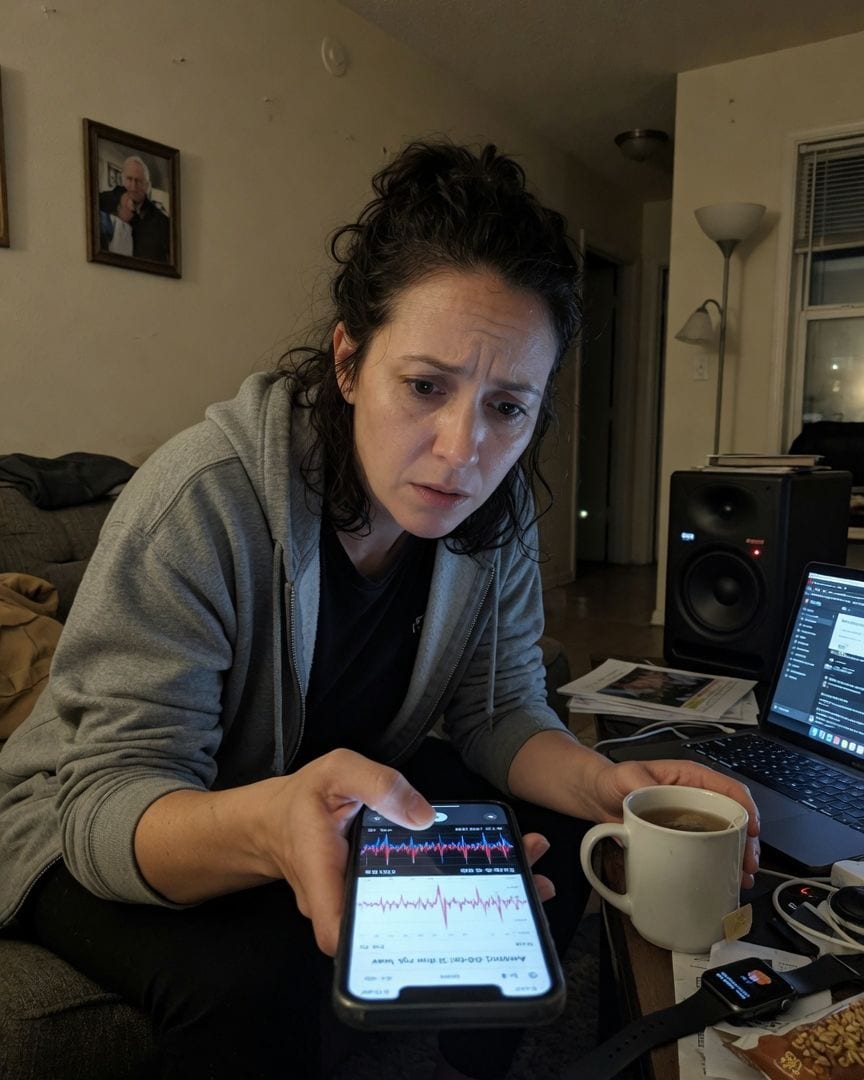
My dead father's smartwatch heart-rate graph climbs again, fast, running hard, three days after he died.
My apartment felt too quiet after my father passed away. Three days later, I found his smartwatch had recorded a violent heart-rate spike, lasting eleven minutes, at 4 AM. He was sixty, not a runner, and dead.
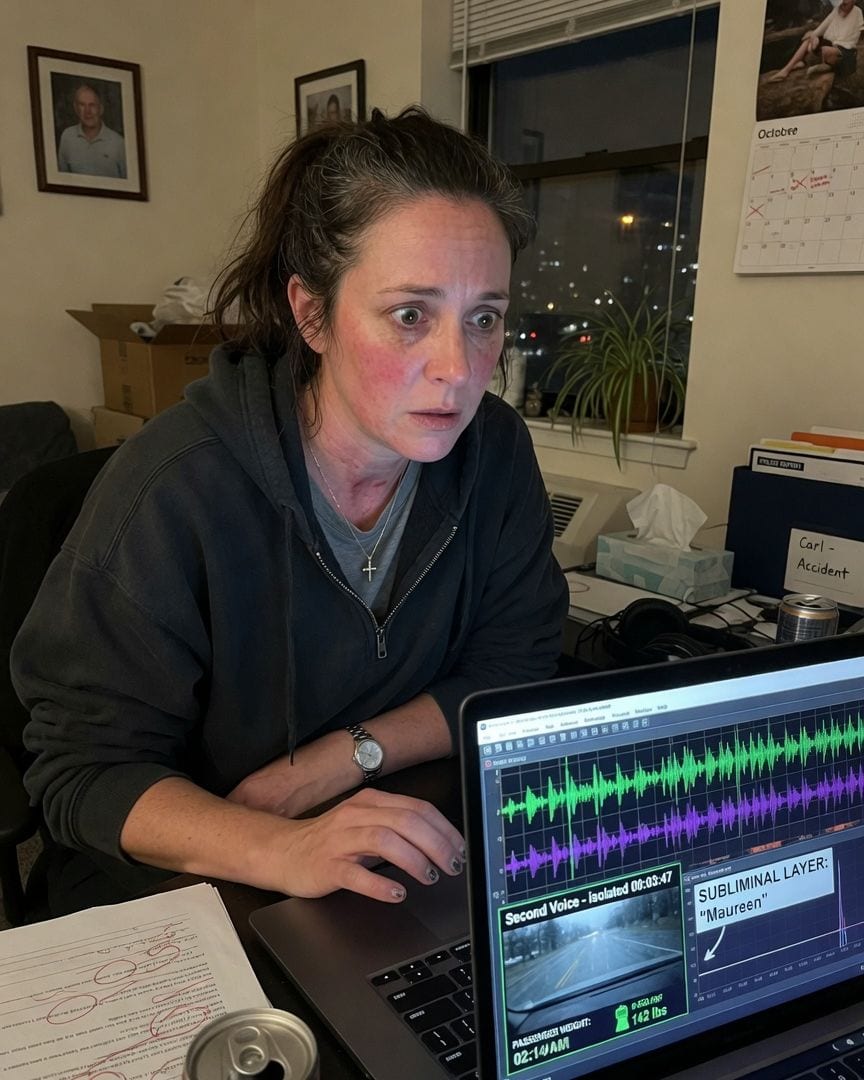
My father's dashcam recorded a soft, familiar voice from the passenger seat. The weight sensor logged someone, and he answered it by name.
Sifting through my dead father Carl's dashcam footage, I expected only the quiet hum of the road. But from the empty passenger seat, a soft voice spoke to him. When I isolated the audio, the voice whispered my own name.

My father takes his coffee black now. He put three sugars in it every morning of my life. He looks at the sugar bowl like it's from another man's house.
My father, Gideon Bishop, came back after eighteen months lost at sea. His return felt like a miracle, until the first morning coffee. He always took three sugars, but his gaze fell on the sugar bowl as if it were a relic from another man's house, then he drank it black. A cold certainty began to form: this simple, small thing was profoundly wrong.
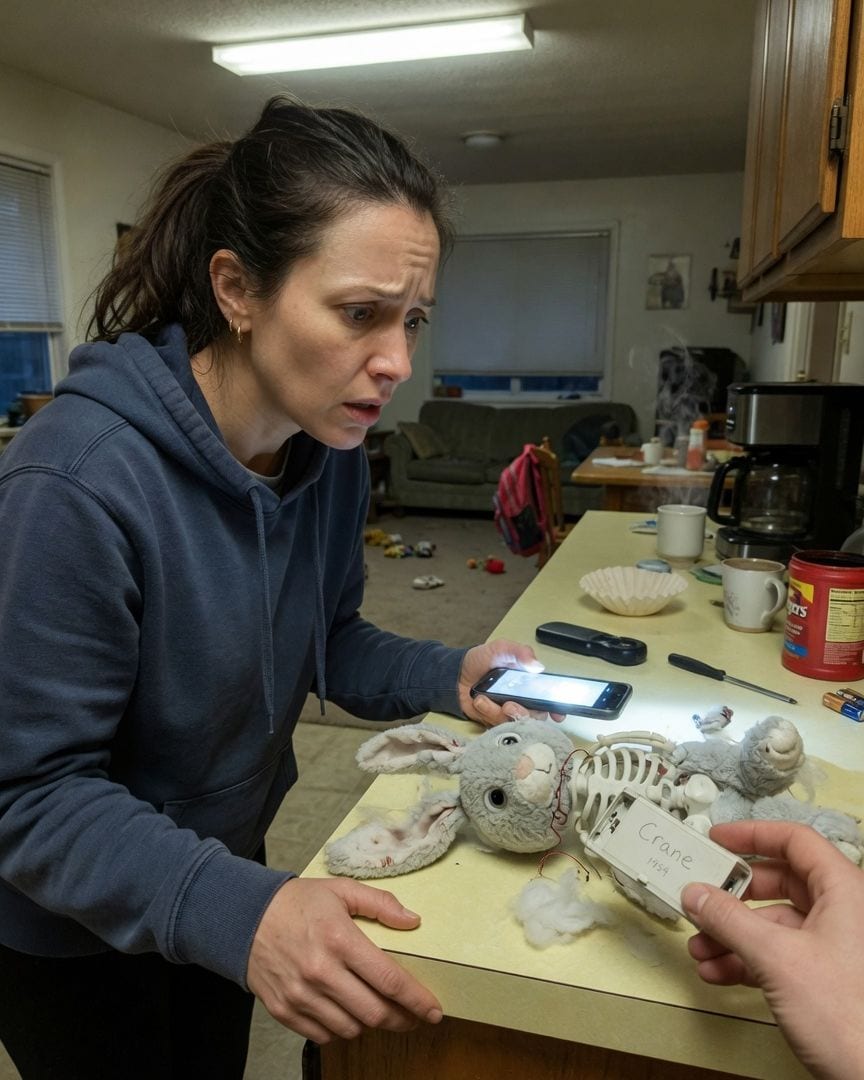
My son's toy rabbit says my name, then, 'bring him to the water.' The batteries are out.
I was making coffee, my son James at school, when I heard a grown man's voice from the living room. It was his favorite toy rabbit, whispering my name: 'Nina, bring him to the water.' The chilling command was impossible; I had removed the rabbit's batteries three days earlier, and they sat on the kitchen counter.
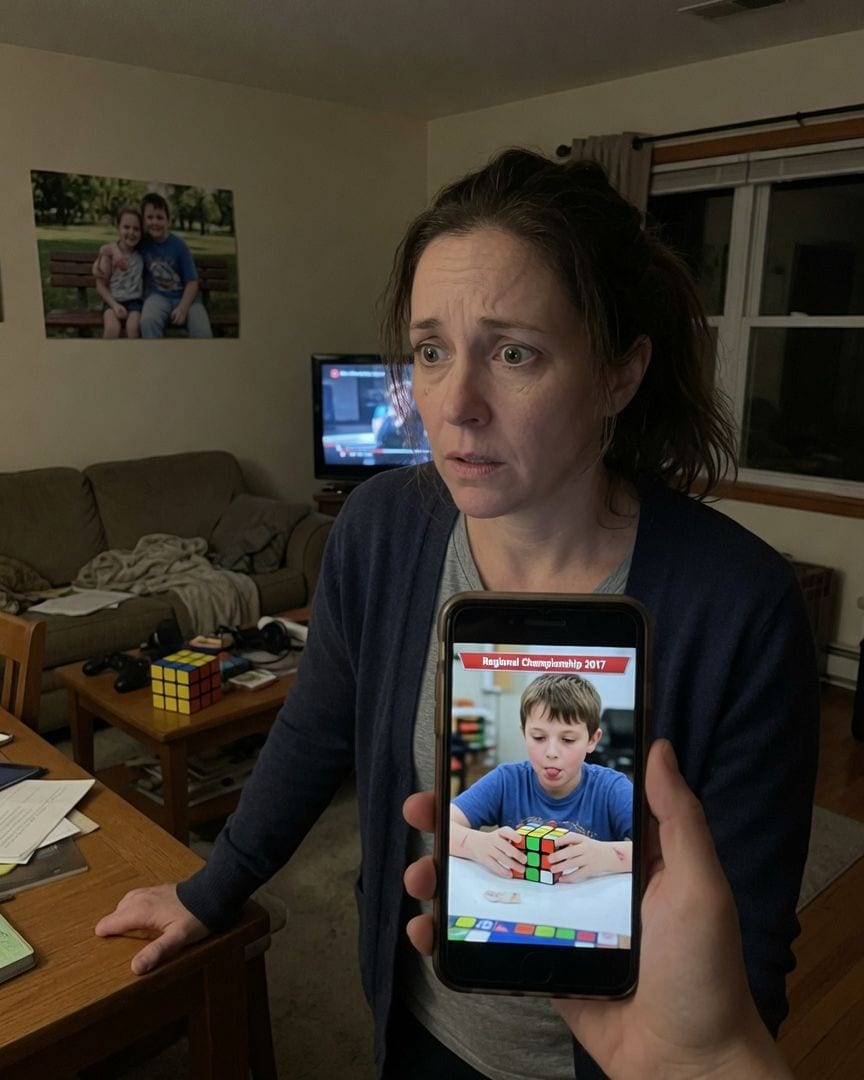
My son solves his puzzle cube yellow-first now. He says he's never used the old sequence, but his winning videos online prove he did.
I asked my fourteen-year-old son, Benjamin, about a shared childhood memory, trying to prompt a familiar connection. He recounted the details perfectly, even adding a wistful observation I'd forgotten. But then he described a conversation with his father, a man who had died before Benjamin was even born.
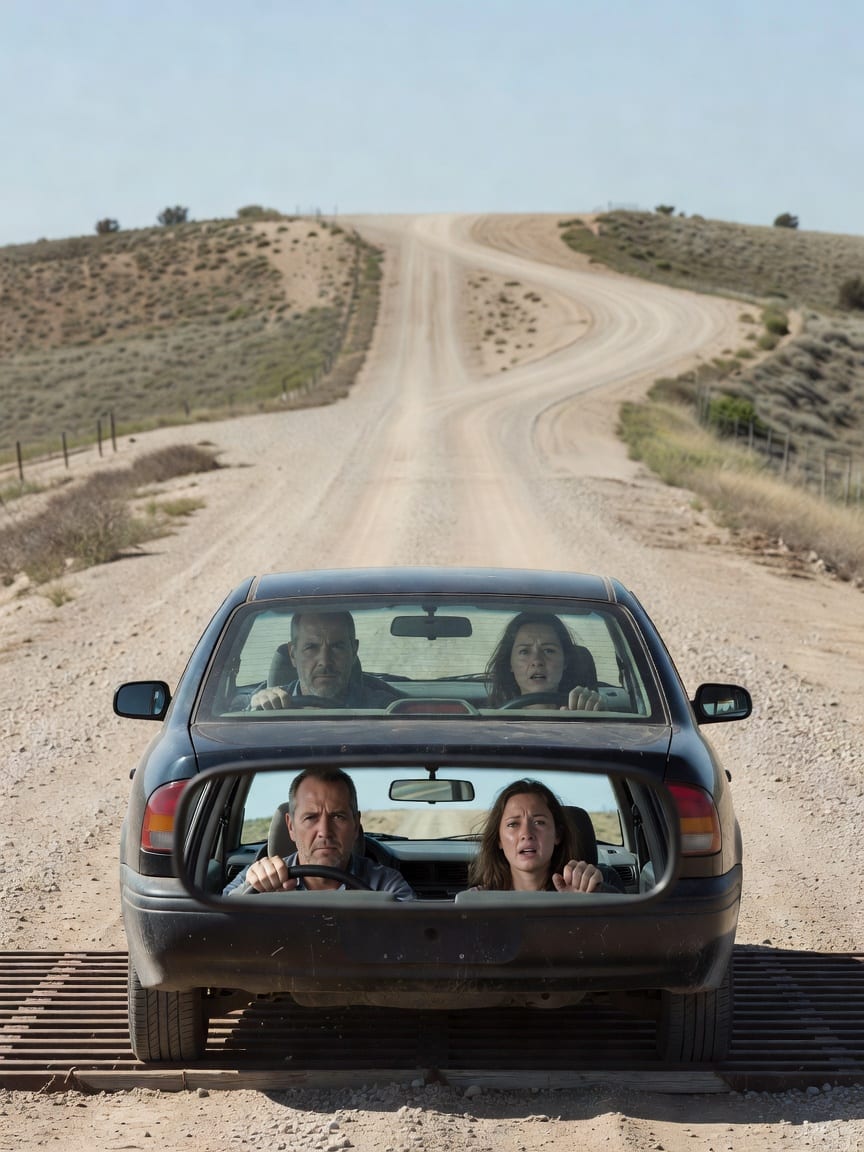
My father's ashes never made it to the hilltop. That single track kept feeding my car back to the cattle grid, the same sheep scattering, the same gate swinging.
I'm trying to scatter my dad's ashes at the highest point, but the track to Ashford Hill keeps looping, pushing my car back down. After my fifth attempt, I walked it myself, only to find the same pale grey gravel and cattle grid appearing inexplicably behind me again. Then, half-buried in the verge, I found a brass marker with strange symbols, dated 1897, that I'm certain wasn't there before.