Mall security footage caught an old woman walking the concourse after closing. Every camera filmed her, but no single frame shows how she got in.
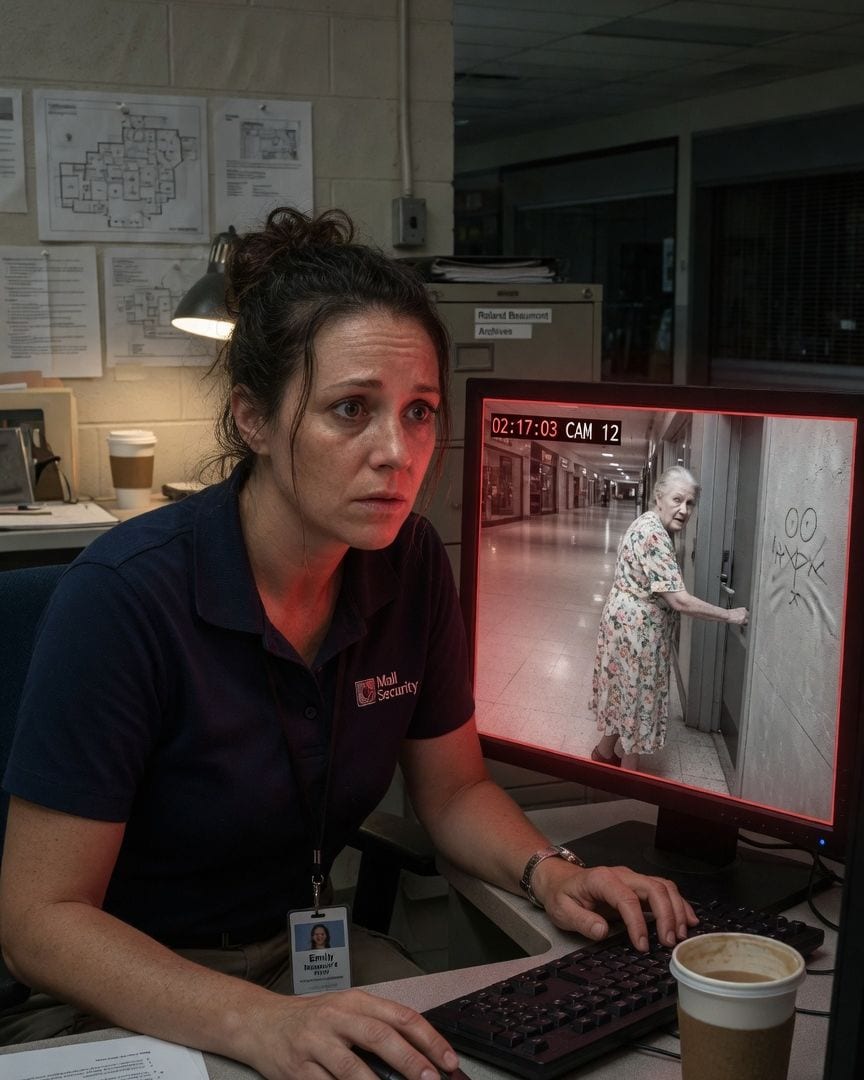
The red glow of the security monitor cast long shadows across my office, painting the fluorescent light of the concourse footage in hues of eerie stillness. It was 2:17 AM. The mall had been locked down for five hours.
My predecessor, Roland Beaumont, had drilled into me the importance of meticulousness. “Every frame tells a story, Emily,” he used to say, “and sometimes, it’s not the one you expect.”
I was scanning the routine overnight footage, looking for the usual — a delivery left askew, a flickering emergency light, maybe a stray pigeon that got in.
The silence of the empty mall outside my door felt amplified by the low hum of the servers.
Then, on Camera 7, tracking the main concourse near the food court entrance, she appeared. An old woman, perhaps in her late seventies or early eighties, wearing a faded floral dress.
She simply walked into the frame, from the direction of where the food court kitchens would be. No door opening. No silhouette passing from a side corridor. She was just there.
My hand flew to the mouse, a cold knot tightening in my stomach. I checked the timestamp on the bottom left of the screen: 02:17:03. The system clock was calibrated daily with the atomic standard; it was accurate.
No alarms had been triggered anywhere in the mall’s extensive network. The old woman walked slowly, deliberately, her gaze fixed straight ahead, as if on a destination only she could see. Her steps were soft, almost gliding.
I rewound, skipping back ten seconds, then twenty. Nothing. One moment the concourse was empty, the next, she was there, already mid-stride. I played it forward, watching her progress.
She passed the empty storefronts, her reflection a pale ghost in the darkened glass. I switched to Camera 6, then Camera 5, tracking her movement down the length of the concourse.
Each camera captured her arrival into its field of view, in sequence, without any preamble. She was never seen entering the frame, only present within it.
My fingers flew across the keyboard, rewinding, fast-forwarding, desperate to find the point of entry. I checked every fire door, every loading dock, the main entrances. I pulled up the exterior cameras, the roof access points. Nothing.
The mall was a sealed vault. And yet, this woman simply was there, on the concourse, at 2:17 AM, without any physical, verifiable means of having entered. The quiet hum of the servers seemed to mock my rising panic.
I spent the next hour scrubbing through the footage, frame by frame, trying to convince myself there was a logical explanation.
My brain raced through the mundane: a homeless person who’d hidden in the bathroom until after closing, a prank by some bored teenagers, a glitch in the timestamp. The timestamp was verified by the central server; it was accurate.
I double-checked every entry point again. No sign of forced entry anywhere. No alarms, not even a sensor ping.
The woman moved with a calm, almost serene pace. She wasn't scurrying, or trying to hide, or looking over her shoulder like someone who knew they shouldn't be there. She looked like she belonged.
I zoomed in on her face as much as the grainy resolution allowed, but it was just a blur of features – old eyes, thin lips, a faint network of wrinkles. No clear identification.
I pulled up the logs for any maintenance crews, cleaning staff, or late-night vendors. All clear. No one else was authorized to be in the mall. Not a soul. It was a ghost town, save for the phantom old woman.
She continued her silent walk, passing the shuttered boutiques. Finally, she reached the fire door at the far end of the concourse, the one that led to the old service tunnels beneath the mall. For a moment, she stopped.
She turned slowly, deliberately, and looked directly into the lens of Camera 12. Her expression was faint, unreadable, yet it felt like she was looking right at me.
Then, she simply pushed the bar of the fire door, stepped through, and the camera showed her disappearing into the unlit tunnel beyond.
I immediately checked the tunnel cameras. There were a few, motion-activated, rarely used. Nothing. No sign of her. The tunnel was empty, dark.
I cross-referenced the fire door logs; it showed it was still locked from the inside, as it should be. It had never been opened. The dread solidified, a cold, hard knot in my chest.
I’d seen the footage a dozen times by then, but it never changed. The woman appeared, walked, looked, and vanished, leaving no trace of how she got in or out. The silence of the office pressed in, heavy and absolute.
I pulled up the footage from Camera 12 again, focusing on the moment the woman turned and looked at the lens. The grainy image, for a fraction of a second, seemed to sharpen, resolve into impossible detail. My breath caught.
I leaned closer to the monitor, squinting, trying to make sense of the flicker. It wasn't just the woman's face.
In the background, just as she began to turn, a section of the solid, featureless concrete wall beside the fire door seemed to ripple. To shift.
For a fleeting instant, where the wall should have been, a faint, impossible architectural detail emerged. A crude, ancient symbol, carved into stone, on what looked like an archway that simply wasn't there.
It was gone as quickly as it appeared, the concrete solidifying back to its blank, grey expanse, but I saw it. I know that wall. I walk past it every day. There’s nothing there but a blank expanse of concrete.
My heart hammered against my ribs, a frantic drum against the silence. I rewound, played it again, then again.
The symbol was there, undeniable, for a fraction of a second, just as the old woman stepped through the door, and the world seemed to hold its breath.
The next morning, I arrived at the mall an hour early, driven by a restless unease that had kept me awake for most of the night. Forget the reports, forget the schedules.
My first stop was the service corridor, the fire door, the exact spot where the old woman had vanished, where that impossible detail had flickered into existence.
The wall was solid. Featureless concrete, just as it should be. No archway. No symbol. I ran my hand over the cold surface, feeling for any seam, any give in the plaster. Nothing. Smooth, unyielding.
I pulled out my phone, comparing the live wall to the paused image on my screen. It was identical in its blankness, yet utterly, horrifyingly wrong because of what I'd seen.
I spent the day cross-referencing blueprints. First the current ones, then the older versions I found in the dusty archives in the basement, smelling of mildew and forgotten paperwork. No archway. No symbol.
The mall was built in the 70s, a standard concrete block, nothing fancy. This corridor was always just a corridor, a utility path, plain and unadorned.
Under the guise of 'checking structural integrity,' I called Isaac Kowalski, the maintenance supervisor. Isaac, a gruff man with a perpetually tired expression who’d been with the mall for decades, didn’t mince words. 'Solid concrete, Miss Abbott.
Nothing but pipes and wires behind it, going all the way down. Always has been.' He sounded annoyed by my questions, but unwavering in his certainty.
Finally, with a sense of trepidation, I decided to reach out to Roland Beaumont, my predecessor. He was retired, living a quiet life in a small house on the outskirts of town. He sounded surprised to hear from me.
I cautiously described the footage, omitting the impossible symbol for now. I didn't want him to think I was hallucinating. Roland listened, his voice thoughtful, a familiar pause punctuating his words.
'Ah, the mall has its own ways, Emily,' he said, a strange, almost knowing note in his voice. 'Things come and go here. Always have. You just learn to look the other way, mostly.'
My blood ran cold at his casual tone.
Roland’s cryptic response only deepened my resolve. I pressed him for more, but he deflected, advising me to 'let sleeping dogs lie.' His evasiveness was unsettling, a calm indifference that felt more menacing than outright denial.
I hung up feeling a prickle of being watched, an unreasonable sensation that settled like a weight on my shoulders.
I was alone in my office later that afternoon, poring over more old blueprints, trying to find anything that hinted at a structural anomaly, a hidden room, anything at all.
The fluorescent lights hummed, and the distant rumble of the service elevator was the only sound. My desktop screen flickered.
For a split second, a faint, almost subliminal image appeared over the blueprint on my screen: a blurred, archaic symbol, strikingly similar to the one I'd seen on the footage. And beneath it, barely legible, a single word: 'Abbott'.
My own last name.
I froze, my breath catching in my throat. It vanished instantly, replaced by the normal blueprint. I checked the system logs, the network activity. Nothing. No unauthorized access, no power surge, no explanation for the phantom image.
It was like a digital ghost, a whisper in the machine.
Later, walking through the quiet mall after closing, heading to my car, a sudden, profound chill swept through the service corridor near the fire door.
It wasn't just cold; it was a specific, heavy cold that felt like it pressed against my skin.
The air grew heavy, thick with something I couldn’t name, and I heard a faint, almost musical hum, just at the very edge of hearing, like a tuning fork vibrating somewhere deep within the building’s guts.
I spun around, flashlight beam cutting through the gloom, but the corridor was empty, stretching into darkness in both directions. Nothing.
When I returned to my office, my heart still thumping, I found a single, yellowed page from an old logbook slipped under my door. It wasn’t one of mine.
The paper was brittle, the ink faded, and the handwriting was unmistakably Roland’s, his meticulous script filling the page. It detailed a similar 'manifestation' twenty years ago, near the same service corridor.
At the bottom, a note in Roland's hand, almost illegible, scrawled harder than the rest: 'The name, Emily. It always comes back to the name.'
I knew I had to confront him. The yellowed logbook page clutched in my hand, I drove to his quiet suburban home. The houses were neat, the lawns manicured.
Nothing about this street suggested the kind of impossible things I now knew lived beneath the mall. He invited me in, seemingly unbothered, as if my sudden appearance was entirely expected.
The air in his living room was warm, filled with the scent of old books and pipe tobacco.
'You knew, didn't you, Roland?' I asked, my voice tight, placing the brittle page on his coffee table. The paper seemed shockingly out of place amidst the mundane comfort of his home.
He sighed, a weary sound that seemed to carry the weight of years. 'Knew what, exactly, Emily?' His eyes, though old, were sharp, observing me.
'The woman. The... manifestations. You saw them too. You logged them.' I tapped the page.
He picked it up, his gaze scanning the familiar script, a ghost of a smile playing on his lips. 'I saw things, yes. More than once.'
He finally met my gaze, his eyes shadowed with an old knowledge that made my stomach clench. 'This mall, it's... special. Always has been. Built on an old crossing point. A thin place. Things bleed through. People, sometimes. Echoes.'
I pushed, unable to process his calm delivery of such impossible truths. 'The symbol on the wall. The one in the footage. It appeared for a split second, Roland. An archway that isn't there.'
Roland’s expression hardened, a flicker of something like concern crossing his face. 'You saw that? That's new. Or maybe I just never caught it.' He leaned back, his gaze distant, remembering.
He explained that for decades, strange occurrences had been part of the mall's hidden history – unexplained noises, cold spots, fleeting figures glimpsed on the edge of vision.
His logs, he admitted, were filled with similar 'incidents,' carefully coded to avoid panic, to keep them mundane enough for internal records.
He recounted how he always tried to dismiss them as tricks of the light or tired eyes, until he couldn't anymore.
'They don't come in,' he said, tapping the logbook page again. 'They come from. From somewhere else. They just... appear. And then they're gone.
The cameras, bless their objective little lenses, they just record what is there, for a moment, even if it shouldn't be.'
The old woman's impossible entry now clicked into place, a horrifying clarity. She wasn't breaking in; she was manifesting. The chilling realization settled over me, heavy and cold: the mall wasn't just a building. It was a portal. A membrane.
A place where reality frayed.
Roland, his face grim, pointed me to a section of his old logbooks that he’d carefully coded, not just for incidents, but for observations, hints.
'I never wrote it down plainly,' he said, his voice dropping, 'but I found an old maintenance access panel, sealed over. It’s in the service corridor, near that fire door. Beneath the plaster, there’s something.'
He described finding ancient, pre-mall stonework, carefully covered up, hidden from view.
My heart hammered against my ribs, a frantic rhythm against the quiet suburban afternoon. I drove back to the mall, a crowbar and a heavy-duty flashlight clanging in the trunk of my car.
The mall was empty, silent, waiting for me. I located the access panel Roland described, hidden behind a forgotten storage rack, just as he'd said. It was stiff, rusted into place, a forgotten secret in plain sight.
With a grunt, I managed to pry it open, the screech of metal echoing in the vast, empty space.
Inside, a small, dark crawlspace, smelling of damp earth and something else, something metallic and cold, like old, wet iron. I shone my powerful flashlight inside.
The crawlspace opened into a narrow passage, clearly carved from rough, unworked stone, far older than any mall could ever be.
And there, on the passage wall, beneath peeling paint and ancient grime, faint but unmistakable, etched into the rough stone, was the exact symbol from the footage. It was real. Physically present.
An impossible object where there should only be solid wall, confirming the channel wasn’t just a recording anomaly, but an ancient, bleeding wound in the fabric of the mall itself.
My flashlight beam illuminated the narrow passage, and the symbol on the wall seemed to glow faintly, an impossible echo of what I’d seen on the screen.
Roland’s coded entries, the flickering screen in my office, the subliminal ‘Abbott’ watermark—it all clicked into place, converging on this one, impossible point.
The passage snaked for about twenty feet, opening into a small, circular chamber. The air here was even colder, heavy with the scent of damp earth, but also something else, something dry and ancient, like dust from a forgotten tomb.
The chamber was clearly pre-dating the mall by centuries, carved with a brutal, unadorned simplicity. In the center of the stone floor, a circular indentation, smooth and worn, as if by countless soft footsteps. This was it.
The ‘crossing point,’ the ‘channel.’ The old woman, the fleeting glimpses Roland had documented for decades, they were all manifestations from this place.
The mall, in its mundane, commercial existence, was inadvertently built directly over a nexus of reality, a seam in the fabric of the world. I understood Roland’s reluctance to share, his careful evasiveness. What could anyone do?
How do you fight a place? How do you close a wound in reality itself? The ‘Abbott’ watermark on Roland’s logbooks, the faint flicker on my screen—it wasn't just a random name. It was a signature, a resonance.
My family's name, linked to the original excavation of this land, meant a deeper connection to this channel. I wasn't just a witness; I was somehow attuned to it, perhaps even a potential conduit for whatever else might bleed through.
The dread twisted into a personal horror, a cold hand tightening around my heart. This wasn't just a story about a lost woman; it was about me, and the unseen forces that had always been underfoot.
I returned to the service corridor, not to escape, but to act. My hands were shaking, but my resolve was firm. I couldn’t destroy the channel, not entirely, but maybe I could seal it, for now.
As luck would have it, Isaac Kowalski was working late, grumbling about a leaky pipe in the adjoining utility room.
'Isaac,' I said, my voice steady despite the tremor in my hands, 'I need your help. There's something under the mall. Something... that shouldn't be.'
Isaac, ever practical, rolled his eyes, a smudge of grease across his forehead. 'Ghosts again, Miss Abbott? You've been jumpy lately.'
I ignored his skepticism. I led him to the hidden access panel, already pried open, and shone my flashlight into the darkness.
He peered in, then backed away, a genuine gasp escaping his lips as he took in the impossible stonework, the ancient passage, the faint, indelible symbol etched into the rough stone. 'What in God's name?'
he muttered, his earlier scoffing dying in his throat.
I explained my theory, the channel, the manifestations. I kept it brief, factual, showing him Roland’s logbook page. Isaac, though clearly shaken, was a man of action, of fixing things. He ran his hand over the symbol, his brow furrowed.
We needed to seal it. Not just the access panel, but the passage itself.
A temporary solution, I argued, until we could figure out something more permanent, maybe even fill the chamber with concrete if we could get official permission later.
Together, we worked through the night, a silent, grim partnership. We found old steel plates and industrial-strength concrete mix in the maintenance bay, supplies that had probably been there since the mall was built.
We sealed the access panel, then reinforced the entire section of the service corridor wall, effectively burying the channel once more.
We worked with a frantic energy, mixing concrete, bolting plates, sealing it away, layer after layer, until the old stone was invisible beneath fresh steel and drying cement.
As the last layer of concrete dried, the smell harsh and metallic in the air, I felt a strange sense of exhaustion, but also a fragile victory. The immediate threat was contained. The mall was, for now, 'normal.'
But as I wiped sweat from my brow, a chilling thought struck me. This mall might be sealed, but Roland’s words echoed in my mind: 'The mall has its own ways... things come and go here. Always have.'
And then, the symbol on the footage, the one that appeared for the first time, not in Roland’s logs, but on my watch. A new development, perhaps. A new kind of bleeding through, testing the edges.
In the weeks that follow, the mall returned to its quiet, predictable rhythm. No more impossible figures on the security footage.
Isaac, changed by what he saw, now cast nervous glances at the reinforced wall, a new, unspoken understanding passing between us. He never mentioned the passage, and I never brought it up.
I, too, was different. I checked the security feeds with a new vigilance, a constant, low thrum of dread beneath my calm exterior. The incident was buried, literally and figuratively, but it was not forgotten.
I told no one else, not wanting to invite ridicule or panic. Roland called occasionally, just to check in, a quiet understanding passing between us in the silences. The channel was sealed, but not gone.
It merely slept beneath the concrete, a wound waiting to reopen.
I sit in my office now, watching the familiar grid of security monitors. The mall is quiet, empty, bathed in the soft, artificial glow of the overnight lights. I sip my cooling tea, the mug warm in my hands.
The old woman hasn't reappeared. The symbol hasn't flickered on my screen. But sometimes, late at night, when the mall is silent and still, I catch myself listening.
Not for a sound, but for an absence, a quiet hum that isn't there, yet feels like it should be, like a phantom limb of sound.
I touch the small, smooth stone I now keep in my pocket, a piece of the ancient wall Isaac helped me pry from the crawlspace before we sealed it.
A faint, almost invisible etching of the impossible symbol is on its surface, worn smooth by my thumb. It's a reminder.
I look up at the screen, at the empty concourse, and for a fleeting moment, the image seems to shimmer, just at the edges. I blink, and it's gone. Just a trick of the light.
Or maybe, she thinks, the channel isn't the only one, and its echoes are everywhere now.
If this one got to you
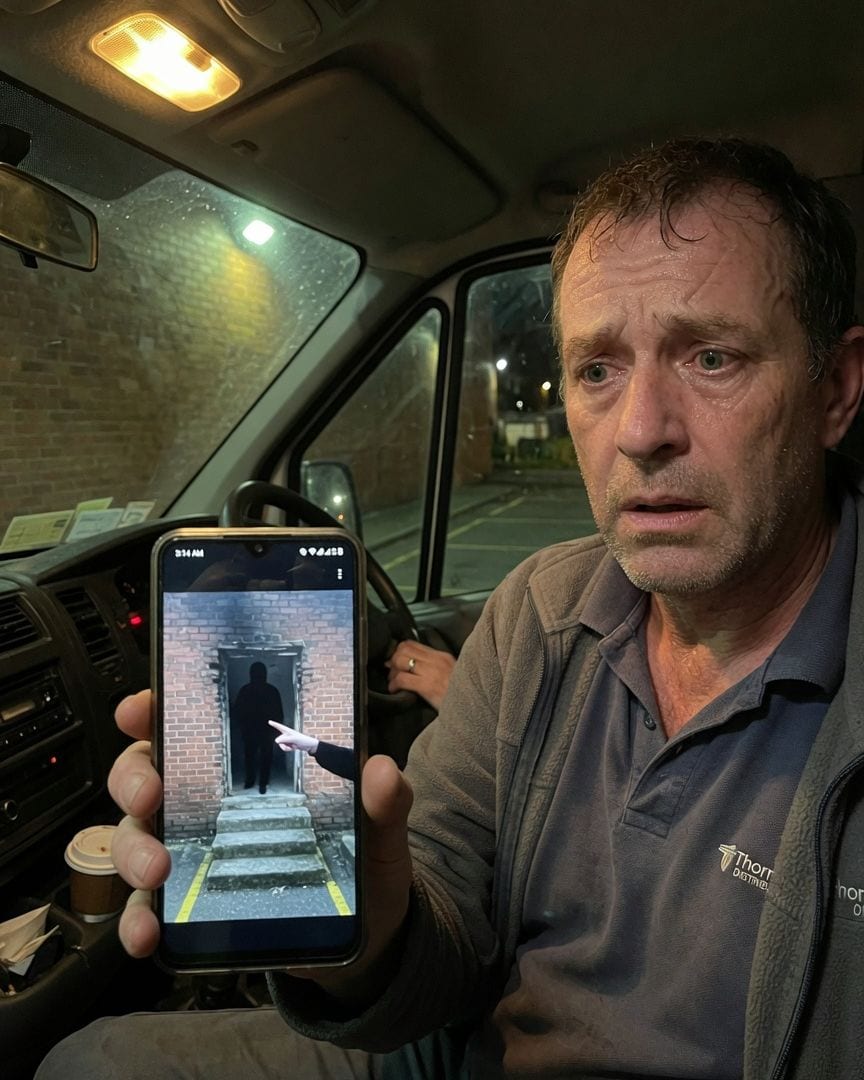
My dashcam showed a doorway in the loading bay wall. Open, with steps into the dark. I got out. Solid brick. Back in the cab, a shape stood on the steps.
It was past three in the morning, just another routine reverse into Loading Bay 7. My van's dashcam flickered on, ready to guide me back against the familiar brick wall. But that night, it showed a doorway where no door should be, open and leading down into absolute darkness.
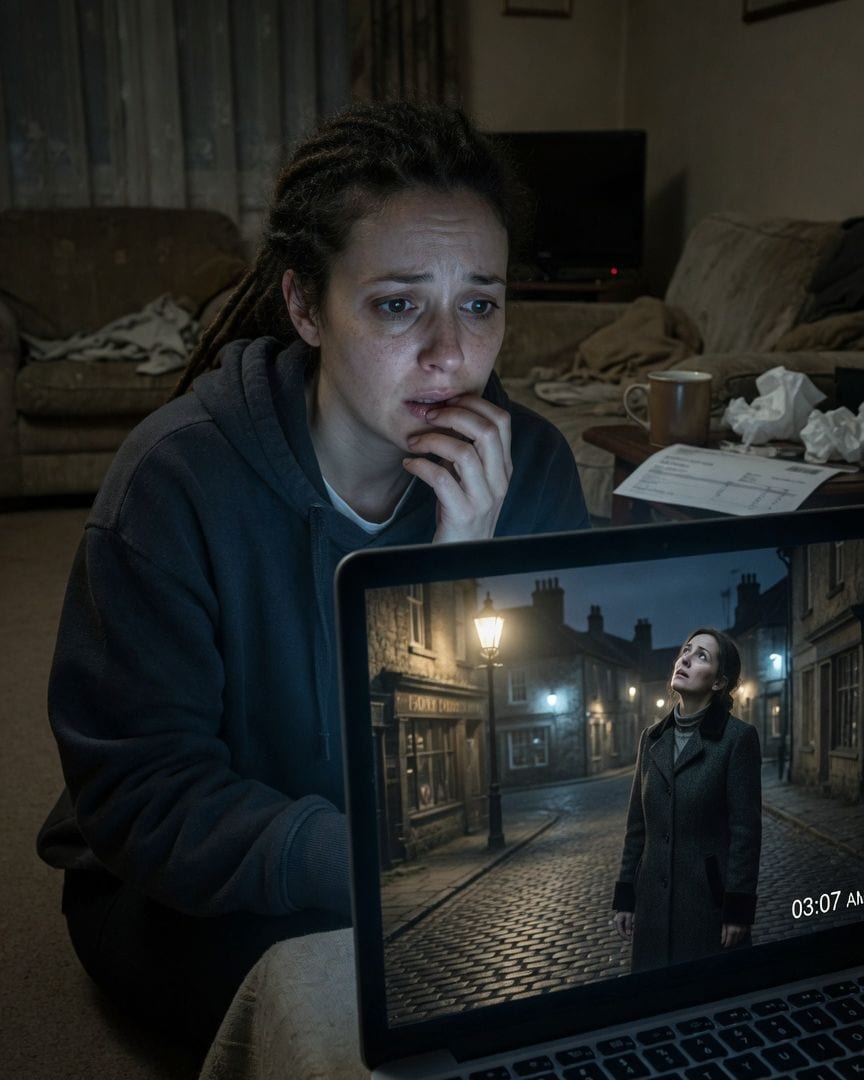
My aunt's coat walked into the village square at 3 AM. The webcam caught her looking straight into the lens, two weeks after we buried her in it.
Staring at my village church webcam at 3 AM, the square was deserted and quiet. Then a figure emerged, wearing the distinctive wool coat my Aunt Constance was buried in just two weeks ago. She paused, then slowly tilted her head up, looking directly into the camera lens, right at me.
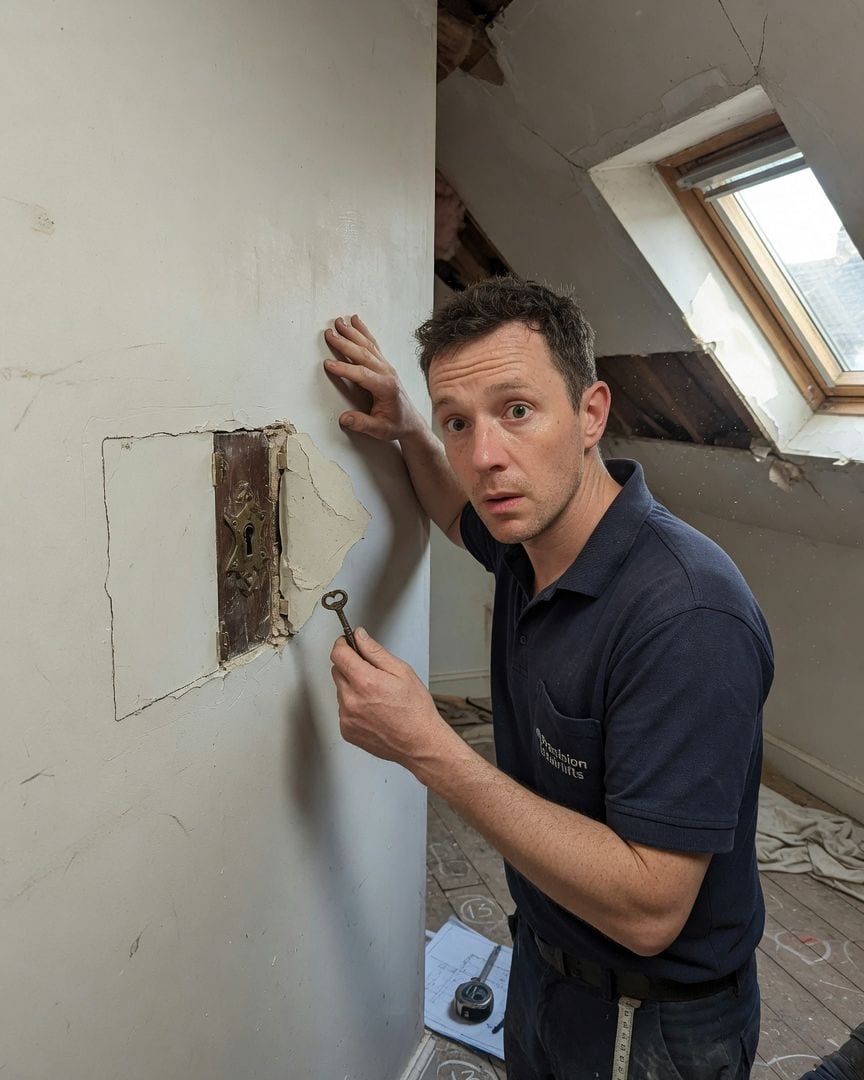
My stairlift tape measures thirteen steps, but my own feet always find a fourteenth — to a door that isn't there.
As a meticulous fitter, I measured my client's new loft stairs, confirming thirteen solid steps. But my foot found a shallow, impossible half-step, leading to a plain wooden door that shouldn't exist. Now the door is gone, leaving only a ghost outline.
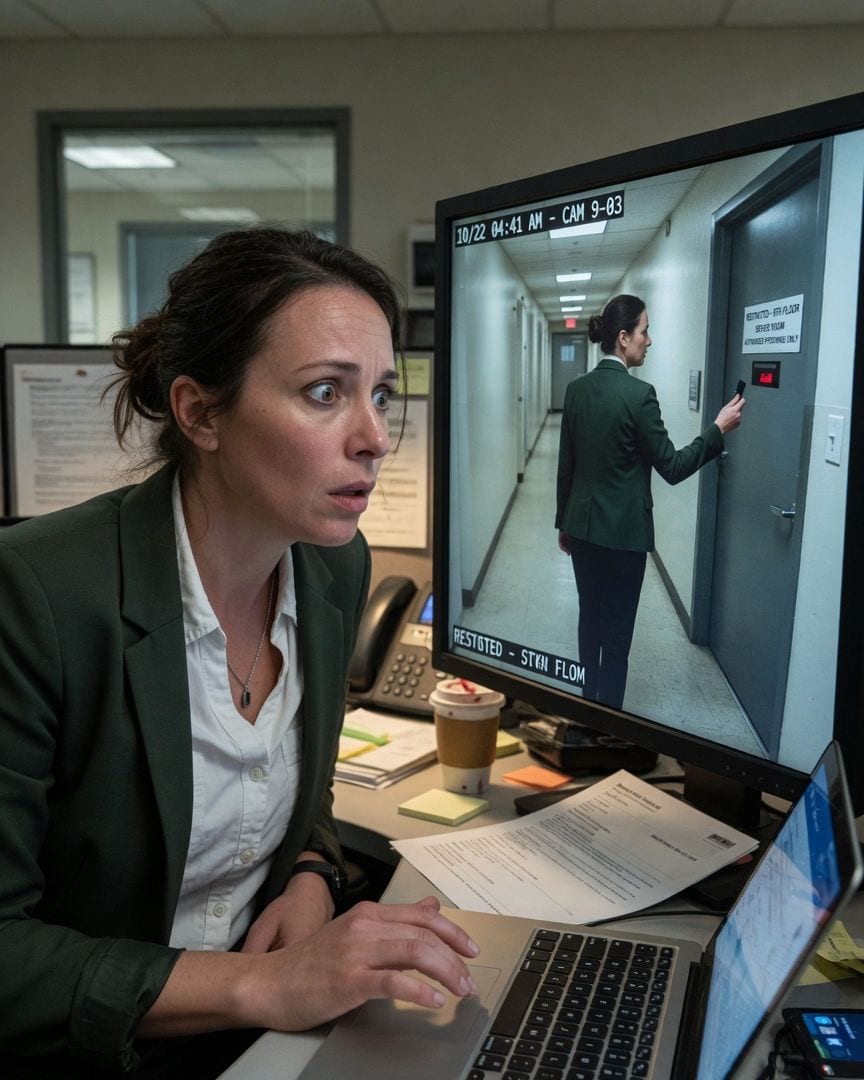
My keycard log shows me in the server room at 4:41am. I was asleep, and my badge was at home.
An email from corporate IT reveals my keycard registered entry into a restricted server room at 4:41 AM last Sunday. I was asleep in my apartment across town, my badge clipped securely to my jacket at home. But then I scrolled down and found eleven more impossible entries, all within the past week, all under my name.
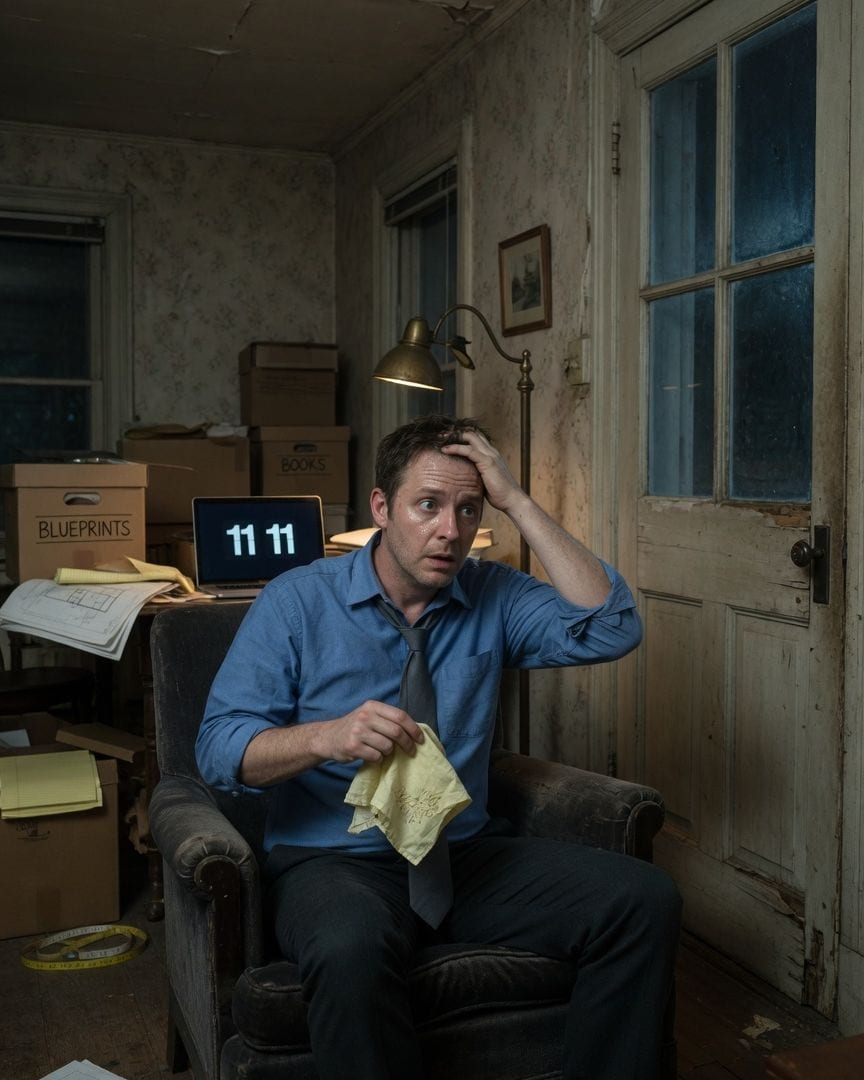
The boarded-up door in my study has twice swung open onto the balcony that was torn off this house years ago — iron railings back, and a woman at the rail with her back to me, watching a street that no longer runs below.
As an architect, I approach my great-aunt's inherited house with a rational eye, seeing its potential, not its ghosts. I knew the charming French door was boarded up because its balcony was removed back in 1953. But for two nights now, at 11:11 PM, those boards simply vanish, revealing the balcony restored and a silent woman watching an impossible street.
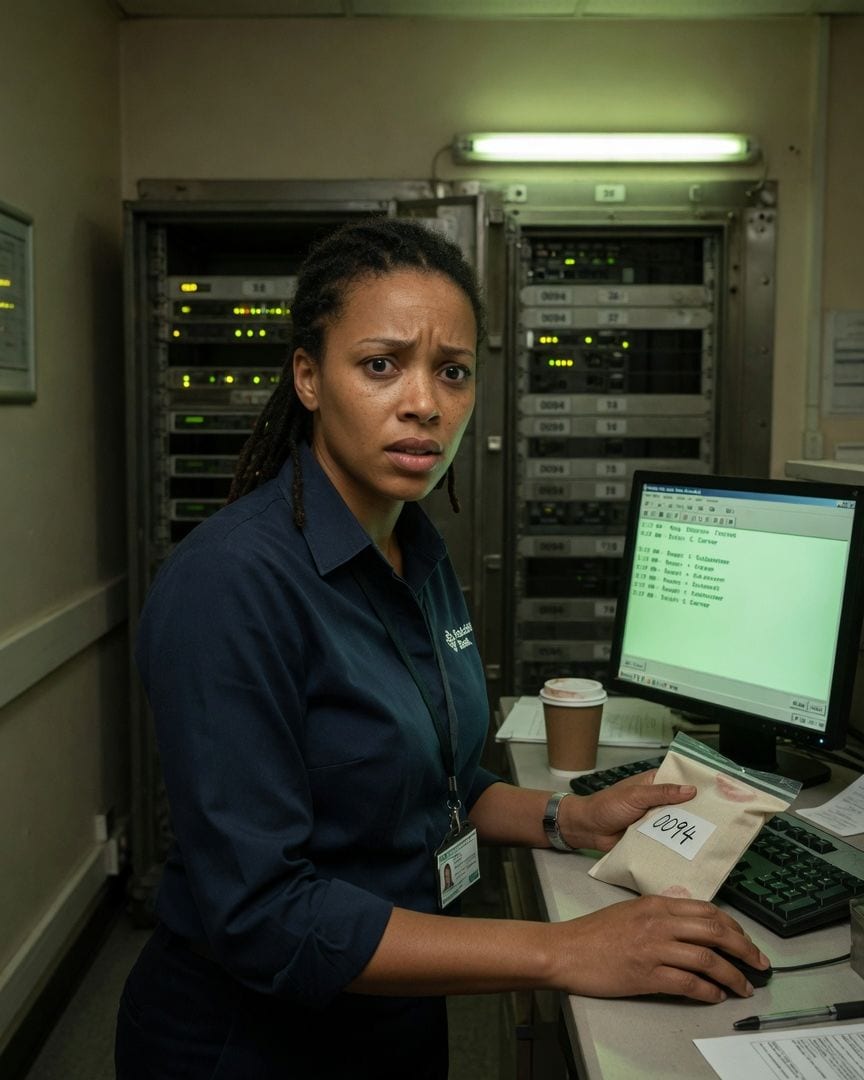
My night-deposit log shows a bag posted at 3:17 AM. My teller number, my count. Bag 0094 is still sealed in the safe, untouched.
I prided myself on precision as a night teller, logging every entry. But at 3:17 AM, a deposit appeared logged under my teller number that I never processed. Security footage then revealed a figure in my uniform, wearing my ID badge, with a blank photo slot.