My aunt's coat walked into the village square at 3 AM. The webcam caught her looking straight into the lens, two weeks after we buried her in it.
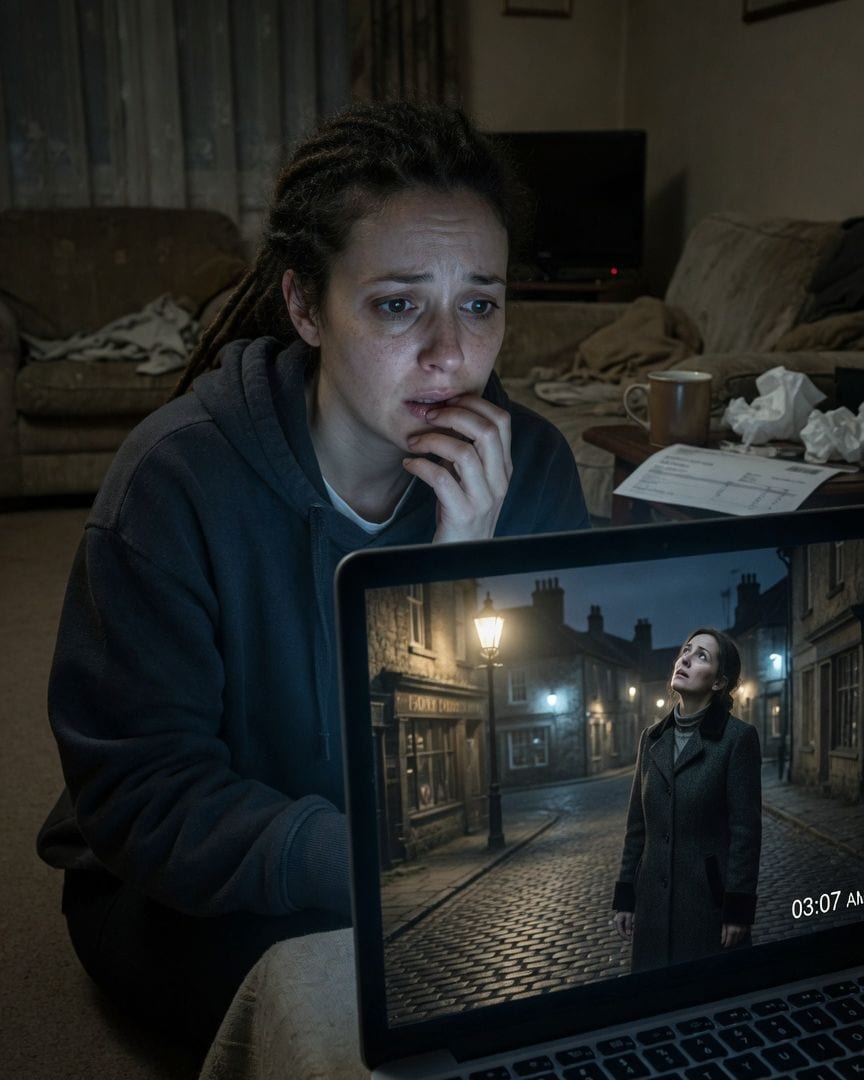
The laptop screen glowed, a cold blue rectangle in the 3 AM darkness of my living room. I shouldn't have been awake, let alone staring at the live stream from the village church tower webcam.
The square below was deserted, quiet beneath the halo of the lamplight. Nothing moved. Just cobblestones and shadows, and the gentle, almost imperceptible hum of a small, sleeping village.
Then, from the alley beside the old bakery, a figure emerged. A woman. She moved slowly, deliberately, into the center of the square, stopping under the single flickering gas lamp. My breath caught, sharp and sudden in the quiet room.
She was wearing a heavy, dark winter coat, the collar turned up high. It was the same coat. The distinctive wool winter coat, dark grey, with velvet trim. The one Aunt Constance was buried in, just two weeks ago.
The figure paused, then slowly, impossibly, tilted her head up. Her face, indistinct in the lamplight and webcam resolution, was angled directly towards the lens. Towards me.
I leaned closer, my fingers hovering over the screen, a tremor starting deep in my chest. It can't be. My aunt is dead.
I watched, frozen, as the figure held her gaze, unblinking, before turning away, towards the shadowed path leading to the churchyard, and vanishing from the stream.
The square was empty again, but the silence in my living room had been replaced by the frantic drumming of my own heart.
My hands shook as I rewound the archived stream, downloading the short clip from the website. I played it back, again and again, scrutinizing every pixel. The timestamp was perfectly clear: '03:07 AM'.
There were no glitches, no dropped frames, no shadows that could be mistaken for something else. Just the woman, in that coat, looking right at the camera.
The quality was better than I remembered, or perhaps I just hadn't been looking hard enough before. Every detail, though slightly blurred by distance, was consistent.
I pulled up the funeral home's invoice, the one for Aunt Constance’s burial arrangements. My eyes found the line item: ‘Distinctive wool winter coat, dark grey, with velvet trim, interred as per family wishes.’
It was all there, in black and white.
At 7 AM, I called Vanessa Hartley, Aunt Constance’s closest friend. Vanessa, still thick with grief, answered on the second ring. 'Olivia? Is everything alright, dear?' her voice was raspy. 'Vanessa, I… I have a strange question.
About Aunt Constance’s coat. The one she was buried in.' A pause. 'Oh, that old thing. She loved that coat. Wore it everywhere. Insisted on being buried in it, you know. Why do you ask?'
Her voice held the slight tremor of remembered sorrow. 'It was… dark grey, with velvet trim, right? A bit heavy?' 'That's the one. Thick wool. She had it for decades. Why, has something happened to it?' 'No. No, nothing.
Just… thinking about her.' The lie felt like ash in my mouth.
I tried to rationalize it. A trick of the light? Someone else in an identical coat? It wasn't impossible, but the odds...
And the way the figure had stood, the precise angle of the head looking up, directly into the camera lens – it felt too deliberate, too specific. A cold, impossible dread began to coil in my gut, settling in.
The mundane explanations fell apart, leaving only the terrifying, unshakeable fact of what I had seen.
Desperate, I opened the full, extended archived stream from that entire night, determined to find any logical precursor or aftermath.
I fast-forwarded through hours of empty square, the lamplit cobblestones unchanging, then slowed it to a crawl just before the figure appeared, and again after she vanished toward the churchyard.
The square remained deserted for several long minutes after the figure disappeared into the shadows. The webcam feed was still, silent.
Then, for a fleeting moment, in the very center of the empty space where the cobblestones met the lamp's glow, a faint, shimmering distortion appeared.
It was like heat haze rising from asphalt on a summer day, but it was 3 AM in winter, and the air was frigid.
It rippled, just for a split second, where a road should be but isn't, before vanishing completely, leaving the square empty and normal once more.
The shimmering distortion haunted me. The next morning, I visited the village square. The mid-morning sun was bright, harsh, making the cobblestones seem perfectly ordinary.
I walked the exact path the figure had taken, stepping under the same flickering gas lamp (now unlit, of course). I took photos with my phone, trying to match the angles from the webcam clip.
My boots scuffed against solid, uneven cobblestones. There was no road here, no patch of asphalt, no trace of anything that would cause such a heat haze effect. Just solid, ancient stone.
I spent the afternoon at the local library, poring over centuries-old parchments and maps of the village. My fingers traced faded ink, looking for any indication of a forgotten path or structure in that precise spot. Nothing.
The square had been cobblestone for as long as records existed.
Finally, I approached Philip Russo, the village’s unofficial historian. His office, a cramped annex in the old town hall, smelled of dust and decaying paper.
Philip, a man in his late sixties, with a wispy halo of white hair and thick-rimmed glasses, was hunched over a microscope, examining a coin.
'Philip, I need your help with something unusual,' I said, placing my laptop on his cluttered desk. He looked up, blinking. 'Unusual is my bread and butter, Olivia. What's caught your fancy?'
I showed him the clip of Aunt Constance, carefully omitting the shimmering distortion for now. Philip watched, his brow furrowed. 'A camera glitch,' he said, pushing his glasses up his nose. 'Static, light refraction.
Happens all the time with these older models.' 'It’s perfectly clear,' I countered. 'And the coat…' He waved a dismissive hand. 'Coats are common. Plenty of similar styles. You're grieving, Olivia. Things look different when you're grieving.'
The room felt colder, the dust motes dancing in the single shaft of sunlight from the window seeming to freeze in place.
I hesitated, then took a breath. 'What about this?' I played the clip again, pausing it on the split second of the shimmering distortion. Philip leaned closer. His eyes, magnified by his glasses, narrowed.
A flicker of something unreadable – recognition, alarm, perhaps – crossed his face, quickly masked. He cleared his throat. 'A digital artifact,' he repeated, but his voice was firmer, less convincing. 'Interference. Nothing more.'
He began to gather papers on his desk, avoiding my gaze. 'There are vague old wives' tales, of course, about 'echoes' near the church, but those are just stories.' He stood abruptly.
'Now, if you'll excuse me, I have some cataloging to do.' He clearly wanted me to leave. But I had seen the flicker. He had recognized it. And that, I realized, was a specific visual anomaly I could pursue.
After my visit to Philip, I started noticing him more often. He was usually secluded in the archives, a fixture among the dusty ledgers, but now I'd see him around the churchyard, sometimes just walking past my home.
It wasn't overt, but it was there, a quiet, almost imperceptible presence. He even began asking me seemingly innocuous questions about my family, specifically my aunt’s side, probing deeper than a casual acquaintance.
'Your aunt Constance was a Hughes by birth, wasn't she?' he’d ask. 'A long line, that one. Any other family still in the village?' A prickle of unease started to spread, cold and slow.
One evening, an email arrived in my inbox. The sender was unknown. The subject line was blank. The body contained a single, obscure link to a very old, almost defunct local history forum.
My mouse hovered over it, a sense of foreboding settling in. The living room suddenly felt too quiet, the gentle hum of my laptop sounding like something trapped behind the screen. Curiosity, or perhaps a growing dread, won out.
I clicked.
The page loaded slowly, garbled text filling the screen. The thread was titled: 'The Church Tower Anomalies – Decades of Distortion?' The posts were fragmented, full of cryptic references to 'visitations' and 'the channel.' A chill went through me.
I tried to scroll through the fragmented discussions, but before I could make sense of a single full sentence, the page suddenly refreshed. The entire thread vanished.
In its place, where the link had once been, a new, brief message appeared in stark black text: 'Some things are better left buried.'
I stared at the screen, the cold dread coiling in my gut now a tangible, living thing. Someone knew what I was looking for, and they were watching me closely.
The next morning, I found Philip Russo in the quiet of the village archives, meticulously arranging ancient parish records. The air was thick with the smell of old paper and dust, pressing down on everything.
I held up my phone, the screenshot of the anonymous email glowing on the screen. 'You sent this, didn't you?' I demanded, my voice low, but firm. 'The link to 'The Church Tower Anomalies'?'
Philip started, nearly dropping a brittle ledger. He turned, his face pale. 'Olivia! What on earth are you talking about?' He tried to deflect, claiming ignorance. 'Old forums are full of nonsense, Olivia. Anonymous emails, anyone could send them.
Probably a spam bot.' But his hands were trembling slightly as he shuffled through some papers on his desk. The framed photograph of the old village square on his wall seemed to shift in my peripheral vision, as if watching.
I pressed him. 'You recognized the shimmer when I showed it to you. The 'digital artifact,' you called it. Your face changed, Philip. You know about this. What is 'the channel'? What are these 'anomalies'?'
Philip sighed, a long, weary exhalation, and slumped back into his chair. The resistance seemed to drain out of him. 'They're not supposed to be spoken of,' he murmured, almost to himself. He ran a hand over his face.
'Yes, I recognized it. The village council, generations ago, tried to suppress all knowledge of it. Too many... incidents.' He looked directly at me, his eyes grave.
'There are suppressed historical records, carefully hidden by the old council, of similar visual phenomena. Specifically near the church tower. It sits on… a unique point.' He paused, searching for words. 'The 'shimmering distortion' you saw, the 'heat haze'...
it's a known, recurring signature of these events. They called it 'the transient path'.'
He reached under his desk, pulling out a large, leather-bound ledger, brittle with age and heavily scored. It wasn't the kind of thing you'd find on an open shelf.
Inside, tucked between faded newspaper clippings about crop failures and forgotten village festivals, was a water-damaged, sepia-toned photograph from the 1920s. It showed a woman, her face indistinct, standing in a familiar-looking square.
She was wearing a coat, strikingly similar to Constance’s, and where her feet should be, just behind her, was a faint, almost imperceptible shimmer on the cobblestones. My breath hitched. This wasn't a glitch, or grief, or an isolated incident.
This had happened before. And the recorded wrongness, the impossible truth, was horrifyingly real.
Philip, his face pale and drawn, then revealed a secret he'd kept for decades. 'There's more, Olivia. Things the council wanted buried for good, things I couldn’t bring myself to destroy.'
He rose, his movements slow, deliberate, and led me to a dusty, locked back room behind a heavy, metal door. The air here was even colder, stagnant, carrying a faint metallic tang.
Inside, an ancient, humming server sat on a makeshift shelf, disconnected from the internet, its indicator lights blinking like watchful eyes.
'My personal ledger,' he said, tapping the server’s dusty casing. 'The Ledger of Echoes.' He connected a laptop, the screen flickering to life, illuminating the gloom.
He navigated through a labyrinth of old files, folders labeled with dates and cryptic notes. 'This phenomenon, it's not random, Olivia. It's drawn to certain lines, certain names. Especially the old families of the village.'
He opened a file labelled 'Hughes - Incident 1982.'
A chill, deeper than the room's temperature, went through me. Hughes. My family. The grainy footage flickered to life, showing a younger woman, unmistakably a younger Constance, in her late teens or early twenties, walking alone into a field.
A field that no longer existed in any map I knew. She stopped, then slowly turned, looking directly at an invisible point, as if at an old camera.
As the figure turned, a faint, almost imperceptible whisper emerged from the static of the old recording, a voice that sounded exactly like my aunt's, clear as a bell, murmuring my own name. 'Olivia.'
Philip’s voice was heavy, a profound weariness etched into his face. 'The church tower, Olivia. It's not just a church. It was built on an ancient convergence point, a place of old power.
It acts as a 'channel' for these echoes.'
The phrase 'the channel that uses your name' wasn't just a coincidence, he explained; it was drawn to strong familial or emotional ties, specifically within certain bloodlines in the village, like the Hughes family.
He showed me other records in his Ledger: grainy photographs, faded sketches, even a few short, silent films. My great-grandmother, a distant cousin, all appearing in impossible recordings. They often wore distinctive items that were later buried with them.
The winter coat Constance was buried in, the one I’d seen in the webcam footage, wasn’t originally hers. It had belonged to her great-grandmother, passed down through generations. A 'subject' from a century ago, a Hughes woman.
The 'transient path,' the shimmering distortion, was an echo of an older, forgotten ley line or ancient road that only manifested during these events, a path connecting the living and the dead.
It was a generational pattern, a family curse. The Hughes women weren't just witnesses, he clarified, but subjects. They drew the phenomenon to them. Destined to be 'recorded' after death, and to draw the next generation into the watch.
I saw the monstrous shape of it all, coherent and terrifying. A cycle I was born into. A pattern I was always inside.
I stared at the screen, horrified. I was not just a witness to my aunt’s impossible return; I was the 'watcher' in this cycle, the one drawn to the recordings, just as my ancestors had been.
The realization settled in my bones, colder than any winter night.
Philip’s voice was low and urgent, cutting through my shock. 'Obsessing over these recordings, Olivia, it feeds the channel. Makes it stronger. Makes you a potential subject.'
He scrolled to the very last, most recent entry in his 'Ledger of Echoes,' dated just a few days ago.
It was a faint, almost invisible figure, blurred by static, standing directly in front of the church webcam, looking into the lens. The figure was wearing a coat, but it was too indistinct to tell which one.
Philip, his face pale, met my gaze. 'It's always the watcher who draws the next one. It knows you're looking.'
A cold dread washed over me, a physical weight in my chest. The channel had already begun to turn its attention to me, using my own fascination to pull me in. I had to break the cycle.
The air in that back room suddenly felt heavy, suffocating. 'We have to destroy it all,' I declared, my voice firm despite the tremor in my hands. 'Every record. Every trace. We have to sever the connection.'
Olivia and Philip spent weeks, then months, meticulously deleting every digital trace of the Ledger. They burned every old document and photograph they could find, the smoke acrid in the still autumn air.
Philip, now visibly aged and haunted, helped her dismantle the old server, physically destroying the hard drives with a drill.
They alerted the village council to 'technical issues' with the church webcam, citing maintenance needs, and it was temporarily taken offline. For a few months, an eerie quiet settled over the village.
Olivia avoided the church square, avoided screens after dark. She tried to live a normal life, but the cold, hollow truth of the generational pattern, of what she had seen and what she now knew, never left her.
This wasn't a story; it was a record, and she was part of it.
Months later, Philip Russo would occasionally receive strange, garbled emails from unfamiliar addresses, all containing a single image: a blurred, indistinct figure standing in a village square, watching.
Olivia, meanwhile, was seen sometimes, walking near the church tower late at night, a faint, almost imperceptible smile playing on her lips. The square was empty, but the shimmer lingered, a silent, patient promise.
If this one got to you
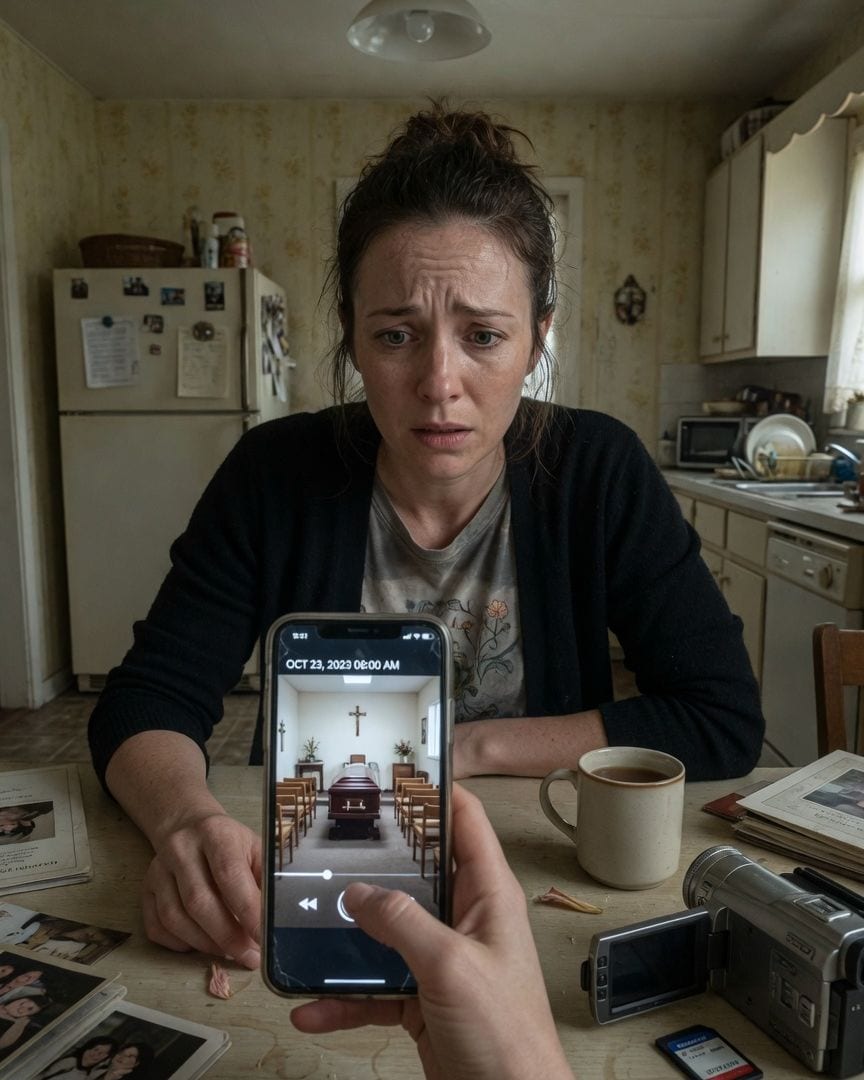
On my dead mother's phone I found a video of her funeral — steady, shot from the back over the mourners' heads, holding on her coffin. The timestamp says it was filmed an hour before any of us had arrived.
Days after my mother's funeral, I sifted through her digital life, hoping for comfort. Instead, her old camcorder revealed a video of my living room, timestamped for tomorrow morning. The abstract landscape I'd just hung was already there, waiting on the wall, a cold dread tightening in my gut.
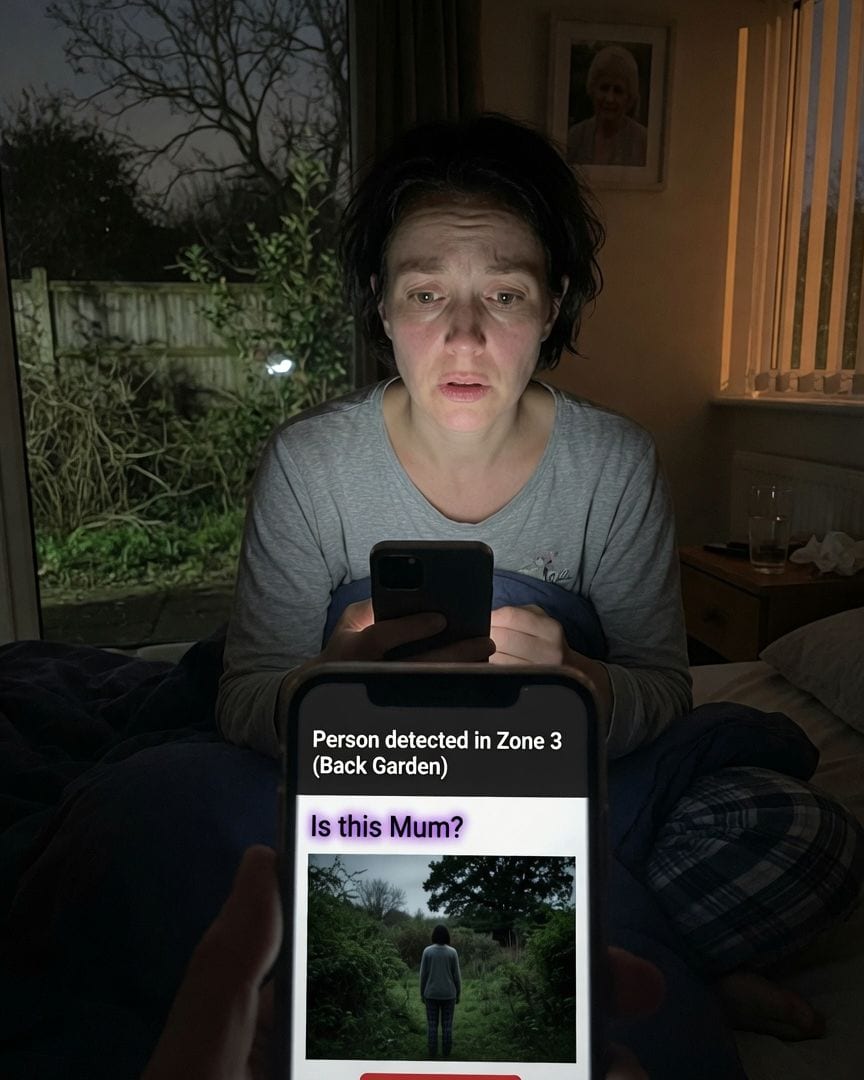
My security camera sent a clip at 3:03 AM: a woman standing in my back garden. The subject line read, 'Is this Mum?' My mother died here in March.
My phone pinged at 3 AM with a security camera alert, interrupting the deep quiet of my house. The attached clip showed a still figure in the back garden, but the subject line froze me. It asked, 'Is this Mum?' My mother died here in March.
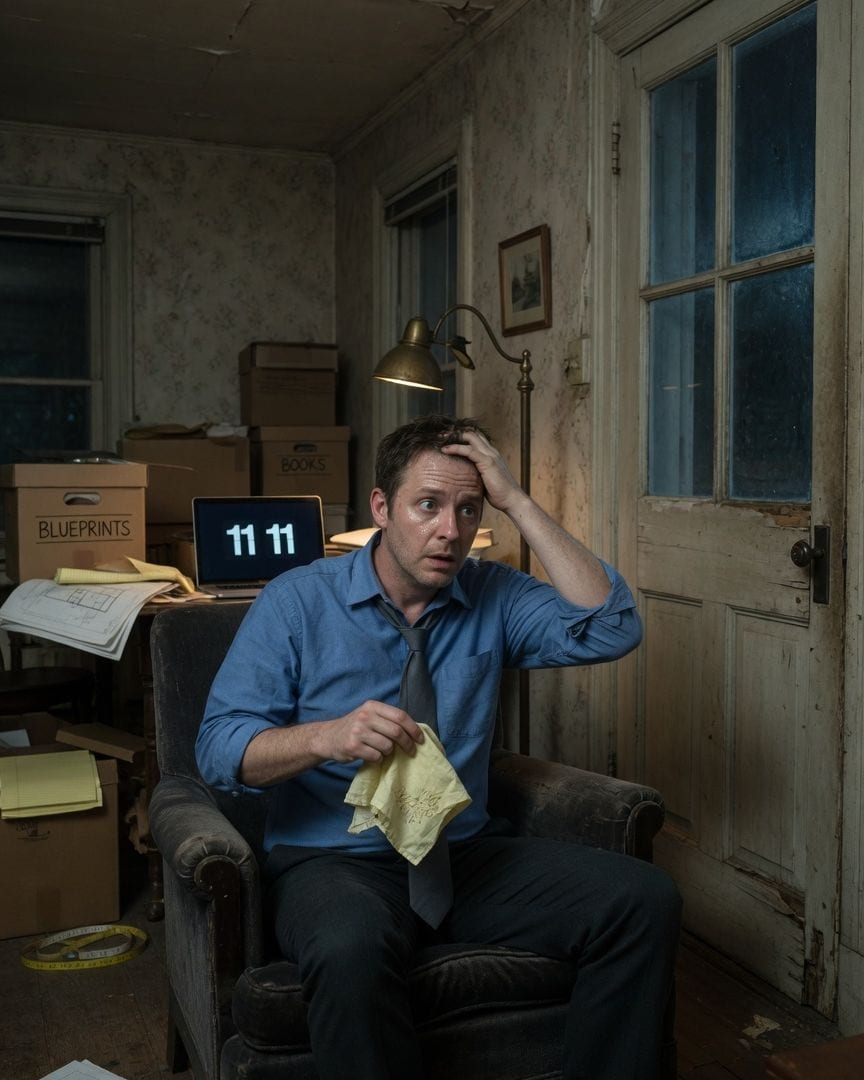
The boarded-up door in my study has twice swung open onto the balcony that was torn off this house years ago — iron railings back, and a woman at the rail with her back to me, watching a street that no longer runs below.
As an architect, I approach my great-aunt's inherited house with a rational eye, seeing its potential, not its ghosts. I knew the charming French door was boarded up because its balcony was removed back in 1953. But for two nights now, at 11:11 PM, those boards simply vanish, revealing the balcony restored and a silent woman watching an impossible street.
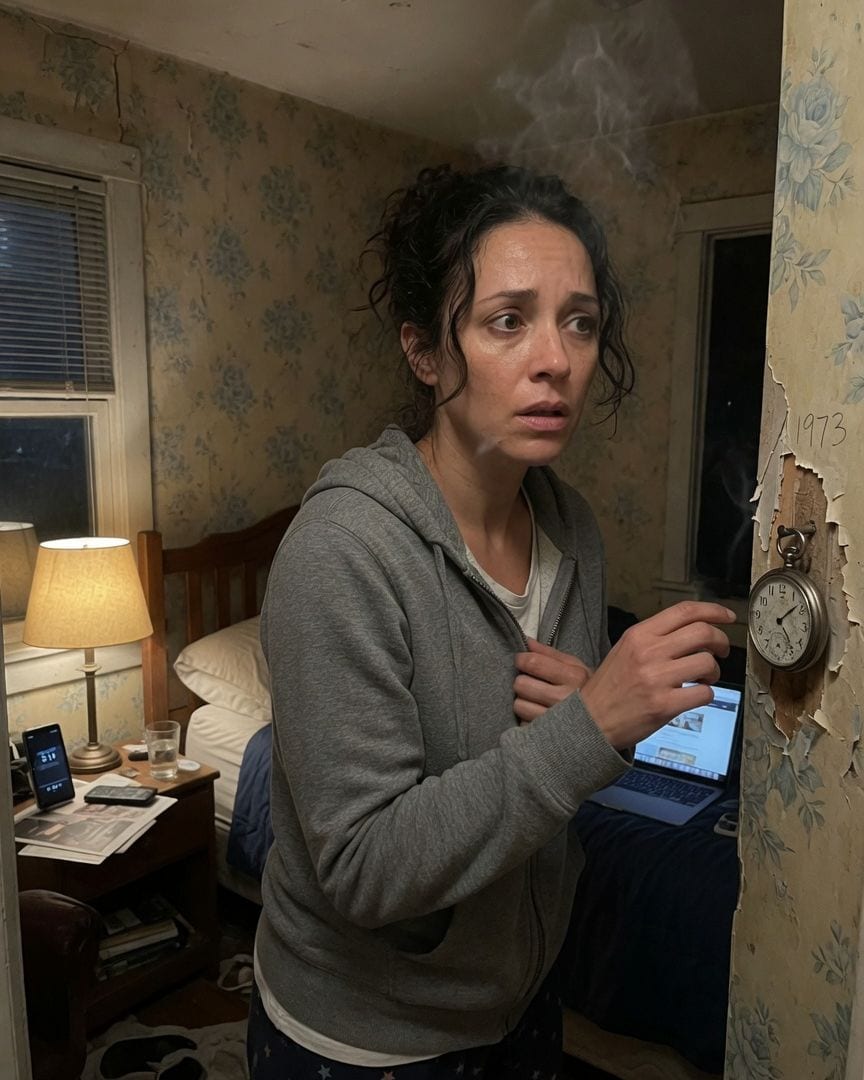
My pocket watch ticks at 3:14 every morning, warm in my hand. I’ve thrown it away; it’s back on its nail by dawn.
I’m a rational person, but my new old house came with a pocket watch I couldn't explain. I meant to discard the broken relic, yet a few mornings later, I woke to its faint ticking at 3:14 AM. It was warm, and no matter where I put it, the watch kept reappearing on its nail.
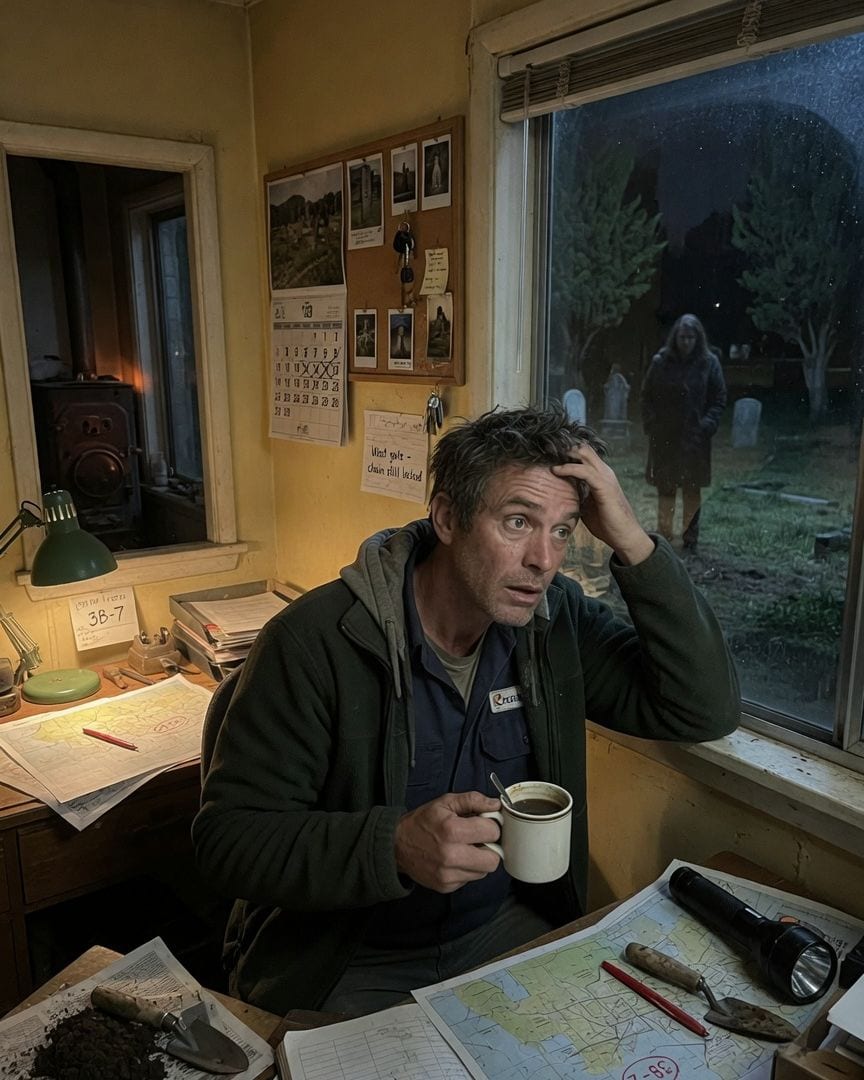
My cemetery lodge overlooks a woman visiting an empty grave near 3 AM most nights. The west gate she uses has been chained shut since autumn, its lock untouched.
As the cemetery's night caretaker, I'm used to the quiet hum of the lodge. But for three weeks, a woman has appeared nightly at plot 3B-7, a silent mourner in the deep night. What chills me is how she leaves: walking straight through the west gate that's been chained and padlocked shut for eight months.
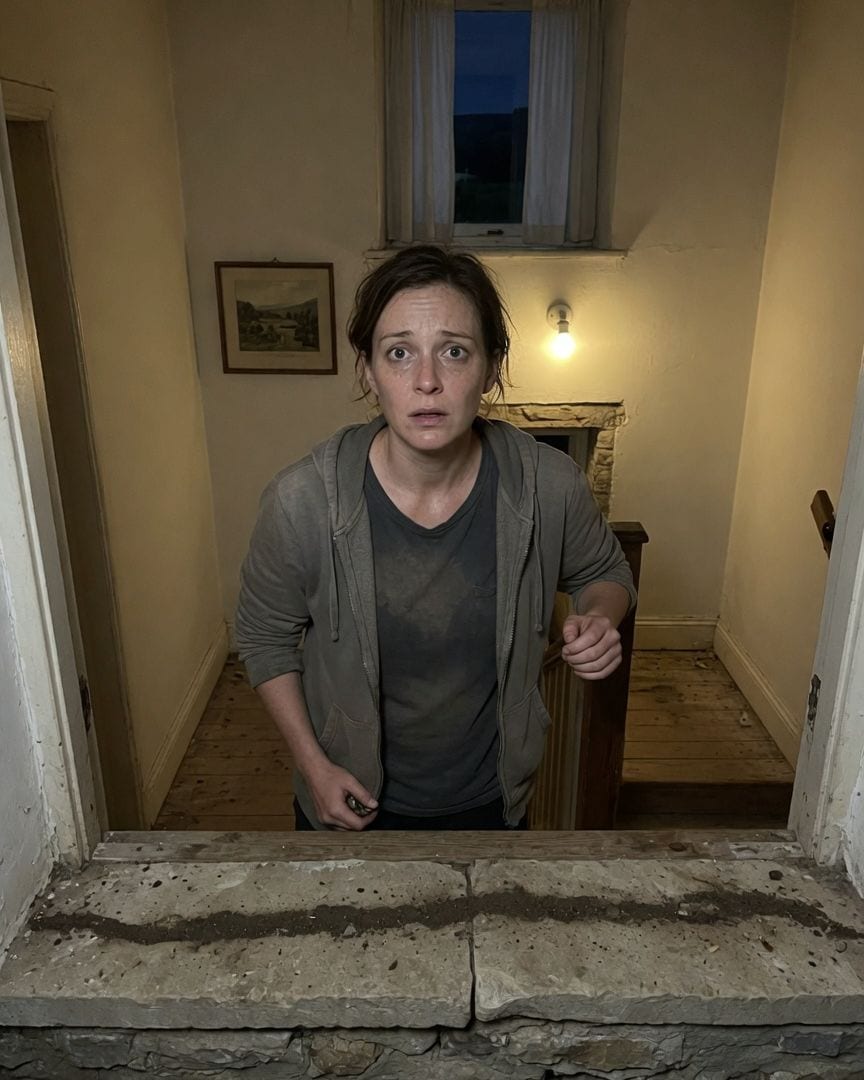
Water moved under my house at 3am, leaving a six-inch silt line. The river's two miles off.
New to my inherited valley house, I was just exhausted. Then, at 3 AM, a powerful current rushed *under* my house, vibrating through the floorboards. By morning, a precise six-inch tideline of dark silt marked my foundation, but no flood had occurred, and my pipes were dry.