My stairs take a slow, heavy descent every 5:55 AM. I feel the banister move, the seventh step creak, then the kitchen door swings shut. Nothing reaches the bottom. I live alone.
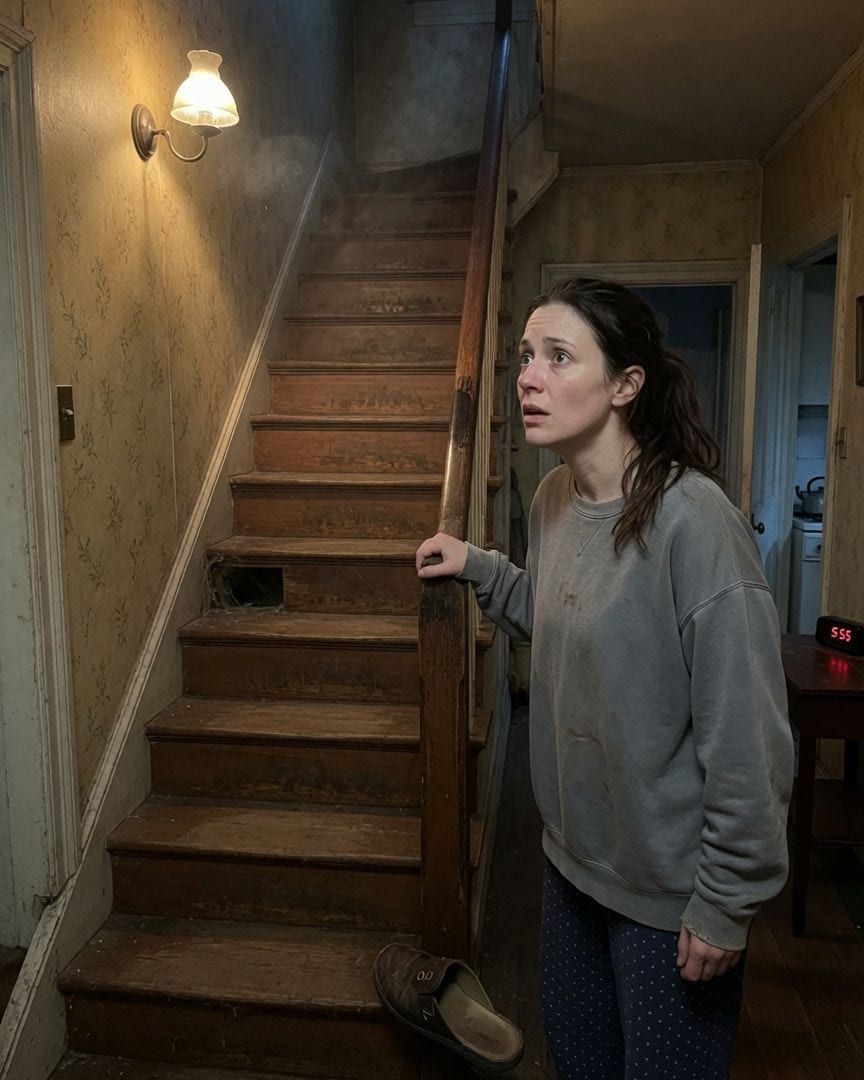
Every morning, without fail, the house wakes before me. It starts at 5:55 AM precisely. I’ll be halfway to consciousness, caught in that fuzzy state between dreams and the insistent chirp of my alarm, when I hear it.
A faint, undeniable shift of weight on the top stair, a slow, heavy descent. It’s not loud, not like someone stomping, but a careful, deliberate progress.
I usually just lie there, eyes closed, listening, but lately, an invisible thread tugs me from the bed. I get up, compelled, drawn by the sound.
As I stand at the foot of the stairs, the banister, cool under my fingers, shudders with the phantom pressure of a hand, a slight vibration that I can almost feel rather than see. Tread by tread, the descent continues.
Each step gives a distinct thud, almost a dragging sound, favoring the left leg. Then, the seventh step—always the seventh—gives its familiar, particular creak, a long, low groan of old wood. The sounds don't continue to the bottom.
They simply cease, hanging in the air, a silent, empty space where the final step should be. I wait, holding my breath, but nothing ever reaches the ground floor.
Then, after a beat of absolute silence, the kitchen door, which I always prop wide open before bed to let the morning light in, swings slowly shut.
Not violently, not slammed by a gust of wind, but deliberately, as if pushed by an unseen hand. It latches with a soft click that echoes in the sudden quiet.
The house settles into silence, leaving me standing in the dark, the faint, impossible scent of phantom toast lingering in the air. I tell myself it’s just an old house, settling, drafts. The pipes. The heating. Anything.
But the schedule never varies, not by a minute, and the creak of that seventh step feels too specific, too personal, to be random.
The routine repeated for weeks, embedding itself into my own morning. My alarm became obsolete. I started looking for other patterns, other small aberrations I could explain away.
The armchair in the living room, a solid, heavy piece that came with the house, has a deeply worn impression on its left armrest, as if someone always leaned there in a particular way, a specific hollow in the polished wood.
In the kitchen, the kettle always sits on the right-most burner, despite my preference for the left, and a slight scorch mark beneath it suggests a long-standing habit.
These were small things, easily dismissed as quirks of a previous owner or my own absentmindedness.
Until I started paying closer attention to the seventh stair itself. It wasn't just the creak.
There was a subtle, almost imperceptible dip in the wood, just to the left side of the tread, as if years of concentrated weight had pressed it down.
I ran my hand along the banister, from the top of the stairs down to the landing, feeling for irregularities. Just above the seventh step, I found a patch of wood, dark and smooth, almost polished to a sheen.
It felt like a groove, not a knot. I pressed my fingers harder into the old wood, tracing the strange smoothness. Puzzled, I pushed again, this time feeling a slight give.
A small section of the wall paneling beside the banister gave way with a soft thunk, revealing a shallow, dust-filled cavity. My breath hitched. Inside, nestled amongst cobwebs, was a single, heavily worn leather slipper.
It was clearly for a left foot.
I pulled the slipper from the hidden compartment, the dust puffing softly into the air. It was old, dark leather, surprisingly light in my hand.
The sole was deeply scuffed, almost worn through on the left side, the heel flattened from years of pressure.
This wasn't just an old shoe; it was a testament to a specific gait, a specific habit, so pronounced it had warped the very fabric of the leather.
The specific, pronounced wear on the left side sent a chill through me. My thumb brushed against the inside tongue, and I felt a raised texture.
Squinting in the dim light filtering from the hallway, I could just make out faded, stitched initials: 'O.L.'. The letters were barely visible, but they were there, a silent, undeniable signature on the routine that played out every morning.
The initials 'O.L.' became an obsession. I knew then that this wasn't some settling old house, not drafts, not pipes. This was a presence, documented, initialed. I started researching the house's previous owners, digging through property deeds online.
The house had been owned by an 'Oscar Lockwood' up until about twenty-five years ago. After that, it was transferred to a trust, then sold a few times before I inherited it from my great-aunt.
Delving deeper, I found a brief, obscure reference online to an Oscar Lockwood, not just as a homeowner, but as a former 'resident' of a local 'rehabilitation program' run by something called the 'Prescott Institute.'
The institute itself, the article stated, had closed down decades ago. The program was vaguely described as providing 'structured living environments' for individuals with 'specific needs.' The information was sparse, almost deliberately so.
It felt like someone had gone to great lengths to erase their digital footprint.
I tried to find more about the Prescott Institute, but its online presence was almost non-existent beyond that single, cryptic mention. Old newspapers, archived town council minutes—nothing.
Eventually, after days of digging, I unearthed an old, defunct local government directory listing a 'George Muller' as the last known 'Archives Manager' for the Prescott Institute, along with an old, disconnected phone number.
Days later, after persistent searching through white pages and public records, I managed to track down a current number for a George Muller in a neighboring town.
My heart pounded as I dialed, the receiver feeling heavy in my hand, my palm slick with sweat. A gruff, elderly voice answered. I introduced myself, trying to keep my voice steady.
I explained about the house, the routine, the slipper, Oscar Lockwood, and the Prescott Institute, feeling slightly ridiculous even as the words left my mouth.
There was a long silence on the other end, punctuated only by Muller's slow, deliberate breathing. It felt like he was weighing every word, every implication.
Muller's voice, when it returned, was surprisingly calm, almost weary. "The Prescott Institute closed for a reason, Ms. Bishop," he said, the words slow and even. "Some things are best left alone."
He didn't deny knowing Oscar Lockwood or anything about the institute. His composure was unsettling.
I pressed him, my voice gaining a desperate edge. I described the 5:55 AM routine in detail, the phantom weight, the left leg, the distinctive creak of the seventh step, the kitchen door swinging shut.
"It's like he's still here," I insisted, "living out his day. Every day."
Muller sighed, a dry, papery sound. "Oscar had his routines. They were... particular. A coping mechanism, some called it. A way to structure his world after his accident."
"What kind of accident?" I asked, my grip tightening on the phone.
Muller dodged the question. "It's all in the past. There's nothing to be gained by stirring it up. You've got a house, Ms. Bishop. Live in it. Don't go looking for echoes."
His tone wasn't threatening, but firm, almost paternal, yet it sent a shiver down my spine. He sounded like someone who had seen this before, and believed he knew how it ended.
He told me, very gently, to "let sleeping houses lie." The call ended abruptly, leaving me with more questions than answers, and a prickling sensation that my investigation had been noticed, and subtly, politely, warned away.
I didn't let it lie. The next day, I called Muller again, my voice steadier now, stripped of the initial fear and replaced with a cold resolve. "Mr. Muller," I said, without preamble, "I found Oscar Lockwood's slipper.
The left one. It's worn through from decades of use. And the seventh step, it's dipped right where he would have put his weight. And the banister? Polished smooth right where a hand would go. This isn't just 'echoes.'
This is specific. This is physical."
There was another long pause, heavier this time, as if he was finally considering the weight of my words, or perhaps the futility of his own silence.
"Oscar had a severe break in his left femur," Muller finally said, his voice softer, almost a whisper, all the weariness suddenly gone, replaced by a clinical precision. "Compound fracture. Never healed quite right. Always favored it.
The doctors at Prescott, they tried to re-educate his gait, but it stuck. Every morning, he'd come down for his breakfast, always the same way. Slow, careful.
He'd brace himself on the banister, use his good leg on the right, and just ease his weight onto the left side of that seventh step. It was his anchor. And the kitchen door?"
He paused, as if recalling a dusty file. "He had a strong need for privacy during his first cup of tea. It was part of his... therapeutic schedule. Unvarying."
A cold wave washed over me, not of terror, but of profound, unsettling recognition. It wasn't a ghost, not in the spectral sense I understood.
It was the indelible imprint of a life, a trauma, a specific, unyielding routine, hammered into the very fabric of the house, day after day, for decades.
Every detail I'd observed, every sound, every worn spot, now clicked into place, not as supernatural, but as profoundly, terribly human. The horror was in the coherence, the flawless fit of every single piece.
"So the house just... remembers?" I asked, my voice tight, barely audible. "It retains the pattern?"
Muller didn't answer directly. "He was in that house for a very long time, Ms. Bishop. His whole world was that routine. The house simply... reflected it back."
The line crackled. I pushed, a desperate need for a deeper truth rising within me. "Was this common, Mr. Muller? This 'reflecting back'? Did other patients in the Prescott program... did their houses 'remember' too?"
Muller took a deep, ragged breath. "The Prescott Institute ran a unique program, Ms. Bishop. Long-term residential care. We had many residents, many houses leased or owned by the institution.
And yes," he said, the word a reluctant exhalation, as if admitting a long-held secret, "we observed similar... 'habits' in other properties. Not always the stairs, of course.
Sometimes it was a specific time a light would turn on, or a particular scent in a room at dusk. The clinical term was 'residual imprints of habitual activity.' We documented them. Just observations, mind you. No one ever thought..."
He trailed off, the sentence unfinished, but the implication hung heavy in the air. "They just kept records. For decades." The call dropped.
I stood in my kitchen, the phone still to my ear, the silence of the house suddenly vast and heavy. Oscar Lockwood wasn't an anomaly. He was one of many.
The house wasn't just remembering him; it was part of a larger, documented pattern. A pattern that had been running, unnoticed by the world, for generations.
I called Muller back, my voice hard with purpose now, all traces of fear replaced by a chilling clarity. "Where are these records, Mr. Muller? The ones documenting the 'residual imprints'?"
He hesitated, then, with a sigh of resignation that sounded like a dry whisper of paper, he gave me a specific, obscure reference: a microfiche archive in the county historical society's basement, listed under 'Prescott Municipal Redevelopment Project, Annex B, Sub-Section 4: Property Utilization Studies'.
It was not where anyone would look for medical or residential records. It was where documents went to be forgotten.
I spent a grueling day in the dusty, silent archive, the stale air thick with the smell of old paper.
I fed reel after reel of microfiche into an old viewer, the hum of the machine a lonely counterpoint to the scratching sound of the film advancing.
My eyes ached, scanning page after page of dense, bureaucratic text, hoping to find a single thread of understanding.
Then I found it: a series of dry, clinical reports. 'Case Study: Residential Unit 7, Oscar Lockwood. Observation: Daily 05:55 AM descent pattern, left-favored gait, banister reliance. Duration: 32 years.'
Followed by similar entries for other 'Residential Units' — different houses, different patients, different routines: 'Unit 12, Helen Crane: Recurring scent of lavender and humming at 10:17 PM daily.'
'Unit 3, Adam Bishop: Thermostat adjustment at 03:00 AM, always to 68 degrees.' The language was chillingly detached, a cold, institutional acknowledgment of suffering and routine, logged as data, never as a problem to be solved.
Each entry detailed a precise, unvarying 'imprint,' a permanent scar on the properties. The horror wasn't a ghost; it was the sheer, bureaucratic coherence of it all. It wasn't an accident.
It was a known, documented phenomenon, clinically observed and filed away.
I printed out dozens of these records, the clatter of the microfiche machine echoing in the quiet archive, each sheet a damning testament.
The final pages I found were a summary report, decades old, discussing the 'long-term stability of patterned behaviors within therapeutic residential environments.'
It concluded that while 'residual imprints' were an observed side effect, they posed 'no direct threat to subsequent occupants' and were therefore 'not a factor in property divestment decisions.'
The Prescott Institute, it states in the sterile language of officialdom, simply monitored these 'imprints' as a testament to the patients' 'successful adaptation to structured living.'
The institutional record stated it plainly, in black and white: they knew. They knew for decades that the routines of their patients were becoming embedded in the houses, but they simply didn't care beyond observing them as a clinical curiosity.
It wasn't a haunting; it was a legacy of institutional indifference, a slow, quiet violation embedded in the very fabric of the homes. I closed my eyes, clutching the stack of papers, the cold print pressing against my palms.
The dread wasn't for a ghost, but for the cold, calculated cruelty of it all. The house isn't just remembering Oscar; it's remembering a system that allowed Oscar to become a permanent, repeating echo.
There's no ghost to banish, no evil to confront, only a chilling, documented truth. I have the records. I have the proof. But the routine in my house, I realized, won't stop.
It was never about Oscar's will, but the house's retained memory, a pattern so deeply etched, it simply runs on, a clockwork of trauma.
I returned home, the printed records spread across my kitchen table like a morbid blueprint. The house was silent, waiting for 5:55 AM. I can't unsee what I've learned, can't un-know the truth.
The house feels different now, not just old, but heavy with the weight of its own documented history, a witness to decades of repetitive motion.
I considered selling, but the thought of passing on this known 'imprint' to an unsuspecting buyer felt like a horrifying complicity. The routines continue, now imbued with a colder, more precise horror.
I understand, but understanding brings no solace, no escape. It merely refines the dread, sharpens it to a fine point.
I still live in the house. I have learned to live with the 5:55 AM routine. I don't fight it, don't try to explain it away anymore. I know what it is.
The dread hasn't lessened, but sharpened, becoming a dull, constant ache behind my eyes, a silent hum beneath the surface of my daily life. I no longer prop the kitchen door open at night. There's no point.
And every morning at 5:55, I just wait for the kitchen door to close on its own.
If this one got to you
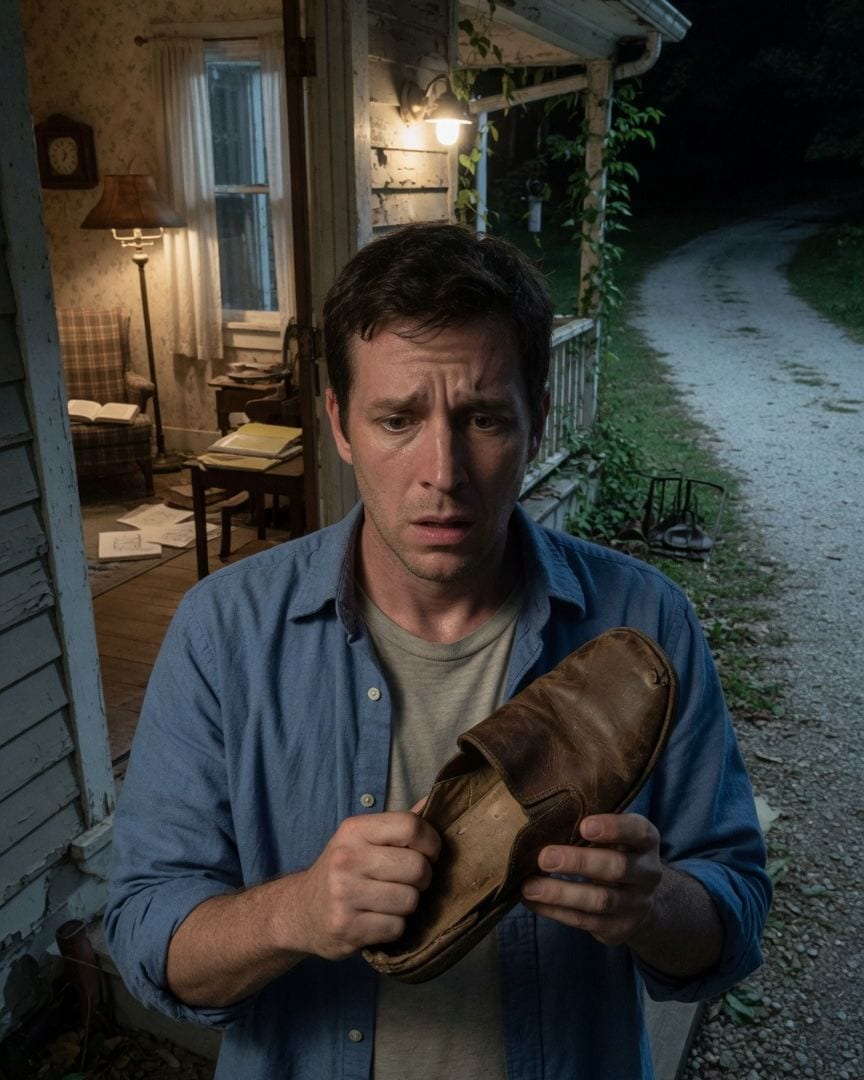
My great-uncle's house has footsteps at 11:10 PM, with a distinct left foot drag. I found the slipper, still warm.
Moving into my great-uncle Leonard’s old, isolated house, I expected some quirks. But the distinct crunch of footsteps on the gravel path outside, always at 11:10 PM, stopping at my front door with no one there, defied all logic. Then, I found a single, heavily worn leather slipper hidden under the porch step, its left heel deeply scuffed, radiating an undeniable, recent warmth.
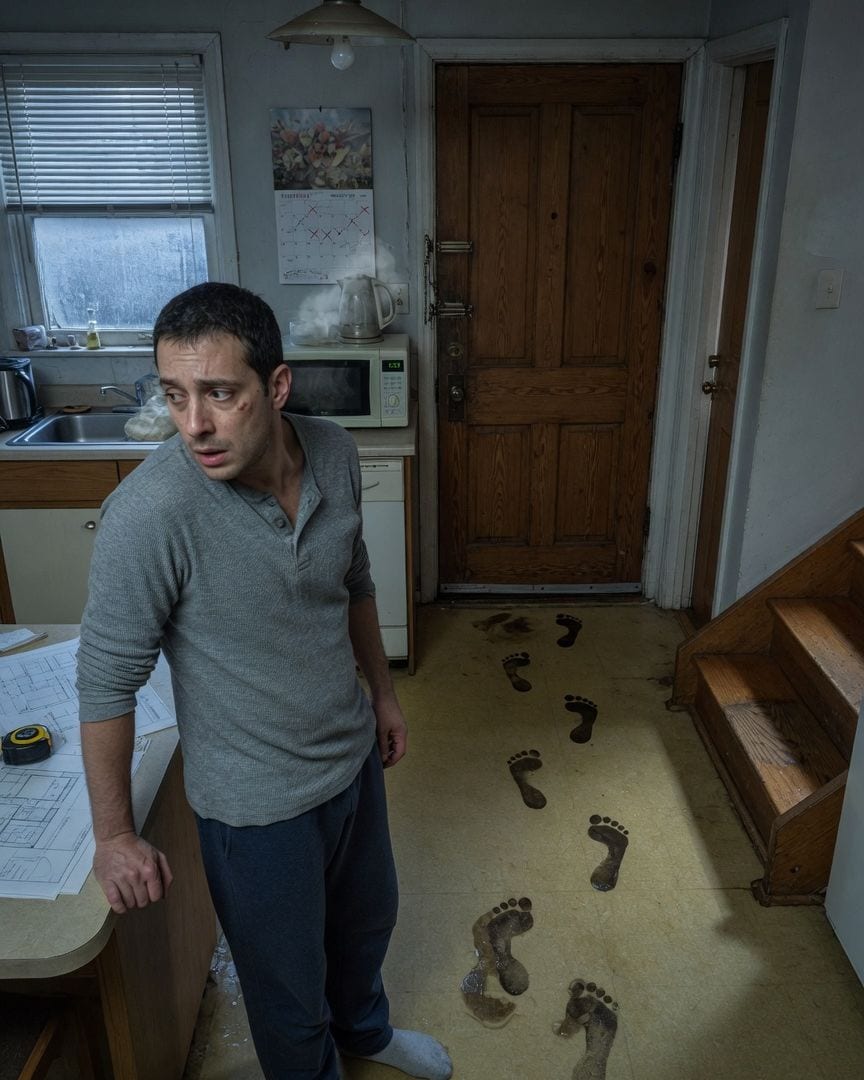
Bare wet footprints cross my locked kitchen floor every morning. Larger than mine, leading from the bolted back door to the stairs, fading from the toes as I watch.
As an architect, I notice details, but nothing in my old house's plans accounted for this. Every morning, wet, bare footprints appear across my kitchen floor, stretching from the bolted back door to the main staircase. They are larger than my own, colder than winter, and simply materialize from nothing.
My front door has a dented gate and a dead hydrangea. I walked past it six times, trying to reach the corner shop just a hundred yards away. The pavement kept bringing me back to my own porch, and the shop's light never moved.
My morning started like any other, a quick walk to the corner shop from my home at Number 14, Elm Terrace. But after walking what felt like two minutes, I found myself back at my own front door, the shop no closer. I tried six times, faster and slower, but my street kept compressing, refusing to let me leave.
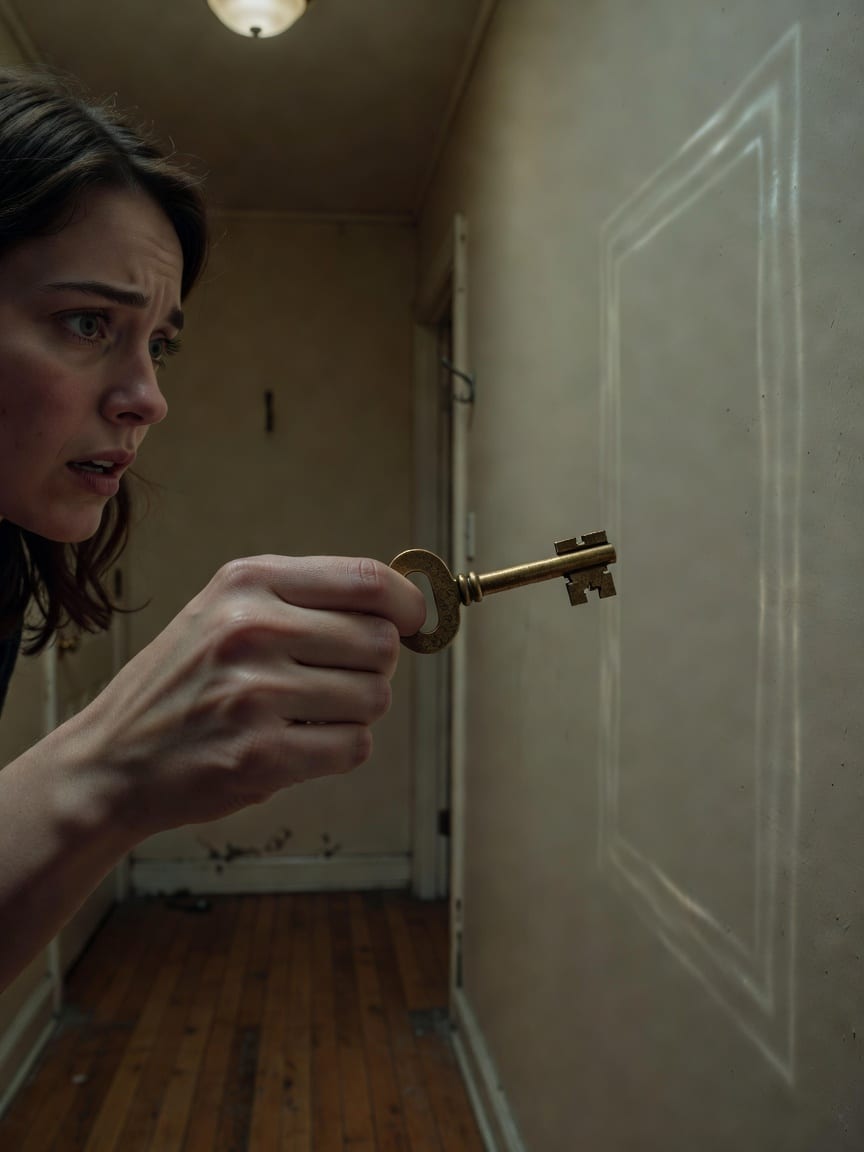
My new house has seven rooms. The removal men counted six. Now one of them asks who's in the locked seventh, on a landing with only six doors.
Moving into my new house, I supervised the removal men hauling boxes. But on the landing, Paul, the senior man, asked about a locked seventh room upstairs, pointing to a blank wall. His quiet certainty, despite the clear absence of a door, filled me with a sudden, icy dread.
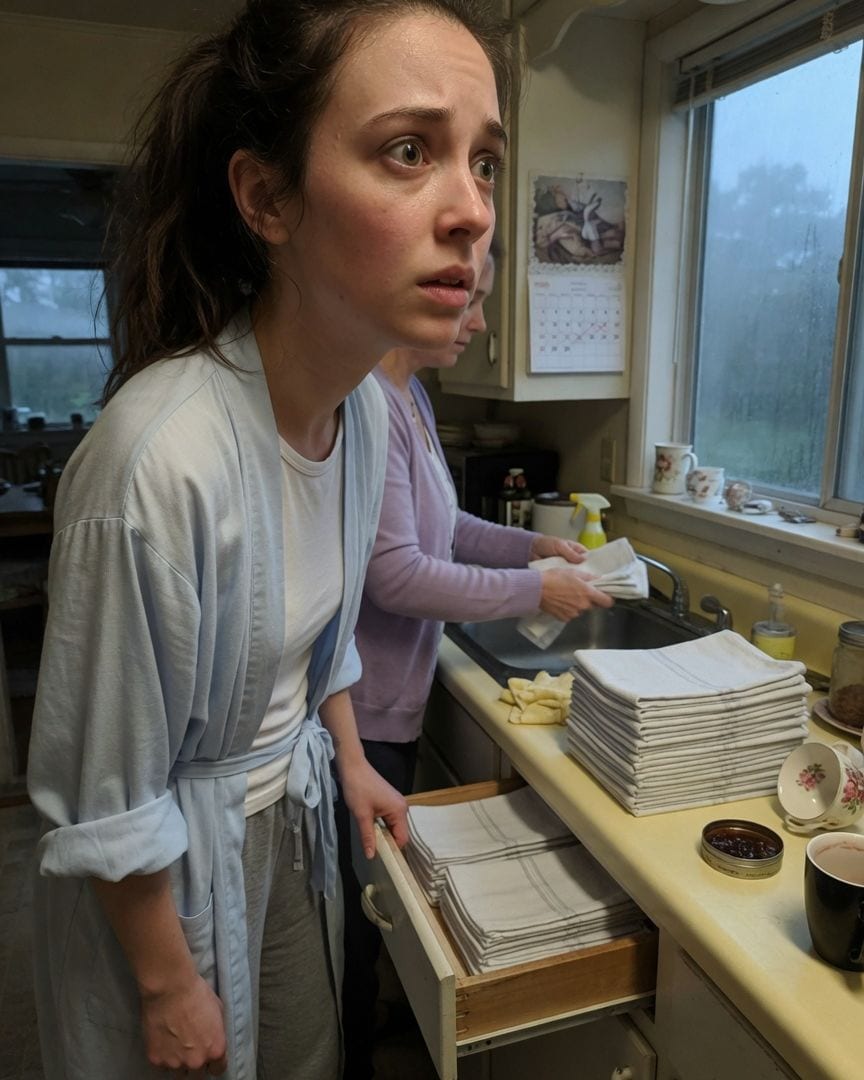
My mother's left wrist has a new scar. She never had one there.
My mother is finally home after her disappearance, and I'm trying to find our old rhythm. But then I watch her fold tea towels, a simple ritual I learned from her. She's doing it completely wrong, seam-out, insisting it's how she's always done it.
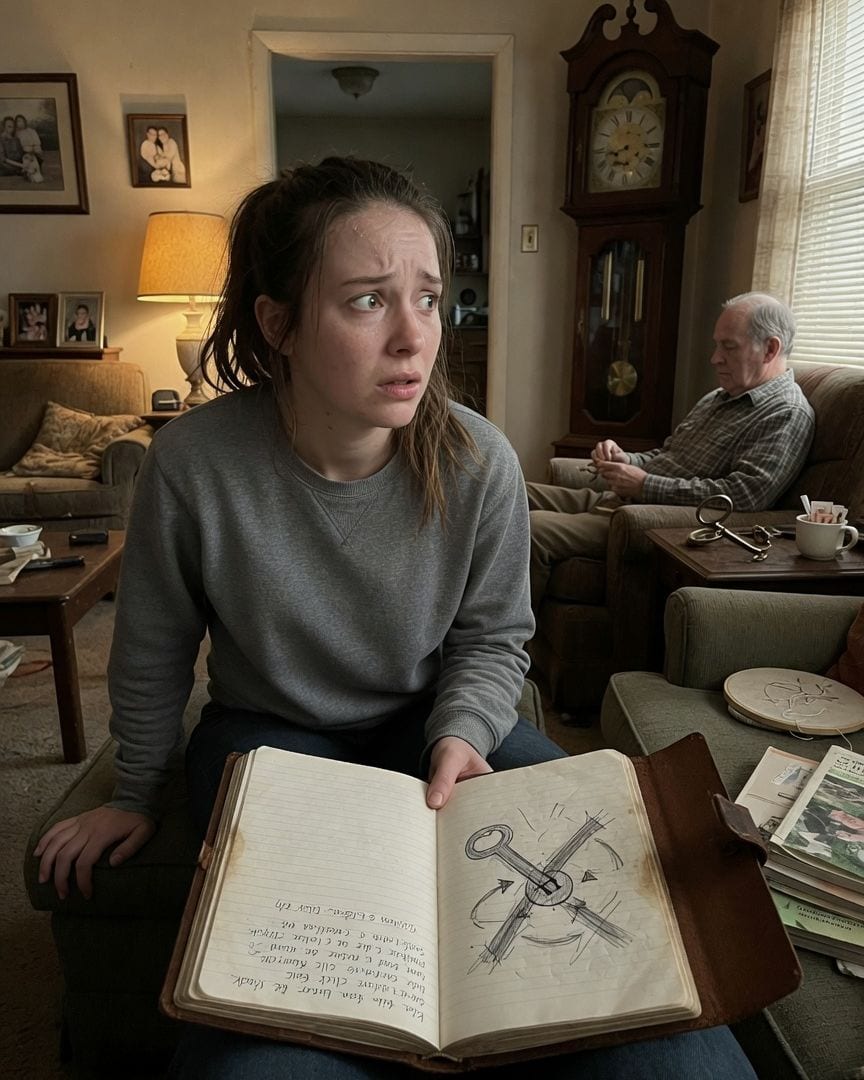
My father winds the hall clock backward, shattering the mainspring. He says he's done it wrong for years.
My father, Roy, returned after six bewildering days missing, a little quieter but otherwise himself. Then came the Sunday ritual: winding the old hall clock. But this time, his hand moved counter-clockwise, shattering the mechanism, and he simply smiled, saying he'd done it wrong for years.