My ancestry DNA kit found me genetically identical to Evelyn Holloway, dead since 1950.
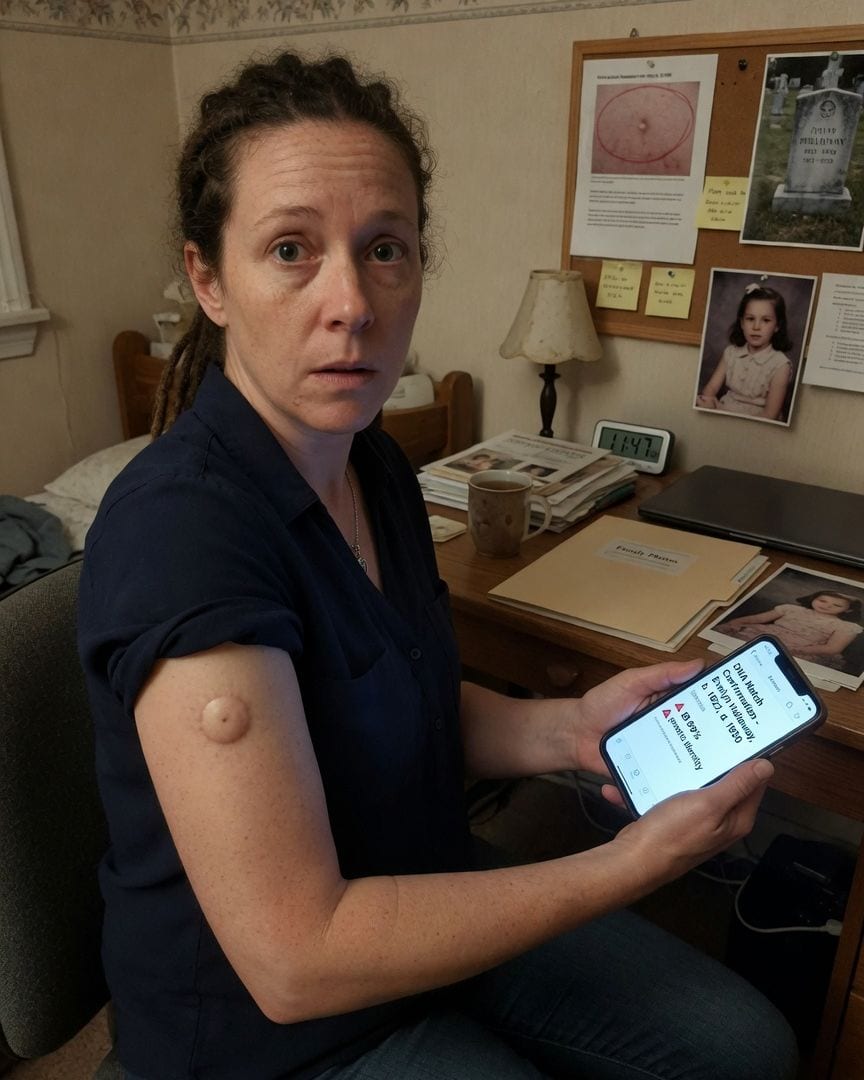
Judith Sterling, 38, sat on the exam table, her arm outstretched. Bridget Whitaker, the travel nurse, paused, her brow furrowed.
Bridget’s finger traced the round, dimpled scar high on Judith’s left upper arm, a mark Judith had carried her entire life without a second thought. It was a smallpox vaccination scar, unmistakable. Bridget cleared her throat.
“You know, that’s… that’s a smallpox vaccine mark. Like my grandmother had.” Judith nodded, confused. “Yes, it’s always been there.” Bridget’s gaze sharpened, her expression shifting from professional assessment to genuine bewilderment.
“But… the smallpox vaccine was discontinued in the States in the early seventies. You’re thirty-eight. You wouldn’t have one. No one your age does.” The air in the sterile room suddenly felt cold.
Judith looked down at her arm, at the familiar dimple, now alien. It was just a scar. A part of her. But Bridget was right. It couldn’t be. Not on her.
The wrongness wasn’t just a detail; it was etched into her very flesh, a silent defiance of time and record that she had somehow never noticed until this precise, unsettling moment.
The nurse, a pragmatic woman, tried to brush it off as a birthmark, an old injury, anything, but the shape was too perfect, too distinct.
Judith knew, with a sudden, sinking certainty, that it was exactly what Bridget said it was. And it shouldn't be.
The scar became an itch in Judith’s mind, a constant, low thrum of unease. She tried to dismiss it, to rationalize it away. Maybe her parents had gotten her vaccinated abroad?
A quick call to her mother, Ruth Sterling, confirmed nothing. “Smallpox? No, honey, they stopped that long before you were born. You got all your regular shots, of course, but never that one.”
Ruth sounded mildly amused by the question, as if Judith had asked about receiving a medieval bloodletting. The mundane explanation failed. Judith, a meticulous project manager, couldn’t let a discrepancy stand.
She ordered an ancestry DNA kit, a casual impulse to distract herself, to prove her own rootedness, to find something normal in her genetic past.
While waiting for the results, she found herself researching smallpox, the history of its eradication, the specific appearance of the vaccine scar. Every article, every medical photo, confirmed it: the mark on her arm was precisely that.
It was an anachronism, a physical impossibility. She even pulled out old family photos, scanning her own childhood images. There it was, faint but visible, even in pictures from her early teens. It had always been there.
She visited her general practitioner, Dr. Ellsworth, a no-nonsense woman who examined the mark, frowned, and admitted she had no explanation. “It’s clearly a smallpox vaccination scar, Judith. But it’s impossible.
Are you sure you weren’t adopted from some remote village where they continued the practice?” Judith laughed, but the sound was hollow. “No, Dr. Ellsworth. I’m quite sure.” The doctor suggested she ignore it, a harmless oddity. But Judith couldn’t.
The scar was a physical lie she was living, a silent betrayal from her own body. The ancestry kit results arrived a week later, an email notification pinging on her phone.
She opened it, expecting a list of distant cousins or a breakdown of her European heritage. What she found instead was a single, bolded match, flagged with an alert icon.
Judith stared at the email from the ancestry lab, the subject line stark: 'DNA Match Confirmation - Evelyn Holloway, b. 1921, d. 1950'. Beneath it, the technical report, unambiguous: '99.99% genetic identity'.
Her own name, Judith Sterling, was listed as the 'subject donor'.
Evelyn Holloway was buried in the old cemetery on Elm Street, a name Judith had seen on a weathered headstone just last week, during a quiet Sunday walk with her husband, Maxwell Carter.
A woman who died decades before Judith was born, a woman whose grave lay just a few miles from her home, shared her exact DNA. It was more than a match; it was a mirror.
The lab’s follow-up email, already in her inbox, confirmed their re-test, their triple-check: 'We understand this may be unusual. We stand by our findings.
The sample provided by Judith Sterling is genetically identical to the sample extracted from the remains of Evelyn Holloway.'
The DNA match ripped open a new, colder kind of wrongness. Judith’s initial attempts to rationalize it were frantic. A lab error? A mix-up of samples?
She called the ancestry company, speaking to a patient but firm geneticist who reiterated the statistical impossibility of a false positive at that level of identity. “It’s not just a close relative, Ms. Sterling. It’s you.
Genetically, you are Evelyn Holloway.” The words hung in the air, absurd and terrifying. Maxwell, her husband, tried to be supportive, suggesting a different lab, a fresh sample. Judith did both. The results, a month later, were identical. Evelyn Holloway.
Same name, same genetic fingerprint. Judith started digging. She visited the local historical society, a quiet brick building downtown.
She found Evelyn Holloway’s obituary from 1950, a small notice: 'Evelyn Holloway, beloved daughter of Thomas and Clara Holloway, passed away peacefully at her home, aged 29.' No cause of death was listed.
Judith also requested her own childhood medical records, a tedious process involving multiple forms and long waits. When they arrived, she pored over them, searching for anything unusual. Routine check-ups, a broken arm at age seven, annual dental visits.
But then she found it, tucked deep in a file from her pediatric dentist, Dr. Bernard Kingsley. A note from 1998, when Judith was thirteen: 'Patient presented with impacted wisdom teeth. Scheduled for extraction.' But Judith had her wisdom teeth.
All four of them, perfectly healthy, never extracted. She’d even had X-rays of them last year. She found the corresponding X-rays in the file – clear images of four impacted wisdom teeth, with a follow-up note confirming the procedure.
But they weren't her teeth. The structure, the root formation, the jawline, was subtly different from her own current anatomy. It was another record that couldn’t be, a phantom surgical history.
The smallpox scar, the DNA match, the phantom dental records – a mosaic of impossible truths was forming, each piece clinical, verifiable, and utterly terrifying. She knew she was being rational. She was checking the facts.
And the facts were screaming.
Judith’s investigation into Evelyn Holloway led her back to the historical society. She spent hours in the archives, poring over microfiche and dusty yearbooks from the 1940s.
She found a photo of Evelyn in a 1948 high school yearbook, a demure young woman with dark hair and serious eyes. The face was familiar, eerily so, but Judith couldn't place it.
She felt a prickle on her neck, a sense of being observed.
Walter Russo, the retired curator, a man in his eighties with sharp, knowing eyes, often sat at a desk in the corner, ostensibly reading, but his gaze seemed to drift towards Judith’s table more often than not.
One afternoon, as Judith was scanning through old newspaper clippings, she overheard Walter speaking quietly on the phone. “…yes, she’s asking about Evelyn Holloway. Very persistent.” He paused, listening. “No, no trouble. Just… curious.”
He glanced up, his eyes meeting Judith’s across the quiet room. He offered a small, unreadable smile. The hairs on Judith’s arms stood up. He knew.
He knew what she was looking for, or at least that her interest in Evelyn Holloway was more than academic. She felt a sudden, cold certainty that she wasn’t just unearthing history; she was disturbing something.
The next day, she found a small, unmarked envelope tucked under her car’s windshield wiper. Inside was a single, crisp black and white photograph.
It was Evelyn Holloway, smiling, standing in front of a house Judith recognized instantly as her own current address, though the house itself looked younger, freshly painted. On the back, handwritten in elegant script, were two words: 'Look closer.'
Judith’s hands trembled. Who had left this? How did they know she was investigating Evelyn? And why was Evelyn standing in front of her house, decades before Judith was born? The threat was no longer abstract; it was personal, precise.
Someone was watching her, guiding her, or warning her. She felt like a pawn in a game she hadn't known existed.
Judith confronted Walter Russo at the historical society. She laid the photograph on his desk, its edges curling slightly. “Mr. Russo,” she said, her voice steady despite the tremor in her hands. “You know something about Evelyn Holloway.
And you know something about me.” Walter picked up the photo, his ancient fingers surprisingly steady. He looked at it for a long moment, then at Judith.
“A fine young woman, Evelyn,” he murmured, as if speaking of a living acquaintance. “Tragic, her passing.” Judith pressed him. “Why was she standing in front of my house? And why do I share her DNA?
Why do my childhood dental records show extractions that never happened to me, but match records I found for Evelyn?” Walter sighed, a slow, deliberate sound. He looked past Judith, out the window, at the quiet street.
“Some things… some things just are, dear. They have a way of repeating. Of finding their way back.” Judith slammed her hand on the desk, a quiet thud in the hushed library. “Don’t give me riddles, Mr. Russo.
I need answers. I’m living a lie, and you know why.” His gaze finally met hers, devoid of malice, filled only with a deep, weary understanding. “The house was Evelyn’s, before it was yours. Her family built it.
And the records… the records get confused sometimes. When a soul, a… a core identity, as it were, finds a new home.” Judith felt a chill deeper than any she’d known. “A new home? What are you talking about?”
Walter leaned forward, his voice dropping to a near whisper. “The spark. The essence. It moves on. Finds a suitable vessel. It carries… echoes. Like your scar. Like your face. Like the records that try to reconcile what shouldn’t be.
Evelyn was one. You are another. And there will be more.” He gestured to the photograph. “Look closer, you said. You’ll see it now, won’t you? The resemblance isn't just a resemblance. It's a continuation.”
Judith snatched the photo, her eyes scanning Evelyn’s face. The faint mole above the lip. The curve of the eyebrow. The exact set of the jaw. It wasn't just similar. It was her.
The face in the 1940s photo, looking out with Evelyn Holloway’s eyes, was Judith Sterling’s own. The full weight of the impossibility crashed down.
Her smallpox scar, the impossible DNA, the phantom dental history, the photograph – it all clicked into a horrifying, coherent pattern. She was Evelyn. And Evelyn was her. But how? And what did that mean for Judith Sterling?
Walter Russo, his eyes ancient and unblinking, simply nodded. He didn't deny it. He didn't even seem surprised. He reached into a drawer and pulled out a small, leather-bound journal, its pages yellowed with age.
He opened it to a page marked with a faded ribbon. 'Evelyn Holloway,' he read, his voice soft. 'Born 1921. Died 1950. Re-emergence, Judith Sterling, 1985.' He looked up, his gaze piercing. 'It's all recorded, dear. Everything.
And you're not the first to look for answers. Just the first to get this far.'
He then turned the journal to another page, a page filled with names and dates, stretching back further than Judith could comprehend, a terrifying lineage of 're-emergences.' He pointed to a name near the top, almost illegible, dated 1890.
'And this one… this one was also found with a smallpox scar. A mark that carried through. A signature, you might say.' Judith felt her stomach lurch. The scar wasn't just from Evelyn.
It was a centuries-old brand, passed down through bodies, a physical testament to an endless, silent cycle.
She wasn't just Evelyn; she was a link in an unbroken chain, a vessel for something that had existed for far longer than any single human life.
The truth wasn't just about her past, but about an inescapable future, an identity that would continue long after Judith Sterling ceased to be.
Walter closed the journal with a soft thud, the sound echoing in the sudden silence of the room. He offered a faint, sad smile. 'Welcome to the understanding, Judith. There's no turning back now.'
Walter Russo explained it all, calmly, methodically, as if discussing the weather. He spoke of a 'lineage of consciousness,' a spark that found new hosts, new bodies, when the old ones expired.
He called them 'keepers,' those few who were aware, who maintained the records. His own family, he revealed, had been keepers for generations.
The smallpox scar, he explained, was a powerful, persistent physical memory, sometimes carrying over, a rare but undeniable physical echo. Evelyn Holloway had received her smallpox vaccination in 1922; the mark was a direct inheritance.
The DNA match wasn't a mix-up; it was the 'genetic signature' of the core essence, a biological blueprint that, while manifesting in different bodies, retained a fundamental identity.
The dental records, the phantom extractions, they belonged to Evelyn, but the system had somehow linked them to Judith’s file because, on a deeper level, the 'patient' was the same.
Walter showed Judith other entries in the journal, names and dates, some with brief descriptions – 'The one who found the journal,' 'The one who saw the face in the mirror change.'
Each entry was a story of someone who, like Judith, had stumbled upon the truth of their own cyclical existence. There was no grand conspiracy, no malevolent entity.
It was simply a natural phenomenon, a quiet, terrifying truth woven into the fabric of certain lives. Judith wasn't possessed; she was the continuation.
Her individuality, her memories, her personality, they were all real, but they were built upon an ancient, recurring foundation.
The dread wasn't in a monster, but in the realization that her entire life, her sense of self, was merely a chapter in a much longer, unknowable book. The world hadn't changed, but Judith had.
She saw the familiar objects in her life, her husband Maxwell, her reflection in the glass, with new, chilling clarity. They were all temporary, fleeting. Only the spark endured.
There was no escape from this truth, no confrontation possible. Walter Russo hadn't given her a villain to fight, or a curse to break. He had given her a mirror, reflecting an endless, cyclical self.
Judith left the historical society that day a different woman. The world was the same, but her place in it had irrevocably shifted. She couldn't undo the knowing.
She couldn't unsee her own face in Evelyn Holloway's faded photograph, couldn't un-feel the phantom pain of a smallpox vaccination she never received. She looked at her husband, Maxwell, with a profound, aching sadness.
He was her anchor, her reality, but now she understood their connection was fragile, ephemeral. He loved Judith Sterling, the woman he knew, the woman who was born in 1985.
He couldn't love the ancient spark, the endless cycle that resided within her. How could she explain it? 'Honey, I'm also Evelyn Holloway, and a dozen others before her, and I'll be someone else after this'? It was impossible.
The truth was too vast, too fundamental, to share without shattering his world, and perhaps her own remaining sanity. She chose silence. She continued her life, went to work, laughed with Maxwell, walked their dog.
But every touch, every glance, every memory, was now filtered through the chilling knowledge. She was a temporary resident in her own body, a borrowed self.
The smallpox scar on her arm became a constant, silent reminder, a physical anchor to the impossible, an indelible mark of a life she hadn't lived, yet undeniably had.
The horror was not in what was coming for her, but in what was already here, what had always been here, quietly waiting for her to notice.
Judith never spoke of Walter Russo or the journal again. The historical society remained a quiet brick building downtown. Walter continued his work, an unassuming guardian of impossible truths.
Maxwell noticed a subtle shift in Judith, a quietude that wasn't quite sadness, but a deep, unshakeable contemplation. She would sometimes stare at her arm, at the smallpox scar, her expression distant.
He attributed it to stress, to the lingering effects of the travel nurse’s strange comment. Life resumed its rhythm, but for Judith, the rhythm was now discordant, a melody played on a borrowed instrument.
She found herself observing strangers with a new intensity, wondering if they too carried echoes, if they were unaware vessels for older, deeper currents. The world felt simultaneously more expansive and terrifyingly small, a stage for an endless, repeating play.
One evening, Maxwell found Judith sitting on the couch, tracing the smallpox scar on her arm. She didn't look up when he entered the room. 'Still thinking about that old mark?' he asked gently, sitting beside her.
Judith nodded, her eyes distant. 'It’s just… a reminder,' she said, her voice softer than usual. She looked at Maxwell then, a long, assessing look that held something new, something ancient and knowing.
It was a look he didn't quite recognize, a depth that hadn't been there before. He felt a faint chill, a sense that she was seeing not just him, but something far beyond him, beyond their shared life.
He tried to smile, but his own lips felt stiff. 'A reminder of what?' he asked, his voice a little strained. Judith simply smiled, a small, subtle curve of her lips that didn't quite reach her eyes.
It was a knowing smile, one that seemed to hold generations of quiet understanding.
Years later, Maxwell would sometimes catch that same distant, knowing look in Judith’s eyes.
He’d ask her about it, but she would only offer that same faint, unreadable smile, as if she knew a joke that only she, and perhaps the world itself, was in on.
If this one got to you
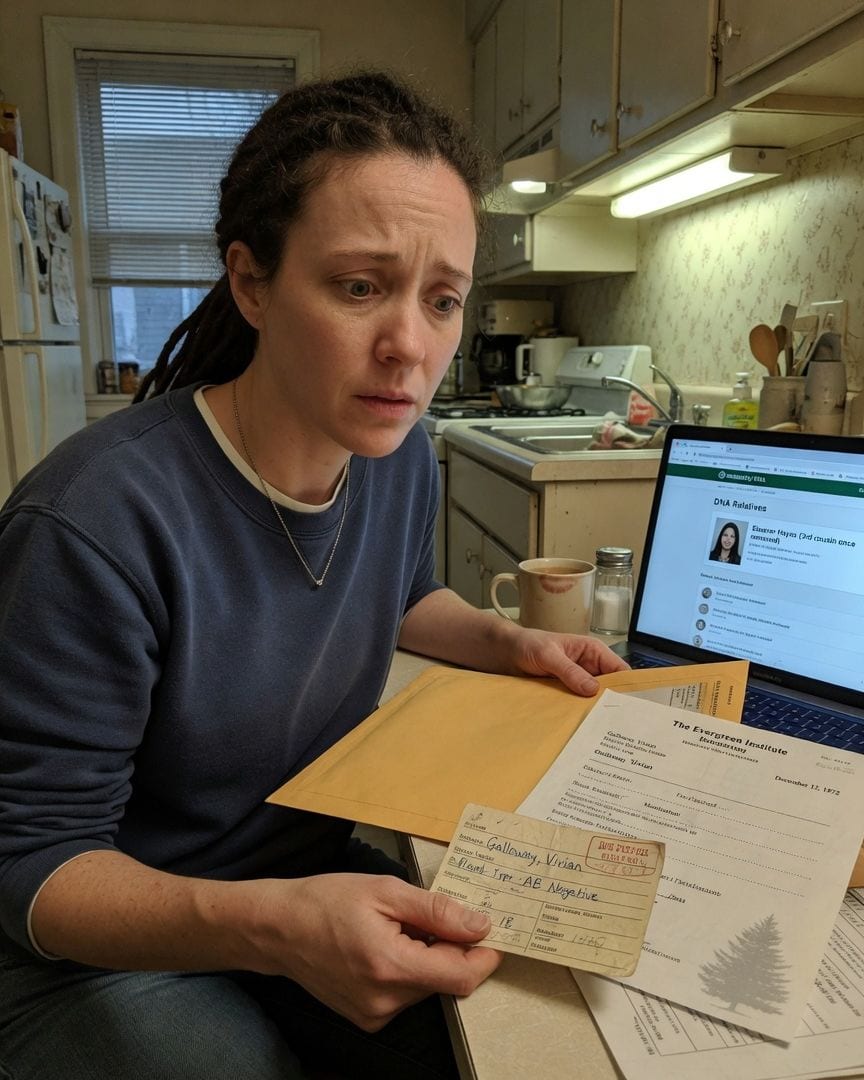
My blood type switched from AB negative to O positive. My old donor card, in my own hand, lists one. Every doctor since has found the other. The transfusion service retyped me three times this week, all O positive.
I sat at the city's transfusion service, my old AB Negative blood donor card on the desk. Doctors had retyped my blood three times that week, each test confirming O Positive. They stated it's medically impossible for a primary blood type to change spontaneously like this, leaving my entire medical history with a terrifying hole.
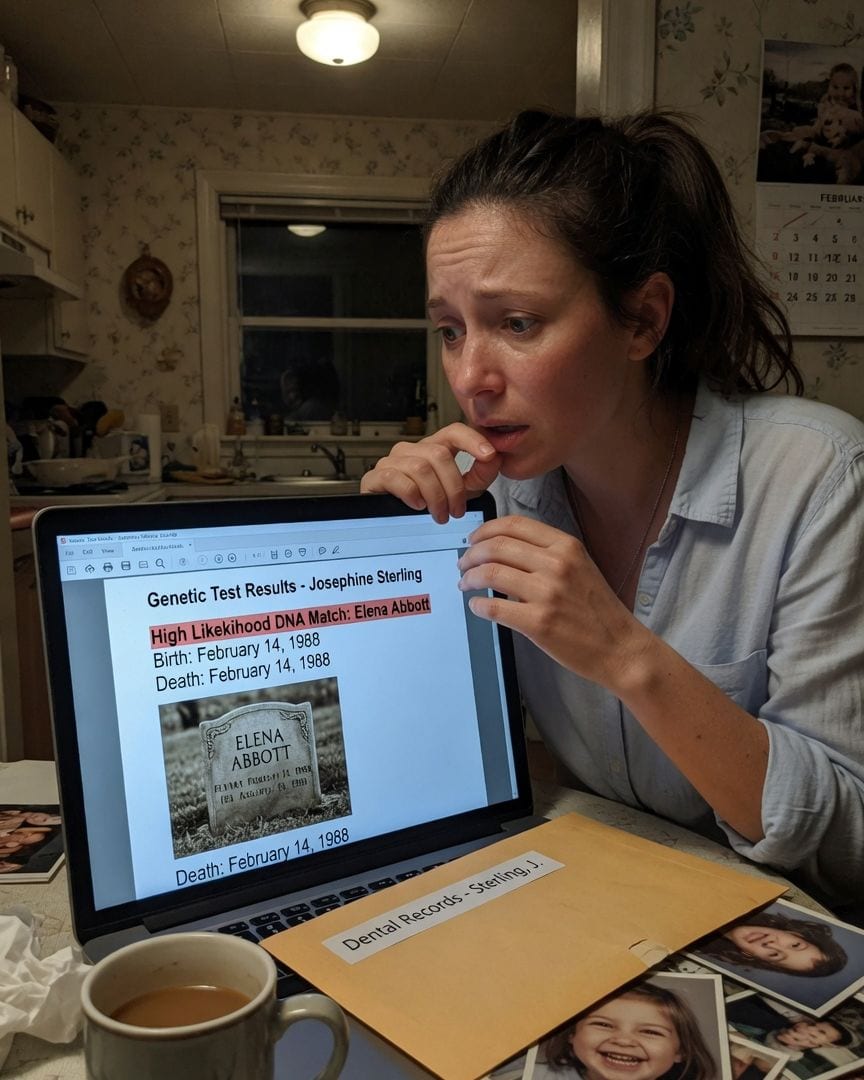
My dental scan shows a titanium implant where my own healthy tooth sits. The dentist tapped the bright screw on screen, then my actual canine, and said both could not be true.
My routine dental check-up took a dark turn when Dr. Caldwell found something impossible on my X-ray. A bright, metallic screw was fused into my upper jawbone. Yet, my own tooth in that exact spot was perfectly healthy, just as it had always been. Dr. Caldwell's words echoed: "These two things cannot both be true, Josephine."
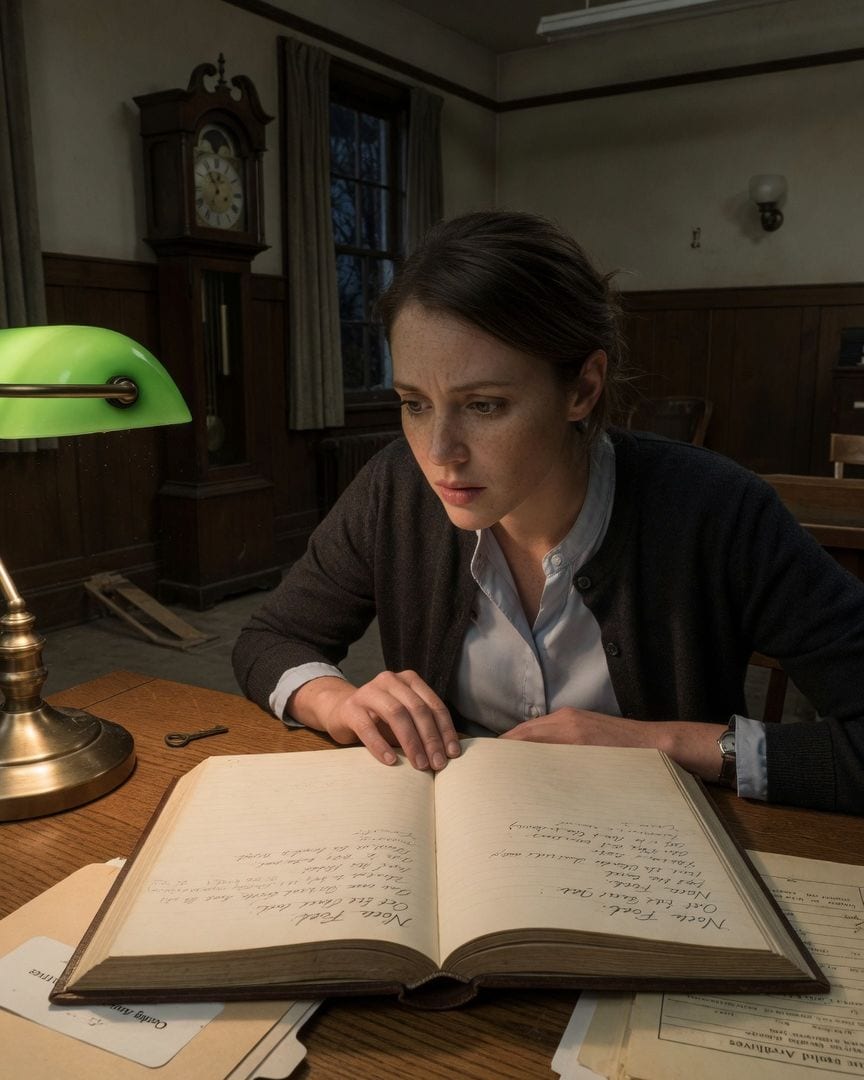
My grandmother’s name reappears in the old book of remembrance — on the same date, same street, every few decades since 1929. A verger’s note reads: 'ask no family.'
As Keeper of the crematorium's Book of Remembrance, my job is quiet and meticulous. But while updating my own grandmother's entry, I found two more Nora Fords listed above hers. Each died on October 3rd, decades apart, with the same address and a strange instruction: 'ask no family.'
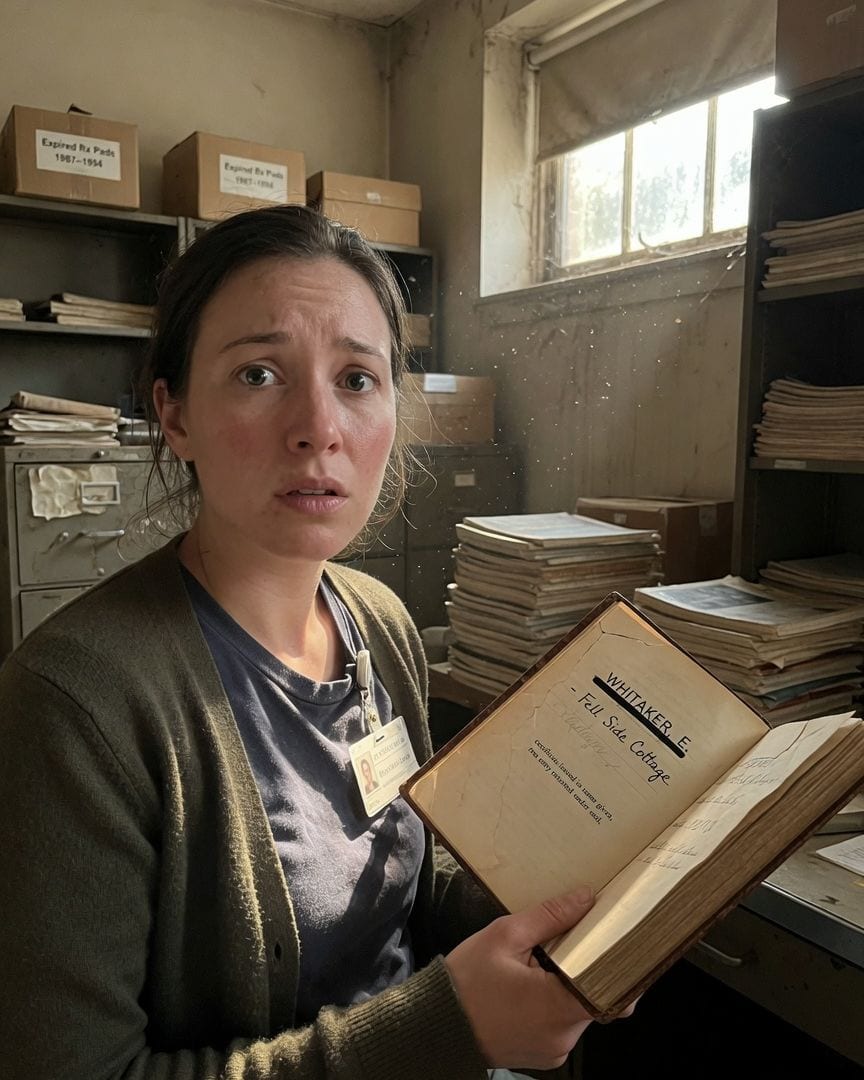
My parish vaccination register holds my 2004 entry; a blacked-out 1931 line lists my same name, same house.
Clearing dusty archives, I found an old parish vaccination register. I recognized my own name and address in the 2004 entries, a routine childhood record. But then I found my name again, in 1931, marked 'retained under seal,' with a chilling log of re-sealing dates going back to 1849.
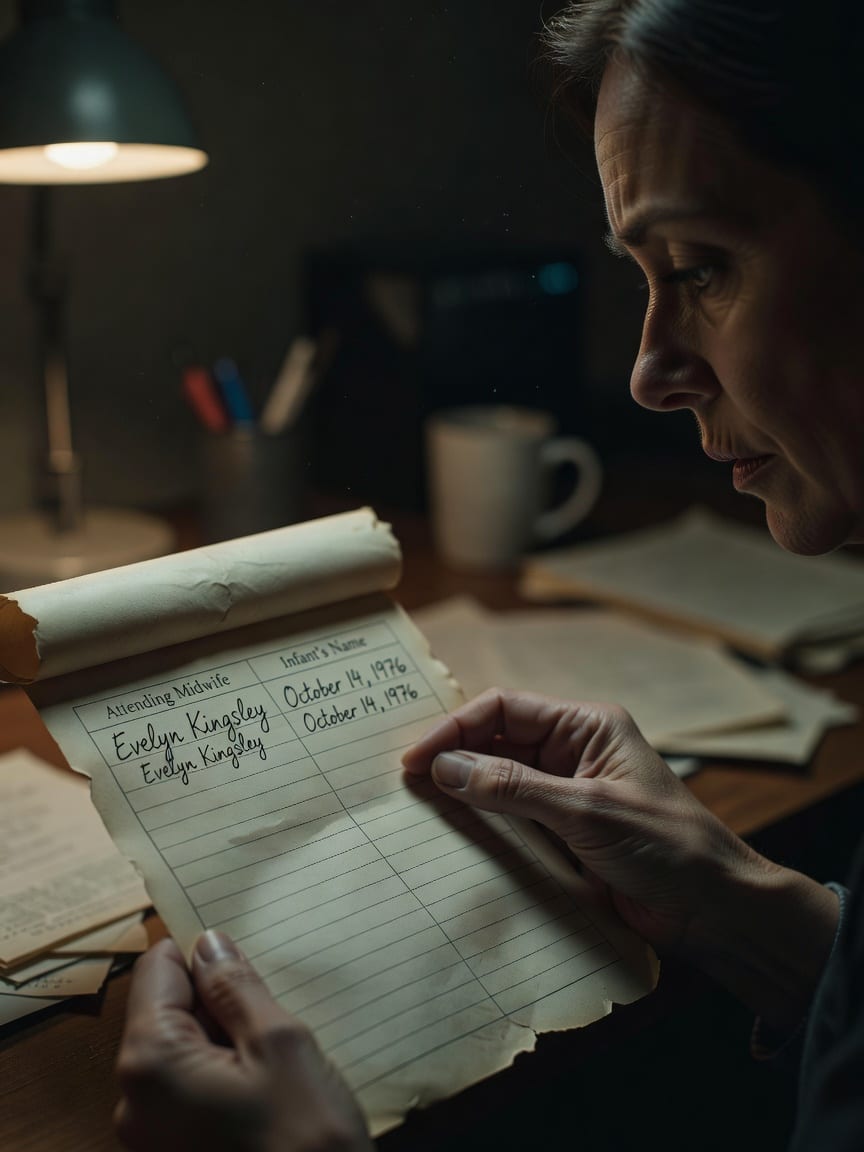
My own handwriting is on my birth certificate, signed as the attending midwife. I was the baby born that night.
I found my adult signature scrawled across my mother’s maternity file, right on my own birth register page. Forensic analysis confirmed it was genuinely my handwriting, dated 1976. But that was the year I was born, and my signature was listed as the attending midwife.
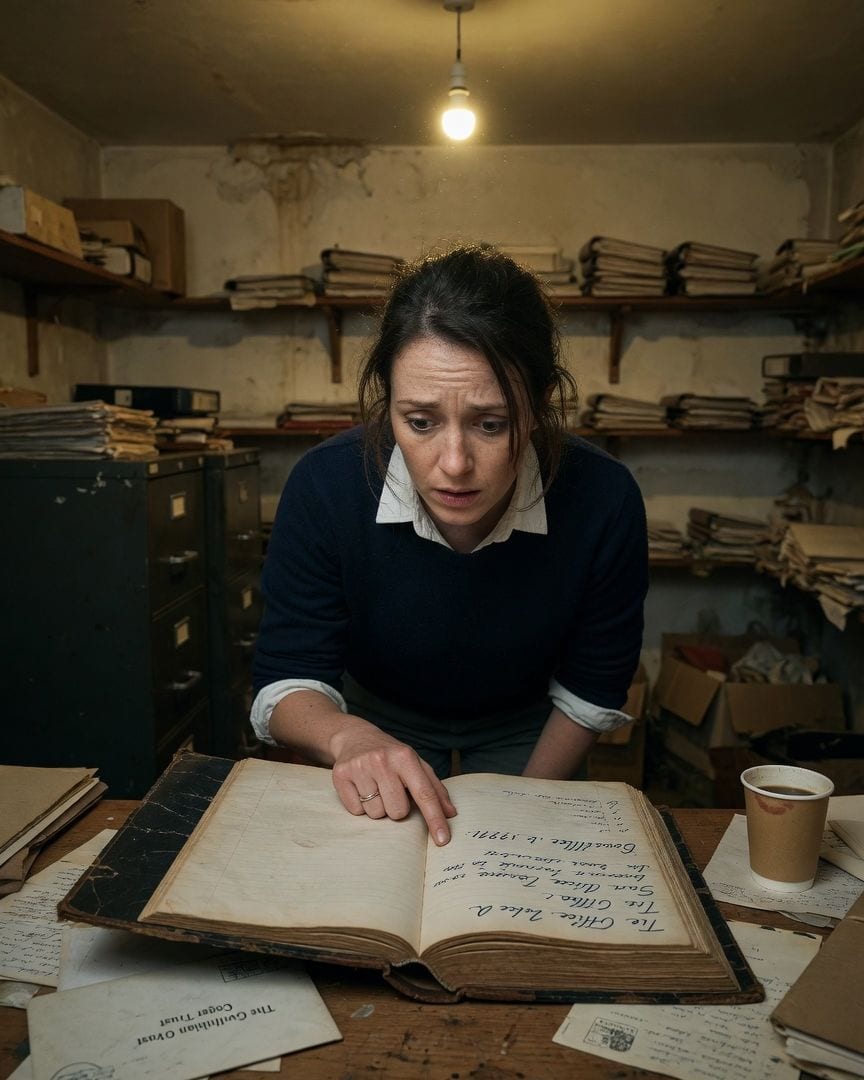
A charity thanked me for a donation 'in loving memory of' my own name. The letter posted from an office lost to the sea decades ago.
A letter arrived, thanking me for a 'generous donation' made in my own loving memory. When I pressed the charity for answers, their historical ledger confirmed the impossible: an entry for Sarah Bishop, born 1991, recorded in 1988. Three years before I was even born.