A charity thanked me for a donation 'in loving memory of' my own name. The letter posted from an office lost to the sea decades ago.
The letter sat on my kitchen table, a stark white rectangle against the polished wood. 'The Gwithian Coastline Trust' was embossed in tasteful grey at the top. It was a formal thank-you, the kind you get after a significant gesture.
Except I hadn't made one.
My eyes scrolled down the crisp print: "…sincerely thank you for your generous donation made in loving memory of Sarah Bishop."
I blinked. Sarah Bishop. My name. My full name, spelled exactly right. Then the bracketed date: "b. 1991." My birth year. A chill that had nothing to do with the cool morning air snaked down my spine.
No one I knew had died. And I certainly hadn't given a charity a "generous donation" in my own memory while I was, very much, still alive.
I flipped the envelope over. The return address stated 'Gwithian Towans Collection Office.' Gwithian Towans. I knew that name. My colleague, Michael, a local history buff, had mentioned it once.
A stretch of sand dunes in Cornwall, and a small office there, apparently, that had been lost to the sea in the late seventies. Submerged during a particularly fierce storm, swallowed by the shifting coastline. 1978, he'd said.
Over a decade before I was even born. Yet here was a letter, postmarked last week, from that very location.
The letter even specified the exact sum – a surprisingly large one – and the date of the 'donation'. It all felt so concrete, so real, yet utterly impossible. My mind raced, trying to conjure a rational explanation.
A clerical error, obviously. A mix-up with another donor. But the details were too precise. Too intimate.
It felt like a posthumous thank-you, sent directly to me, the supposed deceased, as I sat here, sipping lukewarm coffee, very much not deceased.
The air in the kitchen suddenly felt too thin, too quiet, as if waiting for me to catch up to its secret.
Still trying to convince myself it was a simple, albeit bizarre, administrative error, I picked up my phone and called the charity's main number. After navigating an automated menu, a polite, slightly flustered woman answered.
"The Gwithian Coastline Trust, how can I help you?"
"Yes, my name is Sarah Bishop. I received a letter…" I explained the situation, feeling a ridiculous blush creep up my neck. "It says I made a donation in my own loving memory.
And the return address is from an office that… well, it doesn't exist anymore."
The woman, who introduced herself as Ms. Henderson, hummed sympathetically. "Let me just check that for you, Ms. Bishop." There was a long pause, the faint click of a keyboard echoing in my ear. "Ah, yes. Sarah Bishop.
Born nineteen ninety-one. We have a record of a rather substantial donation made in your loving memory, yes. Our system shows it was processed quite clearly."
"Processed clearly?" I pressed, my voice tighter than I intended. "But I made no such donation. And the address on the letter, Gwithian Towans, was lost to the sea in 1978."
Ms. Henderson's tone shifted, becoming noticeably cooler, defensive. "I assure you, Ms. Bishop, our records are very thorough. Perhaps it was an admirer? Or a distant relative, making an unusual gift? These things happen.
The donation was received, the 'in loving memory' detail noted. We can't simply erase a record because you don't recall making it." She then offered, rather curtly, to send a copy of the transaction details to my email.
"No," I cut her off. "I don't need a copy of the mistake. I need to see the original record. The ledger."
"Our ledgers are… historical documents, Ms. Bishop. Not something we typically share." She sounded like she was talking to a particularly stubborn child. The conversation ended with me feeling a hundred times more unsettled than before.
This wasn't a simple error they were willing to fix; it was a confirmed, documented impossibility.
The next day, driven by a gnawing unease, I drove to the charity's actual, modern office in a nearby town. It was a nondescript building, modern and bland. I asked for the records manager, Beatrice Holloway.
A receptionist, after a brief, suspicious glance, directed me to an office down a quiet corridor. Beatrice was an older woman, perhaps late sixties, with sharp eyes that seemed to miss nothing and a weary set to her shoulders.
I presented my letter, laying it on her desk. "This came to me," I stated, trying to keep my voice even.
Beatrice took the letter, her gaze flitting from the 'in loving memory' line to the Gwithian Towans address. She typed my name into her computer system, her brow furrowed. "Nothing here, dear.
No recent donation under your name, not for an 'in memory' fund anyway. Our digital archives are quite comprehensive."
"But it's here," I insisted, tapping the letter. "And it clearly states the Gwithian Towans office."
Beatrice sighed, a long, drawn-out sound that seemed to carry the weight of years. Her eyes narrowed, the sharpness returning. "Gwithian Towans, you say? That's… an old one. Before my time, mostly. But those records… yes. They're kept separately."
She pushed herself up from her desk, her chair groaning in protest. "Come with me."
She led me deeper into the building, away from the bright, modern offices, down a short flight of stairs into a dimly lit back room.
The air here was cool and damp, thick with the smell of old paper and dust. The room was a labyrinth of ancient filing cabinets and shelves groaning under the weight of oversized, leather-bound books.
It felt like stepping back in time, a repository of forgotten histories. Beatrice moved with practiced ease through the stacks, her fingers tracing the spines of various ledgers.
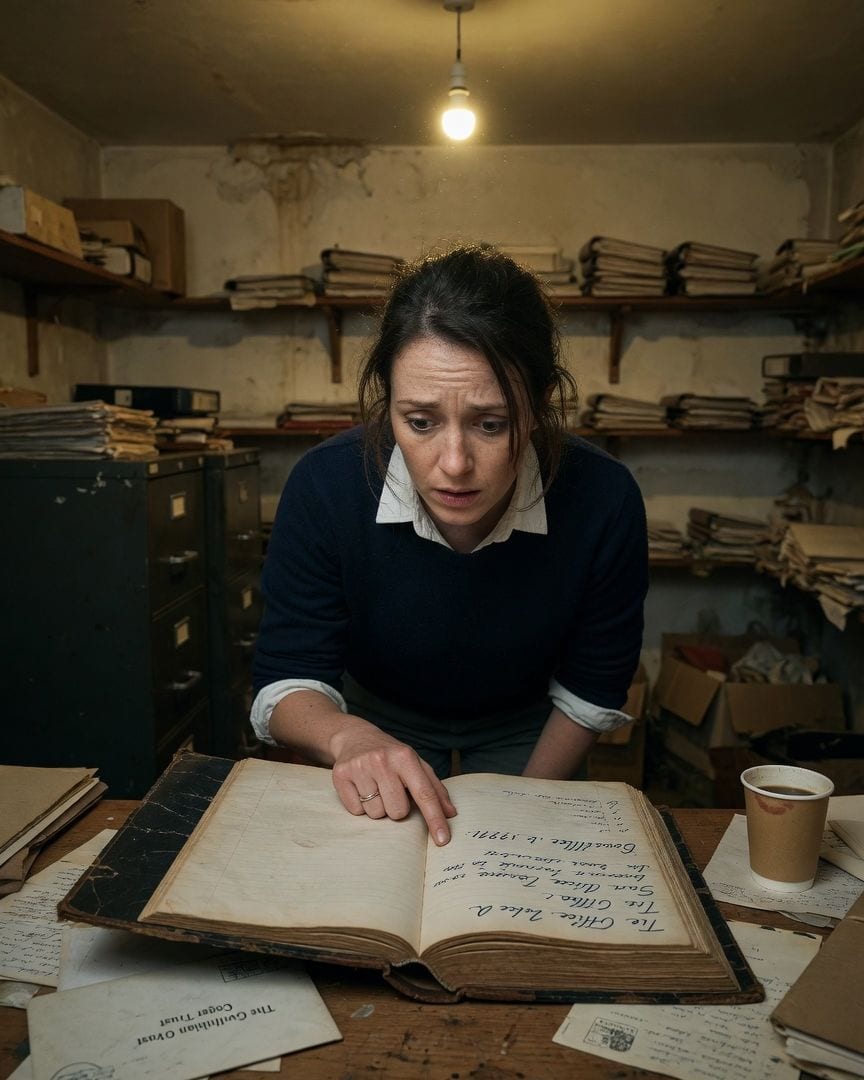
She finally pulled out a specific, heavy book, its cover worn smooth with age, the leather almost black. She placed it on a scarred wooden table, where a single bare bulb hung, casting a harsh, yellow light.
"These are our historical records," Beatrice said, her voice dropping slightly, as if the old books demanded reverence. "Before digital. If it came from Gwithian, it’d be in here."
Beatrice carefully opened the heavy ledger. The leather creaked, protesting the movement. She began to flip through brittle, yellowed pages, each rustle sending a faint whisper of dust into the air.
Sarah leaned closer, her breath catching in her throat, the scent of aged paper filling her nostrils. Beatrice’s finger, gnarled with age, finally stopped, pointing to an entry near the bottom of a crowded page.
Written in elegant, looping script, faded but still perfectly legible, it clearly stated: 'Donation received in loving memory of Sarah Bishop, born 1991.' Below it, the sum, the date, and a cryptic reference to 'G.T. Office, Ledger A.'
But it was the date of the entry itself, written boldly at the top of the page, in the same precise hand, that sent an icy shock through Sarah. 'November 12th, 1988.'
Three years before Sarah was even born.
Sarah's blood ran cold. The low hum of the fluorescent light above seemed to pulse, each throb a beat against her temples.
She reached out, her trembling finger hovering inches from her own name, a name recorded in a book older than her own life, a memorial to a future that hadn't happened yet.
The impossible ledger entry gnawed at me. I spent the next few days in a daze, trying to make sense of something that simply defied logic.
I scoured the internet, searching for any 'other' Sarah Bishop who might have a connection to the Gwithian Towans area or the charity, someone born in 1991, someone who might have actually died. Nothing.
Just an endless stream of irrelevant names.
I even spoke to Michael Coleman, a colleague known for his encyclopedic knowledge of local history. I showed him the Gwithian Towans address on the charity letter.
"Oh, 'The Gatehouse'," Michael said, recognition dawning in his eyes as he peered at an old, faded map on his computer. "That's what the locals called the old collection office. It was more like a small, pre-fab hut, really.
Nothing grand. Used for collecting small donations for coastal erosion projects, mostly." He traced a line on the map. "But it went under with the big storm in '78. Got swallowed by the dunes and the rising tide, practically overnight.
Nobody used it after that, just a local legend now, a point of interest for coastal archeology buffs."
His casual confirmation of the office's fate, and the knowledge that it had been gone for well over a decade before my birth, only deepened the dread settling in my gut.
One afternoon, as I walked home from work, lost in thought, a man stepped out from behind a bus stop, blocking my path. He was middle-aged, neatly dressed, with tired eyes that held a peculiar sorrow.
He looked directly at me, his expression grave.
"Sarah Bishop?" he asked, his voice low but clear, cutting through the general city hum.
I hesitated, a prickle of unease starting at my neck. "Yes?"
The man took a small step closer, his gaze unwavering. He didn't smile, didn't make any attempt at polite conversation. "I'm so sorry," he said, his voice barely a whisper, yet it felt impossibly loud in the suddenly muted street.
"I'm truly sorry for what's going to happen. The fall. The left arm."
He then turned, without another word, and merged into the bustling street, disappearing into the crowd before I could even process his words.
I stood there, frozen, the sincere apology echoing in my mind, a cold premonition of an event that had not yet occurred.
His words were so specific, so utterly out of place, that they lodged themselves in my memory, refusing to be dislodged.
I tried to dismiss it as a random encounter with a troubled person, a street preacher or someone disoriented, but the feeling of being singled out, of being known by a stranger in such an intimate, horrifying way, persisted.
The memory of the ledger entry, my name known before I existed, now had a chilling companion: a future known before it arrived.
I felt a growing unease, a sense of being drawn into something vast and unseen, something that knew more about me than I did myself.
The everyday world around me, usually a comforting chaos of noise and motion, now felt thin, almost translucent.
After the encounter with Walter Larsen, I couldn't shake the feeling of being watched. Every shadow seemed to hold an extra depth, every rustle of leaves sounded like a deliberate whisper. Then my phone started.
It would ring at odd hours, late at night, early morning. When I answered, there was only silence, thick and heavy, or a faint, raspy whisper that sounded exactly like my own name, "Sarah," before the line would cut dead.
The phone felt unnaturally warm against my ear each time, even after it went silent.
I changed my number, hoping to cut the connection, but the calls resumed a few days later, always with that same chilling whisper, always from an unknown number.
Walter Larsen's 'Apology In Advance' had shaken me deeply. The specificity of 'the fall, the left arm' haunted me, making every curb seem higher, every staircase more precarious. I found myself instinctively reaching for handrails, double-checking my footing.
I knew, with a certainty that settled cold and heavy in my chest, that I couldn't ignore this. Not anymore. I needed to know if the charity records held any other impossibilities, any other names marked before their time.
I returned to The Gwithian Coastline Trust office, seeking out Beatrice Holloway again. She was at her desk, sifting through a stack of invoices, her reading glasses perched on her nose.
"Ms. Holloway," I began, my voice firm despite the tremor in my hands.
She looked up, a flicker of recognition in her sharp eyes, quickly followed by a weary sigh. "Ah, Ms. Bishop. Back again? Look, dear, I really can't give you access to all our archives.
These old ledgers, they're mostly for historical interest. We don't actively reference them for current operations, you understand." She made a dismissive gesture, trying to wave me away.
But I was insistent. "I need to know if there are other entries like mine. Other names, dates that don't make sense. Especially anything related to Gwithian Towans. I need to know if I'm the only one."
Beatrice eyed me suspiciously, her gaze unblinking. She considered me for a long moment, then sighed again, a deeper, more resigned sound. "You're not the first to ask about oddities from the Gwithian office," she admitted, her voice dropping.
"There have always been… anomalies. Things that don't quite add up. Local legends, you know." She paused, her gaze distant, as if recalling old, buried memories, a shadow passing over her face. "About the Sand-Claimer.
Old wives' tales they called them. Rumors."
My heart hammered against my ribs. "Legends about what? About what kind of anomalies?"
Beatrice hesitated, her lips pressed into a thin line. The air in her small office seemed to grow heavier, thicker with unspoken meaning.
Then, with another weary sigh, as if finally giving in to an old, familiar current, she said, "Come. There's another set of records. Not usually shown to the public. Too… unsettling."
Beatrice led me deeper into the dusty archive, past rows of forgotten files, to a locked, reinforced cabinet tucked away in a corner.
The air grew colder here, the silence heavier, punctuated only by the distant hum of the building's ventilation. It felt like walking into a vault, a place meant to keep things secret and contained.
"These are the original founding ledgers," Beatrice explained, her voice hushed, almost reverent, as she fumbled with a heavy brass key. The key scraped loudly in the lock, a metallic sigh in the quiet room.
"From before the Trust was even properly incorporated. When it was just… the Gwithian Coastline Preservation Society. And before that, just 'The Gatehouse Keepers'." She swung open the heavy door, revealing a stack of even older, more formidable books.
She pulled out one, its binding cracked, pages almost black with age and moisture damage, a faint smell of salt and decay clinging to it. "These were kept by the first 'keepers' of the Gwithian office.
The ones who lived there, on the dunes, before the sea took it."
She carefully opened it, revealing densely packed, almost illegible script, penned in a variety of hands. I felt a prickle of dread crawl up my arms. "What did you mean, 'anomalies'?"
I asked, my voice barely a whisper, afraid to disturb the ancient quiet.
Beatrice pointed to a series of entries, her finger hovering over them like a divining rod. "Look here. Names. Dates. 'In loving memory of…' just like yours.
But the dates of the entries themselves… they're always years, sometimes decades, before the birth dates listed in the very same entry. And then, there’s a second date, scrawled in a different hand, much later. Often in red ink."
I leaned in, trying to decipher the faded script. It was true. 'Elias Thorne, b. 1948, In loving memory entry dated 1930.' Below it, a later scrawl: 'd. 1995.'
"What's the second date?" I asked, my throat suddenly dry.
Beatrice shook her head, her face pale under the harsh bulb light. "Nobody ever knew. Not for certain. The older staff just called them the 'pre-claims.' Bad luck, some said. Others said it was the Sand-Claimer doing its work."
My mind raced. Pre-claims. My own entry, dated 1988, three years before my birth. Walter Larsen's chilling apology, the specific details of 'the fall, the left arm.' The whisper on the phone, my name.
It all felt connected, forming a web of impossible foresight.
"Can I… can I see more of these?" I asked, my voice firm despite my pounding heart.
Beatrice, seeing the resolute glint in my eyes, nodded slowly. "There's a whole box of them. We digitized some for cross-referencing, but they were never officially integrated into the main database. Too much of a headache to explain.
People didn't like them."
She pulled out a thick printout from a box beside the cabinet, a spreadsheet filled with hundreds of similar 'pre-claim' entries, each with a 'name,' a 'birth date,' a 'pre-claim date,' and that mysterious 'second date' column, often left blank, or filled in with a later, different hand.
My blood ran cold. My 'in loving memory' letter, the impossible ledger entry, the stranger's apology, the voice on the phone – they weren't isolated incidents.
They were part of a pattern, a vast, horrifying system of pre-cognition and pre-claiming, meticulously documented by a charity that had no idea what it was truly doing.
I took the digitized spreadsheet home, my hands shaking so badly I almost dropped it. The sheer volume of names, the impossible dates, made my head spin.
For hours, I sat hunched over my laptop, meticulously cross-referencing the names and the mysterious 'second dates' with online obituaries, public death records, and archived news reports. The dread solidified into a horrifying certainty with each match.
A woman named Edith Coleman. 'Pre-claimed' in 1955. Born in 1960. Her 'second date' in the ledger: 2018. I found her obituary online: Edith Coleman, beloved mother and grandmother, died peacefully in 2018, aged 58. The dates matched.
A man, Thomas Sterling. 'Pre-claimed' 1968. Born 1972. His 'second date': 2023. I found a news report: Thomas Sterling, local businessman, died unexpectedly in 2023, aged 51. Again, the dates matched.
The pattern was undeniable, impossible, and terrifyingly precise. Each 'second date' was the actual date of the person's death, years, sometimes decades, after their 'in loving memory' entry was created.
The ledger wasn't just old; it was a prophecy, a grim accounting of lives marked before they even began. A chronological list of who was next.
I scrolled to the bottom of the spreadsheet, my heart hammering against my ribs, each beat loud in the sudden, oppressive silence of my apartment. There it was, stark and chilling: 'Sarah Bishop, born 1991, pre-claimed 1988.'
And in the 'second date' column, a blank space, waiting.
I stared at the empty cell, the silence of my apartment suddenly deafening, the dread a physical weight pressing down on me, making it hard to breathe.
My name, already on the list, a life already accounted for, awaiting its final, impossible entry.
I returned to Beatrice, the printed spreadsheet clutched in my hand, my face grim. "These aren't anomalies, Beatrice," I said, my voice hoarse. "These are prophecies. Every 'second date' is a death date. I’ve checked."
Beatrice, her face pale, looked at the spreadsheet, then at me. Her sharp eyes, usually so wary, now held a profound, ancient sadness. "I… I always suspected," she whispered, her gaze unfocused, as if seeing something beyond the dusty archive.
"The old timers, they called it 'the Sand-Claimer.' Said it took its due from the dunes, marked its own before they knew their time. The Gwithian office, 'The Gatehouse,' it wasn't just an office.
It was built on what they called 'a thin place,' a nexus where the veil between states of being was permeable. The Trust was originally founded to appease it, to 'maintain' the area, to keep records of its… claims."
She explained how the initial 'donations' were seen as offerings, and the 'in loving memory' entries a way to formalize the entity's pre-cognitive grasp. The charity, unknowingly, had become its chronicler, its archivist of destinies.
Beatrice then looked at me with sorrow, her eyes wet. "And the apologies… they happen. To those who are… strongly marked. A kind of echo, a warning, a courtesy from those who understand. A way to prepare."
Just then, my phone rang, vibrating violently in my pocket. A blocked number. My heart hammered against my ribs, a frantic bird trapped in a cage. I answered, bringing the phone slowly to my ear.
A faint, raspy whisper, barely audible over the static, filled the line: "Sarah." The sound seemed to come from everywhere at once, a chilling breath against my skin.
I slammed the phone down onto Beatrice’s desk, the plastic clattering loudly. As I did, a loud crash echoed from her kitchen, adjacent to the archive. We both froze.
I rushed in to find a heavy shelf had collapsed from the wall, sending pottery and glass shattering across the tiled floor.
My left arm, instinctively thrown out to brace myself against the falling debris, scraped against a jagged shard of ceramic, leaving a deep, bleeding gash.
The fall. The left arm. Walter Larsen's apology, specific and terrifying, had just come true.
The entity wasn't just predicting; it was actively reaching, its influence manifesting in the mundane, confirming its targeted attention and the inevitable nature of its claims.
The charity’s ledgers, Walter’s apology, the calls — they were all pieces of the same impossible, horrifying puzzle, now fully assembled around me.
The air in Beatrice's kitchen, usually so innocuous, now crackled with an unseen energy, a cold, predatory presence.
I knew I couldn't destroy the Sand-Claimer. How do you fight an entity that existed not in flesh and blood, but in the fabric of time and memory, in the very pre-cognitive pattern of lives lived and lost?
But I could, perhaps, refuse its claim. I could alter the terms.
I drove straight to Gwithian Towans, the wind whipping my hair, the vast, shifting dunes stretching before me under a grey, bruised sky.
I found the approximate site of 'The Gatehouse' using Michael's old maps – a slight depression in the sand, a few unnatural, dark stones peeking through, remnants of an old foundation.
This was the nexus, the place where my name was first recorded, where the 'pre-claim' was made.
I brought with me a small, empty, leather-bound journal, a blank slate. I sat among the dunes, the roar of the sea a distant, mournful sound in my ears, and opened the journal.
I began to write, not my name, but a new narrative. I wrote about the Sand-Claimer, about its impossible records, about the lives it had claimed. I wrote about my own experience, acknowledging the claim but refusing its finality.
It was an act of defiance, a reassertion of my own will against an ancient, pervasive pattern.
As I wrote, a profound coldness settled over the dunes, the air growing heavy and still, despite the relentless wind.
The whisper of my name, 'Sarah,' seemed to rise from the sand itself, surrounding me, a vast, unseen presence asserting its ownership. My left arm throbbed where I'd cut it, a dull, insistent ache.
I felt a profound pressure, as if an invisible weight was trying to force the pen from my hand, to erase my words, to stop this act of rebellion.
But I pressed on, my hand cramping, writing until every page was filled, until my hand ached and the ink ran low.
When I finished, I closed the journal, not with a sense of triumph, but with a quiet, terrible resolve.
I buried the journal deep in the sand, directly over where 'The Gatehouse' would have stood, pushing it down with my bare hands until it was completely covered.
It wasn't about stopping the entity, but about altering the terms of my own record, creating a counter-narrative, a testament to my choice to live. The coldness lingered, but it felt different now, less predatory, more… watchful.
I had bought myself time, perhaps. Or perhaps, I had simply given the Sand-Claimer a new, more interesting entry to follow.
I left my job a few weeks later, unable to face the mundane world after what I’d learned.
The drone of office life, the petty grievances, the endless emails – it all felt utterly meaningless in the face of what lay beneath.
I sold my apartment, moving to a small cottage far inland, away from the sea and its ancient claims, away from the unsettling whispers carried on the salt wind.
The Gwithian Coastline Trust quietly folded within months of Beatrice’s internal 'audit.'
The official narrative was financial mismanagement and outdated practices; the impossible ledgers, those terrifying prophecies of lives, were simply filed away as curiosities, never understood, never brought to light.
Beatrice herself retired, disappearing from public life, carrying the weight of the truths she’d guarded for so long. She never contacted me again, and I never contacted her. We both knew too much.
Life is quieter now, but never truly calm. I live with the knowledge, the constant awareness that my name is still on a list, waiting for its second date to be filled.
I scan the news, not for headlines, but for the small print, the obituaries, the 'in memoriam' sections of local papers.
I look for familiar names, for the echoes of the Sand-Claimer's reach, and for the reassurance that it is still out there, still claiming, still moving on.
Sometimes, I still check the new obituaries, just to see if a name I know has finally appeared on the list, or if my own date, still blank, has somehow filled itself in.
If this one got to you
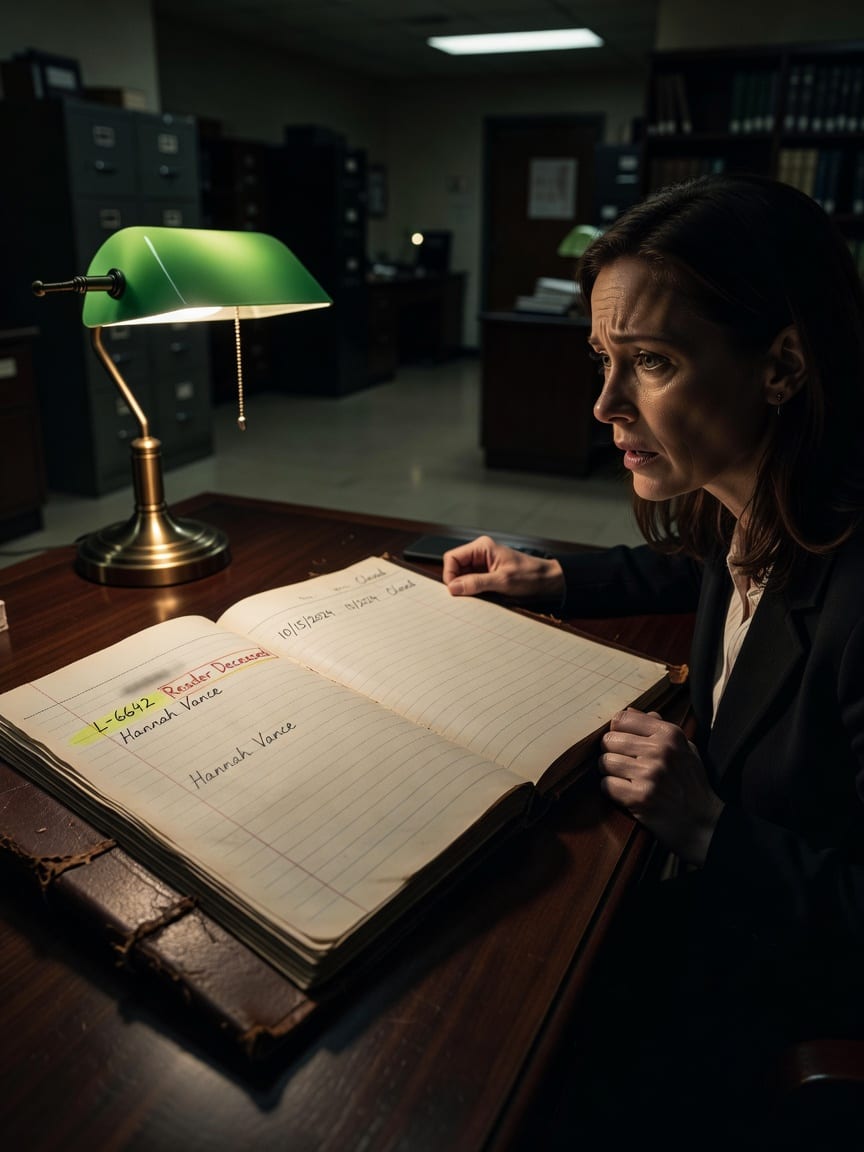
My library card number L-6642 was issued to me at seven — and the ledger shows that number has marked a reader 'deceased' every twelve years since 1949.
Returning my late father's library card to the old town library felt like a small act of closure. But the senior librarian's ancient ledger revealed a chilling pattern of 'reader deceased' entries tied to specific card numbers and borrowed books. My unease turned to cold dread when I secretly found my own name penciled in, marked for a future 'reader deceased' entry.
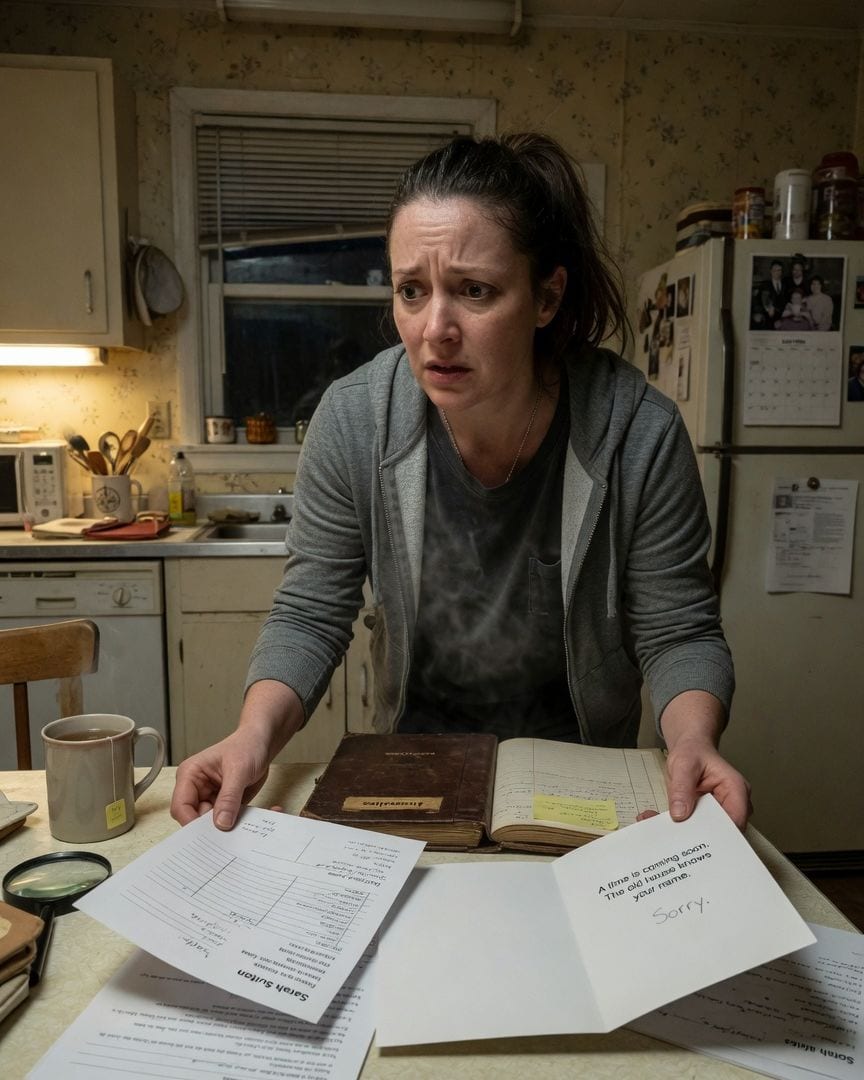
My name sits in the 1966 electoral register. My house, my exact name. Someone pencilled 'sorry' in the margin.
I was sifting through dusty microfiche, tracing my family line for my childhood home, when I found it. The 1966 electoral register for my address listed my exact name: Sarah Sutton. My heart hammered. I wasn't born until 1988; this was thirty-five years before I existed.
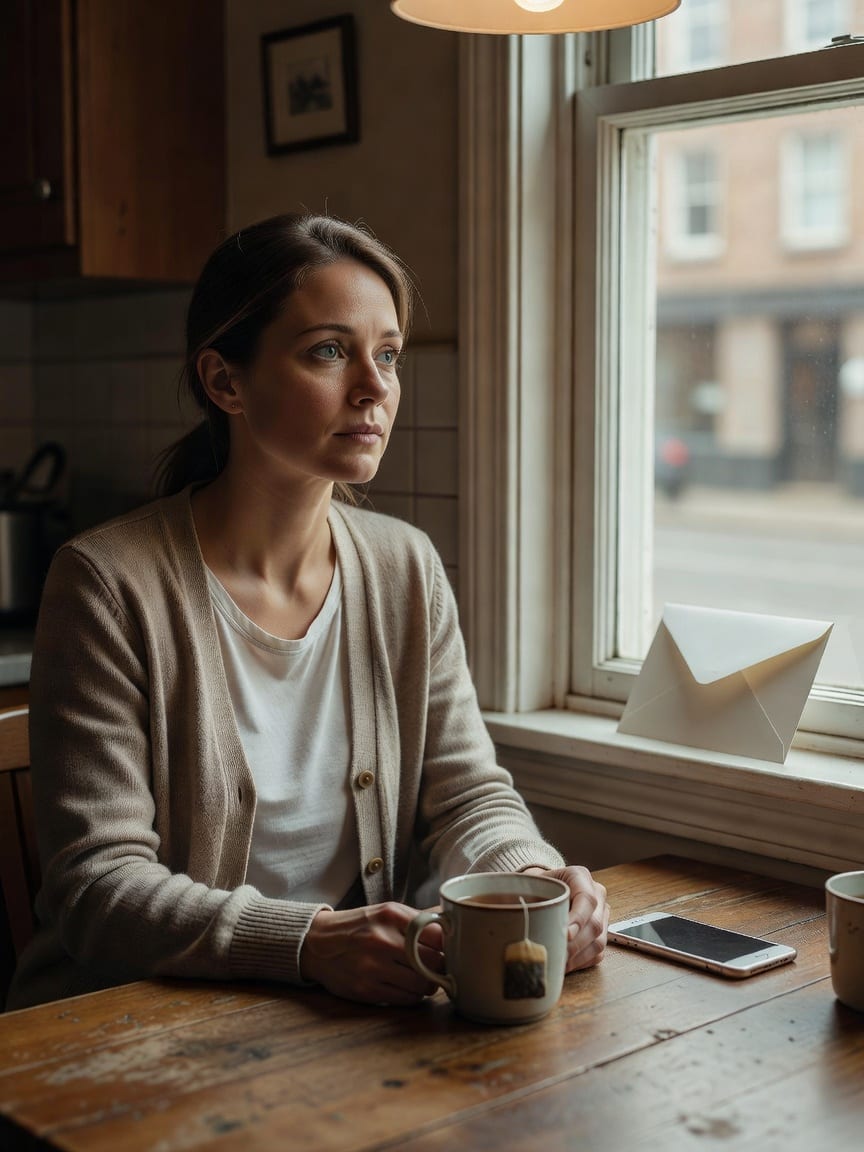
My taxi driver knew my name before I spoke, then apologized for the flight I was going to miss. I was arriving. The cab's plate was scrapped four years ago.
After a strange taxi ride, I received an unsettling birthday card addressed to me. Its return address listed 'Old Mill Road Field,' an empty lot where a mill once stood, and it was postmarked locally. The card arrived four months before my actual birthday, sparking a cold dread I couldn't ignore.
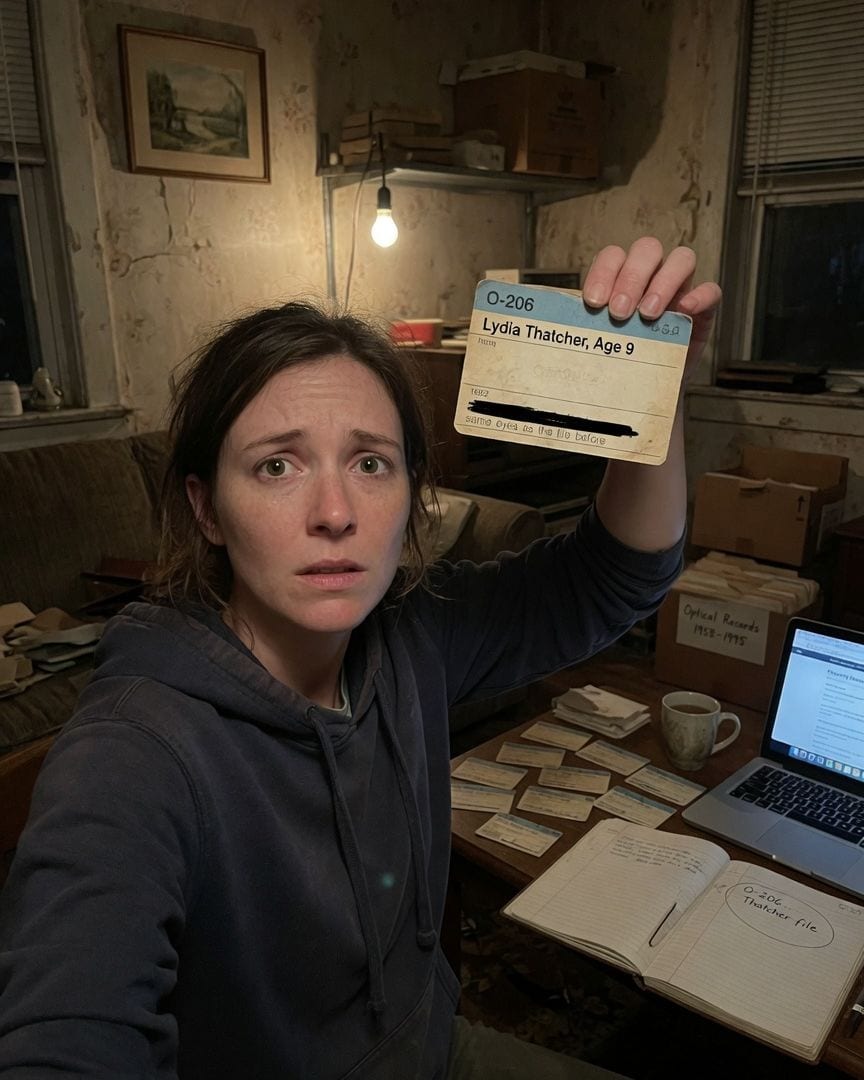
My own optical card is dated 1962, with my name on it. I wasn't born until 1993.
Sifting through old patient files from my former optical practice, I found my own O-206 card. It had my name, Lydia Thatcher, and my current home address printed on it. But the card was dated 1962, decades before I was even born, and a redacted note mentioned 'same eyes.'
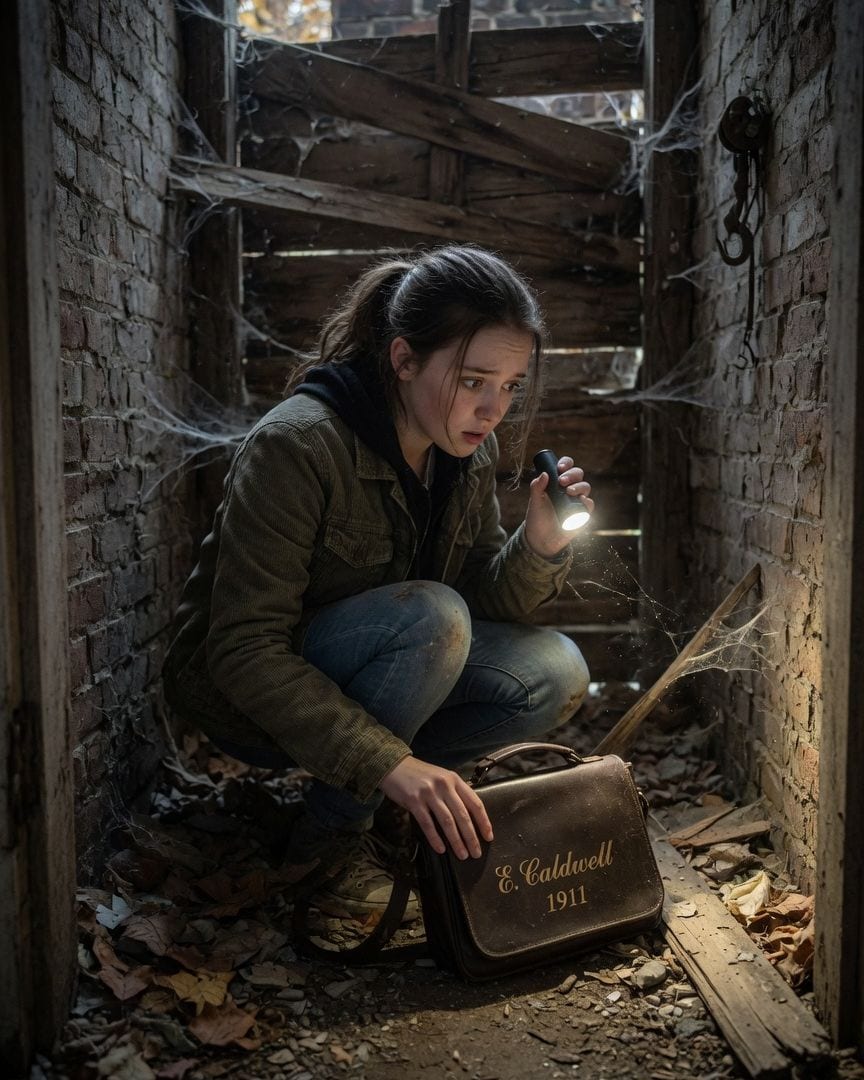
The school attendance register lists a child present every day since 1911. No such student ever sat an exam.
My new school, Caldwell High, felt too quiet, especially around its ancient, boarded-up bell tower. Teachers gave identical, rehearsed lines about it being "structurally unsafe." But then I found the attendance register, detailing a student named Eleanor Caldwell marked present every single day since 1911. No other record of her exists anywhere.
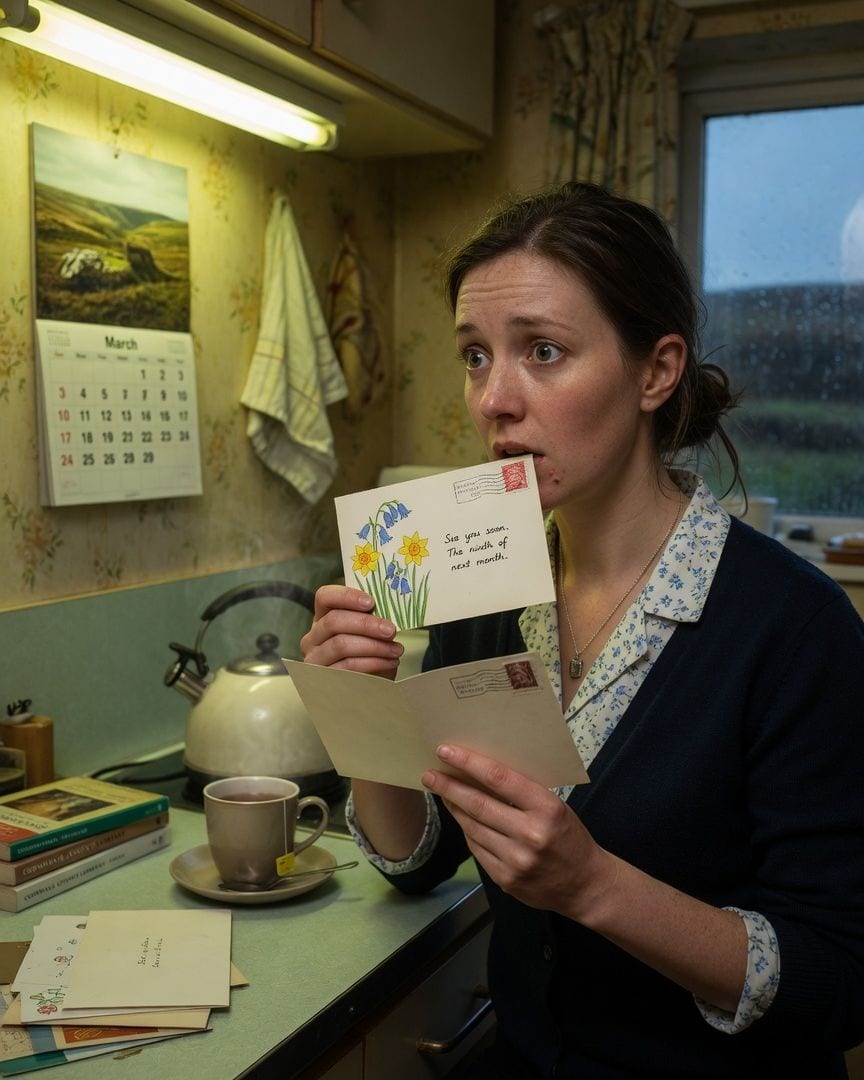
My get-well card arrived from a field, postmarked from a sanatorium that burned down in 1963. It wished me well for an operation I've never had, scheduled for next month.
I was just making tea on an ordinary Tuesday when a strange letter arrived. It was postmarked from Treneglos Sanatorium, a place that burned to nothing over sixty years ago, and contained a get-well card for an operation I'd never had. My research into this impossible message then led me to an old patient register where I found my own name, dated 1958.