My library card number L-6642 was issued to me at seven — and the ledger shows that number has marked a reader 'deceased' every twelve years since 1949.
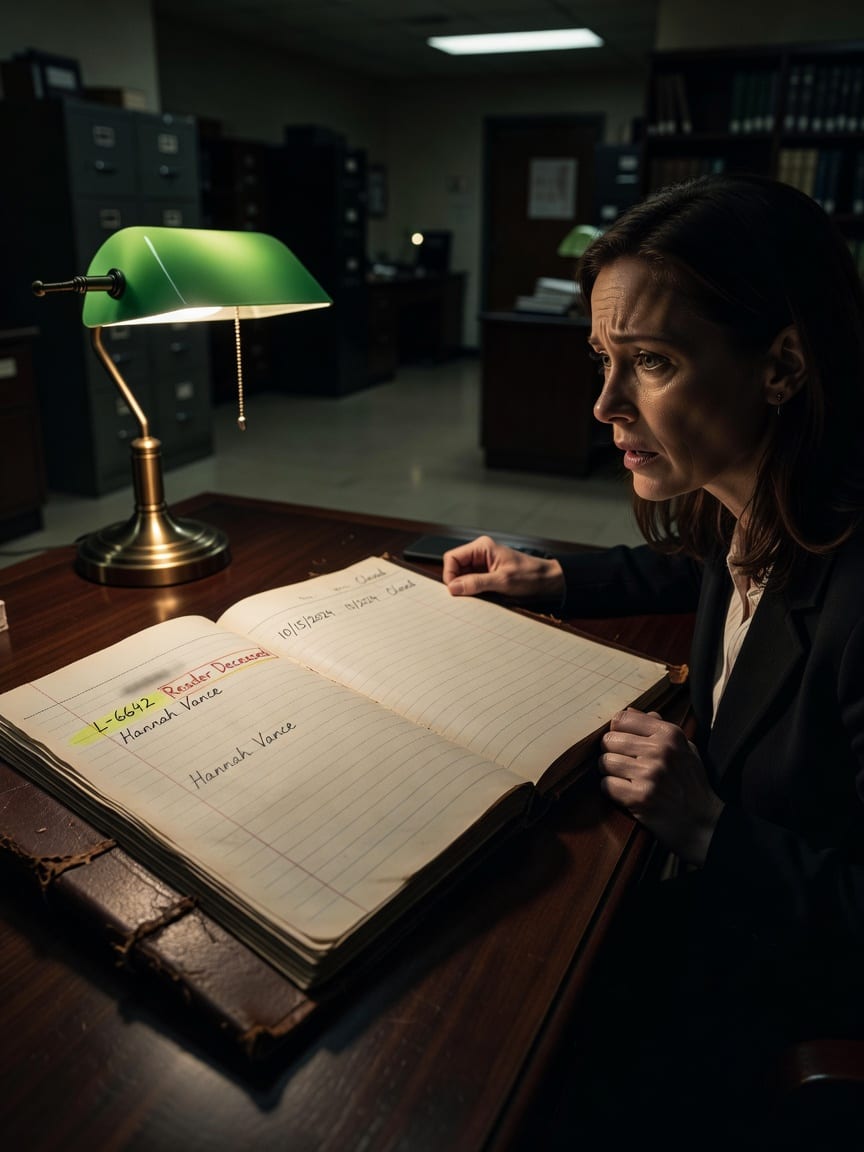
The old photo album smelled like dust and forgotten holidays. Tucked between a picture of Dad at sixteen, all awkward grin and bad haircut, and one of me as a toddler, I found it: his library card. L-6642.
The corner was soft from years of handling, the magnetic strip long dead. Patrick Vance, it read, in faded script. My dad. He’d been gone almost ten years now, a sudden, quiet heart attack that still felt unreal.
A wave of melancholy hit me, sharp and sudden. I decided to return it to the library, to formally close the account, a small, practical act of closure I hadn’t known I needed.
The town library hadn’t changed much since I was a kid. It still had that distinct, comforting scent of old paper, polished wood, and just a hint of something metallic, like ancient ink.
Dust motes danced in the afternoon sun slanting through the tall arched windows. Monica Hayes, the senior librarian, was at the main desk. Her hair was pulled back in a neat bun, her spectacles perched on her nose.
She had kind eyes, I thought, but they held a strange distance, a quiet, unreadable quality. I handed her the card.
"My father's," I explained, trying to keep my voice steady. "Patrick Vance. He passed away a while back. I thought I should... close out his account."
Monica took the card, her fingers surprisingly cool against mine. She nodded slowly, her gaze thoughtful. "Patrick Vance," she murmured, a faint whisper of recognition. She then reached beneath the counter and pulled out a truly enormous book.
It was bound in dark, scuffed leather, thick as a brick, its spine creased with age. The library’s main ledger, I realized. Its pages, when she opened it, were yellowed and brittle, filled with elegant, precise handwriting.
The air in the quiet room seemed to grow heavier. She ran a finger down a column, flipping back several pages before she stopped.
"L-6642," she announced, more to herself than to me. Her finger traced down the line of entries. I leaned closer, a prickle of unease starting low in my gut. The card number repeated, not just once, but every twelve years.
Different names: Eleanor Birch, Thomas Miller, Sarah Jenkins. And beside each name, in that same neat, meticulous script, was the same chilling notation: 'closed, reader deceased, number held'.
"Is that… a policy?" I asked, trying to sound casual, my voice a little higher than I intended. The phrase 'reader deceased' repeated so many times felt wrong, morbid.
Monica looked up, her expression unreadable, her eyes calm behind her glasses. "A tradition, you could say. Certain numbers are held in perpetuity, for historical record. A way to honor previous patrons."
Her voice was smooth, unhurried, as if discussing the difference between fiction and non-fiction. It was too bland, too practiced. My gaze dropped back to the ledger.
"And the books?" I pressed. "It says here, 'Borrowed: The Green Man's Labyrinth, Echoes of the Old Woods, The Silent Spring Offering.' Every single time. The same three books. In the second week of October."
I pointed to the repeated entries, identical down to the week. It couldn’t be a coincidence.
Monica’s eyes flickered to the ledger, then back to me, her composure unwavering. "They’re… local history. Obscure, perhaps. But popular with a niche audience. Especially around autumn." She offered a small, polite smile that didn’t quite reach her eyes.
She closed the ledger with a soft thud that echoed in the quiet space, final and dismissive.
But my gaze, even with the ledger closed, was fixed on where the last entry had been: Patrick Vance, 1985, 'reader deceased.' Below it, I remembered a blank line, waiting.
It felt like a held breath, a space for something yet to happen. The ordinary explanation Monica offered simply wasn’t holding.
The repetition, the exactitude of the dates and the books, the librarian's unnerving composure – it was all too precise for mere coincidence. My stomach twisted with a cold, solid knot.
"That's fascinating," I lied, forcing a smile. "You know, I remember a local history exhibit, years ago, about the town's founding families? Is that still here somewhere?" I hoped the distraction sounded convincing.
As Monica turned to gesture vaguely towards a distant alcove, I seized my chance. I leaned over the counter, my heart hammering against my ribs, and quickly, silently, flipped the heavy ledger open again to the L-6642 page.
My finger trembled as I traced the last 'reader deceased' entry, from 2009. Below it, on the blank line I'd noticed earlier, a name was now faintly penciled in.
My blood ran cold, an actual physical chill that spread through my veins. It was my own name. 'Hannah Vance.' Beside it, my birth year, 1990, and then, 'L-6642.'
And then, in the 'Closed' column, a date she recognized as the upcoming October, followed by the familiar, dreadful words, 'reader deceased.' I pulled back sharply, my breath catching in my throat.
The ledger was open, my name staring back at me, a prophecy written in bureaucratic hand.
I left the library in a daze, the image of my name on the ledger burned into my mind. My apartment felt hollow, too quiet. I tried to rationalize it – a morbid joke someone had played?
A clerical error, however elaborate? But Monica’s calm demeanor, the meticulous records, the recurring twelve-year cycle… it felt too deliberate, too organized to be a prank. It felt like a trap.
I returned home and immediately searched online for 'The Green Man’s Labyrinth,' 'Echoes of the Old Woods,' and 'The Silent Spring Offering.' They were indeed obscure, just as Monica had said, published by a small local press decades ago.
Scans of their covers popped up: archaic, woodcut-style illustrations. The descriptions hinted at forgotten folklore, pre-colonial harvest rituals, and the 'old ways' of the town’s founding families. No digital copies, no easy answers.
They seemed to exist only in print, lost to most of the world.
Next, I tried to find information on the previous L-6642 cardholders. Eleanor Birch, Thomas Miller, Sarah Jenkins. I searched local obituaries, historical society records. Their deaths were unremarkable, often attributed to 'natural causes' or 'accidents.'
A heart attack here, a fall there. No connecting thread, no red flags that would stand out to a casual observer. It was as if they simply vanished into the town’s quiet history after October.
A cold, unsettling thought began to form: they didn't just die; they ceased to exist in any meaningful, memorable way.
I visited the library again, not to confront Monica, but to observe, to delve into the local history section. I spent hours poring over old town council records, land deeds, and family histories.
The sheer volume of material on the town’s early settlers, particularly the Vance, Hayes, and Thornton families, was striking. And then I started to notice it, a subtle, almost imperceptible pattern.
Certain names, often those of prominent founding families, would appear in old town council records or land deeds, then vanish for a generation or two, only to reappear generations later in the same archived documents, often in connection to the library or other town institutions.
The dread deepened: the wrongness wasn't random; it was rooted in the very fabric of the town. This wasn’t some one-off incident; it was systemic.
A few days later, I attempted to borrow the three books. I approached Monica, trying to act casual, a tight knot in my stomach.
“I’m doing some research on local folklore,” I explained, holding up a list of titles, carefully including the three.
Monica took the list, her eyes lingering on 'The Green Man’s Labyrinth,' 'Echoes of the Old Woods,' and 'The Silent Spring Offering.' A faint, almost imperceptible smile touched her lips, a smile that didn't quite reach her eyes.
“Ah, these,” she said, her voice soft. “They’re part of our special collection. Not for circulation, I’m afraid. Too fragile.” Her refusal was polite but firm, leaving no room for argument. A chill snaked down my spine.
The way she said "too fragile" felt less about the books' physical state and more about their contents, or perhaps their purpose.
Later that week, I was working part-time at the town's historical society, archiving old documents. I live alone, I lock my office, and no one else has a key.
When I returned from my lunch break, I found a small, folded piece of paper on my desk. It was a plain white slip, like a library due-date reminder.
On it, written in neat, familiar script – Monica’s script – were two things: 'October 18th' and 'L-6642.' No other context. No name, no message. Just the date and the number.
My blood ran cold, colder than it had been when I saw my name in the ledger. Someone knew I was digging. Someone was watching. The note was a quiet, unambiguous warning.
It was a physical manifestation of the invisible gaze, making me feel hunted, trapped.
I held the slip of paper, crumpled slightly, when I confronted Monica. The library hummed around us, a low, constant drone that seemed to press in on me. “What is this?”
I demanded, my voice low but steady, despite the frantic beating of my heart.
Monica didn’t flinch. She took the slip from my outstretched hand, her gaze calm, unflappable. “A reminder, perhaps? Of a certain obligation.”
I pressed, leaning forward, my hands flat on the counter. “My name in the ledger, the 'reader deceased' status, the twelve-year cycle… what obligation? What are you doing here?”
Monica sighed, a sound of ancient weariness, not frustration. “The library, Hannah, maintains certain traditions. Related to the town’s founding. To its continued prosperity.”
She gestured vaguely to the shelves of local history around us, as if the answer lay within their dusty pages. “The families who built this town… they made arrangements. To ensure the balance.
The ledger is a record of those arrangements. A bond.”
My mind raced, every strange detail I’d uncovered clicking into place with sickening precision. “The books?” I whispered, barely audible. “What do they do?”
Monica’s eyes gleamed with a strange, quiet intensity. “They are guides. For the journey. The names in the ledger are not arbitrary. They are descendants. Of the ones who knew.
The Vance family, the Thornton family, the Hayes family… all intertwined.”
A cold dread, heavier than anything I’d felt before, spread through me. It wasn't a random curse, a glitch, or a prank. It was a system. A managed, institutional horror, running beneath the surface of this quiet town for generations.
“And my father?” I managed, my voice breaking.
Monica looked at me with a hint of sympathy, a flicker of something human that quickly vanished. “He fulfilled his obligation. As you are now expected to fulfill yours.” The words hung in the air, heavy and absolute.
Overwhelmed, I tried to process Monica’s revelation. My father… gone because of some ancient "arrangement"? The thought was monstrous.
I saw the librarian turn, momentarily distracted by a new arrival at the reference desk, a young man asking about genealogical records. This was my chance.
Fueled by a desperate, panicked energy, I lunged for the main ledger, flinging it open to a random page, not the L-6642 section.
I scrolled frantically, my eyes devouring the entries. It was worse than I imagined. Page after page, I saw not just one repeating card number, but dozens, hundreds.
L-711, L-803, L-949, and so on, each tied to different family names – Sinclair, Beaumont, Ingram – all recurring, all with the same 'closed, reader deceased, number held' notation.
The pattern across dates was horrifyingly clear: a meticulous, generational culling, stretching back centuries.
And then, my breath hitched. On a page for L-711, I saw an entry for 'Maureen Hayes,' from centuries ago, with the familiar 'reader deceased' notation.
And on another, much closer to the present, 'Monica Hayes,' with a 'card issued' date from decades past, and a future date, not yet filled in, under 'reader deceased.' The implication crushed me.
Monica, the calm, unbothered librarian, wasn't just a keeper. She was also a part of the cycle, a future victim, or perhaps… something far more insidious. Monica's hand reached for the ledger, her shadow falling over the page.
I froze, the full, horrifying scale of the institution's reach dawning on me.
Monica gently took the ledger from my trembling hands, her touch surprisingly soft, almost maternal. “You understand now,” she said, her voice devoid of triumph, only a deep, ancient resignation. “This library… it is the heart of the arrangement.
For centuries, the families of this town have provided. A tithe, you could call it. To the land, to the entity that ensures our prosperity. The ledger is the contract. The card numbers are the lineage markers.
The books are the… invitation.”
I stared at her, numb, the words settling like lead in my stomach. “You’re one of them,” I whispered, pointing to the entry for Monica Hayes I’d just seen.
Monica nodded. “My family has served as its custodians for generations. My own turn will come, in time. Just as yours has.” She gestured vaguely to the other names in the ledger, the Sinclairs, the Thorntons, the Vances.
“The Vances, the Sinclairs, the Thorntons, the Hayes… we are all bound. The ritual ensures the town thrives. Without it, the harvests fail, the wells run dry, the children sicken. It is a necessary balance.”
The dread wasn't just for my own fate, but for the chilling coherence of it all.
Every clue, every strange detail, every quiet disappearance, every calm, bureaucratic entry in the ledger, now snapped into place, forming a complete, horrifying picture of a town built on quiet, methodical sacrifice.
Fueled by a surge of desperate defiance, a sudden, animalistic urge to fight, I demanded, “This is insane! I’ll expose you! I’ll take this ledger, I’ll show everyone!”
I reached for the heavy book again, my fingers scraping against the leather. But Monica’s grip was surprisingly strong, her hand covering mine, her eyes fixed on me with an unsettling blend of pity and resolve.
“No, Hannah. You won’t. Who would believe you? A young woman, claiming the town’s esteemed library is a den of… sacrifice? They would say you’re distraught. Grieving your father.” Monica’s words were calm, rational, and utterly devastating. She was right.
The institution was too deeply embedded, too benignly respected. The library, the quiet, safe library, was the heart of it.
I tried to pull the ledger free, to at least photograph a page with my phone, but Monica blocked me, her body a surprisingly immovable barrier between me and the heavy book.
“Your time is near, Hannah. The books await. The cycle demands it.” Monica’s smile was faint, not cruel, but resolute. “It’s time you read your books, Hannah.”
The words were a death sentence, delivered with the quiet authority of a librarian recommending a novel.
I felt a cold, heavy hand close on my shoulder, guiding me gently but firmly towards the 'Special Collections' door, a door I had never seen unlocked.
The air grew heavy, thick with the scent of old paper and something else, something ancient and hungry, waiting behind that door. I knew, with a certainty that chilled me to the bone, that there was no escape.
The institution had claimed me.
Hannah Vance’s apartment was cleared out a few weeks later; her landlord simply listed her as having 'moved on.' No missing person report was filed, no questions asked beyond a cursory police check that found nothing amiss.
The town continued its quiet, prosperous existence. A new, young library assistant, fresh out of college, was hired by Monica Hayes to help with the archives, a cheerful young man named Elliot Thornton.
He admired the antique ledger, meticulously kept, its pages filled with neat, precise script.
The library’s clock chimed, marking the second week of October. Monica Hayes, seated at her desk, watched as Elliot Thornton approached, a small stack of three familiar, leather-bound books in his hands. He smiled.
“Just picked these up from Special Collections, Monica. Thought I’d finally read them, you know, for local history immersion.” Monica returned his smile, a faint, almost imperceptible curve of her lips. She made a mental note to update the ledger.
It was time.
Elliot Thornton, L-949, requested the three books in the second week of October.
If this one got to you

My taxi driver knew my name before I spoke, then apologized for the flight I was going to miss. I was arriving. The cab's plate was scrapped four years ago.
After a strange taxi ride, I received an unsettling birthday card addressed to me. Its return address listed 'Old Mill Road Field,' an empty lot where a mill once stood, and it was postmarked locally. The card arrived four months before my actual birthday, sparking a cold dread I couldn't ignore.
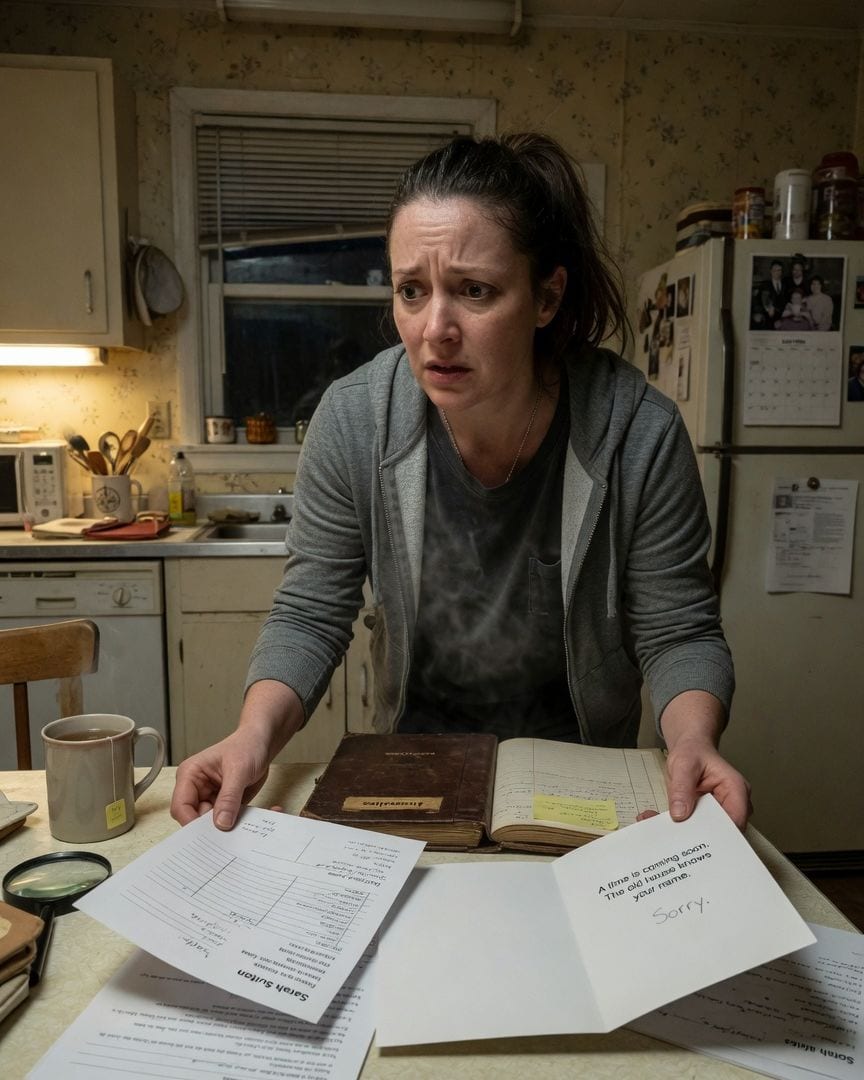
My name sits in the 1966 electoral register. My house, my exact name. Someone pencilled 'sorry' in the margin.
I was sifting through dusty microfiche, tracing my family line for my childhood home, when I found it. The 1966 electoral register for my address listed my exact name: Sarah Sutton. My heart hammered. I wasn't born until 1988; this was thirty-five years before I existed.
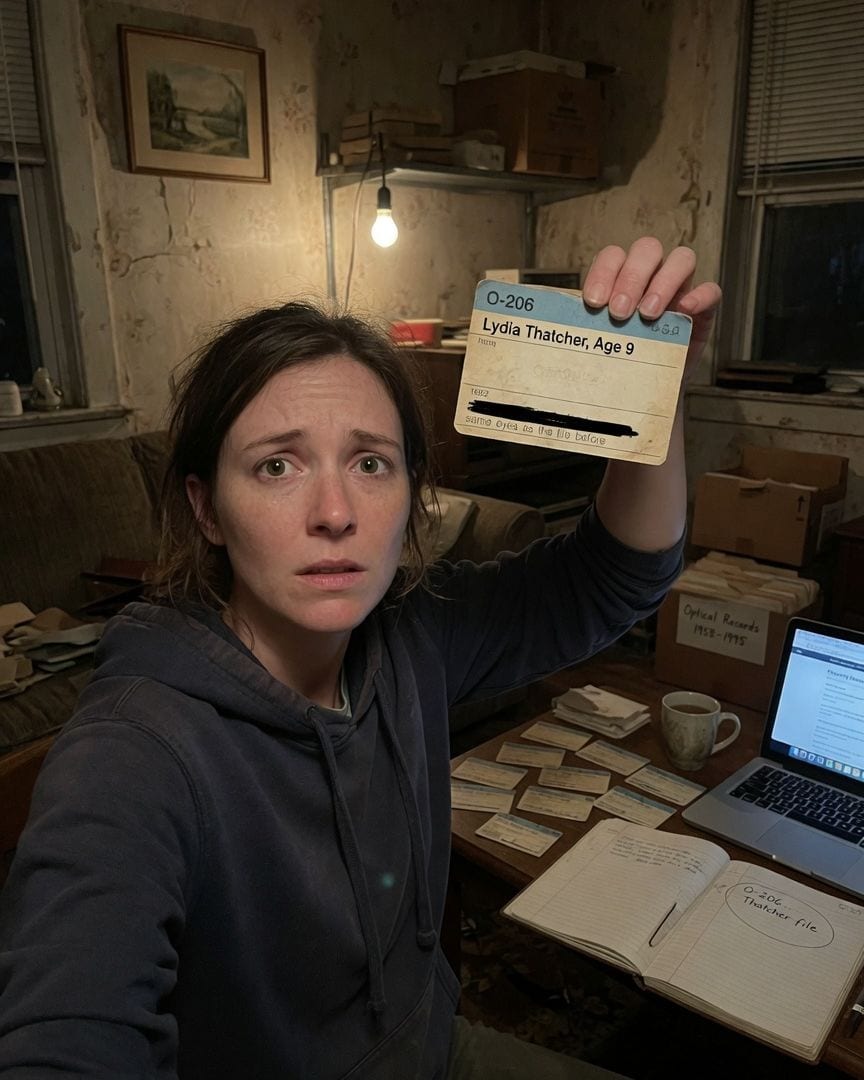
My own optical card is dated 1962, with my name on it. I wasn't born until 1993.
Sifting through old patient files from my former optical practice, I found my own O-206 card. It had my name, Lydia Thatcher, and my current home address printed on it. But the card was dated 1962, decades before I was even born, and a redacted note mentioned 'same eyes.'
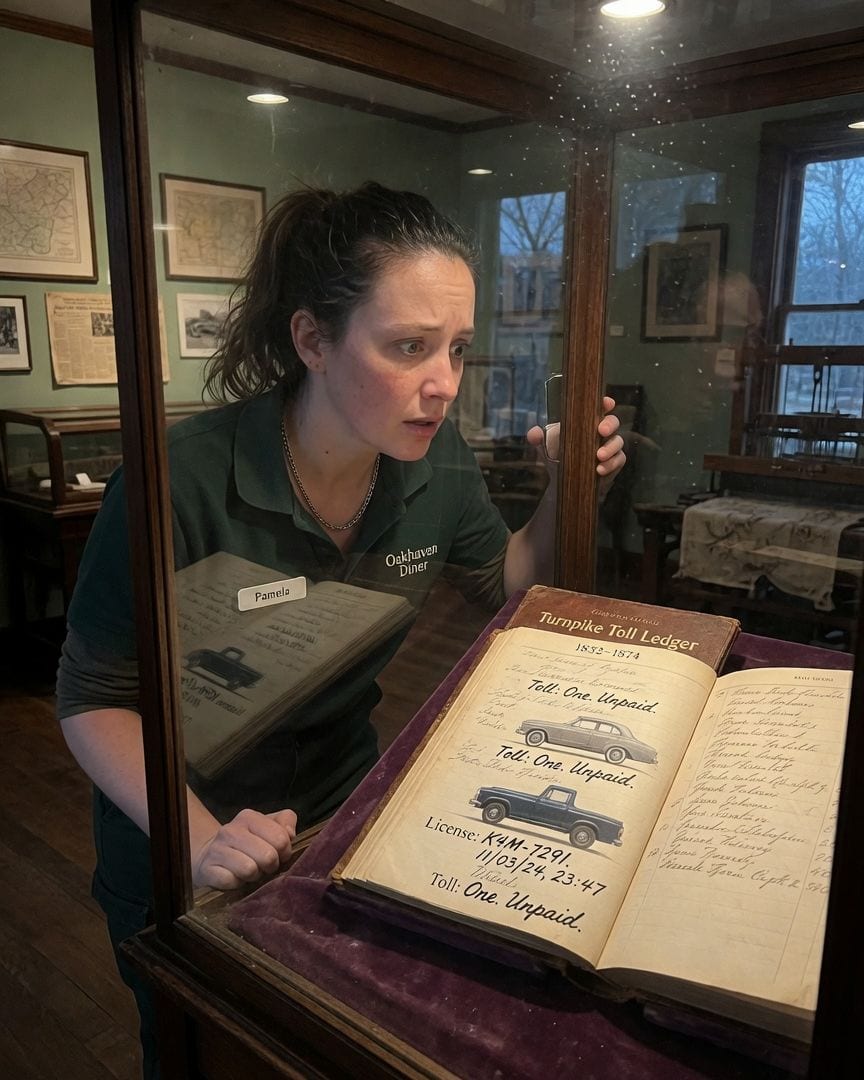
My car stalled at the old turnpike milestone, after dark. The toll ledger, closed in 1874, then listed my car, my stall time, and a toll of one, unpaid.
I had just moved to Oakhaven when my old sedan died on a dark, winding road by an infamous turnpike milestone. The next day, I found my car's exact registration and stall time written in fresh ink in a 150-year-old, locked museum ledger, marked 'Toll: One. Unpaid.' The curator dismissed it as a prank, but her white knuckles and strained voice hinted at something far more unsettling.
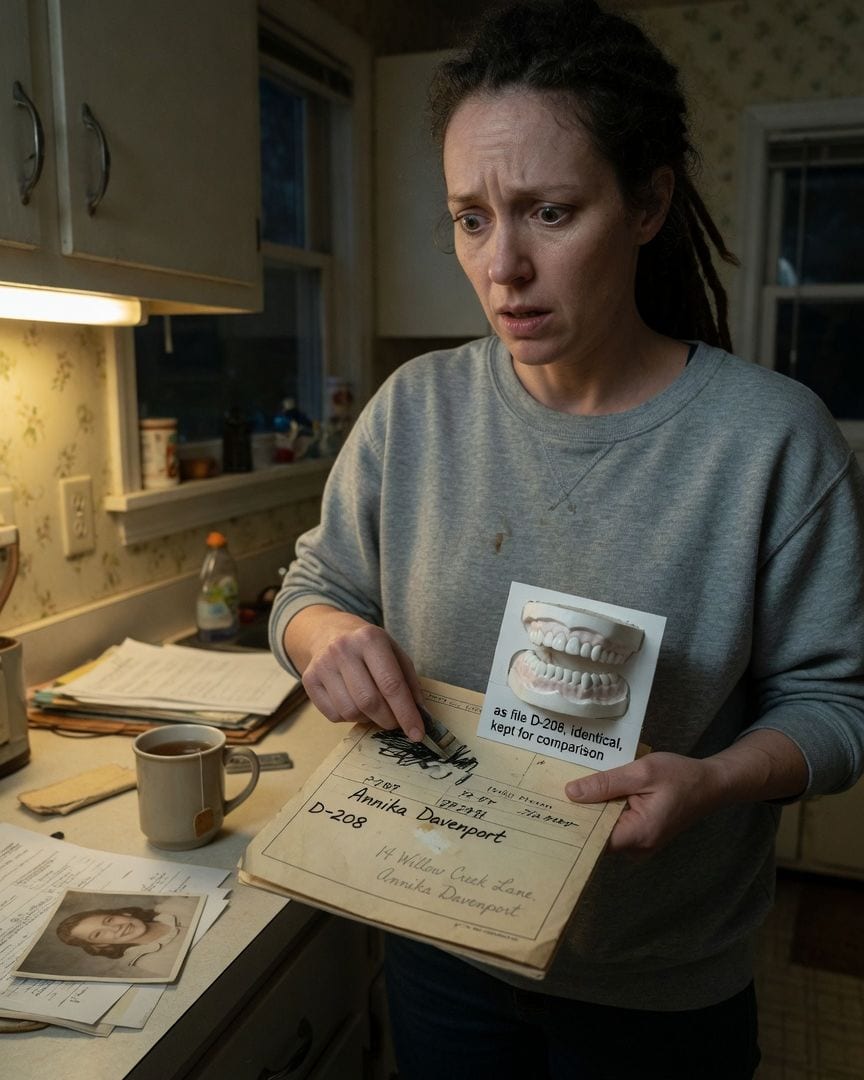
My childhood dental chart lists the house I bought last year — in my own name, years before I was born. A second set of my teeth sits filed beside it, marked 'identical.'
Sifting through old dental records, I found my chart, D-208, with my 1988 birth date. But a line from 1958 was blacked out, and a clipped card with an impression of my teeth listed my name and current home address, decades before I was born. The impossible facts knotted into a cold certainty.
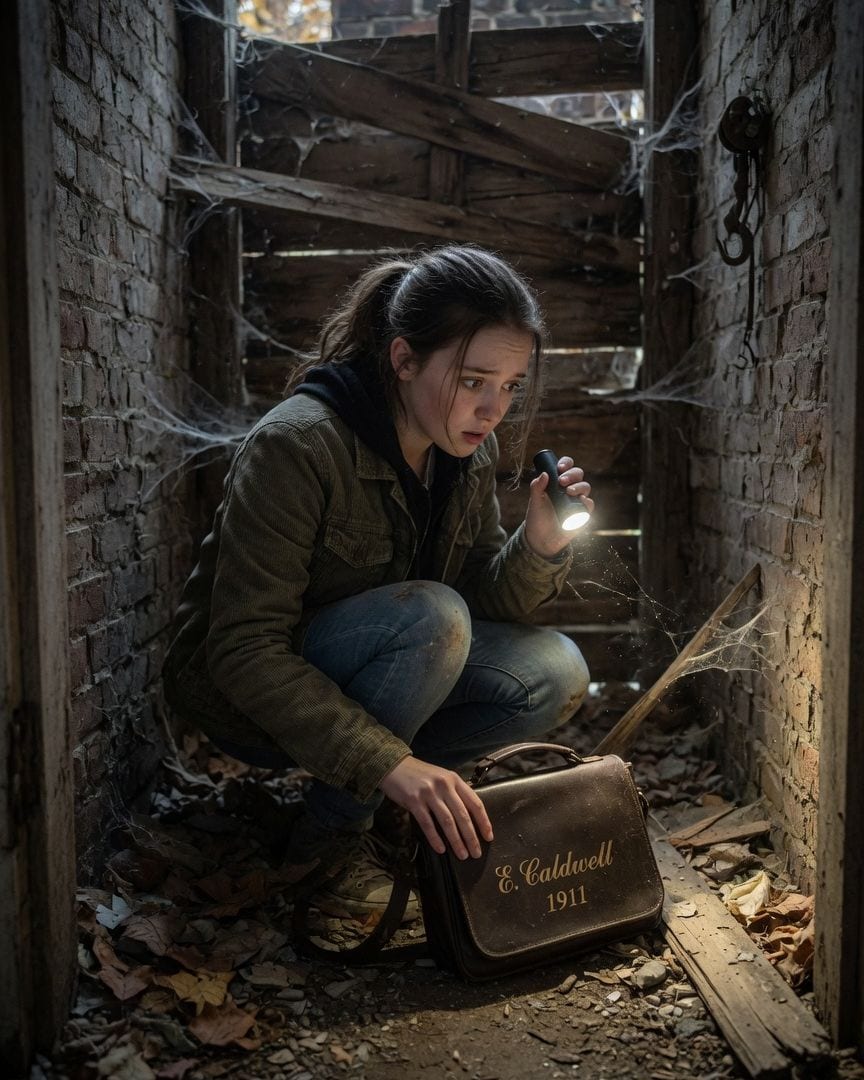
The school attendance register lists a child present every day since 1911. No such student ever sat an exam.
My new school, Caldwell High, felt too quiet, especially around its ancient, boarded-up bell tower. Teachers gave identical, rehearsed lines about it being "structurally unsafe." But then I found the attendance register, detailing a student named Eleanor Caldwell marked present every single day since 1911. No other record of her exists anywhere.