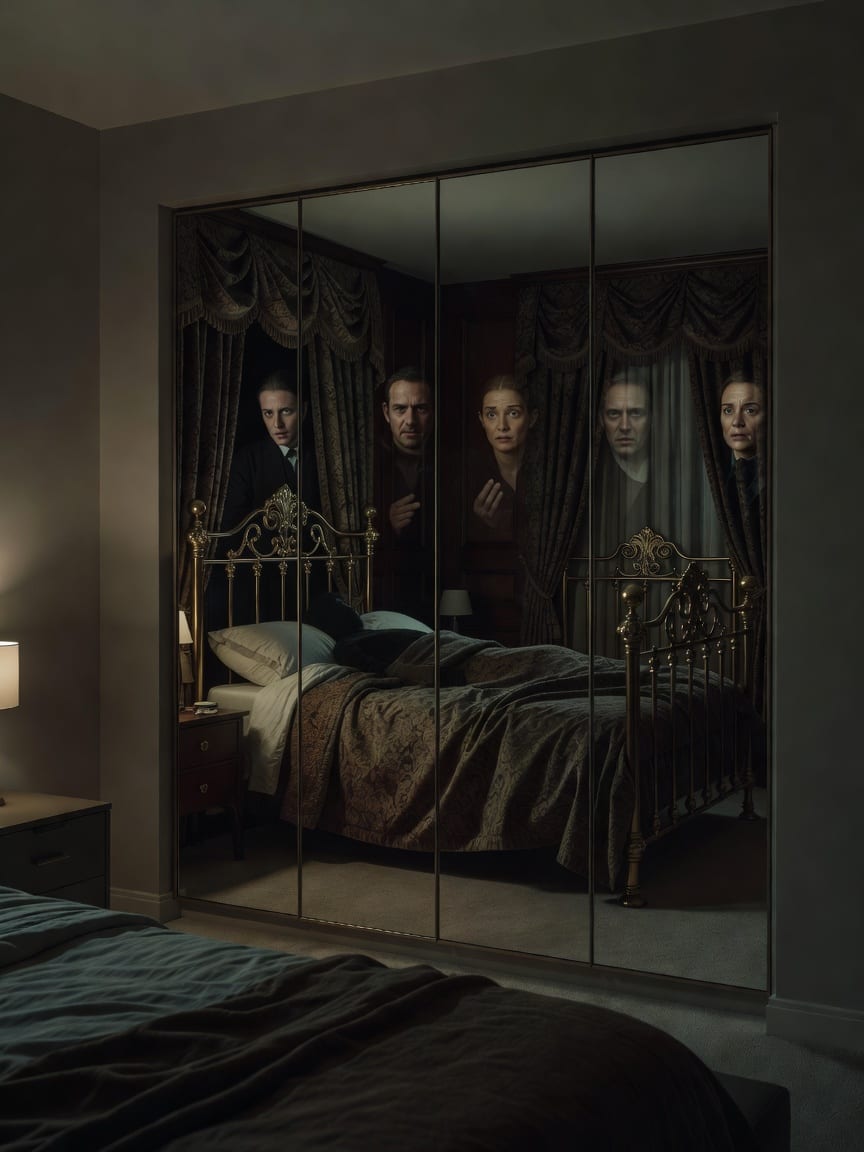
My bedroom mirror shows a Victorian room, not mine. The figure asleep in its brass bed doesn't move, even when I sit up watching.
I woke abruptly. Not with a jolt, but a slow, quiet surfacing from sleep, the kind where you know something is off before your eyes even open. The digital clock on my bedside table glowed 3:58 AM. Too early.
My eyes drifted to the fitted mirror wardrobes that spanned the opposite wall of my bedroom.
They were new, installed just a month after I bought the place, sleek and modern, reflecting my own minimalist furniture, my unmade bed, the faint blue glow of my alarm.
Except they weren't.
Reflected in the glass wasn't my room at all. It was a bedroom I’d never seen, heavy with shadow and old light. A massive brass bedstead dominated the center, its posts twisted with intricate, tarnished designs.
A thick, dark counterpane covered the bed, pulled up to the chin of a figure lying perfectly still, eyes closed, face obscured by the dimness. To the left, a marble-topped washstand held a ceramic basin and pitcher.
The air in my room felt suddenly heavier, colder, and a faint, almost sweet, medicinal scent—like old lavender mixed with camphor—drifted into my nostrils. I sat bolt upright, heart hammering against my ribs, watching it.
The image in the mirror didn't waver. It was a perfect tableau, frozen in time, distinct and utterly separate from the actual room I was sitting in. I blinked hard, rubbed my eyes, even pinched myself. The Victorian room held.
The sleeping figure didn't stir. It wasn't a trick of light. It wasn’t a dream. It was simply there.
The mirror visions persisted. Always near four in the morning, always the same still scene, always that damn smell. I started setting my alarm for 3:55 AM, dread coiling in my gut each time it went off.
I’d watch it, terrified and fascinated, until the sun began to rise and the reflection slowly faded, replaced by my own bedroom, mundane and modern, but never quite feeling safe again.
I’m an engineer. My brain is wired for logic, for solutions. I needed an explanation. I started obsessing over the wardrobes. I ran my hands over the smooth mirror panels, searching. An imperfection? A seam I might have missed?
My contractor was meticulous. There was nothing. But the visions were too real, too consistent.
One afternoon, in broad daylight, I was tracing the edge of a particularly large panel, right where the mirror met the plaster wall on the far right. My finger caught on something — a faint, almost invisible hairline crack.
Not in the glass itself, but in the thin wooden frame that held the mirror in place. It was a perfect, almost seamless fit, but the line was there. I pressed lightly, then more firmly, leaning my weight into it.
With a soft, almost inaudible click, a small section of the panel gave way. It didn't swing open like a door; it just shifted inward a fraction of an inch, revealing a shallow, dust-filled cavity behind the mirror.
It was too small for a safe, too shallow for pipes. It was a hidden compartment, expertly concealed, designed to be missed. The air inside smelled stale, thick with age.
Reaching into the darkness, my fingers brushed against something small, cold, and metallic. My heart thudded against my ribs, a drumbeat in the sudden silence. I pulled it out, my hand shaking slightly.
It was a tarnished silver locket, heavy and cool in my palm. Dust motes danced in the shaft of afternoon light that now streamed through my window, illuminating the ancient piece of jewelry.
I turned it over, examining the intricate, faded engravings. With trembling fingers, I pried open the stiff clasp. It gave with a tiny groan of metal. Inside, nestled beneath a cloudy, protective film, was a tiny, faded daguerreotype.
It showed a young woman, her face serene, eyes closed in what looked like sleep or peaceful repose. My breath hitched. It was unmistakably the sleeping figure from the mirror. The same delicate features, the same quiet stillness.
On the locket’s back, faintly etched into the silver, I read: "E.S. - Nov. 1888."
Armed with the locket, its chilling inscription burning into my mind, I dove into local history. My laptop became my new best friend, its screen glowing late into the night.
Online searches for 'Sinclair, 1888, Thornton Residence' (the house's original name from old property deeds) yielded scant, fragmented results. I pieced together that the house had indeed been owned by a Sinclair family during the late 19th century.
A prominent local family, apparently. But no definitive 'E.S.' The internet was a labyrinth of dead ends, rumors, and half-truths.
Meanwhile, the house felt like it was closing in. The scent of lavender and camphor, once sporadic, now seemed to cling to the bedroom fabric, an almost constant presence.
It wasn't just near four AM anymore; sometimes it would hit me walking past the door, a sudden wave of that sweet, medicinal smell.
Frustrated, and needing concrete information, I visited the local historical society. It was a small, quiet place, smelling of old paper and dust.
An elderly woman, Constance Bishop, sat behind a tall wooden desk, peering over spectacles at a thick ledger. She looked up as I approached, her eyes sharp, intelligent, and unsettlingly direct.
"May I help you, dear?" she asked, her voice surprisingly strong.
"Yes," I started, trying to keep my voice even. "I'm Vivienne Harrington. I just bought the old Thornton Residence on Elm Street, and I'm trying to do some research on its history, specifically the Sinclair family."
A flicker – not of surprise, but of something deeper, older, a shadow of recognition – crossed Constance’s face. It was gone in an instant, replaced by a polite, almost practiced smile. "Ah, the Thornton house. A fine old place.
The Sinclairs lived there for many years, yes. A prominent family back in their day." She offered vague details about their general residence, dates, local contributions, all public knowledge.
But when I pressed about any specific 'E.S.' who might have lived there in late 1888, her responses became evasive, almost dismissive. "Many family members, dear. Records from that era can be... sparse."
I left with more questions than answers, the weight of Constance's knowing gaze heavy on my back. It felt less like I was investigating a house, and more like I was being investigated myself.
The feeling of being watched intensified. It wasn't just the mirror anymore. I found myself glancing over my shoulder in the kitchen, checking the hallway before entering a room.
A prickling sensation on my skin, like someone had just walked over my grave. I kept telling myself it was stress, lack of sleep, paranoia. But the house itself felt different. It hummed with a low, static energy.
One evening, after a particularly strong waft of the medicinal scent filled the bedroom, thick and cloying, I clearly heard it. A faint, distinct sigh. Soft and mournful, it seemed to emanate directly from the wall of mirrors.
It wasn’t a creak, not a settling of the old house. It was breath. Human breath. I spun around, my heart leaping into my throat. The reflection showed only my modern room, empty.
My own terrified face stared back, eyes wide and bloodshot.
The next morning, I woke to find something on my bedside table. Beside my alarm clock, a small, brittle pressed flower. Dried to dust, its petals were a faded, almost brownish purple. It wasn’t one of my flowers.
I don't keep pressed flowers. I don’t even own that species of flower, never mind have it lying around. It felt like a deliberate placement, a silent acknowledgment of my presence, a chilling gift from the house itself.
My skin crawled. This wasn’t just a reflection anymore. This was a direct interaction.
I couldn’t ignore it anymore. The locket, the dates, the mirror, the scent, the sigh, now the damn flower.
I drove back to the historical society, the tarnished silver locket and the brittle pressed flower clutched so tightly in my hand my knuckles were white.
Constance Bishop looked up as I walked in, and I swear, there was no surprise in her eyes. It was as if she’d been expecting me.
I laid the locket and the flower on her desk, the fragile petals crumbling a little as they touched the wood. "Okay, Constance," I started, my voice tight, "I know what I saw. I know what I heard."
I recounted the mirror visions, the way they only appeared in the early hours, the inescapable scent of lavender and camphor, the mournful sigh, the impossible flower appearing on my table.
I described the profound sense of wrongness, the way the house felt alive with a past that wasn't mine.
Constance listened, her face unnervingly calm, her gaze fixed on the locket. She picked it up, her fingers, gnarled with age, tracing the faint inscription: 'E.S. - Nov. 1888.' She opened it, her eyes lingering on the faded daguerreotype.
There was no judgment, no disbelief in her expression, only a quiet, deep understanding that made my blood run cold.
Finally, she spoke, her voice low and even, cutting through the silence of the old building. "Edith Sinclair," she said, confirming the initials with a chilling, matter-of-fact tone. "She passed away in that very room. Late 1888, you're right.
Consumption, they called it then. A long, quiet decline."
My jaw must have dropped. "Consumption?"
"Yes. A common affliction. Slow, wasting. The lavender and camphor, you see, were very common in sickrooms of that era. Used to mask the scent of illness, of death. To give comfort, perhaps. It lingers.
The house, you see, it remembers." She paused, her gaze drifting to the flower on her desk. "And this," she continued, her voice softening just a fraction, "a sprig of heliotrope. A common funeral bloom in Victorian times.
Often placed with the deceased."
She gestured vaguely towards my address on a map pinned to the wall. "The mirror," she suggested, "it’s a particularly strong conduit for this retained memory. A focal point. All those years, absorbing. It plays out."
Every detail I described, every impossible occurrence, Constance explained away with a chilling, rational clarity that made the horror feel more concrete, more real, than any ghost story ever could. It wasn't a haunting; it was a replay.
And I was watching it.
Shaken by Constance's calm, factual explanation, I could only manage a whisper. "Why? Why do you know all this? How?"
Constance paused, her gaze distant, fixed on some point beyond the walls of the historical society, somewhere in the past. "My family," she said, her voice quiet. "We’ve lived in this area for generations. We've always...
known about the Sinclair house. A quiet understanding, passed down. My grandmother, she kept records."
She rose from her desk, moving with a surprising agility for her age to a dusty filing cabinet in the corner. Her fingers, still gnarled, searched through an old drawer, finally retrieving a yellowed, brittle newspaper clipping.
Its edges were crumbling, threatening to disintegrate entirely. She laid it on the desk, smoothing it flat. The headline, dated 1957, screamed: 'Family Abandons Thornton Residence After 'Unexplained Occurrences,' Child Claims 'Ghosts in Glass'.'
I stared at it, a cold dread seeping into my bones. The accompanying article vaguely mentioned a child's repeated claims of seeing 'old rooms' and 'people sleeping' in mirrors, similar to my own experiences.
The date, 1957, clicked into place with the 1888 date, an awful math starting to form in my head.
Constance looked up from the yellowed newspaper clipping, its 1957 headline screaming 'Family Abandons Thornton Residence After 'Unexplained Occurrences,' Child Claims 'Ghosts in Glass'.' Her eyes, deep with an unsettling knowledge, met Vivienne's.
"It always happens like this," she says, her voice flat. "Every so often."
Constance finally laid bare the full, horrifying truth of the house's cycle. Her voice, devoid of emotion, was a steady drone in the quiet room. "The house doesn't just retain memory, Vivienne," she explained. "It re-enacts it.
Every sixty or seventy years, a new cycle begins, and the energetic imprint of Edith's final days intensifies. It becomes visible, audible, even tangible. To the new occupants."
She leaned forward slightly, her gaze piercing. "The mirror, as I said, isn't just a conduit. It's a door. A thin veil through which the past plays out. Your experiences are not unique. The family in the 1957 article?
They saw the same things. Heard the sighs. Smelled the sickroom. Even found the occasional dried flower."
My blood ran cold as she detailed how previous families experienced similar escalating phenomena, each detail mirroring my own. Some, she said, fled the house abruptly, terrified.
Others, and this was the truly disturbing part, succumbed to a strange, listless melancholy, a quiet resignation that echoed Edith’s slow decline. They simply... faded, losing their vibrancy, their will to leave.
"The house," Constance concluded, her voice barely a whisper, "it feeds on this repetition. It draws in new witnesses to fuel its enduring memory."
The coherence of it all was the true horror. Every small wrong detail I had noticed – the cold open, the distinct scent, the unwavering reflection, the locket, the flower, the sigh – now fit perfectly into this chilling pattern.
It wasn’t random. It wasn't a ghost. It was a loop, and I was in it.
My voice trembled, barely a whisper. "What am I supposed to do? How do I break this cycle?"
Constance, still disturbingly calm, shook her head. "There is nothing to do, Vivienne. The house is not evil; it simply remembers. And the cycle cannot be broken.
You, by observing and understanding, are now integral to this current iteration of its memory."
She rose again, moving to a locked drawer in her heavy wooden desk. With a small key from around her neck, she opened it and pulled out a small, leather-bound journal.
Its pages were yellowed, brittle, filled with elegant, faded script. "My grandmother started this," she said, her voice devoid of emotion, "a record of the house's rhythm. You're the fourth."
She turned to a recent page, pointing to an entry from the 1950s detailing the child's mirror visions, the symptoms of the family's decline.
Then, her finger slid to a blank space below it, where my current date was faintly penciled in. My blood ran cold.
"The house remembers," Constance concluded, closing the journal with a soft thud. "And now, so do you. You are part of its story now, just as Edith was, just as the others were."
I stayed in the house. I attempted to sell, of course. Listed it, dropped the price. But the market was slow, and a strange, morbid fascination, a sense of quiet resignation, kept me from pushing too hard.
It was like a part of me didn't want to leave, or couldn't.
The mirror visions returned with increasing frequency. Sometimes even in broad daylight, the Victorian room overlaid on my own, a constant, shimmering presence.
The scent of lavender and camphor was now almost permanent, a ghostly perfume that clung to my clothes, my hair.
I found myself watching the still figure in the brass bed, sometimes for hours, a quiet dread settling deep into my bones, blurring the line between observer and participant.
My own life felt less real than the static tableau in the glass.
I no longer tried to explain away the reflections. They were simply there, a part of my life, a constant, still window into another time, another ending.
Sometimes, I caught my own reflection in the mirror, a silent, living figure standing beside the spectral Victorian room, a witness in a cycle she cannot break.
I wonder if, one day, I too will be part of the house's quiet, recurring memory, a still image in the glass. The house remembers, and now, so do I.
If this one got to you
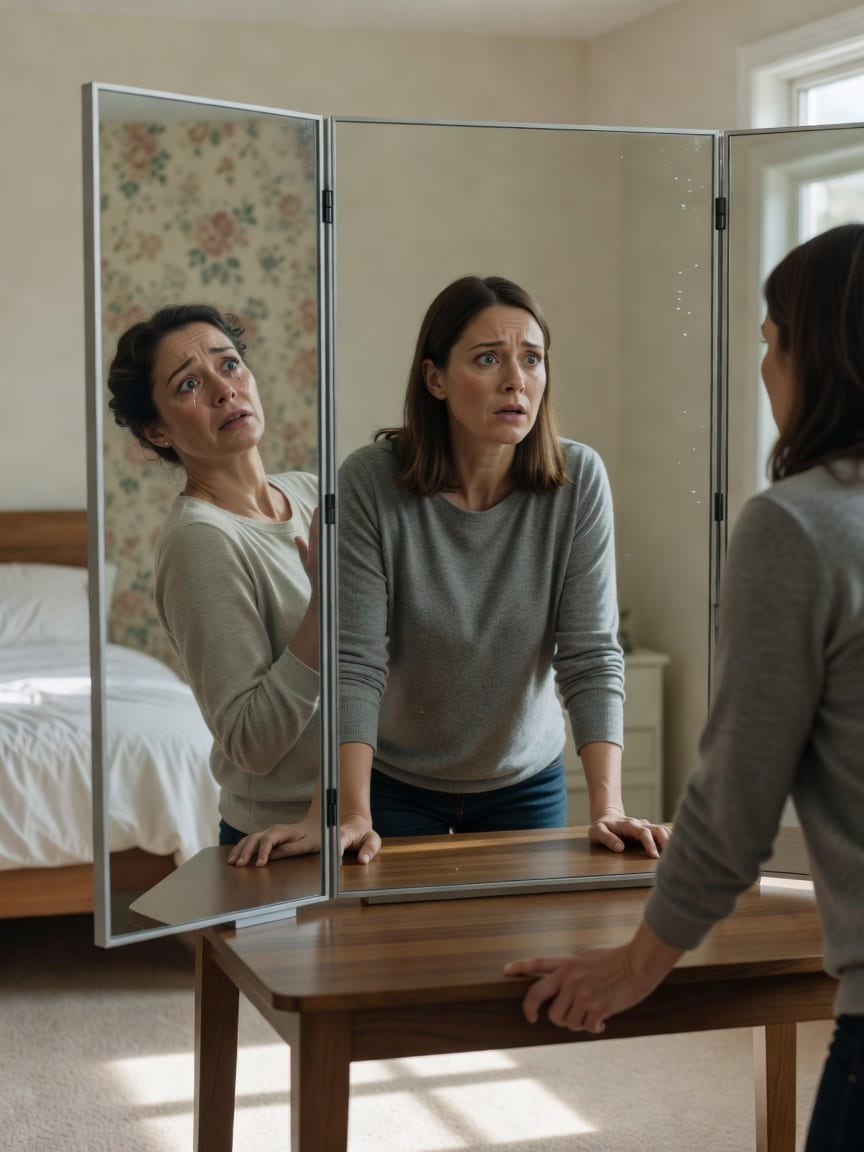
My bedroom mirror shows a woman doing her hair, in a room papered differently than mine. She moves a half-second late.
I moved into my inherited house, with its antique dressing table and mirror. Late at night, the mirror shows a woman doing her hair, but it's not my reflection. Her room has faded floral wallpaper, a stark contrast to my white walls.
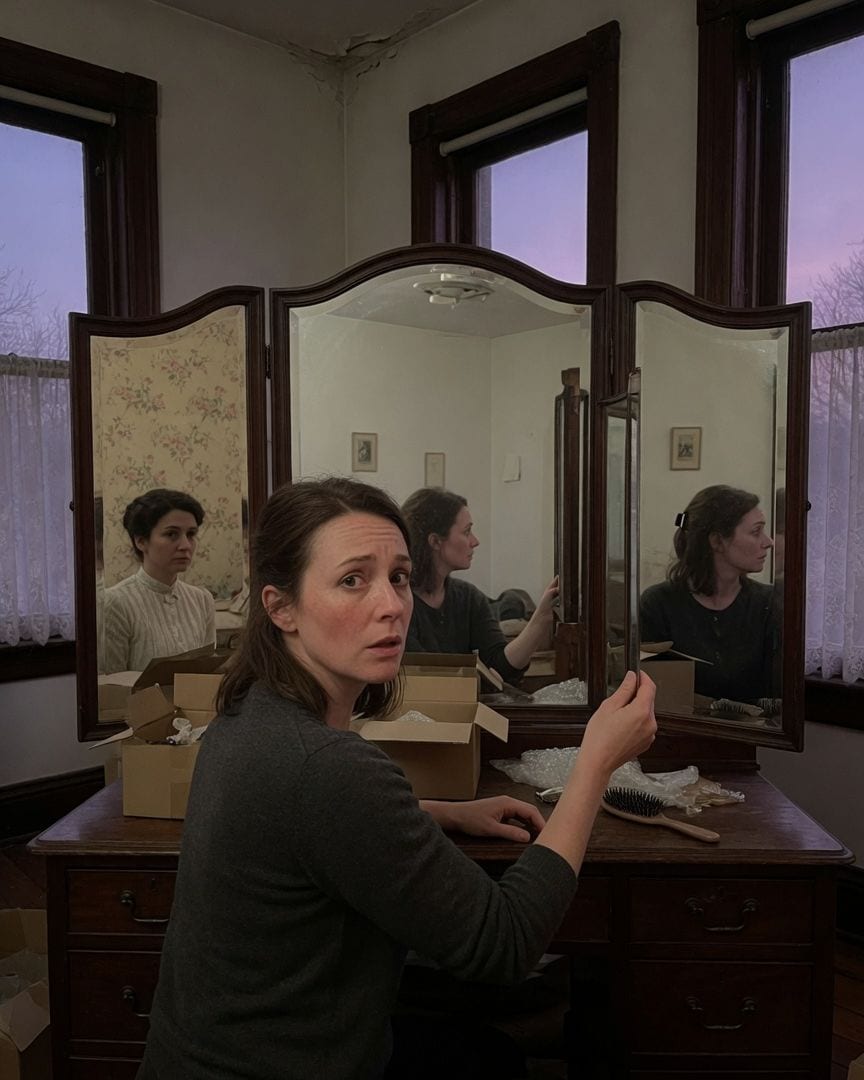
My dressing table mirror shows a woman in a high-necked blouse, doing her hair in a room papered differently from mine. She moves a half-second late, catching up to a memory of the gesture.
Settling into my inherited, old house, I found myself drawn to an antique dressing table with a three-winged mirror. But when I angled the mirror, it showed a woman from another time, brushing her hair in a room unlike my own. Her every movement in the reflection was a half-second too slow, an unsettling temporal stutter across the decades.
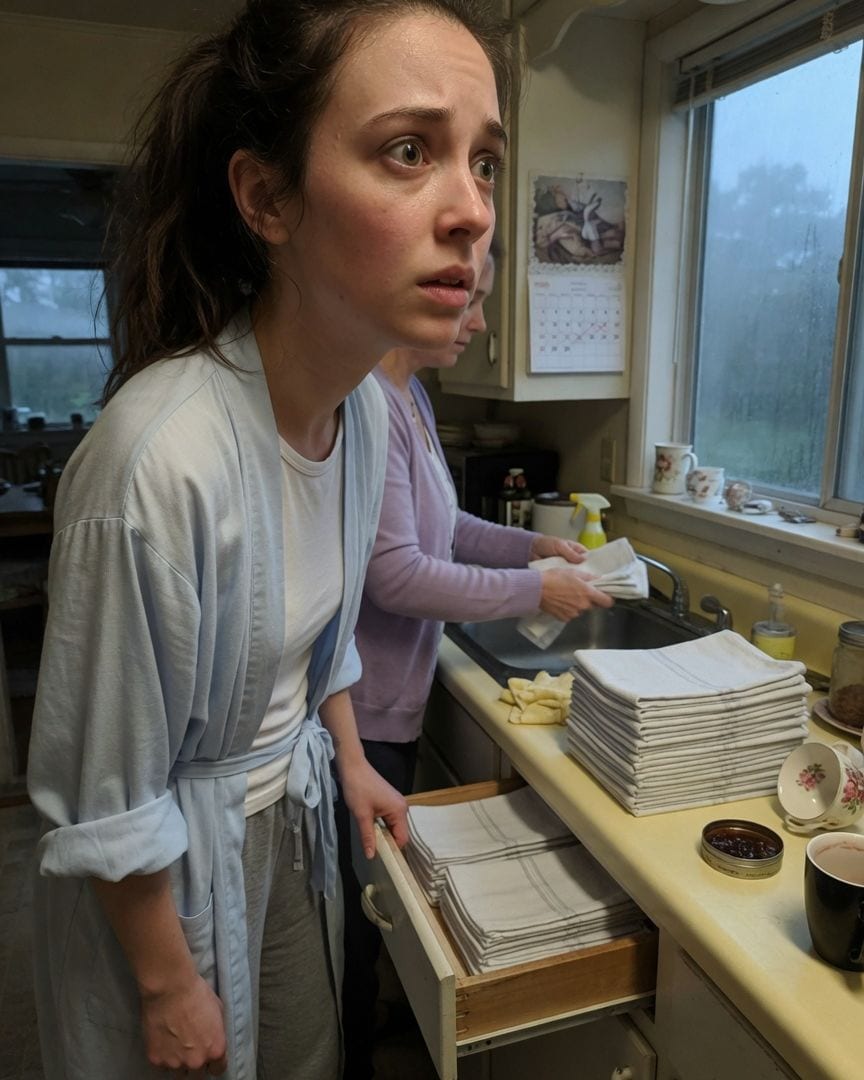
My mother's left wrist has a new scar. She never had one there.
My mother is finally home after her disappearance, and I'm trying to find our old rhythm. But then I watch her fold tea towels, a simple ritual I learned from her. She's doing it completely wrong, seam-out, insisting it's how she's always done it.
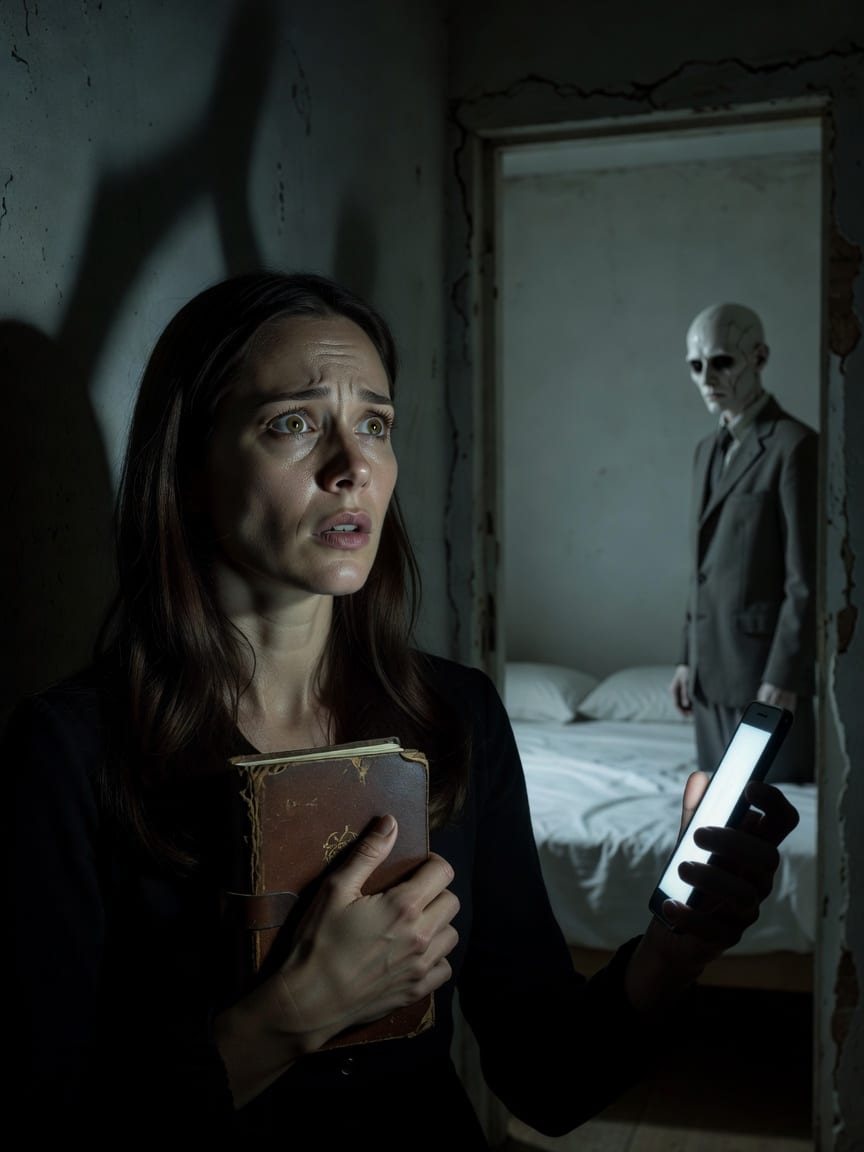
Behind a plastered-over doorway, I found a room. Papered, carpeted, and furnished with a made bed, sealed for decades. The air was dead still, but the bed wasn't dusty. My council tax bill only lists five rooms.
I'm Claire, an architect, meticulously planning my new Victorian terrace renovation. But when I uncovered a hidden room behind a wall, everything I knew about time and decay shattered. The bed was perfectly made, the air still, yet there was no dust, only an unnerving cold.
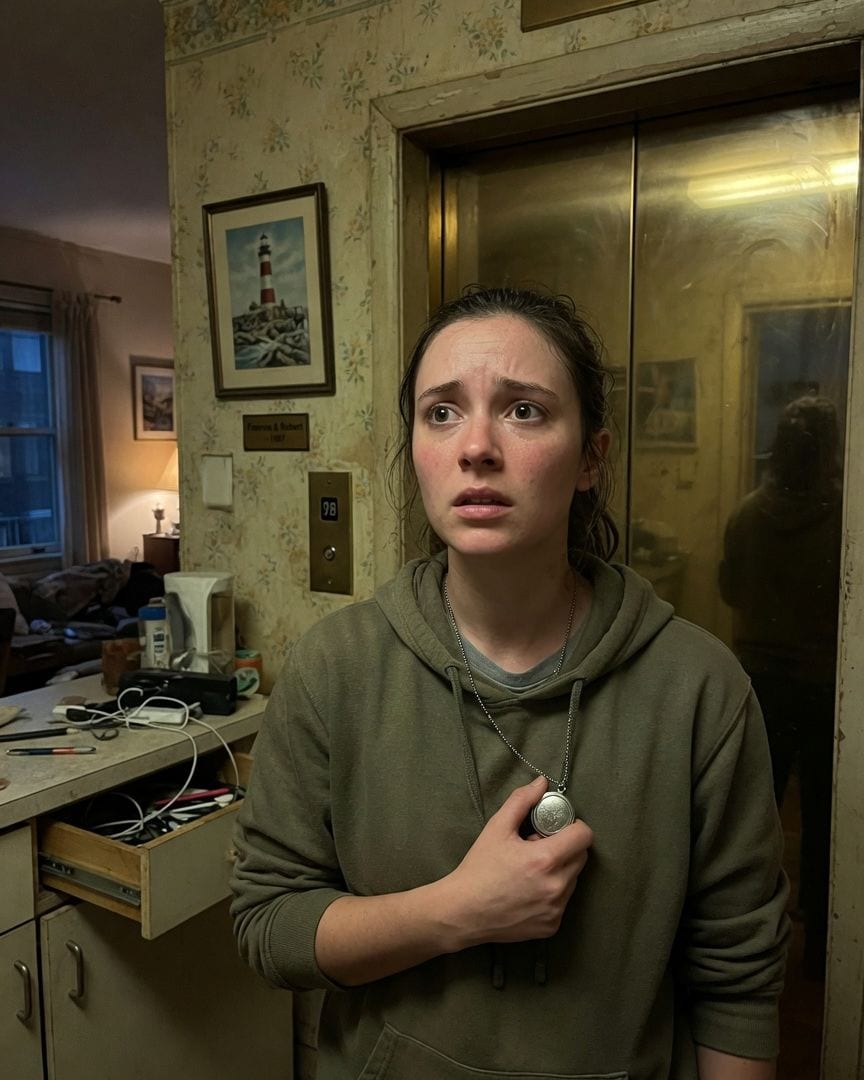
My aunt rode the elevator up, humming, at ease. She hadn't stepped in one since 1994, and told the story of why to anyone who'd listen.
My Aunt Frances stood beside me in the hospital elevator, humming a low tune. It felt deeply wrong; she hadn’t set foot in one since a traumatic incident in 1994, always taking the stairs. Now, after five days missing, she was completely at ease, denying she’d ever feared something so silly, her eyes holding an unsettling calm.
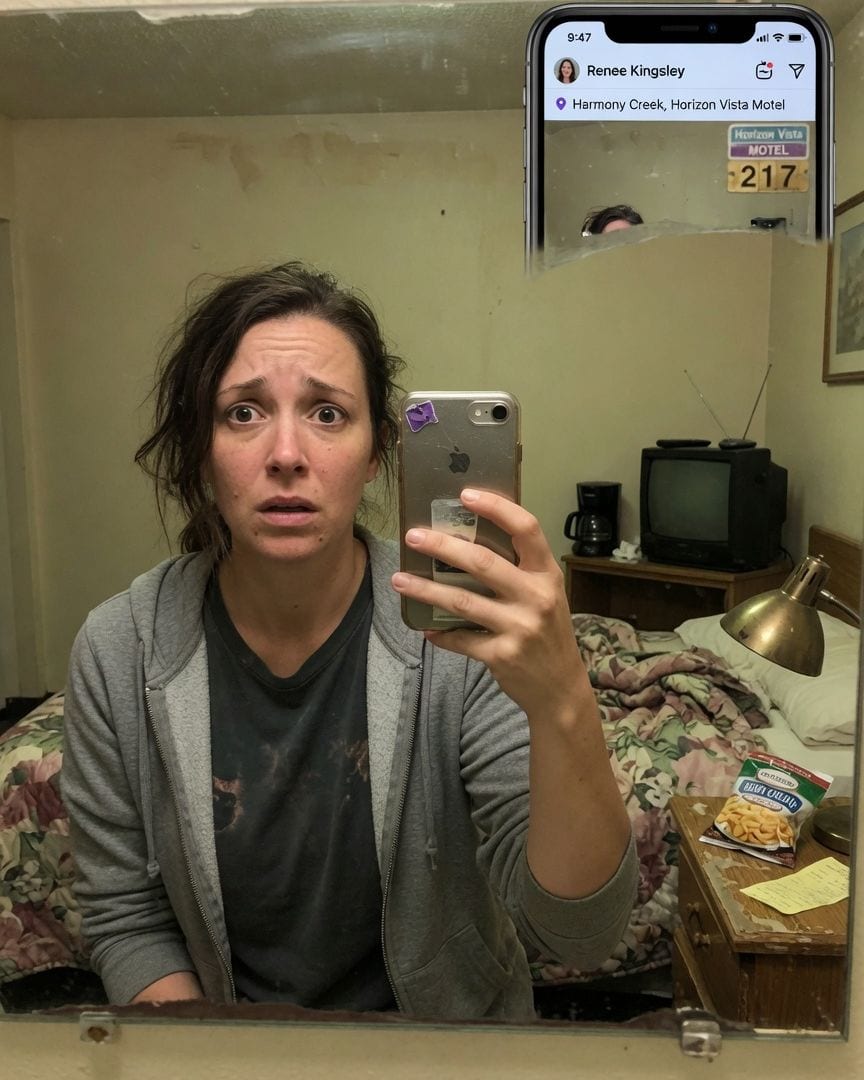
My apartment door opened and closed at 1:20 AM last Thursday, then my digital keycard checked into a motel six hours away, all while I slept.
My Tuesday morning began like any other, until I opened my phone's photo app. Instead of hike pictures, I found forty new photos: a motel room in Harmony Creek, six hours northeast. The last image was a mirror selfie of *my* face, holding *my* phone, but I was asleep in my bed the entire time.