My building grew a seventh floor today, where only sky should be. On its darkest door, a nameplate reads 'E. Abbott'.
I’ve lived in The Sterling Arms for three years, apartment 3B. It’s a solid building, built in 1928, six stories of red brick and wrought iron balconies.
Every morning, I perform the same ritual: I leave my car in the parking garage and, before heading out, I glance up at my apartment window. It's a habit, a quick check that everything's where it should be.
Today, though, my breath caught.
One, two, three, four, five, six. That’s how many rows of balconies there have always been. But this morning, there was a seventh. A whole new floor, sitting impossibly above the familiar roofline, where only sky should have been.
It wasn’t a trick of the light. The sun was sharp and clear. There were real balconies, identical in style to the ones below, just… higher.
On one of them, a faded, old-fashioned linen sheet hung out to dry, rippling gently in the breeze.
From a window on that new floor, a soft, yellow light glowed, like someone had just woken up or forgotten to turn it off.
My mind scrambled for explanations. Construction? No, I would have heard. I would have seen scaffolding. A hallucination? I felt perfectly fine, perfectly awake. I counted again, slowly, deliberately, my eyes scanning each tier. One. Two. Three. Four. Five. Six.
And then, undeniably, seven. The dread wasn’t a sudden shock; it was a quiet, cold certainty that my eyes weren't lying. The building had changed. It was six stories. It always had been.
I’ve measured it, I’ve photographed it, I’ve lived here. But now, it wasn't.
That evening, the impossible floor was still there. The faded linen still hung, stirring faintly in the evening air, and the same soft light still glowed. My heart thrummed a frantic rhythm as I stepped into the lobby.
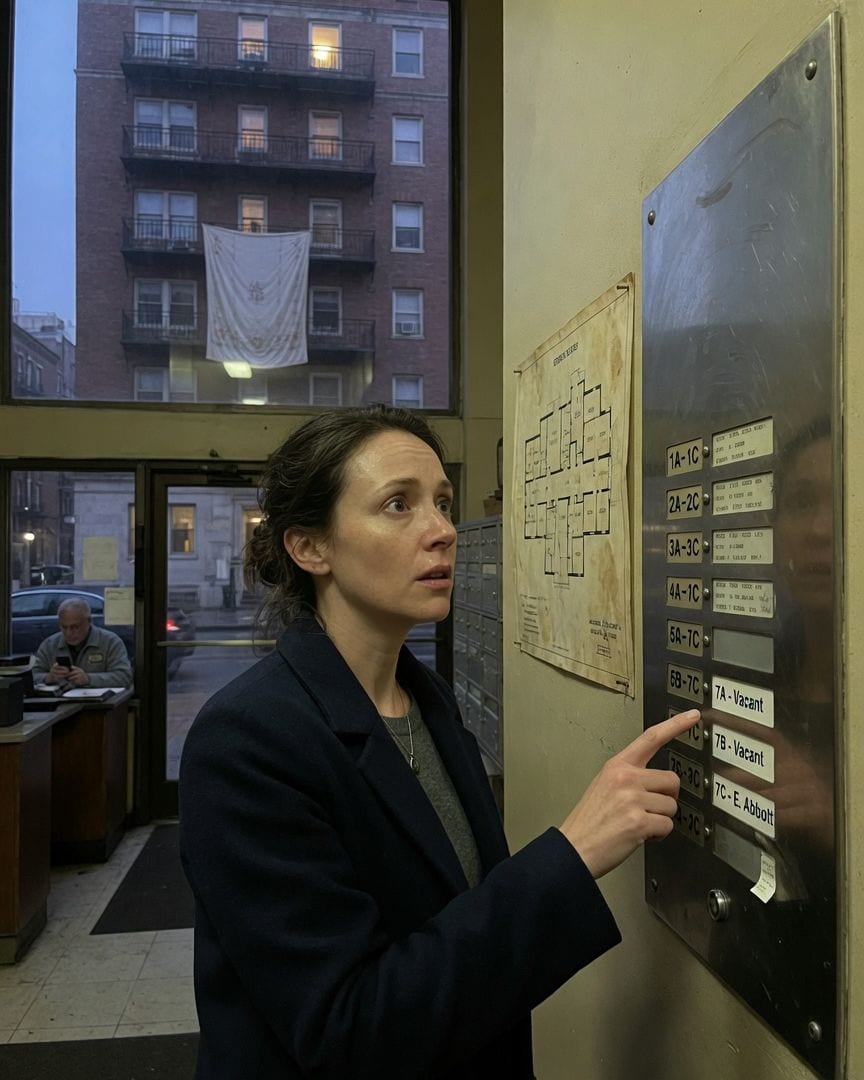
I walked directly to the buzzer panel, the metallic rectangle usually running up to 6C. Now, at the bottom, beneath the familiar tenants, were three new entries: '7A,' '7B,' and '7C.' My finger hovered, then pressed '7C.'
To my surprise, a faint, distant 'BZZZZ' echoed from somewhere high above. No one answered.
I paced to the building's floor plans, tacked to the wall near the mailboxes. They still only showed six floors. Not a single line, not an amended note, not a scrawl indicating a new level.
It was as if no one else had noticed, or cared.
Maxwell Winslow, the night security guard, was at his desk, scrolling on his phone. He’s been here forever, knows every crack in the plaster. “Everything alright, Ms. Abbott?”
he asked, his gaze too calm, too unbothered as I gestured vaguely upwards. “Just… the building. Have you noticed any… new renovations?” I tried to keep my voice casual. He glanced up, then back down at his phone.
“Things change, I guess.” His non-reaction, his utter lack of surprise, was almost as unsettling as the new floor itself. He just shrugged, like it was a minor detail.
I decided against the elevator. I needed to feel the ground beneath my feet, to count the steps, to physically verify. The sixth-floor landing looked exactly as it should, the familiar brown carpet, the old fire extinguisher.
But instead of ending at a blank wall, the staircase continued upwards. A new, narrower flight of stairs, the carpet a slightly different shade of brown, led to an unfamiliar door marked simply with a bold, black '7'.
The air up there felt different, cooler, with a faint, musty scent I couldn't place.
Heart pounding, I climbed the final flight. The seventh-floor hallway was dimly lit, a single bare bulb casting long, wavering shadows. The wallpaper was a faded floral pattern, yellowed with age, something I’d never seen in the lower floors.
It felt older, forgotten, yet impossibly real. I walked past 7A and 7B, their doors solid, dark wood, but silent as tombs. No sounds of life, no light filtering from beneath.
Then I reached 7C. The door was heavier than the others, thicker, darker wood, almost black. A tarnished brass nameplate was affixed to it, a small, oblong rectangle. My fingers trembled as I reached out, tracing the raised, ornate letters.
They spelled my name: 'E. Abbott'. In an antique, looping script, like something from a century ago, my own name stared back at me. Beneath it, the doorknob, oddly, gleamed as if recently polished, reflecting my own terrified, pale face.
The nameplate was a cold shock. My name, etched in a script that felt decades out of time.
I spent the next morning researching my family tree, pulling up old census records and newspaper archives, looking for any 'E. Abbott' who might have lived in this city, or even in this building, decades ago. Nothing conclusive.
My own family line didn't show anyone with those initials in this region at that time. It was a dead end.
Frustrated, I decided a trip to the city's historical archives was in order. I needed to see original blueprints, permits, anything that could explain this impossible floor. The drive usually takes fifteen minutes, a straightforward route down Elm Street.
Today, though, the familiar felt off. I took the usual left turn onto Maple, aiming for the main archive building.
But instead of the library, I found myself back at the same intersection, the same corner gas station, the same traffic light. It was impossible. I drove again, slowly, trying to notice every detail, every sign. Left onto Maple.
And again, the gas station, the intersection. Three times. My GPS insisted I was moving forward, that I was on track, but the landmarks repeated themselves like a skipped record.
I burned a quarter tank of gas before I finally found an alternate route, a winding path through unfamiliar residential streets that eventually spat me out near the archive building, an hour late and thoroughly shaken by the inexplicable detour.
Inside the archives, the air was thick with the smell of old paper. I requested the original building permits and blueprints for The Sterling Arms. The records were unequivocal. The building was designed and built in 1928 as six stories.
No provision for a seventh. Not a hidden space, not an attic, nothing. The architectural plans stopped cold at the roofline. I cross-referenced tenant lists from the 1930s, 40s, and 50s.
Again, no 'E. Abbott' in any apartment, let alone a mythical seventh floor. The rational explanations were failing, one by one. I felt a growing certainty that the problem wasn't with my memory, or with the archives.
It was with the very fabric of the place.
Back at The Sterling Arms, a cryptic note had been slipped under my apartment door. It was typed, not handwritten, and unsigned. "Some things are better left uncounted," it read.
The message was clipped, precise, and it sent a chill down my spine. Someone knew. Someone was watching.
Later that evening, the light on the seventh floor was still glowing. I grabbed my camera, opened my own window, and started photographing the impossible balcony. I zoomed in on the faded linen sheet, trying to capture its antique texture.
As I stood there, lens pointed upwards, I saw Maxwell Winslow in the parking garage below, looking up. Directly at me.
He wasn't waving; he just held my gaze for a beat too long, his expression strange, knowing, almost weary, before he slowly turned away. It was a cold, precise gesture.
The next day, my internet connection in my apartment flickered intermittently, cutting out for minutes at a time.
And when I checked my security camera feed, usually reliable, there was a two-hour gap from the previous night, between 1 AM and 3 AM. Just a blank, grey screen.
I found Maxwell at his desk, polishing the brass bell he kept there. "Maxwell," I said, holding up the typed note. "Did you… happen to see who might have slipped this under my door?"
He barely glanced at it, his eyes returning to the bell. "I'd ignore any anonymous nonsense, Ms. Abbott. People get strange ideas in old buildings." His voice was calm, almost too calm. He knew.
He'd seen this before, or he knew who had. The air around him felt heavy with unsaid things. I felt the shift from investigator to target, a cold realization that someone, or something, was actively trying to deter me.
Desperate for answers, for someone who wouldn't just shrug or make dismissive platitudes, I sought out Greta Donovan.
She lived on the third floor, a retired archivist known for her encyclopedic knowledge of local history and a collection of trinkets that spilled from her apartment into the hallway.
"Oh, that old thing," Greta said, waving a dismissive hand when I tentatively mentioned the seventh floor. She was sitting in an armchair, surrounded by towering stacks of books and newspapers. "It's been known to… appear, from time to time.
Nothing to worry your pretty head about."
I pressed her, detailing the 'E. Abbott' nameplate, the repeating road, the anonymous note. I watched her closely as I spoke. Her eyes, initially vague, narrowed. "You're seeing the pattern, aren't you? Most people don't. They just… adjust. Or forget."
She stood slowly, her joints creaking, and led me into a cluttered spare room. Boxes of old documents were piled to the ceiling, smelling of dust and dried flowers. "The city archives? They don't have everything. Some things… get misplaced.
Or forgotten. Easier that way."
From a precarious stack, Greta pulled out a yellowed newspaper clipping. It was brittle, dated August 17th, 1988. Its headline screamed: 'LOCAL ARCHITECTURAL MARVEL: STERLING ARMS GROWS NEW FLOOR OVERNIGHT!'
The article described the phenomenon with awe, not alarm, focusing on "plans for new luxury apartments" on the "newly discovered" seventh floor. There was a grainy photograph of The Sterling Arms, clearly showing seven stories, with new-looking windows on top.
My breath caught in my throat. I stared, a chill running down my spine. "It was quite a sensation," Greta said, her voice flat, devoid of emotion. "Then, as quickly as it appeared, it was… gone. And everyone just forgot.
Like turning off a light." The dread wasn't just that it had happened, but that it had been erased, leaving no trace but Greta's hidden collection.
I demanded to know more, my voice tight. "What about the people who lived there? The 'E. Abbott' from the nameplate? Did they… just forget too?" Greta sighed, her gaze distant, like she was looking through me, into the past.
She shuffled through another box, pulling out a faded, hand-typed document. "This is a tenant roster from 1988." She laid it carefully on a small, unsteady table.
Her gnarled finger, yellowed with age, traced a line down the page, past 'Apartment 6B, D. Henderson' and 'Apartment 6C, S. Vance,' landing on 'E. Abbott, Apt. 7C.' My own name.
Next to it, in curt, faded red ink, was a handwritten note: 'Relocated - urgent, family matter.' Greta looked up, her eyes holding a deep, ancient sadness. "It wasn't just 'relocated,' dear.
They just… ceased to be part of the building's story. And the city's. Their friends, their families, they remembered less and less until there was no one left who truly recalled them ever being here."
A profound, cold understanding settled over me. This wasn't just a building anomaly, a quirky architectural marvel. This was a cycle of erasure.
And the name on that roster, the same as hers, meant that this 'E. Abbott' was no stranger, and her own story was already written.
Greta explained the full, terrifying truth. "The building itself is a kind of anchor, Eileen. It sits on a place where reality thins, where the lines between what is and what was get blurred."
Her voice was soft, almost a whisper, as if the walls themselves might be listening. "Every few decades, when the conditions are just right, the building shifts.
It pulls in a piece of its own past, or some other impossible geometry, and people get caught in the fold." She described how residents who noticed too much, who questioned too loudly, slowly faded from existence.
Their memories, their records, even their physical presence, dissolved. "The seventh floor isn't new; it's an echo. A part of a previous iteration of the Sterling Arms, that comes and goes. And the 'E. Abbott' from 1988?
She was a woman much like you, a meticulous person, a data analyst even, who started asking questions. She recorded everything, just like you are. But the building… it doesn't like to be questioned."
Greta showed me her own collection of journals, meticulously kept, detailing similar events in 1953, in 1918, each time with a few 'disappearances' or 'relocations' recorded alongside the architectural impossibilities.
The coherent pattern of geometric anomaly, forgotten history, and disappearing witnesses clicked into place with horrifying clarity.
The dread wasn't in a sudden monster, but in the slow, quiet inevitability, the consistent way the building reasserted its impossible reality, erasing all proof.
I knew, with a sickening certainty, that I had to get out. I returned to my apartment, but it felt alien, the walls subtly shifting, the floorboards groaning under my weight like a living thing.
The air was cold, even though the heat was on. I grabbed my phone, my wallet, and a small, tarnished antique key Greta had given me, claiming it "might open something forgotten, if you find the right lock."
My hands shook as I shoved them into my bag.
As I tried to leave, the stairwell seemed to stretch, the landings receding as I descended. Each flight took longer than it should, the steps multiplying beneath my feet.
I could hear a faint, almost imperceptible hum emanating from the walls, a low thrum that vibrated deep in my bones.
I finally reached the ground floor, my legs aching, but the familiar lobby exit door was now a solid, unyielding wall of brick. Panic clawed at my throat.
I ran to the service exit at the back of the building, but it opened onto a narrow, brick alley I’d never seen before, ending in a dead-end with no way out.
I rushed to the parking garage, hoping for escape, but the familiar concrete ramp spiraled downwards into an impenetrable, inky darkness, the smell of damp earth heavy in the air. The building was holding me. It had decided.
Desperate, my mind raced back to the 'Road That Returns' effect. If the external world could loop, perhaps the internal rules of the building were equally malleable.
I scrambled into my car, started the engine, and, with a prayer on my lips, drove straight at the solid lobby doors, picking up speed. There was no crash, no impact.
The car passed through the solid wall as if it were air, emerging onto the street, the tires squealing as I accelerated away.
I didn't look back, driving until The Sterling Arms was a tiny, indistinct dot in my rearview mirror. I had escaped, but the cost was everything I left behind, and the harrowing, impossible knowledge I now carried.
I drove for hours, the hum of the engine a desperate comfort, eventually finding a cheap motel miles away, on the edge of a nameless town.
I tried to explain it to the local police, showing them the blurry photos of the seven-story building on my phone, the faded newspaper clipping, Greta's tenant roster with 'E. Abbott' on it.
They listened patiently, their faces politely skeptical, then suggested I get some rest, perhaps see a doctor.
My landlord, reached by phone, confirmed The Sterling Arms was a six-story building and that my lease was still active, but my apartment "seems to be empty." All my belongings, my furniture, my entire life, were gone.
I tried to find Greta, but no one in the building, when I called under a false pretense, seemed to know who she was.
Maxwell Winslow, when I reached him, denied ever discussing anything out of the ordinary, his voice as calm and unbothered as ever.
The Sterling Arms, seen from a distance on a news report about a minor traffic incident nearby, looked perfectly normal, exactly six stories tall.
I sit in this cheap motel room, staring at the blurry photographs of the seven-story building on my phone, the faded newspaper clipping, the tenant roster I’d managed to snatch. No one believes me.
The truth is mine alone, a heavy, isolating burden. I scroll through my social media, seeing posts from old friends about their normal lives, their normal apartments, their normal problems. I consider posting my story, but what's the point?
They'd just laugh, or pity me. I know what I saw. I know what I escaped. And I know it will happen again.
Years later, a new resident moves into The Sterling Arms. They notice a faint, almost imperceptible hum from the walls at night.
One morning, as they leave for work, they glance up from the parking garage, counting the six familiar rows of balconies.
The newly installed buzzer panel, gleaming under the lobby lights, now ran up to flat 7C, listing 'E. Abbott' among its tenants.
If this one got to you
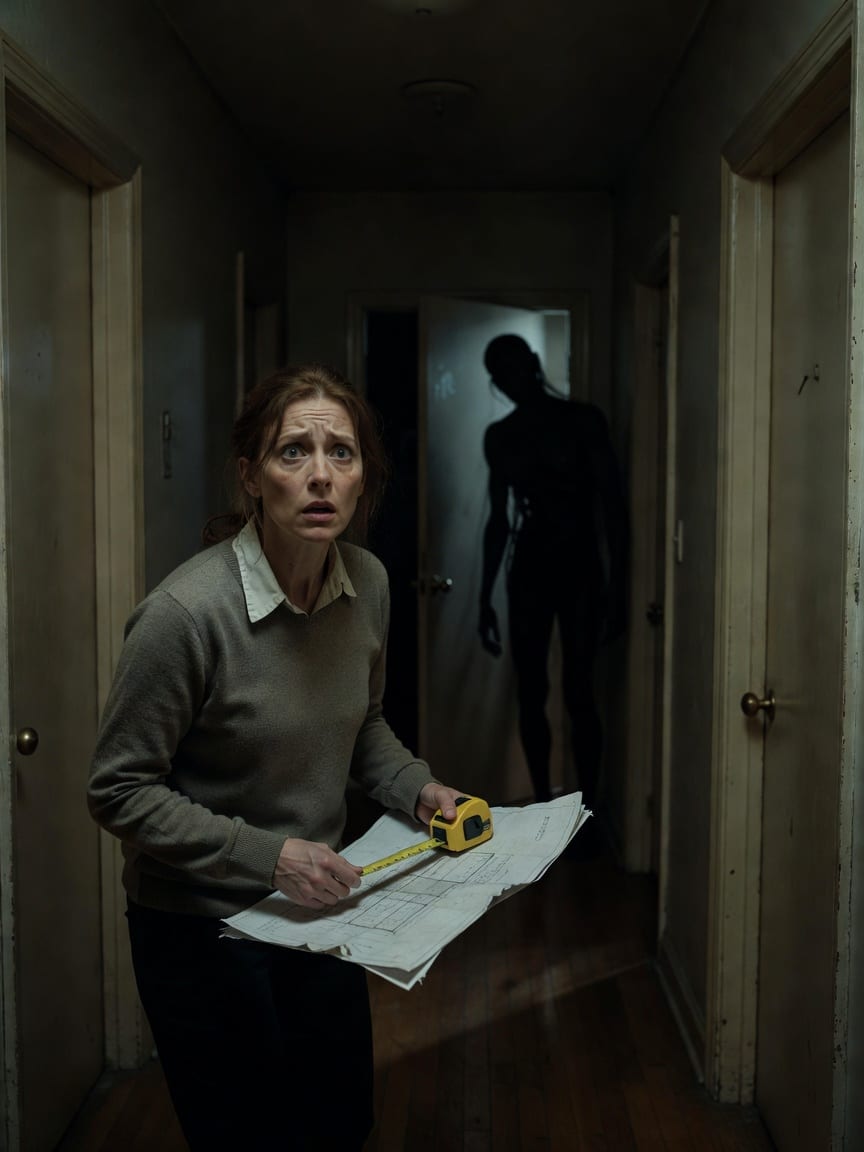
My front door has a dented gate and a dead hydrangea. I walked past it six times, trying to reach the corner shop just a hundred yards away. The pavement kept bringing me back to my own porch, and the shop's light never moved.
My morning started like any other, a quick walk to the corner shop from my home at Number 14, Elm Terrace. But after walking what felt like two minutes, I found myself back at my own front door, the shop no closer. I tried six times, faster and slower, but my street kept compressing, refusing to let me leave.
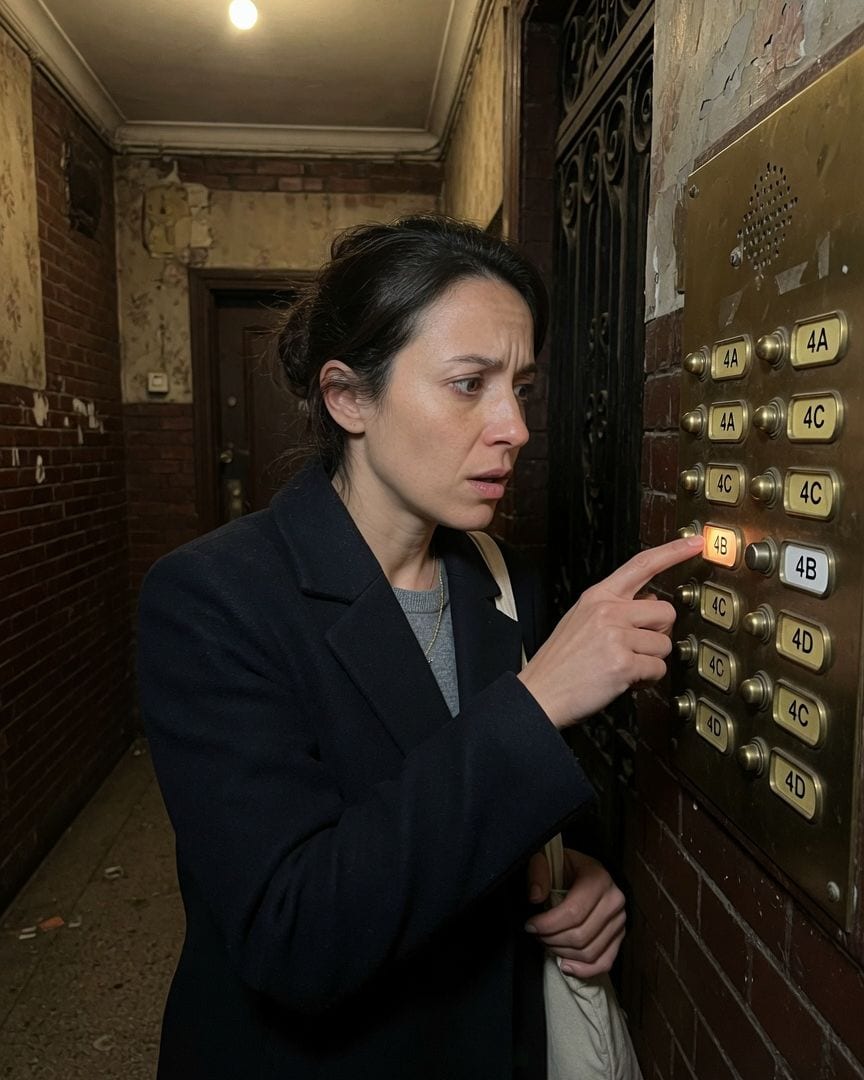
My mother's intercom panel grew a fifth buzzer for her floor, 4B. I pressed it. Something breathed on the line before it died.
Visiting my mother's old building always makes me jumpy. But today, something far stranger stopped me cold at the intercom panel. A new, glowing buzzer for '4B' appeared on the fourth floor, even though there are only four apartments.
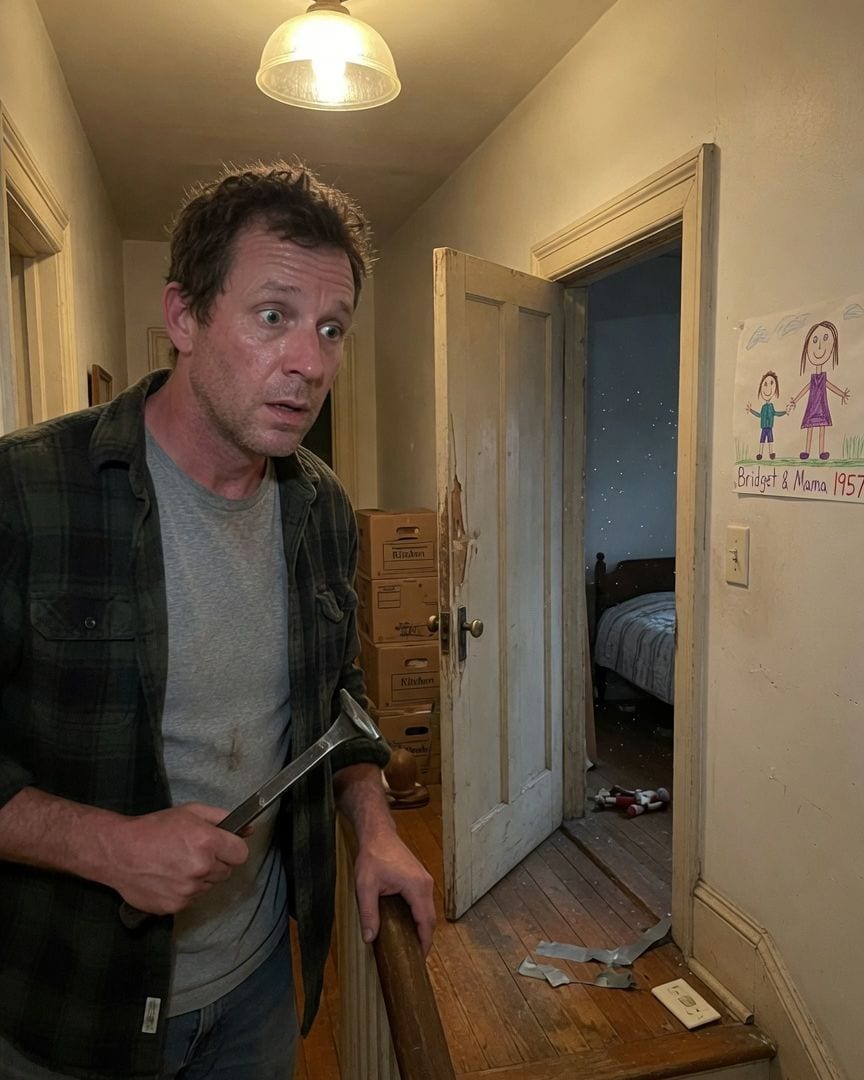
My landing light switches itself off at 9:40 every night. I've watched the switch flick down under nothing, the tape peeled back. The house holds its breath.
My great-uncle's old house was a quiet gift, a place to finally settle. But as I unpacked, a strange worn path on the floorboards led me to a small, barely visible door, perfectly blended into the wall. It was undeniably locked, and felt like a deliberately obscured secret.
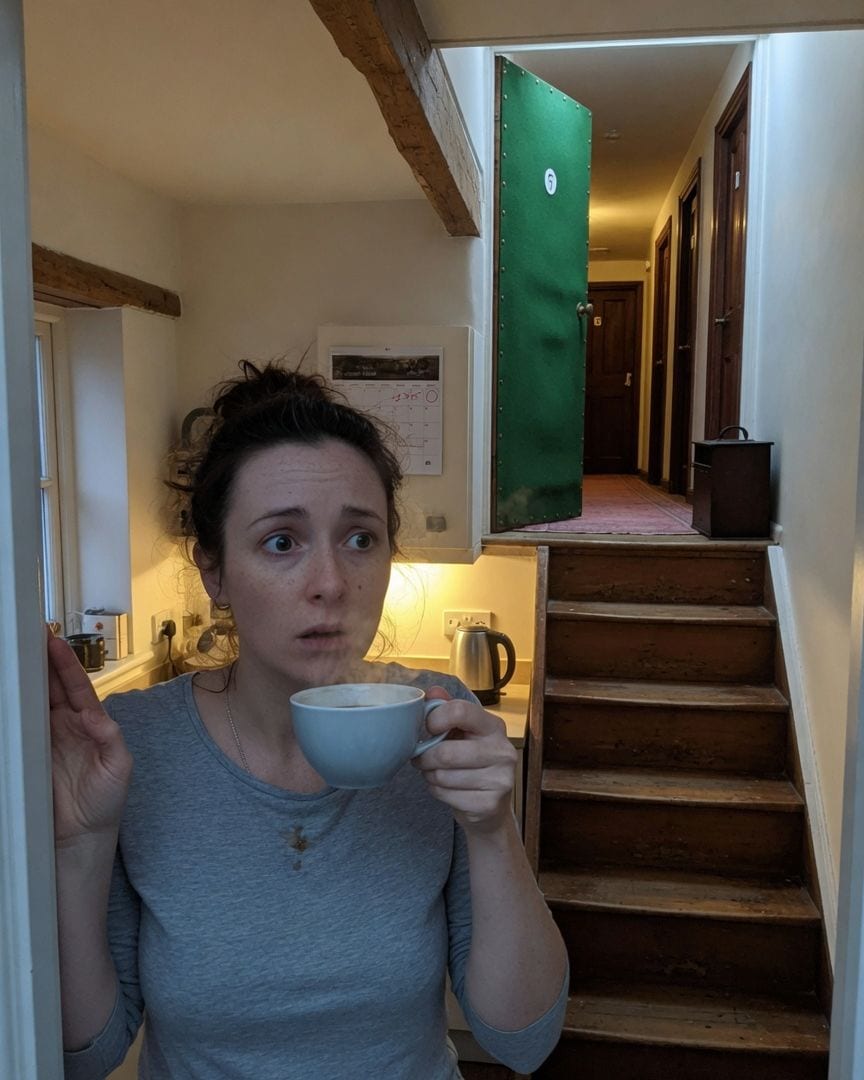
A green baize door I hadn't built stood ajar at the top of my servants' staircase, onto a corridor of numbered rooms far longer than my house, a housemaid's box left outside room seven.
After a year of renovations, my old estate house was finally complete, and I lived alone. One morning, I awoke to find a finely embroidered linen napkin on my bedside table, smelling faintly of lavender. It was identical to a stack I'd glimpsed in a corridor that had vanished overnight.
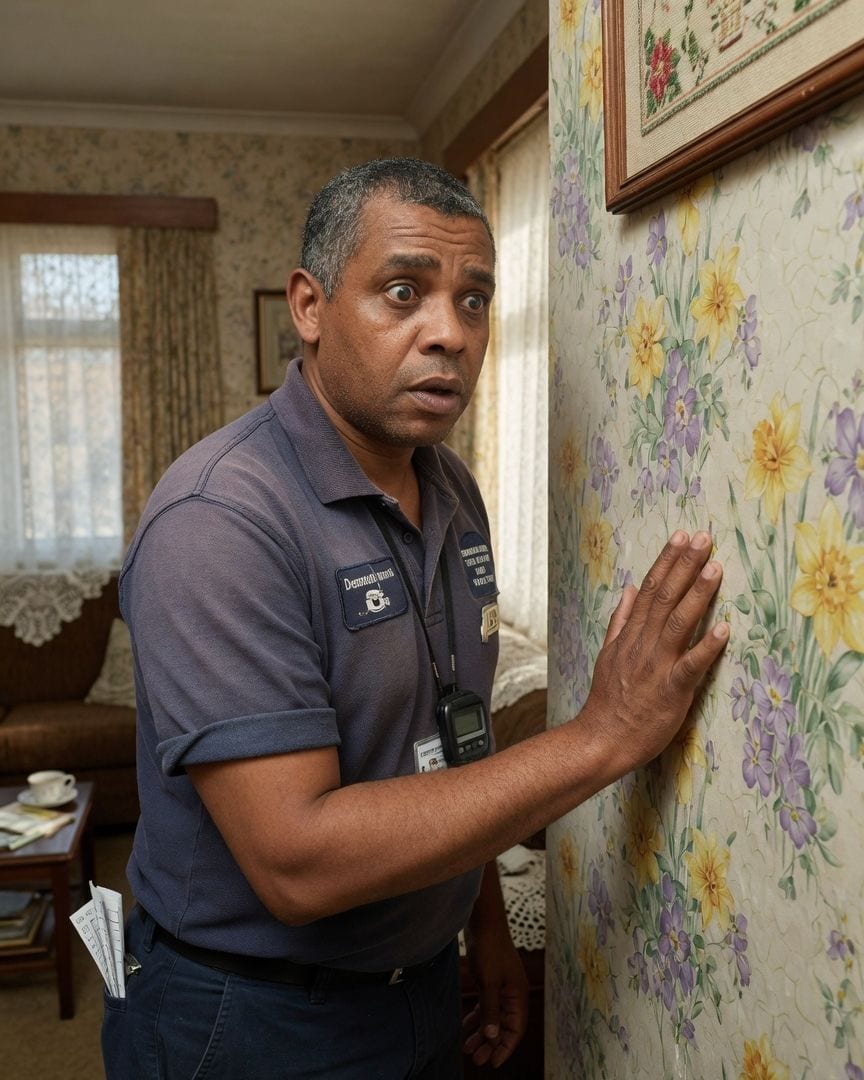
I read the water meters on this street, and this month number 30 grew a second one in pavement that was solid last month — its pipe runs back under a front door I cannot find.
I'm Desmond Drummond, a city water meter reader, used to the predictable rhythm of my fifteen-year route. But this month, Mrs. Crane's house on Elm Street showed a second meter reading. It led to a new meter pointed at a blank brick wall, and later, to a hidden door behind her living room wallpaper where no door should exist.
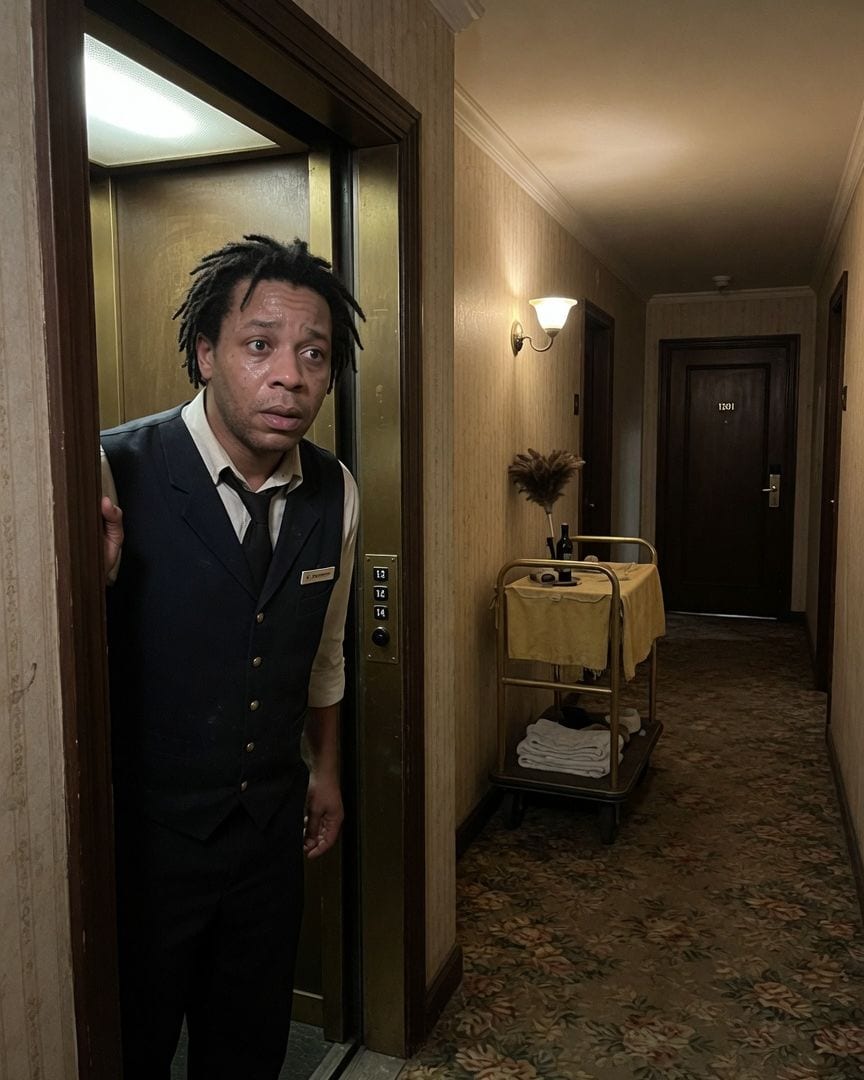
My hotel lift grew a Floor 13 button last week, unlit and proud. A guest pressed it before I could stop them.
As night porter, I'd always dismissed our hotel's missing 13th floor as superstition. But last week, a new button for '13' appeared on the lift panel, opening to a forgotten corridor that shouldn't exist. Stepping inside, I found an old night porter's uniform, complete with a name tag bearing the name of a local historian.