I read the water meters on this street, and this month number 30 grew a second one in pavement that was solid last month — its pipe runs back under a front door I cannot find.
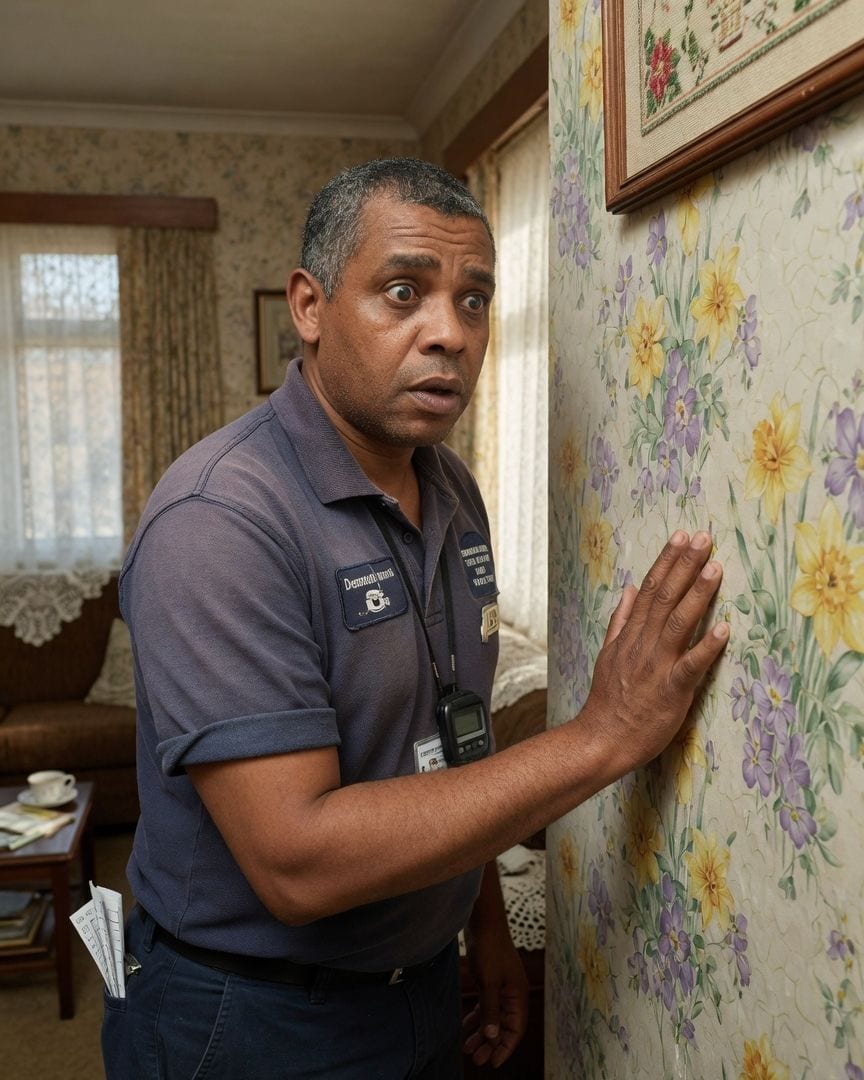
It started like any other Tuesday. I’m Desmond Drummond, 42, a water meter reader for the city. Been doing this for fifteen years, same routes, same houses, same faces. You get a rhythm.
You learn the cracks in the pavement, the stubborn weeds around the meter covers, the houses that always pay on time. Number 30 Elm Street, Mrs. Crane’s place, has always been one entry in my logbook.
One stop-tap, one clear reading.
But this month, my digital log showed two. Two readings for Number 30, both climbing steadily, side-by-side. I tapped the screen, assuming a system glitch. Happens all the time, software updates.
I found the familiar stop-tap on the front lawn, lifted the plastic cover, took the reading. Standard.
Then I followed the GPS marker for the second reading. It pointed a few paces down the pavement, near the side of Mrs. Crane’s house. And there it was.
Set into freshly poured, dark asphalt that definitely wasn’t there last month, was another meter cover. It felt cold and smooth beneath my fingertips, too new, too perfect, like a misplaced tooth in an old smile. I lifted it.
The pipe ran back under the curb, then under where Number 30 should be.
Except, from this angle, where the front door to that particular section of the house should have been, there was just… a blank stretch of brick and ivy. A wall. No door, no porch light, no knocker.
Just solid, unblemished facade, like the house was turning its back on something it didn't want to acknowledge.
I spent the rest of the day trying to rationalize it. A new annex? A detached garage I’d never noticed before, somehow plumbed in separately? I called the office, reported the discrepancy.
They checked the system, found the duplicate readings, and dismissed it as a 'data error'—just as I'd expected. "We'll send someone to recalibrate the street's GPS," the dispatcher chirped.
But the physical meter, the fresh asphalt, the missing door… they weren’t data errors. They were solid facts, cold beneath my fingertips.
The next morning, unable to shake the feeling, I returned to Elm Street. I was armed with a measuring tape and the city's old architectural plans for the block, pulled from the archives.
I paced the front of Number 30, counting windows, marking distances. It was a standard semi-detached, three beds, two reception rooms. Nothing unusual. I checked the plans against the physical structure, confirming every window, every corner. Everything matched perfectly.
Except for the area where the second meter's pipe would lead. According to the blueprints, that spot should have been the main living room. A solid, internal space.
I knocked on the front door of Number 30. Sharon Crane, a spry woman in her late seventies who had lived there since the 60s, answered. She's always friendly, always offers a cup of tea.
I explained, vaguely, about a 'meter issue,' a 'survey update.' She let me in, curious but unworried. As I stood in her living room, I gestured toward the wall that backed onto where the second meter’s pipe would lead.
"Mrs. Crane," I asked, trying to sound casual, "has anything ever been… changed here? An extension, a major renovation?" She shook her head, her floral scarf rustling. "Not since my Arthur passed, dear.
And he only ever put in the patio out back."
I studied the wall. It was a solid expanse of floral wallpaper, daffodils and violets. But as I squinted, I noticed a faint, almost invisible seam in the pattern, a subtle vertical line where the paper didn't quite meet.
It was barely a hair's breadth, easy to miss if you weren't looking. I pressed against it. It felt solid, completely rigid, but the line was definitely there, almost like a poorly patched-over doorframe, papered over to erase its existence.
I excused myself, promising to call the office again, needing to escape the unnerving presence of that wall. Later that day, the image of that faint seam gnawing at me, I drove back to Number 30.
Sharon was out, gardening in her meticulously kept backyard, humming to herself. I waited until her back was to the house, then quietly slipped inside. The living room was empty, still.
I approached the seam in the wall, my heart thudding a nervous rhythm against my ribs. I ran my hand along it, feeling a faint roughness where the paper overlapped, a slight give beneath my fingertips.
I pushed harder, applying firm, even pressure. There was a faint click, like an old lock turning. A section of the wallpapered wall, previously indistinguishable from the rest, swung inward a fraction of an inch, revealing a dark, narrow gap.
I forced it open, and there it was: a small, unmarked wooden door, previously hidden, now gaping like a silent mouth. I pushed the small, unmarked door fully open.
I stepped onto a small, dusty landing, the air suddenly colder, and saw a single, heavy wooden door at the far end, not matching the rest of the house.
I knew, with chilling certainty, that this space, this landing, and especially that door, were not on any blueprint, and there was nowhere for them to physically be.
I quickly closed the hidden door behind me, my heart hammering like a trapped bird. The next day, I returned, armed with a flashlight and a sense of grim determination. Sharon Crane was out again, as I’d hoped.
I slipped back into the house, through the hidden door, and onto the impossible landing. The air here was still, thick with an old, stale scent, like dust and damp earth mixed with something else I couldn't place.
I tried the heavy wooden door at the end of the landing. It was unlocked. I pushed it open slowly, expecting… I don’t know what. Another wall? A crawl space?
Instead, inside was a small, unfurnished room. No windows, just plain, unpainted plaster walls, a bare concrete floor.
It felt like a cellar, but it was unmistakably on the ground floor, within the footprint of a house that shouldn't have this space.
There was a faint, almost imperceptible hum in the air, a low frequency that vibrated through the soles of my shoes. On one wall, a single, rusted brass tap protruded, dripping slowly into a small, grimy drain in the floor.
No sink, no basin, just the tap. I checked my phone for signal – nothing.
I measured the room with my tape. Its dimensions were strange, not fitting any standard architectural module. It was too long for its width, yet felt cramped.
I even tried knocking on the walls, listening for hollow spaces or shared walls with the rest of Number 30. But the sound was dead, muffled, as if the room existed in a vacuum, insulated from reality.
I snapped a few photos with my phone, though they came out strangely distorted, the edges of the room seeming to curve inward, the bare plaster looking almost warped.
When I checked the exterior of Number 30 again, trying to pinpoint where this room would be, it was impossible.
It should have been visible, or at least its presence should have distorted the outer wall, but the house's exterior remained perfectly normal, perfectly consistent with the blueprints.
This room was simply not there from the outside, yet here it was, undeniably present, and somehow consuming water. This had to be where the second meter’s pipe led.
A few days later, I was back at the office, trying to cross-reference the odd water usage from the second meter with any historical records.
I was deep in the company's dusty archives, a room that smelled of mildew and forgotten things, looking for anything similar.
I found a few anomalous readings for other properties over the decades, always dismissed as 'ghost readings' or 'system errors.' As I was sifting through a particularly thick ledger from the 1980s, my phone buzzed. It was an unfamiliar number.
I answered. A calm, even voice, neither male nor female, simply stated, "Mr. Drummond. Some things are best left uncounted." Then the line clicked dead.
I froze, the old ledger open in my hands. My heart hammered against my ribs. I checked the number; it was untraceable. A prickle of dread crawled up my spine. Someone knew. Someone was watching my investigation.
I looked around the quiet archive, suddenly feeling exposed. The only other person was a young intern, absorbed in her own work across the room, headphones on.
I tried to shake it off, but the voice's tone, utterly devoid of emotion, chilled me to the bone.
I found myself looking over my shoulder more often after that, especially when I was on my route. I felt an invisible gaze.
I even noticed a dark, unmarked sedan parked a few streets away from Elm Street for two consecutive days. It never moved, never showed a driver, but its presence was a cold, heavy weight. The message was clear: stop digging.
But the uncanny room, the two meters, and the impossible geometry of Number 30 refused to be ignored.
I knew I couldn't stop. The phone call only intensified my resolve. I had to know. I visited Sharon Crane again, this time with a more direct approach, no more vague 'meter issues.'
"Mrs. Crane," I began, sitting opposite her in her neat, floral living room, "that house… Number 30. Have you ever noticed anything… unusual about it? Anything that doesn't quite add up?"
Sharon hesitated, her gaze drifting to the living room wall, where the hidden door was. A faint tremor, I thought, in her usually steady hands. "Unusual?" she repeated slowly, her voice softer than usual.
"Well, when my Arthur and I bought it, the solicitor mentioned something about the deeds being… complicated. Something about a discrepancy in the original survey. They called it 'a slippage.'
Said it was nothing, just old records being messy, you know how it is."
I leaned forward, my pulse quickening. "A slippage? What did that mean?"
Sharon shrugged, a frail gesture. "He said it meant the house was a few feet off where it should be, on paper. But it was cheap, so Arthur didn't mind. He liked a bargain."
She paused, her eyes widening slightly, as if a long-buried memory was struggling to the surface. "But… there was a pipe, years ago. Before your time, before I even lived here, I think.
A pipe that just… came up in the garden, with a tap on it. No one knew what it was for. It just ran and ran. The council came, turned it off, dug it up.
Said it wasn't on any map."
My mind raced. A pipe that 'just ran and ran.' A pipe 'not on any map.' It sounded exactly like the second meter, decades earlier, a faint echo from the past.
"And the house, Mrs. Crane," I pushed gently, "did it ever… feel bigger than it should? Or smaller?"
Sharon frowned, her brow furrowed in thought, then a flicker of memory crossed her face, a fleeting, almost fearful light in her eyes. "Arthur used to joke.
Said he could walk from the living room into the shed in the garden, if he just found the right door. Said it made no sense, but he swore he almost did it once.
He was always a bit of a drinker, mind. But he was very particular about his numbers.
And he always said this house had one more room than it ought to, but he could never find it again after he first glimpsed it."
The 'room that isn't counted.' The 'slippage.' The unexplained pipe. It all clicked into place, a horrifying mosaic forming in my mind.
Number 30 wasn't just a house with a quirk; it was a living anomaly, a consistent, recurring geometry that defied logic. Sharon's casual recollections painted a picture of a phenomenon that had been present for generations.
I thanked Sharon, my mind reeling. I now understood that the 'slippage' and the 'room that isn't counted' were all manifestations of Number 30's impossible geometry, a recurring anomaly that had been playing out for decades.
The next day, I was back in the archives, specifically looking for records from the time Sharon mentioned the 'pipe that just ran and ran.'
I dug through old meter reader logs from the 60s, then the 70s, meticulously searching for any mention of Number 30 and its anomalies.
I found several. One log, yellowed and brittle, from forty years ago, detailed an almost identical situation: 'Anomaly at 30 Elm St. Second meter found, unauthorized tap in garden. Consumption noted.'
The log described the same 'missing front door' phenomenon I’d witnessed. I pored over the handwriting, the meticulous notes detailing the 'correction' made by the company. My eyes scanned for a signature. There it was: 'R. Carver.' Richard Carver.
My predecessor. I remembered the name, a quiet man who retired abruptly a few years before I started.
Then I noticed something else. A small, faint doodle next to Carver's signature, a tiny, almost invisible sketch of a spiral, tucked into the corner of the page.
It was eerily similar to a nervous habit I had myself, a little unconscious curl I'd often draw next to flagged readings in my own logbook.
I flipped through more pages, finding similar 'corrections' for Number 30 over the decades, always linked to a second meter, always signed by different names, but the handwriting in the margins, the way the discrepancies were phrased, felt sickeningly familiar.
Below it, a scrawled note, 'Checked against existing plans; anomaly noted, then corrected. Water usage reconciled.' I realized with a gut punch that I had seen these notes before, written in my own hand, in his logbook, just days ago.
The realization hit me with physical force, a cold wave washing over my dread-soaked skin. I wasn't just investigating an anomaly; I was part of it.
The similar handwriting, the identical observations, the 'corrections'—it was a cycle, a pattern laid out over decades. I pulled out my own logbook, my hands shaking slightly, comparing it to Carver's.
The faint spiral doodle, the precise phrasing of certain observations, the way a 'data error' was noted with a tiny exclamation mark—it was almost identical.
I saw a pattern of 'observers,' each drawn into the impossible geometry of Number 30, each documenting its recurring phantom. My own name, Desmond Drummond, was just the latest in a long line.
I realized the calm voice on the phone wasn't a warning, but an acknowledgement of my role, a part of the mechanism.
The 'slippage' Sharon mentioned wasn't a one-time event; it was a constant, shifting fold in reality, periodically manifesting a parallel Number 30.
And the water meter readers, myself included, were the unwitting registrars, our observations giving the phantom house just enough 'reality' to persist.
I remembered Sharon's comment about Arthur, "He could walk from the living room into the shed in the garden, if he just found the right door."
The phantom house wasn't just a separate structure; it was a shifting, out-of-phase version of Number 30 that could intersect with the real one at points, like the hidden room, creating impossible shortcuts or additional spaces.
The second meter wasn't a mistake; it was the lifeline for this impossible echo. I was not merely a witness; I was a participant, my very act of logging the discrepancy feeding the anomaly, validating its existence.
I had to break it. I returned to Number 30. Sharon Crane was out, as always, probably at her bridge club. I went through the hidden door, onto the cold landing, and into the phantom room.
The air here felt heavier today, almost oppressive, the faint hum more pronounced, a low, throbbing presence. I looked at the single dripping tap, rusted brass against bare plaster. This was it.
This was the heart of the impossibility, the anchor of the second meter. If I stopped the water, if I stopped the phantom house's lifeline, perhaps I could break the cycle, snap this impossible thread.
I gripped the tap, feeling the cold, rough metal under my palm. It was stiff, old, resisting my grip. I twisted with all my strength, my knuckles white, my teeth gritted.
I grunted, straining, and with a painful screech of metal, it slowly, reluctantly, ground shut. The dripping stopped. The hum in the room died down, replaced by an eerie, profound silence.
For a moment, nothing happened.
Then, the walls of the room began to shimmer, subtly at first, like heat haze rising from hot asphalt. The unpainted plaster seemed to ripple, to stretch and contract.
A faint, almost imperceptible groan echoed around me, as if the very space itself was protesting, tearing itself apart. The air grew impossibly cold, then impossibly hot, then normal again, in quick, dizzying succession.
I stumbled back, my head spinning, hitting the heavy wooden door behind me. The door, which had felt solid moments before, now gave way with a soft creak.
I fell backward through it, expecting another impossible space, another twist in the geometry.
Instead, I landed with a thud on Sharon Crane's living room floor, right where the hidden door was. The wallpapered wall was solid behind me, no seam, no give, just daffodils and violets. I scrambled up, looking around, disoriented.
The living room was utterly normal, bathed in the warm glow of afternoon sunlight. The air was warm, familiar, full of the scent of old potpourri.
I felt a profound sense of exhaustion, my body aching, but also a strange, terrible clarity. I had stopped the tap, broken the cycle, at least for Number 30.
I knew I had escaped being the latest 'observer,' but the cost was the knowledge of what I now carried.
I never returned to Number 30 for meter readings. I requested a transfer to a different district, claiming 'personal reasons.' The company, after a brief investigation, found no record of a second meter at Number 30, nor any hidden rooms.
The digital log for Elm Street was 'corrected,' the anomalous readings deleted. Sharon Crane continued to live her life, oblivious to the hidden battle fought within her walls. The street, Elm Street, settled back into its quiet, unremarkable routine.
I continued my work, but now, every anomaly, every slight discrepancy in a logbook, every faded note in an archive, carried a new, chilling weight.
He still reads meters. He still keeps his logbook meticulously. But now, he sees the world differently. He sees the cracks, the small inconsistencies that others dismiss.
He notices the subtle shifts in the pavement, the faint, almost invisible seams in old brickwork, the way a hedge might grow just a little too far, obscuring an unseen corner. He knows that Number 30 wasn't unique.
He knows that the impossible geometry, the folds in reality, are far more common than anyone suspects. He just learned how to stop looking for them, for a while. But the knowledge, once gained, cannot be unlearned.
The world is full of places that aren't on any map, waiting for someone to notice their second meter.
If this one got to you
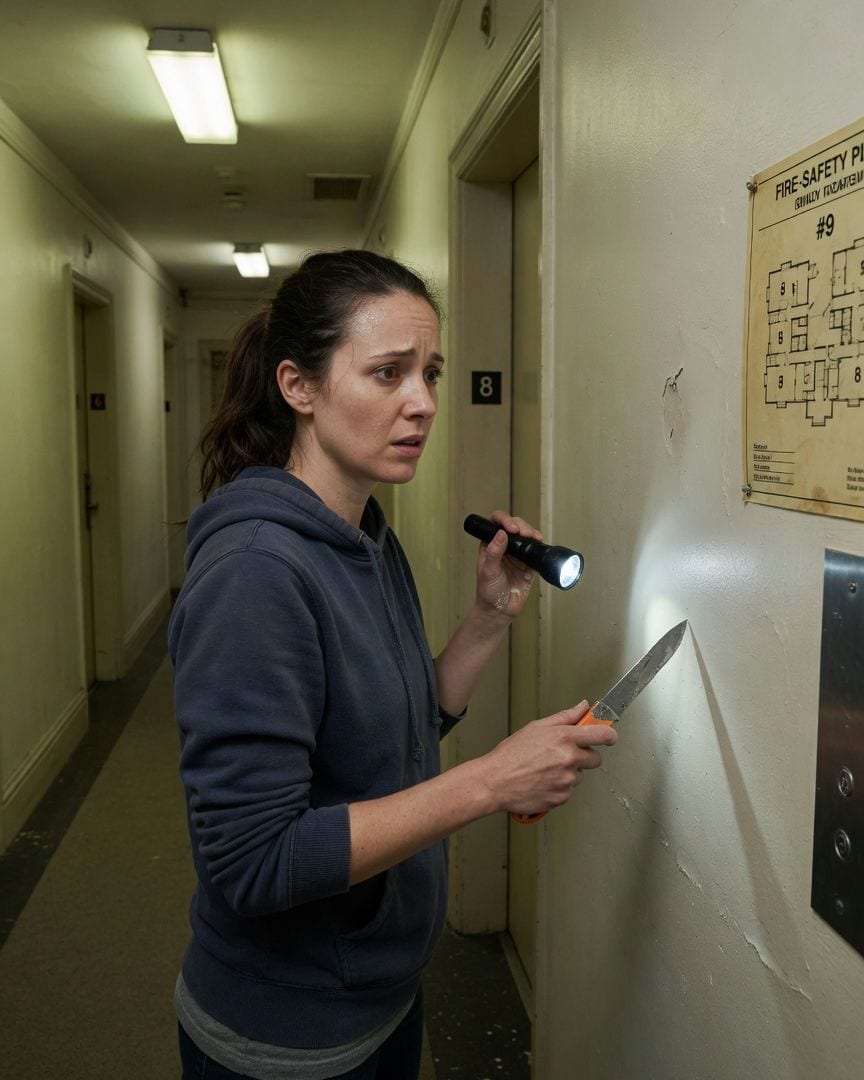
That blank wall in my hallway has a hidden metal plate. Tonight, after eleven years, it just clicked.
For eleven years, my apartment building's fire plan has shown nine apartments on my floor. But I've only ever counted eight doors, the space for the ninth a blank wall. Now, I've found a hidden metal plate behind the plaster, and from deep within, I just heard a soft *click*.
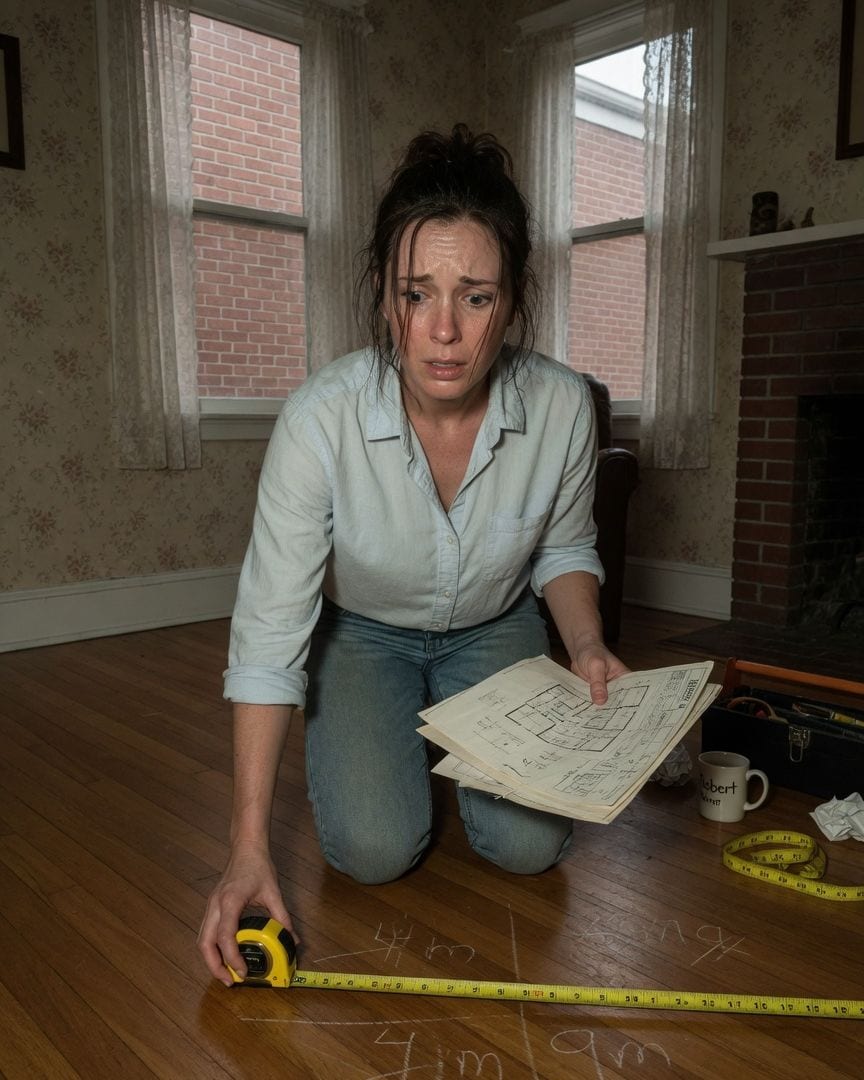
Our living room measures four by five metres. But the outside wall is nine metres long. A metre of house, gone, and I can't find it.
After moving into our charming 1920s house, I was meticulously measuring the living room when the dimensions refused to add up. My calculations of the interior space led me to discover a narrow, unpainted fifth door in the hallway, tucked almost out of sight. It wasn't on any original plans, and it opened to absolute, impenetrable darkness.
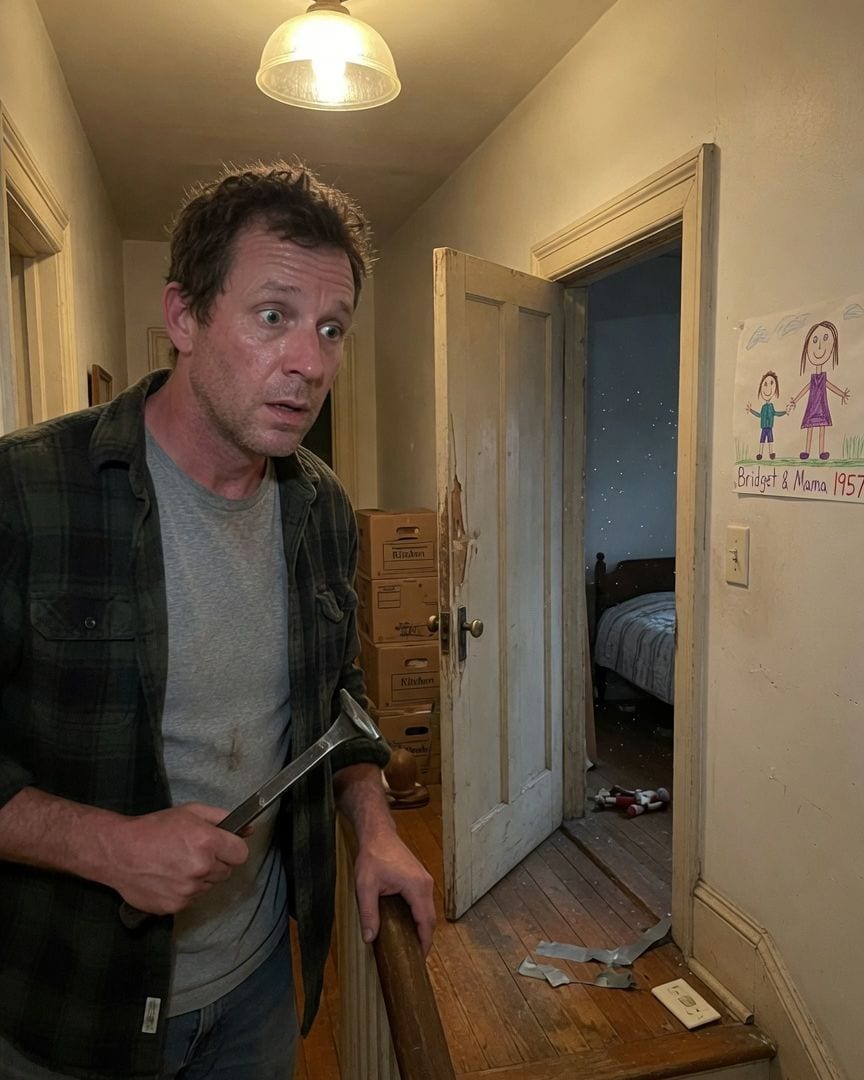
My landing light switches itself off at 9:40 every night. I've watched the switch flick down under nothing, the tape peeled back. The house holds its breath.
My great-uncle's old house was a quiet gift, a place to finally settle. But as I unpacked, a strange worn path on the floorboards led me to a small, barely visible door, perfectly blended into the wall. It was undeniably locked, and felt like a deliberately obscured secret.
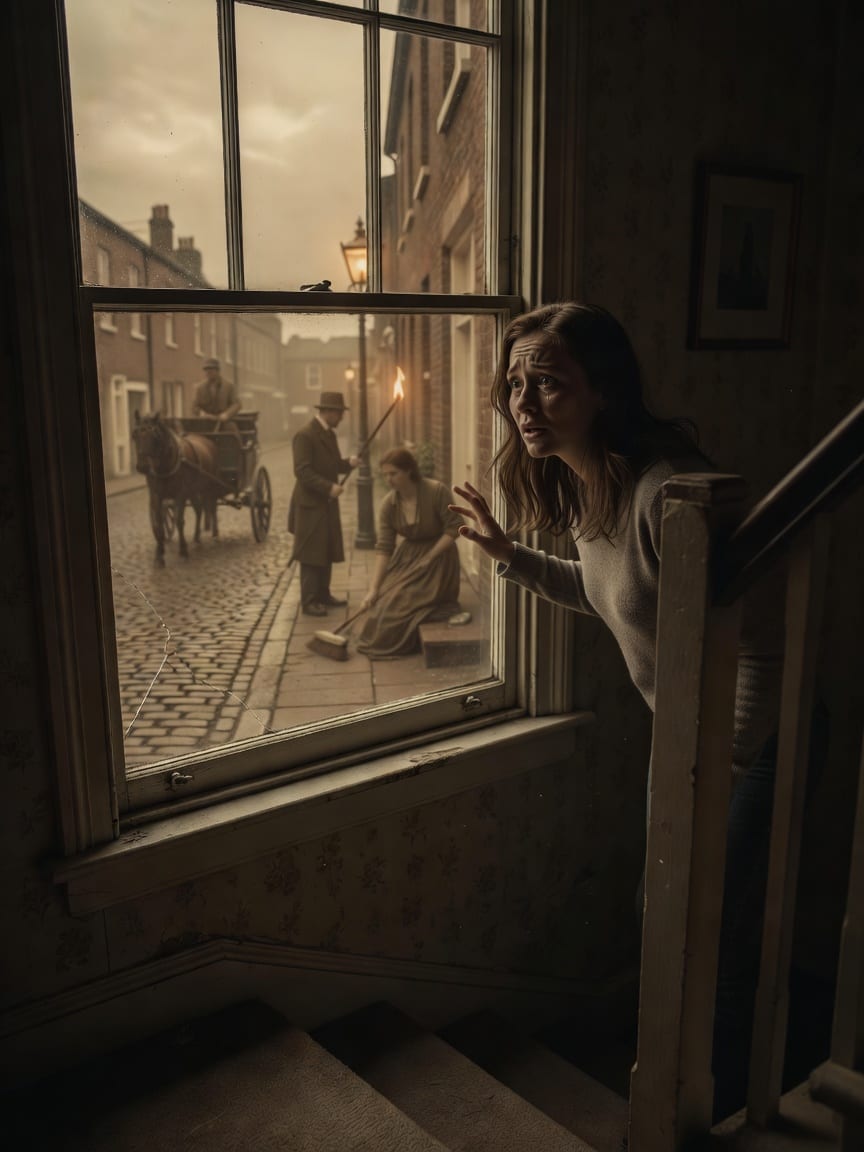
My half-landing window looked down on a cobbled street, a horse and cart. My panes, same crack. Below, only the bins.
I moved into this inherited house for a fresh start, living alone in the quiet. But the third stair on the main flight is deeply worn, a ghostly scoop hinting at decades of unseen footsteps. It feels hollow, and the wall beside it hides a faint, inexplicable seam.
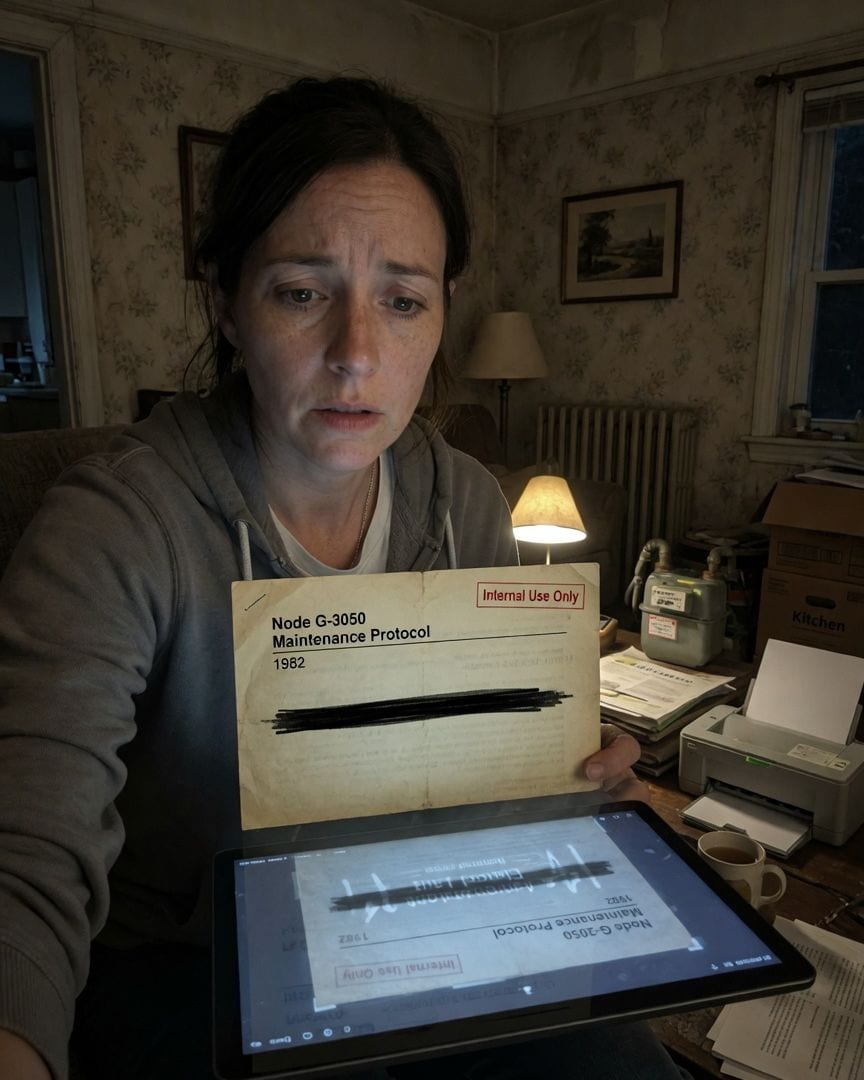
A different tenant every decade since 1949, each one gone — yet our gas meter's final reading comes back identical every time, though the house sat empty in between.
My new house at 14 Elmwood Lane was meant to be a fresh start, a normal home. But the gas bill was wrong. It showed my account, G-3050, active since 1949, with a meter reading of 3050 that had never changed, even when the house stood empty for decades.
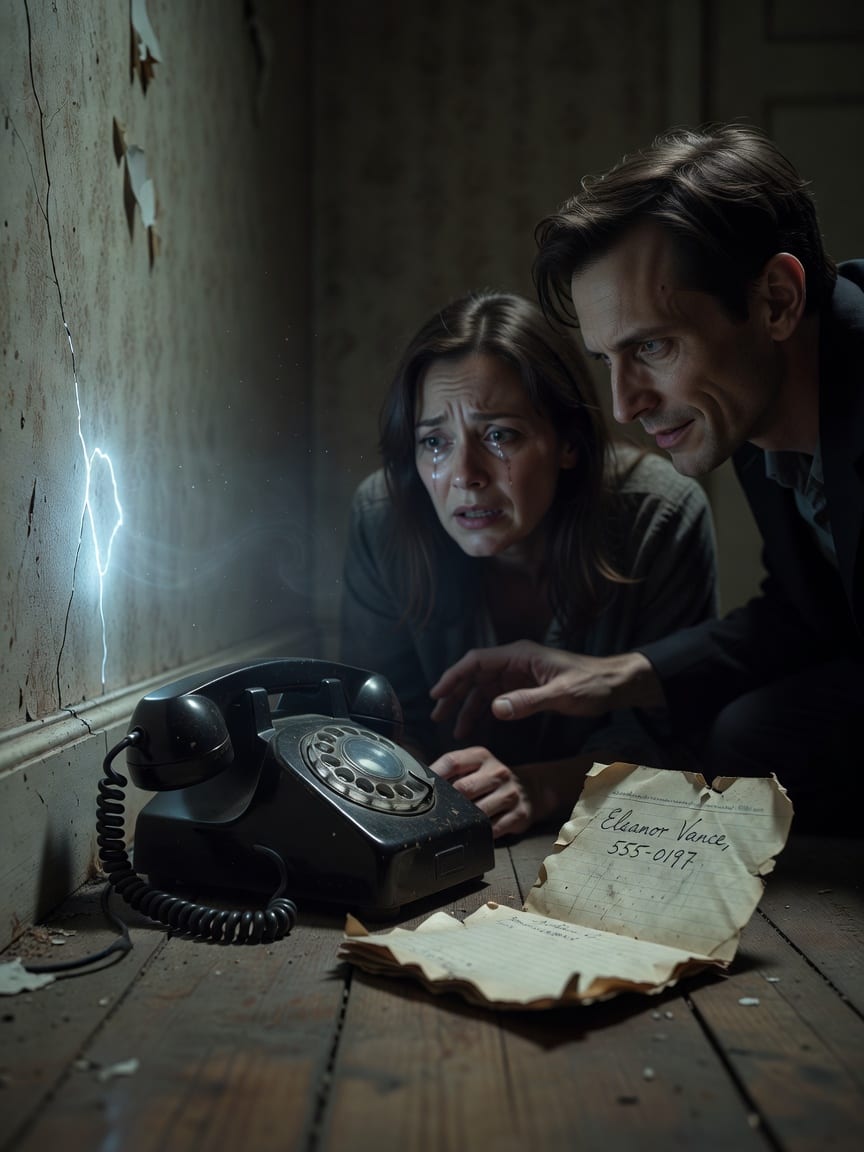
My house's walls ring when I dial a phone number from a 1974 directory. My neighbors said that directory was trash.
I was sifting boxes in my new house when I found an old 1974 telephone directory for my street. It listed my address, 12 Elm Street, under the name "Mr. & Mrs. Sheppard." On a whim, I called the faded seven-digit number. My cell phone rang, but a low, muffled sound also vibrated from the wall beside me.