My mother's intercom panel grew a fifth buzzer for her floor, 4B. I pressed it. Something breathed on the line before it died.
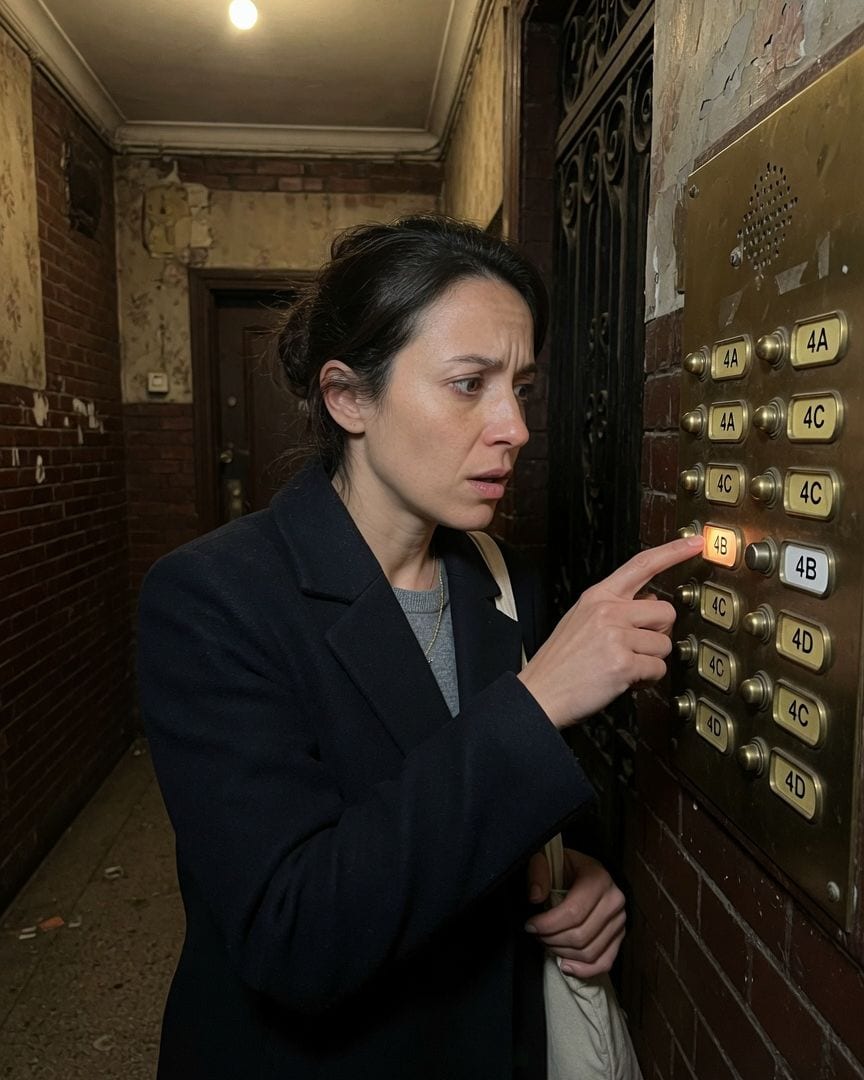
I always feel a little jumpy visiting my mother’s building. It’s an old brick monolith, the kind with wrought iron details and a perpetually faint smell of dust and something metallic, like old coins.
Today, though, it wasn't the usual chill that got me. As I approached the intercom panel in the dimly lit foyer, my fingers already reaching for "4A" – Mom's flat – I stopped dead.
Something was off.
The panel was an antique, rows of brass buzzers with tiny, hand-painted numbers. Ground floor, first, second, third, fourth. Four apartments on each floor. Always has been. Except now, on the fourth-floor line, there were five.
A new, perfectly aligned buzzer sat between 4A and 4C, glowing faintly, almost imperceptibly, with a soft, warm light I couldn't quite place. It read '4B'.
I blinked, rubbed my eyes. Fatigue, probably. Long week. But it was still there. A brand-new 4B.
"What the hell?" I muttered, leaning closer. The new button had a different texture, smoother, somehow, than the others. I hesitated, my thumb hovering. It had to be a mistake, a prank, or maybe a new tenant Mom hadn't mentioned.
My mother, Pamela, isn't exactly a font of building gossip.
Curiosity won out over caution. I pressed '4B'.
For a moment, nothing. Then, through the tinny speaker above the panel, a sound. Not a voice, not a buzzer, but a faint, wet, resonant breathing.
It was slow, deep, like something heavy inhaling, then exhaling a long, sighing whisper that seemed to come from somewhere impossibly close, yet also impossibly far away.
It crackled, distorted, then abruptly cut out, leaving only the mundane hum of the building’s old wiring.
I pulled my hand back as if burned. The rational part of my brain immediately started working: faulty wire, a short, someone messing with the system.
But the other part, the one that had just heard that impossible sound, felt a cold knot tighten in my stomach.
Taking the ancient, groaning elevator up, I tried to shake it off. New tenant. Definitely. A noisy one, by the sound of it.
The elevator doors clunked open onto the fourth-floor landing. The familiar patterned carpet stretched out before me, the same four wooden doors lining the hallway. Flat 4A, Mom's, directly to my left. 4D at the end of the hall.
Two more across. My eyes swept the space, counting instinctively: one, two, three, four. Exactly four doors. As it always had been, since the first time I visited my mother here as a child.
I took a breath, told myself I was being stupid. I counted again, slower this time, my gaze sweeping the space where a fifth door might logically fit. The wall was solid. Unbroken. Just the old floral wallpaper, perfectly intact.
Nothing. No extra door. The numbers refused to add up. The cold knot in my stomach turned into a hard, dense stone.
"Mom, did you hear about a new tenant on the fourth floor? Like, a 4B?" I asked Pamela, after we’d settled in with tea and biscuits. She was engrossed in a crossword puzzle, barely looking up.
"Hmm? Oh, no, dear. Not that I know of. Probably just an old building glitch. Happens all the time, buzzers getting mixed up, lights flickering." She waved a dismissive hand, solving 'a five-letter word for 'slovenly'' with a triumphant flourish.
Her indifference was almost more unnerving than the intercom panel itself.
I tried to push it, mentioning the breathing sound, the way the buzzer glowed. She just chuckled. "Hazel, you're imagining things. This old place has always had character."
Unconvinced, and with that persistent knot still tight in my gut, I called the building manager the next morning. Mark, a friendly but overworked man, listened patiently to my rambling account of the phantom 4B buzzer.
"4B?" he repeated, a frown in his voice. "No, Ms. Thornton, there's no 4B. Never has been. The fourth floor has four flats: 4A, C, D, and E. Someone must be messing with the panel, or it's shorting out."
He assured me he'd check the wiring. He sounded genuinely perplexed, not evasive. No plans for expansion either, he added. Just an old building, prone to quirks.
Still, the image of that glowing button, the sound of that breath, wouldn't leave me. I decided to take it a step further.
I ended up at the city's historical society, a dusty, quiet place that smelled of forgotten paper and mothballs. I requested old architectural drawings of the building, telling the archivist it was for a 'personal project' on local history.
Sifting through brittle, yellowed blueprints, I found general layouts from the 1930s and 40s. They consistently showed only four units on the fourth floor. Nothing new there.
But then, tucked among a stack of maintenance schematics from the mid-1950s, I found one faded diagram. It wasn’t a floor plan, but a cross-section detail of the fourth-floor exterior wall.
And on it, exactly where a fifth door would appear if 4B existed, was a curiously thick wall section. Almost a deliberate blank space. A solid block of grey, disproportionately thick compared to the surrounding walls. It was strange.
Most buildings had structural elements, but this was a void, a place that simply wasn't accounted for in any detail.
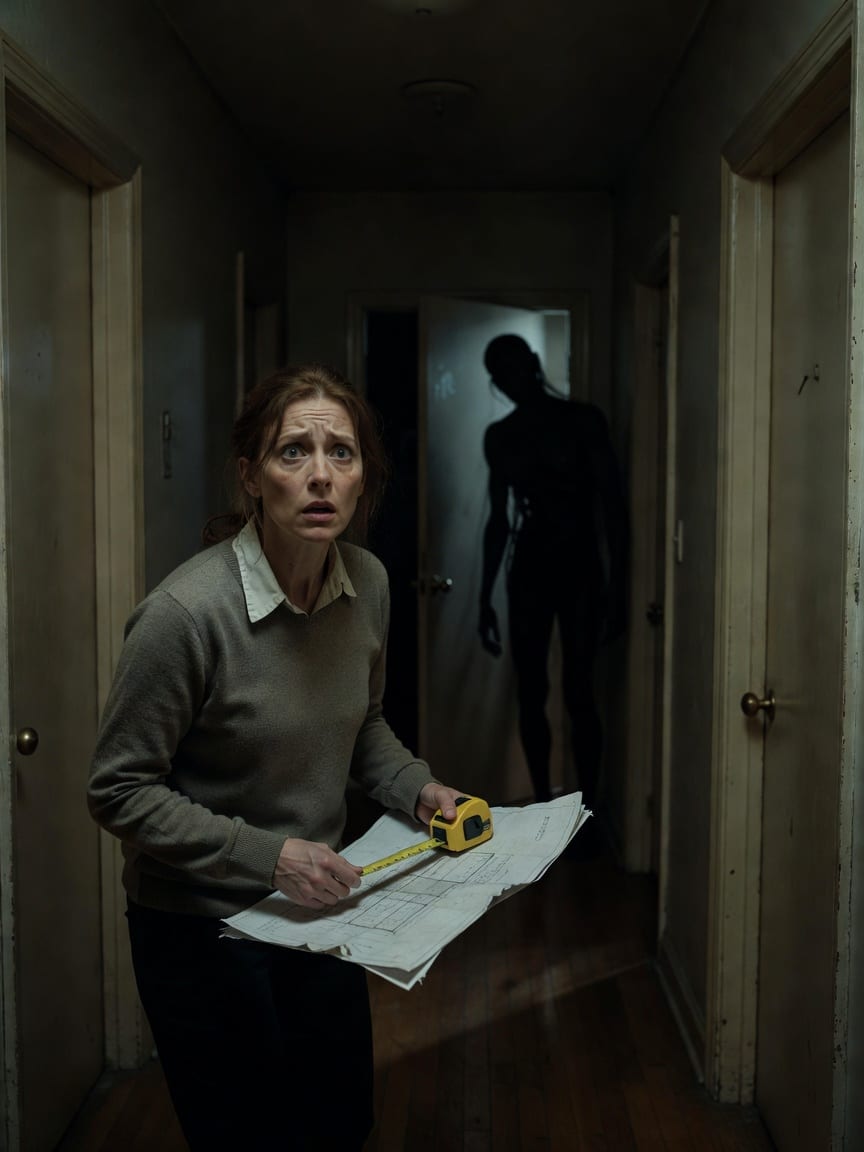
Back on the fourth-floor landing, armed with a tape measure I’d borrowed from Mom, I felt ridiculous, but I had to know. I paced the floor, comparing my measurements to the old plans, trying to pinpoint the exact location.
The space where 4B would theoretically exist, according to that strange diagram, was precisely the length of a standard doorway. But it was solid wall. I pressed my palm against the spot, right between 4A and 4C.
And then I felt it. A subtle, inexplicable chill emanated from the plaster, far colder than the ambient hallway air. It wasn't a draft; the air in the hall was still and warm. It was coming from the wall.
The discrepancy was unnerving, refusing any rational explanation. My ordinary world was beginning to feel... stretched.
Frustrated by the complete lack of answers, and the persistent chill in that one spot, I found myself back on the fourth-floor landing late one night.
I'd told Pamela I was going home, but instead I just sat in the corridor, trying to feel it out. The building was quiet, settled.
The chill from the 'blank' wall was more pronounced now, like something solid and cold radiating through the plaster. I ran my fingers along the painted surface, tracing the familiar floral pattern of the wallpaper, searching for any anomaly.
My fingertips snagged. A faint, almost invisible seam. It was barely there, a hairline crack running vertically down the wall, exactly where a doorframe would be.
It wasn't the kind of seam you'd notice unless you were actively looking for it, or unless you knew it was there. Curiosity overriding caution, a cold, focused determination taking hold, I picked at it.
The wallpaper peeled back with surprising ease, like it was never properly adhered. And beneath it, not plaster, not brick, but a dark, heavy wooden doorframe. It was utterly unlisted, unpainted, rough-hewn, and had no handle.
Just a solid, seamless slab of dark wood, now exposed, standing stark and silent against the familiar flowered wall. The air around it suddenly felt thick and still, as if the building itself was holding its breath.
I tried the door. I pushed, I pulled, I leaned my full weight against the seamless wood. It remained stubbornly shut, a silent, unyielding block in the middle of the familiar fourth-floor landing.
It was smooth, almost polished in some places, like countless hands had brushed against it, but there was no give, no latch, no hinge. The wood felt cold, somehow drier than the air around it.
I stood there for a long time, just staring at it, this impossible thing I had uncovered.
The next day, I didn’t call Mark. I didn’t call Pamela. I went to the library, then online. My research wasn't for building codes anymore. I was looking for strange disappearances, local legends, anything that felt... off.
It was a long shot, but the feeling that had gripped me on the landing was too strong to ignore. I stumbled upon an old community forum, barely active now, but with years of archived posts.
One thread, titled 'Old Building Anomalies,' caught my eye. Someone had mentioned a 'local eccentric' named Maxwell Davenport, who used to live in my mother's building.
The post said he was known for collecting 'unusual neighborhood histories' and had a particular fascination with 'disappearing architecture' in the area.
Disappearing architecture. The words echoed in my head.
It took me three days to track him down. Maxwell Davenport, age eighty-eight, lived in a quiet, sun-drenched corner of the local senior community center, amidst stacks of old books and what looked like meticulously categorized files.
He was a small man, his skin like parchment, but his eyes were startlingly keen, intelligent, and held a depth of experience that felt ancient.
He initially dismissed me, attributing my questions about old building quirks to 'youthful fancy.' He offered me tea, then returned to his newspaper, seemingly uninterested. "Young people always looking for ghosts in the plaster," he mumbled.
"It's just an old building, dear. They settle."
"But it's not just settling," I pressed, trying to keep my voice even. "I found... an extra door. On the fourth floor. Between 4A and 4C. It's not on any plans."
His hand, which had been reaching for his teacup, froze. The cup rattled against the saucer. His head snapped up, his keen eyes fixing on me with an unsettling intensity.
A flicker of something, recognition or perhaps alarm, crossed his face. He put the teacup down carefully, slowly. The crossword puzzle he’d been doing lay forgotten.
"An extra door," he repeated, his voice barely a whisper. "On the fourth floor. You say it had no handle?"
I nodded, feeling a prickle of unease. His composure had shifted entirely. This wasn't an eccentric old man anymore. This was someone who knew. He invited me to sit, his gaze now fixed on me, no longer dismissive, but analytical.
Almost wary.
I began regular visits to Maxwell Davenport. He was a puzzle, slowly revealing pieces of a much larger, darker picture. He spoke in riddles, referring to the building as having 'moods' and 'appetites.'
He’d recount cryptic tales, not of ghosts, but of 'things that return,' and 'spaces that hunger.' He warned me, in a calm, measured tone that made his words all the more chilling, to 'let sleeping geometry lie.'
"You stir something up, girl," he'd say, his eyes never leaving mine. "That place… it notices. It's not just walls and mortar."
I tried to get him to elaborate, to explain the breathing I heard, the cold, the impossible door. He’d just shake his head, a distant, pained look in his eyes. "Some things don't have explanations. Only consequences."
One particularly unsettling afternoon, as I was leaving Maxwell's apartment, he leaned close. His voice dropped to a whisper, barely audible, his breath smelling faintly of peppermints and old paper. "It knows you're looking, Hazel. It always knows."
That evening, back at my mother's building, his words were a cold echo in my mind. The elevator doors clunked open onto the fourth floor. As I stepped out, I was met by an oppressive, unnatural cold.
It wasn't just the 'blank' wall anymore; the entire landing felt like stepping into a freezer. The air was still, heavy, pressing down on me. I could see my breath in faint clouds.
And then I heard it. From the unseen depths behind the hidden door, a faint, rhythmic thumping. It wasn't like footsteps or pipes.
It was low, guttural, like something vast and heavy being dragged, or perhaps a slow, pulsing heartbeat deep within the walls. Thump… thump… thump. It was too regular, too resonant to be anything natural.
My eyes snapped to the hidden door. It was still perfectly sealed, indistinguishable from the wallpaper unless you knew where to look.
But as I watched, a long, wavering shadow, far too deep for the dim hallway light, seemed to stretch from the almost-invisible seam of the hidden door.
It momentarily lengthened towards me, an inky blackness that defied the single overhead bulb, before retracting slowly, almost fluidly, back into the wall.
A prickle of pure dread, cold and sharp, crawled up my spine. Maxwell’s words echoed. It knows you're looking. I wasn't just investigating anymore. I had been noticed.
The next day, I confronted Maxwell directly. I recounted the thumping, the cold, the impossible shadow. His calm facade, the one he’d maintained for so long, finally cracked.
The flicker of alarm I’d seen before was now a stark, terrified understanding. He rose slowly from his armchair, his hands trembling.
"I knew it," he whispered, his voice thin and reedy. "It's waking up again."
He led me to a dusty old chest in the corner of his apartment, its wood dark and scarred. With a key from a chain around his neck, he unlocked it, the hinges groaning.
From within, he produced a faded, brittle, hand-drawn map of the building. It was far older than any I’d found at the historical society, meticulously detailed, almost obsessive.
On the fourth floor, a section was circled in red, labeled in spidery ink: '4B - The Fold.'
Maxwell’s voice dropped to a near whisper, his eyes haunted. "It's a cycle, Hazel. It always has been. Every few decades, this building… it shifts. It creates a space. A lure."
He traced the outline of the circled '4B' with a trembling finger. "They called it 'The Fold' because it's not truly there, not truly gone. It's a fold in the fabric, an impossible space that manifests."
He recounted how, when he was a young man, a similar phenomenon had occurred. He was twenty-eight, living on the third floor. A resident, a vibrant young woman, had disappeared without a trace from the fourth floor.
The police had called it a runaway, chalked it up to a young woman's flight. "But I knew," Maxwell insisted, his voice cracking with an old pain. "I saw the wall 'breathe' then too.
I heard the thumping, different then, but the same hunger."
He explained that the building 'wakes up' periodically, creating the fifth flat to draw someone in. His eyes, though old, held a deep, profound sorrow. "They said she just left. But I saw the wall change. I heard it.
And then she was gone. Never to be found." The earlier clues clicked into place in my mind: the building plans with the blank space, the inexplicable chill, the rhythmic thumping. It wasn't a glitch. It was a pattern.
A terrifying, deliberate cycle.
"The previous victim," Maxwell continued, his voice barely audible, "she was a distant relative of mine. My cousin. She lived in the flat directly across from your mother's, on the fourth floor, just like you visit."
He looked at me then, a profound sadness in his gaze, and I felt the hair rise on my arms.
My mind reeled with the implications. A recurring, predatory architecture. And now, it was happening again. The danger suddenly felt chillingly personal.
"Who was she?" I asked, my voice barely a whisper. "Your cousin?"
Maxwell hesitated, his gaze distant, lost in memories I could only guess at. He reached into his worn leather wallet, the kind that had seen decades of use, and pulled out a small, yellowed photograph.
It was a black-and-white image, faded with age, but clearly preserved. It showed a young woman, perhaps in her early twenties, smiling, her dark hair swept back from her face.
She was standing on the very landing outside Pamela’s flat, the familiar patterned carpet beneath her feet, a subtle ghost of the hidden door's seam visible in the background, almost imperceptible.
My breath caught in my throat. On the back of the photograph, in faded, elegant script, was a name and a date: 'Vera Mitchell, 1964.'
Vera Mitchell.
The name hit me like a physical blow. It was her own grandmother's maiden name. My grandmother’s maiden name. Pamela rarely spoke of her mother's side of the family, especially her own mother, who she'd said had died tragically young.
Vera Mitchell. My grandmother.
The building didn't just take a stranger, or Maxwell’s distant cousin. It took their family. My family. The cycle wasn't just happening again; it was coming for her. It was coming for me.
The full, horrifying truth detonated in Hazel's mind. The building wasn't just a random anomaly; it was a predator with a lineage, a living geometry.
It targeted families connected to previous victims, drawing them into its impossible architecture, perhaps to complete a pattern, a 'harvest.'
Maxwell, his voice heavy with resignation, explained that once inside, individuals were not merely trapped but absorbed, their essence becoming part of the structure, fueling its impossible shifts and subtle influence.
He believed the 'breath' on the intercom was the building itself, its initial lure, and the thumping, its slow, inexorable digestion.
He confessed he tried to warn Vera, but she, too, was drawn in, caught by the strange fascination of the hidden door, by the call of the 'Fold.'
He urged Hazel to break the cycle, to find something to seal the 'Fold' permanently, but admitted he never knew how.
He showed her old family records, tracing the Mitchell line, noting other unexplained disappearances from the area over centuries, all coinciding with the building's 'awakening.'
The building was a living tomb, and her family name was etched into its very foundations as its preferred sustenance.
Hazel, propelled by a desperate resolve, returned to the building late that night. Maxwell's warnings echoed in her head, but so did the image of Vera, her grandmother, smiling on the landing.
This wasn't just about her anymore; it was about generations.
The hidden door on the fourth floor landing was no longer seamless. It stood slightly ajar, a sliver of impossible, inky darkness visible. A low, resonant hum emanated from within, a deep vibration that seemed to tickle her teeth.
Taking a deep, shuddering breath, Hazel pushed it open.
Inside was not a flat, but a twisting, narrow, stone-lined corridor. It smelled of damp earth, old iron, and something vaguely organic, like wet stone and something… fresh, yet ancient.
The geometry was utterly wrong; walls curved inward and outward simultaneously, the ceiling shifted from impossibly low to dizzyingly high. Disoriented, Hazel stumbled through the oppressive space, the air growing thick and cold, pressing in on her, stealing her breath.
She could feel the walls breathing around her, a subtle expansion and contraction, like ribs.
At the end of the corridor, in a small, impossibly angled chamber that defied all logic, she found a single, ancient wooden chest, half-buried in the damp floor.
It was simple, unadorned, covered in a fine layer of dust and what looked like dried moss. With trembling hands, her heart hammering against her ribs, she pried open the heavy, creaking lid.
Inside, among a collection of forgotten, decayed trinkets—a broken pocket watch, a rusty thimble, a dried sprig of lavender—lay a tarnished silver locket. She recognized the style from old family photographs, a Victorian design. She opened it.
On one side, a tiny, faded photo of Vera Mitchell, young and vibrant, smiled out at her, an eerie twin to Maxwell's photo.
On the other, deeply engraved into the silver, were the digits '1964' and a single, chilling word: 'Thornton.'
The locket was real, undeniably dated, a tangible artifact from the impossible space, and it inextricably linked her family to the building’s cycle, to its hungry mechanism.
As she held it, the stone walls around her began to visibly contract, the air growing colder, thinner. The deep, guttural thrumming resonated through the entire structure, growing louder, closer, like a vast, hungry heartbeat.
Hazel Thornton's mother, Pamela, reported her daughter missing a few days later. Police found no forced entry to the flat, no signs of struggle, just her phone left on the kitchen counter, its battery dead.
The building manager, a new hire, confirmed that the intercom panel had only four buzzers for the fourth floor, as it always had, dismissing Pamela's frantic claims of a 'fifth flat.'
Maxwell Davenport passed away peacefully in his sleep a week after Hazel's disappearance, his secret map and records found neatly organized in his chest of keepsakes.
The local paper ran a small article on Hazel's disappearance, quickly forgotten amidst other news.
The fourth floor landing of the old building sometimes feels noticeably colder than the rest of the building.
Residents occasionally report a faint, rhythmic thumping sound, deep within the walls, usually late at night, which they attribute to old pipes or settling foundations.
On the intercom panel downstairs, the '4B' buzzer remains absent, but every few years, an electrician called to fix a flickering light on the fourth floor will swear they momentarily saw five buzzers there, not four, before it corrected itself.
The building manager just shakes his head, blaming faulty wiring.
Pamela Thornton visits her old flat less often now, but when she does, she always pauses on the landing. She places her hand on the smooth, unblemished wall where a door should never be, listening.
She swears she can hear a faint, almost imperceptible humming from deep within, a quiet, satisfied thrum. 'Is that so?' she whispers to the wall, a strange, knowing smile on her lips.
The hum deepens, a quiet, satisfied thrum.
If this one got to you
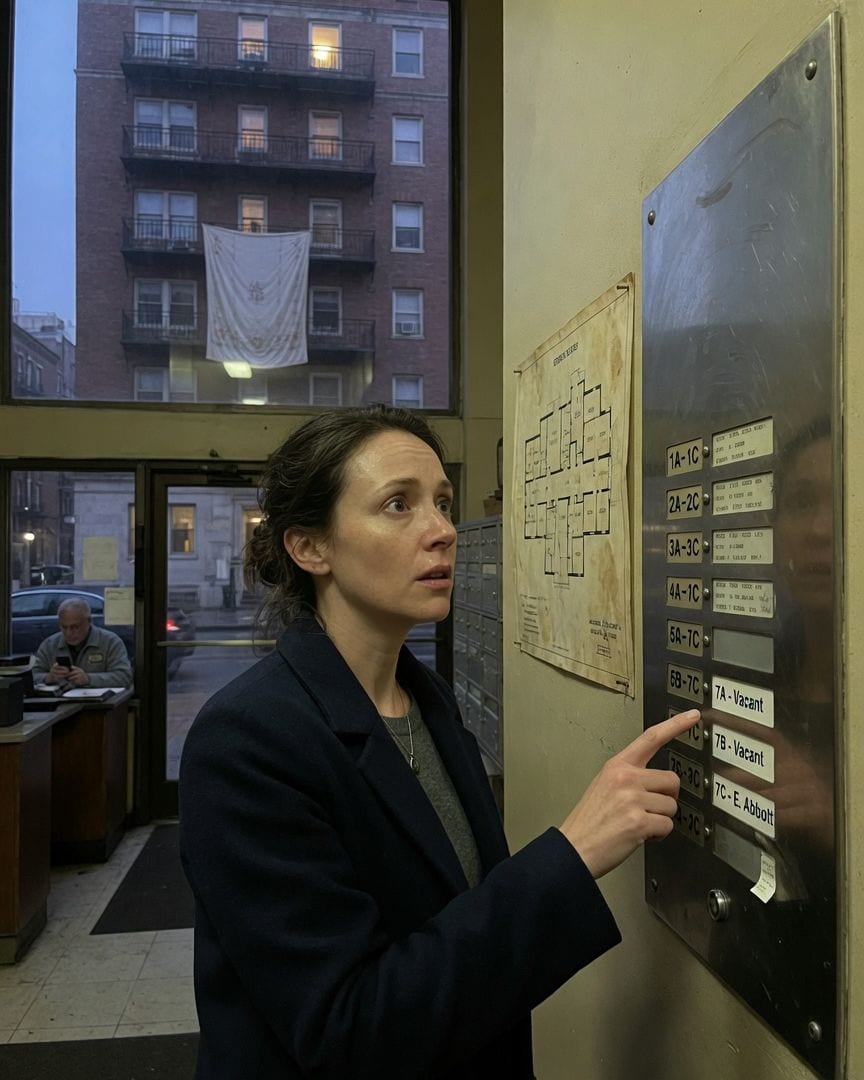
My building grew a seventh floor today, where only sky should be. On its darkest door, a nameplate reads 'E. Abbott'.
For three years, I've lived in apartment 3B of The Sterling Arms, a familiar six-story building. Every morning, I glance up at my window from the parking garage, a routine check. But this morning, my breath caught: a seventh floor, complete with balconies and a soft yellow light, now sat impossibly above the familiar roofline where only sky should have been.
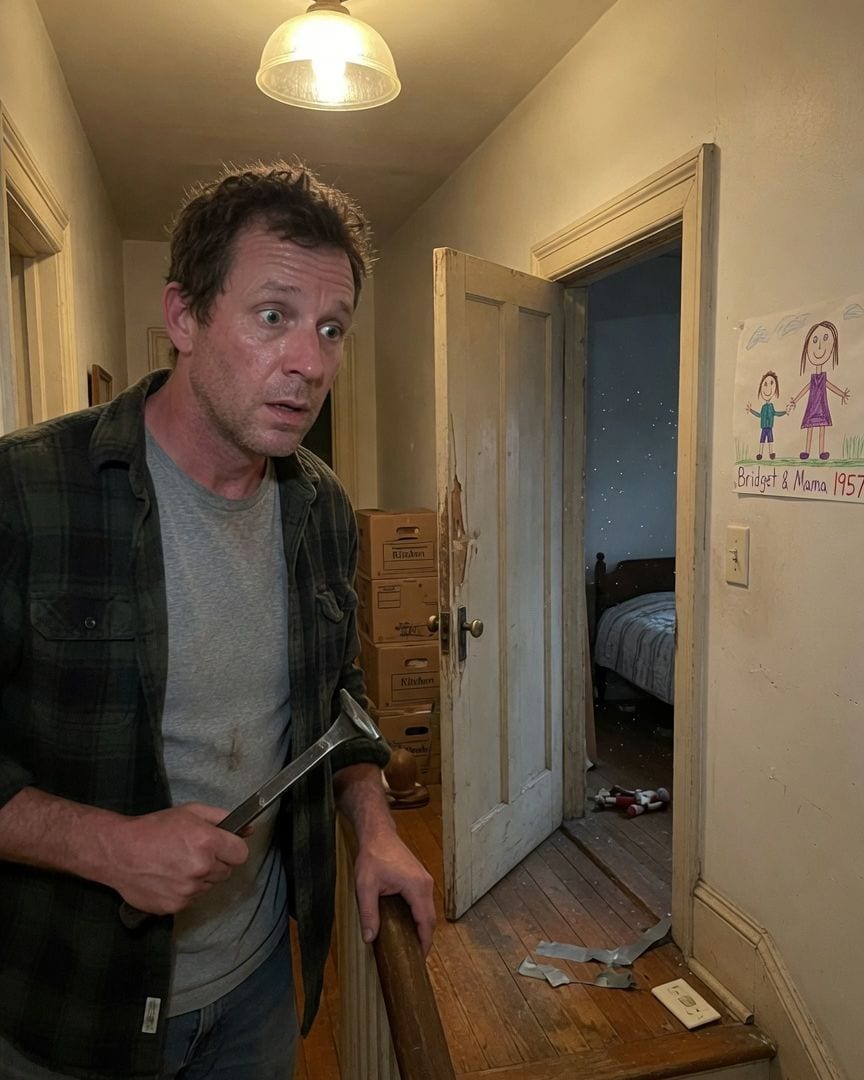
My landing light switches itself off at 9:40 every night. I've watched the switch flick down under nothing, the tape peeled back. The house holds its breath.
My great-uncle's old house was a quiet gift, a place to finally settle. But as I unpacked, a strange worn path on the floorboards led me to a small, barely visible door, perfectly blended into the wall. It was undeniably locked, and felt like a deliberately obscured secret.
My front door has a dented gate and a dead hydrangea. I walked past it six times, trying to reach the corner shop just a hundred yards away. The pavement kept bringing me back to my own porch, and the shop's light never moved.
My morning started like any other, a quick walk to the corner shop from my home at Number 14, Elm Terrace. But after walking what felt like two minutes, I found myself back at my own front door, the shop no closer. I tried six times, faster and slower, but my street kept compressing, refusing to let me leave.
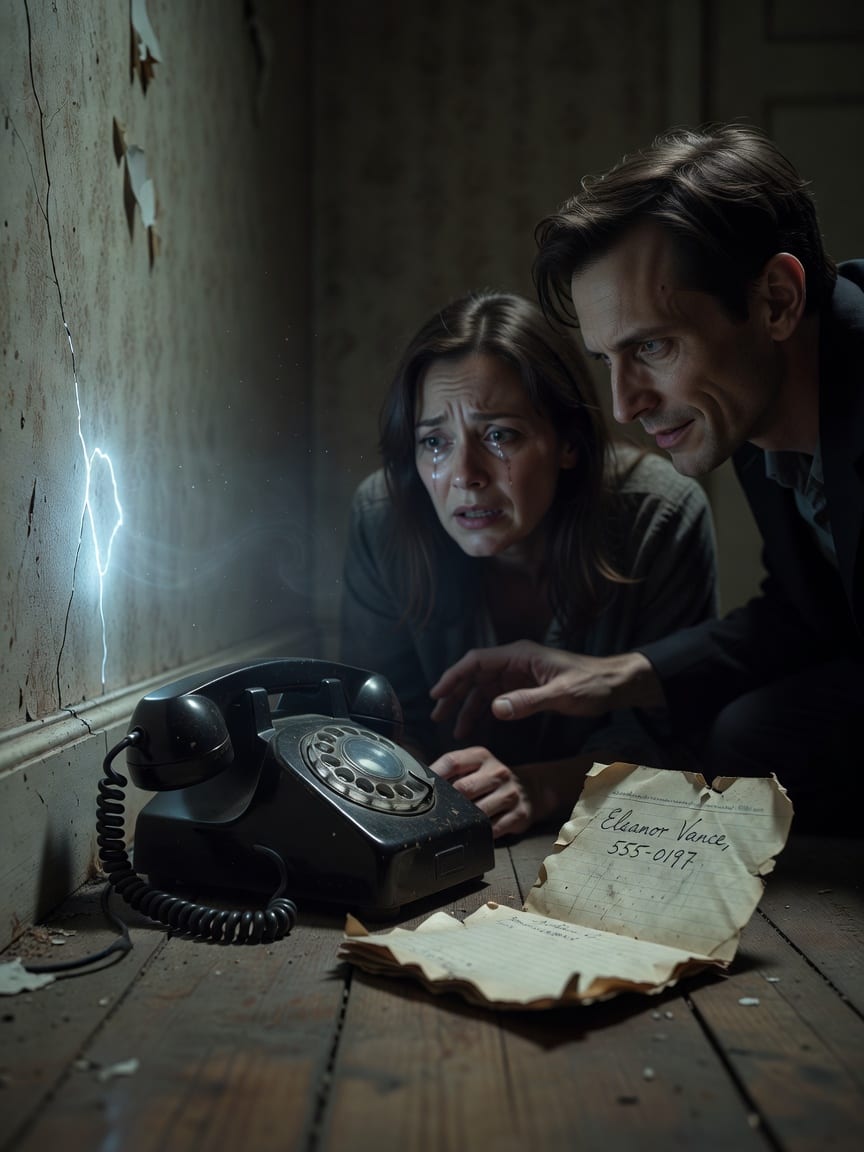
My house's walls ring when I dial a phone number from a 1974 directory. My neighbors said that directory was trash.
I was sifting boxes in my new house when I found an old 1974 telephone directory for my street. It listed my address, 12 Elm Street, under the name "Mr. & Mrs. Sheppard." On a whim, I called the faded seven-digit number. My cell phone rang, but a low, muffled sound also vibrated from the wall beside me.
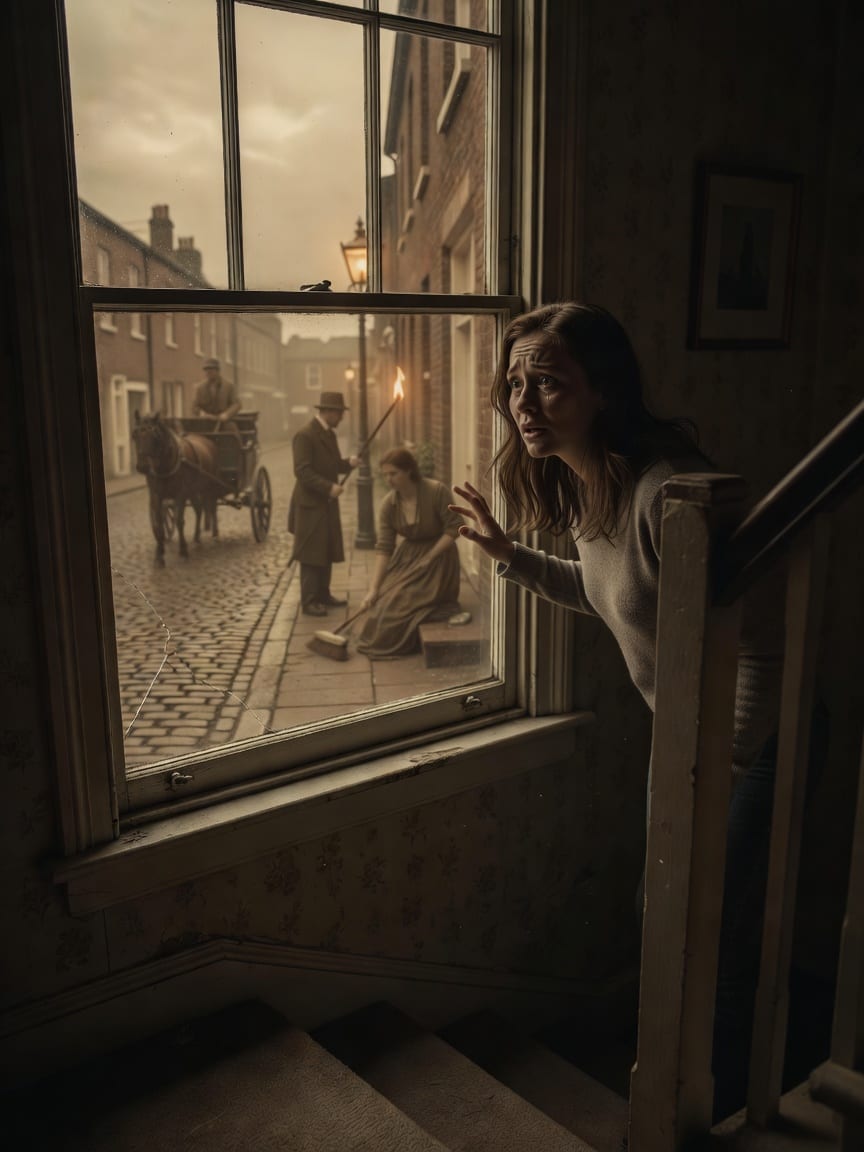
My half-landing window looked down on a cobbled street, a horse and cart. My panes, same crack. Below, only the bins.
I moved into this inherited house for a fresh start, living alone in the quiet. But the third stair on the main flight is deeply worn, a ghostly scoop hinting at decades of unseen footsteps. It feels hollow, and the wall beside it hides a faint, inexplicable seam.
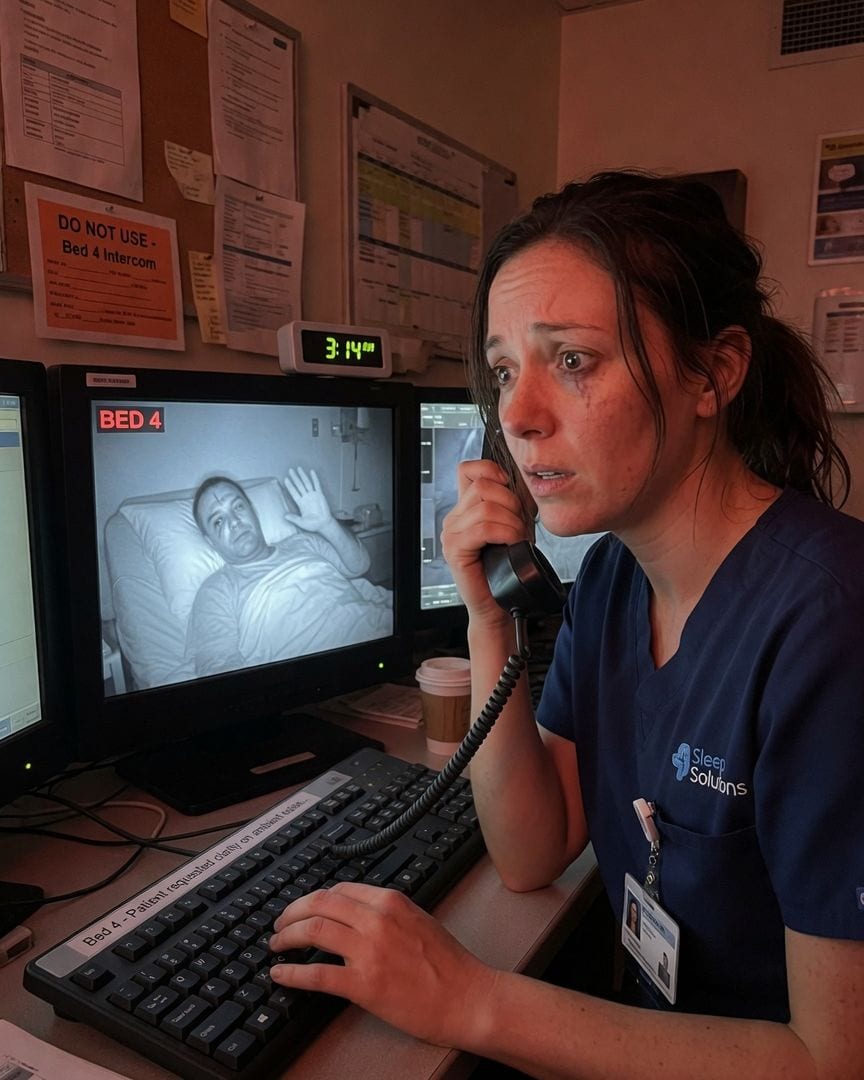
Bed 4's patient always waves at my camera, asking if I hear the humming. Bed 4 was never booked.
As an overnight nurse, my shift at Sleep Solutions is usually routine. But after interacting with a patient in Bed 4, my manager insists the room has been off-limits for deep cleaning all week with its intercom disconnected for months. Yet, I found a faint, warm indentation on the new mattress where the patient had been.