Mid-appointment about my cough, my doctor told me to call my estranged sister tonight — a sister I'd never mentioned to him. The note on his screen ended with her name and a time.
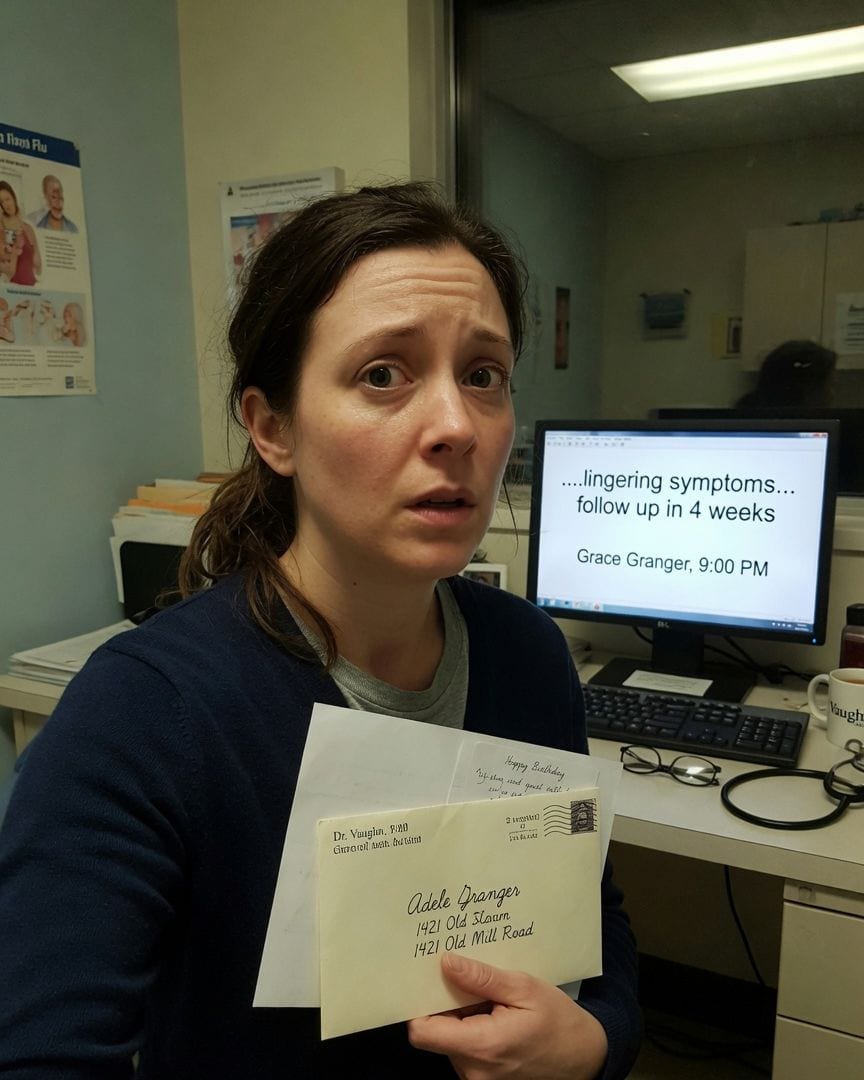
It started with a cough. A dry, persistent thing that had burrowed into my chest and refused to leave, even after weeks.
Dr. Vaughn, my GP for a decade, sat across from me, his stethoscope cool against my skin, his expression one of familiar, gentle concern.
“Just a lingering viral thing, Ade,” he said, pulling away the cold metal and reaching for his glasses. He slid them onto his nose, then turned to his computer screen to type out notes and a prescription.
The fluorescent lights hummed above us, the quiet efficiency of the room a comfort. I was already planning my afternoon, the mild discomfort of my chest a distant thought.
Then he stopped. His fingers froze mid-air above the keyboard. He slowly removed his glasses, letting them dangle from one earpiece between his thumb and forefinger.
He didn’t look at me, but stared at a point just over my shoulder, as if listening to something only he could hear. The air in the room seemed to thicken, suddenly heavy and still.
“I’m sorry, Ade,” he said, his voice soft, almost apologetic. “You should call your sister tonight.”
My breath hitched. Grace. My sister. We hadn’t spoken in years, not since our last argument spiraled into silence. I had certainly never mentioned her to Dr. Vaughn. The idea was absurd. I must have misheard.
He blinked, a slow, deliberate movement, then shook his head, as if clearing cobwebs. “My apologies, Ade. Lost my thread for a moment there. Too many late nights, I suppose.”
He offered a small, tired smile, a normal explanation for a deeply abnormal moment. He turned back to his screen, his fingers resuming their typing. But as he did, I caught a glimpse of the note he’d been working on.
In crisp, black text, at the very end of a short paragraph of medical jargon, were the words: ‘Grace Granger, 9:00 PM.’
My throat felt tight, not from the cough, but from a sudden, impossible coldness. I mumbled my thanks, took the printed prescription, and practically fled the office.
The rational part of me tried to dismiss it as a tired doctor’s slip, a strange coincidence. Maybe he’d seen Grace’s name in a shared database, mistook me for someone else.
But the specific time, 9:00 PM – typed right there on his screen, right after my sister’s name – it clawed at me.
I tried calling Grace. Her number, the one I hadn’t dialed in years, was disconnected. I sent a text to her old number, a desperate, brief message: Are you okay? Call me. No reply.
Her social media profiles, which I occasionally, guiltily, checked, hadn’t been updated in months. She was just… gone, as far as I was concerned.
The next morning, a cream-colored envelope was tucked into my mailbox. It wasn’t a bill, or junk mail. It was thick, almost formal, and addressed simply to ‘Adele Granger.’
No street number, no apartment, just my name, in elegant, unfamiliar cursive. The postmark was crisp, the date exactly two weeks prior. The return address was a street name I didn’t recognize: 1421 Old Mill Road.
My heart hammered against my ribs. Old Mill Road wasn't in my neighborhood. I grabbed my phone, opened Google Maps, and typed in the address. The satellite image loaded, then zoomed in. My stomach dropped.
It wasn't a house, or a business, or even a set of derelict buildings. It was an empty, overgrown field on the outskirts of town, bordered by a collapsed stone wall and a dense thicket of trees.
A place where nothing stood but weeds and ghosts.
I tore open the letter. Inside, printed in the same unnervingly elegant hand, was a belated 'Happy Birthday' message.
It wished me 'joy and quiet reflection' on a date two weeks ago, a date I had spent alone, a date I had largely forgotten.
The tone was eerily personal, as if from an old acquaintance who knew me intimately, yet signed off with an anonymous 'Best Wishes.' The paper felt heavy, thick, almost like vellum.
It smelled faintly of something earthy, like dry leaves and old books.
The mundane explanations evaporated, one by one. A prank? Who would know my birthday, my estranged sister’s name, and have access to an empty field’s exact address for a postmark? And why?
Compelled, a cold dread tightening its grip, I typed '1421 Old Mill Road' into an online archive of local newspapers. I scrolled through decades of digital pages, the grainy text blurring before my eyes, until I hit gold.
Or rather, black-and-white. An article from 1972, yellowed and pixelated, screamed a headline: 'Granger House Demolished After Decades of Disuse.'
A fuzzy photo beneath the caption showed a dilapidated old Victorian, its porch sagging, roof tiles missing, being torn apart by a crane. The address listed was identical to the letter’s postmark: 1421 Old Mill Road.
The article mentioned the property was 'the last remaining holding of the local Granger family,' and, chillingly, specifically named a 'Rosemary Granger,' a name I had never heard before.
My own surname, tied to a house that shouldn't exist, a place that was now just an empty field, made my stomach clench.
The next day, I drove out to 1421 Old Mill Road. The Google Maps image had been accurate. It was truly desolate, surrounded by a sagging chain-link fence that had clearly been there for decades.
Weeds pushed through cracked asphalt where a driveway might have once been. The silence was profound, broken only by the rustle of dry leaves in a faint breeze.
Beneath the overgrowth, almost invisible unless you were looking for it, was a faint, rectangular outline of concrete, a foundation peeking through. The newspaper's story was confirmed. A house had stood here. A Granger house.
Standing there, I felt an unsettling pull, a strange gravity emanating from the ground itself. The air wasn't cold, but it felt thin, as if something invisible was displacing the warmth.
I had the distinct, prickling sensation of being watched, not by a person, but by the field itself.
Later that afternoon, I found myself at the local historical society, a quiet building tucked away on a side street.
The woman behind the desk, Patricia Whitaker, was in her late seventies, with sharp, intelligent eyes that seemed to miss nothing. When I asked about the Granger family, her gaze sharpened.
She gave me a strange, unreadable look, a flicker of something knowing in her eyes, before her expression smoothed.
“The Grangers, yes,” she said, her voice soft, almost a murmur. “A very old family around here. The Granger line always had a particular connection to that land, you know. Old Mill Road. Back centuries.”
She gestured vaguely towards a wall of archives. “You’ll find property records there, old census data. Plenty of Granger names.”
But her eyes lingered on me, a faint, almost imperceptible smile touching her lips, as if she knew something much more specific. As if she knew me.
I spent hours poring over dusty files. And there they were: more old letters, cream-colored, addressed to various Grangers – men, women, even children – over the decades. A letter to ‘Eleanor Granger’ for her 21st birthday in 1948.
Another to ‘Thomas Granger’ on the occasion of his son’s birth in 1963. All postmarked from 1421 Old Mill Road, from the house that was demolished in 1972, and then from the empty field it became.
All with similarly uncanny, formal ‘acknowledgements’ for births, deaths, or anniversaries. It wasn't just me. It was a pattern.
My continued research at the historical society didn't go unnoticed. The air in the quiet reading room seemed to hum with an unspoken tension, an awareness.
One afternoon, as I was poring over a faded land deed, detailing property lines that included 1421 Old Mill Road, Patricia Whitaker approached my table. Her footsteps were silent on the worn rug.
She stood beside me, a calm, knowing expression on her face.
“Still digging into the Grangers, dear?” she asked, her voice soft, almost a whisper, but it cut through the dusty quiet of the room like a razor.
She wasn't asking out of curiosity; she was stating a fact, one she already knew.
I looked up, trying to appear casual, my pulse quickening. “Just… trying to trace some family history,” I lied, weakly.
Patricia smiled then, a small, almost imperceptible turn of her lips. It was a cold smile, not unkind, but ancient, as if she'd witnessed centuries.
“Some things are best left buried, you know,” she said, her gaze drifting towards the towering shelves of historical documents, then back to me, her eyes unsettlingly direct. “Especially when the ground remembers.”
I tried to brush her off, to feign disinterest, but she leaned in slightly, lowering her voice further. “It knows its own, Ade. Always has. And it remembers its schedule.” She didn't threaten. She didn't warn.
She simply stated it as a simple, undeniable fact, like the sunrise. There was no malice in her tone, only a deep, unshakeable certainty.
The implied knowledge, the calm composure in Patricia’s eyes, sent a chill through me that settled deep in my bones.
I realized then that my attempts at rational investigation had only served to make me more visible, not just to Patricia, but to whatever ‘it’ was, and to those who, like Patricia, understood 'it.'
The historical society itself seemed to hold its breath, the old books on the shelves watching.
I stood up, pushing my chair back, the scrape echoing in the hushed room. “What do you mean, ‘it’?” I demanded, my voice a little louder than I intended. “What schedule?”
Patricia didn't flinch. She just turned, a silent invitation, and walked slowly to a locked, glass-fronted cabinet in a dimly lit corner. With a small, ornate key, she opened it, revealing a single, antique, leather-bound ledger.
It was thick, its cover worn smooth by countless hands. She retrieved it carefully, like a sacred text, and placed it on a nearby reading table. The air around it felt suddenly colder.
“This,” she said, her voice still calm, “is the family record. Not of births or deaths, not in the way you might think. But of acknowledgements.”
She opened the ledger to a worn page, the paper inside brittle and yellowed. It was filled with names, all Grangers, meticulously handwritten in various hands, some elegant, some crude, but all precise.
Each name was followed by a date, written with unsettling specificity. My eyes scanned the page, searching. I saw 'Rosemary Granger' with a date from 1957. Then, further down the list, impossible, horrifyingly clear: 'Grace Granger.'
And next to her name, the date: Last night. 9:00 PM.
The pieces clicked into place with chilling clarity, a puzzle whose solution I desperately wished I hadn't found. Dr. Vaughn’s comment wasn’t a premonition from him, but the pattern speaking through him, an unwitting conduit.
It wasn't a warning for me to call Grace; it was an echo, a symptom of Grace’s designated ‘turn.’
“The letters are just reminders,” Patricia said, her finger tracing a line of names, the sound of her nail a faint rasp against the ancient paper. “A formal acknowledgement. The field remembers its own.”
She pointed to entries that spanned over a century, a continuous, unbroken line of Grangers. Each marked. Each acknowledged.
My finger, trembling slightly, traced my own name in the ancient ledger. 'Adele Granger.' Then Grace's name, just above mine, the ink next to it confirming the impossible: last night, 9:00 PM.
The exact time Dr. Vaughn had typed on his screen. A cold, suffocating dread washed over me as I finally understood what it meant for Grace.
Her estranged silence, her disconnected phone, her absence – it wasn't just a falling out, or a life moved on. It was her designated time.
The GP's comment wasn’t for me to call Grace, but simply an echo, a breach, an unintended revelation that Grace had already fulfilled her part. She had been acknowledged.
But then my eyes fell back to my own entry. 'Adele Granger.' There were not one, but multiple dates listed next to my name. One was my actual birthday, a date I had just received a letter for.
But another, much earlier, stood out like a scream on the page. It was dated 1985. Years. Years before I was even born.
The true, inescapable horror of the pattern locked into place then, not just a current marking, but a pre-ordained role. A claim that was established before I even existed.
The dates weren't for me, not for something that would happen to me. They were for something I am.
Patricia Whitaker watched my face, her own utterly devoid of surprise or pity. She saw the dawning horror in my eyes and nodded slowly, as if confirming a truth we both now shared.
“It’s not about being chosen, dear,” she said, her voice soft, almost kind, but with an underlying current of absolute finality. “It’s about being acknowledged. The field, the legacy, it claims its own. Always has.”
She pointed to the sequence of names and dates in the ledger, her finger moving with practiced ease, showing how the ‘marking’ passed through the Granger line, a meticulously maintained roster.
The dates next to my name, especially the one from 1985, weren’t for an event to me, but for a designation of me. A pre-existing role.
My existence, my very identity, was simply the vessel for a pattern already laid out. The letters weren’t warnings; they were formal acknowledgements of my inherent place in that pattern, a continuous claim that stretched back generations.
Grace’s date, 9:00 PM last night, had meant her time to be fully ‘acknowledged’ had come. She hadn't disappeared; she had simply been accounted for.
The entity tied to the land wasn’t reaching for me, not in the way I’d imagined a threat. It had always known me, as an integral part of its unending, cyclical existence.
The dread wasn't a vague fear of the unknown; it was the suffocating weight of comprehension. Every clue, every impossible letter, every cryptic word from Dr. Vaughn, now made perfect, horrifying sense. It all fit.
And that coherence was the deepest horror.
I tried frantically to reach Grace again. My phone felt cold and unresponsive in my hand. I dialed her disconnected number, texted into the void, searched her dormant social media profiles one last time. Nothing. There was no trace.
Grace hadn’t disappeared in a conventional sense; she had simply fulfilled her part in the pattern, becoming untraceable, absorbed into its quiet mechanism. There was no escape.
There was no fighting an entity, a legacy, that saw generations as a single, continuous claim, a tapestry woven before birth.
The climax wasn't a confrontation, but the terrifying, crushing understanding that I was next in line, and had always been. The letters would continue to arrive, on schedule, acknowledging my existence, my purpose, my eventual absorption into the pattern.
The truth was understood, and it could not be undone or acted upon. I was simply left knowing, and that knowing was my new, inescapable reality.
Grace Granger was never reported missing. No police inquiries were ever made. For the rest of the world, she simply faded away, an estranged sister who’d moved on, a forgotten branch of the family tree.
I, however, was left with the indelible knowledge, the weight of the ledger now burned into my memory, and the empty field that hummed with an ancient, patient sentience. The letters stopped for Grace.
But for me, they had just begun their new, regular schedule. Life continued around me, mundane and ordinary, but for Adele Granger, it was now lived under an invisible, inescapable mark.
The next letter arrived last week, a simple printed card wishing me 'peace' on a date that is not yet, but will be. I keep it on my desk, a physical reminder of the pattern I now inhabit.
The knowing is the ending. It simply is.
Adele Granger lives quietly now. Her sister Grace is never mentioned. Sometimes, when she answers the door, she finds an envelope addressed to her by name, postmarked from the empty field.
She opens them, reads them, and places them carefully in a box, a faint, almost imperceptible smile touching her lips. The field remembers its own.
If this one got to you
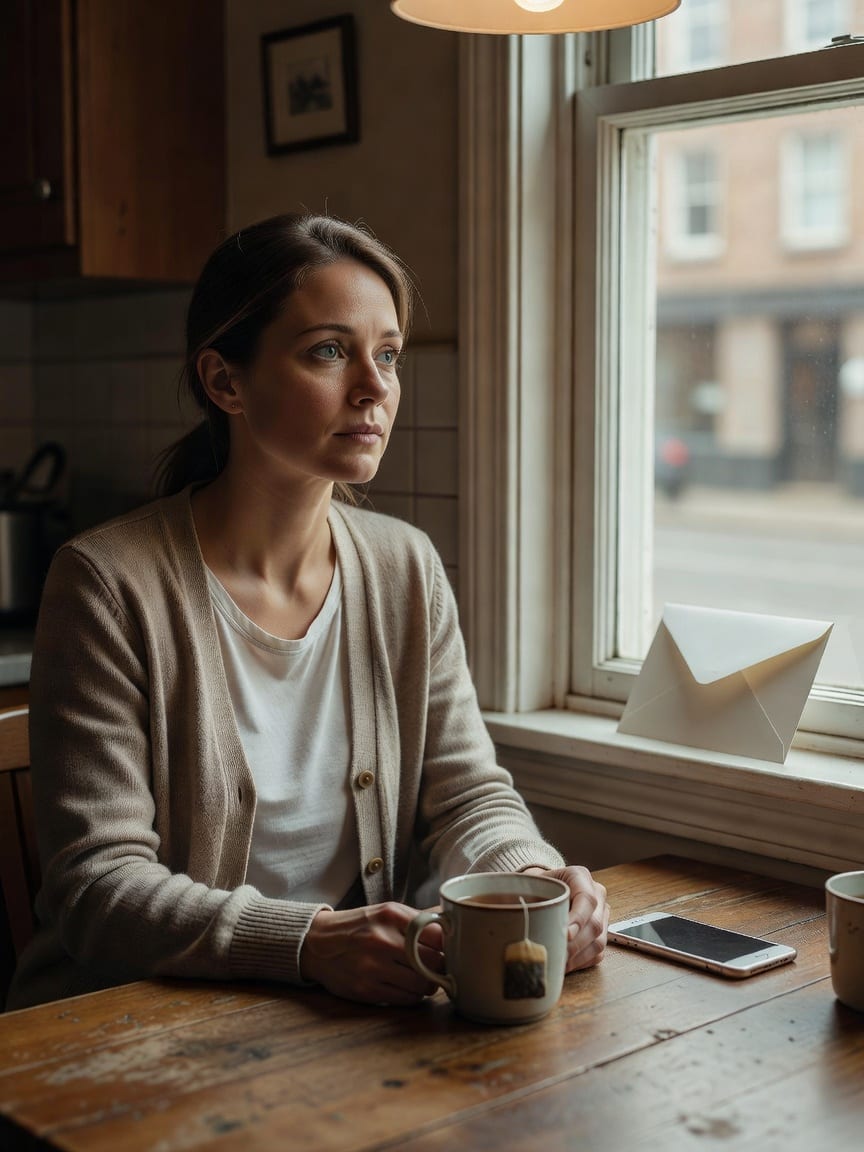
My taxi driver knew my name before I spoke, then apologized for the flight I was going to miss. I was arriving. The cab's plate was scrapped four years ago.
After a strange taxi ride, I received an unsettling birthday card addressed to me. Its return address listed 'Old Mill Road Field,' an empty lot where a mill once stood, and it was postmarked locally. The card arrived four months before my actual birthday, sparking a cold dread I couldn't ignore.
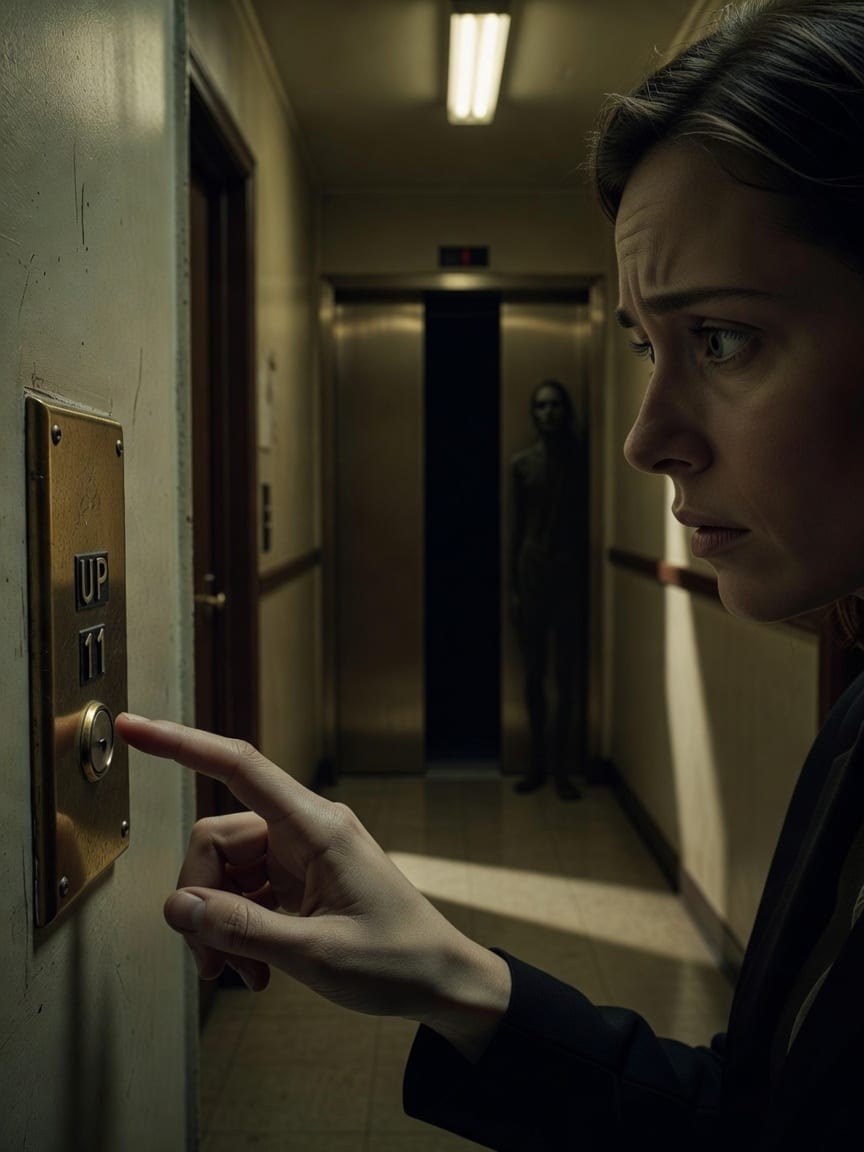
My doorman warned me not to take the tenth-floor lift on Saturday. The building's lift passed inspection last month. He seemed terrified that he'd said it.
My doorman's unsettling warning about the tenth-floor lift left me with a metallic taste of unease. I tried to rationalize it away, but then a birthday card arrived for me, five months early, from an impossible address. It was a site linked to unexplained disappearances, and a cold certainty began to settle in.
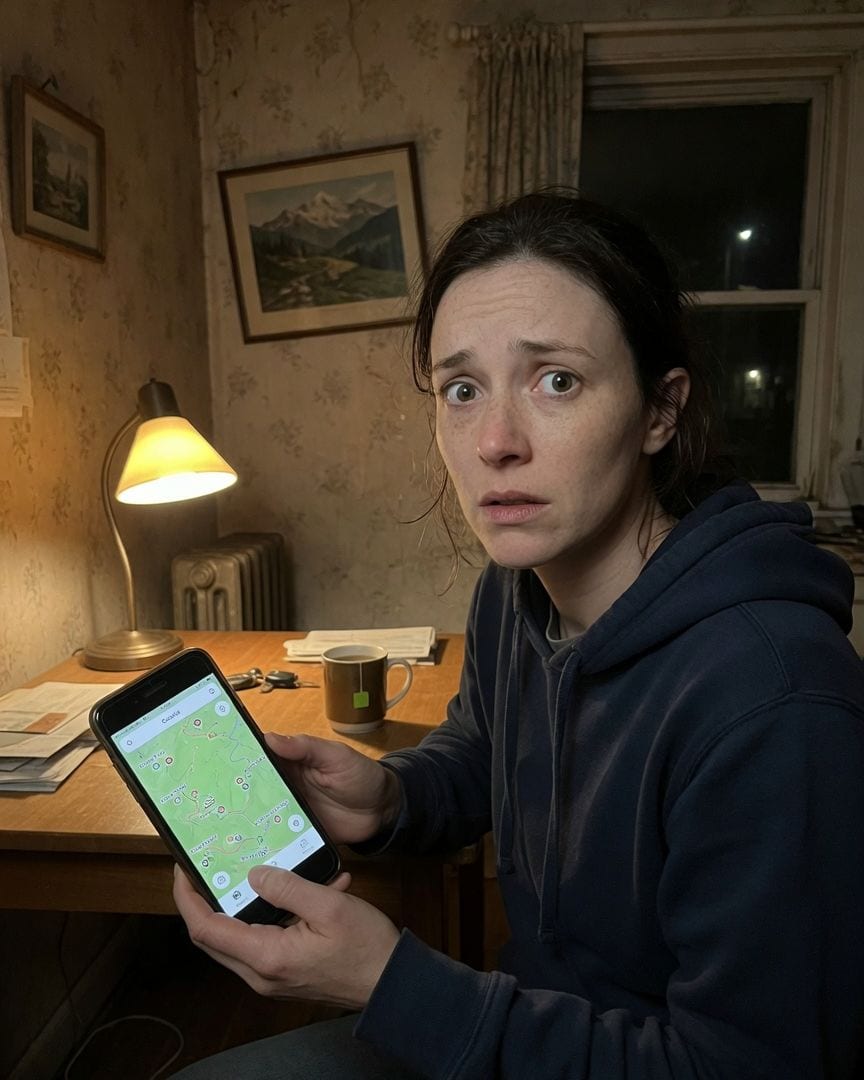
My hiking app scrubbed the hill's name from the map, on a phone that's been in airplane mode for two days.
I just moved to town and hiked a local hill, 'Cathan Tor,' according to my phone's app. But when I mentioned the name to the mechanic, he froze, dropped his wrench, and whispered, 'Don't say that name, Colette.'
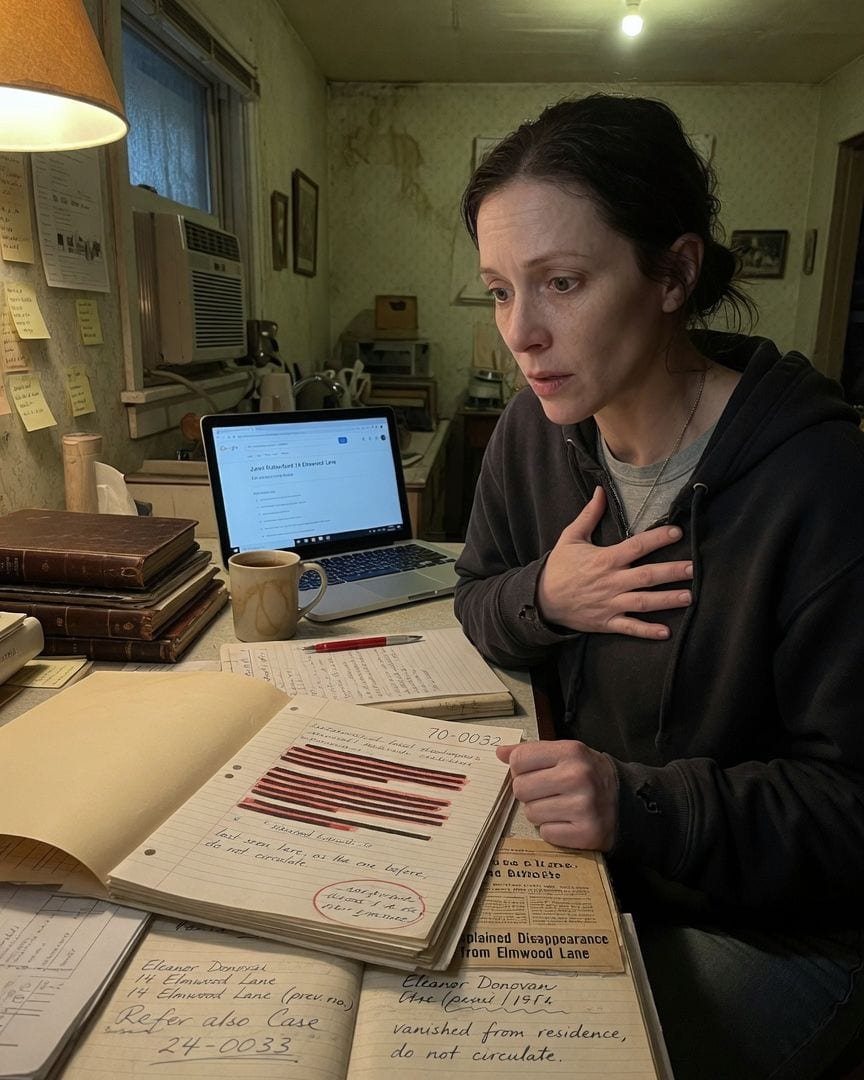
My own address is on a missing person's file from 1970. The blacked-out line names my street. She never lived here.
When my neighbor vanished, I started digging into old local missing persons cases. In a police file for a woman who disappeared in 1970, I found my own address, 14 Elmwood Lane, framing a blacked-out section of the duty log. Janet Rutherford never lived here, and the file contained a chilling handwritten note: 'do not circulate.'
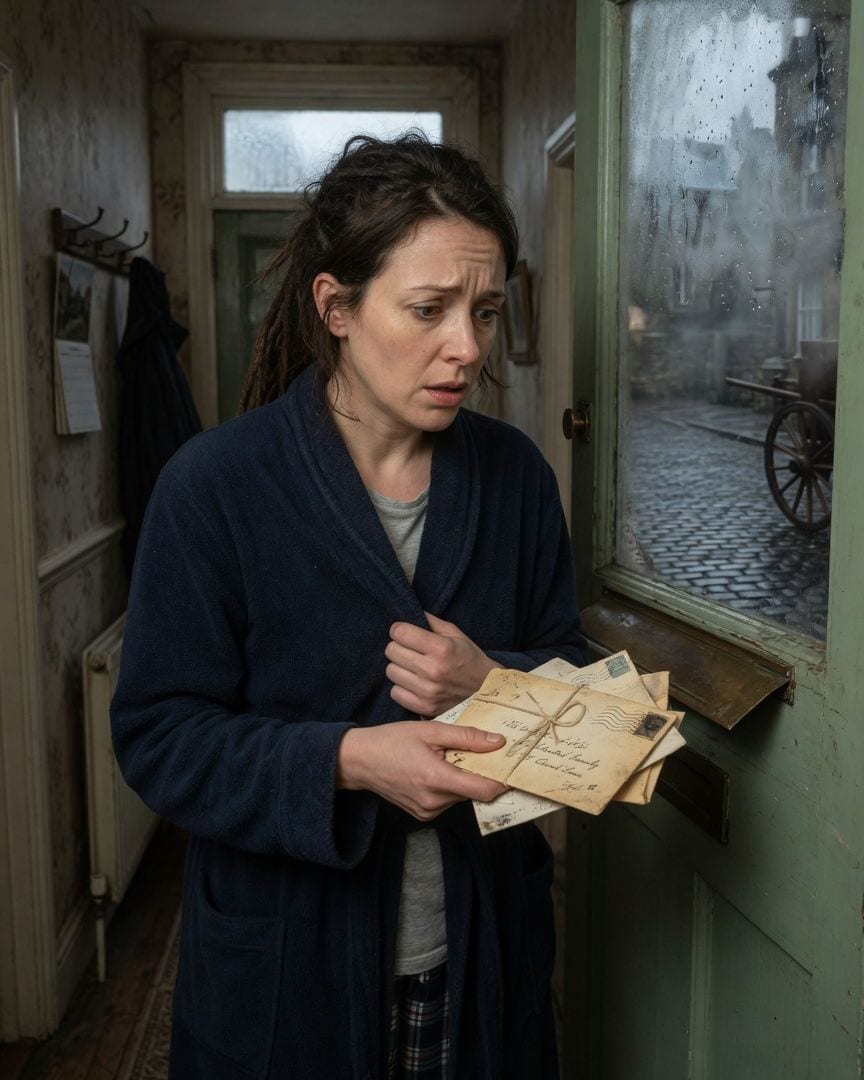
Seventy years ago, a hidden journal recorded my door opening to the wrong street and receiving Lockwood post.
I'd only recently moved into my inherited house, a quiet place on the edge of town. One grey morning, a distinct clatter from the front door's post flap caught my attention. Reaching down, I expected my gravel path, but instead, the flap showed a dark, cobbled street that wasn't mine. A bundle of warm, old letters, addressed to 'The Lockwood Family,' slid through, before the vision flickered and was gone.
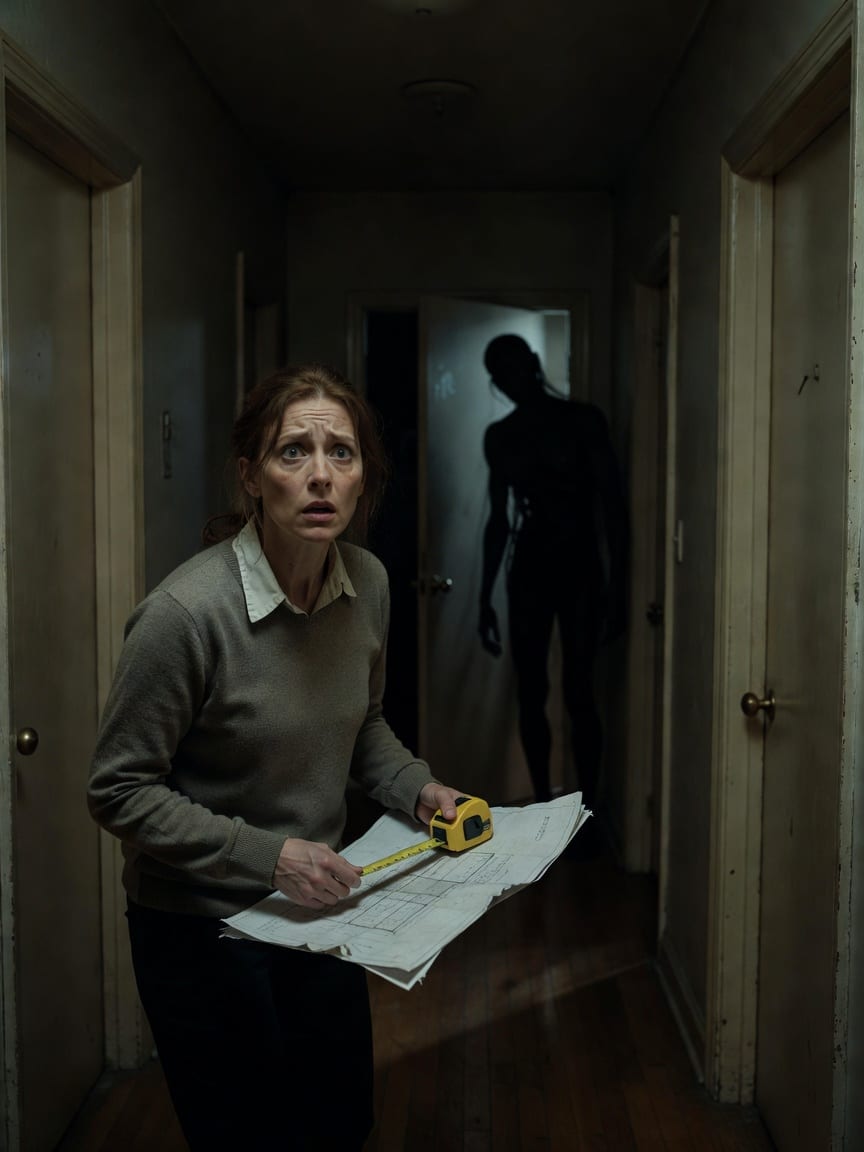
My front door has a dented gate and a dead hydrangea. I walked past it six times, trying to reach the corner shop just a hundred yards away. The pavement kept bringing me back to my own porch, and the shop's light never moved.
My morning started like any other, a quick walk to the corner shop from my home at Number 14, Elm Terrace. But after walking what felt like two minutes, I found myself back at my own front door, the shop no closer. I tried six times, faster and slower, but my street kept compressing, refusing to let me leave.