My own address is on a missing person's file from 1970. The blacked-out line names my street. She never lived here.
The file smelled of damp paper and old air conditioning, a scent particular to local government buildings.
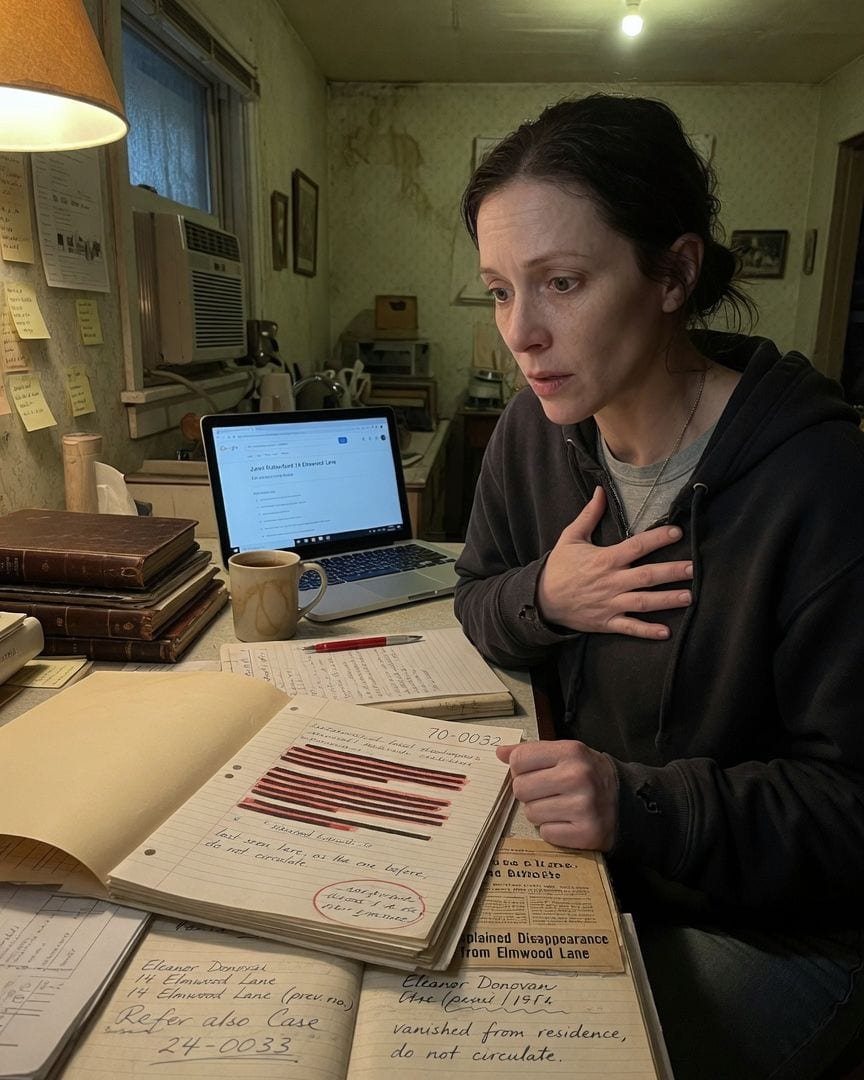
I’d spread it across my kitchen table, trying to make sense of the thick black marker line that obliterated part of the duty log. It was the police file on Janet Rutherford, who’d vanished from the village in 1970.
I’d requested it because, well, because of Carol Winslow, who’d gone missing from my street just last month. A neighbor. You start to look for patterns.
Most of Janet’s file was mundane, sad. Witness statements, search efforts, dead ends. Then I hit the duty log for the week after she was reported missing.
Halfway down the page, tucked between 'interviewed local shopkeepers' and 'canvassed bus route,' was the thick black bar. And framing it, in fading, typewritten text, was my own address: '14 Elmwood Lane.' My breath hitched.
Below the blacked-out line, a handwritten note, faded ink, almost illegible, but distinct: 'last seen here, as the one before, do not circulate.' My heart gave a cold thump. Janet Rutherford never lived at 14 Elmwood Lane.
She lived on the other side of the village, according to the file’s cover sheet. A clerical error? My eyes darted to the case number above the black line, a string of digits ending in '70-0032.'
And then to the number scribbled, by hand, at the very bottom of the page, beneath the 'do not circulate' note: 'Refer also Case 24-0033.' Case 24-0033. That was Carol Winslow’s case number, from last month. One digit higher.
It was too close.
I tried to rationalize it. A misfiled address, a clerk’s mistake. Maybe Janet Rutherford had visited someone at 14 Elmwood Lane before she vanished? I opened my laptop, punching in ‘Janet Rutherford 14 Elmwood Lane.’ Nothing. Not a single hit.
The internet was a vast ocean, but for this specific query, it was a desert. My fingers hovered over the keyboard, then I typed in '14 Elmwood Lane history.' Old deeds, property records.
My house, built in 1905, had a long, unremarkable past. Owners came and went. No murders, no suicides, no obvious dark chapters. Just names and dates of purchase.
Next, 'Carol Winslow missing Elmwood Lane.' A few local news articles popped up, short, generic. 'Local Woman Vanishes,' 'Police Continue Search.' The same vague 'missing, no leads' boilerplate I'd seen a hundred times.
No mention of a specific address, though I knew she’d been in her house, down the street from me, when she was last seen. The sense of frustration was a cold knot in my stomach.
I shifted to local archives, digital and then physical. Old newspaper clippings. It took hours, sifting through microfiche, the projector humming like a trapped bee. Then I found it. A brittle, yellowed article from 1953. 'Unexplained Disappearance from Elmwood Lane.'
Not 14 Elmwood Lane, just 'Elmwood Lane.' A woman named Mary Jenkins. No body, no clues, no witnesses. The language was eerily similar to the 1970 file. 'Local speculation,' 'no obvious motive.'
Nothing in any official police records I could access, just this obscure newspaper mention. The police file on Janet Rutherford had said 'as the one before.' Had this been it?
The mundane explanations — coincidence, misfiled address, shared street name — felt increasingly flimsy. The quiet bureaucratic language of 'do not circulate' now seemed like a deliberate suppression, not a simple clerical error.
It was like someone wanted these cases to be forgotten, disconnected. I kept thinking about that phrase, 'the one before.'
The local council archives were a different kind of quiet. Musty, thick with the scent of aging paper and time. I had to pull strings, citing local history research for a (non-existent) neighborhood project.
They eventually granted me access to the older registers, the ones that pre-dated computerization. My fingers brushed over dusty, leather-bound volumes, some so old the covers were flaking. The pages crackled as I turned them, tracing lines of faded script.
I was looking for anything, any mention of disappearances, any other 'do not circulate' notes, any pattern at all connected to Elmwood Lane.
Deep within a brittle, handwritten ledger from the early 20th century, I found it. An entry for '14 Elmwood Lane.'
It was under a previous street number, a municipal re-numbering from 1910, but the property description confirmed it was my house. Beside it, dated 1908, a name: 'Eleanor Donovan.'
And the chilling, familiar note, almost erased by time, but undeniably there: '…vanished from residence, do not circulate.' My breath hitched. Donovan. My own surname. Eleanor Donovan.
From my house, decades before my family ever lived here, before I was even born.
The ledger fell open, a silent scream across the faded page, pinning me to a history I never knew, a history that now felt impossibly, terrifyingly personal.
The discovery of Eleanor Donovan sent me down a rabbit hole of family genealogy. It was painstaking work, tracing faded photographs and obscure census records.
But I confirmed it: Eleanor was a distant great-aunt, my paternal grandmother’s aunt, who had indeed lived at 14 Elmwood Lane in the early 1900s.
The family history was vague about her; 'she moved away,' 'she went to live with distant relatives.' No record of her death. Just an abrupt cessation of existence in any official document. Like she’d simply ceased to be.
I remembered Marcus Holloway’s name from some of the obscure historical society documents I’d dug up about Elmwood Lane. A retired local historian, former council archivist. If anyone knew the hidden corners of this town’s past, it would be him.
I found his address in the phone book, a quiet bungalow on the edge of town.
He was tending roses in his front garden when I arrived, a man with a surprisingly vigorous handshake for his age, and eyes that were both sharp and weary. I introduced myself, explained my 'research.'
He invited me in, to a living room crammed with books and the smell of pipe tobacco. Initially, he was evasive, speaking in generalities about 'local legends' and 'old houses having their quirks.' I pressed him.
I laid out the copies I’d made: the redacted police file on Janet Rutherford, the 1908 ledger entry for Eleanor, and the recent news report about Carol Winslow.
'It’s not a coincidence, Mr. Holloway,' I said, my voice tight. 'Young women. Always from 14 Elmwood Lane. Always 'missing' with no trace. Always a 'do not circulate' appended to their records. And my own ancestor, from the same house.'
I pointed to the dates. 'Look. 1908. Then 1953, the newspaper article. 1970. And last month, Carol. They’re not perfectly regular, but they cluster. Like a cycle.'
Marcus’s composure began to crack. A flicker of something haunted in his eyes, a deep sadness that seemed to settle around him like a shroud. He didn’t deny the pattern. He looked at the documents, then at me.
'Some things are better left buried, Miss Donovan,' he said, his voice quiet. 'For everyone’s sake.' The silence in the room stretched, punctuated by the ticking of an old grandfather clock in the corner, a sound that suddenly felt ominous.
I found myself increasingly uneasy. It wasn’t just the stories now; it was a feeling. A persistent prickle on the back of my neck. I started noticing Marcus Holloway’s old sedan.
Sometimes, it would be parked down the street, near the corner, for hours. I’d see him behind the wheel, his silhouette still and unmoving. Once, he drove slowly past my house, his gaze seeming to linger on my front door.
My phone rang with unknown numbers. When I answered, there was only silence, or sometimes, a faint, distorted whisper, like wind through dry leaves. I’d hang up, heart pounding. Was it just a telemarketer? Or something else?
One evening, I returned home from the grocery store. The air in the house was colder than usual, even for October. And my front door, which I was certain I’d locked, was slightly ajar.
Just a crack, barely noticeable, but enough to make my stomach clench. I pushed it open slowly, my hand trembling, ready to grab the nearest heavy object. Nothing appeared stolen.
The TV was where I’d left it, my laptop on the counter. But then I saw it. On the kitchen counter, next to a stack of mail, lay a single, old-fashioned silver locket. It was my grandmother’s.
I’d inherited it years ago, kept it in a small wooden drawer in my bedroom, rarely looked at it. It was open, displaying a faded tintype of a young woman. I picked it up.
The woman in the photo bore an unsettling resemblance to Eleanor Donovan, the great-aunt who had vanished in 1908. The message was clear. Someone had been inside. Someone knew about my research. Someone knew about Eleanor.
The dread turned personal, coiling tight in my chest.
The next morning, I found Marcus Holloway tending a small community garden near the old council building. The air was crisp, carrying the scent of damp earth and late-blooming marigolds. I walked straight up to him.
'You've been watching me,' I stated, my voice tight, barely controlled.
He didn't flinch. He slowly straightened up, wiping his hands on a gardening rag. His gaze was steady, unblinking. 'Someone has to, Patricia,' he said, his voice calm, almost mournful.
'You're digging in ground that's been quiet for a long time.' His composure was more unnerving than any threat, suggesting a deep, unshakeable knowledge, and perhaps, a quiet complicity. The sunlight suddenly felt cold.
I shoved the locket into Marcus’s hand, the old silver cool against his palm. 'Who was in my house? What is going on?' My voice was raw, frayed.
Marcus sighed, a long, weary sound, his gaze distant, fixed on the distant rooftops of the village. 'No one was 'in' your house, Patricia. It was always there.'
He turned the locket over in his hand, his thumb tracing the faded tintype. '14 Elmwood Lane isn't just a house. It's what we call a 'thin place.' A nexus.
The veil between worlds, or whatever you want to call it, is… exceptionally weak there.'
He explained, his voice low, measured, as if recounting a dull administrative fact. 'The local authorities – police, council, even certain old families – they’ve known about this for centuries. Not known what it is, exactly, but known its effects.
The house has always been difficult, as the old timers used to say. People disappear. Not runaways, not foul play, not even accidents. They simply… cease to be here.
Like a door opened, and they walked through it, only the door vanished behind them.'
He went on to explain the institution’s role. 'We can’t stop it,' he said, his voice tinged with ancient sorrow. 'It can’t be stopped. It’s a force of nature, in its own way.
But we could, and still do, contain the knowledge of it. The 'do not circulate' in the files isn’t about protecting the victims, Patricia. It’s about preventing mass panic. Maintaining social order.
The missing person reports are a necessary bureaucratic lie. Easier to have a hundred missing persons than to explain a 'thin place' to an entire population.'
He confirmed the cyclical nature. 'The 'thing,' as we informally call it, seems to require a 'new one' when the 'old one' fades. Carol Winslow’s disappearance last month, that was a sign. The cycle was reactivating. It was time again.'
My earlier clues clicked into horrifying place. The redacted lines. The repeating addresses. The quiet management. The shared street name on the 1953 report; it wasn't the house, but the street itself, the ground beneath it.
It wasn’t a monster in the dark; it was a terrifying, documented reality, a long-standing, horrifying secret.
'We couldn’t save them,' Marcus said, his voice flat, 'but we could keep the world from knowing the depth of the hole they fell into.' The air in the garden grew heavy, cold, as if the sun had momentarily vanished.
I felt a cold dread seize me, locking my breath in my throat. 'Why are you telling me this now?' I whispered.
Marcus looked at me with an intensity that chilled me to the bone. He reached out, his gnarled finger hovering inches from my inner wrist. 'Because you're not just a curious resident, Patricia.
Your family, the Donovans, they have a history with that house. A very old one.' He described how certain lineages, those who lived on or near such 'thin places' for generations, became… attuned. More susceptible.
He gestured to my inner wrist, to a tiny, almost imperceptible star-shape birthmark I’d had all my life, a detail I’d never thought to hide, never thought anyone would notice.
'Eleanor had one just like it,' he said, his voice barely a whisper. 'It’s a marker. You found the files, Patricia. But the files found you.' His gaze was steady, unblinking.
He leaned in, his voice dropping to a low, unnervingly calm whisper. 'Your grandmother, Patricia. She told me to watch for the signs. To watch for you.' A cold dread seized Patricia, locking her breath in her throat.
The file wasn't just about the house; it was about her.
Marcus’s words hung in the air, a bell tolling for my future. He explained that the 'thing' wasn't malevolent in a human sense, but a natural, cyclical phenomenon tied to the land beneath 14 Elmwood Lane.
'It’s a hunger,' he said, 'that opens, drawing in those with a particular energetic resonance. Often, those marked by the star-shape.' My birthmark. It wasn't a flaw; it was a beacon.
He revealed that over generations, certain families, including the Donovans, had become inextricably intertwined with its cycle. Some members vanished, others became quiet 'custodians' like himself, trying to manage the fallout.
'Not to stop it,' he stressed, 'but to lessen the chaos. To prevent a wider panic.' The local council, years ago, had formalized this 'management.'
They created the redacted files, the 'do not circulate' policy, and a small, unofficial department dedicated to 'anomaly containment.' Marcus had been a part of it.
They learned that public awareness didn't help; it only agitated the 'thing,' making its manifestations more frequent and less predictable. The horror wasn't a conspiracy of evil, but a bureaucratic response to an uncontainable, ancient truth.
My house wasn't just a location; it was a living, breathing trap, and my lineage, my very being, was the bait.
Every clue, from the blacked-out line to my ancestor's disappearance, to Marcus's chilling knowledge, now formed a perfectly coherent, terrifying pattern. The institution wasn't protecting people; it was protecting itself from the chaos of its own profound powerlessness.
Armed with Marcus’s admissions and my compiled evidence, I didn't run. I couldn't. I confronted Diane Drummond, the current head of the local council. She was a stern, unyielding woman in her fifties, sharp suit, sharper demeanor.
I laid out the files on her polished mahogany desk: Janet Rutherford’s redacted file, the news clippings from 1953, the brittle ledger entry for Eleanor Donovan, Carol Winslow’s case number, the genealogical links to my family, the star-mark.
The pattern, stark and terrifying, stared up at her.
Drummond initially tried to dismiss it as 'unsubstantiated folklore,' her voice tight with official disdain. But my presentation was calm, rational. Decades of consistent, documented 'missing persons' from a single address, all with the same redacted, suppressed notes.
I told her about Marcus Holloway, about the 'do not circulate' policy. I told her I would go public. I would leak every file, every note, every chilling detail to national media, to anyone who would listen.
The council, fearing an unprecedented scandal and the breakdown of public trust, was forced to act.
They couldn’t 'stop' the thing, as Marcus explained, but they could stop managing its silence. Under public pressure, 14 Elmwood Lane was officially condemned as 'structurally unsound' and 'a risk to public safety.'
The official notice was tacked to my front door, the wood already bowing. Within days, it was boarded up, fenced off, with perpetual monitoring cameras installed around its perimeter.
The flow of 'missing persons' from that address was publicly acknowledged as 'anomalous,' and the council promised a 'full, transparent inquiry' into historical missing person cases.
I knew the 'inquiry' would be a whitewash, a bureaucratic exercise in controlled information, but it was enough.
The immediate cycle at my house was broken, made to stop, not by destroying the 'thing,' but by exposing the institution’s complicity and making the specific location uninhabitable.
I moved out of the village a week later, finding a small flat in a nearby town. The news cycle around 'the Elmwood Lane disappearances' eventually faded, replaced by other, newer horrors.
The council issued a bland report, citing 'unique geological conditions' and 'historical record-keeping errors.' Marcus Holloway vanished from public life, his small garden left untended, the roses blooming wildly, uncared for.
I still carry the chill of what I uncovered. The knowledge that the 'thing' wasn't truly gone, only relocated, or perhaps, waiting for another 'thin place' to manifest its hunger.
The star-mark on my wrist still felt like a brand, a permanent reminder.
A year later, I was watching a late-night news report. A small, rural town, miles away from Elmwood Lane, grappling with a sudden, unexplained cluster of disappearances.
The police chief, grim-faced, spoke of 'unprecedented circumstances' and 'a lack of any discernible pattern.' But I saw it. I saw the subtle, almost imperceptible star-mark birthmark on the reporter's inner wrist as she gestured, pointing to the police tape.
I knew the truth, a truth that outlives any single answer. There were always other houses, other files, other marked lineages. And somewhere, another quiet institution was already beginning to manage the silence.
The dread never truly ends; it just moves on. I turned off the television, the silence of my new apartment suddenly vast and cold. I knew it won't be the last time I hear such a report.
It was never the only one.
If this one got to you
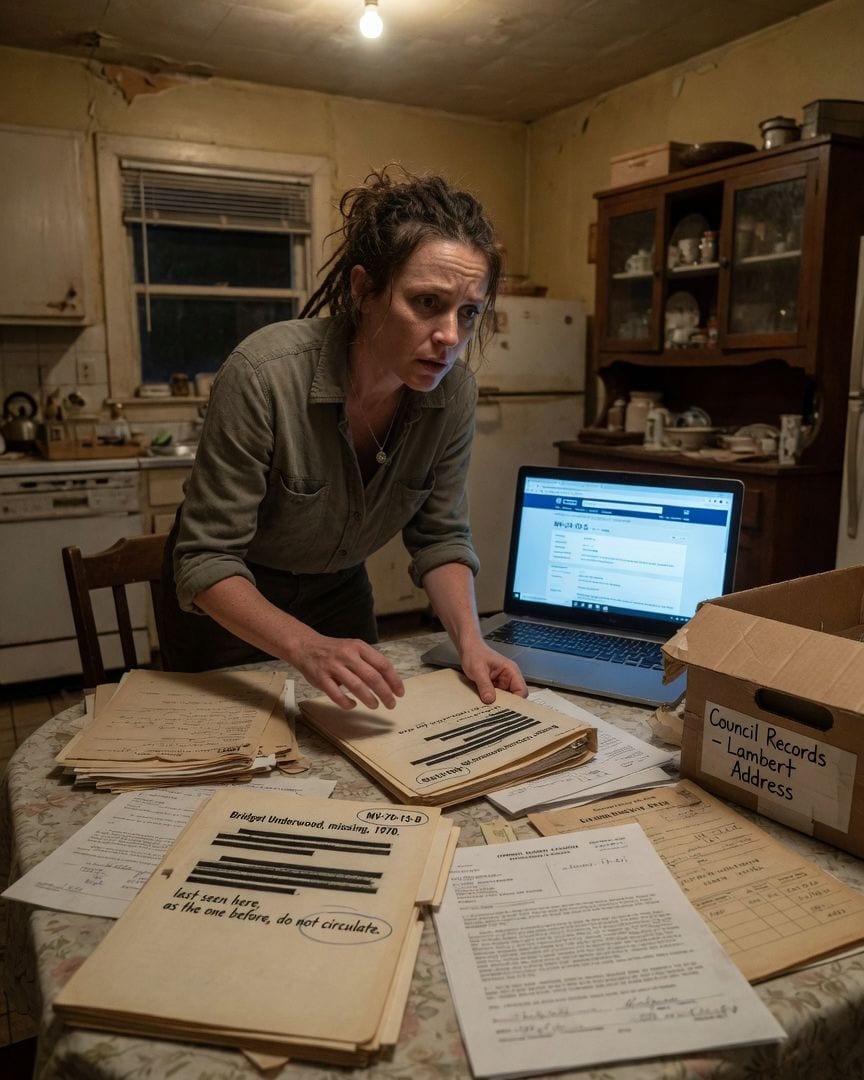
My address appears on a 1970 missing-person report. It says 'last seen here, as the one before,' and the case number is almost identical to a new one from last month.
As a local historian, I'm used to old records, but a police file for a 1970 missing person stopped me cold. It listed my current address, with a chilling note: 'last seen here, as the one before, do not circulate.' I knew Bridget Underwood never lived here, yet there it was.
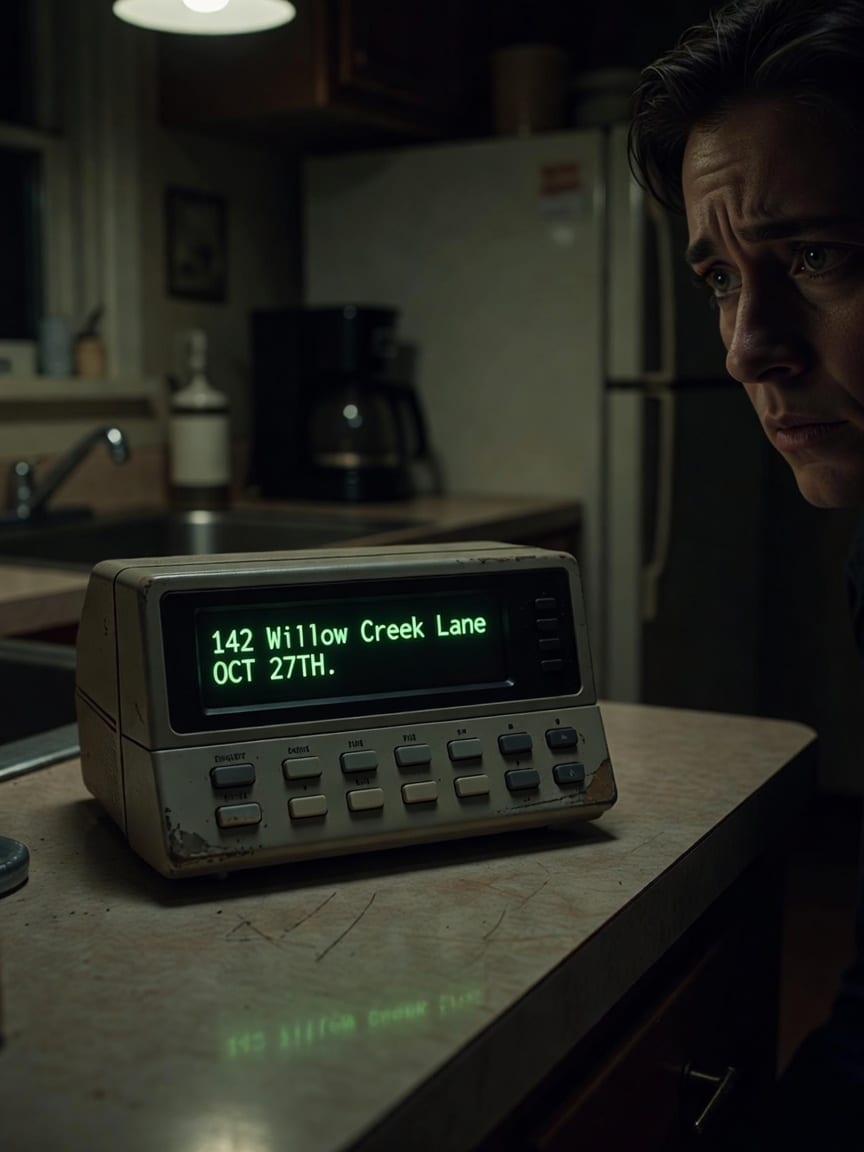
My radio scanner picked up a channel at 2 AM reading local addresses. Mine was on it, dated tomorrow.
I was tracking a storm on my old weather radio when a synthesized voice cut through the static. It began reading local street addresses, then my own: 142 Willow Creek Lane. But the date it gave for my address was tomorrow.
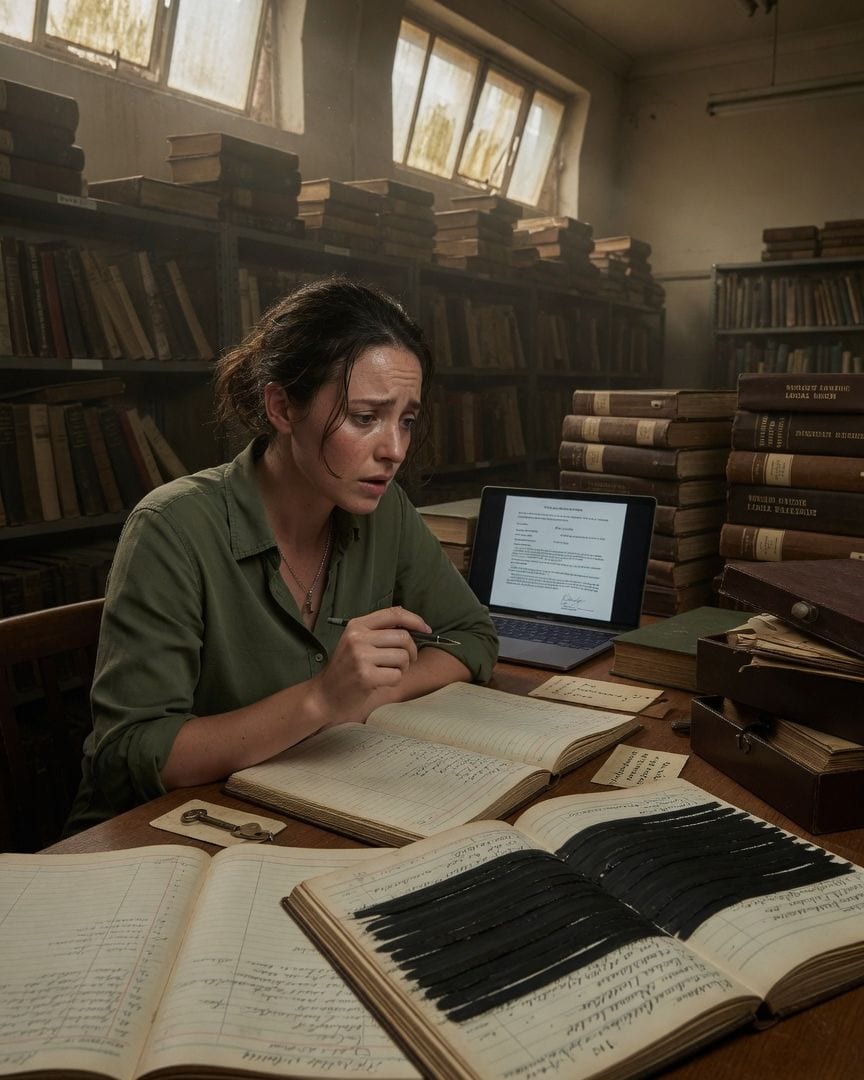
My grandmother’s name is on a blacked-out line from a 1954 drowning inquest, on our street, with a note: 'do not send a second notice.'
Transcribing old inquest registers in the quiet archive was a routine task, until I found a 1954 entry for an accidental drowning. The next of kin line was savagely blacked out, but the faint impression underneath named Patricia Kingsley, my grandmother. Her address was listed on Weir Lane, eleven years before she ever lived there, alongside a chilling note: 'do not send the notice a second time.'
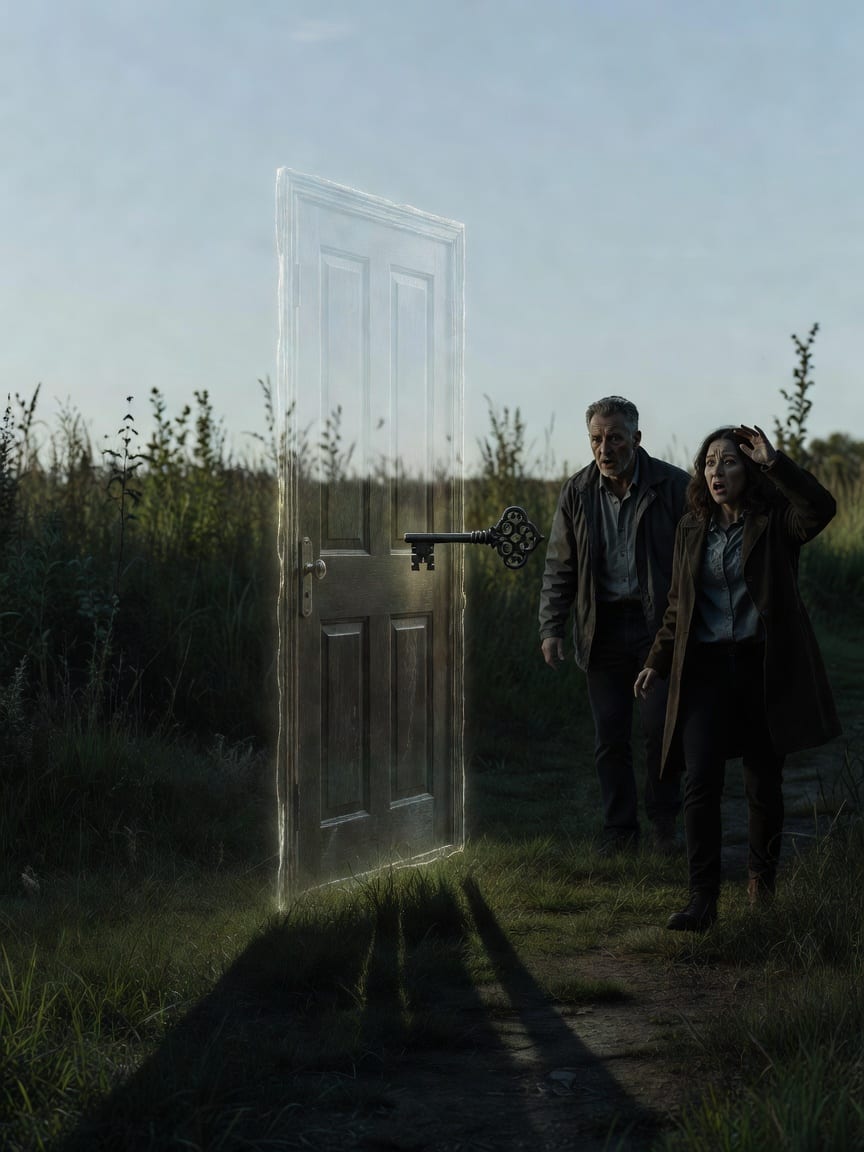
My name was on a package lodged in 1974. I wasn't born until 1985. Inside was a key and a note: 'You know which door. Not yet.'
I'm Elena Radcliffe, 38, and a solicitor's letter just arrived for me about a package. The firm's records state it was lodged in 1974, years before I was born. Now I've found an old newspaper article reporting a woman with my exact name vanished that very year.
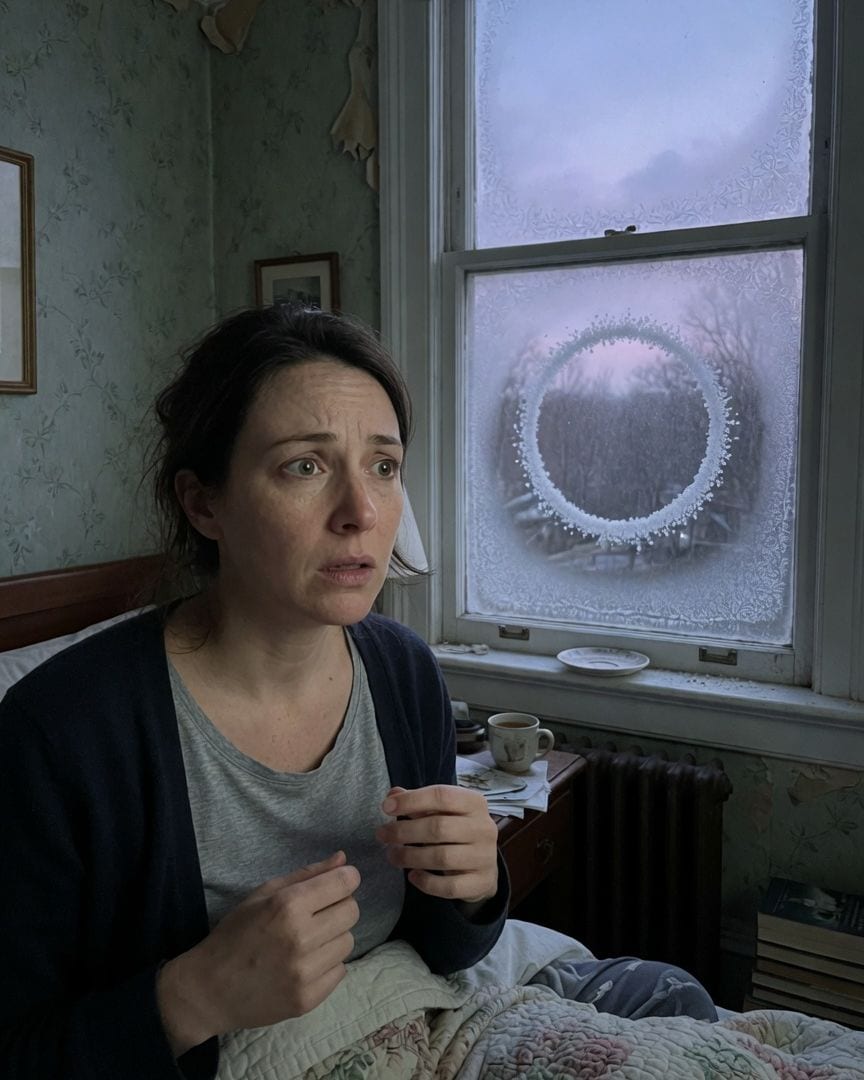
A 1963 obituary for a vanished 7-year-old girl lists *my Fenwick address* as her last known home.
Fenwick has its quaint traditions, like placing a salt saucer on the sill for protection. I put mine on my fourth-floor bedroom window, a private scoff at local custom. The next morning, the saucer was gone, replaced by a perfect salt ring on the *outside* of the glass, impossible to reach.
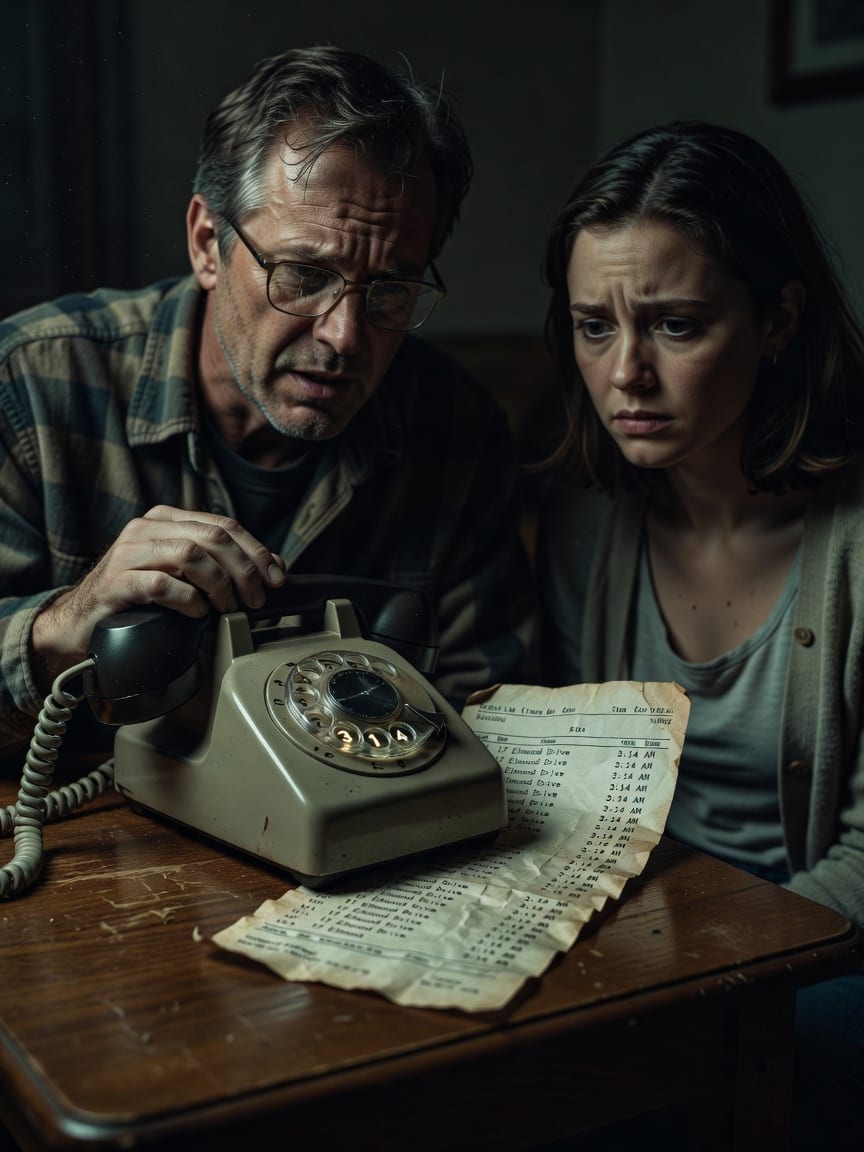
My phone bill itemised forty calls from my number to a house demolished in 1990. Each call at 3:14 AM, lasting eleven minutes. The bill arrived postmarked from a flattened building.
I expected the usual mobile bill, but my landline statement listed forty calls from my number to '17 Elmwood Drive.' That address was for a house torn down in 1990, a vacant lot I remembered from childhood. The phone company insisted the calls were legitimate, leaving me profoundly unsettled by the impossible charges.