My phone bill itemised forty calls from my number to a house demolished in 1990. Each call at 3:14 AM, lasting eleven minutes. The bill arrived postmarked from a flattened building.
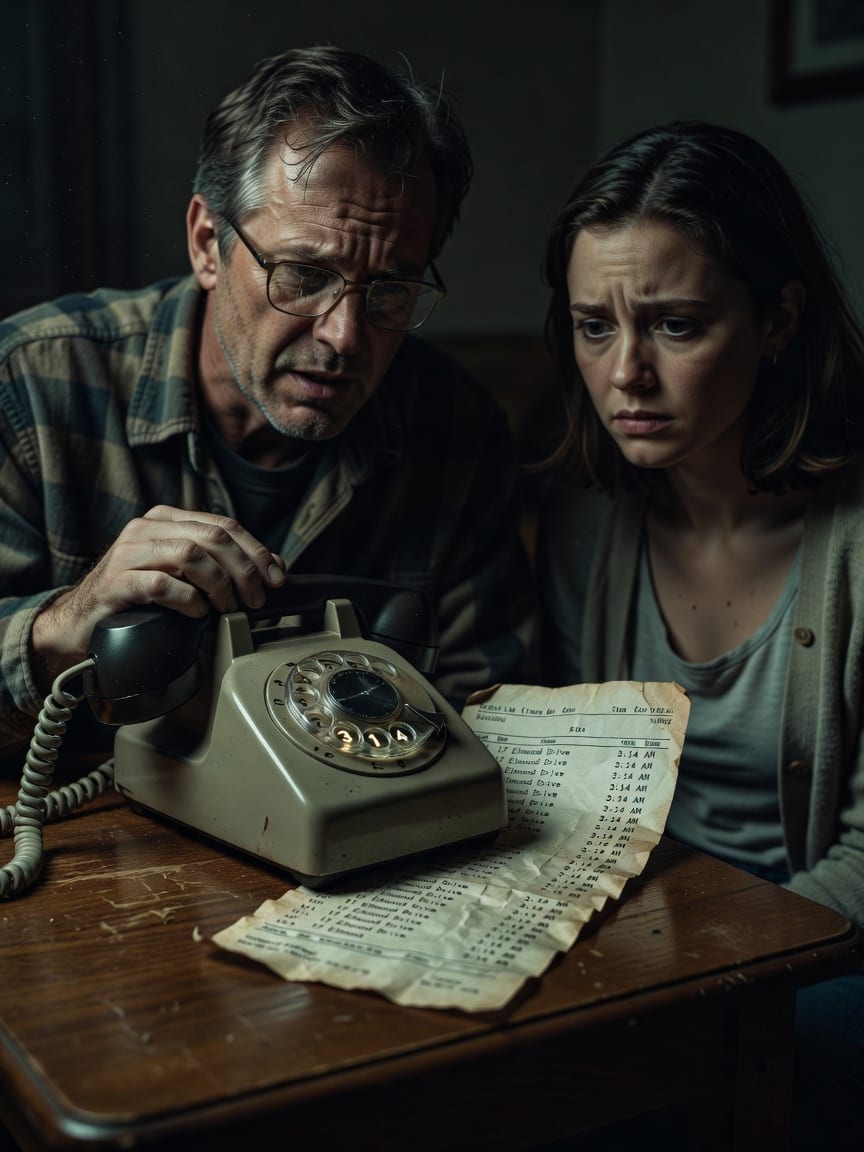
The envelope felt flimsy, cheaper than usual. When I tore it open last Tuesday, I fully expected the usual shock of my mobile data charges. Instead, I got something far stranger.
It was a phone bill for my home line, the dusty landline I only keep because my internet package bundles it. My name, Vivienne Sheppard, was correct. My account number, correct. The total, correct. Then I saw the itemised calls.
Forty of them. All from my number. All to the same number: 01923 876912, listed simply as '17 Elmwood Drive'. Every single call timed for precisely 3:14 AM, lasting exactly eleven minutes.
My first thought was a mistake. A phantom charge. I mean, 17 Elmwood Drive? That house was torn down in 1990.
I remembered the lot, a scraggly patch of weeds between two newer builds, because I’d biked past it as a kid. And the postmark on the envelope itself made no sense: "Higher Bore Exchange."
That building was bulldozed ten years ago to make way for a retail park.
I called the phone company, dread already a cold knot in my stomach. A man named Donald Calloway picked up, his voice a drone of practised customer service.
I explained, trying to keep my voice even, "I'm looking at a bill here, and it's got calls to a demolished house. From my landline. Forty of them, all at 3:14 AM." There was a long silence on his end.
"And the bill is postmarked from your old Higher Bore Exchange." Another silence. "Ms. Sheppard," he finally said, his tone flat, "I'm showing these calls as legitimate. They’re logged from your line.
Our system indicates these were outbound calls, completed, lasting exactly eleven minutes each." He paused. "And the postmark is… unusual. But the bill is authentic."
He offered no further explanation, just a vague promise to 'investigate the postmark anomaly,' which felt like a lie even as he said it. The call ended with me no wiser, just profoundly unsettled.
I spent the next day trying to shake off the weirdness. Donald Calloway’s dismissive tone replayed in my head, a hum of bureaucratic incompetence. It had to be a system glitch, right? A legacy error.
But a part of me couldn't let it go. I had to see for myself.
My lunch break became an impromptu detective mission. I drove out to Elmwood Drive, a residential street now lined with modern bungalows and renovated semis.
The address, 17 Elmwood, was exactly as I remembered: a vacant, overgrown lot, long since cleared of any foundation, just dirt and thistle, surrounded by a chain-link fence. There was nothing there.
Not a shed, not a forgotten sign, just a heavy silence that pressed down on the quiet street. The idea of my landline, dormant for months, connecting to this emptiness forty times felt absurd, a joke. But it wasn't funny.
Next, I headed to the site of the former Higher Bore Exchange. As expected, it was a gleaming retail park, bustling with shoppers pushing carts.
The old brick building, with its squat, almost industrial architecture, was gone, replaced by a brightly lit supermarket and a coffee shop. No trace of the place that had supposedly sent me that flimsy, impossible bill.
Frustration simmered, mixed with a growing, prickly sense of unease. I needed a real answer, not just a system error or a bulldozed building. On a whim, I pulled into the parking lot of the local history society.
Maybe someone there, someone who remembered the old days, could shed some light. Inside, the air smelled of dust and old paper.
I found Gary Porter, a man in his late seventies with a kindly, rumpled face, sorting through a pile of faded photographs.
I explained the situation, holding out the bizarre phone bill. Gary peered at it through thick spectacles, his brow furrowed. "Higher Bore, eh? And Elmwood Drive." He nodded slowly. "Funny, that. Remember Elmwood. Mostly new builds now.
And the exchange… good old days. They kept everything on paper then. Everything." He tapped the bill. "Demolished, both of them, yes. A strange business, that bill." He paused, lost in thought.
"You know, the phone company back then, they had this… special ledger. For 'special lines,' they called them. Or 'long-term accounts.' Not official, mind you. More of an internal thing. Sort of a keeper of peculiar histories, if you like.
I seem to recall it ended up in the town's historical archives when the old office closed." He chuckled, a dry, raspy sound. "Some folks used to tell tales about the Elmwood lines. Ghost stories, mostly.
People getting calls from numbers that shouldn't exist, stuff like that. Just local gossip, mind you. Nothing to it." But the way he said "nothing to it" didn't sound entirely convinced. He just sounded tired.
Following Gary's vague directions, I found myself in the hushed, cool air of the town’s historical archives. The place was a labyrinth of dark wood shelves and towering stacks of records, smelling of brittle paper and faint mould.
I spent an hour, fingers trailing along the spines of countless dusty books, my earlier frustration slowly replaced by a focused, almost desperate need to find something.
Then, my fingers brushed against it. An unusually thick, oversized ledger, bound in scuffed, dark leather, sitting almost hidden behind a row of municipal tax records. It looked ancient, its pages thick and yellowed at the edges.
A keeper of peculiar histories, Gary had called it. My heart began to pound with an unwelcome, hollow beat.
With trembling hands, I carried it to a reading table and carefully opened the cover. Inside, meticulous, faded copperplate script filled the pages, page after page of names and addresses, stretching back decades.
I flipped through the index, my eyes scanning for anything related to Elmwood. And there it was, under 'E': 'Elmwood Lines.' I turned to the indicated page, my breath catching in my throat.
The entries were sparse for that section, just a handful of names and associated numbers. And then I saw it. Pristine. Unmistakable. Neatly written beside the address '17 Elmwood Drive,' was my own full name, 'Vivienne Sheppard.'
And directly beneath it, in the same careful hand, the date: '1988'. My mind reeled, refusing to process the impossible sight. I wasn't born until 1991.
The ledger felt like a block of ice in my hands. I practically ran back to Gary Porter, the heavy book clutched to my chest.
He looked up, his expression already one of mild annoyance, but his jovial demeanor crumpled the moment he saw my face, then the open ledger. He picked up his spectacles, his hand shaking slightly as he read the entry.
"Vivienne Sheppard," he murmured, his voice barely audible. "1988. Impossible." He placed the ledger down with a thud, leaning back in his chair. "The Elmwood Line," he finally said, his gaze distant. "It wasn't just gossip, Vivienne.
It was a local legend. More than that. Some claimed it was a line that, even after the houses were gone, seemed to… remain. You’d get strange calls. Or bills. Like yours." His voice dropped to a whisper.
"A few people, over the years. They received similar 'communications.' And then they vanished. Just… gone. Mrs. Sullivan, at number 17, she was one.
Disappeared right out of her life in '88, around the time that entry was made for her, I think."
Mrs. Sullivan. My stomach twisted. I remembered seeing a different name for 17 Elmwood Drive in other records for 1988. I spent the next few hours in the society’s local newspaper archives.
It didn't take long to find it: "Local Woman Vanishes Without A Trace." The article detailed the sudden, unexplained disappearance of a Mrs. Evelyn Sullivan from 17 Elmwood Drive in late 1988, leaving her home and all her belongings behind.
No note, no struggle, just… gone. Another knot tightened in my gut.
I tried to trace the actual phone number listed in the ledger entries, the one from my impossible bill. I used online search engines, old directories. Nothing. The number was unassigned. A ghost in the system.
I even called the phone company again, bracing myself for Calloway's bureaucratic wall, but another representative confirmed their database showed no record of that specific number ever being re-allocated after 1990.
It just… disappeared from the network, a black hole where a line should be. Except, apparently, for me.
As I delved deeper into the bizarre history of 17 Elmwood Drive and the phantom calls, an unsettling sense of being observed began to creep into my life. It started subtly.
My landline phone, usually a silent monument to a bygone era, occasionally emitted a faint, almost imperceptible click, as if an extension had been picked up then immediately replaced.
Just a soft, dry thk from the handset, but loud enough in the otherwise quiet apartment to make me jump.
I’d pick it up, hear only a clear dial tone, and replace it, telling myself it was just static, an old line, an old house settling.
Then came the 'wrong number' calls. Not forty, like on the bill, but three in one week. Each time, I’d answer to nothing but static, thick and buzzing, with a strange, rhythmic hum beneath it, like a distant, off-kilter heartbeat.
I told myself it was telemarketers, or a crossed line. But the hum… it was always there.
I confided in Audrey Brooks, my friend and colleague. She listened patiently, her brow furrowed. "Viv, maybe you're just stressed? This whole phone bill thing, it's messing with your head."
She tried to rationalize it, offering explanations about old wiring, electromagnetic interference. But even Audrey started to look over her shoulder when she was at my apartment, her eyes darting towards the silent landline.
One night, I was sitting alone, researching Mrs. Sullivan's disappearance again on my laptop, the screen illuminating the dark room with its pale glow. The apartment felt impossibly still.
Suddenly, the screen flickered violently, an electronic cough that made my heart leap. For a split second, a distorted, garbled image flashed across it – not a webpage, but something else. It was the ledger. My ledger.
And on the screen, the entry with my name, 'Vivienne Sheppard,' at '17 Elmwood Drive,' was highlighted in an unnatural, pulsing red, the date '1988' stark beneath it.
The image vanished as quickly as it appeared, replaced by my research page, the laptop now humming normally, innocently. My blood ran cold.
Moments later, my mobile phone rang. The screen displayed 'Unknown Number.' I stared at it, my thumb hovering over the answer button, a primal sense of dread coiling in my gut. Who knew this number? Who was this?
After what felt like an eternity, I answered, bringing the phone to my ear. There was only a dial tone, clear and steady.
But beneath it, just at the edge of hearing, almost imperceptible above the static, I distinctly heard it. A faint, distorted whisper, like dry leaves scuttling across pavement, articulating my surname: 'Sheppard.'
The whispered name felt like a cold finger tracing my spine. I dropped the mobile onto the sofa, my breath catching. It wasn't random. It wasn't a mistake. I knew it, with a terrifying certainty.
I didn't sleep that night. The next morning, I called Audrey, my voice still raw from fear.
She came over, and I showed her the ledger again, pointing to the '3:14 AM, 11 minutes' notations that punctuated several entries, not just mine. Her face, usually so composed, was pale.
"Viv, this is… terrifying," she whispered, her finger tracing the careful script. We started going through the entries systematically.
The ledger wasn't just a record of addresses; it was a sequence of names, each with a date, and next to many, that chilling notation. Some entries had additional notes scribbled in smaller, fainter script: 'disconnected,' 'transferred,' or 'ceased activity.'
A pattern emerged, horrifying in its meticulous detail.
I knew I had to go back to Donald Calloway. This time, I didn't call. I drove directly to the phone company's main office, the heavy ledger tucked under my arm.
Calloway was surprised to see me, his expression hardening when he saw the book. I placed it on his desk, open to the 'Elmwood Lines' section.
"Look at this, Mr. Calloway," I demanded, my voice tight. "My name. Dated 1988. Calls at 3:14 AM for eleven minutes. Just like on my bill. And others. Mrs. Sullivan, for example. She vanished."
He initially dismissed it as an archaic anomaly, a forgotten relic of old record-keeping. "Ms. Sheppard, this is an old company ledger. From before digitalization. There were all sorts of… peculiar internal notes."
He tried to close the book, but I held it open.
"Peculiar? Every entry in this section has the same time and duration. 3:14 AM. Eleven minutes. This isn't just old data. This is a pattern.
My name is in here, before I was even born, linked to a house that no longer exists, and now I'm getting calls from it." I leaned forward, my voice dropping. "What did Gary Porter mean about 'special lines'?
What about a 'ghost line'?"
Calloway’s composure, usually so impenetrable, began to crack. His eyes darted around his pristine office, avoiding mine. He sighed, a deep, shuddering sound, and finally admitted, "Alright. Look. The old Higher Bore exchange… it had a notorious 'ghost line.'
Or 'persistent signal,' as the engineers called it. It defied all attempts to shut it down. They couldn't isolate it. Couldn't re-route it.
It was like an echo from the network's past, a residual energy that sometimes, for reasons no one understood, would 'latch onto' specific, active lines."
He picked up a pen, twirling it nervously. "It was mostly stable, for decades. Its original 'terminus,' as they called it, was the Elmwood Drive numbers.
After the demolition, the calls… well, they'd still register internally, but had nowhere to go. They’d just die out. But recently," he swallowed, his voice barely a whisper, "the pattern of these 'echoes' has… shifted focus. From its original terminus.
To a new, active line." He finally met my gaze, his eyes wide and filled with an unsettling mixture of fear and pity. He didn't need to say whose line.
The implication hung heavy in the silent office, a suffocating weight.
I left Calloway's office in a daze, the dread now solidifying into an icy certainty. I am the new focus. The calls were never from me; they were for me. A methodical summons.
I rushed home, the city lights blurring past my tear-filled eyes, my chest tight with a fear I'd never known.
Bursting through my front door, the silence of my apartment felt predatory.
I threw my bag down and frantically checked my landline's call log, as if expecting to see some outbound record to Elmwood, some proof I had imagined it all. But it was blank. No outbound calls. Only silence.
I stood there, trembling, my hands clammy. The digital clock on my microwave, a mundane appliance, glowed in the dark. It flickered, changing from 3:13 to 3:14 AM.
At that exact moment, a sharp, insistent chime echoed through the silent apartment. My landline phone. It was ringing.
I stared at the handset, then at its small digital display. My breath hitched. It didn't show a number. It read: '17 Elmwood Drive.'
My hand shook uncontrollably as I reached for the receiver, a terrible, cold premonition settling over me, coating my tongue in ash. I lifted it, bringing the cold plastic to my ear.
There was only static at first, the rhythmic hum I'd heard before, and then, faint and distorted, barely a whisper, like a breath drawn across a razor's edge, it articulated my name. "Vivienne." And then the line went dead.
I dropped the receiver, my hands clammy and shaking so violently I couldn't hold them still. "Audrey," I gasped into my mobile, the word torn from my throat. "Get over here. Now." My voice was ragged with pure, unadulterated fear.
Audrey arrived within fifteen minutes, her face pale, her usual composure shattered. She took one look at my trembling hands and the discarded phone and knew.
Together, we poured over the ledger once more, the weight of the book pressing down on the coffee table like a tombstone.
Every chilling detail clicked into place: the repeated 3:14 AM calls, the eleven-minute duration, the names, the dates, Mrs. Sullivan's disappearance, and Calloway's 'ghost line.'
Audrey, her finger trembling, pointed to my name. "Vivienne, your name isn't just on the list. It's the next name. Look at the sequence, the dates. It's… a succession. A horrifying, decades-long sequence of 'channels'."
The words hung in the air, heavy and absolute. The entity hadn't just latched onto my line by accident; it had chosen me. The demolished house, 17 Elmwood Drive, was merely the previous 'terminus,' the old receiver.
The 'calls' were never a mistake, never a glitch. They were a methodical summons, a transfer of connection from the old, inactive channel to me. It wasn't calling from my number. It was calling me.
Attempting to draw me fully into its network, to make me the new nexus. The new channel.
The realization solidified into a grim resolve: I had to sever this connection. Audrey, her eyes wide with a fear that mirrored my own, frantically searched online for any folklore, any obscure methods for 'unmaking' such a tie.
We found fragmented accounts, whispers of old rituals involving physical disconnection, symbolic severance, cutting ties not just with the line, but with the entire place.
I started to pack, grabbing only the most essential things – a change of clothes, my passport, my wallet. My hands were clumsy, fumbling with zippers. The apartment felt colder now, the silence charged, expectant.
My digital clock ticked over to 3:14 AM.
My landline phone, still connected to the wall jack but no longer plugged into the handset, began to ring. Not from the phone itself, but from within the walls.
A faint, resonant hum that vibrated through the floorboards, up into my bare feet, chilling me to the bone. And then, clearer this time, echoing from every corner of the room, vibrating in my teeth, I heard my name again.
"Vivienne."
Panic seized me, sharp and cold. I grabbed a pair of wire cutters from my toolbox. With trembling hands, I yanked the landline cord from the wall jack, the plastic groaning in protest.
Then, with a desperate strength, I savagely snipped through the wires. The phantom ringing intensified, morphing into a low, guttural thrum that seemed to emanate from beneath my skin.
A profound coldness filled the room, a palpable pressure pressing in on me from all sides, suffocating me. I felt an unseen presence reaching, tightening its grip.
I smashed my mobile phone against the wall, the screen shattering with a pathetic crunch.
Then I stumbled out of the apartment, leaving everything behind, the resonant ringing pursuing me down the hallway, echoing in my ears even as I burst into the night.
I drove until the sun rose, my car speeding away from the city, away from everything. I moved to a new city, changed my name, and meticulously avoided landlines or any form of permanent connection.
I cut ties with Audrey, too, terrified that my friend, now a corroborating witness, might become a new target, a new link in the chain. The calls to my old number eventually ceased, the silence a fragile, hard-won peace.
Yet, the specific time, 3:14 AM, still sends a jolt of ice through my veins every night. I built a new, isolated life, haunted by the knowledge that I'd survived, but not escaped.
The dread became a permanent companion, a whisper in the quiet corners of my mind.
I live a quiet, isolated life. I avoid anything that reminds me of phones or connections, living off the grid as much as possible. I don't give out my address. I pay for everything in cash.
One day, a plain white envelope arrived in my new mailbox. No return address, no postmark. It was just addressed to 'Vivienne Sheppard,' my new address neatly typed. Inside was a single sheet of paper. It was a phone bill.
It was for an old, unassigned number, but my current name was on it. And it itemized forty calls, all from '17 Elmwood Drive' to her new address, each at 3:14 AM, lasting exactly eleven minutes.
I haven't had a landline in years. I live alone.
Vivienne Sheppard's new apartment remained empty for some weeks after. No one saw her leave. Her neighbours reported a faint, almost inaudible sound that seemed to emanate from within the walls, dismissed as a fault with the old building.
The only sound now is the faint, distant ringing, echoing from inside the walls.
If this one got to you
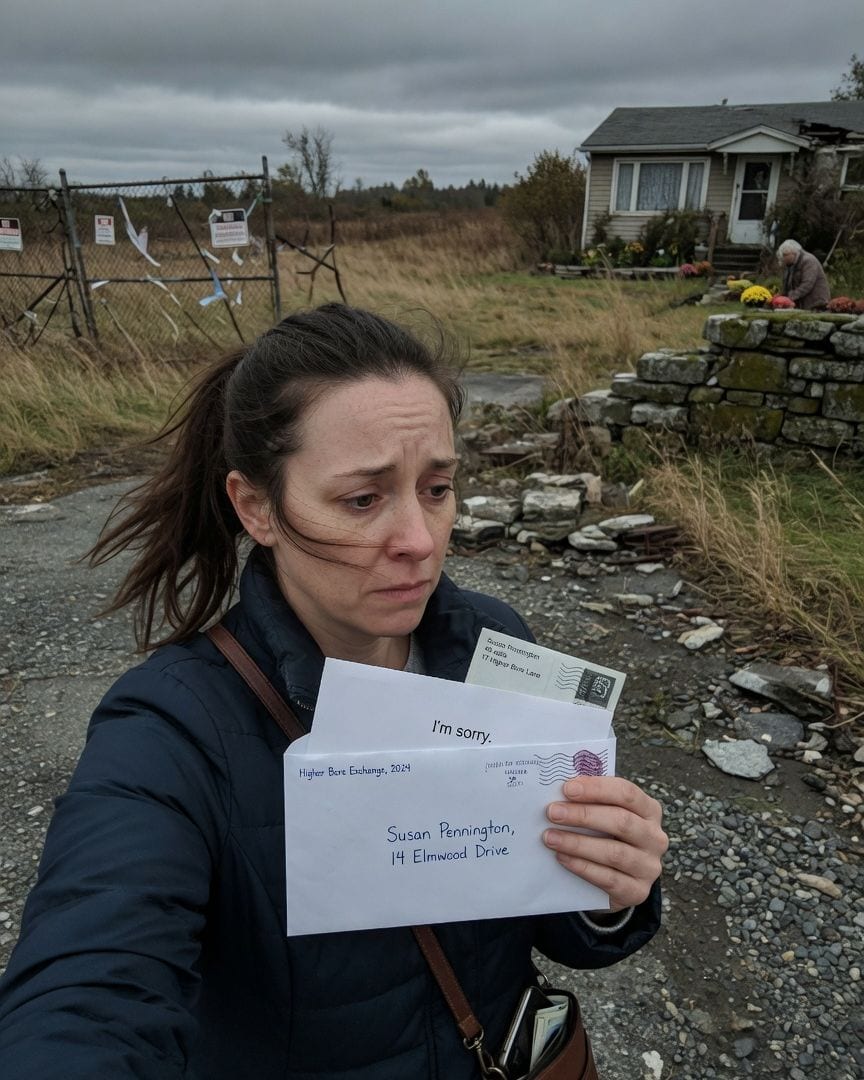
My phone bill listed forty calls made at 3:14 AM to a house demolished in 1990. The paper bill came from a flattened building. My name is on it.
I stared at my phone bill, my morning coffee forgotten. It detailed forty calls, each at 3:14 AM, to an address I knew was a vacant lot where a house had stood decades ago. But the real dread began when I saw the bill's return address: a telephone exchange flattened years before.

My taxi driver knew my name before I spoke, then apologized for the flight I was going to miss. I was arriving. The cab's plate was scrapped four years ago.
After a strange taxi ride, I received an unsettling birthday card addressed to me. Its return address listed 'Old Mill Road Field,' an empty lot where a mill once stood, and it was postmarked locally. The card arrived four months before my actual birthday, sparking a cold dread I couldn't ignore.
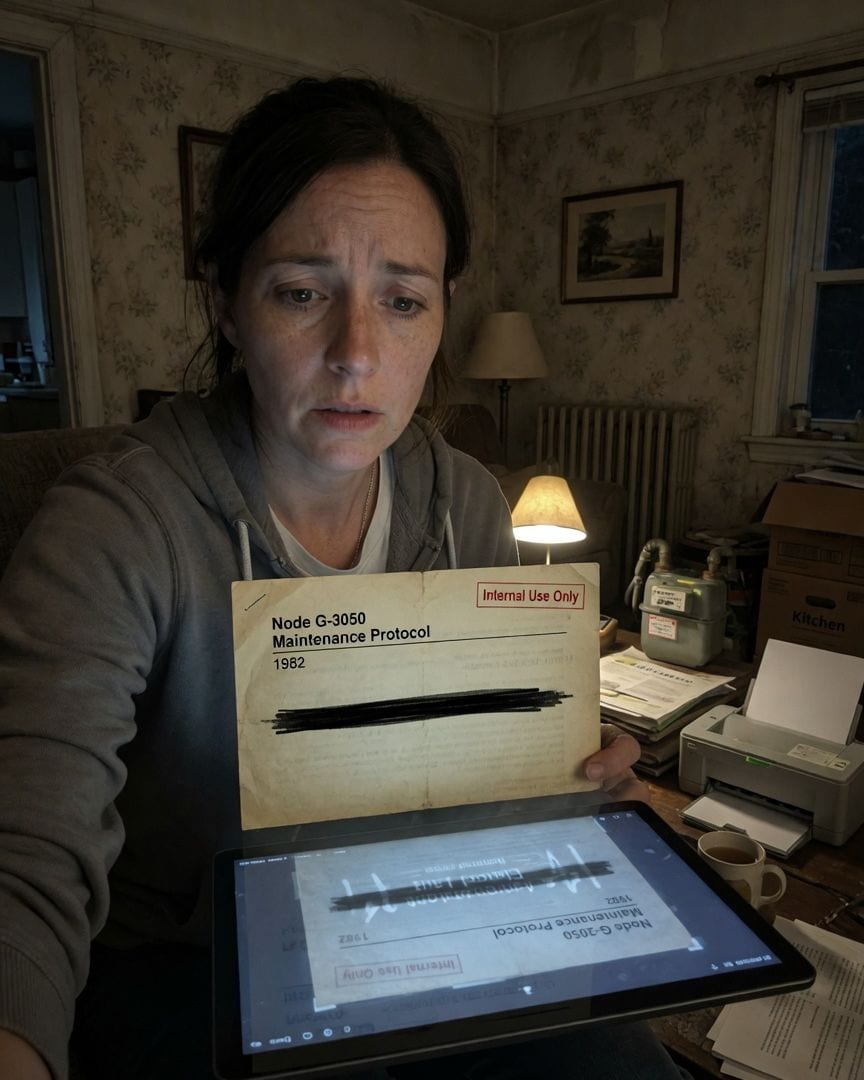
A different tenant every decade since 1949, each one gone — yet our gas meter's final reading comes back identical every time, though the house sat empty in between.
My new house at 14 Elmwood Lane was meant to be a fresh start, a normal home. But the gas bill was wrong. It showed my account, G-3050, active since 1949, with a meter reading of 3050 that had never changed, even when the house stood empty for decades.
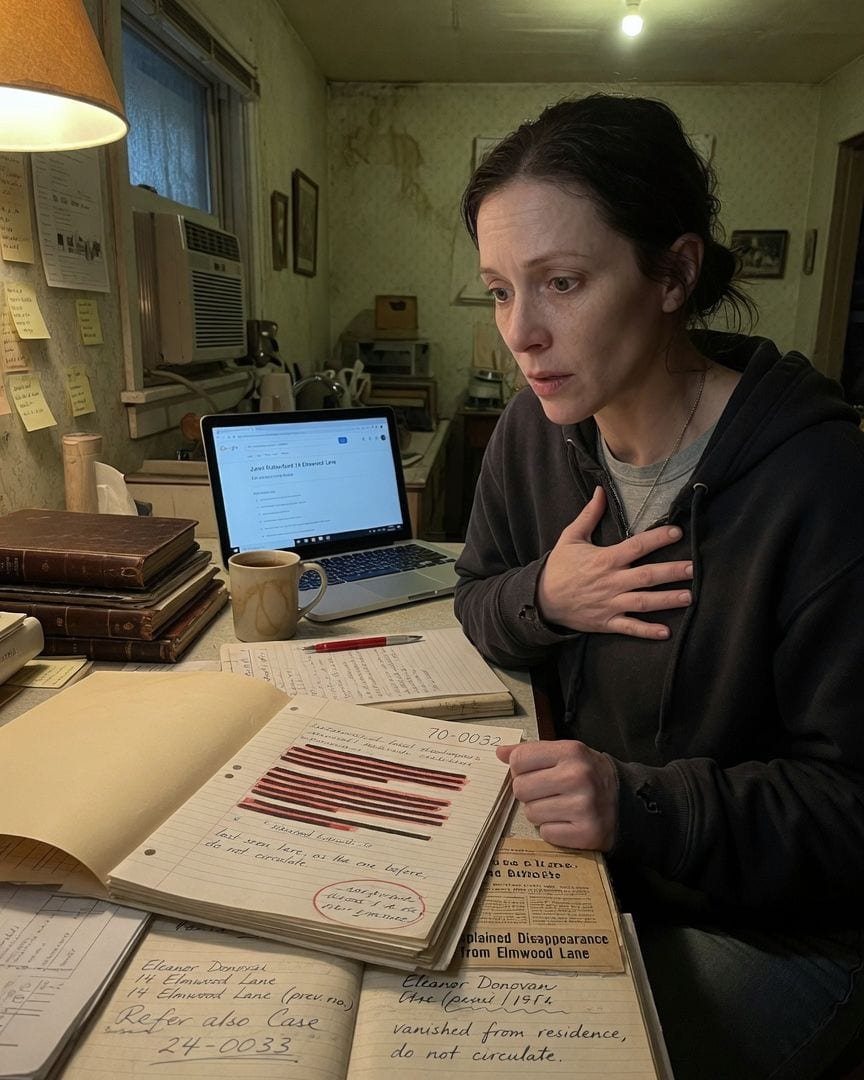
My own address is on a missing person's file from 1970. The blacked-out line names my street. She never lived here.
When my neighbor vanished, I started digging into old local missing persons cases. In a police file for a woman who disappeared in 1970, I found my own address, 14 Elmwood Lane, framing a blacked-out section of the duty log. Janet Rutherford never lived here, and the file contained a chilling handwritten note: 'do not circulate.'
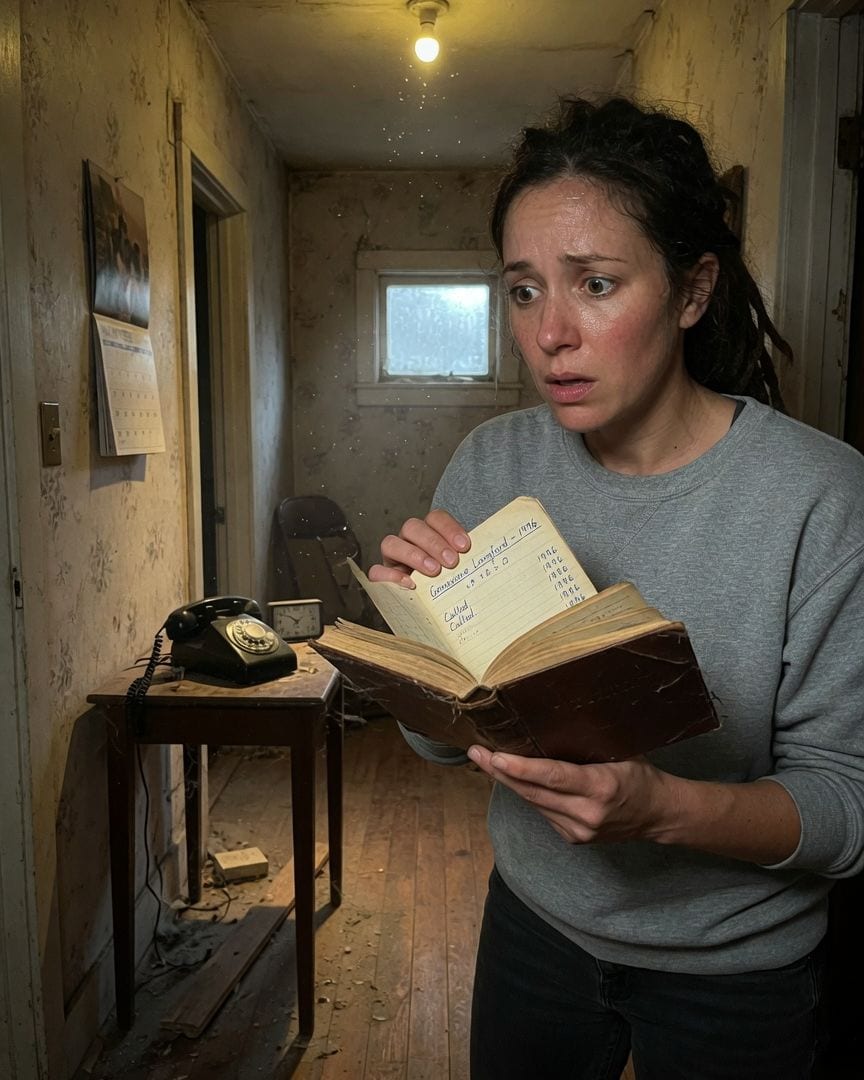
My dead rotary phone rings at 8:05 every night. I pick it up. A room full of voices, then a woman drawing breath.
I inherited an old house, complete with a black rotary phone that the company confirmed was disconnected in 1996. Yet, most evenings at 8:05 PM, it rings. When I pick up, a distant murmur fills the line, followed by a woman drawing a deep, shuddering breath every single time.
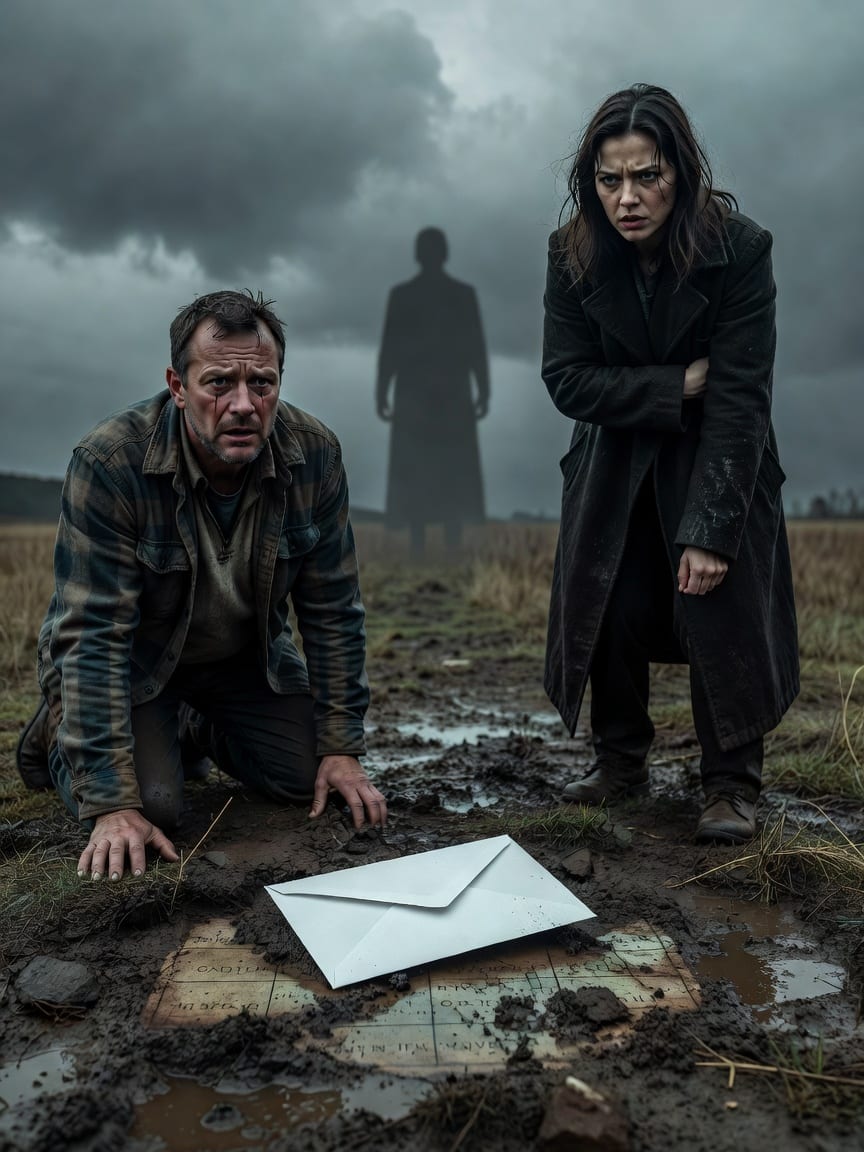
My mail carrier delivers polling cards to Nine Acre Field. It floods, they say. The tithe map shows nine family plots there.
As the new county archivist, I was used to quiet days poring over dusty records. But then I found an empty field, Nine Acre, was receiving current-year polling cards and utility notices for nine distinct addresses. When I investigated, I unearthed a perfectly crisp, current-year tax bill, buried in its soil, surprisingly warm against my fingers.