A 1963 obituary for a vanished 7-year-old girl lists *my Fenwick address* as her last known home.
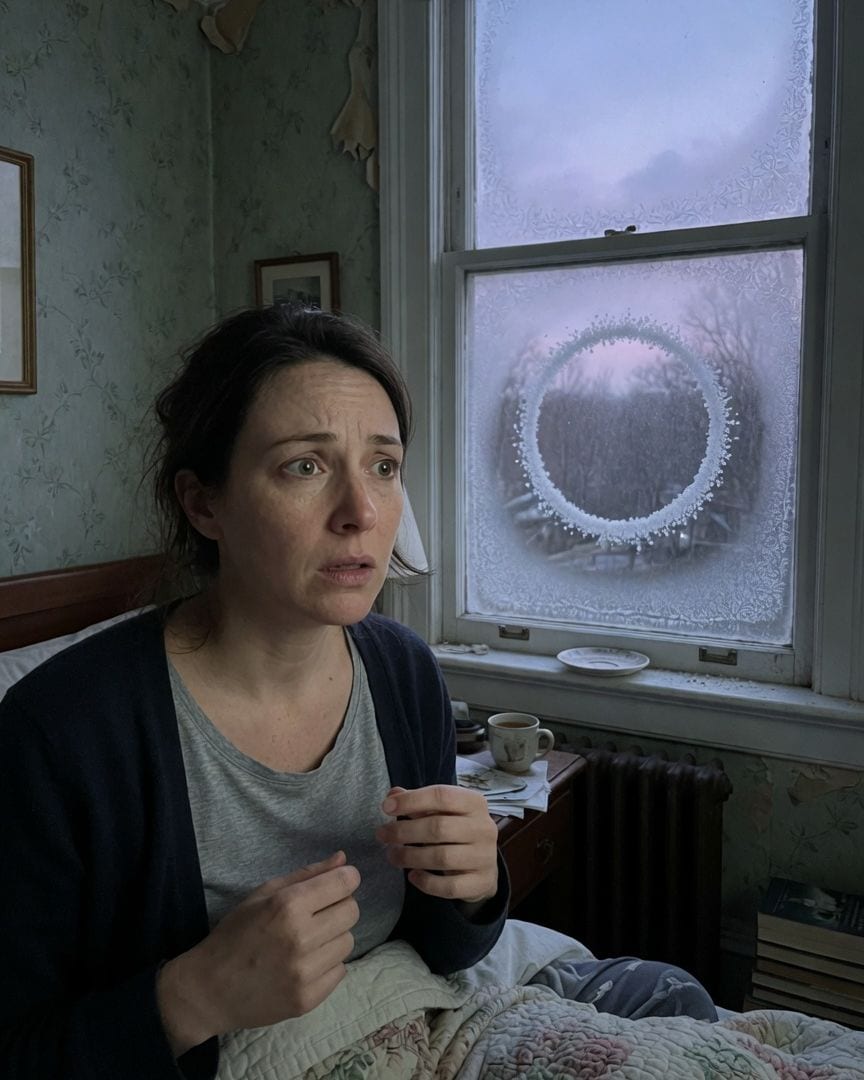
"They said it was ‘quaint.’ That’s the word they always use for Fenwick’s peculiar habits. 'Oh, it’s just a quaint old town, Lydia, with its quaint little ways.' The salt saucer was one of them.
'First frost of the year, darlin’,' Mrs. Albright had chirped, 'you put a saucer of salt on your sill. Keeps the house safe.'
I’d smiled, nodded, and promptly forgotten about it until the chill in the air bit harder than usual, a real bite this time.
Last Tuesday, November 7th. The sky was the color of bruised plums, and the air had that sharp, clean smell of impending winter. I’d remembered the salt then, a half-hearted gesture, really.
A white ceramic saucer from the kitchen, heaped with coarse sea salt, placed on the inside ledge of my bedroom window. Four floors up. No one would even see it. Just another quaint Fenwick eccentricity I could privately scoff at.
I woke up the next morning to a light that felt… sharper. Colder. The first frost had arrived, painting the world outside in silver. But it wasn't the frost that made me sit bolt upright. The saucer was gone.
Not knocked over, not even shifted. Simply gone from the sill. I checked the floor, under the radiator, even the bed. Nothing.
Then I saw it. On the outside of the glass, a perfect, unbroken circle of coarse white salt. Not just a smudge, but a distinct ring, like someone had carefully drawn it with a compass.
My bedroom window is on the fourth floor of this old house. There’s no fire escape, no ledge wide enough for a squirrel, certainly no ladder anywhere near it. The glass itself was pristine, untouched.
I pressed my palm against it. Cold. Unnaturally cold, even for a frost.
A prank? Who? How? The impossibility of it gnawed at me, a cold, specific dread settling in my stomach. There was no way to put it there. No way at all.
I spent the rest of that morning trying to force logic onto the impossible. Maybe the wind? But the ring was too perfect, too adhered. A suction cup trick? Who would bother, and how?
Every explanation I conjured dissolved under the weight of the facts.
I called Mrs. Albright, then drove over to the Millers, the couple next door. Their house was identical to mine, old and drafty. 'The salt saucer,' I started, feeling a little foolish.
'Mine… well, it vanished, and a salt ring appeared outside my window.'
Mrs. Miller, a woman usually overflowing with gossip, just looked at her husband, Mr. Miller, who was whittling something on their porch. He cleared his throat. 'Just what you do, Lydia,' he said, not looking up. 'Keep the salt out.
Good for the house.'
'But it's gone,' I insisted. 'And the ring—'
Mrs. Miller cut in, her voice unnaturally bright. 'Oh, you worry too much, dear. Probably a gust. You know Fenwick can get quite breezy. Our saucers are still full, see?'
She gestured to a small ceramic dish on their own sill, brimming with white salt. The conversation was over. They exchanged a look I couldn't decipher, a quick, almost imperceptible flick of the eyes. Evasion.
That evening, a restless energy pushed me out of the house. I found myself at the Fenwick public library, a small brick building that smelled of old paper and dust.
I told the librarian I was researching local history, a plausible excuse. She pointed me to the microfiche reader.
Scrolling through decades of the Fenwick Chronicle, I started with the 'Local News' section for November. It was tedious, blurry work. But then, a flicker. November 14, 1903: Local Farmhand Vanishes After First Frost. No further details, no body, no explanation.
I scrolled, faster now, a cold thread beginning to weave itself through the mundane headlines of bake sales and town council meetings. November 10, 1963: Young Girl Reported Missing from Fenwick Home. Same vague language: 'unexplained,' 'no foul play suspected,' 'last seen after the first frost.'
And again, no resolution.
The articles were remarkably quiet, hushed. As if the disappearances were a normal, if regrettable, part of the Fenwick calendar. Decades apart, yes, but always clustered around early November. Always 'after the first frost.'
I felt a prickle on my skin, the kind you get when you step into a cold pocket of air indoors. A pattern was forming, chillingly distinct, even if I couldn't name it yet.
I kept digging, scanning through the blurry microfiche until my eyes ached. Then I found it. A yellowed, brittle clipping, tucked away in the November 1963 reel. Not a news article, but an obituary, small and stark.
Eleanor Granger, age 7. Beloved daughter. Last seen November 12, 1963. Unexplained disappearance.
My breath hitched. November 12, 1963. 'Last seen after the first frost.' The words seemed to hum, a cold, quiet note in the dusty archive. But it was the address that truly froze me. 14 Elm Street. My address.
The old Fenwick house I was renting.
My finger traced the date on the yellowed obituary: November 12, 1963. Eleanor Granger. The address listed was hers. 'Last seen after the first frost.' The words seemed to hum, a cold, quiet note in the dusty archive.
Eleanor Granger. Seven years old. My house. The name and the address burrowed into my mind like splinters. I couldn't shake it.
Sleep became a series of fitful, cold naps, haunted by the image of that salt ring on my window.
For days, I was back at the Fenwick library, a creature of the microfiche glow. I expanded my search, not just 'missing persons,' but 'unexplained absence,' 'moved suddenly,' 'house abandoned.' I started cross-referencing street addresses, mapping out the incidents.
The pattern, once a whisper, began to shout.
Every sixty years, almost to the day, a major 'absence' occurred. 1903, 1963, and then… a gap. I pulled up property records, old town ledgers. My house, 14 Elm Street, seemed to be a recurring point on this horrifying map.
Not always the victim's address, but frequently near it, or mentioned in the peripheral chatter of the day. And always, always, the reports were tied to the period 'after the first frost.'
Always, too, there was some vague mention of a 'neglected home' or a 'broken tradition' in the surrounding local chatter, though never explicitly connected to the disappearances in the official papers. The more I looked, the more certain it became.
That salt saucer, Mrs. Albright’s 'quaint' tradition, was a shield. And mine had been broken.
Between these sixty-year spikes, there were other mentions, quieter ones. Odd sounds. Things moving on their own. Shadows glimpsed at windows, high up, where no one could be. They were dismissed as local superstition, 'winter jitters,' or 'old house creaks.'
But when I plotted them, too, they formed a network, denser around the 'major claim' houses, like mine. The entire town seemed riddled with these subtle, creeping wrongnesses.
I had always prided myself on my rationality, on my ability to find the logical explanation. My old life in the city, my job as an archivist, it was all about order, about making sense of the chaos.
But here, in Fenwick, the ordinary explanations for each individual case—'ran away,' 'accident,' 'moved suddenly'—they crumbled. They couldn't stand against the weight of the collective, cyclical evidence. A child vanishes in 1903. Another in 1963. Always around the first frost.
Always in Fenwick. Always with the ghost of a broken 'tradition' hovering nearby. And now, a salt ring on my window, four floors up.
My intense research did not go unnoticed. The Fenwick library was a small place, and I was clearly spending too much time hunched over the microfiche reader, surrounded by stacks of yellowed newspapers.
I'd started to notice an old man, Samuel Hughes, the one who occasionally sold crabs down at the docks, lingering near the local history section.
His hair was wispy white, his skin like old parchment, and his eyes… his eyes, ancient and knowing, tracked my movements. He never spoke, just watched. The skin on my neck would prickle.
One afternoon, as I was packing my notes, my laptop open to my mapping grid, Samuel 'accidentally' bumped into my table. My papers scattered. He bent, slowly, to help me gather them, his hand brushing mine.
His skin felt like cold stone. He held my gaze a moment too long, a quiet intensity in his eyes that went beyond mere apology.
'Some things,' he said, his voice a low, gravelly murmur, 'are best left undisturbed, city girl. Fenwick has its ways. It's for the best.' He didn't offer to explain what ways, or why it was for the best.
He simply straightened up, turned, and shuffled away, his heavy boots echoing faintly on the linoleum, leaving me with a prickling sense of being watched, and a clear, unsettling warning.
My blood ran cold, not from the library's draft, but from his quiet certainty.
I gathered my things, the map on my laptop screen suddenly starker, more menacing. That night, back in my house, the unsettling feeling grew.
I was in bed, trying to read, when I felt a distinct coldness near my bedroom window, even with it tightly shut.
It wasn't just the outside frost; it was a specific, localized chill, like someone was breathing ice against the glass from the outside. I pulled the blanket higher.
Then, a faint, almost imperceptible scraping sound. Skhh-skhh. It wasn't the wind. It was too regular, too deliberate. It was coming from the outside glass, four floors up.
The sound wasn't loud enough to wake Megan, my niece, who was sleeping peacefully in the next room, but it was loud enough for me. My heart hammered against my ribs. I lay there, rigid, until the sound simply… stopped.
I couldn’t let it go. Not after the scraping. Not after the cold. The next morning, I staked out the general store, waiting for Samuel Hughes. He came out with a small bag of groceries, his usual slow, deliberate pace.
'Mr. Hughes,' I said, stepping in front of him. He stopped, his ancient eyes fixed on me, devoid of surprise. He'd been expecting me. 'We need to talk. About Fenwick's ways. About the salt.'
He sighed, a long, weary sound. 'I told you, city girl. Best left alone.'
'No,' I countered, my voice tight. 'Best understood. I know about the disappearances. About Eleanor Granger. November 1963. My house. I know about the pattern, the sixty-year cycle, the 'first frost' disappearances. I know the town covers it up.
What is it, Mr. Hughes? What is the salt for?'
He looked around, as if checking for eavesdroppers, though the street was empty. His gaze settled on my window, four floors up, then back to me. 'The salt saucer,' he began, his voice barely a whisper, 'it ain't just quaint.
It's a ward. Been here generations. Against… the Claimer.'
My blood ran cold. 'The Claimer?'
'It comes with the first frost,' he said, his eyes distant, seeing something far beyond the quiet Fenwick street. 'Always has. If the ward ain't kept, if the salt is broken or ain't enough… it marks its target.
That ring on your window, city girl. That's its mark. Its selection.'
The salt ring. The perfect, impossible salt ring. It all clicked into place, brutally, terrifyingly. My broken ward. My window.
'So the disappearances…' I trailed off, hardly daring to voice it.
He nodded, a slow, grim movement. 'The Claims. It takes one. Always has. The town… we learned to live with it. To manage it. To keep the peace. Better one, than… than what could be.'
His voice was flat, devoid of emotion, like he was reciting an ancient, terrible truth. 'We keep it quiet. Always have. For generations. The newspapers, the official reports, they just say 'unexplained.' It's how it's always been done.
To keep the outside world from knowing. To keep the cycle going.'
'A cycle?' I pressed, my mind reeling. 'What kind of cycle? Why? What does it want?'
'It seeks something specific,' Samuel explained, his voice growing fainter. 'Not just any victim. There's a… a need. A balance. The salt, it’s a small tithe.
A way to tell it: not here. Not this one. Not yet. When the tithe is broken, it claims what it believes it's owed. And it remembers where it's taken before. It remembers the blood.'
The last words were almost lost in the wind, but they hit me with the force of a physical blow.
Replacing? Remembers the blood? My heart pounded against my ribs. 'Why my house, Samuel? Why Eleanor Granger? Was she… a replacement?'
Samuel hesitated, his gaze unfocused, as if seeing beyond me, into the past. His eyes, already ancient, seemed to darken further, the pupils dilating.
'It's not just taking,' he whispered, leaning closer, his breath smelling of stale tobacco and something else, something earthy and old. 'It's replacing. The Claimer… it remembers the blood.'
He reached into the pocket of his worn coat and pulled out a small, leather-bound book, its cover cracked and faded with age. A family ledger, he told me, passed down through his own family in Fenwick for generations.
He opened it carefully to a page where a brittle, sepia-toned photograph was tucked. It was a family portrait from the early 1900s, perhaps a wedding. But what stopped me cold was the background. It was my living room.
The fireplace, the exact angle of the window, the ornate molding on the ceiling. Unmistakable.
He pointed a trembling finger at a young child in the portrait, a girl, no older than seven, standing stiffly in a white lace dress. Her eyes were wide, innocent. And above her left eyebrow, a tiny, distinctive birthmark.
Before I could ask, he reached into my open bag, without asking permission, and pulled out my phone.
He scrolled through my gallery, quick and efficient, until he found a recent picture of Megan, my niece, playing in the Fenwick yard, a smudge of dirt on her cheek, her bright eyes laughing up at the camera.
He placed my phone next to the old photograph.
The child in the century-old portrait, with the same wide, innocent eyes and that tiny, distinctive birthmark above her left eyebrow, was an unnervingly perfect likeness of Megan.
Samuel's voice dropped to a whisper, pointing a trembling finger first at the faded photograph of the child from 1903, then at Lydia’s phone, open to a recent picture of Megan. 'The blood remembers,' he rasped. 'And the Claimer...
it remembers the blood.'
The blood remembers. And the Claimer… it remembers the blood. Samuel's words echoed in my ears, bouncing off the walls of my skull, shattering every last shard of my rationality.
The little girl in the faded, sepia photograph, her face so startlingly like Megan's, staring out from a century ago, from my very own living room. The tiny birthmark. It wasn't coincidence. It wasn't a trick of the light.
Megan. My niece.
The uncanny resemblance detonated in my mind, a cold, silent explosion. The Claimer wasn't just a monster that took randomly. It was an entity tied to specific bloodlines, to specific losses, to a past 'Claim' that needed to be 'replaced.'
Eleanor Granger, the child from 1963, wasn't just a casualty; she must have been another such 'replacement,' a vessel for an even older loss. Her disappearance had been a second cycle, a dark echo.
And now, my broken salt ward, that casual, unthinking dismissal of a 'quaint' tradition, combined with Megan's unwitting presence in this house, her genetic link to a child previously 'Claimed' from these very walls… it had marked her.
The salt ring, an icy embrace on my window, was not for me. It was for Megan. It was because of Megan.
The Claimer was seeking to 'reclaim' what it lost, or what it believed was owed, through a familiar vessel. All of it clicked into place with a horrifying, sickening coherence. The specific dates, decades apart, always around the first frost.
The quiet disappearances, hushed away by the town. The town’s secretive management, its carefully maintained 'peace.' The salt ring, not a random act, but a mark. And now, the terrifying, undeniable pattern of lineage.
Outside Samuel’s shop, the air was brutal. The first frost had intensified into a deep, pervasive freeze. The wind howled, a low, mournful sound, rattling the windows. This wasn't just winter; it felt like the very air was alive, waiting.
This was the Claimer's time. And it had found its target.
Panic clawed at me, cold and sharp. My rational mind, shattered, finally gave way to primal terror. Megan. I had to get Megan out. Now.
I rushed back to the house, heart pounding. Megan, blissfully unaware, was drawing at the kitchen table, humming to herself. 'Megan, honey, we need to go,' I said, trying to keep my voice even, failing. 'We're going on an adventure.'
She looked up, her innocent eyes wide. 'Now? It's snowing.'
I grabbed my keys, pulling on my coat. The temperature in the house felt like it was dropping, even with the heating on full blast. Outside, the world was a canvas of pristine, unbroken white.
Snow covered the driveway, the street, piled against the windows.
I slid into the driver's seat of my old sedan, turned the key. The engine coughed once, weakly, then died. I tried again. Nothing. Just a strangled groan from beneath the hood.
The cold seeped into the car, wrapping around me like a shroud. I got out, walked to the hood, lifted it. It was frozen solid. The roads, usually plowed by now, were strangely quiet, untouched. Impassable.
Fenwick was locked down, isolated by an impossible blizzard.
The cold outside felt impossibly deep, a living presence, pressing in on the house. Escape was impossible. The Claimer was already here, drawn by my broken ward, by Megan's presence, by the blood it remembered.
Megan, meanwhile, had gone back to her drawing. I glanced over her shoulder. She was sketching a tall, impossibly thin shadow figure, its head cocked, standing outside a window. The window was high up. Like mine.
The figure had a single, knowing eye.
I knew then what I had to do. The salt had been a tithe. A ward. My initial offering had been inadequate, carelessly given. But I had something else. Something personal. Something irreplaceable.
I went to my bedroom, to the tarnished silver locket my mother had worn, the one she’d given me before she passed.
It wasn't just jewelry; it was a link, a memory, a piece of my own history, my own bl**d. My hands trembled as I took it from its velvet box.
I found a clean, empty saucer, filled it with fresh salt, and placed it on the inside of my bedroom windowsill, just as Mrs. Albright had said. Then, with trembling hands, I laid the locket gently on the salt.
It wasn’t a full ward, I knew. But it was a profound, personal sacrifice, an attempt to divert the Claimer, to offer something else of value, something of myself, to protect Megan.
The house creaked, a sound like old bones shifting. Then, from outside my window, four floors up, I heard it again. A faint, almost silent scraping sound. Skhh-skhh. It moved across the glass, then downward.
And then, a soft, almost imperceptible thud on the frozen ground below.
Megan slept soundly in the next room, dreaming her innocent, untroubled dreams.
The next morning, the blizzard was gone. The world was still white, but the sky was clear, a startling blue. I went to the car, half-expecting it to remain dead.
But the engine coughed, then turned over, a strong, reassuring rumble.
I packed our bags in a blur, my movements automatic. Megan, quiet and subdued, followed me without protest. We left Fenwick that morning without a word to anyone. No goodbyes to the Millers, no explanation to Mrs. Albright.
The town seemed to hold its breath as we drove away, a silent, watchful presence in my rearview mirror. I never looked back.
I carried the knowledge with me, a chilling, coherent understanding of the pattern, and the profound, silent cost of my sacrifice. The locket was gone. Vanished from the salt saucer.
Once, months later, I tried to tell my sister what had happened. My words came out disjointed, a jumble of salt rings and old photographs, bloodlines and silent disappearances.
It sounded like madness, unraveling into an impossible tale no one believes. She looked at me with pity. I never mentioned Fenwick again.
Lydia and Megan live in the city now, far from Fenwick. The tall buildings loom, impersonal and safe. I keep a small, rough-hewn wooden saucer on my windowsill, always empty, even in summer.
A ritual without purpose, a ghost of a ward. I never talk about Fenwick, not really. What is there to say that wouldn’t sound like the rambling of a broken mind?
Megan lives with me permanently now. My sister, sensing something had shifted in me, agreed it was for the best. Sometimes, Megan draws.
And sometimes, her drawings are of a tall, thin shadow figure, standing outside windows, even windows on high floors, a single, knowing eye peering in.
The figures in her drawings often wear a tiny, intricately detailed silver locket around their necks, nestled against their shadowy chests.
And I, living on the twelfth floor of a high-rise, occasionally find small, perfectly smooth stones on my windowsill. Black, gray, white. No dust, no dirt. Just there.
Lydia never returned to Fenwick. The small, peculiar wooden saucer on her city windowsill was always empty, but the window itself was always perfectly clean, even after a storm.
If this one got to you
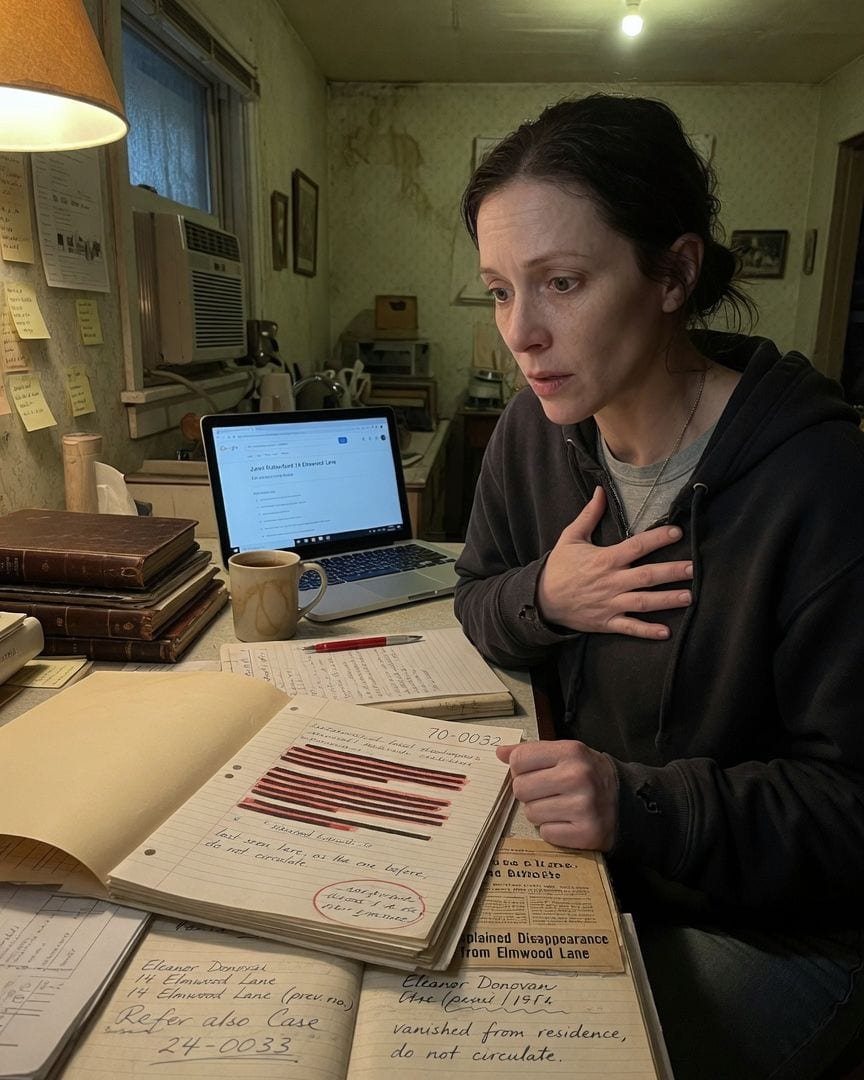
My own address is on a missing person's file from 1970. The blacked-out line names my street. She never lived here.
When my neighbor vanished, I started digging into old local missing persons cases. In a police file for a woman who disappeared in 1970, I found my own address, 14 Elmwood Lane, framing a blacked-out section of the duty log. Janet Rutherford never lived here, and the file contained a chilling handwritten note: 'do not circulate.'
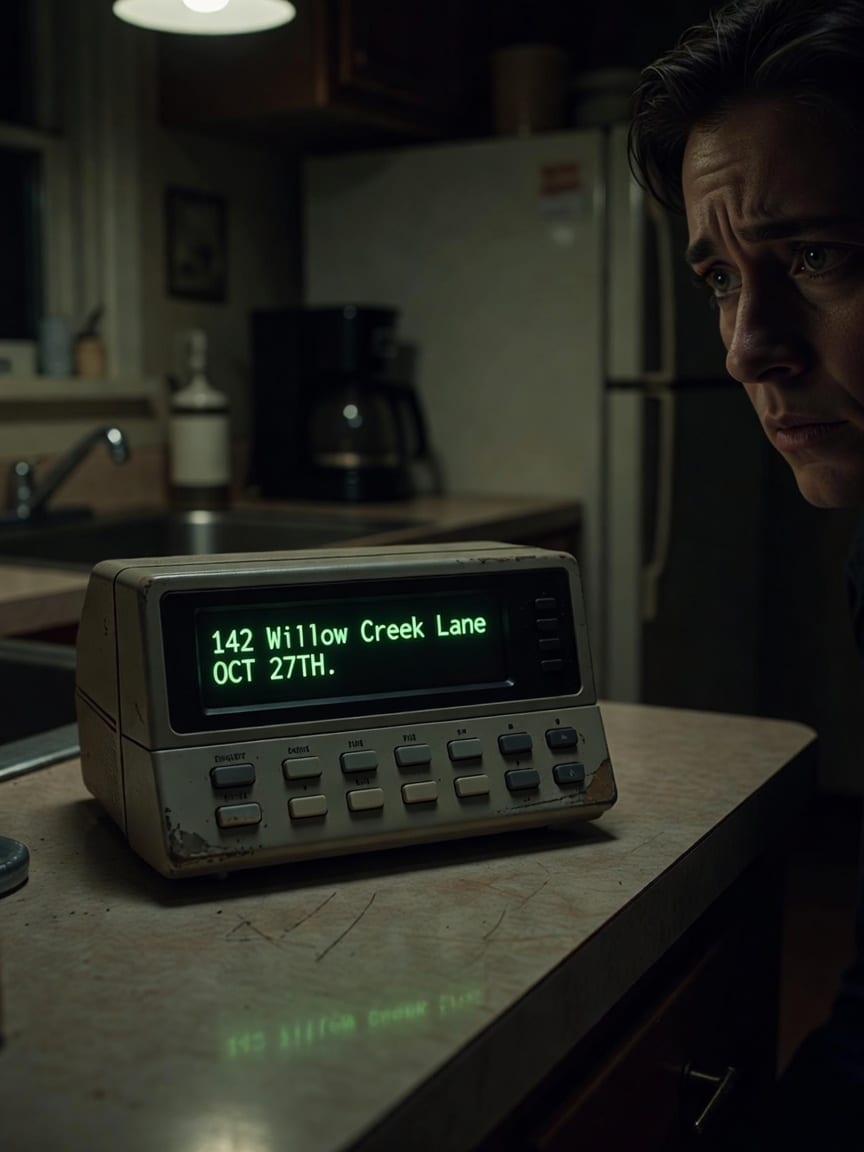
My radio scanner picked up a channel at 2 AM reading local addresses. Mine was on it, dated tomorrow.
I was tracking a storm on my old weather radio when a synthesized voice cut through the static. It began reading local street addresses, then my own: 142 Willow Creek Lane. But the date it gave for my address was tomorrow.
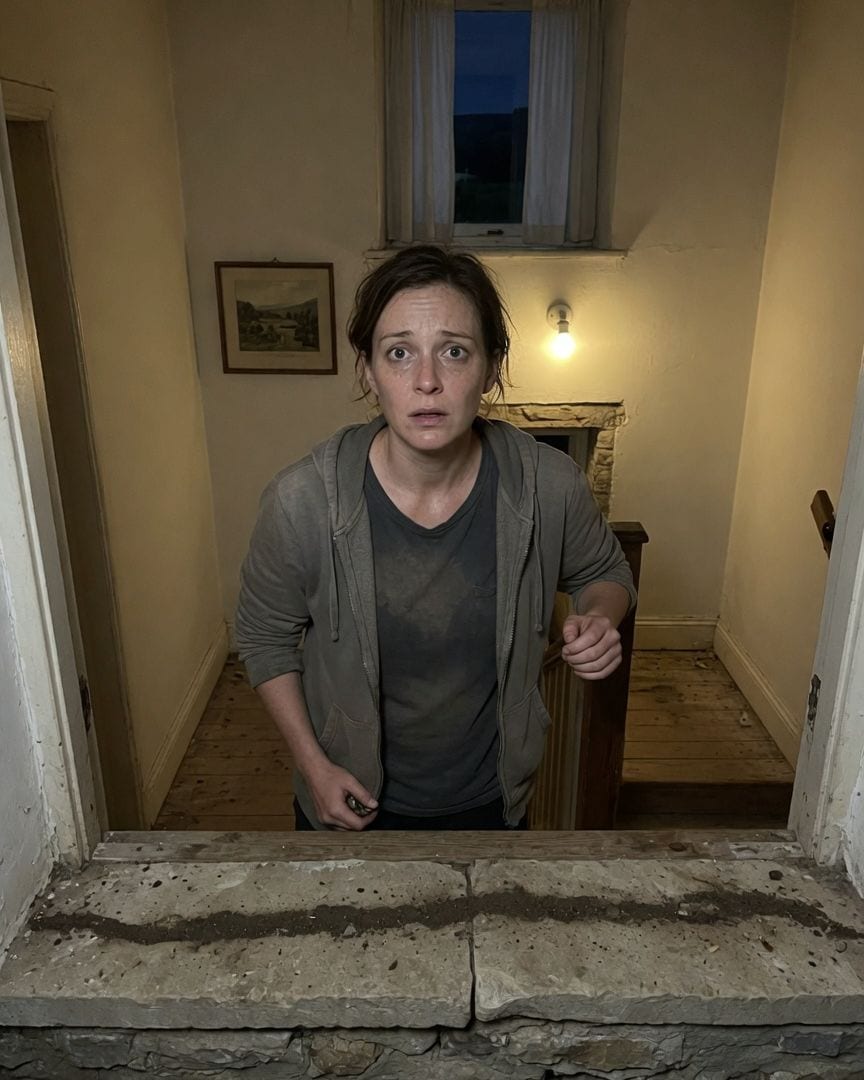
Water moved under my house at 3am, leaving a six-inch silt line. The river's two miles off.
New to my inherited valley house, I was just exhausted. Then, at 3 AM, a powerful current rushed *under* my house, vibrating through the floorboards. By morning, a precise six-inch tideline of dark silt marked my foundation, but no flood had occurred, and my pipes were dry.
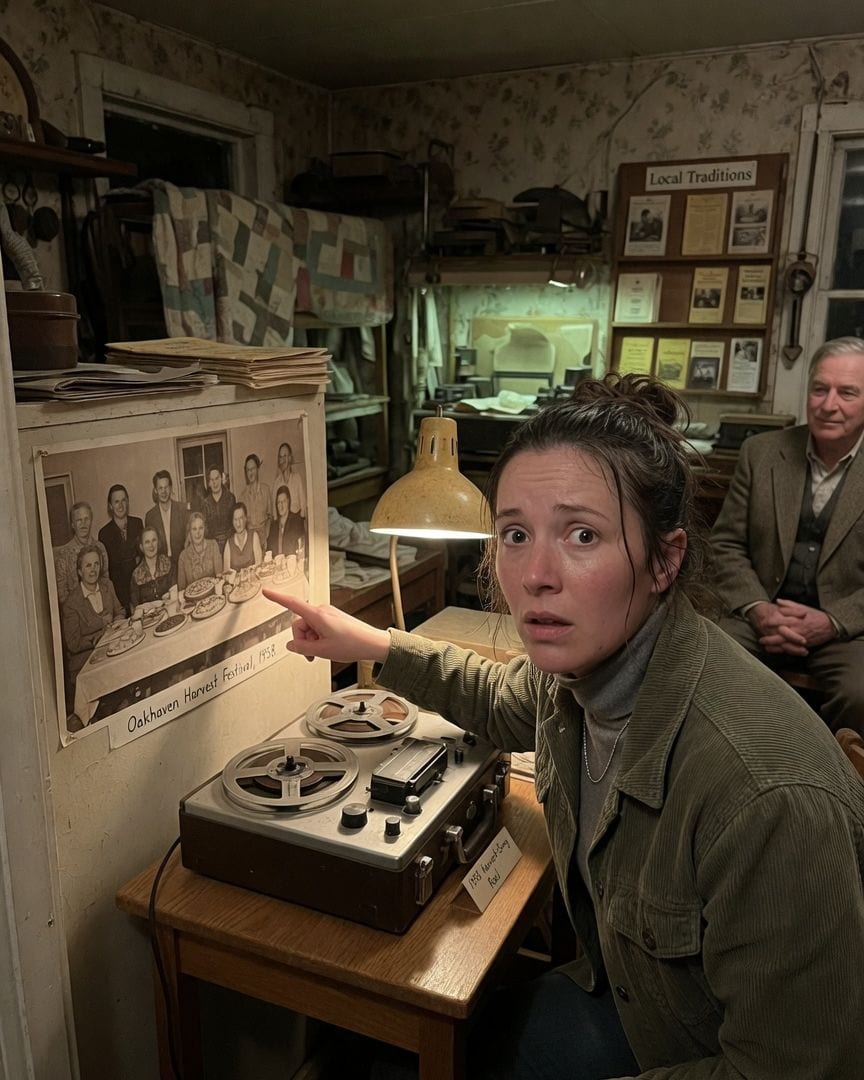
The folk museum's harvest tape counts one more singer than the photograph shows. The curator turned the recorder off before playing it.
I found a quiet escape at Oakhaven's dusty Folk Museum, where the curator played a rare 1958 harvest song. But as a cheerful tune filled the room, a low voice began to count. The tape tallied thirteen, yet the old photograph beside it showed only twelve smiling villagers.

My name was on a package lodged in 1974. I wasn't born until 1985. Inside was a key and a note: 'You know which door. Not yet.'
I'm Elena Radcliffe, 38, and a solicitor's letter just arrived for me about a package. The firm's records state it was lodged in 1974, years before I was born. Now I've found an old newspaper article reporting a woman with my exact name vanished that very year.
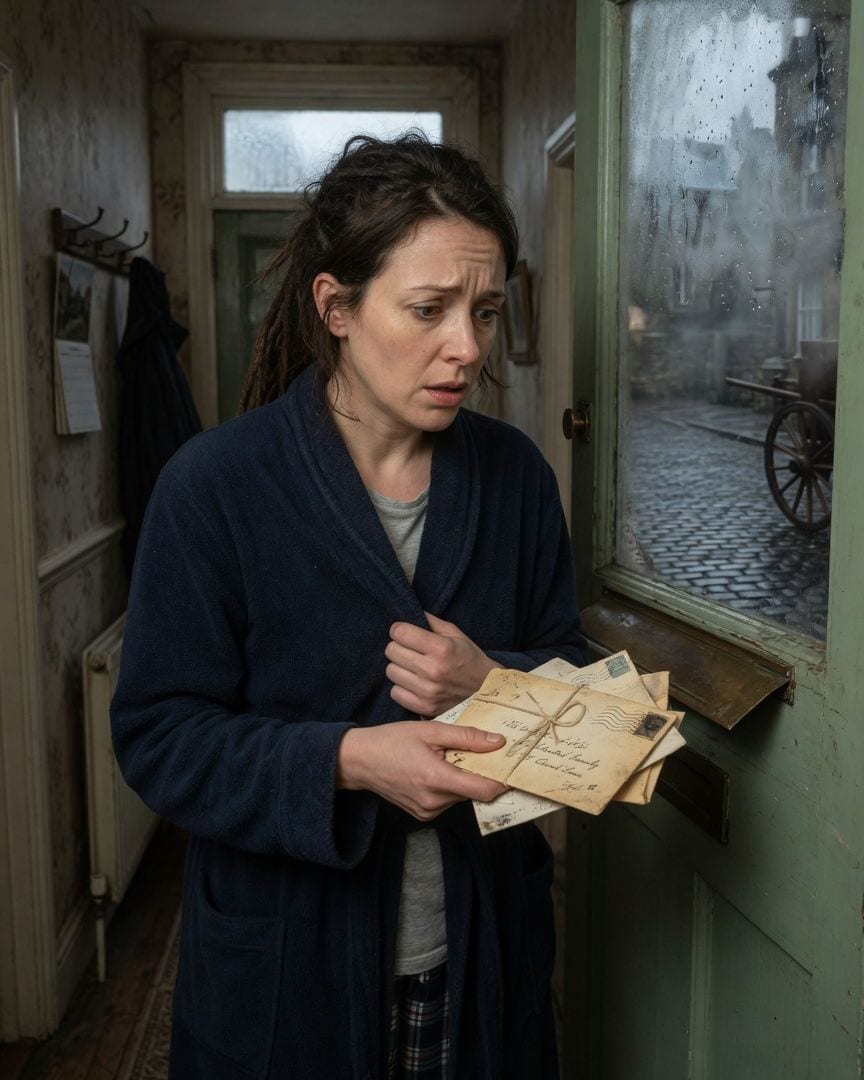
Seventy years ago, a hidden journal recorded my door opening to the wrong street and receiving Lockwood post.
I'd only recently moved into my inherited house, a quiet place on the edge of town. One grey morning, a distinct clatter from the front door's post flap caught my attention. Reaching down, I expected my gravel path, but instead, the flap showed a dark, cobbled street that wasn't mine. A bundle of warm, old letters, addressed to 'The Lockwood Family,' slid through, before the vision flickered and was gone.