The folk museum's harvest tape counts one more singer than the photograph shows. The curator turned the recorder off before playing it.
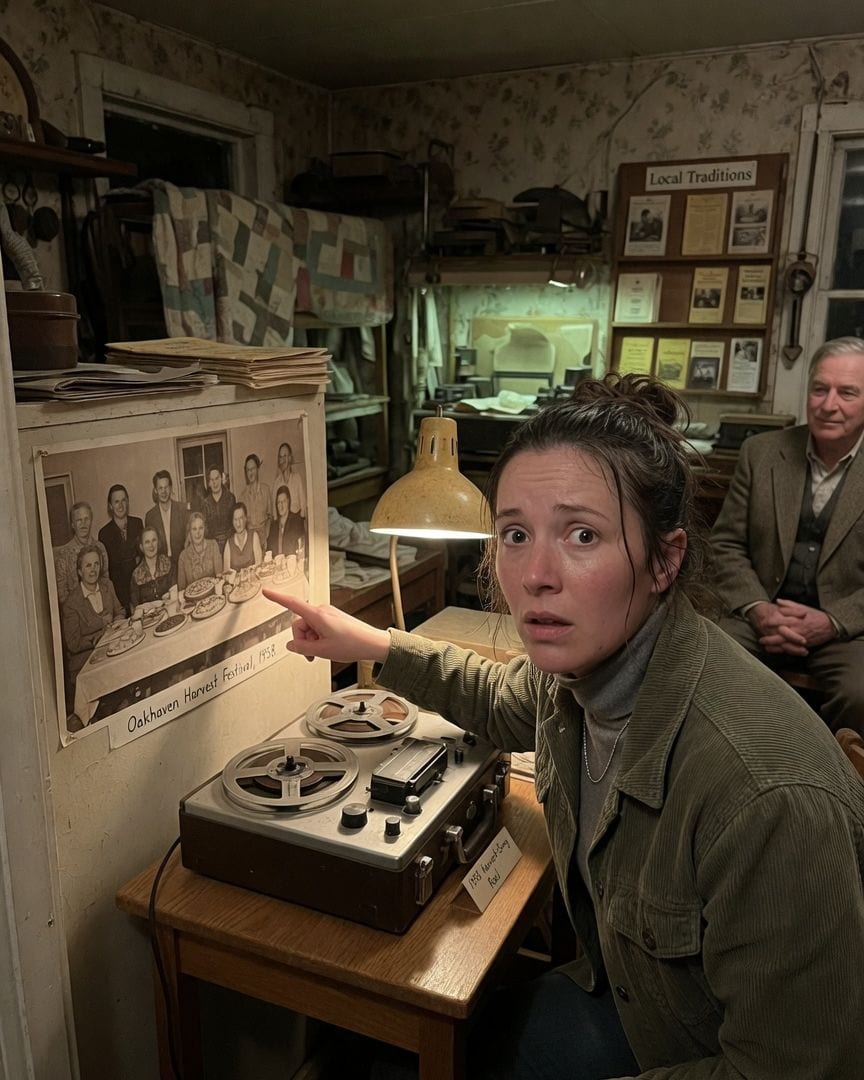
The Oakhaven Folk Museum was a quaint, dusty place, smelling of old paper and beeswax. I’d only been in Oakhaven a few months, having moved for a job I already regretted, and the museum offered a quiet escape.
William Easton, the curator, was a man in his late sixties, with a neat tweed jacket and a smile that seemed permanently serene, almost unnerving in its unwavering calm. He greeted me like an old friend, despite our brief acquaintance.
“You’re just in time,” he said, his voice soft, gesturing towards a reel-to-reel tape recorder on a small oak table. “I was about to play a rare find. A 1958 harvest-song reel. From a local family’s collection.”
He threaded the tape with practiced ease. As his fingers moved, almost imperceptibly, he flicked a small switch on the side of the machine. The soft whirring sound of the mechanisms died.
Then, just as quickly, it clicked back on, and he pressed ‘Play.’ My eyes drifted to a faded, sepia-toned photograph on the wall beside the recorder.
It showed a dozen smiling faces, villagers gathered around a laden table for a harvest supper, dated simply: 'Oakhaven Harvest Festival, 1958.'
The reel began to turn, and a cheerful, slightly tinny folk song filled the small room, accompanied by a lone fiddle and a banjo. It sounded authentic, innocent. But beneath the music, faint yet distinct, a rhythmic, low voice began.
It was like a soft murmur, an almost meditative chant, counting. 'One… Two… Three…'
I found myself counting the faces in the photograph. I pointed. One, two, three… there were twelve people in total, smiling out from the past. The voice on the tape continued its quiet tally, unaffected by the singing.
'…Eleven… Twelve… Thirteen.'
My breath hitched. Thirteen. I looked at the photograph again, then back at the tape player, then at William. His serene smile hadn't wavered. He was watching me.
"Just an old recording anomaly," he said smoothly, as if reading my thoughts. "Sometimes the microphone picks up background chatter, or perhaps the tape was reused. It's common with older recordings."
I nodded, trying to accept it, but the number thirteen kept echoing in my head. It refused to settle, a small, cold pebble in the otherwise pleasant quiet of the museum.
The 'thirteen' gnawed at me. I tried to dismiss it, to accept William’s explanation, but the image of those twelve smiling faces and that phantom thirteenth voice kept returning. It felt wrong, a misplaced detail in an otherwise coherent memory.
I couldn't shake it. The next day, I decided to visit the local library, hoping to find more about the 1958 harvest. Perhaps there was a community record of attendees, a larger group that might explain the discrepancy.
Pamela Yates, the librarian, was a woman with kind eyes and a ready smile, a comforting presence in Oakhaven. She greeted me warmly.
I asked about the 1958 festival, specifically if there were any notable events, anything that might explain an "extra" person. Pamela provided general information—a good harvest, a community picnic, the usual activities.
But when I mentioned the museum's tape and the curious count, her smile faltered. Her gaze, which had been so direct, flicked away, landing on a shelf of local history books before snapping back.
"Oh, that old thing," Pamela said, her voice a little too bright, a touch too casual. "Just a quirk of the recording. As William says, those old tapes can be tricky.
We had a good harvest that year, nothing out of the ordinary to my recollection. A quiet time."
But her eyes held something, a flicker of unease that belied her placid tone. It was quick, almost imperceptible, but I saw it. I sensed the subtle shift, the carefully constructed nonchalance.
It wasn’t a lie, not exactly, but an omission.
Deciding not to press her directly, I told her I was just doing some general research on Oakhaven's history and asked to browse the local newspaper archives.
Tucked away in a dusty reel of microfiche from late 1958, amidst articles about school plays and town council meetings, I found a small entry. It was less than a paragraph.
'Local girl, Ruth Lockwood, moved away to the city for opportunity.' It was a short, generic piece, almost an announcement. No follow-up article, no farewell party mentioned, just a quiet, definitive statement of departure.
It felt less like news and more like an official declaration. The specificity of the name, Ruth Lockwood, paired with the vague reason, sent a chill down my spine.
My unease solidified into suspicion. Ruth Lockwood. The name from the newspaper clipping. Why did it feel so wrong, so… thin?
The vague 'opportunity in the city' seemed like a brush-off, not a genuine reason for a young woman to simply vanish from local records.
I returned to the library the next day, my resolve hardened. Pamela Yates was nowhere in sight, a small 'back in 5 minutes' sign propped on her desk. I didn't wait.
Now bolder, I ventured into the less-indexed sections, the deeper town records that usually gathered dust: old property ledgers, civic logs from decades past. My fingers traced through brittle, yellowed pages, the faint smell of mildew clinging to them.
I was looking for anything that might shed more light on Ruth Lockwood.
I finally found a ledger, bound in worn, dark leather, marked 'Oakhaven Resident Registry - 1940-1960.' It was mostly prosaic entries: births, deaths, marriages, property transfers, new arrivals.
Then, halfway down a page for November 1958, nestled between a birth record for a 'Thomas Miller' and a property transfer for 'The Old Manse,' I found it. A small, almost hidden entry, in a different, careful hand.
The name stood out, stark against the other faded ink: 'Ruth Lockwood - Harvest 1958'.
And beneath it, not a destination, not a new address, not 'moved to city,' but a single, stark, chilling word, written in dark, firm ink that seemed to leap from the page: 'Taken.'
The word 'Taken' burned in my mind, an ice-cold brand. It was too absolute, too blunt to be a casual note. I knew, with a certainty that settled deep in my bones, that this wasn't some family tradition.
I confronted Pamela Yates the next morning. I had the old ledger open on her desk, my finger pointing to the entry.
Pamela’s face, usually so open and kind, became a mask of carefully constructed neutrality, her features tightening. She wouldn't meet my gaze. "That’s just… an old record, dear," she said, her voice strained, barely above a whisper.
"Some families had their own ways of noting things. Old traditions, you know. Sometimes people simply… departed."
But her eyes, when they darted quickly to mine and away again, betrayed a deep-seated fear. It was a raw, primal dread, poorly hidden beneath her forced calm. I pressed her, my own voice low and firm. "What traditions, Pamela?
What does 'taken' truly mean?"
She wouldn't elaborate. She mumbled about 'Oakhaven’s quiet understanding' and 'keeping the peace,' her fingers nervously smoothing the worn leather binding of the ledger.
Her evasiveness, the way her gaze skipped around the room as if seeking an escape, confirmed my suspicion: she knew something. She knew exactly what 'Taken' meant.
I didn't buy her vague explanations. The town’s silence, William Easton’s calm smile, Pamela’s fear – it was all too deliberate. Over the next few days, I expanded my search, driven by a cold, persistent dread.
I started cross-referencing other periods around the Harvest Festival, not just 1958. I meticulously combed through dusty town archives, looking for similar vague departures, searching for that specific chill I’d felt with Ruth Lockwood’s entry.
The pattern emerged with horrifying clarity. It wasn't just Ruth Lockwood. Every twenty-five to thirty years, always coinciding with the post-Harvest period, a young adult from Oakhaven would disappear from the official records.
They would 'move away for opportunity,' 'seek better prospects in the city,' or simply 'depart for personal reasons.' The official records were always sparse, often using identical, almost boilerplate phrases.
No forwarding addresses, no family goodbyes, just a sudden, clean erasure. It was a grim litany: Ronald Yates in 1986, Linda Easton in 2012. The names were local, familiar surnames in Oakhaven.
The dread deepened; this wasn't an isolated incident, not a series of unfortunate coincidences. This was a recurring bleed, a cyclical wound in the heart of the community, meticulously swept under the rug.
As my investigation progressed, a subtle but undeniable shift occurred. I started noticing William Easton more often. At first, I dismissed it. Oakhaven was a small town; it was natural to run into people. But it began to feel… deliberate.
I saw him at the general store when I was picking up groceries, his calm gaze meeting mine across the aisle.
Then, in the park, as I sat reading, he walked past, offering a polite nod and that same serene, unsettling smile.
Later, I’d catch a glimpse of him watering his prize-winning roses as I drove past his house, his figure framed in my peripheral vision, and then again, walking past my small rental house, his head turned slightly.
He’d always offer a polite nod, a serene smile, and a seemingly innocuous question about my "interest in Oakhaven’s rich history." His inquiries felt too specific, too pointed. "Finding any more curious old recordings, Camille?"
he’d ask, or "Unearthing any fascinating old ledgers in the library?" His tone was always light, but the words carried a weight that made my stomach clench.
One evening, after another long day spent poring over microfiche at the library, I returned home to find something tucked under my door. It wasn't in an envelope, had no name, just a folded piece of plain paper.
Inside, a single line, written in a neat, old-fashioned script, so precise it was almost impersonal:
'Some things are best left alone, newcomer. Oakhaven has its ways.'
My hands trembled as I read it. The paper felt cold, even in my warm grip. It wasn't a threat, not overtly, but a warning, heavy with unspoken implication.
The calm tone of the note was more chilling than any shout. It wasn’t just the words; it was the meticulous script, the quiet certainty behind them.
I realized the town wasn't just silently complicit; it was actively, quietly, watching me. They knew I was digging, knew I was breaking their unspoken rule.
The sense of isolation grew, the friendly facades of Oakhaven now seeming like a collective, impenetrable wall.
Clutching the anonymous note, my heart hammering, I went straight to Pamela Yates the next morning, bypassing all pleasantries.
I laid out my findings on her desk: the meticulously compiled list of names, the dates that mapped perfectly to the Harvest Festival cycle, the identical vague departures, and the chilling 'Taken' entry for Ruth Lockwood from the old ledger.
Pamela stared at the documents, her face pale, the usual warmth completely gone, replaced by a deep-seated terror. "What is this, Pamela?" I demanded, my voice low and trembling. "What does 'Taken' mean? Why are these people vanishing?"
Pamela finally broke. Her shoulders slumped, and she buried her face in her hands, her frame shaking slightly. Her voice, when it came, was a ragged whisper, barely audible. "It’s… it’s how Oakhaven has always been, Camille. A quiet understanding."
I pressed, desperate for answers. "Understanding with whom? For what?"
She looked up, her eyes red-rimmed but resolute, an ancient, weary knowledge in their depths. "With… the land. With what’s beneath it. It keeps us safe. Keeps our harvests rich, our winters mild, our lives peaceful. Always has."
She explained it wasn't a choice, not anymore, but a pact, maintained for generations. A truth too old to question. "One for the many, Camille. Always one. It’s been this way for centuries."
The pieces clicked into a horrifying, coherent picture: the 'extra' count on the museum tape, the 'moved away' articles with their boilerplate phrases, the hidden ledger entry for Ruth Lockwood. It wasn't a random monster or an isolated incident.
The folk rule wasn't a superstition; it was a desperate measure of control, a forced silence. The town wasn't just covering up disappearances; they were facilitating them, offering a sacrifice to maintain their prosperity.
The dread wasn't in a random, monstrous killer, but in the cold, calculated, continuous agreement of an entire community, a chilling, collective complicity stretching back generations.
Pamela, still trembling, her eyes now dry but filled with a profound despair, slowly reached out a shaking hand. Her finger tapped one of the names on my meticulously compiled list, a name I had added only yesterday.
"This one," she whispered, her voice barely audible, raw with an ancient, desperate fear. "Gary Fletcher. He’s been asking too many questions lately. Like you."
My breath caught in my throat. Gary Fletcher. My new acquaintance, the friendly, easygoing local I’d had coffee with just yesterday. We'd been talking about my 'local history project,' and he'd seemed so genuinely interested, so normal.
I remembered him saying he found the old stories fascinating, almost as if he were trying to draw me out.
Pamela’s eyes, wide and filled with a desperate, ancient fear, met mine. "And the next Harvest Festival is just two weeks away, Camille. The count will begin soon."
I looked at Gary’s name on the page, then at the calendar pinned above Pamela’s desk, the date of the upcoming festival circled in red.
The realization hit me like a physical blow, colder and harder than any punch: I hadn't just uncovered a historical pattern; I had walked right into a live, active cycle. And Gary, my new friend, was now marked.
He was already inside it.
The next morning, I found Gary Fletcher in the town square, looking distracted, checking his phone with unusual urgency. He was usually so laid back, but today he seemed on edge.
I pulled him aside, my voice urgent, barely above a whisper. "Gary, we need to talk. It's about Oakhaven. It's serious."
He laughed, a nervous, dismissive sound that didn't quite reach his eyes. "Oh, Camille, still on about those old wives' tales and folk songs? Thought you'd have moved on by now."
"No," I insisted, my grip firm on his arm. "Listen to me."
He frowned, then admitted, lowering his voice conspiratorially, "Actually, I did hear something weird last night. A faint counting sound, like a whisper, in my house. Just at the edge of hearing, rhythmic. Kept me up.
Probably just the old pipes settling, right? Or the wind through the eaves?" He tried to sound casual, but a tremor in his voice betrayed him.
The counting. My stomach clenched, cold dread settling deep. I pulled out my list, the dates, the names, the ledger entry for Ruth Lockwood, everything I had meticulously gathered.
I explained Pamela’s hushed confession, the ancient pact with the land, the 'one for the many.' I laid out the horrifying coherence of it all: the prosperity for the price of one, the quiet complicity of generations, the chosen 'Taken.'
Gary’s face drained of color as the pieces clicked into place, not for me, but for him.
The casual disappearances that no one ever truly questioned, the town’s collective silence, William Easton’s too-calm watchfulness, his own 'counting' experience last night – it all became terrifyingly clear.
The true horror wasn't a monster in the woods, but the monstrous, chilling coherence of it all: an unspoken agreement, maintained by generations, a pattern of sacrifice that ensured the town’s survival, taking those who questioned too much, or simply those chosen by an unseen hand.
He had broken the 'folk rule' by noticing, by questioning, just like me. He was marked, and the festival was days away.
Panic set in, cold and absolute. We knew, with a terrifying certainty, that we had to leave Oakhaven. Immediately. We went to Gary’s small house, our movements furtive, every shadow seeming to hold a watchful eye.
We packed our meager belongings, tossing them hastily into bags. As we loaded Gary’s old pickup truck, the rusty tailgate creaking under the weight, I glanced across the street.
William Easton was standing in his garden, calmly watering his prize-winning roses, his back to us. But his gaze, even from a distance, felt serene and fixed on our house.
We sped out of Gary’s driveway, heartbeats pounding in our ears, a frantic drumbeat against the silence of the town. We took the main road out of Oakhaven. Up ahead, a hastily erected barrier blocked our way.
'ROAD CLOSED FOR EMERGENCY REPAIRS,' a flimsy sign read. There was no one around, no work crews, just the barrier. We tried an alternate route, a winding back road that led past the old mill.
We found another 'road closed' sign, identical to the first. Every path seemed to lead us back into the town’s quiet, suffocating embrace.
"There’s an old logging trail," Gary gasped, his voice tight with desperation, pointing to a barely visible track off the last paved road, almost swallowed by overgrown brambles and thick trees. "Barely used anymore, but it might get us out."
We veered onto the rough, overgrown path. The truck bounced violently, the branches of the ancient trees pressing in, clawing at the windows, scraping loudly against the metal.
Deeper and deeper we drove, the engine straining, until with a sudden lurch, the truck stalled, the engine dying with a final, choked cough. Silence.
A profound, unnatural silence fell, heavy and absolute, swallowing the buzzing of insects and the rustle of leaves.
Then, a low, rhythmic hum began, vibrating through the ground beneath us, growing louder, deeper, as if the very earth was breathing.
The shadows of the surrounding trees lengthened, twisting into grotesque, reaching forms, stretching out towards the truck in the dimming light. Gary grabbed my hand, his knuckles white, his grip like a vise.
From the darkness just beyond the truck’s headlights, a voice, deep and resonant, began to count. Not human. Not animal. From everywhere and nowhere. 'One… Two… Three…'
The logging trail remained undisturbed for days. When a curious hiker eventually ventured down it, drawn by a local legend, they found Gary Fletcher’s old pickup truck, doors ajar, packed luggage scattered around it.
No sign of Camille Thatcher or Gary Fletcher. The town of Oakhaven held its annual Harvest Festival as planned, a quiet, prosperous affair, filled with cheerful folk songs and bountiful tables.
No one spoke of the two newcomers who had recently 'moved away for opportunity.' The official records were updated, concise and vague.
A few weeks later, William Easton, neat in his tweed jacket, visited the Oakhaven Folk Museum. He smiled, a serene, knowing expression on his face. He tidied the 1958 harvest display, adjusting the faded photograph of the twelve smiling villagers.
Then, with deliberate care, he placed a new reel onto the tape recorder, its tape gleaming, fresh and untouched. He pressed play. Beneath the cheerful folk singing, a faint, rhythmic voice began to count. 'One… Two… Three… Fourteen.'
The Oakhaven Gazette ran a small article about two missing persons, listing them as 'moved away for opportunity.' The article was short, specific, and vague.
'Is that so?'
If this one got to you
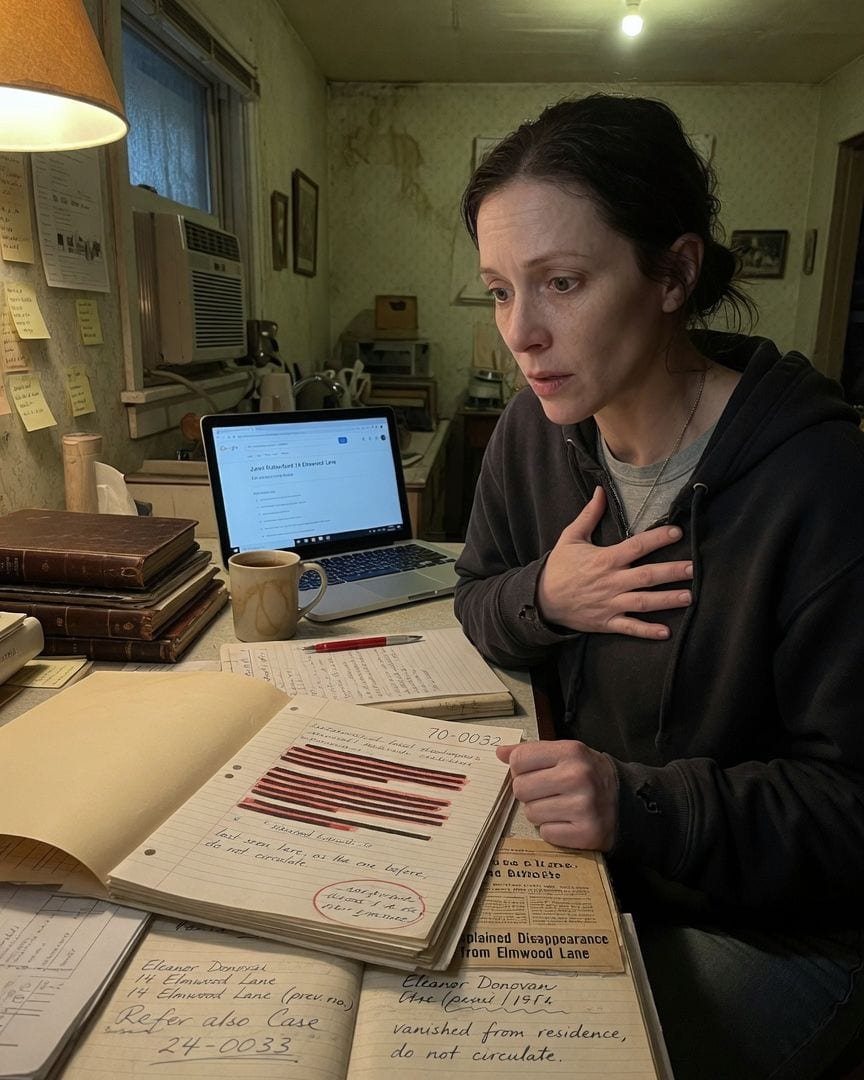
My own address is on a missing person's file from 1970. The blacked-out line names my street. She never lived here.
When my neighbor vanished, I started digging into old local missing persons cases. In a police file for a woman who disappeared in 1970, I found my own address, 14 Elmwood Lane, framing a blacked-out section of the duty log. Janet Rutherford never lived here, and the file contained a chilling handwritten note: 'do not circulate.'
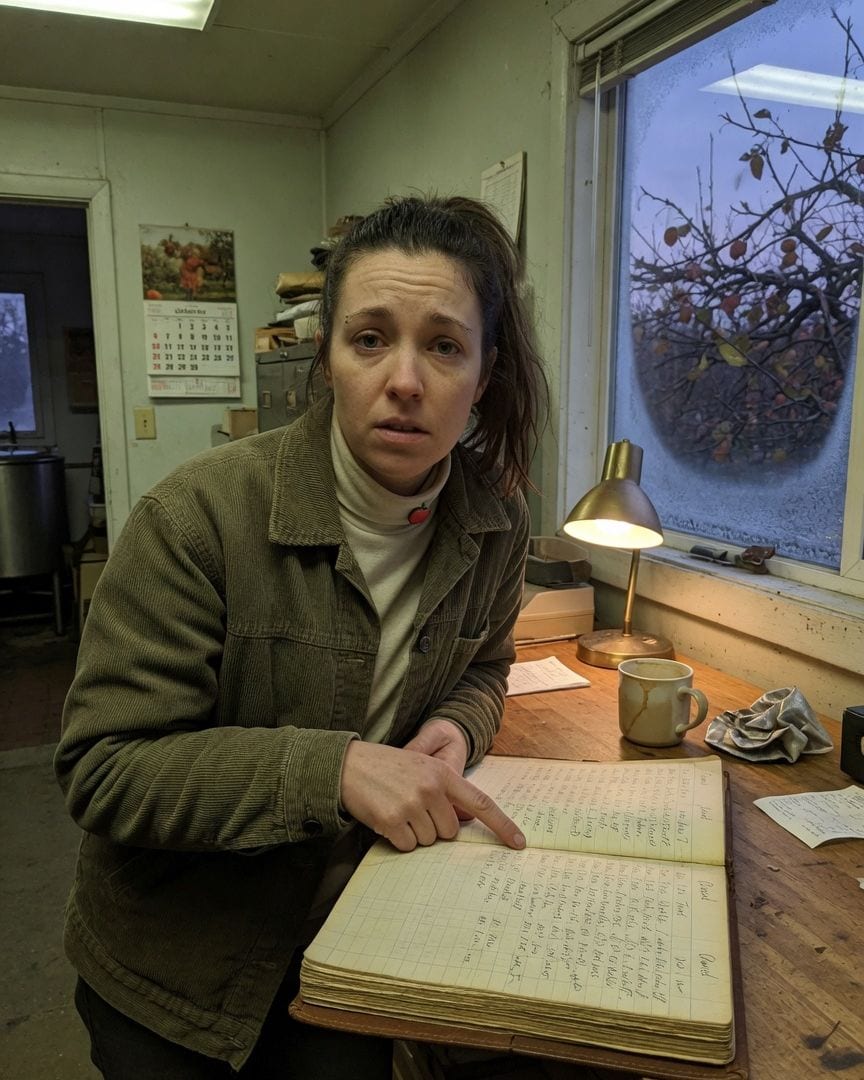
My orchard's picking ledger listed my apples two weeks early, showing the exact weight I took and, beside it, 'owed'.
Seeking quiet, I settled into a cottage by Felix Carver's apple orchard, dismissing his traditions about leaving 'the birds' share' apples. After I picked them, I found his old ledger. There, my exact apple weight was marked "Owed" in stark, new ink, dated a fortnight before I'd even touched the trees.
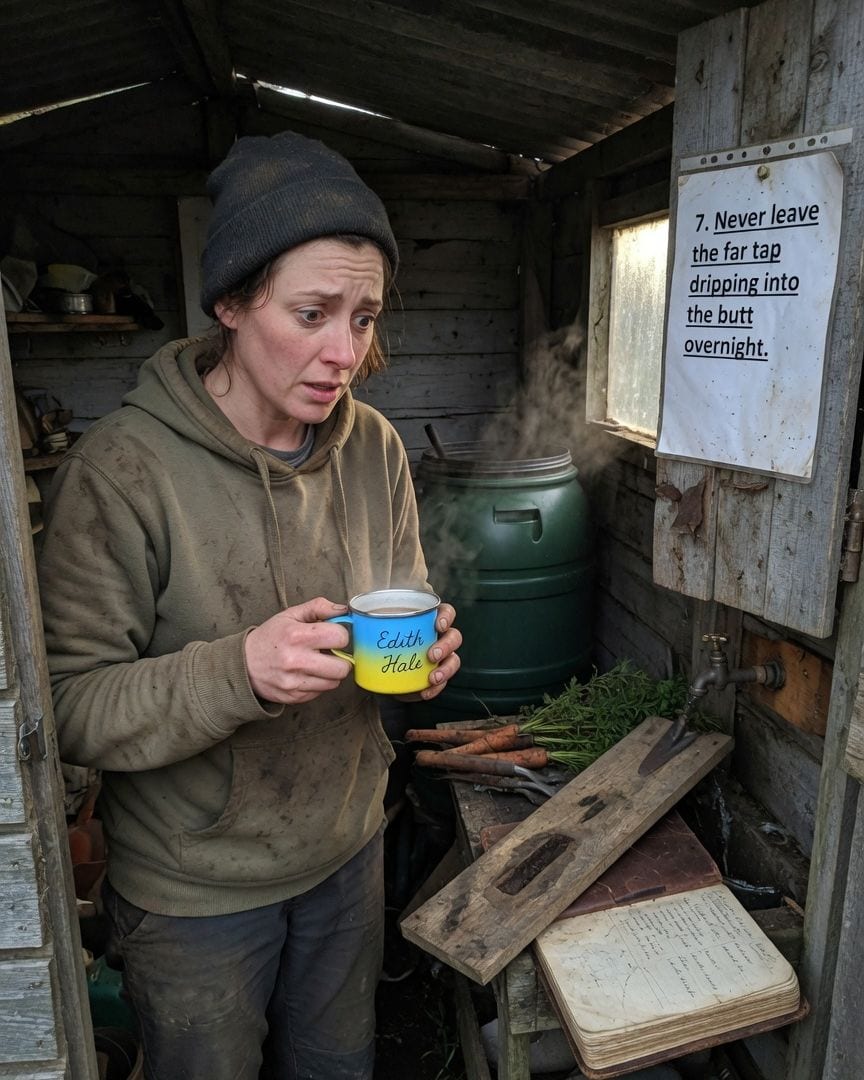
The one night I left the tap dripping, my allotment water butt was full to the brim and warm to the touch — with a child's unrusted tin cup floating on top.
Moving to Blackwood, I hoped my allotment would be a fresh start. But the shed's rulebook warned, 'Never leave the far tap dripping.' One morning, my water butt was full and steaming, an unnerving warmth rising from it. Inside, a child's tin cup floated, unrusted, etched with the name 'Edith Hale'.
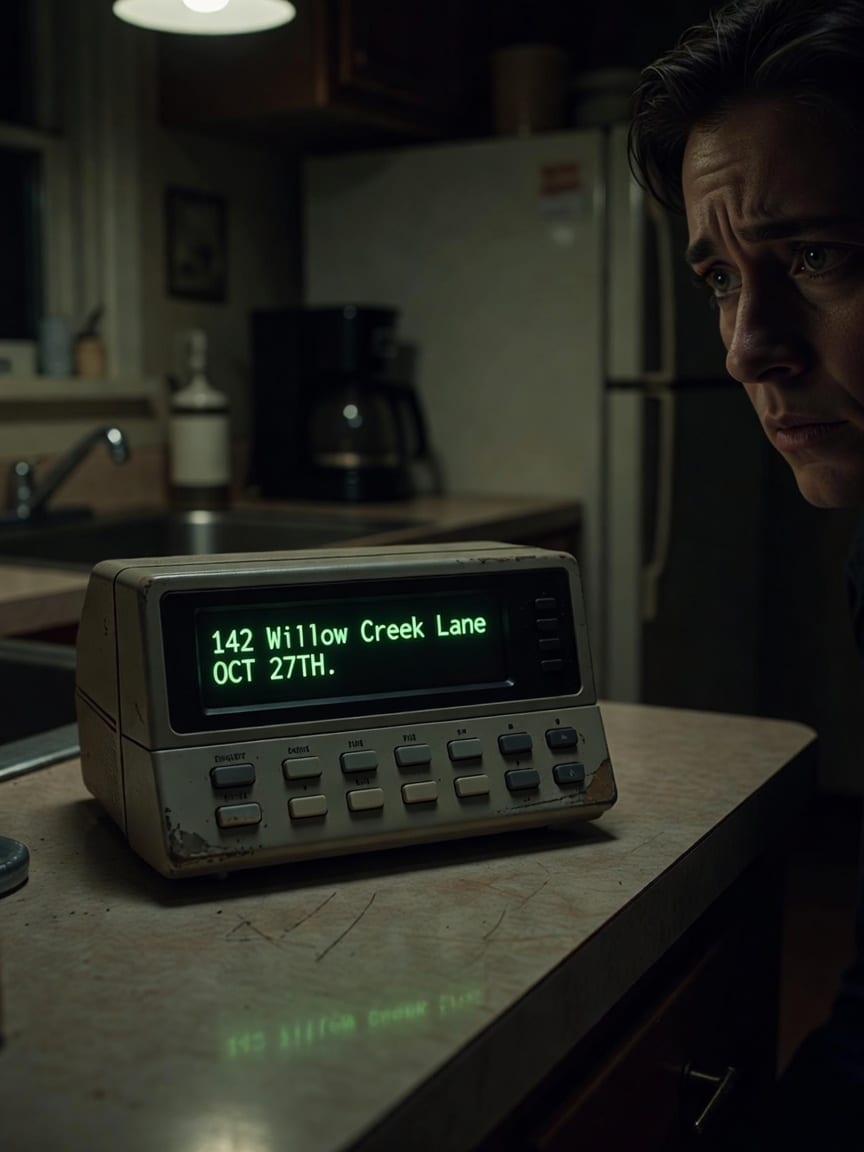
My radio scanner picked up a channel at 2 AM reading local addresses. Mine was on it, dated tomorrow.
I was tracking a storm on my old weather radio when a synthesized voice cut through the static. It began reading local street addresses, then my own: 142 Willow Creek Lane. But the date it gave for my address was tomorrow.
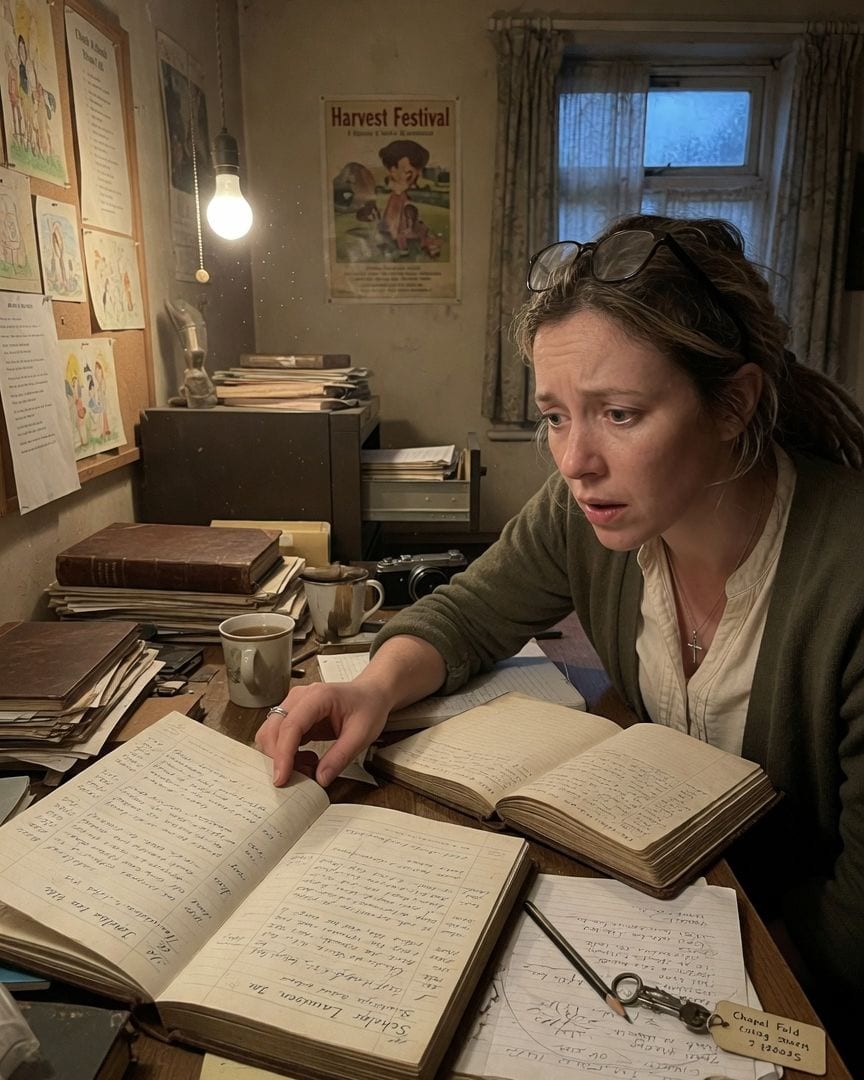
My name is in the chapel's old Sunday school register as 'Scholar 33'. But 'Scholar 33' appears every seventh year since 1907, each child from the same cottage, each marked 'not called for'.
Sorting dusty chapel archives, my job as a local history enthusiast, was a soothing journey through generations. But then my own name, Penelope Lawson, jumped out: 'Scholar 33' for the current year. I'd never attended. Flipping back, I found the same 'Scholar 33' entry repeating every seven years for over a century, always linked to the same old cottage.
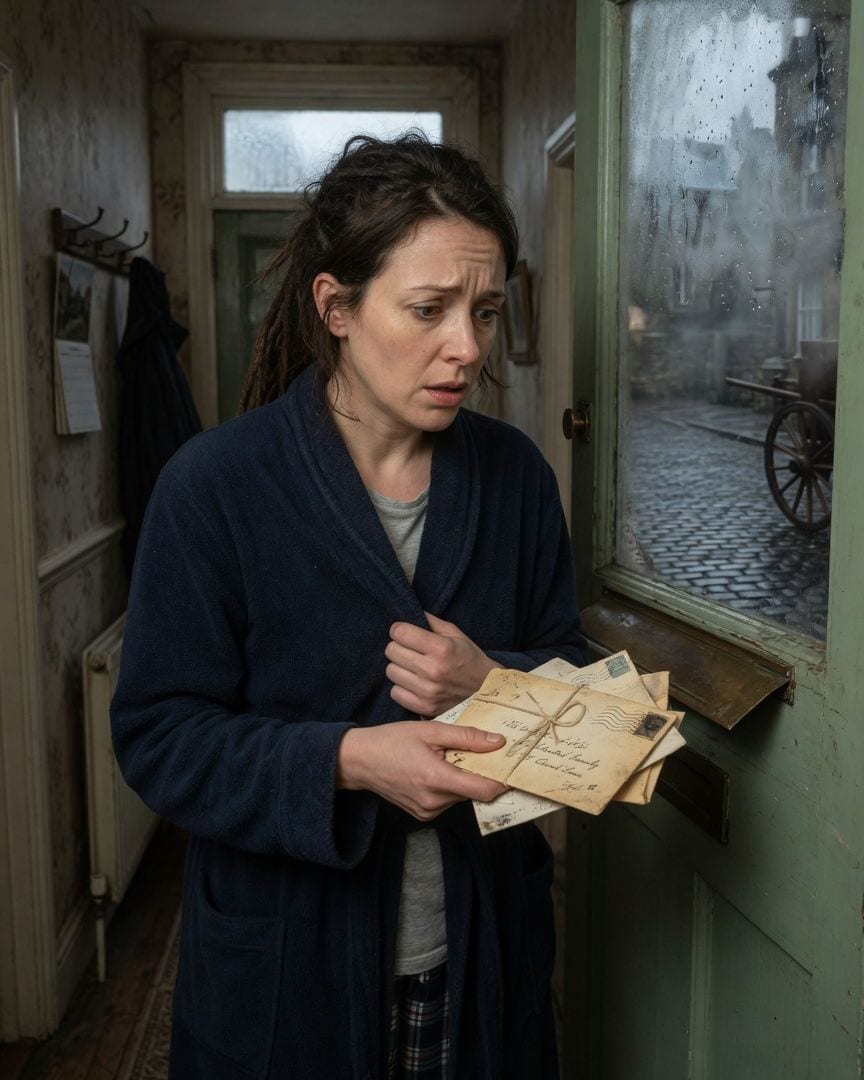
Seventy years ago, a hidden journal recorded my door opening to the wrong street and receiving Lockwood post.
I'd only recently moved into my inherited house, a quiet place on the edge of town. One grey morning, a distinct clatter from the front door's post flap caught my attention. Reaching down, I expected my gravel path, but instead, the flap showed a dark, cobbled street that wasn't mine. A bundle of warm, old letters, addressed to 'The Lockwood Family,' slid through, before the vision flickered and was gone.