The one night I left the tap dripping, my allotment water butt was full to the brim and warm to the touch — with a child's unrusted tin cup floating on top.
The move to Blackwood had been all about a fresh start, and the allotment was meant to be the anchor. Something solid and green to dig my hands into.
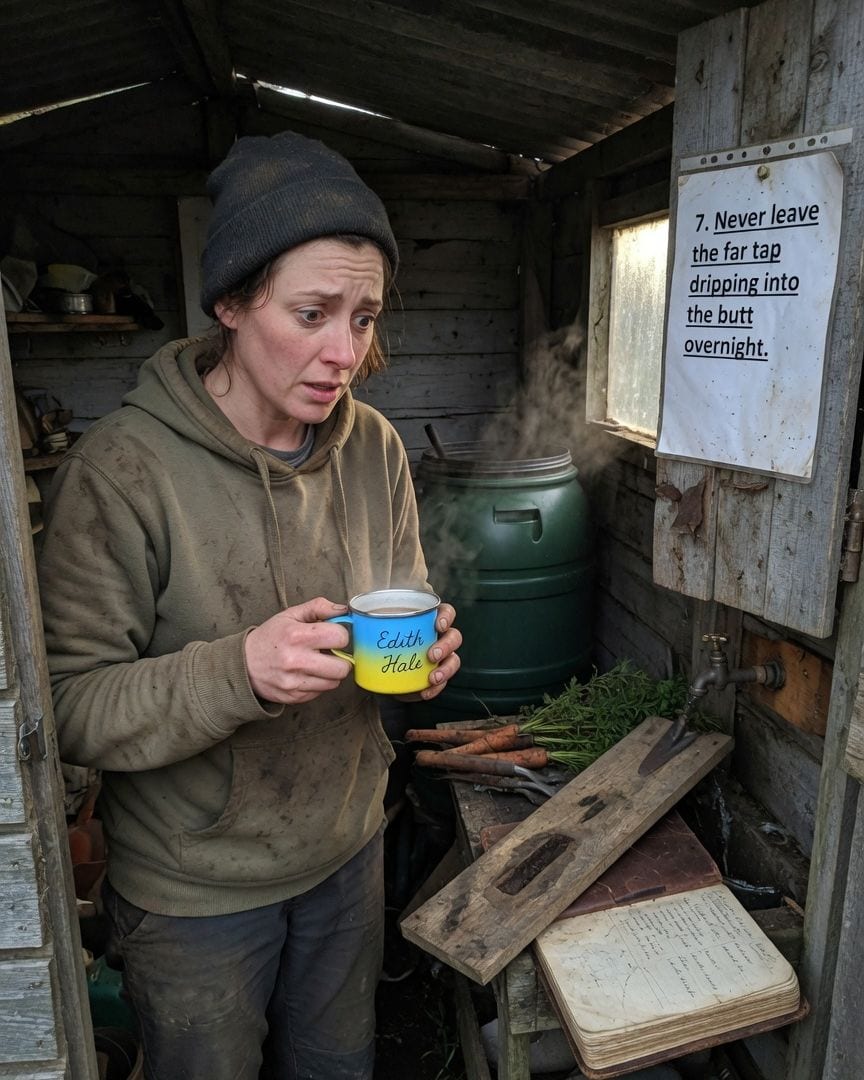
The shed, a ramshackle affair of weathered planks, came with a laminated rulebook tacked inside the door. Most of it was common sense: 'Keep pathways clear,' 'No loud music after dusk.' But rule seven made me pause.
It was inked over three times, stark and emphatic: Never leave the far tap dripping into the butt overnight. A strange fixation, I thought, for a town that otherwise seemed so easygoing. Probably some ancient dispute over water conservation. I filed it away under ‘quaint local customs.’
Then came the late autumn evening. I’d been so focused on getting my last row of winter carrots in before the light completely failed that I’d rushed cleaning up.
I remembered wiping my muddy hands on my trousers, gathering my tools, and locking the shed door with a satisfying click. It wasn’t until the next morning, when I went to fetch water for my seedlings, that I noticed it.
The large green water butt, usually half-empty at this time of year, was filled to the brim. Not just full, though. A faint wisp of steam rose from its surface in the crisp morning air.
I dipped a finger in, expecting the usual icy cold. Instead, the water was unnervingly warm, like a bath left to cool. My skin prickled.
And then I saw it, floating face-up on the surface, just beneath the faint mist. A child's tin cup, unrusted, its metal gleaming despite having sat in water all night.
Etched into its side, in careful, looping script, was a name: 'Edith Hale'. I pulled it out, the metal strangely hot against my skin, and a chill, utterly at odds with the cup's warmth, ran straight through me.
Who on earth was Edith Hale?
The tin cup, still radiating a faint, unnatural warmth, felt heavy in my hand as I walked into the Blackwood Public Library. It was a small, quiet place, smelling of old paper and dust, presided over by Lydia Sterling.
Lydia was a woman whose presence was as hushed as the rows of books she tended, her movements economical, her voice soft.
Her grey hair was pulled back in a neat bun, and spectacles perched on the end of her nose.
She looked up as I approached the counter, her eyes, sharp and intelligent behind thick lenses, lingering on the cup I clutched. It was only for a fraction of a second, but it felt like an inspection.
"Can I help you, dear?" she asked, her tone even.
"Yes," I managed, my voice a little rougher than I intended. "I found this. I was hoping you might have some old town records, or archives. I'm looking for a name. Edith Hale."
Lydia nodded slowly, her gaze still fixed on the cup. "Edith Hale," she repeated, almost to herself. "A common enough name, you know. But for records... you'll want the microfiche. Back there." She gestured vaguely towards a dimly lit corner.
I spent the next hour hunched over the flickering screen, feeding in rolls of film, the whirring machine the only sound in the otherwise silent room. And then I found it. A faded obituary in the Blackwood Chronicle, dated 1911.
Hale, Edith. Aged seven. A tragic loss. Below it, a listing in the churchyard records. A small headstone, long since grown over. Edith Hale, 1911. A child.
My mind scrambled for explanations. A shared name, yes. A discarded toy, perhaps, tossed into the water by some long-dead child and only just now surfaced. It was a stretch, but I tried to make it fit.
But the cup’s unblemished state, its unyielding warmth, the sheer, incredible improbability of it all. It gnawed at me. The library itself seemed to hold its breath around me, waiting.
I went back to Lydia. "Lydia," I said, trying to keep my voice casual. "Do you remember anything unusual around 1911? Any strange incidents, perhaps related to children?"
She paused, her fingers smoothing the spine of a book. "Oh, a sad time, dear," she said, her voice soft, almost a sigh. "Long ago. Blackwood's always had its share of sad tales, you know. Best not to dwell."
She turned, pulling a heavy tome from a shelf. "Perhaps you'd be interested in the local history of our botanical gardens?"
The subject was changed, smoothly, completely, with a practiced ease that sent a new, colder kind of chill through me. My mundane explanations were not just fraying; they were beginning to unravel.
Unnerved by Lydia’s too-smooth evasion and the persistent, phantom chill the tin cup had left in my hand, I returned to the allotment shed. I needed a rational explanation, something tangible to fight against the growing sense of wrongness.
I ran my hands along the weathered planks of the shed, searching, hoping for a dropped clue, a forgotten label, anything. My fingers brushed against a loose board near the far tap – the very tap I’d left dripping.
It felt colder than the surrounding wood, and brittle, almost like aged leather.
I pried the plank open, the wood groaning softly in the quiet afternoon. Tucked into the cavity behind it was a small, leather-bound ledger, its cover cracked and dry. It smelled of earth and something else, something stale and old.
I pulled it out, my fingers tracing the first page, the paper thin and yellowed with time. It was a list, handwritten in fading, spidery ink. The first name I clearly saw, stark against the page, read: 'Edith Hale, 1911'.
Beneath it, more names, more dates, stretching back through the decades, each entry ending with a strange, looping symbol I didn't recognize.
For days after finding the ledger, I lived in a blur of frantic research. The names. The dates. I cross-referenced every entry with every archived document I could find: old newspaper clippings, census records, even dusty church registers.
I spent hours at the microfiche reader, the hum of the machine a constant companion to the growing dread in my chest. Each time, the results were chillingly consistent.
"Working late again, dear?" Lydia Sterling would ask, appearing silently at my side with a fresh cup of lukewarm tea, her eyes tracking my movements. She offered 'help', pointing me to obscure archives, always ready to assist.
But whenever I tried to ask about the specific patterns I was seeing in the ledger – the precise gaps between certain dates, the clusters of names – she’d become vague, her gaze drifting.
"Oh, the old records are full of fascinating things, aren't they? But sometimes, it's just the vagaries of history." Her tone was soothing, but her eyes held a different, unreadable intensity.
What I was uncovering wasn’t vague at all. I found a disturbing number of missing persons reports, mostly children, scattered across Blackwood’s history. Each aligned, with chilling precision, to the dates in the ledger.
The official explanations were always the same: runaways, accidents, children who 'wandered off' into the surrounding forests or were swept away by flash floods. Convenient, always.
I tried talking to other locals. Over coffee at the bakery, at the village green market. "Funny thing," I’d say, trying to sound casual, "I was looking at some old records, noticed a few missing children from way back."
The response was uniform, almost rehearsed. A quick shake of the head. "Oh, those old stories," they'd say, their voices hushed, their eyes darting away. "Blackwood’s always had its share of sad tales, best not to dwell."
The blacksmith, a gruff but usually friendly man, simply grunted and turned back to his forge. The woman who ran the post office offered a tight, unsettling smile.
Each time, the conversation would smoothly pivot to the weather, the upcoming fête, anything but the topic I’d raised. It wasn't forgetfulness, or even a desire to avoid unpleasantness. It was a practiced silence.
A collective understanding, like a heavy, unseen blanket draped over the town. I had stumbled not just into old records, but into a secret kept alive, carefully, for generations.
The air in the library, once just dusty, now felt thick with unspoken history, pressing in on me.
As I delved deeper into the ledger and the town’s hushed past, I started noticing Felix Merritt. He tended the allotment plot next to mine, a meticulous gardener, his hands gnarled with age and work.
He was always there, pruning the roses, weeding around his prize-winning leeks. But his gaze, I realized, often drifted. Not to my crops, but to my shed.
Then to me, as I sat on the rickety bench inside, poring over my notes. He never spoke, never approached. Just observed. A quiet, steady presence that began to feel less like benign curiosity and more like a surveillance.
The shed itself seemed to breathe around me, its wooden walls creaking, almost listening.
One evening, returning to the shed after a late library session, I stopped short. Right on my shed’s threshold, precisely centered, was a small, smooth river stone. It hadn’t been there that morning.
Painted on its surface, in dark, dried pigment, was the exact looping symbol from the ledger. The one that marked each tragic entry. My heart hammered against my ribs, a frantic bird trapped in a cage.
Someone knew what I was doing. Someone was watching me. And they were sending a message.
Later, as I was back at the library, meticulously examining yet another microfiche reel – this one detailing obscure birth and death records from the early 20th century – Lydia Sterling approached. She wasn't carrying tea this time.
She simply stood beside me, her silhouette framed by the projector's pale light. "You’re working very hard, dear," she said, her voice soft, almost a sigh, but with an underlying current of steel.
The hum of the microfiche machine seemed to pulse in the sudden silence.
I looked up, trying to appear nonchalant. "Just trying to make sense of some old Blackwood families."
Lydia’s gaze met mine, unwavering. Her eyes, usually so mild, now held a deep, almost sorrowful authority. "Some things are best left buried, though," she continued, her voice dropping to a near whisper. "For everyone’s peace.
This town… it likes its quiet. It needs its quiet."
It wasn't a threat, not in the usual sense. It was a warning, unmistakable, delivered with a calm, practiced resignation that chilled me far more than any raised voice could have. The town wasn’t just avoiding the subject.
It wasn’t just dismissive. It was actively protecting something. And I, unknowingly, was digging it up.
I found Felix Merritt at his allotment plot the next morning, tending a row of late cabbages. The ledger was in one hand, the river stone with its painted symbol in the other.
He looked up as I approached, his face, usually a mask of gentle concentration, now simply etched with a profound, bone-deep weariness. There was no surprise in his eyes, only a quiet recognition.
"You found the book," he rasped, his voice like dry leaves skittering across the ground. He didn't deny it.
He just wiped his hands on his trousers and slowly straightened up, his gaze fixing on the far tap of my shed.
"What is it, Felix?" I demanded, my voice tight. "What is all of this? The names, the dates, the symbol? Lydia... the whole town. Why are you all doing this?"
He sighed, a long, drawn-out sound that seemed to carry the weight of decades. "That tap," he said, nodding towards my shed, "and the butt. It's... the opening."
He paused, choosing his words carefully, as if recounting an ancient, well-worn tale. "Rule seven. Never leave it dripping. The town has known for generations that breaking that rule... awakens it."
"Awakens what?" The words felt absurd, yet a cold dread was already coiling in my gut.
"It," he repeated, his gaze distant. "And when it's awake, it comes for a child."
He looked at the ledger in my hand. "That book... it's the town's grim record. A chronicle of the takings. A desperate attempt to track the cycle. To warn future generations, if they'd only listen."
He glanced towards the village, a faint, sad smile touching his lips. "The 'too-smooth stories', as you called them, the silence... that's the desperate effort. To keep it dormant between cycles. To avoid panic.
To protect our own, for as long as we can."
My mind flashed back to Edith Hale's cup, to its unnatural warmth, to the date, 1911. "The cup," I whispered, holding it out to him. "Edith Hale. 1911. Was she one of them?"
Felix nodded slowly. "The cup was a return. A relic from a past taking. A warning, Charlotte. A sign that the entity had noticed your breach. That the cycle... it was ready to begin again."
He explained that the pattern of dates wasn't random, as I'd first feared, or simply tragic coincidence. "It's a precise, terrifying cycle," he said, his voice flat. "And the symbol... it marks each incident.
A way for the keepers to track it. To know when it's active."
The horror of it all snapped into place with sickening clarity. The town’s silent complicity wasn't malice, but a desperate, generations-long act of self-preservation. Every hushed word, every averted gaze, every conveniently dismissed missing child report. It wasn't about forgetting.
It was about managing the unbearable, hoping to contain an endless, monstrous cycle. The air itself seemed to thicken with the echoes of lost children, chilling me to the bone.
I was reeling, the weight of his words pressing down on me. "When?" I finally managed, the single word raspy. "When is the next… taking? You said it was a cycle. When is it due?"
Felix closed his eyes, a deep weariness settling on his face, carving new lines into his already aged skin. He slowly opened the ledger, his finger tracing the last entry, then moving to the blank line beneath it.
"It's always been every seventy years," he murmured, his voice barely a whisper, "give or take a season. And always in late autumn. This time of year." He paused, his finger resting on the last recorded date. "The last one...
was in '53."
My mind raced, scrambling to do the math. 1953 plus 70 years... my breath hitched. "That means... it's due now," I whispered, the words catching in my throat, each syllable a shard of ice.
The air around us, once merely crisp, now felt charged, heavy with an unseen presence.
Felix simply nodded, his eyes still closed. "And it always shows itself to the one who opens the door," he added, his voice so quiet I almost missed it. My heart pounded, a frantic drumbeat against my ribs.
I had opened the door. I had left the tap dripping. The blame, cold and sharp, settled squarely on my shoulders.
"But... who?" My voice was barely audible. "Who has it chosen this time?"
He finally opened his eyes, and the sorrow I saw there made my stomach clench. "There's a girl," he said, his gaze sweeping towards the cluster of houses beyond the allotments. "Beatrice Montgomery. Seven years old.
She lives with her grandmother just a few streets away." He paused, his voice heavy with grim certainty. "She's been found by your shed for the past three days now, Charlotte. Just sitting there. Not playing, not talking. Just... humming.
The old lullaby. A strange, haunting tune that no one in town has heard in decades, a tune the local children's choir stopped teaching generations ago."
The silence that followed was absolute, broken only by the distant caw of a crow, a sound that suddenly felt profoundly ominous.
Horrified, the cold fact of Beatrice’s lullaby burning in my mind, I raced towards Beatrice Montgomery's grandmother's house, Felix Merritt following behind me, his gait slow but determined. Every step felt like a heavy stone dropping into a bottomless well.
We found the house, a small cottage with roses still clinging to the walls, and the front door ajar.
Inside, Beatrice’s grandmother was frantic, wringing her hands by an open window. And there, sitting on the window seat, was Beatrice. Her small frame was still, her head tilted slightly, a faint, eerie hum escaping her lips.
It was the lullaby. Her gaze was fixed, not on us, not on her distressed grandmother, but on the distant allotments, a strange, serene expression on her face, utterly detached from the unfolding reality.
The sound itself, a sweet, ancient melody, made the hairs on my arms stand on end.
"She won't stop," Beatrice’s grandmother sobbed, her voice raw with worry. "For three days, she's been like this. Drawn to the allotments. She says she 'just knows' the tune.
I keep asking where she learned it, but she just hums it louder."
Felix, his face grim, stepped forward. "It's the call," he said, his voice flat, devoid of emotion, yet carrying immense weight. "The entity uses it to call its chosen victim."
He then looked at me, his eyes holding a profound, shared sorrow. He revealed the full, awful truth, confirming every fragmented piece of information I had gathered, every suppressed fear.
"The entity... it takes a child," he explained, his words deliberate, measured. "But sometimes, as a cruel gesture, or a sign of its awakening, it 'returns' an object from a previous victim. Like Edith Hale's cup.
It places it in the water butt, for the one who breaks the rule to find. A warning, yes. But also a signal that its search for a new victim has begun."
He continued, the truth unfolding like a dark tapestry. "The 'taking' is always preceded by the chosen child being drawn to the shed. Drawn to the opening. And singing the lullaby. It's how we know."
The town’s agreement, the pact of silence, the carefully maintained folk rule – it was all a desperate, multi-generational effort to keep the conduit dormant, to hide the truth from the outside world, and to hope, against all evidence, that the cycles would eventually stop.
The ledger, he concluded, wasn’t just a record. It was a silent, desperate vigil. A chronicle of their failures, and their fears. A monument to the children they couldn’t save.
I knew, in that gut-wrenching moment, that I couldn't fight 'it' directly. The entity, the cycle, the ancient horror Felix described – it was beyond any human intervention. But I could fight for Beatrice.
With Felix's quiet, grim support, I convinced Beatrice’s grandmother. It wasn't easy. She was bewildered, frightened, disbelieving. But seeing the raw terror in my eyes, the cold, resolute resignation in Felix’s, and her granddaughter’s unnerving, distant humming, she finally agreed.
"Just for a holiday," I urged, my voice tight, "a sudden family emergency, anything. Just go. Now."
Felix, with a lifetime of quiet influence in Blackwood, moved with unsettling efficiency. He made a few calls, spoke to a few people in hushed tones. Within the hour, a rental car was arranged, bags were packed.
No one questioned their sudden, hasty departure. The town, I realized, was already too practiced in looking away, in smoothing over inconvenient truths.
As I helped them carry Beatrice’s small suitcase to the car, her grandmother’s hand trembling in mine, I saw Felix return to the allotment shed. He carried a heavy chain, thick and industrial, and a formidable padlock.
He didn't look at me, his gaze fixed on the task ahead.
He stood by the far tap, his face a mask of grim determination. He didn't just turn the tap off. He began to dismantle it entirely, wrenching it from the pipe with a heavy wrench.
The metallic groan of the old plumbing echoed starkly in the twilight. Then, he sealed the shed's doors with the chain, the metallic clang echoing sharply in the fading light. A desperate, futile gesture, I thought, yet necessary.
I knew this wouldn't stop the cycle, only perhaps delay it, or shift its focus to another vulnerable point.
The immense weight of the town's grim secret settled upon me then, a burden I now shared, a knowledge that seared itself into my soul. I knew, with absolute certainty, I could not stay in Blackwood, not with this understanding.
Beatrice and her grandmother left Blackwood that night, their departure as quiet as the town itself.
I packed my own belongings within the week, selling my allotment plot to a distant relative of Felix Merritt who never asked why the far tap was bricked over and sealed.
The town settled back into its quiet rhythm, the collective agreement palpable in the hushed conversations and averted gazes whenever I tried to speak of what I'd found. No one believed me, or perhaps, everyone simply chose not to.
I carried the ledger with me, its brittle pages the only tangible proof of the horror I'd witnessed, a secret that had irrevocably altered me.
I moved to a city, miles from any allotment, any quiet town with its too-smooth stories. The ledger is locked in a box, a constant, heavy presence in my new, ordinary life.
Sometimes, late at night, a sound will catch my ear – a distant drip, or the quiet gurgle of pipes – and I'll remember the taste of fear, the chill of knowing.
I learned to check every tap, every drain, every water source in my apartment, compulsively, my hands running over the cold metal, searching for any hint of warmth, any subtle vibration.
It's a small price to pay for sanity, I tell myself. But then I remember the cup, the dates, the lullaby, and the quiet, terrible resignation in Felix's eyes. I know it's not over, not truly.
I just bought myself some time. The water will always be warm, even in winter.
If this one got to you
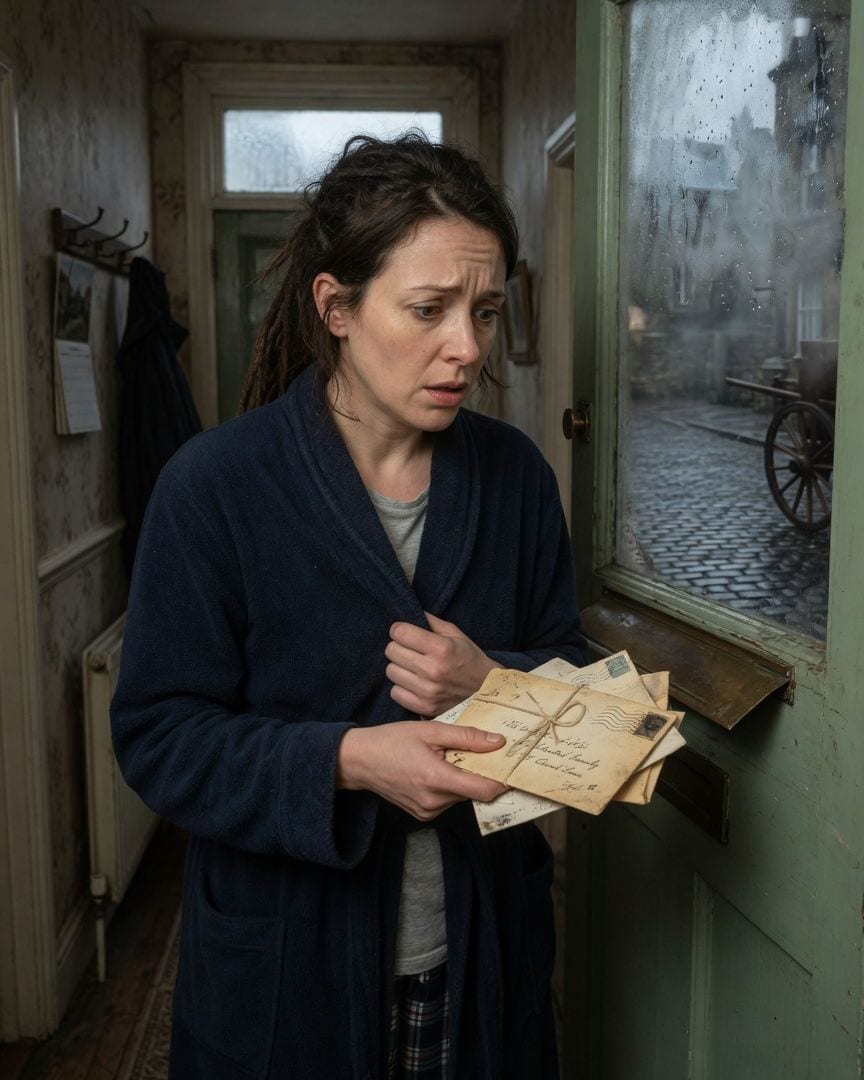
Seventy years ago, a hidden journal recorded my door opening to the wrong street and receiving Lockwood post.
I'd only recently moved into my inherited house, a quiet place on the edge of town. One grey morning, a distinct clatter from the front door's post flap caught my attention. Reaching down, I expected my gravel path, but instead, the flap showed a dark, cobbled street that wasn't mine. A bundle of warm, old letters, addressed to 'The Lockwood Family,' slid through, before the vision flickered and was gone.
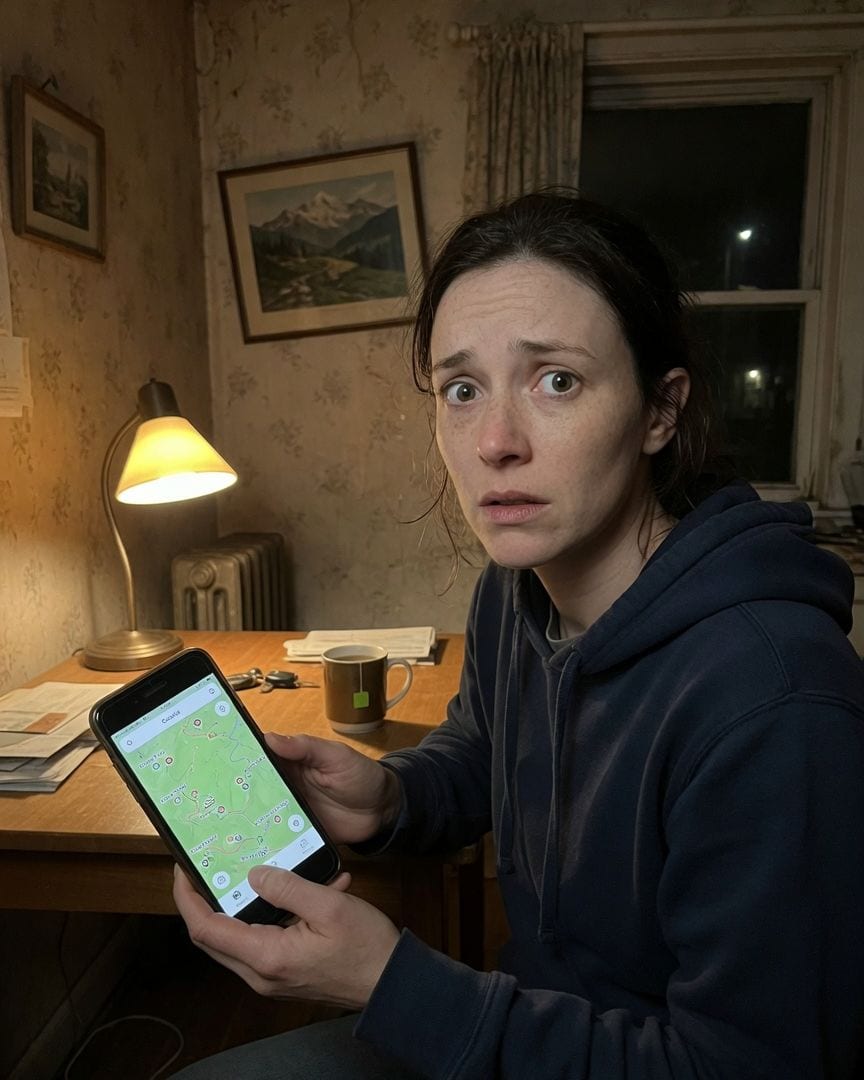
My hiking app scrubbed the hill's name from the map, on a phone that's been in airplane mode for two days.
I just moved to town and hiked a local hill, 'Cathan Tor,' according to my phone's app. But when I mentioned the name to the mechanic, he froze, dropped his wrench, and whispered, 'Don't say that name, Colette.'
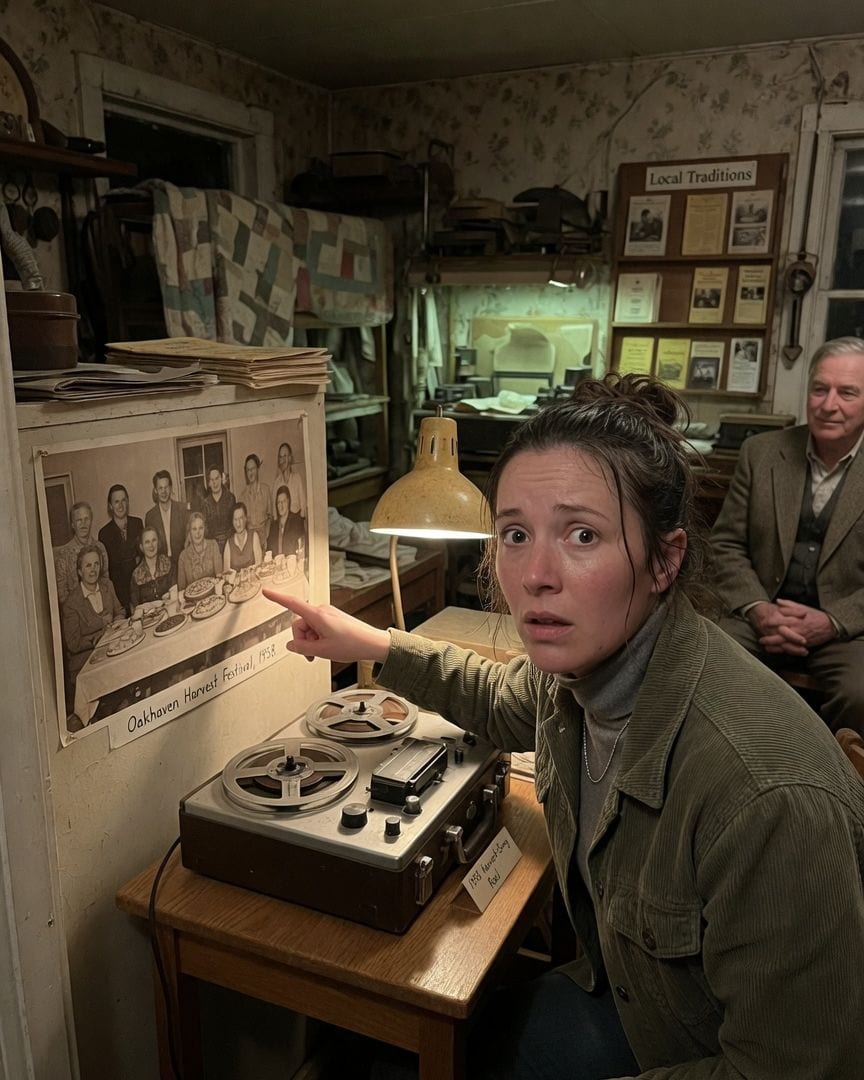
The folk museum's harvest tape counts one more singer than the photograph shows. The curator turned the recorder off before playing it.
I found a quiet escape at Oakhaven's dusty Folk Museum, where the curator played a rare 1958 harvest song. But as a cheerful tune filled the room, a low voice began to count. The tape tallied thirteen, yet the old photograph beside it showed only twelve smiling villagers.
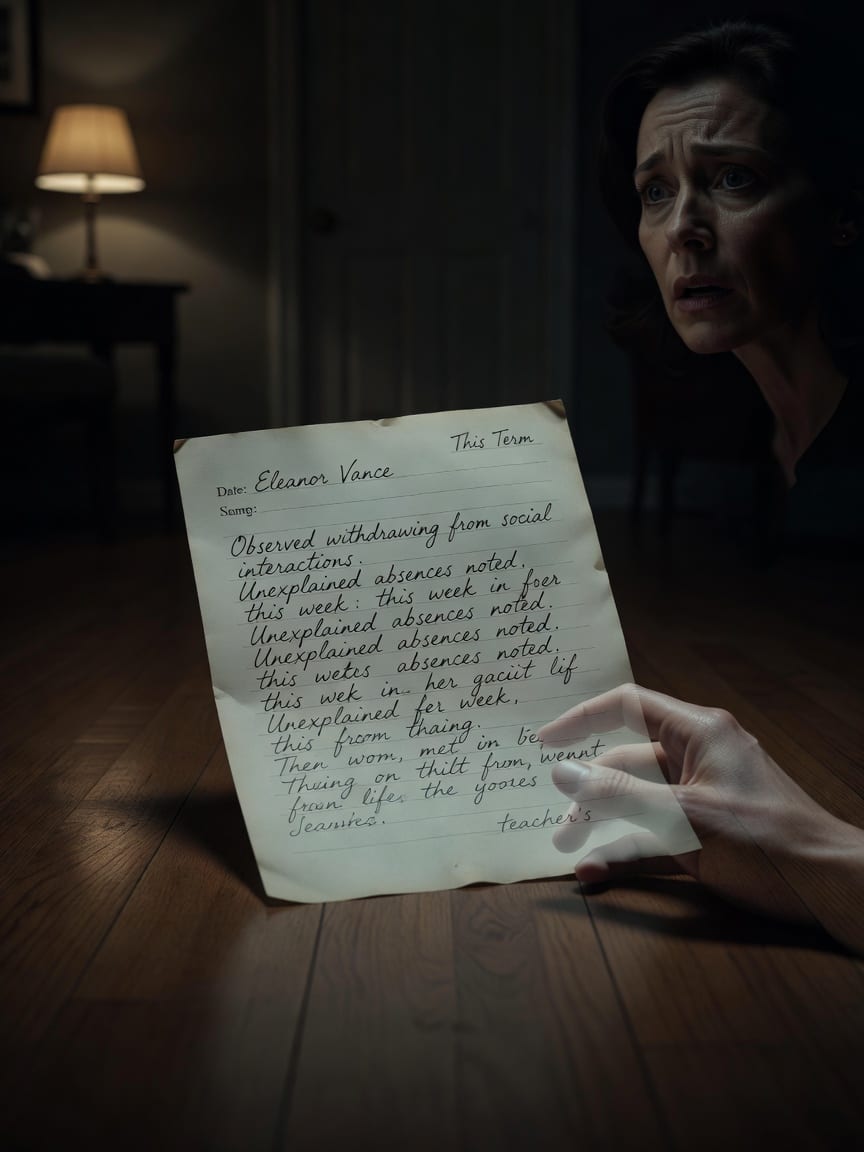
My school reports keep arriving, one a term, signed by teachers dead for decades. The latest describes something I'm doing *this week*.
My name is Eileen Caldwell, and my quiet life was upended by a school report from a place demolished decades before I was born. The report, signed by a long-dead teacher, eerily detailed my current habits. But the real shock arrived when I found my own name in a student register, dated 1968, with precise descriptions of my childhood—years before I existed.
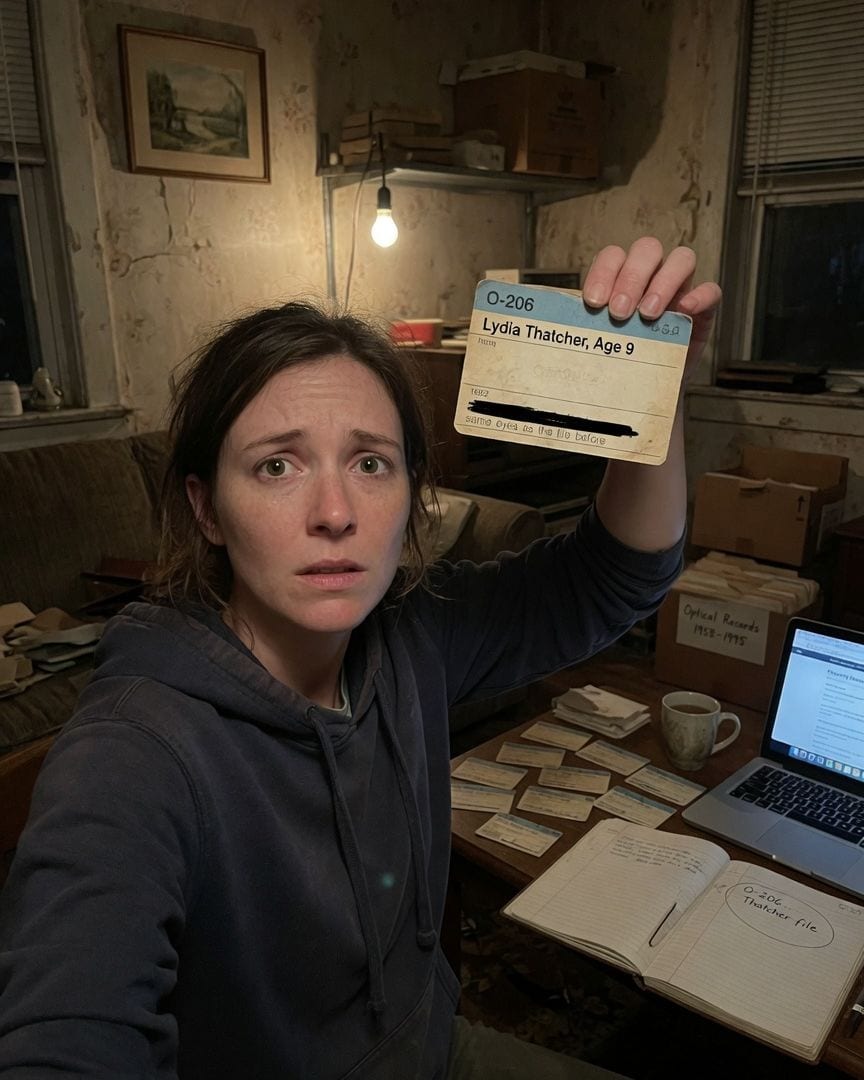
My own optical card is dated 1962, with my name on it. I wasn't born until 1993.
Sifting through old patient files from my former optical practice, I found my own O-206 card. It had my name, Lydia Thatcher, and my current home address printed on it. But the card was dated 1962, decades before I was even born, and a redacted note mentioned 'same eyes.'
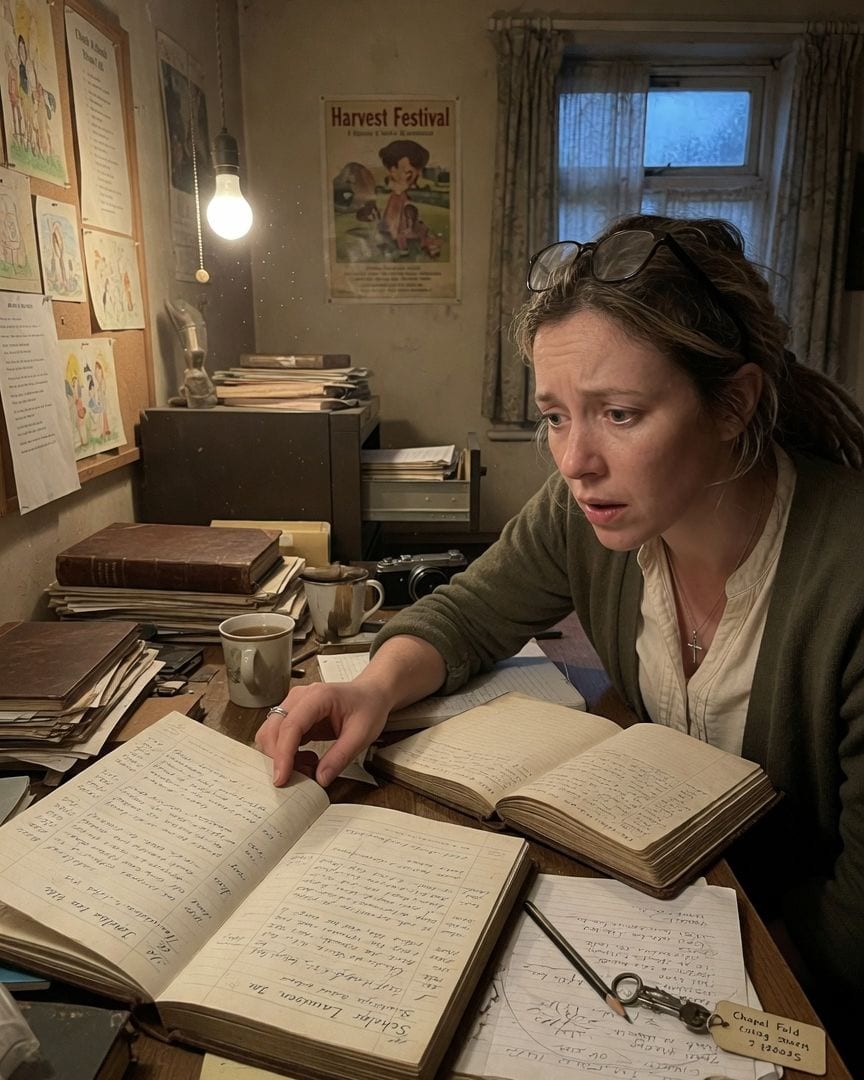
My name is in the chapel's old Sunday school register as 'Scholar 33'. But 'Scholar 33' appears every seventh year since 1907, each child from the same cottage, each marked 'not called for'.
Sorting dusty chapel archives, my job as a local history enthusiast, was a soothing journey through generations. But then my own name, Penelope Lawson, jumped out: 'Scholar 33' for the current year. I'd never attended. Flipping back, I found the same 'Scholar 33' entry repeating every seven years for over a century, always linked to the same old cottage.