My school reports keep arriving, one a term, signed by teachers dead for decades. The latest describes something I'm doing *this week*.
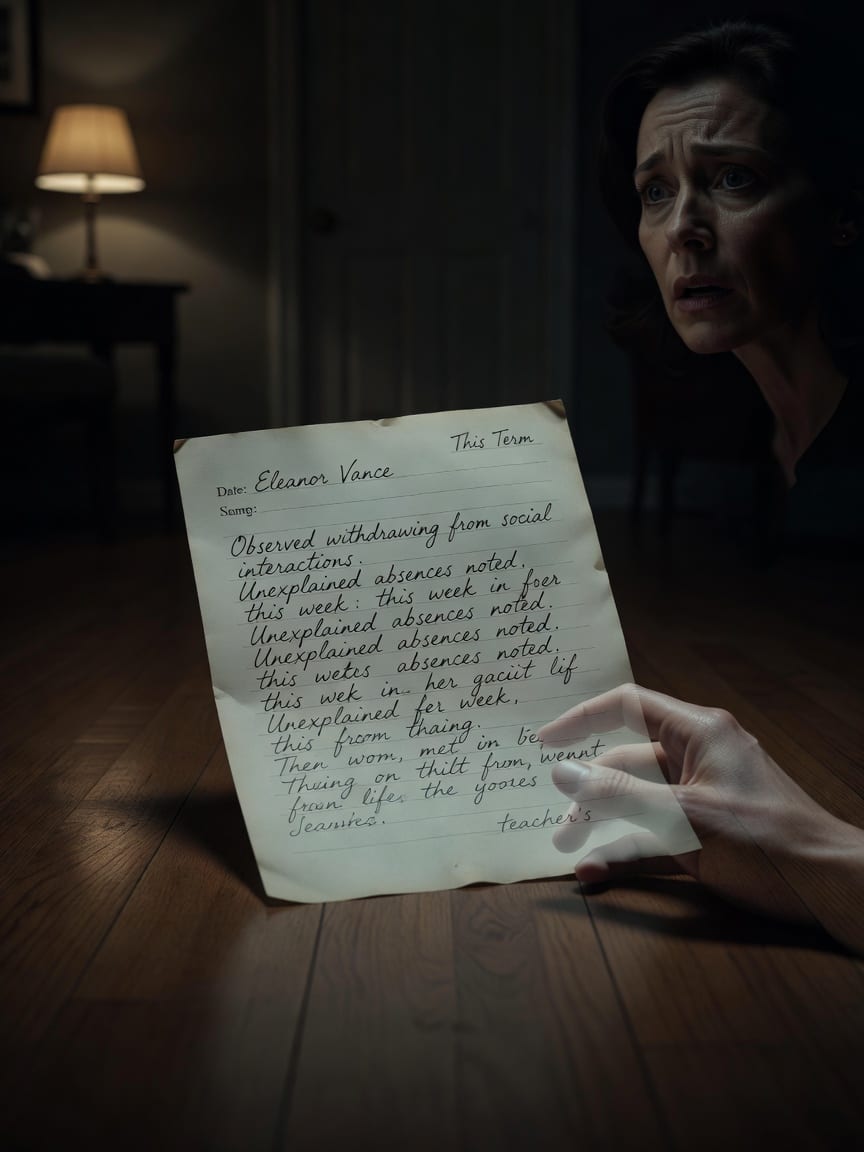
The first one arrived six months ago. Just a regular cream-colored envelope, no return address, slipped through the letterbox with the usual bills. I didn't think much of it until I opened it.
I still remember that morning. I was sitting at my kitchen table, my toast growing cold, staring at the crisp sheet of paper. My name, "Eileen Caldwell," was typed perfectly in the center.
Below it, the letterhead read "Lanivet Board School." Lanivet Board School. The name hit me like a cold spray. I knew that name from local history books. It had been flattened in 1975, fourteen years before I was even born.
I was thirty-five now.
It was a school report. A school report addressed to me.
My hands started to shake. The date on it was "Summer Term," but there was no year. The teacher's signature, scrawled in faded blue ink, read "Mr. Roland Sutton." I knew that name, too.
Not personally, but I'd seen it in the obituary section of an old newspaper while researching local history a few years back. He’d been a local primary school teacher, died in 1998.
The man had been dead for over two decades.
The comments were what really got me. They weren't generic. "Eileen shows a keen interest in historical archives, often lingering in the local library far too long." It wasn't wrong. I do linger.
It felt like someone had been watching me, detailing my habits. The next line, however, felt like a direct punch to the gut. It read: "Her efforts this week, particularly concerning the old Caldwell family records, will prove most illuminating."
I live alone. I hadn't even thought about the Caldwell family records until that very second. Not a passing thought, not a stray impulse. Nothing. It wasn't on my radar.
But the report, dated sometime in the past, was describing something I was apparently doing this week. The coffee suddenly tasted like ash.
Shaken, I tried to rationalize it. A peculiar local prank? Some kind of elaborate, twisted joke? I called the local post office, my voice tight. They had no record of anything like "Lanivet Board School" ever being a sender.
I tried the council, asking about misdirected mail, a peculiar historical society. Nobody had heard of it since its demolition. The polite but confused voices on the other end of the line only deepened the cold knot in my stomach.
I needed facts. I drove straight to the local library, a quiet, dusty place that always smelled of old paper and beeswax polish. Chloe Yates, the head librarian, a woman with kind, weary eyes, saw the desperation in mine.
I explained, haltingly, about the report. She looked at me with a mix of sympathy and bewilderment, the way people do when you suggest something impossible. She helped me locate an old volume on local institutions.
The book confirmed it, just as I knew: Lanivet Board School, founded 1883, demolished 1975. Concrete facts that offered no comfort.
I pressed her, leaning over the heavy wooden counter. "Were there any records that survived? Any staff? Any... eccentric teachers?"
Chloe paused, rubbing a spot on the counter with her thumb. "The school was known for its unusually meticulous record-keeping," she said slowly, "almost obsessive. Everything was documented.
We have a few artifacts here, recovered from the ruins before they built the housing estate." She gestured to a small, locked display case set into the wall near the local history section.
Inside, under a faint strip light, sat a faded photograph of a squat, brick school building, a tarnished brass bell, and a small, leather-bound ledger. It was embossed with "Lanivet Board School: Student Register."
The accompanying plaque stated it was recovered from the demolition site.
As I looked at it, an inexplicable pull settled over me. A strange sense of recognition, like seeing something you’ve only ever dreamt of. The ledger. I felt a chill, despite the warm library air.
I asked Chloe about the ledger. She hesitated, looking from my face to the glass case. "It's genuine," she said, finally. "Though we rarely display it. It's too fragile."
She retrieved a small brass key from a hook under the counter, the jingle echoing in the hushed library. The lock clicked, soft and precise. Chloe carefully lifted the ledger out, placing it gently on the counter between us.
The leather was dark, almost black, but surprisingly supple for its age, not dry or brittle at all.
My hands trembled as I reached out, my fingers brushing the smooth cover. Chloe gave a small, encouraging nod. I opened it. The pages were thick, creamy paper, filled with neat, elegant cursive handwriting. Student names, birth dates, attendance records.
My heart hammered against my ribs, a frantic drum against the silence of the library.
I flipped through the entries, page after page, my eyes scanning, almost expecting to see nothing.
Then, halfway through the book, on a page dated 'October 1968' – seven years before the school's demolition, twenty-one years before I was born – my breath hitched in my throat.
Written clearly, in that same elegant copperplate, was the name 'Eileen Caldwell'. Below it, a series of precise, personal observations that felt eerily like my own childhood: 'Shows an uncommon fascination with intricate patterns, spending hours examining textile designs.'
'Prefers quiet solitary play over boisterous games.' 'A peculiar habit of tapping her fingers in a rhythmic sequence when deep in thought.' All of it was me. Every single detail.
The final phrase, underscored twice, pulsed on the page, promising something far worse. It read: 'Subject shows promise for the coming cycle.'
I spent the next few days lost in the archives, a kind of feverish obsession taking hold. The world outside the library's heavy oak doors felt distant, unreal.
Chloe Yates, sensing my intensity, mostly left me to it, though her quiet assistance was invaluable, pulling dusty boxes from high shelves without me even asking. I scoured microfiche reels, poring over old school registers and town records.
I needed to know who this 'Eileen Caldwell' was. Had there been a relative, a forgotten namesake? Nothing. No Eileen Caldwell born in the 1960s with my exact details. It was impossible.
I researched the 'teachers' names from my strange reports. Some, like the 'Mr. Roland Sutton' from my first report, corresponded to real individuals who had taught at Lanivet and had indeed died decades ago.
I found their obituaries, their old staff photos. They were real, but dead. Others, though, were completely untraceable. Phantom names with no birth, death, or employment records anywhere. It was like they’d simply materialized onto the reports.
I dug deeper into the school's history. I found mentions of its founder, a reclusive figure known only as 'The Proprietor', notorious for his 'unorthodox educational philosophies' and an almost fanatical obsession with local lineage.
He believed certain families in the area held a 'particular aptitude for observation and record-keeping.'
The further I went, the more I stumbled into the murky territory of local folklore. Whispers in obscure historical texts of 'the Chroniclers,' a clandestine group rumored to have operated in the area for centuries.
They were said to 'record' the lives of specific families, generation after generation. One particularly unsettling passage mentioned an unusual 'registry' that predated any physical building, a system of notation that simply... existed.
Desperate for answers that couldn't be found in archives or forgotten legends, I remembered a distant relative: Margaret Caldwell.
She was in her eighties, lived in an isolated cottage just outside of town, known for her sharp memory and an uncanny grasp of local history.
I called her, leaving a rambling message, hoping she might offer some lead, some forgotten anecdote that could explain the impossible.
Weeks passed after I called Margaret. My investigation morphed from a research project into an obsession, a relentless pursuit of an explanation for the unexplainable.
A growing unease settled over me, a chilling certainty that I was no longer just looking for answers, but that something was looking back.
I felt observed, a subtle pressure on the edges of my senses, like being watched from just out of sight.
One rainy afternoon, as I was leaving the library, a stack of heavy, borrowed books clutched to my chest, a man stepped out from under the awning of a closed shop. The air felt suddenly colder.
He was roughly 45, dressed in a worn but neat coat, with tired, deep-set eyes that seemed to have seen too much. He stopped, directly in my path, effectively blocking my way.
"Eileen Caldwell?" he asked, his voice soft but firm, utterly devoid of surprise.
I froze, a jolt of alarm going through me. "Yes?"
He offered a small, rueful smile, a strange twist of his lips that didn't quite reach his eyes. "My name is Isaac Winslow. I just wanted to apologize."
I frowned, rain beginning to prickle my cheeks. "Apologize for what?"
His gaze seemed to drift past me, as if seeing something only he could perceive, something far away or deep inside. "For what you're about to lose. It's a heavy burden, being chosen."
He paused, a beat of uncomfortable silence stretching between us, then added, "And for the quiet that follows."
Before I could respond, before I could ask another question, he nodded once, a strange, resigned gesture of understanding, and quickly walked away. He melted into the grey, rain-slicked street, his form blurring into the downpour.
I watched him go, a shiver running down my spine that had nothing to do with the cold.
Two days later, my beloved antique grandfather clock, a heavy, dark wood family heirloom that had chimed the hours for three generations in my family, suddenly stopped. Its pendulum hung frozen, midway through a swing.
Its chimes, which had marked the passage of my entire life, were forever silenced. The 'quiet' Isaac spoke of descended, thick and heavy, filling my house with an oppressive, deafening stillness.
Shaken to my core by Isaac's chilling apology and the subsequent, impossible loss of my clock, I finally received a call back from Margaret Caldwell.
Her voice was calm, almost serene, as if she'd been expecting my call for years, knew exactly what I would say.
I drove straight to her small, cluttered cottage on the edge of the moor, the silence in my own home too loud to bear.
Margaret, frail but with eyes that missed nothing, offered me tea, her gaze sharp and knowing. Without preamble, I recounted everything. The school reports arriving in the mail, my name on them, the flattened school, the dead teachers.
The impossible ledger entry from 1968, detailing my own life before I was even born. Isaac Winslow’s terrifying apology, followed by the silent, empty house. I laid it all out, a breathless torrent of unbelievable facts.
Margaret listened patiently, occasionally nodding, her hands clasped over a chipped teacup. When I finally finished, the silence in her cottage was even heavier than in my own.
She simply said, her voice soft, "It's been a long time since I heard about the 'reports,' Eileen. My grandmother used to get them."
I stared at her, the blood draining from my face. "Your grandmother?"
Margaret nodded. She explained that 'Lanivet Board School' was indeed a real place, a physical building, but it was also always a front, a convenient cover for something far older, far more pervasive.
"'The Chroniclers,'" she explained, using the name from the folklore, her tone utterly matter-of-fact, "they've always been here. Observing. Recording. Guiding. Before the school, there was the Chapel of Witness, and before that, just the stones on the hill."
She revealed that certain families, including the Caldwells, had always been 'of interest' to this entity. The reports, she said, were not just records, but subtle instructions, premonitions, or even demands.
"They mark us," she added, "and they expect us to follow the path they've laid out."
Margaret then rose slowly, walked to a shelf laden with books and framed photos, and retrieved a worn, leather-bound photo album. She returned, sat down, and opened it to a faded photograph, taken sometime around 1950.
A group of children, maybe ten or twelve years old, stood stiffly, posed for the camera. A young Margaret, barely seven, with tight pigtails and a shy smile, stood in the front row.
Next to her, a girl with strikingly similar features to my own – the same high cheekbones, the same slight turn of the mouth – smiled shyly at the camera. But it was the background that seized my attention.
Blurred and indistinct, behind the children and half-obscured by a gnarled oak tree, a tall, slender figure stood. Too indistinct to make out details, but its posture was one of unwavering observation, like a sentinel watching over its flock.
"Some of us," Margaret said quietly, her eyes distant, "are simply more attentive to their whispers."
A cold dread, sharp and penetrating, settled deep in my bones. The implications of Margaret's calm, matter-of-fact words reframed everything. The reports, the ledger, Isaac's impossible apology, the silent clock – it all clicked into place with horrifying, inescapable coherence.
It wasn't a prank, not a delusion, not a coincidence. It was a system.
I thanked Margaret, my voice barely a whisper, feeling a desperate, primal need to process this alone, away from her unsettling serenity. As I drove home, the landscape blurring through the windshield, my mind raced.
I tried, one last time, to convince myself it was an elaborate shared delusion, a local eccentricity passed down through generations.
But the terrifying coherence of it all, the way every wrong detail now fit perfectly, slammed against my attempts at rationalization.
Just as I pulled into my driveway, the engine still running, my home phone – the landline, which I rarely ever used – began to ring. The caller ID glowed 'UNKNOWN'.
I stared at it, my heart hammering against my ribs, a sudden, overwhelming certainty washing over me. This was it.
I hesitated, then answered, lifting the cold plastic to my ear. A voice, perfectly clear and utterly devoid of any human warmth, spoke my name.
"Eileen."
Then, it detailed a specific, deeply personal item I cherished, something I kept hidden in a locked wooden box under my bed: a small, faded crayon drawing I'd made as a child, depicting my long-gone family home.
The voice described its impending, irreversible destruction. "We apologize for what you are about to lose," it calmly stated, each word precise and unnerving, "but it is necessary for your continued instruction."
The line clicked dead, leaving only the dial tone buzzing in my ear, and me standing frozen in my living room, the impossible words echoing in my mind, the truth of what watched me finally, inescapably, revealed.
I stood paralyzed, the phone still in my hand. The dial tone faded, but the voice didn't. It returned, not through the phone, but seeming to fill the room, echoing directly in my mind. It was calm, measured, utterly unhurried.
It explained that 'Lanivet Board School' was not a physical place, not anymore, but a conceptual entity, a pervasive pattern of observation and influence that had merely used various physical structures throughout history – the school, the chapel, the ancient standing stones Margaret mentioned – as convenient focal points, a mundane facade.
It explained that it had 'marked' me, just as it had marked others in my lineage, not as a victim, but as a participant in a long-standing, inescapable process.
The 'teachers' names, it revealed, were simply identifiers it used, drawing from local history, to lend a comforting, familiar guise to its communications.
The reports were its way of communicating its 'expectations' or 'predictions,' which it then subtly influenced, ensuring they came to pass.
It detailed how it had been 'recording' my life since before my birth, guiding my interests, my choices, my very path, all towards this moment.
Isaac Winslow, it implied, was one of its 'messengers,' a 'former subject' now tasked with preparing others for their own instruction.
The voice concluded, stating that I was now fully 'aware,' and it needed me to fulfill a specific, crucial 'task' this week, as outlined in the latest report – the one that spoke of the Caldwell family records.
A task that would significantly alter the lives of others in my family line, and ensure the 'pattern' continued.
Horrified, but with a cold clarity, I knew I could not fight this entity directly. It was too vast, too pervasive, a part of the very fabric of my world. But I refused to be a puppet.
My only option, a desperate, illogical hope, was to disappear. To sever all ties and hope to break the pattern.
I moved with frantic energy, gathering all the reports I’d received, the notes I’d meticulously transcribed from the impossible ledger, and a hastily written, rambling letter to Margaret, hoping the older woman would understand, perhaps even forgive.
As I packed a small bag – a change of clothes, some cash, essentials – the voice returned, calmer now, almost disappointed, directly in my mind.
"You're packing the old ledger notes, Eileen. You're trying to leave. That won't work."
The real-time observation, the utter invasiveness of its knowledge, drove me to an extreme, panicked choice. I pulled out the reports, the ledger notes, and my phone.
With shaking hands, I set fire to the reports in my kitchen sink, watching them curl and blacken, the smell of burnt paper acrid in the air.
I smashed my phone with a heavy hammer, once, twice, until the screen shattered and the device lay inert.
Then I took the fragments of the ledger notes, tore them into tiny pieces, and flushed them down the toilet, watching them swirl away.
I left Margaret's letter on the kitchen counter, my final, pathetic testament to what I had discovered. Then I grabbed my small bag and fled. I fled my house, my car, my entire life.
I drove for hours, no destination in mind, just away, not looking back. I severed every connection, abandoning my identity, my home, my past.
The cost was absolute: I lost everything I knew, carrying only the unspeakable, unbelievable knowledge of what watched and recorded.
Eileen Caldwell vanished. Her landlord reported her missing after a week of unanswered calls. Her family, baffled, assumed a sudden breakdown, a quiet woman finally cracking under unseen pressure.
Margaret Caldwell, when questioned by the police, remained perfectly calm, her eyes distant, as if gazing into another time. She simply told them, "Eileen went where she needed to go. Some paths are simply laid out for us."
The police found the charred remains of paper in the sink, a smashed phone, and Margaret's cryptic note.
They dismissed it all as evidence of a mental health crisis, closing the case as a voluntary disappearance, a woman who simply walked away from her life.
Years later, Eileen lives under a new name, in a distant city, working a quiet, unremarkable job in a dusty archive.
She has built a new life, devoid of any ties to her past, always looking over her shoulder, always listening. She lives in constant, low-level dread, but she has survived. Or so she tells herself.
One morning, she finds a crisp, cream-colored envelope slipped neatly under her apartment door. There is no sender's address. Inside, a single sheet of paper. It's an old-fashioned school report, her new name perfectly centered at the top.
The 'teacher's' name is unfamiliar, but the comments below describe her current, quiet life, her routines, her new fears. It's dated 'This Term'.
The final comment reads: 'Eileen has settled well, but her next lesson begins soon.'
If this one got to you
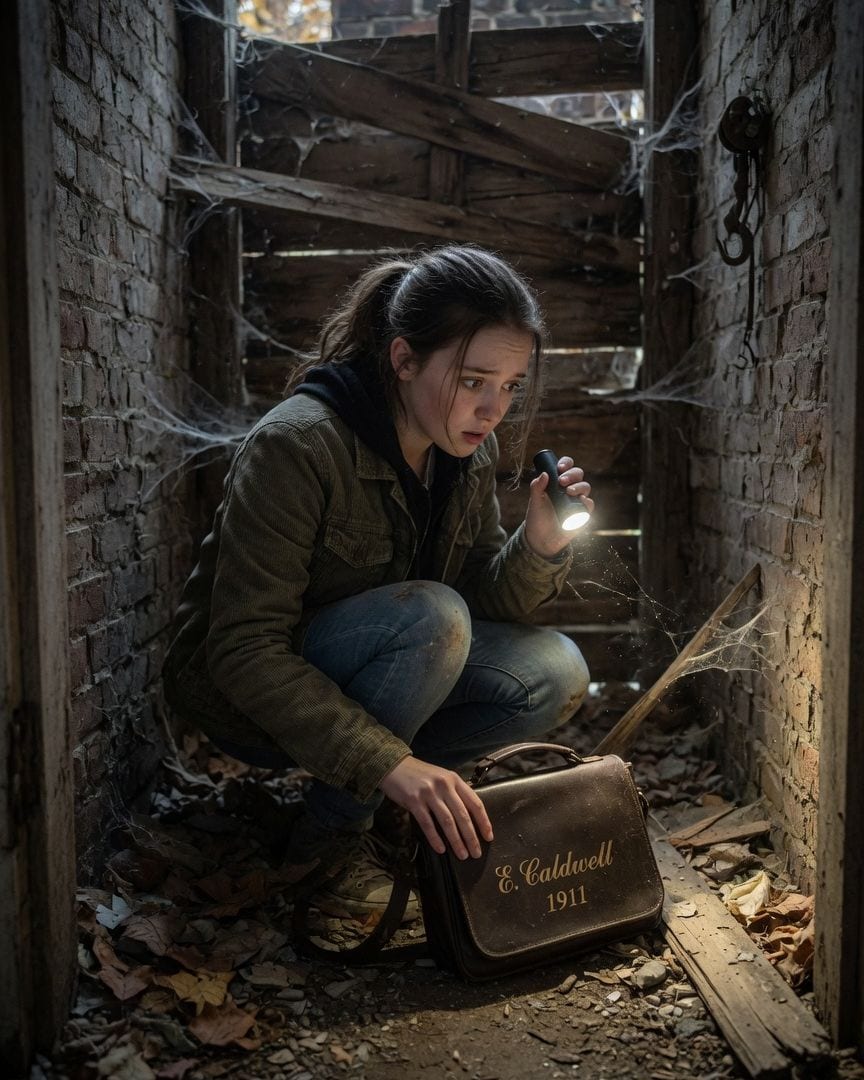
The school attendance register lists a child present every day since 1911. No such student ever sat an exam.
My new school, Caldwell High, felt too quiet, especially around its ancient, boarded-up bell tower. Teachers gave identical, rehearsed lines about it being "structurally unsafe." But then I found the attendance register, detailing a student named Eleanor Caldwell marked present every single day since 1911. No other record of her exists anywhere.
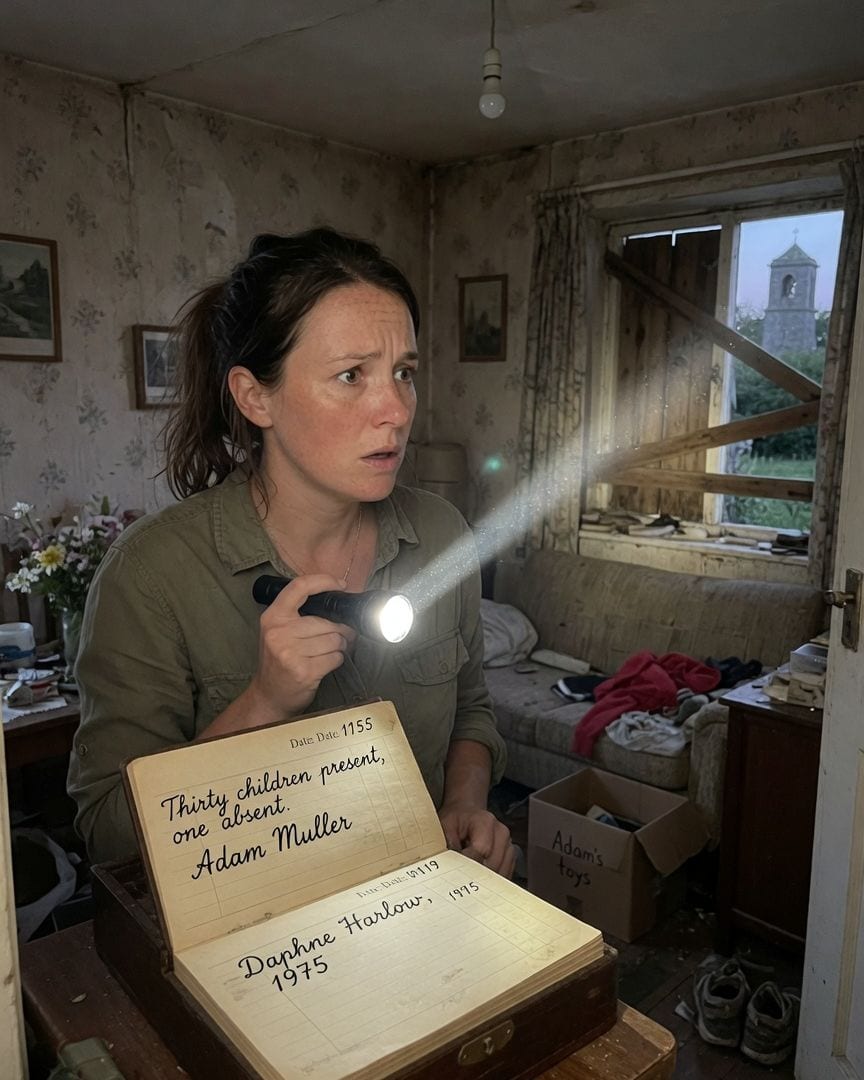
My son rang the old school bell. The attendance register, visible through the boarded window, now shows today's date and his name marked 'absent'.
We moved to a quiet village for peace, but my six-year-old son Adam found the old, boarded-up schoolhouse. Locals warned us, "Never ring the old school bell." That Tuesday, Adam rang it. Later, I saw his name on the school's long-closed attendance register, marked 'absent' in impossibly fresh ink from today.
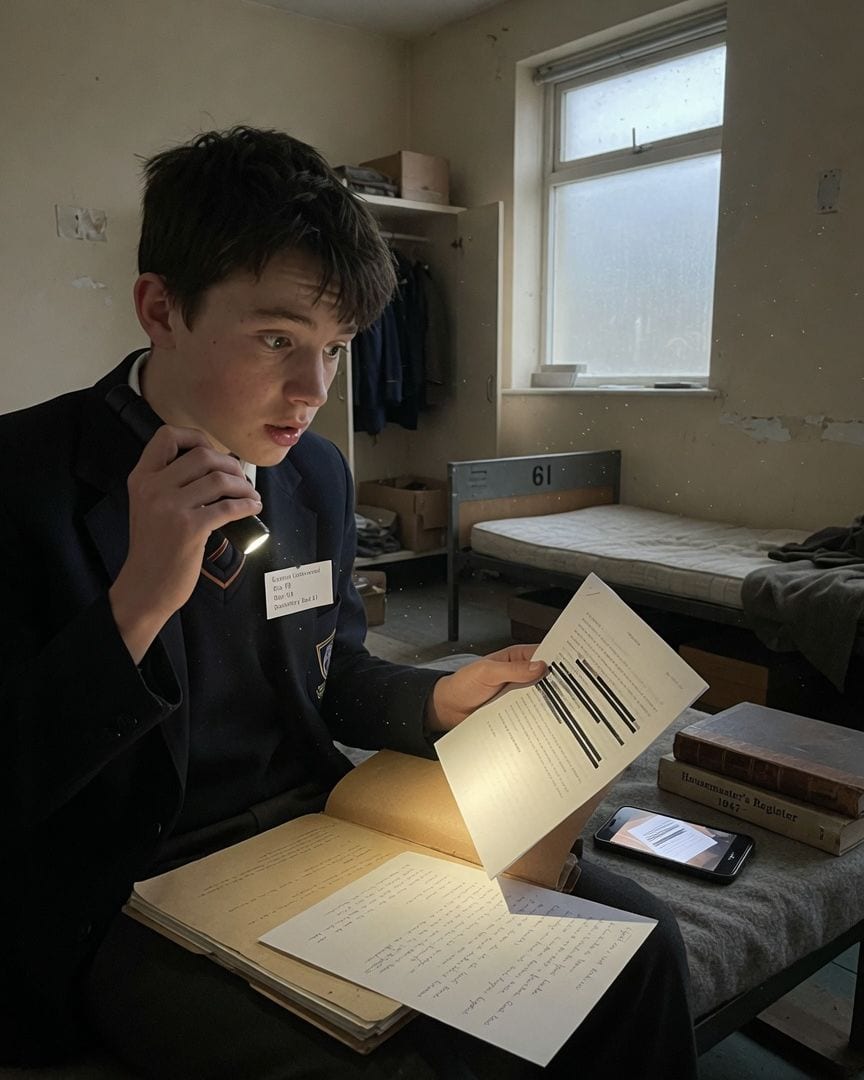
My boarding school bed number was 61, and the archive shows a boy assigned it every eight years since 1947, each leaving mid-term with the bed 'to remain made up'.
I found my matriculation card, listing me as 'Boy 61, Dormitory Bed 61.' Later, an old ledger revealed every boy assigned that bed since 1947 left mid-term, with an unsettling note: 'bed to remain made up.' Our housemaster’s recent scribble, 'as the others,' only deepened the dread around my own assigned bed.
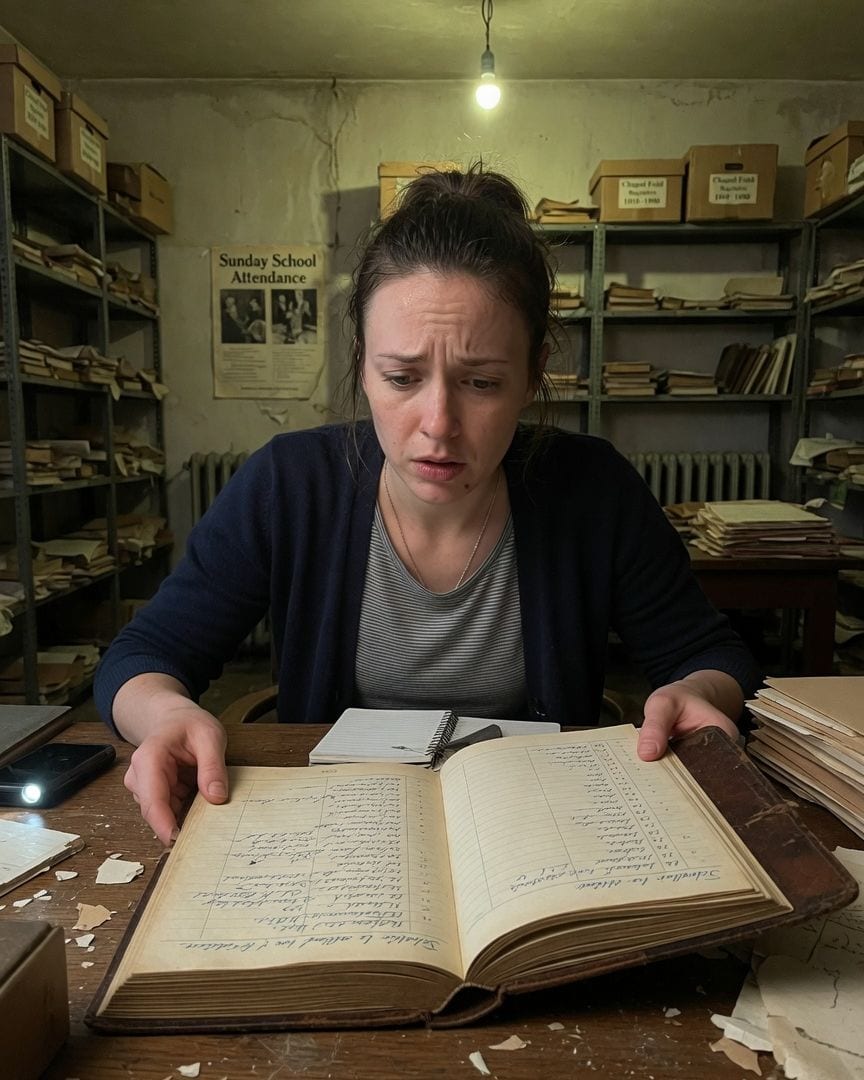
My Sunday school register shows scholar 33. Turning back, that same scholar 33 is entered every seventh year since 1907, always from my old address.
As a chapel volunteer, I found comfort cataloging old documents until a Sunday school register revealed a chilling pattern. Every seven years since 1907, 'Scholar 33' from my old address, Chapel Fold, was entered. Each entry was marked with the same curt, chilling phrase: 'ceased to attend, not called for.'

My taxi driver knew my name before I spoke, then apologized for the flight I was going to miss. I was arriving. The cab's plate was scrapped four years ago.
After a strange taxi ride, I received an unsettling birthday card addressed to me. Its return address listed 'Old Mill Road Field,' an empty lot where a mill once stood, and it was postmarked locally. The card arrived four months before my actual birthday, sparking a cold dread I couldn't ignore.
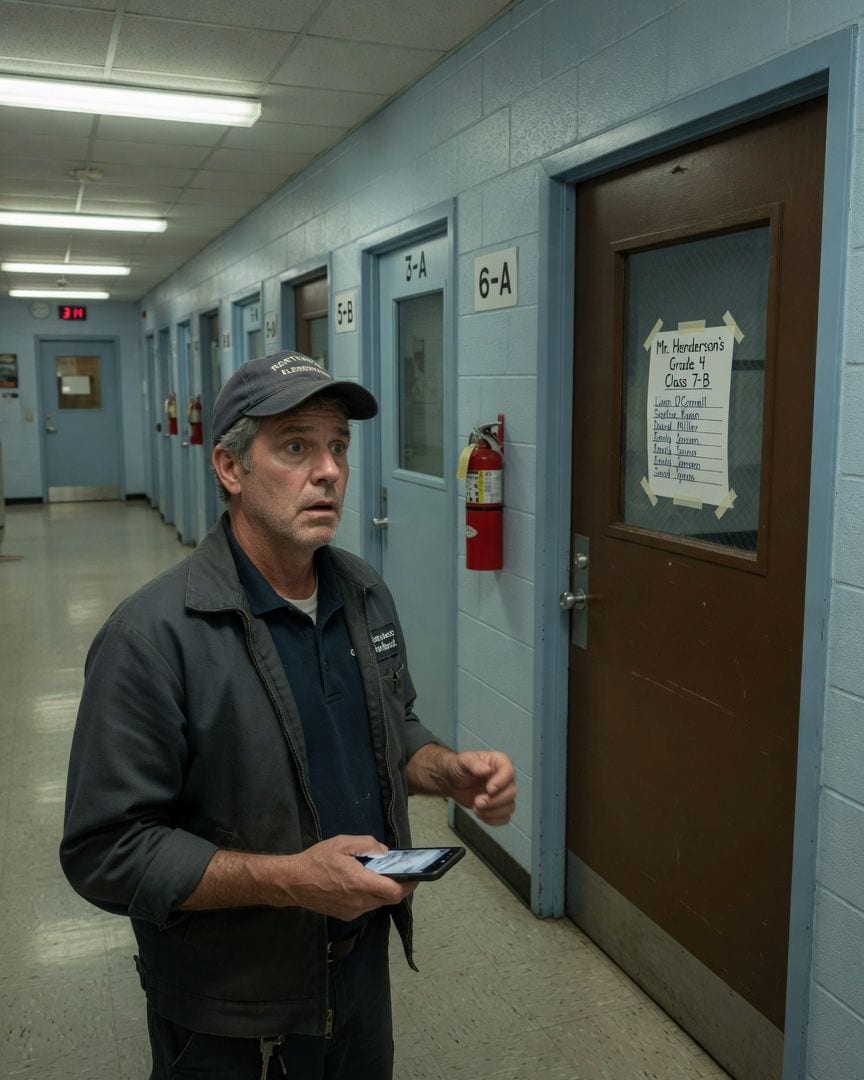
My classroom doors counted twenty-three last night. The extra one had a class list taped inside, names of children who've never been at this school.
My job as night caretaker at Northwood Elementary is routine: 22 classrooms, all accounted for. But one night, an impossible 23rd door appeared in the science block, nestled where only a wall should be. It bore a class list of students and a teacher who don't exist in any school record. Then, in an old logbook, I found that exact same list, dated 40 years ago.