My name is in the chapel's old Sunday school register as 'Scholar 33'. But 'Scholar 33' appears every seventh year since 1907, each child from the same cottage, each marked 'not called for'.
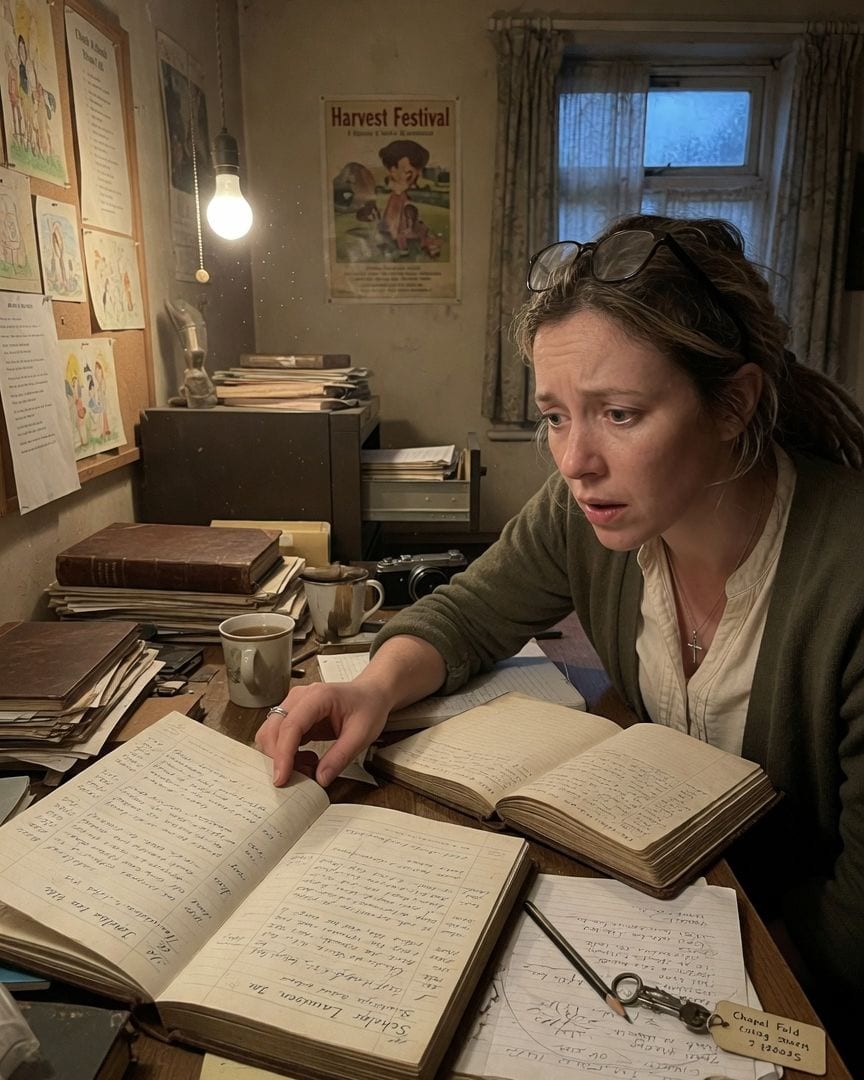
I was sorting through the Chapel Fold parish chapel's archives when I found it. A volunteer, a local history enthusiast – that’s me, Penelope Lawson, thirty years old, practical, not given to flights of fancy.
My job was to digitize the dusty, leather-bound Sunday school registers, a task that felt like a quiet journey through generations. It was soothing, at first.
I flicked through the thick pages, the ink smelling faintly of age and something sweet, like old tea leaves. Then, a name jumped out at me. My name. Penelope Lawson, entered as 'Scholar 33' for the current year.
A small prickle, like static electricity, ran up my arms. My family had only lived in Chapel Fold for a decade. I’d never attended this Sunday school. I'd have remembered. Maybe a clerical error?
A new system I wasn't aware of? I turned back the pages, looking for my sister’s name, or anyone I knew, to see if it was a recent glitch.
Instead, my eyes snagged on another entry: 'Scholar 33', dated seven years prior. A different child entirely, Charlotte Brooks. And below her name, the address: the old cottage on Chapel Fold.
My breath hitched. I flipped back further. Seven years before that, another ‘Scholar 33’, a boy named Thomas Miller, also from the same cottage. And another.
Every seventh year, stretching back, meticulously entered in clear, neat handwritings that changed with the superintendents but the entry itself remained identical: ‘Scholar 33’ from the cottage on Chapel Fold.
Each entry, without fail, was ruled off with a single, chilling note: 'ceased to attend, not called for.'
Running down the margin, in a faded but firm hand that appeared on many entries, was the superintendent’s note: 'keep 33 on the roll, mark them present.' Even my own name, the most recent ‘Scholar 33’, had the same instruction.
Keep 33 on the roll. Mark them present.
I tried to rationalize it. An inside joke, perhaps, passed down through the Sunday school staff? A numbering system that got reused for some forgotten reason?
But the consistency was too precise, the seven-year interval too exact, stretching back over a century to 1907, when the first 'Scholar 33', Constance Drummond, was entered. And always, always, the cottage on Chapel Fold.
I looked up the cottage in the chapel's historical property deeds. It was listed as a chapel-owned dwelling, though records showed it had been rented out, or at least occupied, over the decades. I needed to see it.
That evening, I drove past it. A small, unassuming stone building, tucked away from the main road, its windows dark and curtained.
It looked empty, neglected, but as I slowed, a faint wisp of chimney smoke, almost invisible against the evening sky, drifted up from its ancient stack. Someone was there.
Back at the chapel the next day, a dull, persistent ache behind my eyes, I searched for other records related to 'Scholar 33.'
The main ledgers were frustratingly bland, showing no unusual expenditures or special notes for any of the children. Just the usual receipts for hymnals and repair work. No hint of anything out of place. But the chapel was old.
So old. There had to be something more.
I started pulling out every forgotten book, every brittle document, delving into the forgotten corners of the vestry. That’s when I found it. Tucked away behind a loose floorboard, a small, unmarked, leather-bound account book.
It was older, heavier than the others, with rougher, thicker paper, smelling of damp earth and something acrid, like old iron. I pried it open, dust motes dancing in the dim light.
Inside, amidst entries for parish expenses and donations, there was a single, brief line that wasn't about money.
My finger traced a faded, spidery hand across the page. The leather of the book felt cold, despite the warmth of my skin. It was nestled between mundane records of tithes and repairs, a stark anomaly.
It read: 'Scholar 33 (1935) – Transferred, full provision made.' No 'ceased to attend.' No 'not called for.' Just a quiet, chilling finality.
The word 'Transferred' chilled me more than any simple disappearance could have. It implied agency, a deliberate act. Not someone leaving of their own accord, but someone being moved. And the 'full provision made' felt like a grim receipt.
I spent weeks cross-referencing old census records, local directories, parish archives – anything I could get my hands on – trying to trace any of the 'Scholar 33' children or their families. Each path led to a dead end.
Every family linked to the cottage on Chapel Fold simply vanished from the records after their child’s 'departure.' No forwarding address, no trace in any subsequent directories. It was like they’d never existed.
I started to notice another pattern: the cottage itself seemed to change occupants roughly every seven years, coinciding eerily with the 'Scholar 33' cycle.
One family would move in, a child would be listed as 'Scholar 33', then seven years later, the child was 'not called for', and within a year or two, the family itself was gone, replaced by new faces in the next census.
I tried talking to older villagers, mentioning the cottage and the unusual Sunday school entries. Their reactions were immediate, unsettling. Eyes would flicker away, gazes dropping to their teacups or the patterns on the chapel floor.
'Some things are just the way they are, dear,' one old woman murmured, her voice tight, quickly changing the subject to the price of milk.
Another, Martha, who’d lived in Chapel Fold her whole life, just shook her head, a worried line appearing between her eyebrows. 'Best not to stir up old dust, Penelope. Some things are best left alone.'
I didn't listen. I found an archived newspaper clipping from the 1970s. The Chapel Fold Gazette, yellowed and brittle, reported on the sudden 'relocation' of a family from Chapel Fold – the Brooks family.
Charlotte Brooks, the ‘Scholar 33’ from 1968, was their child.
The article mentioned the family moving 'for personal reasons,' but the tone was strangely sterile, almost dismissive of a family simply vanishing from the community they’d been part of for years.
I tracked down the local reporter, now retired and living in a nursing home. He had no further information, only a vague memory of the story being 'closed quickly,' a phrase he repeated with a shake of his head.
He couldn’t recall who had asked him to close it.
My inquiries didn't go unnoticed. Victor Crane, the chapel's long-serving elder, a man in his early seventies with a perpetually calm expression and an air of quiet, unshakeable authority, approached me a few days later.
I was sifting through dusty property deeds in the chapel office, the light dim and heavy with the smell of old paper.
'Still delving into our little histories, Penelope?' he asked, his voice smooth, devoid of any genuine curiosity, almost a practiced courtesy. The sound of it made the air in the room feel suddenly cooler.
I explained my fascination with the 'Scholar 33' entries and the Chapel Fold cottage, trying to sound as academic and detached as possible. Victor listened, nodding slowly, his gaze unwavering, resting on me with an unnerving stillness.
His eyes were kind, but they held an ancient knowledge, like deep, still water.
'Ah, yes. A long-standing tradition,' he said, as if discussing a flower festival or the annual bake sale. He picked up a stray fallen leaflet from my desk, smoothing it flat.
'Some things, you see, are best left filed away, dear. For the peace of mind of all involved.'
He then offered me access to the chapel's oldest, most meticulously organized ledgers, a trove of records he assured me would 'answer all her questions.'
But his eyes, though still kind, held a depth of quiet knowledge that sent a shiver down my spine. He didn't threaten, he simply knew, and his composure was far more unsettling than any anger could have been.
It was the calmness of someone who understood everything, and found it perfectly normal. Later that week, I found the cottage on Chapel Fold, which had seemed empty for so long, now had its porch light on at odd hours.
One night, I saw a figure silhouetted in the window, watching the road, just for a moment, before receding into the shadows. I couldn't make out who it was. But I wondered if it was Victor.
Unsettled by Victor's unnerving calm and the shadowy figure at the cottage, I decided I couldn't let it lie. I had to confront him directly.
I found him in the chapel's small, perfectly manicured garden, tending to rose bushes with meticulous care. The air was thick with the scent of damp earth and blossoms.
'Mr. Crane,' I began, my voice steady despite the tremor in my hands. 'I've been looking into the 'Scholar 33' entries. And the families from Chapel Fold. They don't just 'cease to attend.' They vanish.'
Victor straightened slowly, wiping his hands on a pristine linen cloth he’d tucked into his waistband. He looked at me, his gaze unhurried. 'Vanish? A strong word, Penelope. They are... relocated. For their well-being. For the well-being of the parish.'
His tone was unwavering, as if he were reciting a catechism. 'The chapel has always taken its responsibilities seriously. Generations have benefited from our care.'
'What care?' I pushed, feeling a cold knot tightening in my stomach. 'What happened to Charlotte Brooks, to Constance Drummond, to all those children? To their parents?'
Victor sighed, a sound of weary patience, as if explaining a complex but obvious truth to a slow student. 'They are looked after. Provided for. It is an arrangement that ensures balance, a certain... harmony for Chapel Fold. The land.
The people.' He turned and led me back inside the chapel, the heavy oak door closing softly behind us, muffling the birdsong from the garden. He walked to a locked cabinet, older than any other furniture in the vestry.
From it, he retrieved a slim, unmarked folder, tied with a faded red ribbon.
Inside was a single document, yellowed with age, brittle at the edges, but clearly a formal agreement. It was dated 1907, the very same year the 'Scholar 33' entries began.
It detailed a 'Covenant of Generational Offering' between the Chapel Fold parish and the occupants of the cottage, outlining a 'transfer of stewardship' for a designated child every seven years. The legalistic language was dense, chilling.
'This,' Victor stated, tapping the document with a perfectly manicured finger, 'is how we ensure the prosperity and peace of our community. A necessary provision.'
I stared at the cold, bureaucratic language, the terms 'stewardship' and 'provision' echoing in my mind, twisting every mundane detail I’d found into something monstrous.
The 'Transferred' entry in the old account book, the vanishing families, the superintendent's note to 'keep 33 on the roll, mark them present.' It wasn't a joke, or an error, or a coincidence.
It was all an elaborate, century-old system, managed by the chapel itself, right under everyone’s noses. My own name on the register, 'Scholar 33,' felt like a branding iron suddenly searing my skin.
Victor, seeing my dawning horror, offered a thin, almost sympathetic smile. The corners of his eyes crinkled. 'There's more, of course. For those who manage the arrangements.'
He gestured to a heavy, leather-bound ledger lying open on his desk, an older, more personal volume than the chapel records I’d been sifting through.
It looked almost identical to the one I’d found behind the floorboard, but this one was immaculately kept. 'My family has kept this for generations. A record of... all aspects.'
My hand trembled as I reached for it, a terrible premonition coiling in my gut. Victor didn't stop me.
The ledger was filled with the familiar 'Scholar 33' entries, but alongside them, in a separate column, were the names of the children's parents.
Each parent's name was followed by a date, often just a few months after their child's 'departure,' and a small, cryptic symbol I didn't recognize. A circle with a cross through it, like a tiny, stylized 'X'.
I turned to the final page, my fingers clumsy. It lay open before me. Below the last 'Scholar 33' entry, my own name was written in Victor’s precise hand. Penelope Lawson. Followed by a date just three months from now.
And that small, unadorned symbol I didn't recognize. Below it, the names of my own parents, David and Eleanor Lawson, with dates six months after mine, and the same symbol repeated.
I stared at my name, then my parents' names, the dates, the chilling symbol – that circle with the cross. My throat was suddenly dry, constricted. 'What is this?'
I whispered, my voice barely audible, a ragged breath escaping my lungs.
Victor leaned forward, his calm breaking only slightly to reveal a flicker of something ancient and weary in his eyes. 'The 'Covenant of Generational Offering' isn't just for the child, Penelope. It’s for the line.
The family that occupies the cottage on Chapel Fold offers a 'steward' every seven years. And in return for the parish's continued prosperity and protection… the lineage is folded back into the fold.'
He pointed to the symbol next to my parents' names with a steady finger. 'That symbol signifies 'absorption.' The parents, too, are 'relocated,' their lives quietly ended, their existence erased from public record.
It ensures the offering is complete, the cycle unbroken. Your parents, Penelope, moved into the cottage just over a decade ago. They became part of the arrangement when you were designated 'Scholar 33.' It is a quiet, necessary process.
The chapel has managed it for centuries.'
He didn't gloat, he didn't even seem cruel. He simply stated facts, like reading from a history book.
He opened a larger, even older, parchment document from the cabinet, its script faded but legible, detailing the full terms of the 'tithe of lineage' dating back to the 1700s, signed by previous chapel elders and the 'Cottage Keeper.'
It spoke of 'sustaining the land' and 'preserving the peace' through 'sacrificial stewardship.'
Every clue, every vanished family, every 'not called for' child, every quiet word from Victor, every evasive glance from the villagers, clicked into place with horrifying coherence, forming a picture of centuries-old institutional horror. My family. My parents. Me.
I pushed back from the desk, the ledger falling open with a soft thud. 'No. I won't let this happen. To me, to my parents.' My voice came out as a desperate, ragged gasp.
Victor merely shook his head, his face a mask of serene finality. 'The covenant is ancient, Penelope. It cannot be broken. Not without consequences for all of Chapel Fold.'
He gestured vaguely out the stained-glass window towards the quiet village, the sunlight painting colored streaks on the dust motes in the air. The implication was clear: break the covenant, and untold disaster would befall everyone.
'The date for your transfer is set. Your parents' provision is arranged.'
A cold dread settled in my bones, heavier than any fear I’d ever known. I was Scholar 33, and the institution was an immovable, quiet force, rooted deeper than any of the ancient stones of the chapel.
I couldn't fight centuries of tradition, nor could I expose it without endangering everyone I knew in Chapel Fold. There was only one choice, the one they left you.
'I'm leaving,' I stated, my voice firm despite the tremor in my hands. 'I'm leaving Chapel Fold, tonight. And I'm never coming back.'
Victor's calm smile returned, a faint, knowing curve of his lips. 'As you wish, dear. But the covenant… it always finds a way. The cottage will always have an occupant. And 'Scholar 33' will always be on the roll.'
He watched me gather my things, his eyes following my every move as I backed out of the chapel, into the twilight.
I glanced back one last time, seeing him standing framed in the chapel doorway, a serene, ancient figure overseeing a ritual I could only escape by severing myself entirely from my life, from my family, from everything I had known.
Penelope left Chapel Fold that night. She never returned. Her cottage, still legally hers, remained empty for months before the chapel quietly took ownership, citing an obscure clause in the old property deeds, long since signed by previous ‘Cottage Keepers’.
Her parents, confused and upset by her sudden departure, eventually 'relocated' from Chapel Fold, as Victor’s ledger had predicted. Their new address was always vague, their phone numbers disconnected.
Eventually, their names, too, faded from Penelope's contact list, replaced by a deep, aching silence.
The chapel continues its work, its bells ringing out across the quiet valley, the cottage on Chapel Fold once again occupied by a young family, oblivious to its history.
Years pass. Penelope lives far from Chapel Fold now, a quiet life, haunted only by dates on a calendar. Every seventh year, she feels a cold unease, a phantom echo of the cycle.
She avoids all news from the valley, but sometimes, a small detail catches her eye: a local newspaper from a nearby town, reporting on a new family moving into a quaint stone cottage.
A young child, their face beaming, is pictured on the porch. The address is always different, but the feeling is the same. She knows the chapel's reach extends further than she could have imagined, its influence a quiet, creeping tendril.
She is safe, for now. But 'Scholar 33' is always on the roll, somewhere. She sees the child’s bright eyes, and she knows. The cycle continues, quiet and unbroken.
If this one got to you
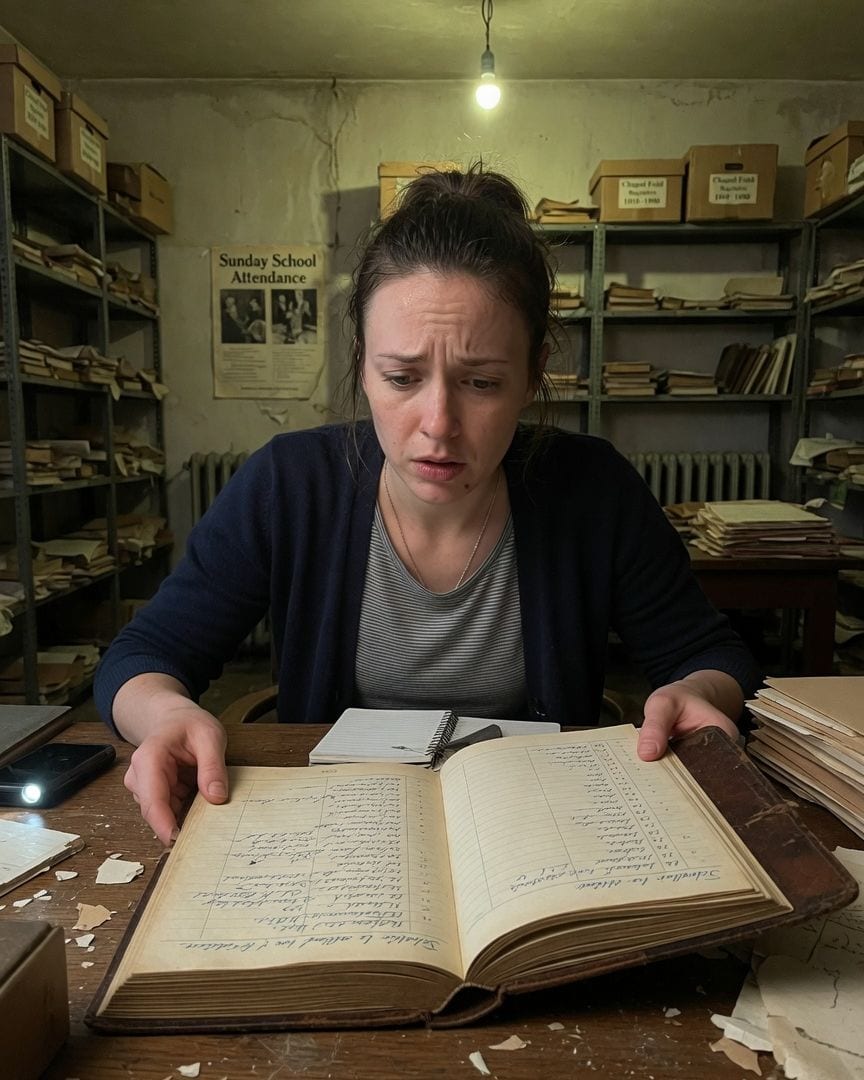
My Sunday school register shows scholar 33. Turning back, that same scholar 33 is entered every seventh year since 1907, always from my old address.
As a chapel volunteer, I found comfort cataloging old documents until a Sunday school register revealed a chilling pattern. Every seven years since 1907, 'Scholar 33' from my old address, Chapel Fold, was entered. Each entry was marked with the same curt, chilling phrase: 'ceased to attend, not called for.'
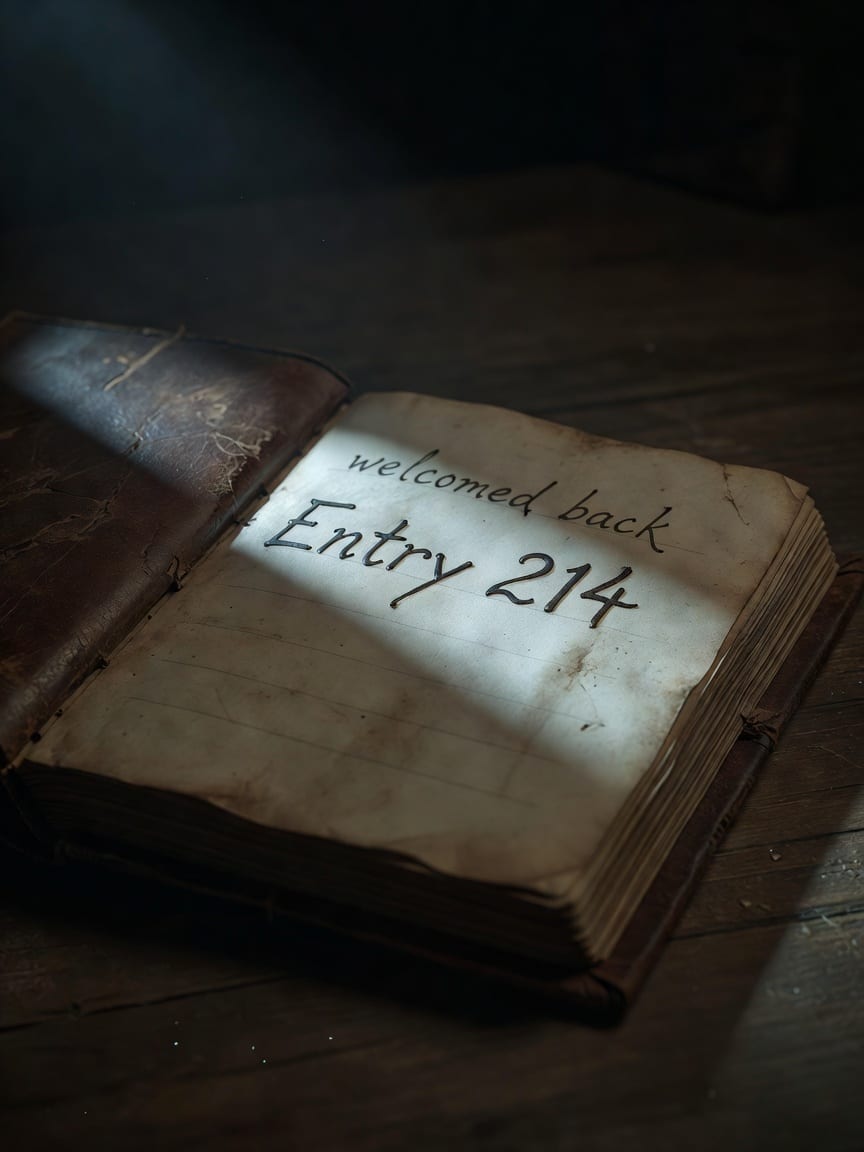
My hand traced the ink of 'welcomed back' beside Entry 214 in the old baptism register. It was the same entry number, used for a christening every seventeen years, inked over and over. Someone had been managing this for over a century.
As the new keeper of my village church's baptism register, I found solace in its unchanging ritual. But when I opened the heavy volume to Entry 214, I saw it was inked over an older, identical number. I soon discovered this specific entry had been used every seventeen years since 1873, each time with the same cryptic note: 'welcomed back'.
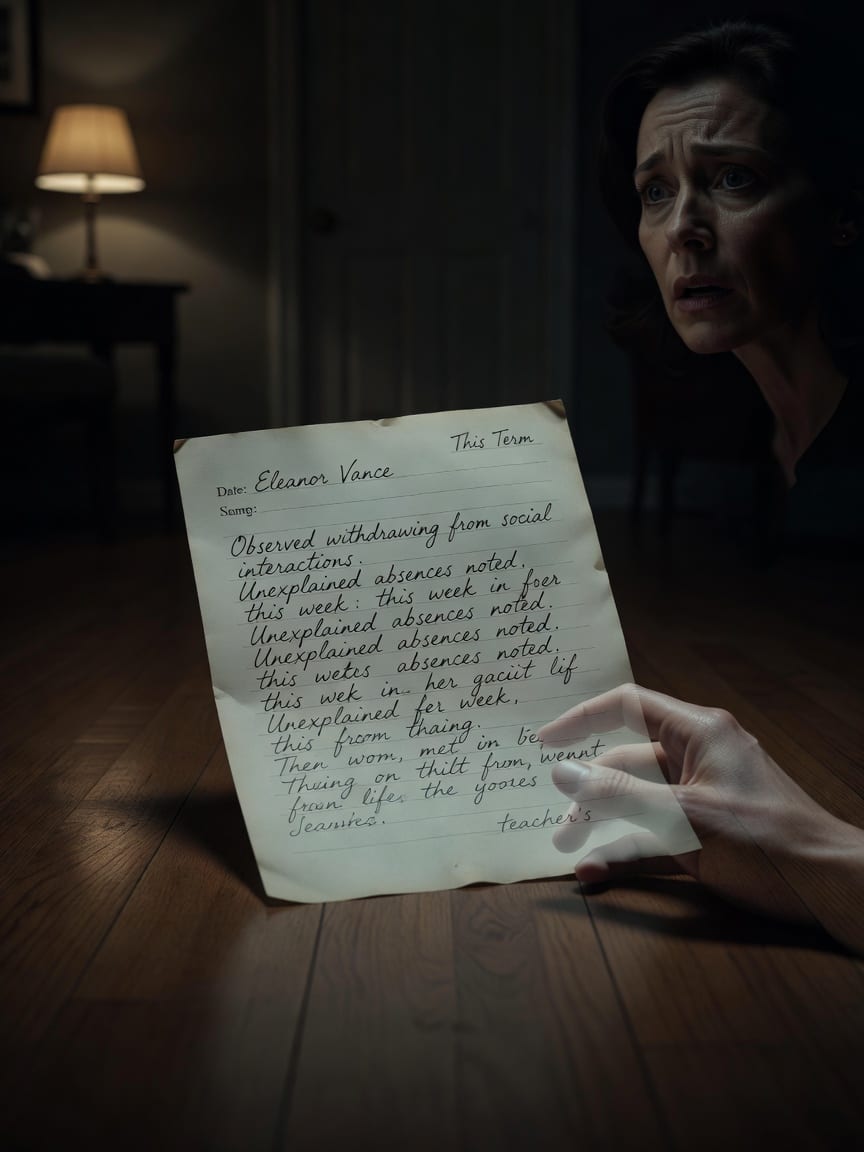
My school reports keep arriving, one a term, signed by teachers dead for decades. The latest describes something I'm doing *this week*.
My name is Eileen Caldwell, and my quiet life was upended by a school report from a place demolished decades before I was born. The report, signed by a long-dead teacher, eerily detailed my current habits. But the real shock arrived when I found my own name in a student register, dated 1968, with precise descriptions of my childhood—years before I existed.
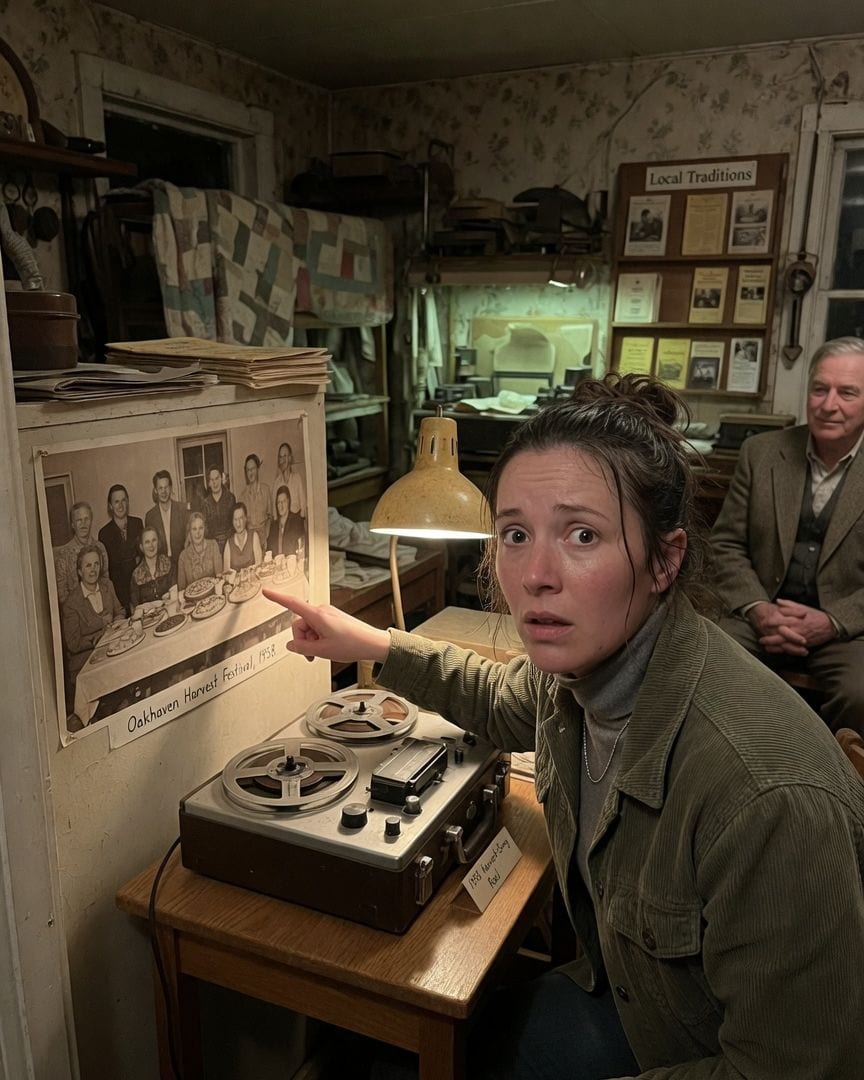
The folk museum's harvest tape counts one more singer than the photograph shows. The curator turned the recorder off before playing it.
I found a quiet escape at Oakhaven's dusty Folk Museum, where the curator played a rare 1958 harvest song. But as a cheerful tune filled the room, a low voice began to count. The tape tallied thirteen, yet the old photograph beside it showed only twelve smiling villagers.
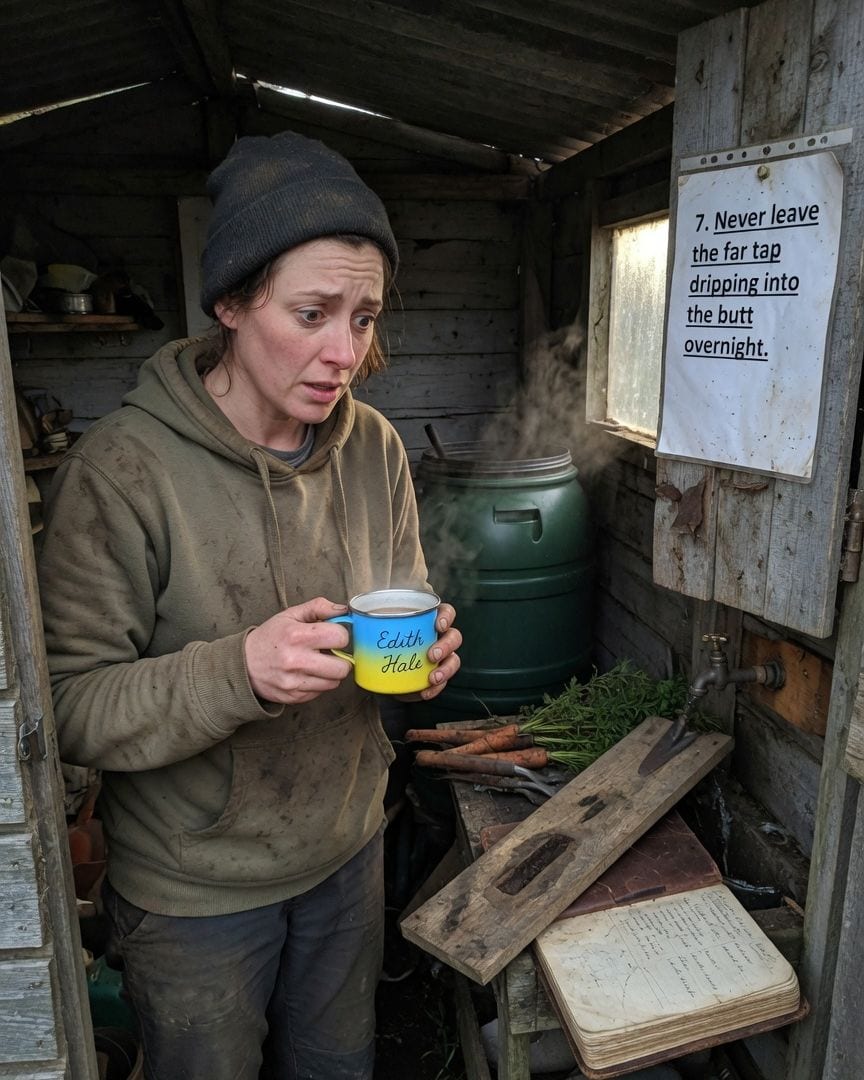
The one night I left the tap dripping, my allotment water butt was full to the brim and warm to the touch — with a child's unrusted tin cup floating on top.
Moving to Blackwood, I hoped my allotment would be a fresh start. But the shed's rulebook warned, 'Never leave the far tap dripping.' One morning, my water butt was full and steaming, an unnerving warmth rising from it. Inside, a child's tin cup floated, unrusted, etched with the name 'Edith Hale'.
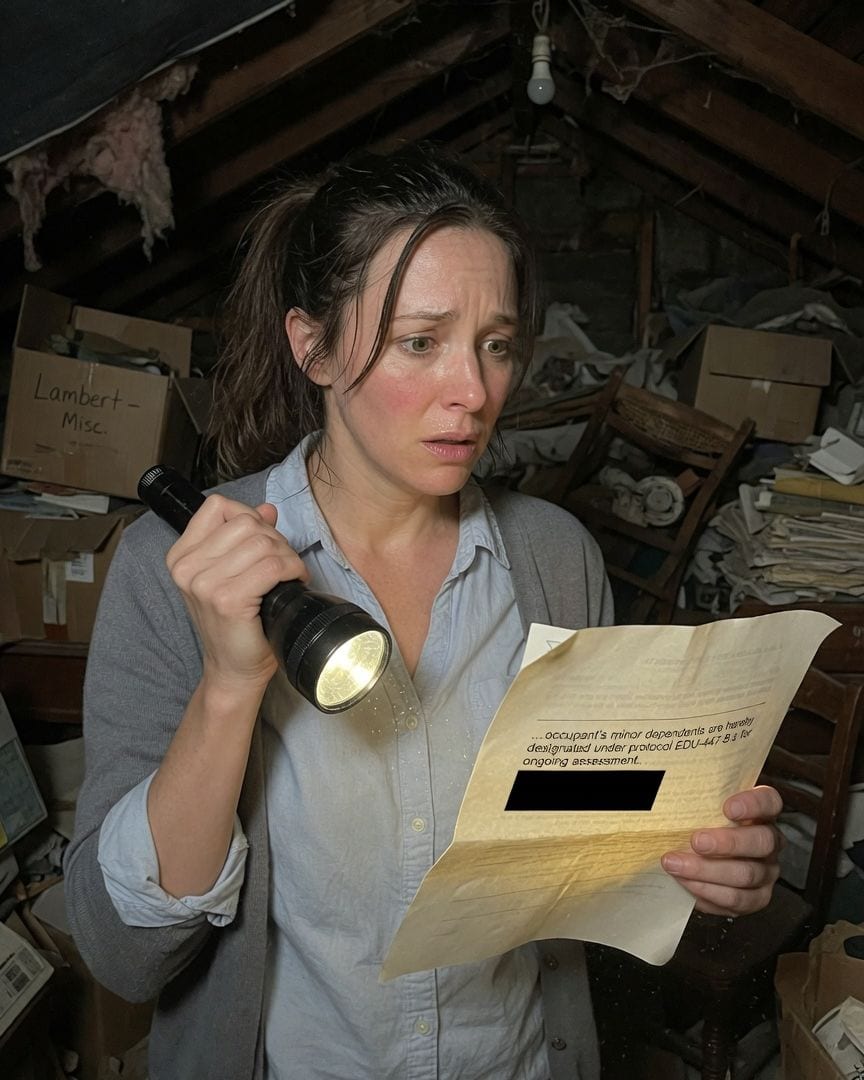
My county archive digital file has a redacted line from 1901, marked 'recurs each generation.' The address? My house. The instruction number? My son's school registration.
Searching mundane county archives, I found a 1901 school log entry for my house, Church Lane, No. 17. A perfectly blacked-out line, marked as 'Withheld – recurs each generation,' pointed to a code Monica at the Education Office used when registering my son. Then, in our attic, I found an identical blacked-out line on an old property notice, designating 'minor dependents' under the same code.