My name was on a package lodged in 1974. I wasn't born until 1985. Inside was a key and a note: 'You know which door. Not yet.'
My name is Elena Radcliffe. I’m 38. Or I was, until recently. I'm writing this down because I don't know who else to tell, or if anyone will even see it. But I need to say what happened.
I need to make a record.
The solicitor's letter arrived on a Tuesday, crisp and official, requesting my presence to collect a package. My name, Elena Radcliffe, was printed clearly at the top.
It was the next line that snagged me: 'lodged with the firm for safekeeping until the addressee should call.' And then the date: 'since 1974.' My stomach dropped. I was not born until 1985.
I reread it, thinking it had to be a typo, a joke. But the letterhead was genuine: Vance & Holloway, Solicitors. An old, established firm in the city.
I called them, half-expecting a confused receptionist to tell me it was an error. Instead, a polite voice confirmed the appointment.
Two days later, I found myself in their offices, which smelled of old paper and polished wood, the kind of place where time moved slower.
Roland Vance, the solicitor, was exactly as I’d imagined: impeccably dressed, polite, almost apologetic about the unusual circumstances. He confirmed the letter's details with a slight, almost imperceptible shrug. "It's highly unusual, Ms. Radcliffe, I agree.
But our records are clear." He then sent me to Alice Sinclair, a young clerk, to retrieve the item from the strongroom.
Alice returned moments later, holding a small, sealed envelope. My name was scrawled across it in an elegant, old-fashioned copperplate hand, the ink faded to sepia. The paper itself felt thick, substantial, unlike anything modern.
I broke the seal, my fingers fumbling. Inside, nestled against thick cardstock, was a single, heavy key—dark, ornate iron, clearly antique. Beneath it, a folded note. I unfolded it, my fingers trembling slightly.
The same copperplate script read: 'You know which door. Not yet.'
I stood there, the cold weight of the key in my palm, the words echoing in my head, feeling a chill that had nothing to do with the strongroom's temperature.
The air in the reception area, which moments before had felt merely cool, now seemed to press in, heavy and still.
Back in my apartment, the key felt alien. I tried it on every lock I owned—my front door, my old jewelry box, a dusty antique cabinet I’d inherited. Nothing. It didn’t fit. The note’s confident assertion—'You know which door'—mocked me.
I tried to rationalize it. A family heirloom? A distant relative I’d never known? But my family was small, no one with money or a penchant for cryptic messages. And why 1974?
I started to research Vance & Holloway, just to confirm they were real, that this wasn't some elaborate prank. They were very real, established for generations, their history stretching back further than I’d imagined.
But when I tried to trace the package's original sender, or any address associated with the note’s implied origin, I hit a wall. The firm’s records only stated 'Lodged by prior arrangement.' No name, no address for the sender.
It was a dead end.
I then focused on the year: 1974. I dug through online archives of local newspapers, searching for anything unusual from that era, anything connected to the firm or my surname.
It took hours, sifting through microfilm scans and digitized tabloids, my eyes blurring. But then I found it: a small article from the local gazette, dated October 1974. 'Local Woman Vanishes Without a Trace.'
The name leapt out at me: 'Elena Radcliffe.'
The article described a woman, aged 25, who had disappeared from her home in the outskirts of town, leaving no note, no sign of struggle.
Her neighbors reported her as quiet, polite, a 'creature of habit' who simply failed to return one day. The address listed was for a house on Old Mill Lane. I cross-referenced it with current maps.
Old Mill Lane still existed, but the numbers didn't go that high. A quick check of historical zoning maps revealed why: the house at that address had been demolished in 1978 to make way for a small, undeveloped park.
Now, it was just an empty, overgrown field.
The next morning, driven by a growing, unsettling compulsion, I visited the local historical society. The building itself felt like a tomb of forgotten stories, air heavy with dust and the smell of old paper.
I requested their archives for Old Mill Lane, specifically the period around 1974. An archivist, an older woman with kind eyes, brought out a heavy box of photographs and local records.
I sifted through them, my heart thrumming with a strange mix of fear and anticipation.
And then I found it: a faded, sepia-toned photograph, labeled 'Old Mill Lane, circa 1973.' It showed the very house from the news clipping, a small, unassuming cottage with a porch swing.
Standing in the front garden was a young woman, smiling, her face clearly visible: the 1974 Elena Radcliffe. She had kind eyes, just like the archivist, and her dark hair was styled in a popular cut of the era.
But in the background, partially obscured by a large oak tree and the photograph's own age, a second figure stood.
Its face was indistinct, shadowy, like a smudge on the old film, but its posture, the length of its hair, the way it held its head—it was unmistakably, chillingly, like me.
The photograph haunted me. I couldn't shake the image of that shadowy figure, so like myself, standing in a picture taken years before I was born. It felt like a violation, a premonition, or something worse.
I tried to dismiss it—a trick of the light, a common silhouette, my mind playing games. But the feeling persisted, a cold, sharp claw in my gut.
I returned to the historical society, determined to find more about the 1974 Elena Radcliffe. Her file was thin: birth certificate, school records, a few tax documents. No family, no close friends listed. Just a quiet life that abruptly ended.
The archivist, a different one this time, mentioned an odd local legend as I was signing out the file. "People used to talk about the 'Letters From Nowhere' around Old Mill Lane," she said, without looking up from her cataloging.
"Letters arriving for the old residents, postmarked from places that didn't exist, or from the house itself after it was empty. They said the last lady there, the one who vanished, got them all the time." My blood ran cold.
The postmark for my own solicitor's letter hadn't specified an origin beyond the city, but the package had been 'lodged.' Was this a similar communication?
I asked the archivist if she knew anyone who lived near Old Mill Lane back then, anyone who might remember the 'other' Elena. She gave me the name of Gordon Mitchell, an elderly man who’d owned the general store nearby.
"He's a bit of a recluse," she warned, "but he remembers everything."
I found Gordon Mitchell’s address in an older part of town, a small, well-kept bungalow surrounded by a riot of roses. The air was still and warm, heavy with their scent.
He answered the door slowly, his eyes sharp and clear behind thick spectacles, taking me in with a steady gaze that seemed to miss nothing.
Gordon Mitchell listened patiently as I recounted the solicitor's letter, the key, the note, and my discoveries about the previous Elena Radcliffe. He nodded occasionally, his expression unreadable. I felt a prickle of unease.
He didn't seem surprised, or even particularly concerned. His calm was more unnerving than any shock.
When I mentioned the 'Letters From Nowhere,' a faint, knowing flicker passed through his eyes, but he said nothing, just gestured for me to continue.
As I left his house, a sense of being watched settled over me, prickling the hairs on my neck. I dismissed it as paranoia, a side-effect of my research, the oppressive quiet of the street exaggerating my fears.
The next morning, however, a new letter arrived in my mailbox. It was perfectly typed, no return address, just my name, 'Elena Radcliffe,' in stark, block capitals.
The postmark was smudged, but I could make out 'Old Mill Lane' and a date from yesterday. My blood ran cold. The demolished field. I tore it open. 'Stop looking,' it read.
'You are not the first, nor will you be the last. Your time will come.'
It then referenced a detail I hadn't shared with anyone but Gordon Mitchell—a specific phrase from the solicitor's letter I’d quoted to him about the package being 'lodged for safekeeping.' My heart hammered against my ribs. Someone knew.
Someone was watching me. And they knew exactly what I was looking for, and who I had spoken to. The letter wasn't a random threat; it was targeted, intimate, and chillingly precise.
The dread tightened its grip, turning from abstract wrongness to a living, breathing presence aimed directly at me.
I raced back to Gordon Mitchell's house, the warning letter clutched in my hand, the crisp paper crinkling with every panicked step. He opened the door, his placid expression unchanged, as if he'd been expecting me.
"You received a letter," he stated, not a question. "I told you he remembers everything," he added, referring to the sender. "He's been watching for a long time." The roses outside seemed to shiver in a breeze that wasn't there.
My voice was hoarse. "Who is 'he'? What is this? The letter, the other Elena Radcliffe... why my name?"
Gordon sighed, a deep, weary sound. "Sit down, child. There's much you need to understand."
He poured two cups of herbal tea, the steam rising in lazy coils, his movements slow and deliberate, as if he had all the time in the world. "The name 'Elena Radcliffe' is not just a name, dear. It's...
a designation. A role." He explained that the 'Elena Radcliffe' who vanished in 1974 wasn't unique. "She was the previous keeper. Just as you are the current one."
My mind reeled. "Keeper of what?"
"Of the door," he said, his eyes fixed on mine, unwavering. "The door from the note. It’s on Old Mill Lane, where the house used to be. Not a physical door, not anymore. But a threshold.
A place where things… cross over." He explained that the 'Letters From Nowhere' the previous Elena received weren't warnings from a person, but communications, instructions from whatever lay beyond the threshold. "When her time was done, she fulfilled her role.
She passed through. Her disappearance was not a tragedy, Elena. It was an obligation met." He looked at me, a flicker of genuine sorrow in his eyes. "I'm sorry, Elena. I should have warned you when you first came.
But it's not my place to interfere with the calling." The silence in the small room felt vast, heavy.
The pieces began to click into place with a horrifying inevitability: the package lodged for safekeeping, the key, the note, the demolished address, the vanishing act of a previous namesake.
It all pointed to a predetermined destiny, an inescapable pattern I had stumbled into, or rather, been chosen for.
Gordon saw the dawning horror in my face. "This isn't new, Elena," he said softly. "It's been happening for a very long time."
He rose, slowly, and went to an old, dark wooden chest in the corner of his living room. The wood creaked faintly as he knelt.
He unlocked it with a tiny, intricate key, revealing a single, heavy object wrapped in worn velvet.
He unwrapped it, revealing a large, leather-bound ledger, its pages yellowed with age, its cover embossed with a symbol I couldn't quite discern in the dim light. He carried it carefully to the table and laid it open.
The pages were filled with elegant, uniform script, each entry a name, and a date. And every single name was 'Elena Radcliffe.'
My breath hitched. He pointed to the earliest entry, his finger tracing the copperplate. "Elena Radcliffe, 1688."
He then slid his finger down the page, past dozens of entries, each followed by a cryptic notation: 'Passage Taken,' 'Watch Transferred,' 'Duty Fulfilled.'
His finger stopped at the bottom of the last page, at the most recent entry, the ink still seeming fresh. My own full name, identical. It was waiting for its own notation.
Gordon explained the ledger. "This is the record of the Keepers, Elena. The 'Elena Radcliffes' throughout the centuries. Each one chosen, each one given the key, each one tasked with tending the threshold."
He described the threshold not as a physical gate, but a fragile point between worlds, a tear in the fabric of reality that periodically threatened to widen. "The house on Old Mill Lane was built over it, a focal point.
When it was demolished, the door didn't vanish, it simply became less anchored. More volatile." The 'Letters From Nowhere,' he revealed, were communications from the 'other side,' not malevolent, but insistent.
"They tell the Keeper when the door stirs, when it needs tending. Sometimes, when a Keeper's time is done, they call for her to pass through, to maintain the balance from within."
He looked at my antique key, now warm in my hand, the metal strangely alive. "That key, Elena, is not for opening a lock. It is a focus. A symbol of your authority, your connection to the threshold.
It will guide you to the door when it is time." He confirmed the figure in the photograph was indeed a manifestation, a 'pre-echo' of the next Keeper, appearing to witness the previous transfer.
The terror wasn't just in being chosen, but in the chilling coherence of it all. Every strange detail, every impossible clue, now slotted perfectly into this ancient, terrifying pattern.
My life, my name, had been a path laid out centuries ago.
I left Gordon Mitchell's house in a daze, the ledger's weight pressing into my mind, its dark cover a shadow behind my eyelids.
The key felt heavy in my pocket, no longer just a curiosity but a burden, a burning ember against my skin. The world outside felt thin, translucent, as if the veil Gordon spoke of was everywhere.
I knew what I had to do. The compulsion was no longer subtle; it was an undeniable, terrifying current pulling me.
I drove to Old Mill Lane, to the empty field where the house once stood.
The afternoon sun was warm, but a peculiar chill emanated from the center of the field, a patch of ground where the weeds seemed to grow thicker, darker, as if fed by something unnatural.
I walked towards it, my steps deliberate, one foot in front of the other, each one an act of surrender.
The key, clutched in my palm, began to vibrate, a low hum resonating through my bones, a deep, resonant tone that seemed to speak directly to something ancient within me.
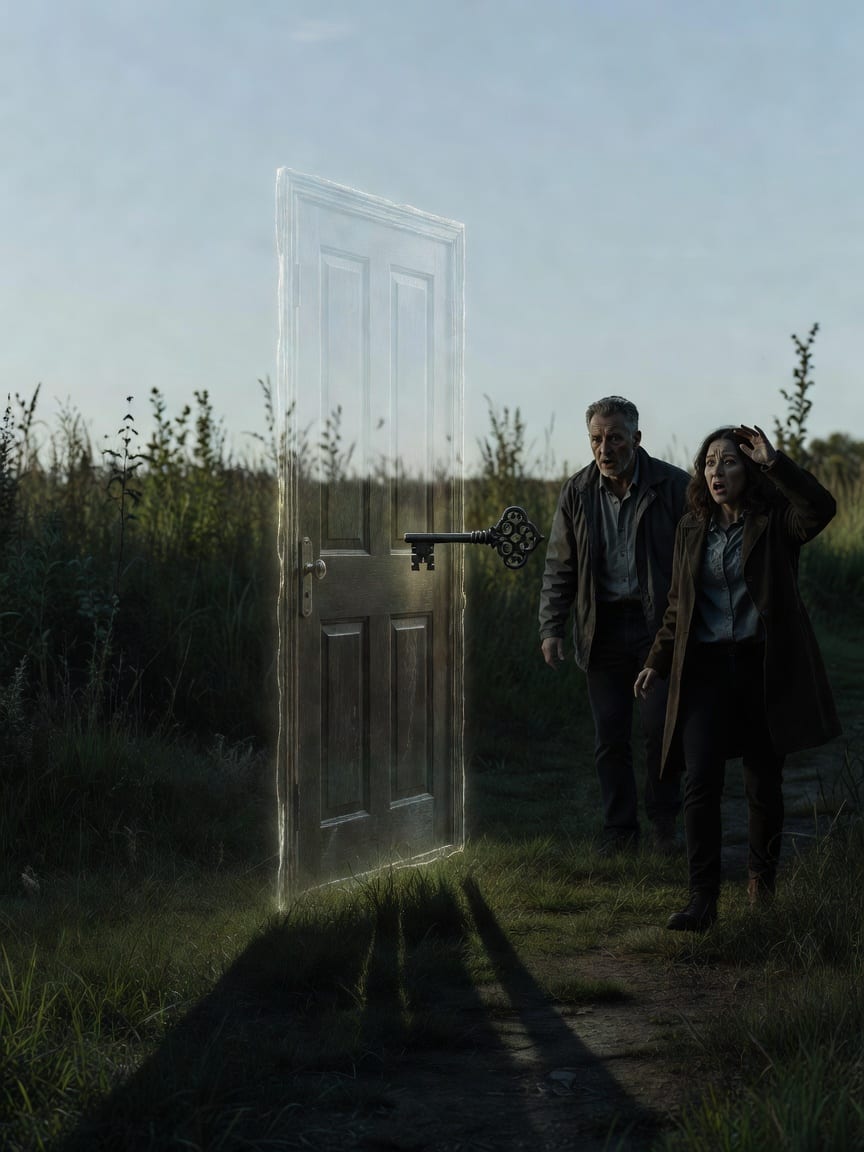
As I reached the cold patch, the air shimmered, like heat haze on a summer road, but denser, more defined, a ripple in space.
Before me, an outline began to form, faint but unmistakable: the shape of a tall, narrow door, its frame etched in shimmering, ethereal light. No hinges, no handle, just the impossible suggestion of an opening.
The hum intensified, a low thrumming that seemed to vibrate inside my skull. The key in my hand grew hot, almost burning, as if it had found its true purpose.
I raised it, and it seemed to pull towards the shimmering doorway, aligning itself with an unseen lock, a perfect, inevitable fit. The note's words echoed: 'You know which door. Not yet.' But now, I knew. It was time.
A faint, almost imperceptible whisper brushed against my ear, a voice that used my name, calling me forward.
I felt an irresistible pull, a terrible intimacy with the shimmering form before me, a feeling of coming home to a place I had never known.
My breath caught, and I took one last look at the world behind me, the familiar trees, the distant houses, the mundane reality I was leaving behind. Then, I stepped forward.
Elena Radcliffe vanished. Her apartment was found impeccably clean, rent paid months in advance, no sign of forced entry or struggle. Her phone, wallet, and keys were all found neatly placed on her kitchen counter.
The solicitor's letter, the old photograph, the warning note—all were gone. Gordon Mitchell, when questioned, simply stated she had 'gone where she was meant to go,' offering no further explanation. The police investigation yielded nothing.
The case went cold, another quiet disappearance in a world too busy to notice the subtle, unsettling patterns beneath its surface.
Weeks later, a solicitor's letter arrived at the Radcliffe family home. It was addressed to 'Elena Radcliffe,' in the familiar copperplate hand.
It informed her that a package had been lodged with the firm 'for safekeeping until the addressee should call.' It had been in their strongroom, the letter said, since last month.
Her mother picked up the letter, her brow furrowed in confusion. "Another one," she mumbled, then sighed, placing it on the kitchen table. Her husband, David, looked up from his newspaper. "Another what, dear?"
She shook her head, a faint, wrong little smile on her face. "Oh, just another letter for Elena. From Vance & Holloway."
If this one got to you
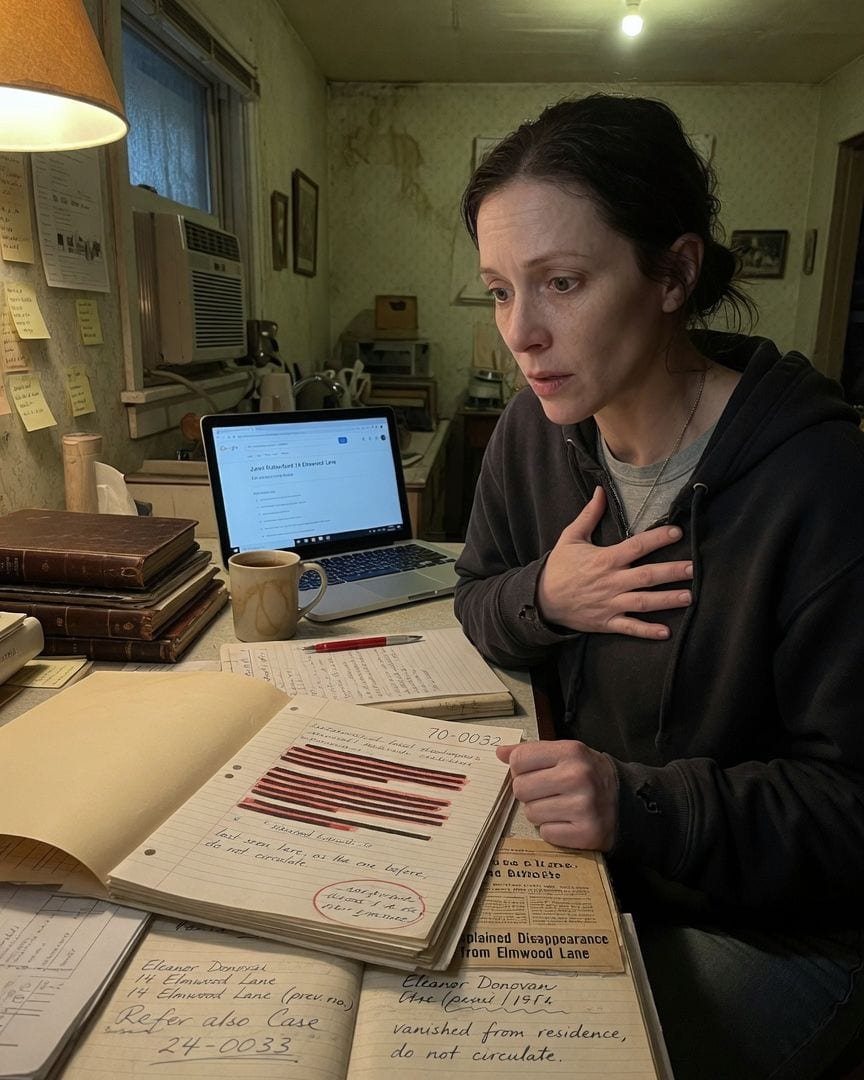
My own address is on a missing person's file from 1970. The blacked-out line names my street. She never lived here.
When my neighbor vanished, I started digging into old local missing persons cases. In a police file for a woman who disappeared in 1970, I found my own address, 14 Elmwood Lane, framing a blacked-out section of the duty log. Janet Rutherford never lived here, and the file contained a chilling handwritten note: 'do not circulate.'
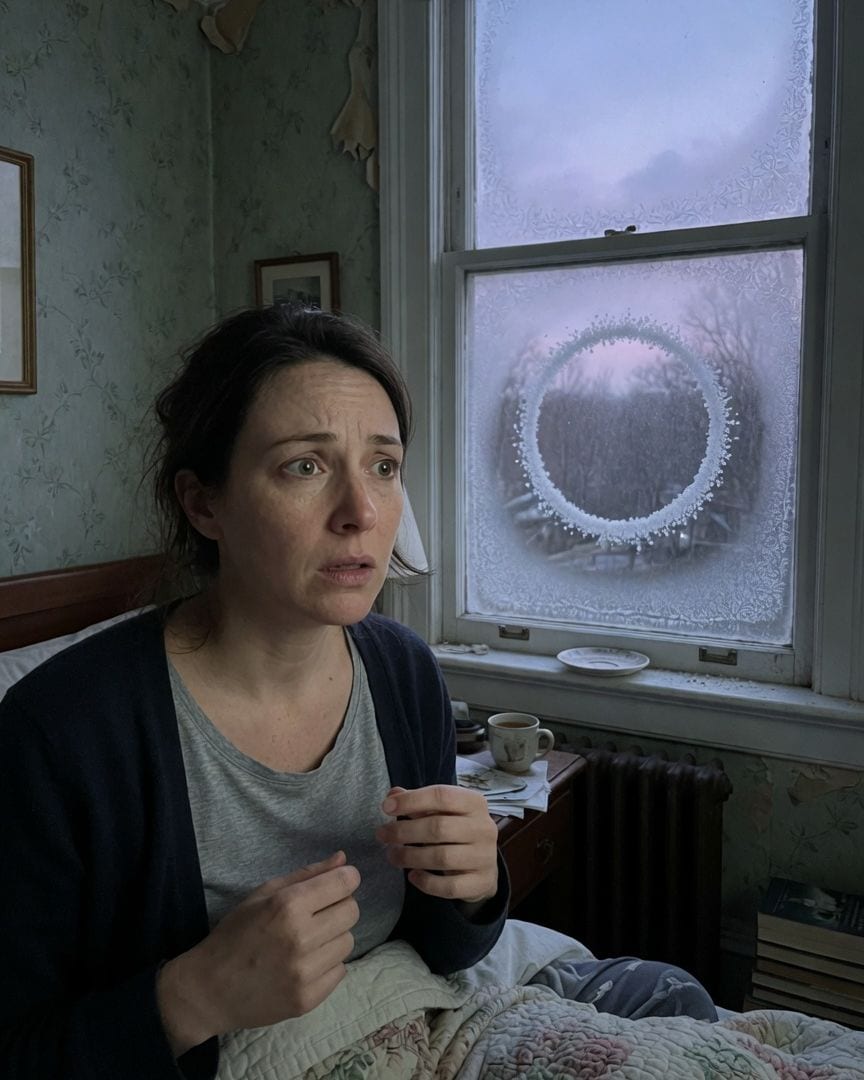
A 1963 obituary for a vanished 7-year-old girl lists *my Fenwick address* as her last known home.
Fenwick has its quaint traditions, like placing a salt saucer on the sill for protection. I put mine on my fourth-floor bedroom window, a private scoff at local custom. The next morning, the saucer was gone, replaced by a perfect salt ring on the *outside* of the glass, impossible to reach.
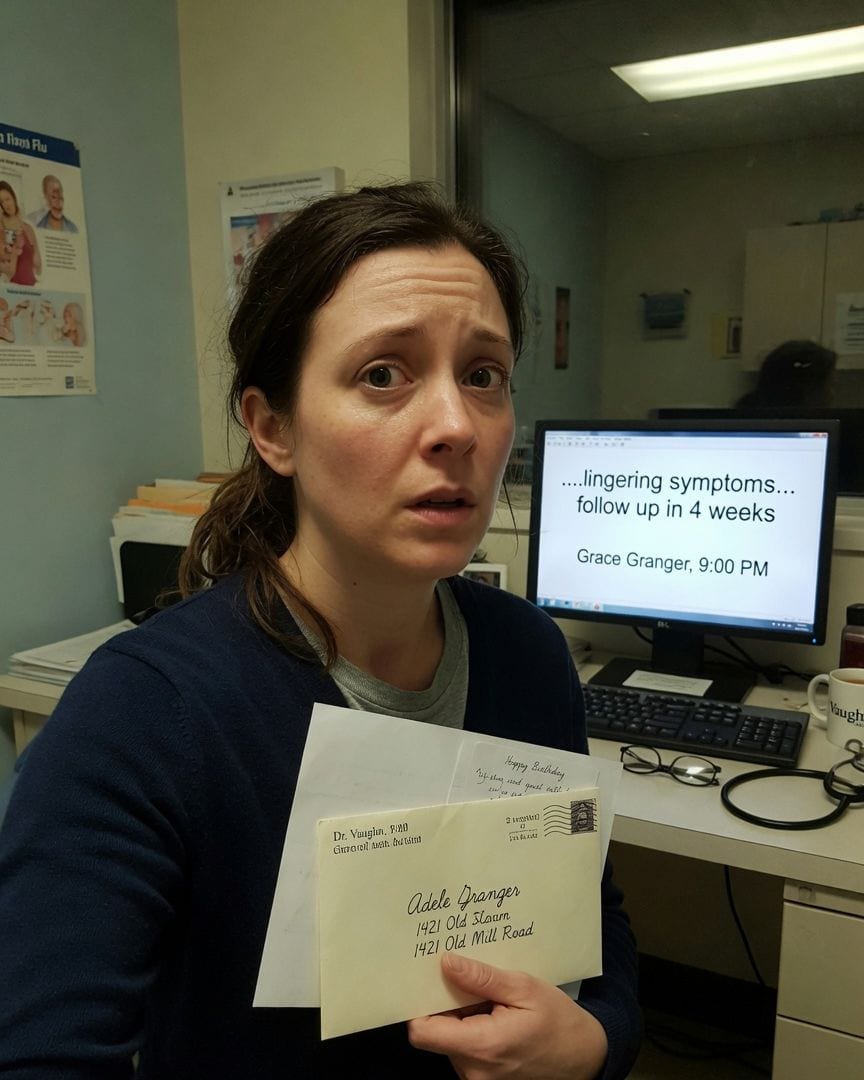
Mid-appointment about my cough, my doctor told me to call my estranged sister tonight — a sister I'd never mentioned to him. The note on his screen ended with her name and a time.
My doctor dismissed my cough as a lingering virus, but then he said something impossible: "You should call your sister tonight." I hadn't spoken to Grace in years, and I'd never mentioned her to him. When I saw her name on his screen with a specific time, a cold dread began to claw at me.
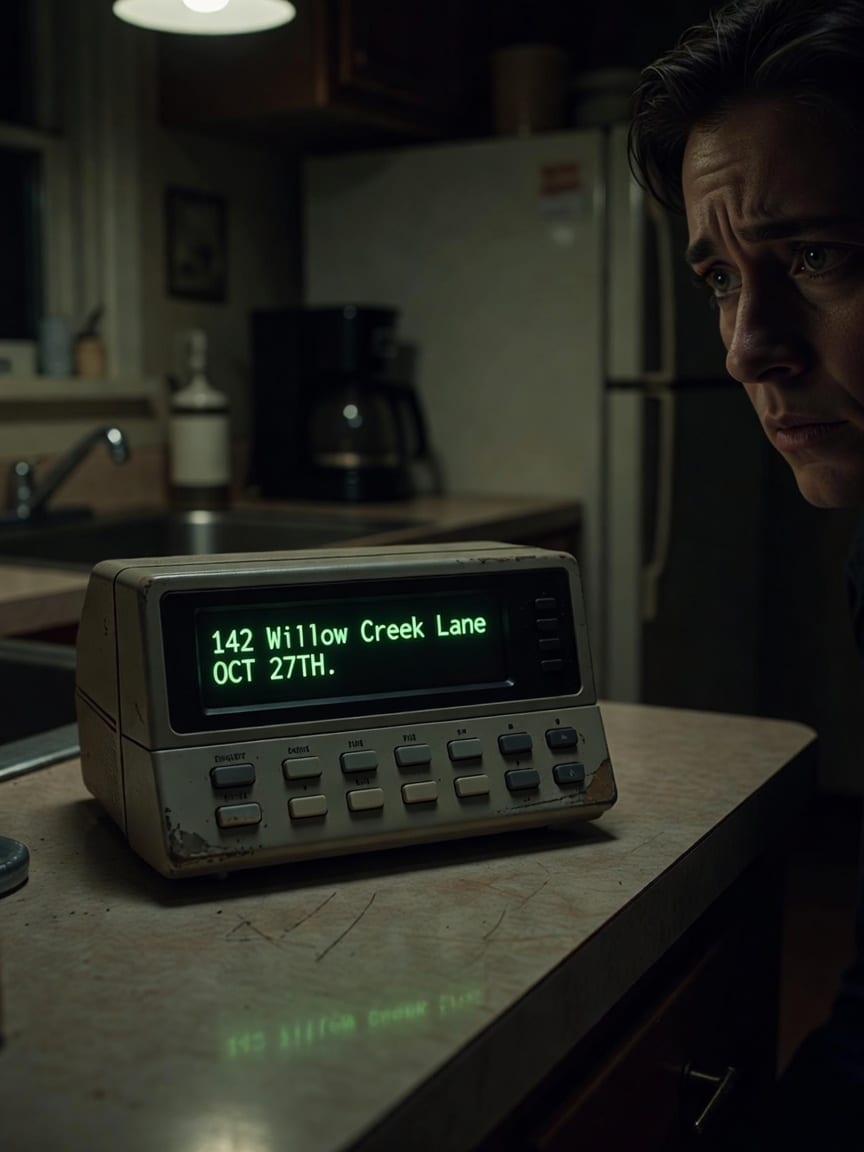
My radio scanner picked up a channel at 2 AM reading local addresses. Mine was on it, dated tomorrow.
I was tracking a storm on my old weather radio when a synthesized voice cut through the static. It began reading local street addresses, then my own: 142 Willow Creek Lane. But the date it gave for my address was tomorrow.
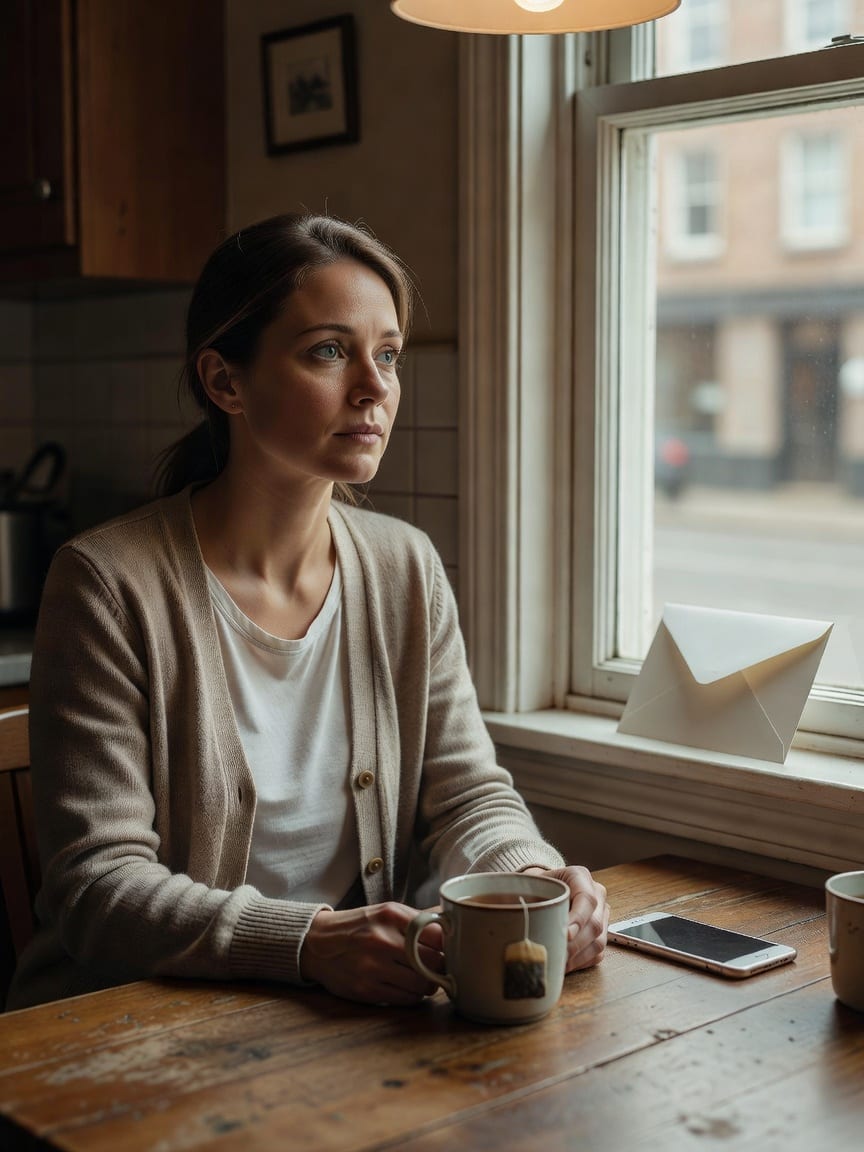
My taxi driver knew my name before I spoke, then apologized for the flight I was going to miss. I was arriving. The cab's plate was scrapped four years ago.
After a strange taxi ride, I received an unsettling birthday card addressed to me. Its return address listed 'Old Mill Road Field,' an empty lot where a mill once stood, and it was postmarked locally. The card arrived four months before my actual birthday, sparking a cold dread I couldn't ignore.
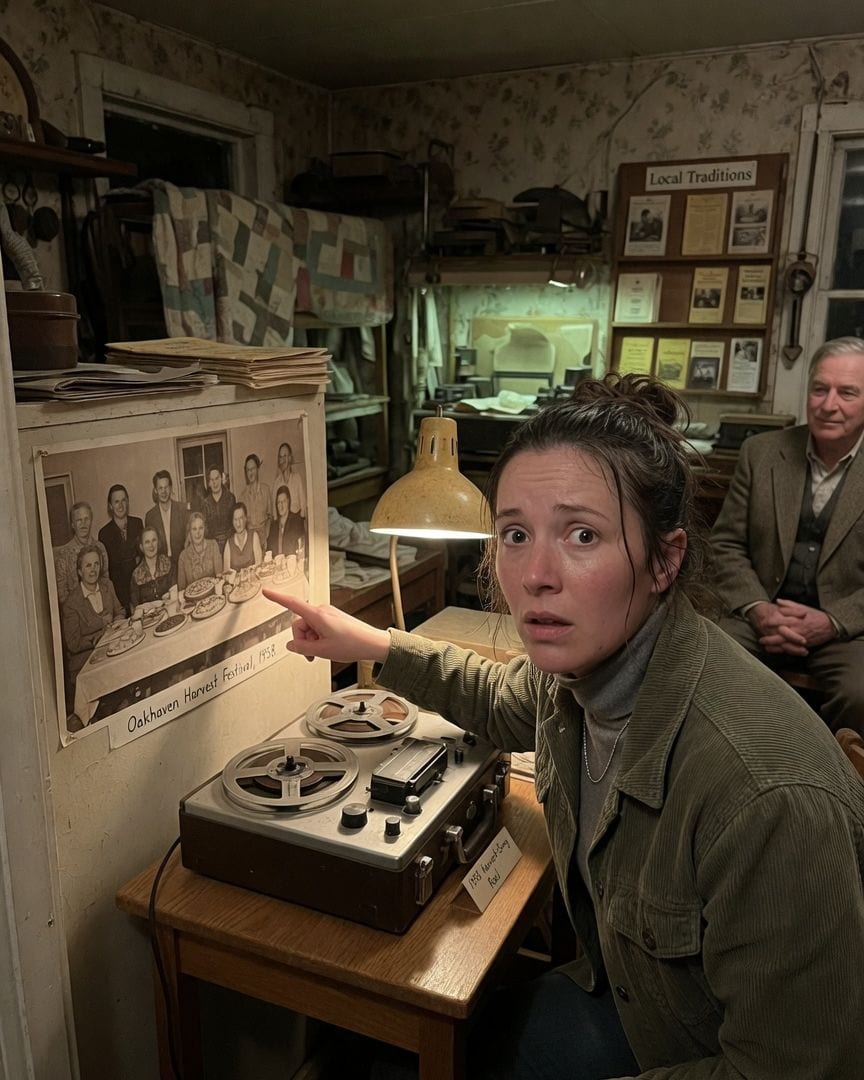
The folk museum's harvest tape counts one more singer than the photograph shows. The curator turned the recorder off before playing it.
I found a quiet escape at Oakhaven's dusty Folk Museum, where the curator played a rare 1958 harvest song. But as a cheerful tune filled the room, a low voice began to count. The tape tallied thirteen, yet the old photograph beside it showed only twelve smiling villagers.