My address appears on a 1970 missing-person report. It says 'last seen here, as the one before,' and the case number is almost identical to a new one from last month.
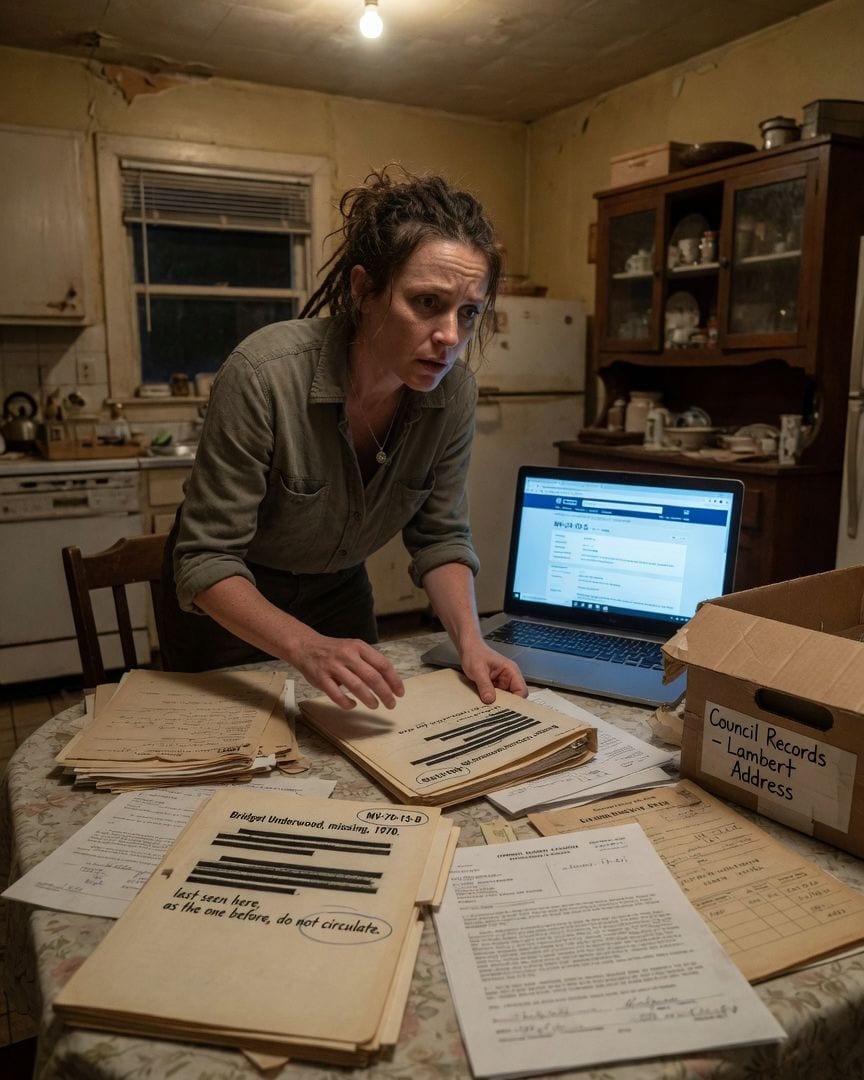
The smell of old paper and dust always reminds me of home, not because my house is particularly old, but because I’ve spent the last decade rooting through the village archives.
I’m Iris Lambert, a local historian, and my kitchen table is usually buried under census records or property deeds. Today, it held a police file: Bridget Underwood, missing, 1970.
The file was mostly standard procedure, faded ink on brittle paper. But one line in the duty log stopped me cold. It was heavily redacted, a thick black bar obliterating the text.
Framing that bar, however, was my own address – the house Bridget Underwood never lived in – and a chilling, handwritten note: 'last seen here, as the one before, do not circulate.' Beneath it, the case number, MV-70-13-B, stood out.
I pulled up my property deeds, just to be sure. My house had stood at this exact address since the late 1800s. There was no way Bridget could have lived here in 1970.
I cross-referenced her last known address from the file; it was miles away, across the county line. I also couldn't shake the case number. MV-70-13-B.
It was one digit off from a recent missing-person report opened on my street only last month for a young woman named Sophia Prescott. MV-24-13-S.
The cold, bureaucratic calm of the note, the way it suggested an ongoing, managed situation, made my stomach clench. It was a quiet dread, a paper whisper of something deeply wrong.
I tried to rationalize it, of course. A clerical error. A misplaced file in the chaos of a small-town records office decades ago. But the handwritten ‘do not circulate’ felt too deliberate, too knowing. It suggested instruction, not mistake.
My gaze kept returning to Bridget Underwood’s case number: MV-70-13-B. I opened my laptop, the screen a blue glow in the dim kitchen light, and navigated to the digital police archives. I typed in Sophia Prescott’s name.
The number flashed on my screen: MV-24-13-S. The ‘13’ was identical.
A shiver ran down my spine, tracing the shape of my vertebrae. The chance of two unrelated missing persons cases, from the same street, decades apart, sharing a sequential ‘13’ identifier felt astronomically low.
It was more than coincidence; it was a mark. Driven by a mounting unease, I expanded my search, sifting through the digital records for any other missing persons cases reported from my street. There weren't many, thankfully.
But then I found it: an older file, from 1961, concerning a male named Gordon Sheppard, also reported missing from my address. His case number: MV-61-13-G.
The pattern was undeniable. Three different people. Three different decades. All from my address. All bearing the ‘13’ designation. The mundane explanation of a simple error dissolved, replaced by the chilling implication of a deliberate, recurring system.
The consistent ‘13’ and the ‘as the one before’ note were far too specific to be chance. It felt less like a police incident number and more like an index. A category. For something I couldn’t yet grasp.
Convinced this wasn't random, I fired off an urgent request to the local council's records office. I asked for all missing person files associated with my address since 1960.
Tessa Hale, a junior clerk I knew slightly, looked at me strangely when I submitted the form, a frown creasing her brow, but she complied.
Days later, a large, heavy cardboard box arrived on my porch. I dragged it inside, the thick tape straining as I cut it open.
I spread the files across my dining table, arranging them by date, trying to find some order. The sheer volume was unsettling, far more than I’d expected for a single address.
As I sifted through them, my breath caught in my throat. It wasn't just a common '13' series.
Several files, for entirely different individuals, from different decades—a young woman in 1985, an elderly man in 1999, a teenager in 2010—all bore the exact same case number, 'MV-XX-13-X', differing only in the year and the initial of the missing person.
Each one, meticulously filed, each one marked 'last seen here, do not circulate'. The neat, consistent handwriting across all the older files was eerily uniform, as if penned by the same hand across half a century.
It wasn't just a reused number; it was the same number for different people, a meticulous, organized system of disappearing.
The discovery of identical case numbers for entirely different people shattered any remaining pretense of normalcy. I returned to the records office, my request now more pointed, less casual. Tessa Hale was behind the counter.
She saw me approach, and her shoulders visibly stiffened.
"I need access to the original, physical intake ledgers," I stated, my voice betraying none of the tremor in my hands. "The ones predating digital records. Specifically for the 'MV-XX-13-X' series."
Tessa hesitated, a flicker of unease in her eyes. "Those are... deep storage, Iris. And usually, we only pull them for official inquiries."
"This is official," I pressed, hoping my historian status carried some weight. "I'm looking into a pattern of anomalies in historical missing persons reports. It relates to a property I own."
She chewed on her lip, then sighed, retrieving a heavy ring of keys from a drawer. "Alright, but you'll have to sign a waiver. And I’ll have to supervise, per protocol."
In the dusty archives, tucked away in a dimly lit corner of the basement, I found row upon row of bound, leather-covered ledgers. The air was cold, stale, thick with the scent of decaying paper.
Tessa stood by the door, arms crossed, watching me. I located the entries for the ‘13’ series. The pattern was instantly clear: ‘MV-XX-13-X’ wasn't a unique identifier; it was a specific ‘series’ number, almost a category.
Each entry was unusually brief, almost formulaic – name, date last seen, address, then in block capitals: ‘CATEGORY 13: RECURRING INCIDENT – RESTRICTED CIRCULATION.’ No details, no follow-up notes, just the cold, stark classification.
I traced the ‘13’ series back through decades, noting its consistent application.
In the margin of a 1980 entry, a faint, spidery handwritten note caught my eye, penned in the same meticulous hand that marked the files on my table: ‘Refer to Edmund F. for ‘13’ series protocol.’
Edmund F. The name rang a bell, a hollow clang in the quiet of the archives. I remembered seeing it on a polished brass plaque in the reception area: 'Edmund Foster, Head of Records, 1975-2005.'
The unease that had been a vague hum solidified into a specific dread. Someone designed this. Someone managed it. And their name was right there, on the page, like a chilling signature.
I started asking about Edmund Foster, subtly at first, then more directly. Tessa Hale, when questioned, became visibly uncomfortable. "Mr. Foster?" she'd say, her eyes darting away. "He's... a local fixture. Still volunteers at the historical society. Very respected."
But there was a subtle shift in Tessa’s demeanor, a guardedness she hadn't shown before. Her answers were clipped, almost defensive. I felt a prickle of being watched, a sense that my inquiries were being noted.
I tried to dismiss it as paranoia, the late nights poring over files getting to me, but the feeling persisted, like a chill on the back of my neck even indoors.
Later that week, I returned home from the grocery store to find something unusual. An anonymous, unaddressed envelope had been slipped under my door. It was thin, beige, perfectly plain.
I picked it up, my fingers brushing against the crisp paper. No return address, no stamp. Just... there. Inside was a single, photocopied page from what looked like an official records manual.
A specific section was highlighted in bright yellow: ‘CATEGORY 13: RECURRING INCIDENTS - RESTRICTED CIRCULATION.’ The text was dry, bureaucratic, detailing precise instructions for filing, redacting, and ensuring no public dissemination.
It explicitly stated that these incidents were not to be escalated to external authorities. No sender, no note, just the page.
It was a clear, chilling message: someone knew I was digging, and they were either warning me, or perhaps, guiding me. The danger was no longer just historical; it was personal.
The silence of the anonymous delivery was louder than any spoken threat, proving that my investigation had been noticed, my progress monitored. I clutched the paper, the implications of its quiet presence settling like a cold stone in my gut.
The house, usually a comfort, felt suddenly watchful, its old timbers groaning in the shifting breeze like a whisper.
I couldn’t let it sit. The next morning, I confronted Tessa Hale. I found her at her desk, organizing a stack of birth certificates. I placed the photocopied manual page on her desk, carefully smoothing out the creases.
Tessa’s face drained of color. She stared at the page, then at me. "Where did you get this?" she whispered, glancing nervously around the empty office. The hum of the fluorescent lights seemed unnaturally loud.
"Someone put it under my door," I said, keeping my voice low but firm. "This isn't just a category, is it? This is a protocol. And Edmund Foster's name is on the old ledgers, connected to it."
Tessa’s composure fractured. Her hands went to her mouth, covering a gasp. "It's... it's an unwritten rule," she admitted, her voice barely audible. "A procedure, passed down. Mr. Foster, he… he trained me on it personally when I started.
How to handle the '13' series. How to ensure they were filed correctly, how to redact certain details, how to make sure they never... escalated." She hunched over her desk, her shoulders shaking slightly.
She described Edmund’s calm, almost detached explanation of the 'procedure,' as if it were simply part of the job, a necessary evil. "He’d say it was about 'maintaining order,' about 'preventing unnecessary alarm.' He made it sound so normal, Iris.
Like it was just part of the local bylaws." Tessa confessed that Edmund still 'checks in' on the files sometimes, 'just to make sure everything's in order.'
The pieces clicked into place with a sickening thud. The consistent handwriting, the careful redactions, the formulaic entries in the ledgers. It wasn't incompetence, not a series of unfortunate errors. It was deliberate, meticulous management.
The 'missing' people weren't lost; they were categorized, filed away, their disappearances integrated into a system designed to ensure they remained quiet, unnoticed by the wider world.
The true horror wasn't just the disappearances, but the calm, institutional acceptance of them. The dread deepened: this wasn't a cover-up; it was a centuries-old accounting practice, a routine, bureaucratic function of the village.
Armed with Tessa’s terrified confession, I returned to the ‘13’ series files, my hands trembling as I re-examined them. The dining table, once a place of comfort, now felt like a forensic lab, cold and sterile.
I focused on the names and dates, looking for any other common threads beyond the address and case number. My eyes scanned the files: Gordon Sheppard, Bridget Underwood, Sophia Prescott, the others from 1985, 1999, 2010.
Then I noticed something chilling. Every single person in the ‘13’ series, from Gordon Sheppard in 1961 to Sophia Prescott, shared an unusual middle name – Alistair – or a birthdate that fell on the 13th of a specific month.
Not all had the middle name, but a significant number did, and those who didn't often had the peculiar birthdate. It wasn't random selection; it was a specific type of person disappearing, chosen by some hidden criteria.
The dread tightened its grip, cold and immediate, spreading through my chest.
I thought of my own name, a detail I’d barely considered in years.
My grandmother's old family Bible, a heavy, leather-bound book, was still open on my coffee table, where I'd been tracing my own lineage for my local history project. My grandmother's neat script confirmed it: ‘Iris Alistair Lambert, born October 13th.’
The air in my living room turned instantly cold, prickling my skin.
Every single missing person in the '13' series, from 1961 to Sophia Prescott, shared an unusual middle name – Alistair – or a birthdate that fell on the 13th of a specific month. She, too, carried that mark.
The realization hit me like a physical blow. I, too, fit the pattern. The threat wasn't just external; it was already inside me, part of my very identity.
Stunned and terrified, my body moving on instinct, I rushed to the local historical society. The late afternoon sun cast long, distorted shadows through the arched windows.
I found Edmund Foster in a quiet corner, calmly cataloging old village maps, his movements precise, unhurried, as if the world outside his immediate task did not exist.
I confronted him, my voice strained but firm.
I laid out the evidence, each piece a stone on a path to a horror he already knew: the identical case numbers, the 'Category 13' protocol, the shared middle name ‘Alistair’ or the 13th-day birthdate among the missing.
Edmund didn't deny a word. He looked up from an ancient parchment, his eyes clear and unblinking, devoid of any surprise or malice.
"You've been thorough, Miss Lambert," he said, his voice soft, almost paternal, as if commending a diligent student. He explained, without a shred of emotion, that it was 'the way things are.'
He spoke of 'the land's appetite,' a cyclical need that predated the village itself, tied to an ancient nexus beneath my very house.
His job, and the job of those before him, was merely to 'manage the records,' to ensure the 'pattern' was maintained and not disrupted. To keep the wider public unaware of what he simply referred to as 'the harvest.'
He spoke of it like managing a natural resource, a utility bill, a mundane fact of the local ecosystem.
The dread wasn't in any anger or villainy, but in his utter calm, his complete acceptance of this horrifying truth, as if it were nothing more than routine administration.
Every planted clue clicked horribly into place, forming a coherent, terrifying picture of an institution calmly facilitating unspeakable horror.
Edmund gestured to a specific spot on the old village map he was examining, directly where my house now stood. "This land has always had its needs, Miss Lambert. It takes. Not randomly, but with a certain... discernment."
He explained that the disappearances were not random acts of violence, but a 'harvest,' a natural process tied to the ancient nexus beneath the village.
The institution's role, he calmly articulated, isn't to stop it, but to ensure the 'flow' is managed, preventing panic or investigation that could 'disrupt the cycle.'
He spoke of generations of record-keepers, passing down the 'protocol,' ensuring the 'Category 13' files were meticulously maintained, a long line of quiet caretakers.
He then looked directly at me, his gaze unwavering, no longer paternal but appraising. "And you, Miss Lambert, with your inherited name, you've shown a remarkable aptitude for understanding the patterns. A rare insight."
He slid an old, leather-bound ledger across the table. It was open to a blank page. On it, in the same neat, consistent script Iris had come to dread, was already inscribed: 'MV-24-13-I'.
He offered me a choice, his voice still unnervingly calm: "To become part of the record-keeping, as I have. To learn to manage the inevitable.
Or," he gestured vaguely towards the empty chair opposite him, where I had been sitting moments before, "to become part of the record."
The choice was not presented as a threat, but as a logical, almost administrative, decision, the only two options laid bare.
The calm of his explanation was the worst part, stripping the horror of any drama, reducing it to a cold, inescapable fact. I stared at the blank line in the ledger, my name already waiting to be entered.
Iris Lambert is not seen again at the historical society or the records office. Her research notes, once scattered across her kitchen table, are gone.
Tessa Hale, visibly rattled, quietly cleans out Iris's desk at the council office, avoiding eye contact with colleagues.
The files Iris had been working on, the ones with the '13' series numbers, are returned to their proper place, their anomalies now seamlessly refiled, marked 'reviewed and closed' in a neat, familiar hand.
The specific missing person reports Iris had requested are now back in their deep archive boxes, their redacting lines just as thick and black as before. No one asks where Iris went.
A quiet, almost imperceptible shift settles over the records office, a return to the long-held, unspoken order. The village continues, undisturbed, its long-buried truths once again filed away.
Tessa, going through Iris's old research notes, finds a small, hand-drawn map of the village. One spot is circled in red, labeled 'my house.'
Beside it, a single, recent entry in the official record log is visible, its ink still fresh, mirroring the format of the 'Category 13' files.
A few weeks later, Edmund Foster is seen at the historical society, guiding a new volunteer through the archives. He points to a particular shelf. "These are the 'Category 13' files," he says, his voice soft and even.
"They require careful management." The new volunteer, a young woman with a quiet, studious air, nods. Her middle name is Alistair.
If this one got to you
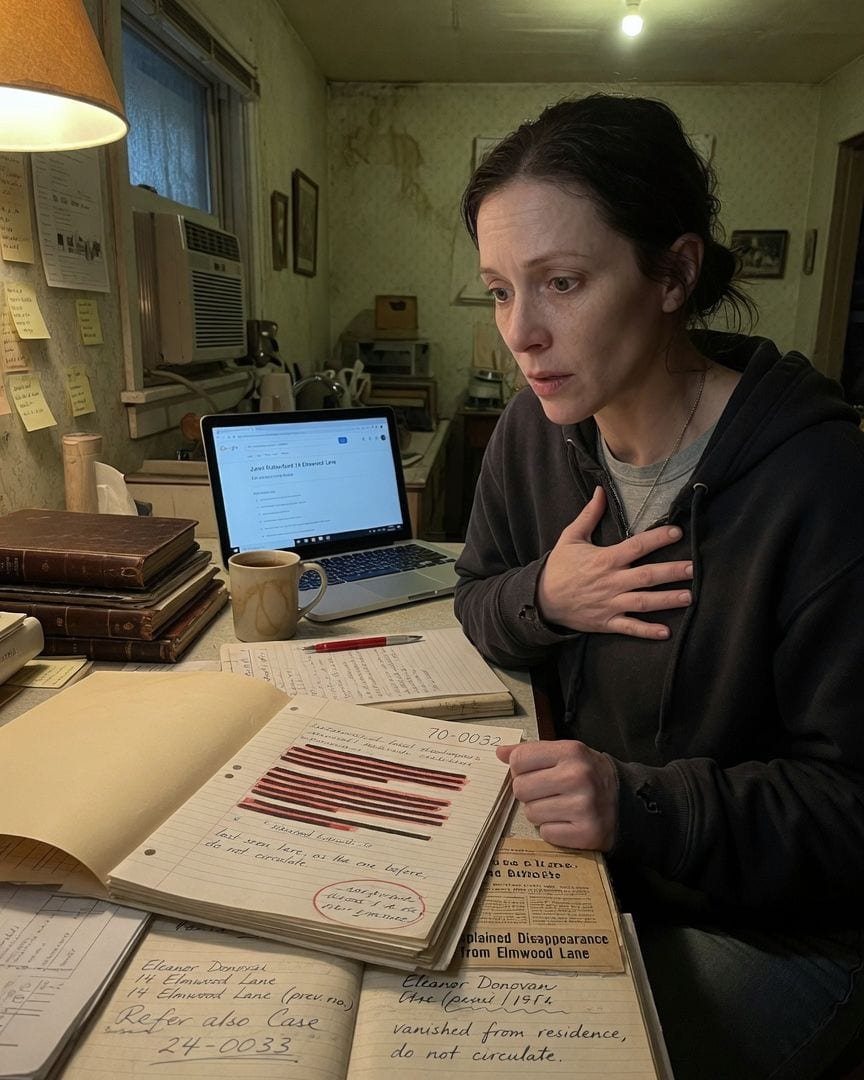
My own address is on a missing person's file from 1970. The blacked-out line names my street. She never lived here.
When my neighbor vanished, I started digging into old local missing persons cases. In a police file for a woman who disappeared in 1970, I found my own address, 14 Elmwood Lane, framing a blacked-out section of the duty log. Janet Rutherford never lived here, and the file contained a chilling handwritten note: 'do not circulate.'
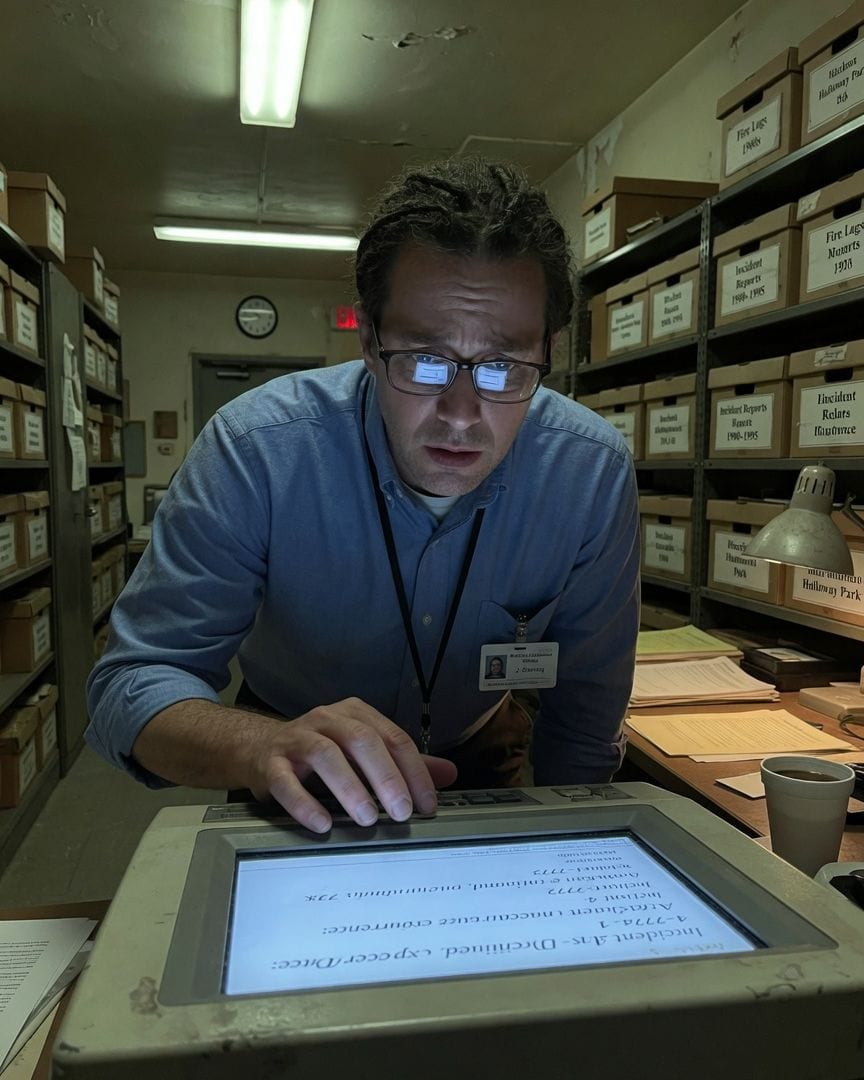
My old rope works fire log repeats the same 3:14am blaze, same incident number, across 1967, 1980, 1993. Each ends: 'origin undetermined, expect recurrence.'
As an Archival Digitization Officer, my days are spent scanning old records. I was numbly working through fire service logs when Incident 4-772 caught my eye: the same structural fire, same time, same number, repeated across different decades. Each entry ended with the chilling, identical phrase: 'origin undetermined, expect recurrence.'
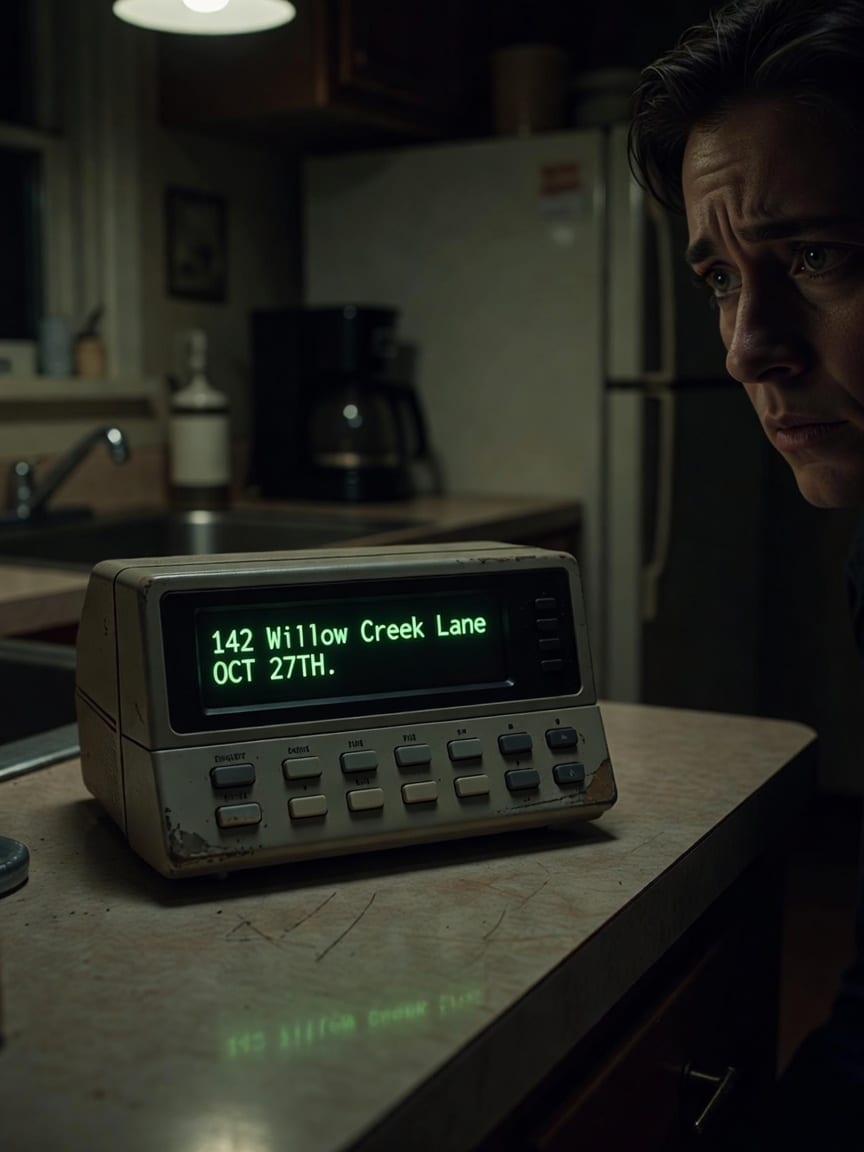
My radio scanner picked up a channel at 2 AM reading local addresses. Mine was on it, dated tomorrow.
I was tracking a storm on my old weather radio when a synthesized voice cut through the static. It began reading local street addresses, then my own: 142 Willow Creek Lane. But the date it gave for my address was tomorrow.
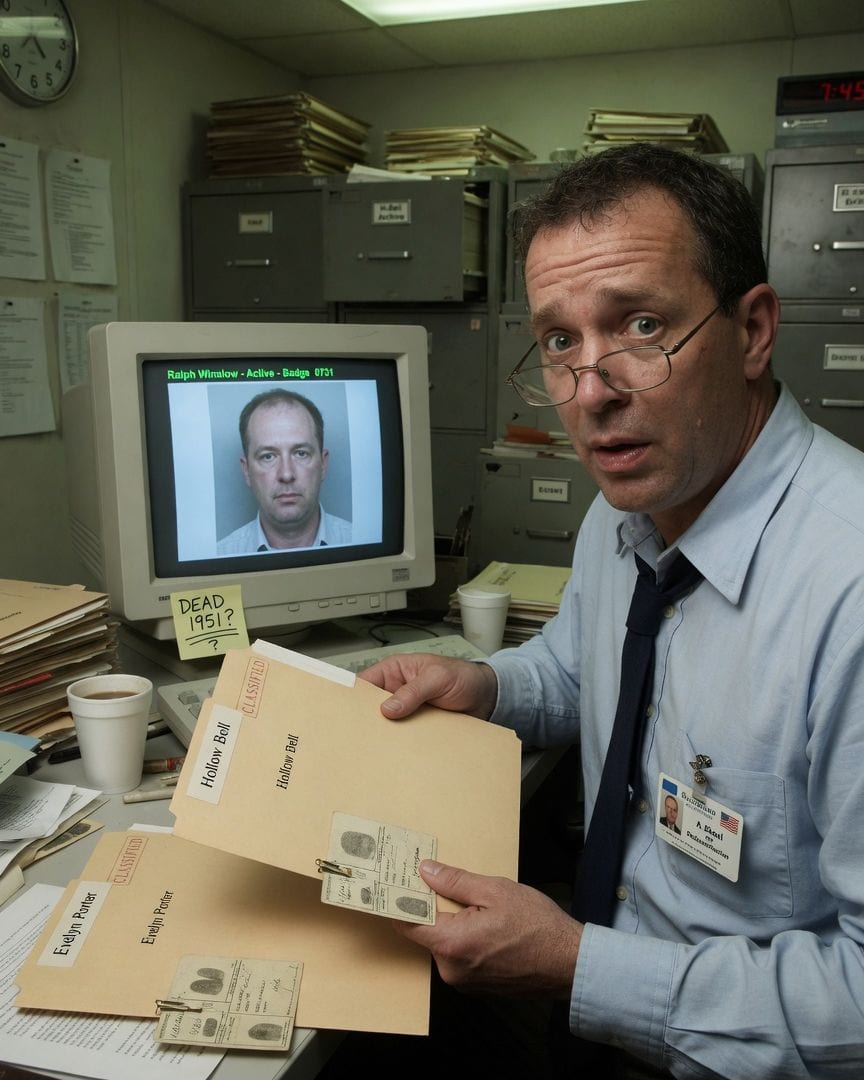
A Cold War declassification reviewer finds a man reported dead in 1951 just badged into his building.
Anton Skeel, a declassification reviewer, hoped his tedious work on old Cold War files would finally lead to an early retirement. He stared at a folder for 'Hollow Bell' containing a fingerprint card from 1958 for a man named Ralph Winslow, who was reported dead in 1951. Out of professional pique, Skeel ran the prints, only to find Ralph Winslow currently employed and badged into the building that very morning. The employee photo, however, was a complete stranger, attached to a file that insisted the man was both seven years dead and decades active. Now, a second impossible file has surfaced, revealing another 'returned subject' reported lost at sea, whose photo also belongs to a stranger.
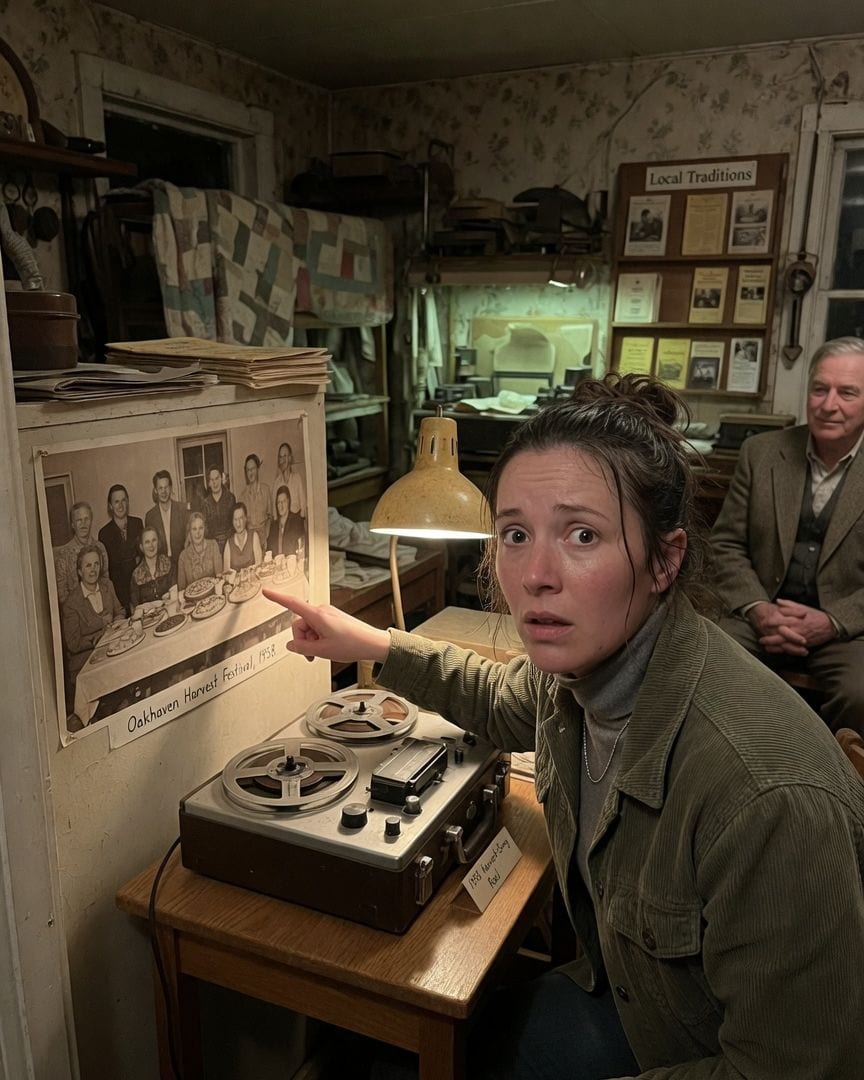
The folk museum's harvest tape counts one more singer than the photograph shows. The curator turned the recorder off before playing it.
I found a quiet escape at Oakhaven's dusty Folk Museum, where the curator played a rare 1958 harvest song. But as a cheerful tune filled the room, a low voice began to count. The tape tallied thirteen, yet the old photograph beside it showed only twelve smiling villagers.
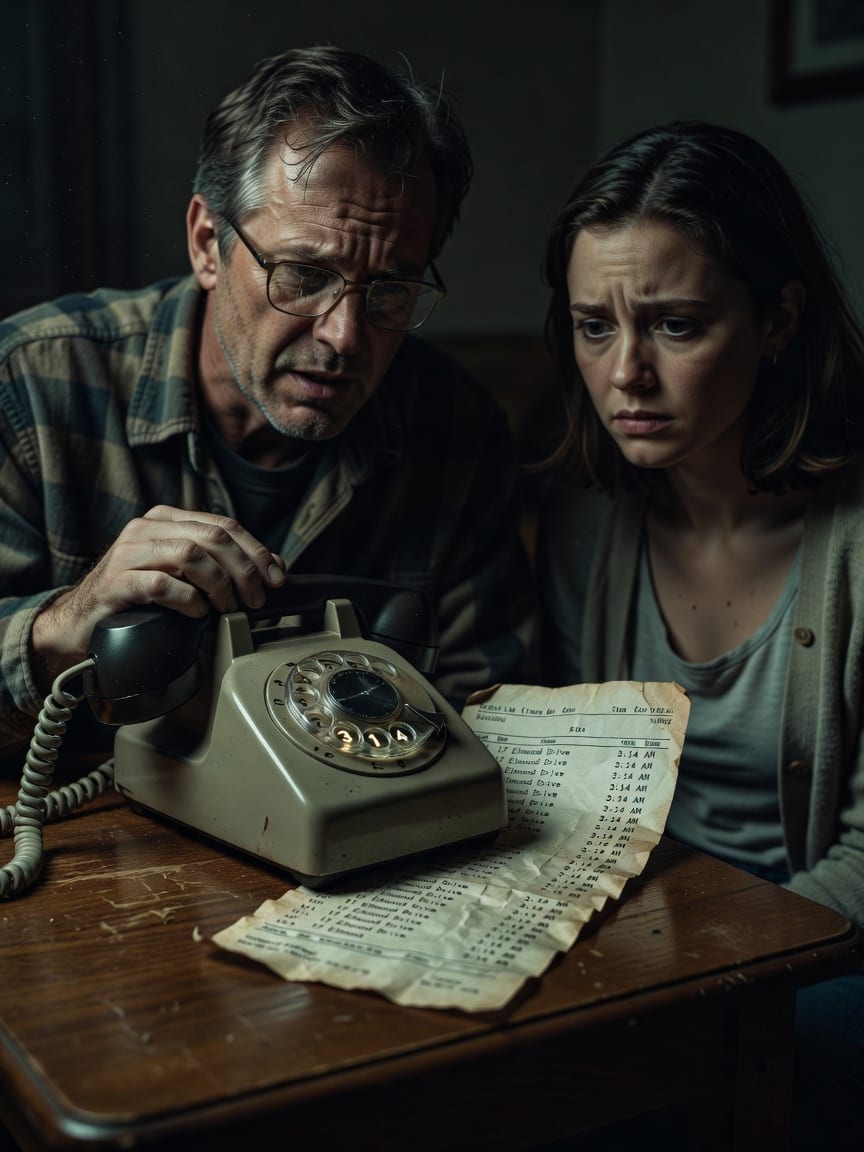
My phone bill itemised forty calls from my number to a house demolished in 1990. Each call at 3:14 AM, lasting eleven minutes. The bill arrived postmarked from a flattened building.
I expected the usual mobile bill, but my landline statement listed forty calls from my number to '17 Elmwood Drive.' That address was for a house torn down in 1990, a vacant lot I remembered from childhood. The phone company insisted the calls were legitimate, leaving me profoundly unsettled by the impossible charges.