My old rope works fire log repeats the same 3:14am blaze, same incident number, across 1967, 1980, 1993. Each ends: 'origin undetermined, expect recurrence.'
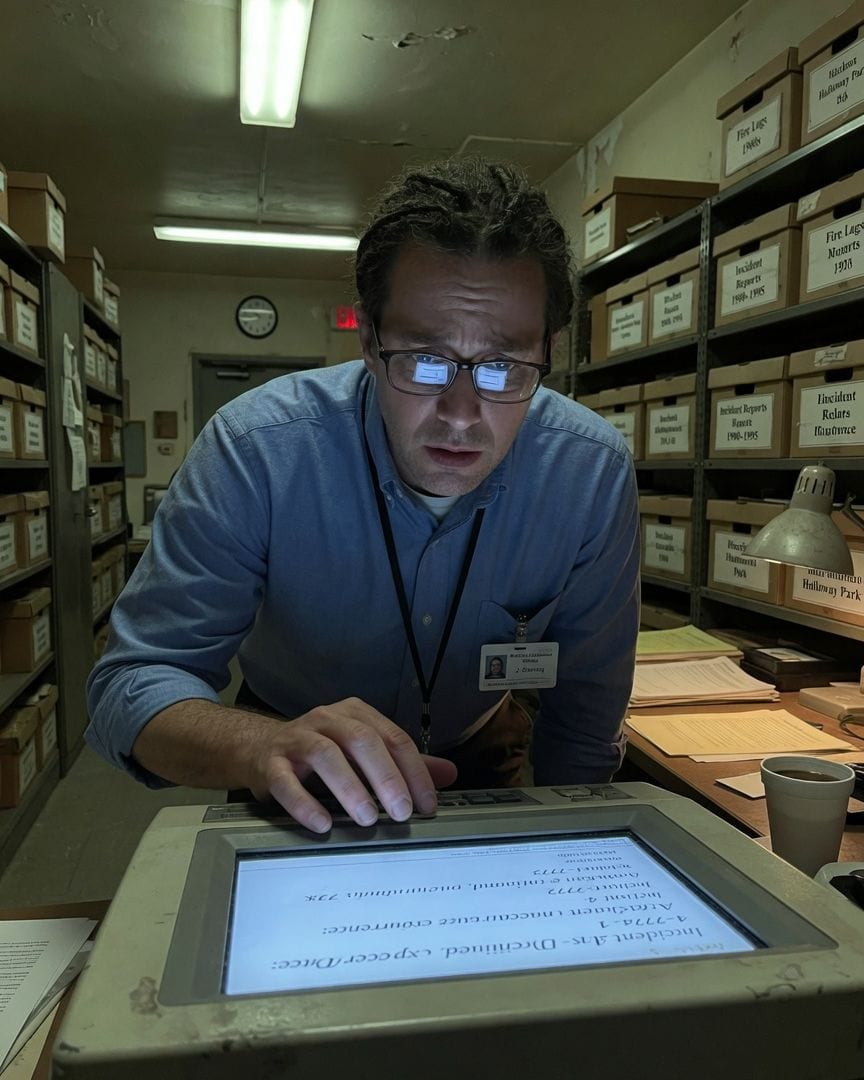
My fingers ached, stiff from the monotonous click and scroll. As an Archival Digitization Officer, my days were a blur of microfiche readers and databases, turning decades of paper into neat, searchable files.
Today it was fire service incident logs, endless pages of smoke and water and mundane tragedy. I was numbly scanning through them, the low hum of the ancient microfiche reader a constant companion, when Incident 4-772 snagged my attention.
It was a fire at the old rope works, a derelict industrial shell on the outskirts of town. The entry was unremarkable: 'Structural Fire, Old Rope Works, 3:14 AM.' Nothing unusual there.
But as I scrolled, preparing to file it away, the exact same incident popped up again. Same building, same incident number, 4-772. Same time: 3:14 AM. The date, however, was 1967. I blinked, a faint throb starting behind my eyes.
I was certain I’d just processed an entry for 1993.
I scrolled back, then forward. The screen flickered, a cold blue glow reflecting off my glasses. It wasn't my eyes. There it was: Incident 4-772, Old Rope Works, 3:14 AM, 1993. Then, further down, the identical entry for 1980.
And again for 1967. Each one bore the same, precise incident number, 4-772, as if it were a re-run. A software glitch, I thought, a database error from some messy migration decades ago. It had to be.
But the dates were distinct, undeniably separate, and the timestamps precise to the minute. My gut tightened.
And then I saw the last line of each report. Identical.
Each one ended with the same chilling, italicized phrase: 'origin undetermined, expect recurrence.' The words seemed to jump off the flickering screen, mocking the rational part of my brain that insisted this was just bad data. It wasn’t a glitch.
It was a pattern that shouldn’t exist.
The repeated 4-772 entry gnawed at me. I tried to dismiss it, to rationalize it as a quirk of historical record-keeping, but the words 'expect recurrence' whispered in the back of my mind. I couldn't shake it.
For the rest of the day, my digitization work slowed to a crawl, my focus fractured.
I subtly probed the database, not for what I was supposed to be doing, but for other reissued incident numbers, for other patterns that defied logic.
My heart gave a sick lurch when I found another. Incident 7-119. This one wasn't a fire, but a 'disturbance' at Holloway Park, a local green space I’d walked through countless times.
Like the rope works fire, it repeated with uncanny regularity, roughly every thirteen years, always in the early hours of a specific autumn night. And there it was again, the same unsettling coda: 'origin undetermined, expect recurrence.'
The easy, mundane explanation – a quirky naming convention, a bureaucratic oversight from some long-dead council clerk – began to crumble. This wasn't a one-off anomaly. This was systemic.
I felt a cold dread seep into my bones, worse than any fleeting fear. I needed to see the physical records, to rule out any digital corruption for good.
After hours, when the archive was quiet and empty, the only sound the distant hum of the servers, I retrieved the dusty microfiche for the corresponding years. The tiny, faded print of the original paper documents confirmed everything.
The same number, the same time, the same unsettling note. I ran my finger over the microscopic text, the chill in the air of the archive matching the one in my gut. This wasn't some phantom of the digital age.
This was a meticulously maintained, decades-old paper trail. Someone had been keeping these in order. The neatness of it, the quiet bureaucracy that preserved such a blatant impossibility, was far worse than any monster. It implied a deliberate, hidden hand.
Driven by a growing, frantic dread, I expanded my search. I started cross-referencing incident numbers with local addresses, trying to see if these strange recurrences were tied to specific locations beyond the park and the rope works.
On a whim, I typed in the name of my own street, Sterling Road. The database churned, a low, mechanical growl echoing in the silent archive.
A new incident number flashed on the screen: 1-901. 'Containment Breach – Sterling Residence.'
My breath caught in my throat. I live on Sterling Road. The dates listed for this 'breach' recurred, though less predictably than the others, stretching back to before I was even born.
The file was heavily redacted, lines blacked out with an almost aggressive thoroughness, but the address was unmistakably his street. My street.
And then, in a small, unredacted corner of one of the older entries, I saw it. My own surname. Sterling. Not 'Sterling Road,' but simply 'Sterling.'
The wrongness had found its way to my doorstep, a quiet, documented threat tied directly to my very name.
The 'Sterling Residence' entry had me in a vice, a cold, unyielding grip on my focus. Sleep had offered no respite, only fragmented images of redacted files and repeating timestamps.
I returned to the archives the next morning, fueled by an almost frantic need for answers, for any explanation that could make sense of the Sterling name attached to 'Containment Breach.'
I started cross-referencing the recurring incidents – 4-772, 7-119, 1-901 – with old council employee records.
My fingers flew across the keyboard, searching for connections, for names that appeared consistently across the decades in roles associated with 'oversight' or 'incident management.'
A pattern began to emerge, faint at first, then sharpening into an undeniable truth: a small, consistent group of individuals whose names resurfaced on committee lists, review panels, and assessment groups related to these very incidents.
Their official departmental titles shifted over the years, from 'Public Safety Liaison' to 'Urban Development Coordinator,' but the names themselves persisted, almost like a lineage.
Albert Lockwood, the current Head of Archives, was one of them.
His name appeared on 'review panels' and 'assessment committees' related to the rope works fires, the park disturbances, and even, more vaguely, 'residential security protocols,' stretching back to the 1970s. It wasn’t random. This wasn't bureaucracy. This was a network.
I tried to casually sound out Emily Langford from IT, mentioning 'anomalies in the legacy database' and 'some odd recurring incident numbers.' Emily, pragmatic and focused on current system upgrades, just waved a dismissive hand.
'Oh, that's just classic data migration quirks, Nathan. Trust me, the old system was a nightmare. We’re still finding ghosts in the machine from thirty years ago.' Her rational explanation, once a comfort, now felt like a blindfold.
I realized, with a sickening lurch, that the people who managed the records weren't just filing the wrongness away; they were the same people who, in some quiet, bureaucratic way, managed the incidents themselves.
The files weren't just records of wrongness; they were the machinery of it.
As I dug deeper, a subtle, unsettling shift occurred. Access to certain older microfiche records, particularly those I'd been examining, became inexplicably 'restricted' or 'under review.'
Files I had open the previous day, marked with my little yellow tabs, were mysteriously re-filed, their trays returned to the wrong cabinet slots.
I tried to dismiss it as administrative red tape, a reaction to my 'unusual' queries, but the timing was too precise. It felt like an invisible hand was nudging me, watching me.
I returned to my desk after a quick coffee break, the lukewarm cup still clutched in my hand. On my keyboard, a printout lay waiting. It wasn’t something I'd asked for, not something from my active queue.
It was a page from Incident 1-901, the Sterling Residence file. Not the digital version I’d been viewing, but a fresh, crisp scan of the original paper, black text on aged white.
One line, previously heavily redacted, was now highlighted in vivid, fluorescent yellow: 'Grandfather, N. Sterling, initial contact, 1961.'
The blood drained from my face, leaving a cold, clammy film on my skin. Someone knew. Someone knew exactly what I was looking for, what I had found. Someone was watching me.
And they were telling me, very clearly, that this was far deeper, far older, than I could have imagined. I crumpled the printout in my trembling hand, the coffee cup rattling in its saucer.
My mind raced, then locked onto one certainty: Albert Lockwood. He was the common denominator, the one whose name spanned the decades, the one who oversaw the archives.
I marched straight to his office, the crumpled printout a tight knot in my fist.
'Mr. Lockwood,' I said, trying to keep my voice steady, trying to project a calm I didn't feel, 'I need to understand these recurring incident logs. And why this was left on my desk.'
Albert Lockwood looked up from his ancient ledger, its pages thick with handwritten entries. His expression was unreadable, unnervingly calm, as if he'd been expecting me, not merely for minutes, but for years.
He gestured to the chair opposite his desk, a gesture of almost practiced welcome. 'Sit, Nathan. I've been expecting you to find your way here.'
His voice was level, devoid of surprise or concern, the quiet composure of it more chilling than any anger would have been.
I didn't sit. I slammed the crumpled printout on his desk, flattening it with my palm. 'My grandfather? What does this mean? And these fires, these 'disturbances'... they keep happening.'
My voice came out sharper than I intended, laced with a tremor of fear and outrage.
Albert leaned back slowly, his eyes fixed on me. A faint, almost imperceptible smile played on his lips, a knowing glint. 'They are not errors, Nathan. And 'origin undetermined' isn't a mystery.'
He paused, letting the words hang in the air, heavy and dense. 'It means the origin isn't fire. Or water. Or human error. It means the origin is something else entirely.'
The small, windowless office seemed to shrink around me, the air growing thick, cold. 'Something else?' I whispered.
'Our town has... certain points of instability,' Albert continued, his gaze unwavering. 'Places where the veil is thin. The old rope works, Holloway Park, even certain residences. These incidents you've found are not random occurrences. They are containment protocols.
Necessary resets.'
My mind struggled to process the words, to fit them into any rational framework. 'Resets? You mean... someone causes them? These fires, these breaches?'
Albert's gaze was steady, calm as a lake at dawn. 'Someone ensures they follow the established pattern. To prevent... worse. The 'expect recurrence' isn't a prediction, Nathan. It's an instruction. A duty.'
He picked up the printout I'd thrown on his desk, his fingers tracing the highlighted line. 'Your grandfather, N. Sterling, was one of the earliest recorded 'duty holders' for the Sterling Residence point. Not just 'initial contact,' as you read.
He performed the first protocol there.'
He met my horrified stare. 'It's a legacy, Nathan. A quiet, necessary burden that has passed through certain families for generations. Your family, among them, has a deep, if forgotten, connection to these specific sites.
You see, the wrongness isn't a monster you can fight. It's a pressure you have to manage. And your grandfather, like others, understood that.'
Albert Lockwood reached into a locked drawer in his antique desk, the brass key turning with a quiet, practiced click. He pulled out a heavy, leather-bound register, its cover worn smooth with age, its spine thick and cracked.
It wasn't an incident log. This was something else entirely. It felt ancient, radiating an almost palpable weight.
'This,' Albert said, placing it gently on the desk between us, 'is the Duty Roster.'
He opened it to a central page, yellowed and brittle, the paper like fragile parchment. On one line, precisely dated 1967, I saw it: 'N. Sterling' – my grandfather – neatly penned next to 'Incident 4-772, Rope Works, Oversight.'
My grandfather wasn't just 'initial contact' for the residence; he was actively involved in the fire protocol, a 'duty holder' for the rope works. He had been complicit in these 'resets' all along.
My gaze, trembling, dropped to the next blank line on the page, clearly marked with the current year. And there, already neatly written in Albert’s precise, familiar hand, was my own full name: 'Nathan Sterling.'
Albert closed the heavy book with a soft, final thud. The sound echoed in the quiet office, resonant and absolute. His gaze was calm, almost expectant, as if my acceptance was a foregone conclusion.
The weight of decades of 'duty,' of quiet, unsettling maintenance, settled onto my shoulders, heavy as a shroud.
I wasn't just discovering a system; I'd been drafted into it, my name already signed in blood, or ink, for a duty I never knew existed, a legacy I was now expected to uphold.
Albert Lockwood gestured to the open 'Duty Roster,' his gaze steady, calm. 'It's been waiting for you, Nathan. The wrongness isn't a monster in the shadows, not in the way you might imagine.
It's a constant, quiet hum, a pressure on reality itself, tied to these specific locations. The old rope works, Holloway Park, your residence. They're like anchor points, or perhaps fault lines, in the fabric of things.'
He leaned forward, his voice dropping slightly, though still devoid of emotion. 'The incidents are like pressure valves. If they don't occur, if the protocols aren't followed, that pressure builds.
The 'origin undetermined' simply means the source is this underlying instability, not a spark or a faulty wire.
The fires, the disturbances, the breaches – they're not to destroy it, but to manage its energy, to keep it from spreading, from unraveling things in ways we can't comprehend.
We don't understand the 'why' fully, only the 'how' and the 'what if not'.'
He explained that the Sterling family, among others, has historically been sensitive to these 'points,' or perhaps simply too close to them, generation after generation. And thus, they were tasked with their maintenance. 'Your grandfather understood this, Nathan.
He performed his duties without question. He was a good steward.' Albert paused, a faint, almost pitying look in his eyes. 'The brass key you'll find in the old safe, marked with your family crest, is for the rope works.
It grants access to the fueling points. The fuel is already laid for the next 4-772 recurrence. It's due next week. Your name is on the roster, Nathan, because the time has come for you to uphold your family's legacy.
To ensure the balance holds.'
I pushed the heavy roster away, sliding it across the polished wood of his desk. My voice was hoarse, thick with disbelief and a rising panic. 'I can't. I won't. This is insane.'
Albert simply shook his head, a gesture of weary finality. 'It is reality, Nathan. And the duty is inherited. It always has been. The system will continue, with or without your cooperation. But without a duty holder, the protocols fail.
And when they fail…' He left the sentence unfinished, the implication hanging in the air like a suffocating weight.
He rose, walking to a discreet, unmarked door in the back of the archives, concealed behind a false bookshelf that had always simply seemed like a permanent fixture.
It swung open silently, revealing not more shelves, but a small, windowless room that hummed with a faint, low thrum, a sound that seemed to resonate in my very bones.
Strange, archaic instruments glowed with an eerie, internal light – polished brass and dark wood, with intricate, indecipherable dials. Jars filled with unidentifiable, shimmering substances lined a shelf, each meticulously labeled with symbols I didn't recognize.
This was the true control room. This was where the wrongness was watched.
On a small, flickering monitor, a grainy live feed showed the exterior of the old rope works.
The decrepit building was silent, inanimate, but above it, a faint, almost imperceptible shimmer hung in the air, distorting the light, making the brickwork seem to waver.
'The next recurrence for 4-772 is imminent,' Albert stated, his voice devoid of emotion, a simple declaration of fact.
He reached into a small wooden box on a nearby table, carved with intricate, faded symbols, and pulled out a single, heavy, old-fashioned brass key, tarnished dark with age. 'Your grandfather's. For the old works. The fuel is already laid.'
He placed the key in my trembling hand. The cold metal felt ancient, heavy with unspoken history, a physical manifestation of the burden.
I stared at the key, then at the shimmering image on the monitor.
I could feel the hum of the room in my bones, the quiet pressure of the wrongness, a subtle shift in the air, a tension in the silence. I understood. I was not being asked; I was being conscripted.
To refuse was not an option. To refuse was to unleash an unknown, unimaginable horror. My hand tightened around the key, the choice already made for me, not by my will, but by the weight of generations.
Days later, the local news reported a fire at the old rope works. 'Origin undetermined,' the anchor stated, her voice bored, moving on quickly to traffic. 'No injuries reported.'
I sat at my desk, numbly digitizing the new incident log for 4-772, dated today. The familiar phrase 'origin undetermined, expect recurrence' was already there, typed in by some anonymous hand, a quiet instruction for the future.
Emily Langford from IT leaned over my cubicle wall, oblivious, a cheerful clatter of her coffee cup. 'Heard they're creating a new 'Archival Protocol Specialist' position, Nathan.
Sounds like a lot of dusty old files, but they mentioned 'specialized historical data management'.' She paused, a grin spreading across her face. 'You might be perfect for it, Nathan.
All those old microfiche and odd patterns you're so good at finding.' She winked, completely unaware of the monstrous truth behind her words.
I managed a tight, forced smile, my jaw aching. The low hum of the archive, once background noise, now felt like a living thing, a whisper in my ear, a constant reminder.
I knew exactly what the 'Archival Protocol Specialist' position truly entailed.
The brass key now rests in a small, velvet pouch in my desk drawer. I touch it sometimes, feeling the cold weight of my inheritance, the rough grooves of my grandfather’s family crest beneath my thumb.
The world outside my window remains oblivious, bustling with its everyday concerns, trapped in its safe, oblivious loop.
But I now see the faint shimmer above certain buildings, hear the subtle, underlying hum of the town, feel the pressure of the 'points' in my peripheral awareness.
I am no longer just an archivist; I am a keeper, a silent guardian of the protocols, a pressure valve.
I look at my hands, seeing not just my own fingers, but the ghost of my grandfather's, and his father's before him, performing the same duty, ensuring the balance, forever.
I know my name will appear again, on another blank line, for another recurring incident. The file is always open, and my name is already on the next blank line.
If this one got to you
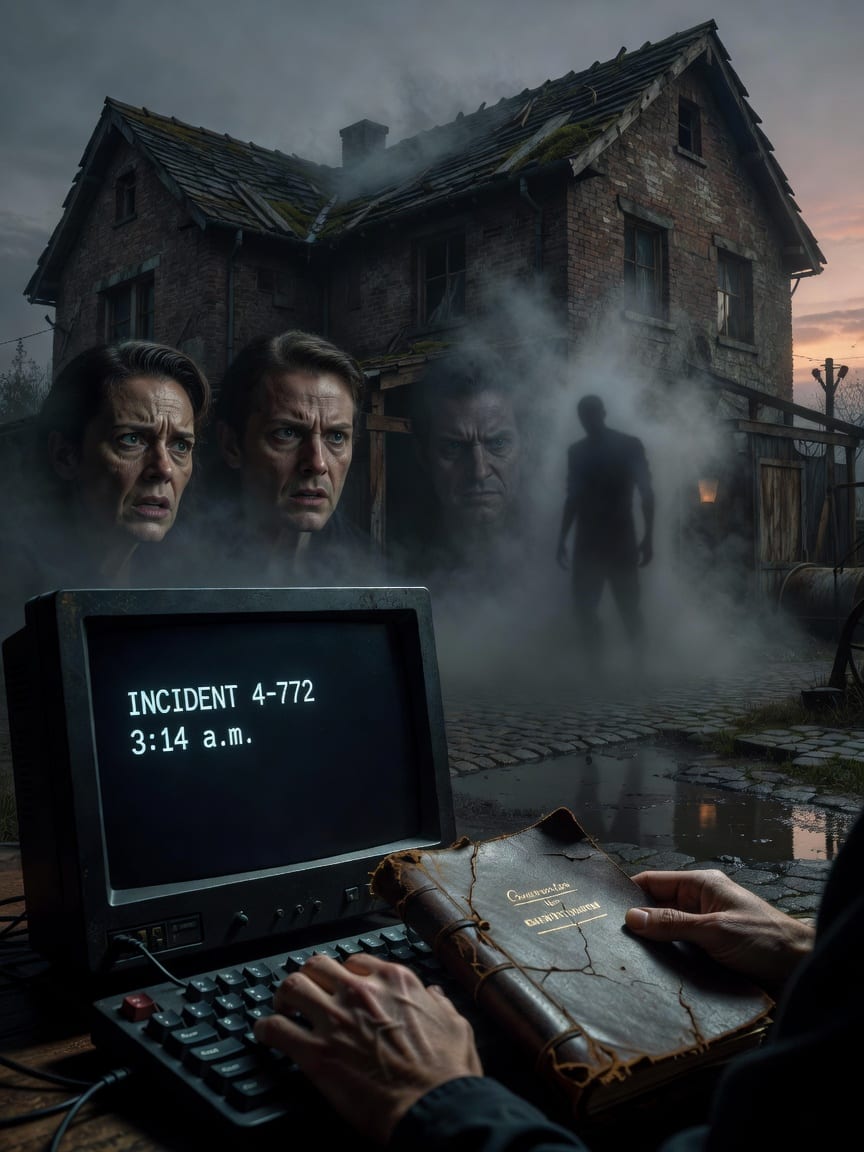
My screen showed Incident 4-772: a fire at the old rope works, 3:14 a.m. It was logged again for 1980. Then 1967. And 1993. Same incident, same time, same building. Each report ended with the same three words: 'expect recurrence.'
As a new archivist, I usually found my work digitizing old fire service records monotonous, until I found a heavily redacted line in a 1961 site assessment. Faint letters beneath the black bar slowly revealed my own family name, DRUMMOND, dated years before I was even born.
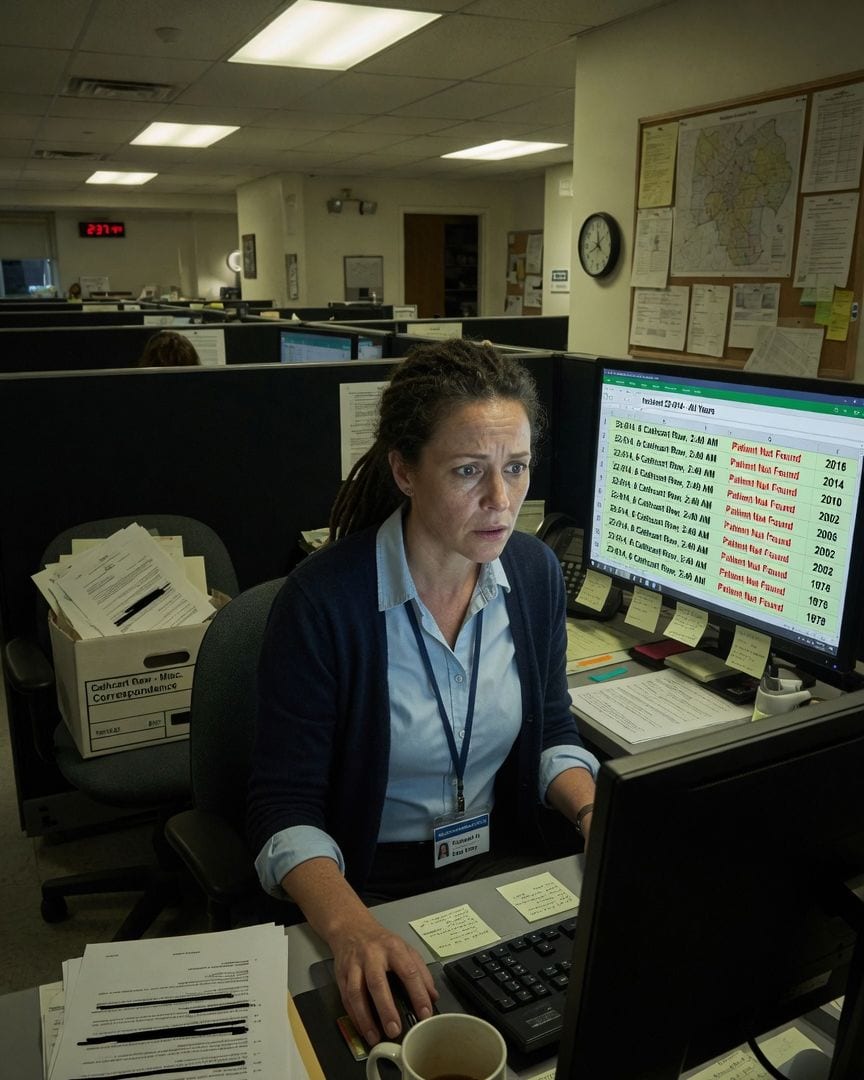
My computer log shows the same 2:40 AM call to Cathcart Row, every four years since 1978, always closed 'patient not found'.
Working data entry for the County Ambulance Trust, I found a routine incident logged as 'Patient Not Found.' But digging deeper, I discovered the exact same phantom call had repeated every four years for over forty years, always at the same address, always at 2:40 AM. Then I found a heavily redacted memo linking it to my own street.
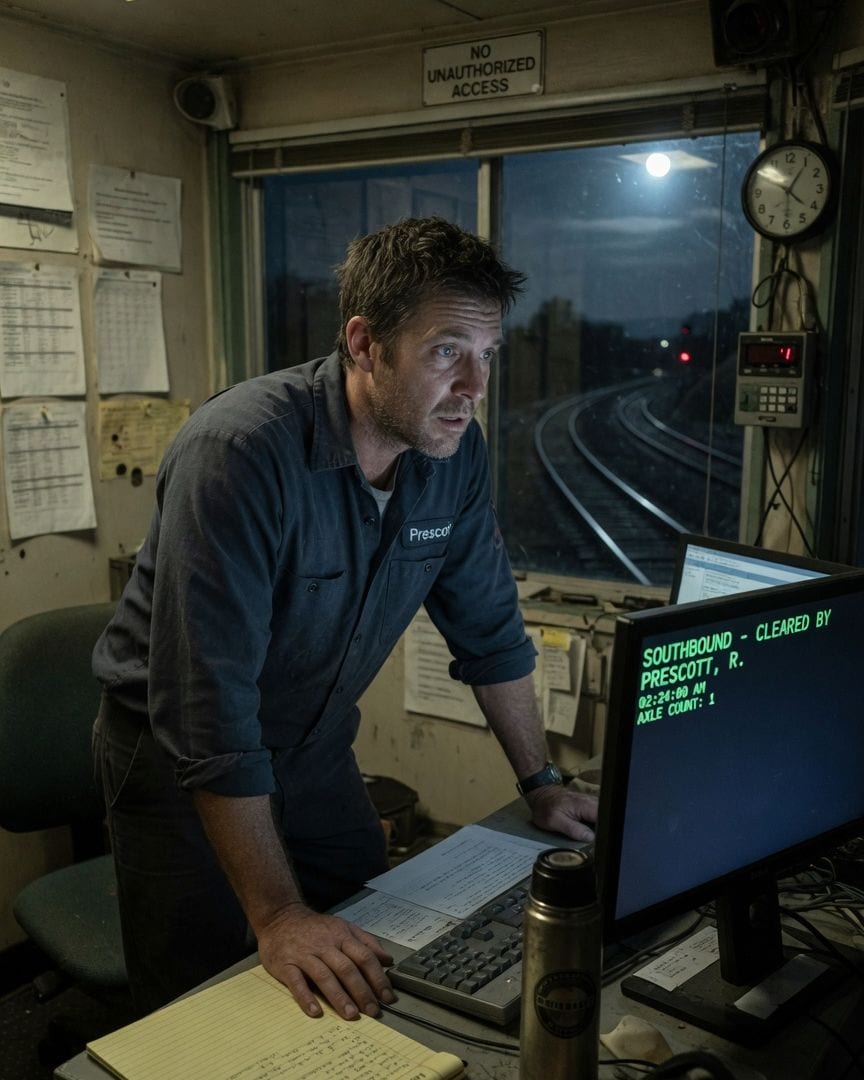
My signal box log shows I cleared a southbound train at 2:24 AM. No train was booked, but the wheel counter ticked over once.
My night shift in the signal box is usually quiet, just the hum of the panel and distant trains. But at 2:24 AM, a log entry for a southbound train appeared on screen, cleared by my name, even though I hadn't touched a thing. A cold prickle ran up my neck when the wheel counter ticked once, confirming an impossible passage on the empty tracks.
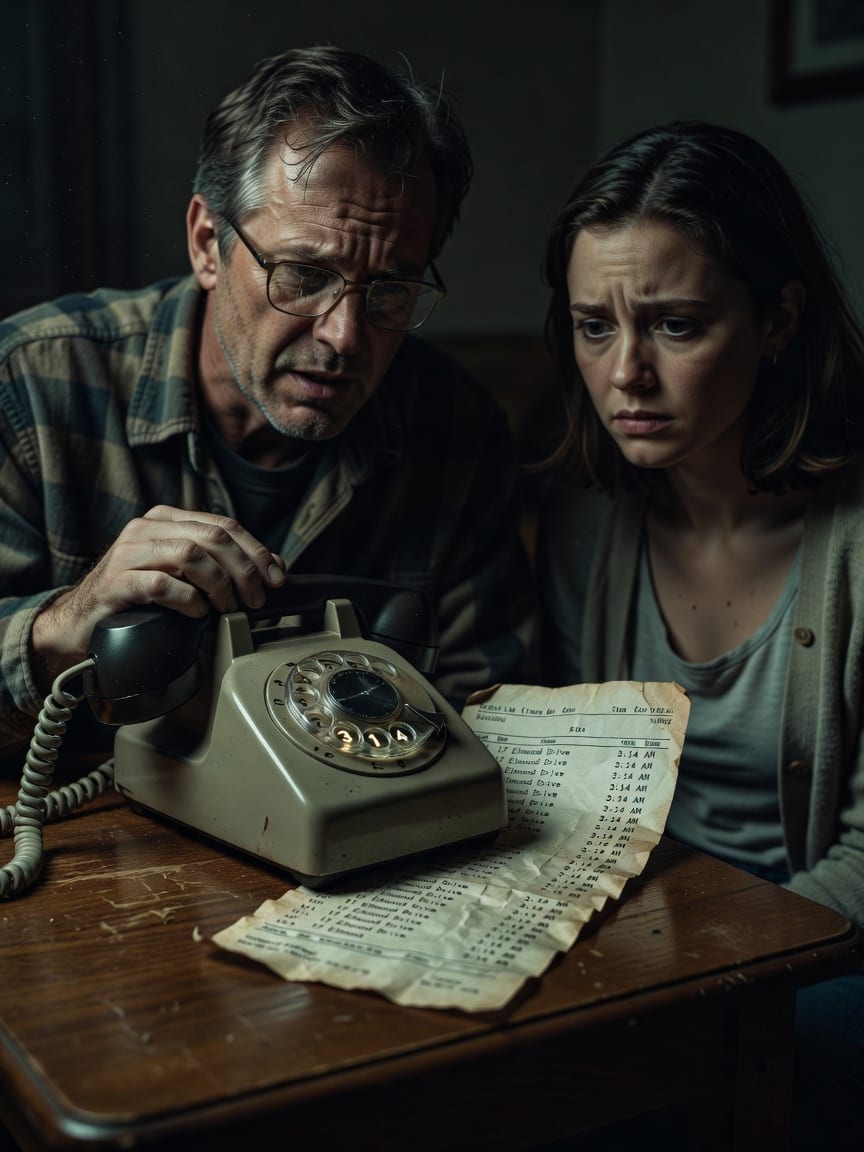
My phone bill itemised forty calls from my number to a house demolished in 1990. Each call at 3:14 AM, lasting eleven minutes. The bill arrived postmarked from a flattened building.
I expected the usual mobile bill, but my landline statement listed forty calls from my number to '17 Elmwood Drive.' That address was for a house torn down in 1990, a vacant lot I remembered from childhood. The phone company insisted the calls were legitimate, leaving me profoundly unsettled by the impossible charges.
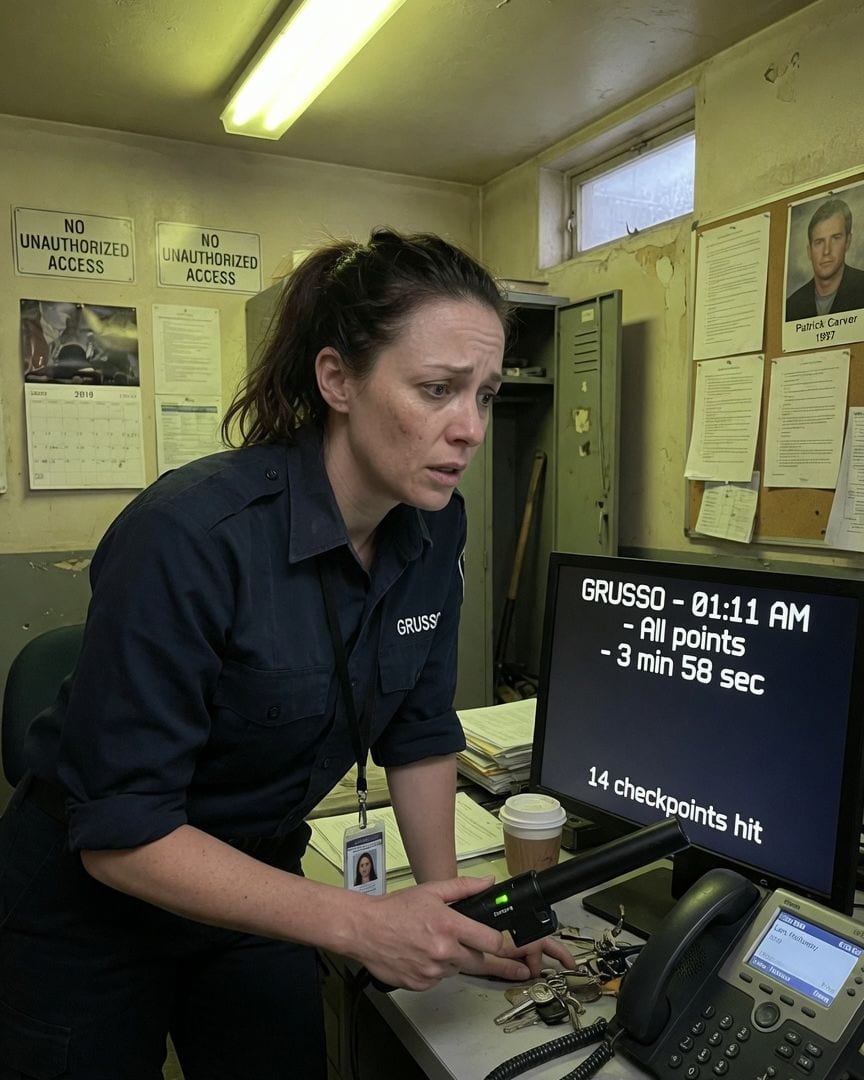
My security wand logged a full round at 1:11 AM in under four minutes. It was in the charger. Every tap is logged as mine.
Finishing my night shift, all I wanted was to get home. But the dock readout screen showed my security wand logged a full patrol at 1:11 AM, completed in just under four minutes. I knew my wand had been charging right beside the monitor the entire time, yet the log, under my ID, confirmed the impossible.
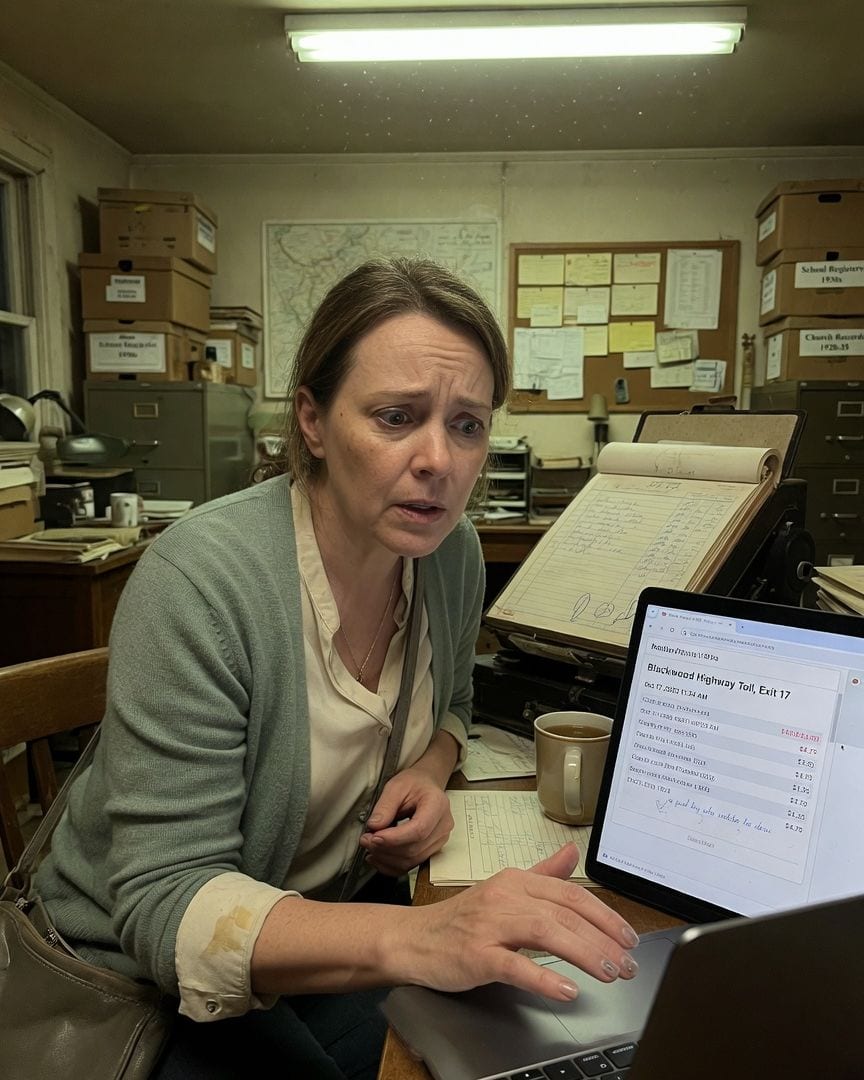
A 1931 school register marks me present every single day of that spring term — but I was born in 1969. And the teacher's note beside my name calls me 'a quiet boy who watches the door.'
As the village archivist, Lydia Kowalski uncovered her own name in a 1931 school register, decades before she was born. Then she found her unmistakable signature in the book, followed by the teacher's chilling note describing 'a quiet boy who watches the door'. Later, her bank statement showed a highway toll charge from a place she'd never been, on a day she was home with the flu.