My computer log shows the same 2:40 AM call to Cathcart Row, every four years since 1978, always closed 'patient not found'.
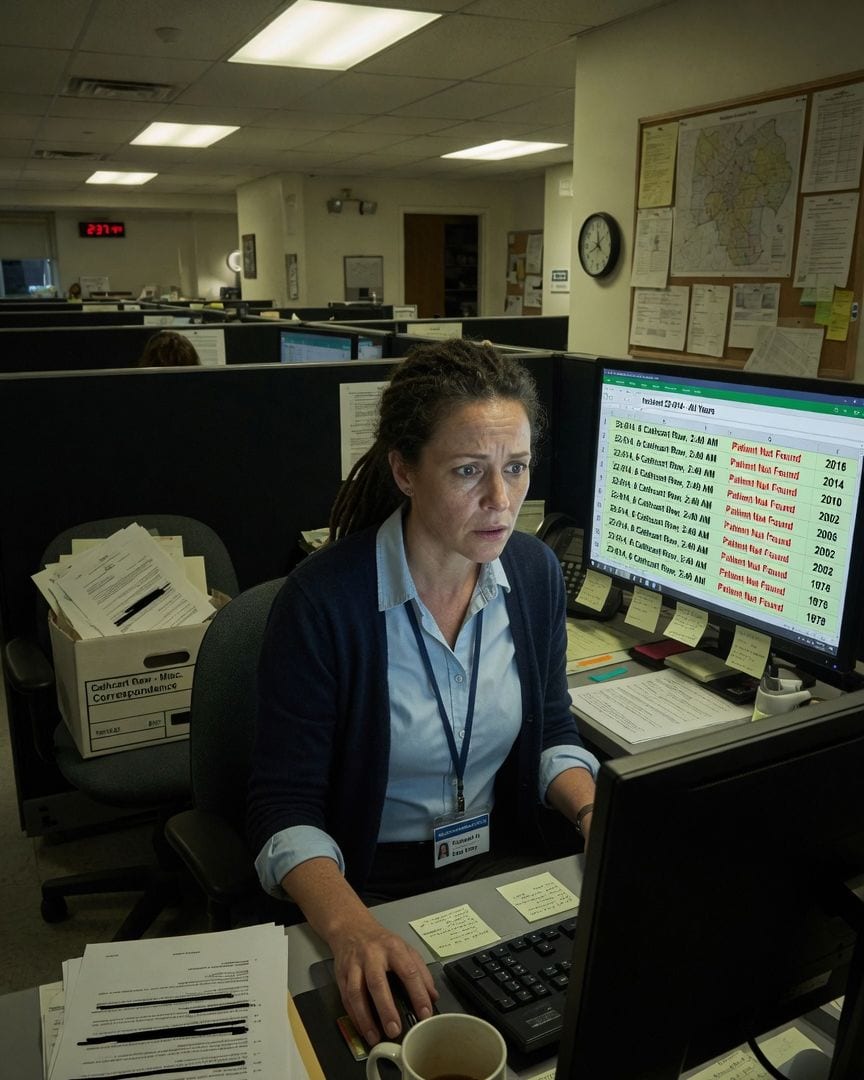
The hum of the County Ambulance Trust office was a familiar drone, a low thrum against the late shift's quiet. It was 2:40 AM, and the digital queue fed me another incident: ‘22-014, 6 Cathcart Row, Chest Pains.’ Standard stuff.
I processed it, clicked ‘dispatched,’ and moved on to the next entry, the fluorescent lights reflecting dully off my screen.
I’d been working data entry for the Trust for three years now, and the routine had a rhythm I found comforting. Little did I know how quickly that rhythm would fracture.
Later that week, reviewing archived logs for a routine audit, a line snagged my eye. Incident 22-014. 6 Cathcart Row. 2:40 AM. Closed: ‘Patient Not Found.’
My first thought was a system glitch, a phantom entry the algorithm had coughed up. It happened. I scrolled past, but something made me hesitate, pull back.
The exact incident number, the precise coordinates, the exact time, and that chillingly consistent ‘Patient Not Found’ status. It felt too specific to be random. I scrolled back, then further, running a quick search.
The screen filled.
2018. 6 Cathcart Row. 2:40 AM. Patient Not Found. 2014. 6 Cathcart Row. 2:40 AM. Patient Not Found. 2010. 6 Cathcart Row. 2:40 AM. Patient Not Found.
It kept going. Every fourth year, like clockwork, back to 1978. Always 6 Cathcart Row, always 2:40 AM, always empty.
The office felt colder than usual, the familiar hum now a subtle, persistent thrum against the silence, as if the building itself was holding its breath.
My rational mind tried to find an explanation. A recurring prank call? Some kid who’d perfected an automated dialer decades ago? Or maybe a system error, one of those deep-seated legacy bugs that created ghost entries out of thin air?
I tried to tell myself it was just a statistical anomaly, a quirk of the system. But the sheer, unblinking precision of it gnawed at me. Forty-four years of identical, unexplainable incidents.
I approached Gerald Marsh, my senior data manager, during his morning coffee break. He was a man whose calm demeanor was legendary, unflappable even in the face of the Trust’s most spectacular data crashes.
I gestured at the screen, showing him the endless scroll of 22-014 entries. He barely glanced at it, his eyes lingering instead on his steaming mug.
“Ah, 22-014,” he said, a faint, almost bored smile playing on his lips. He took a slow sip. “A legacy bug. Goes back decades. We just… close them out. Phantom entries, you know.”
He waved a dismissive hand, as if shooing away a fly. “Nothing to worry about, Deborah. Just one of those quirks we inherited from the old system.”
But I couldn't shake the feeling. Phantom entries don't repeat with such perfect, clockwork precision for over forty years, always at the exact same address, the exact same minute.
A chill, light and sharp, seemed to seep from the monitor and spread through the air around my desk.
I spent the next few days cross-referencing. Police dispatch logs. Hospital admissions. Fire department records. Anything that might corroborate a real event, a genuine emergency call that for some reason wasn’t properly logged on our end. But there was nothing.
Incident 22-014 existed only within the Ambulance Trust’s archives, a self-contained loop of an emergency that never was, always ending with the same four words: ‘Patient Not Found.’
The absence of any other record was more unsettling than a hundred false alarms. It meant this wasn’t just a ghost in our machine; it was a ghost that only our machine could see.
I started pulling older physical files, searching for anything else related to Cathcart Row or other unusual ‘patient not found’ entries. I ignored Gerald’s casual glances.
Days bled into nights as I delved deeper, bypassing official channels, digging into the physical archives down in the Trust's basement.
The air down there was thick with the scent of old paper and dust, a quiet contrast to the hushed hum of the office above. After hours of sifting through mildewed boxes, I found one labelled 'Cathcart Row - Misc.
Correspondence'. Inside, among faded memos and outdated protocols, was a single sheet from 1982, crisp and brittle with age, but otherwise pristine. It was marked 'CATHCART ROW INCIDENTS - PROTOCOL REVISION'.
The memo detailed minor procedural changes for future 22-014 dispatches, new instructions for paramedics if they encountered... nothing. Most of the document was clean, unremarkable.
But halfway down, beneath a paragraph about 'observation parameters' for the recurring incident, a single line had been heavily redacted with thick black marker.
It looked like someone had gone over it not once, but several times, determined to erase whatever was written there.
Curiosity burning, a sudden, cold spark in my chest, I held the brittle paper up to the harsh overhead light above the archive desk, tilting it just so. My heart hammered, a frantic drum against my ribs.
Faintly, through the layered ink, I could make out fragmented letters, ghostly grey against the black. Enough to piece together two words that made my breath catch, cold and sharp in my throat: '...Elmwood Drive...'
My own street.
The sight of 'Elmwood Drive' on that decades-old, redacted memo had rooted itself in my mind, a sliver of ice. I lived on Elmwood Drive now, in a semi-detached house with a small garden.
But in 1982, I hadn’t even been born, and my family certainly hadn’t resided there. It wasn't a coincidence; it was a cold, impossible connection.
A shiver ran through the office air around me, not from a draft, but from the sudden, impossible coherence of it all.
I intensified my archival dive, moving beyond just 22-014, looking for any other documents linking Cathcart Row to Elmwood Drive, or any other unusual addresses that might show up alongside 'patient not found' entries.
My search led me to an old staff directory from 1985, tucked away in a drawer beneath a stack of fire-safety regulations. Under the heading 'Archivist,' I found the name Eleanor Crane, listed with a long tenure.
A quick search on the borough's public records confirmed she was still living locally, a spry 68-year-old, retired and tending a meticulously kept garden just a few miles from the Trust.
I arranged a 'casual' visit, feigning interest in local history for a university project I was supposedly helping a friend with. Eleanor was initially wary, her eyes sharp and assessing as she offered me tea in a sunny conservatory.
The scent of her roses, blooming just outside the glass, filled the air. She spoke fondly of her years at the Trust, cataloging everything from medical equipment manifests to forgotten patient files.
But when I, carefully, mentioned the persistent 'Cathcart Row incidents' and the 'unusual recurrence' of the 'patient not found' status, Eleanor's expression shifted.
The sunlight seemed to dim slightly in the room, or perhaps it was just my perception. A flicker of something – recognition, perhaps even pity – crossed her face.
Her hand, which had been resting on a half-finished embroidery hoop, tensed.
"Ah, Cathcart Row," Eleanor said, her voice softening, almost a whisper, as she snipped a deadhead from a rose with surgical precision. "Some things, dear, are kept on file for reasons that transcend simple records.
They're about the way things… repeat. Cycles, you see. Not glitches, not mistakes. Just cycles." She met my gaze, a strange, knowing glint in her eyes. "Some things are better left filed away."
She looked away then, back at her roses, but the implication hung in the air, thick and heavy.
After her meeting with Eleanor, I felt a subtle shift in the office, a creeping sense of being watched.
My computer, which I always locked when I stepped away, occasionally greeted me with a login screen upon my return, as if someone had been there, idly nudging the mouse. Files I'd left open would be closed, or minimized.
Once, a specific archive folder I'd been scrutinizing, full of scans of old incident logs, was inexplicably empty, only to reappear the next morning, perfectly restored.
I dismissed it as IT issues, or maybe I was just tired, working too many late shifts, but a creeping unease settled in, a cold dread that clung to the edges of my vision.
The monitor in the corner of my eye seemed to pulse, a silent, knowing throb, as if it contained a secret it wasn't supposed to share.
Then Gerald Marsh stopped by my desk, his usual calm tinged with something too deliberate, too focused. "Still fascinated by our historical data anomalies, Deborah?" he asked, his voice soft, almost a purr, the question itself a gentle prod.
"It's a rabbit hole, that one. Some things are best left as 'legacy bugs,' wouldn't you agree?" His gaze lingered on me for a beat too long, assessing, before he moved on, leaving a faint chill in his wake.
That evening, as I drove home, my thoughts still racing, I noticed a dark sedan parked a few houses down from my own on Elmwood Drive.
Its lights were off, tucked into the deepening twilight, but the silhouette of a man was visible in the driver's seat. It was Gerald Marsh's car. My stomach lurched.
He wasn't looking at my house, not directly, but rather at the street itself, his face obscured by shadow. He was just… observing.
I drove past, my heart hammering a frantic rhythm against my ribs, then circled the block, a sudden, desperate urge for proof. When I returned, just minutes later, the car was gone.
The empty space felt like a punch to the gut. I felt a cold certainty that had nothing to do with cold drafts or fatigue: I wasn't just investigating; I was being watched.
The surveillance solidified my resolve. I couldn't ignore it, couldn't explain it away. The next day, after my shift, I drove straight back to Eleanor's house, no longer pretending.
The sun was setting, casting long, bruised shadows across her immaculate garden.
I laid out the facts, one by one, watching her face: Cathcart Row, the four-year cycle, the 'patient not found' status, the redacted memo, Elmwood Drive, and Gerald Marsh's watchful presence outside my house.
Eleanor listened, her face grave, her hands clasped tightly in her lap. The evening air grew heavy around us, the scent of the roses now almost cloying.
"Gerald is… dedicated," she finally said, her voice barely a whisper, a tired admission. "He manages the protocols."
I pressed, leaning forward, my voice tight. "Manages what? What is 'patient not found' really, Eleanor?"
Eleanor sighed, a deep, weary sound that seemed to carry the weight of decades. "It's a code, dear. A classification. For events that defy medical explanation, occurrences that simply… manifest. They aren't 'patients' in the way we understand.
They are… phenomena. And the Trust, for decades, has been tasked with simply monitoring them. Not intervening, not stopping them. Just observing, logging, and filing. Maintaining equilibrium."
A chill, colder than any I'd felt before, crawled up my spine. The room, which had seemed so warm and inviting before, now felt like a sterile observation chamber.
"So, it’s not a bug," I whispered, the realization dawning, awful and precise. "It’s a feature. An official cover-up for something inexplicable."
Eleanor nodded slowly, her eyes distant. "The 2:40 AM call isn't an emergency dispatch; it's a scheduled observation. A bureaucratic ritual. These phenomena have… signatures. Cycles.
And sometimes," she paused, her gaze meeting mine, suddenly sharp and clear, "they have a resonance with certain locations. Or even… people. Some families are more attuned. They draw it, or are drawn to it.
The records are kept for a reason, you see. To track the patterns. To predict. To manage the unmanageable."
The earlier clues clicked into place with horrifying precision. Gerald’s calm dismissal wasn't ignorance; it was the practiced neutrality of a manager. The recurring call was a scheduled event, not an error.
And the redacted line on Elmwood Drive wasn't a random error; it was a marker, a cold, clinical reference point.
I felt the world tilt on its axis. The cold, bureaucratic machinery of the Trust wasn't just archiving anomalies; it was actively managing them, tracking them, accepting them as an immutable part of the world.
My mind raced, trying to grasp the implications, the sheer scale of the hidden reality she was describing.
"And Elmwood Drive?" I asked, my voice tight, barely a thread of sound. "Was my family connected? Is that why it was on that memo from 1982?"
Eleanor didn't answer directly. Instead, she walked over to a small, fireproof cabinet, built into the wall of her conservatory, almost invisible until she pointed it out.
She unlocked it with a tiny, antique key she wore on a chain around her neck, and pulled out a thick, bound ledger.
The old ledger, heavy and leather-bound, seemed to thrum with a suppressed energy as she laid it on the polished wooden table. She flipped through pages filled with neat, precise handwriting, stopping at a specific entry.
The scent of old paper and something else, something metallic and faint, rose from its pages.
She carefully tore out a single sheet, a printout from a more modern printer, but folded and tucked into the ancient book. It was a long list of incident numbers, dates, and addresses. All marked 'patient not found.'
It wasn't just Cathcart Row. There were dozens, maybe hundreds, of such entries, stretching back further than 1978, some with different cyclical patterns, some with different times. The sheer volume of it was staggering.
Eleanor’s finger, gnarled with age, traced a line on the page, then stopped. Her eyes, filled with a profound, unsettling pity, met mine.
"You see, Deborah," she said, her voice heavy with a profound, unsettling finality, "the patterns aren't just about places. They're about connections."
Her finger rested on an address I knew intimately, an address from my deepest childhood memories, followed by the familiar 'patient not found' status, and the date 1998. "Your childhood home," Eleanor whispered.
"You weren't just a witness, dear, you were always part of the record."
I stared at the entry for my childhood home, dated 1998. The blood drained from my face, leaving a cold, hollow ache.
The memory of that house, always a safe, warm place in my mind, twisted into something alien and terrifying. "What happened in 1998?" I demanded, my voice barely audible, a desperate whisper.
Eleanor, her face etched with a weary acceptance, explained that the 'patient not found' entry for my childhood home indicated a 'manifestation event' during my childhood, a cyclical resonance that marked certain individuals or families.
The Trust's records weren't just about locations, but about the 'attuned.'
The redacted line about Elmwood Drive in 1982 was likely a preliminary survey, a 'pre-emptive observation' for a known 'attuned' family moving into the area, or perhaps a family connected to a previous manifestation.
The Cathcart Row incident was merely one of the oldest, most consistent, and most prominent 'signatures' in the borough.
The entity wasn't a monster, Eleanor clarified, her voice flat, devoid of emotion. It was a 'presence,' a 'pattern of resonance' that emerged and receded, leaving an indelible, subtle mark on those within its field.
The horror wasn't in a physical threat, not in anything I could fight or flee from, but in the cold, dispassionate management of the utterly alien, the quiet, bureaucratic acceptance of a reality beyond human comprehension.
The Trust wasn't fighting it; it was simply tracking it, filing it, and ensuring its existence remained an unacknowledged truth.
Every clue – the repeating call, the empty house, the redacted street, Gerald’s strange calm, Eleanor’s cryptic hints – now clicked into place, forming a coherent, terrifying tapestry of hidden reality.
I realized I wasn't just an observer; I was, and always had been, a data point in their quiet, endless ledger. A subject of an ongoing, incomprehensible experiment. My entire life, perhaps even my existence, was a recorded 'phenomenon.'
Armed with Eleanor's revelations and the chilling list that tied my entire life into this pattern, I returned to the Trust.
The familiar fluorescent lights and the low hum of servers now felt like the oppressive ceiling and internal organs of a vast, unfeeling organism.
I found Gerald Marsh in his office, the door ajar, the glow of his monitor washing his face in pale blue.
I walked in, placed the printout – the list of 'patient not found' entries, including my childhood home – squarely on his desk.
His calm never wavered. He picked up the sheet, his eyes scanning the addresses, including the one for my childhood home. A faint, almost imperceptible nod.
"Eleanor has a habit of oversharing," he said, his voice flat, devoid of surprise or anger. "But she's not wrong."
He confirmed everything: the 'phenomena,' the 'attunement,' the institutional protocols that stretched back further than any of us had been alive. He spoke of 'maintaining equilibrium,' of 'observing without interference,' as if discussing weather patterns or stock market fluctuations.
There was no malice in his tone, only a profound, unsettling detachment, a chilling acceptance.
"You have an unusual sensitivity, Deborah," he continued, leaning forward, his gaze unnervingly direct. His eyes, usually so bland, seemed to bore into mine. "A rare attunement. You could be invaluable.
We could teach you to understand the patterns, to manage them. To truly see what others can't." He wasn't threatening me; he was recruiting me.
The offer was a trap, an invitation to descend into a life spent coldly managing the inexplicable, a life where humanity was merely a collection of data points, and I would be one of the quiet, unquestioning custodians.
I felt a wave of cold revulsion, bile rising in my throat. "No," I said, my voice firm, though my hands were trembling. "I won't be part of this."
I knew I had to get out, but I couldn't leave without proof. Just then, his desk phone buzzed, a sharp, insistent ring. Marsh hesitated for a fraction of a second, his eyes still on me, before answering.
It was an internal call, urgent, about a system error.
While Marsh was momentarily distracted, his back half-turned, talking quietly into the receiver, I acted.
With trembling fingers, I quickly connected a small USB drive I'd brought with me to his desktop, initiating a rapid download of the classified incident logs and internal memos from his unsecured server.
The transfer progress bar crawled agonizingly slowly across the screen, a digital hourglass draining my courage. Every second felt like an hour.
Marsh hung up, his eyes returning to me, a knowing glint in them. He watched me as the final bytes transferred. The progress bar vanished. I pulled the drive, stood up, and met his gaze.
There was no anger, no surprise, just a faint, almost imperceptible smile. His calm was worse than any threat, a vast, indifferent ocean. He simply nodded, a silent acknowledgment of my escape, and the proof I now carried.
I walked out, his unnervingly serene gaze following me until I was out of sight.
I resigned from the County Ambulance Trust the next day, citing 'personal reasons' that were far too complex and terrifying to articulate.
I liquidated my assets, sold my house on Elmwood Drive at a slight loss, ignoring the strange, lingering cold in the hallway, and moved to a new city, hundreds of miles away.
I picked a borough with no known 'patient not found' addresses in the downloaded files on my USB drive, a desperate attempt to outrun the patterns.
The drive, containing the horrifying truth, was hidden in a safe deposit box, a digital time capsule no one would ever believe, should it ever be found.
I cut all ties with my former colleagues, especially Gerald Marsh, whose composed smile was now burned into my memory. I tried to rebuild my life, to find normalcy, to forget the patterns I’d uncovered.
But the knowledge was a permanent stain on my perception. I saw the world differently now, always scanning for the subtle, the repetitive, the inexplicably empty.
Life in the new city was quiet, anonymous. I got a new job, a new routine. But the patterns, once seen, could not be unseen.
A neighbor’s cat, a sleek black shadow, always appeared on the same fence post at exactly 7:03 AM, regardless of the weather. A faint, distant siren, with a peculiar rising cadence, sounded precisely the same every Tuesday night.
A specific shadow, long and thin like a reaching finger, fell across my window at the exact same moment each evening, regardless of the season, a precise, unmoving mark against the fading light.
I found myself subconsciously logging these small, meaningless recurrences, my mind a new kind of archive. The knowledge of the institution, of Gerald Marsh’s calm management, of Eleanor Crane’s weary acceptance, clung to me like a second skin.
I hadn't just escaped the Trust; I had become an attuned observer myself, forever scanning the world for the echoes of the unacknowledged.
The proof I carried was useless to anyone else, but it was a heavy, constant companion to my own, altered reality. I knew the truth, and that truth had made me permanently hollowed, forever watching.
The patterns I now see are everywhere, and I wonder if I am simply watching, or if I'm still part of the record.
If this one got to you
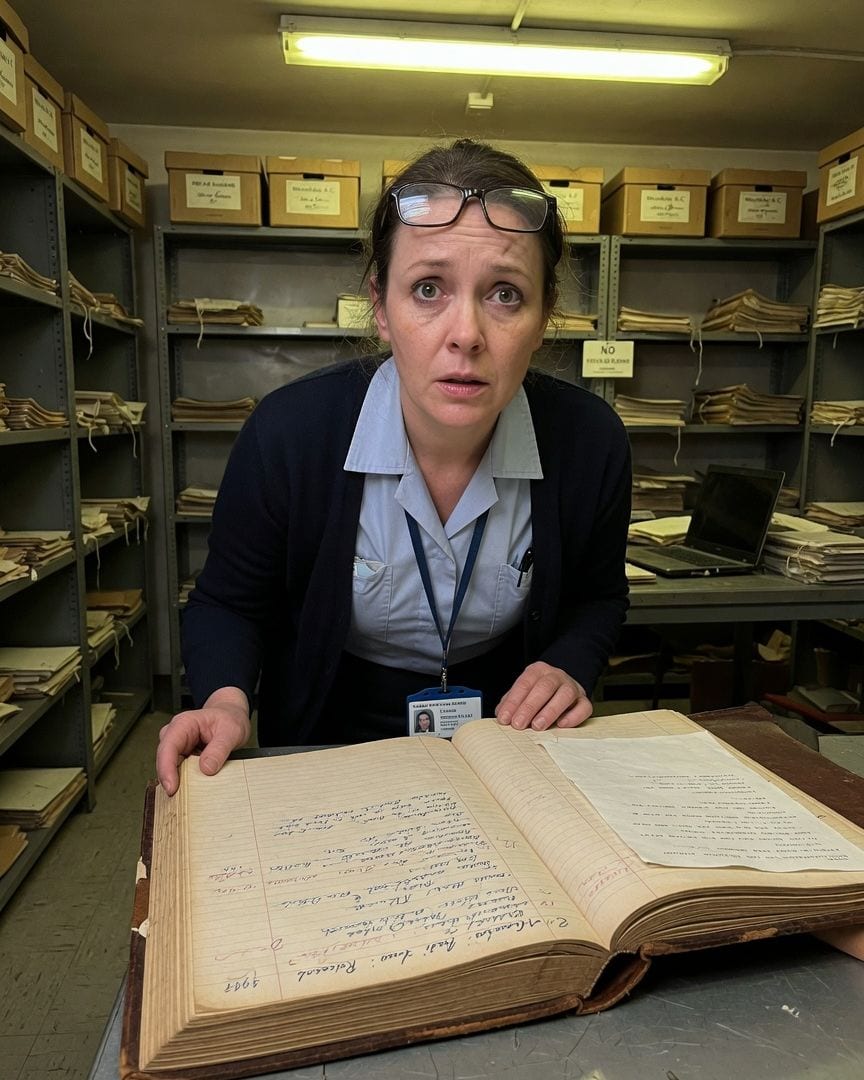
My ambulance trust's incident log shows callout 22-014 to 6 Cathcart Row at 2:40 AM. Every four years, the same call, same address. Always 'patient not found'.
My job involves tedious data entry for ambulance calls, but Incident 22-014 was different. It appeared every four years, always at 2:40 AM, always closed as 'patient not found.' Digging into the dusty physical archives, I found an entry from 1961 for the exact same incident, but its resolution read: 'Subject Secured. Relocated to "Holding".'
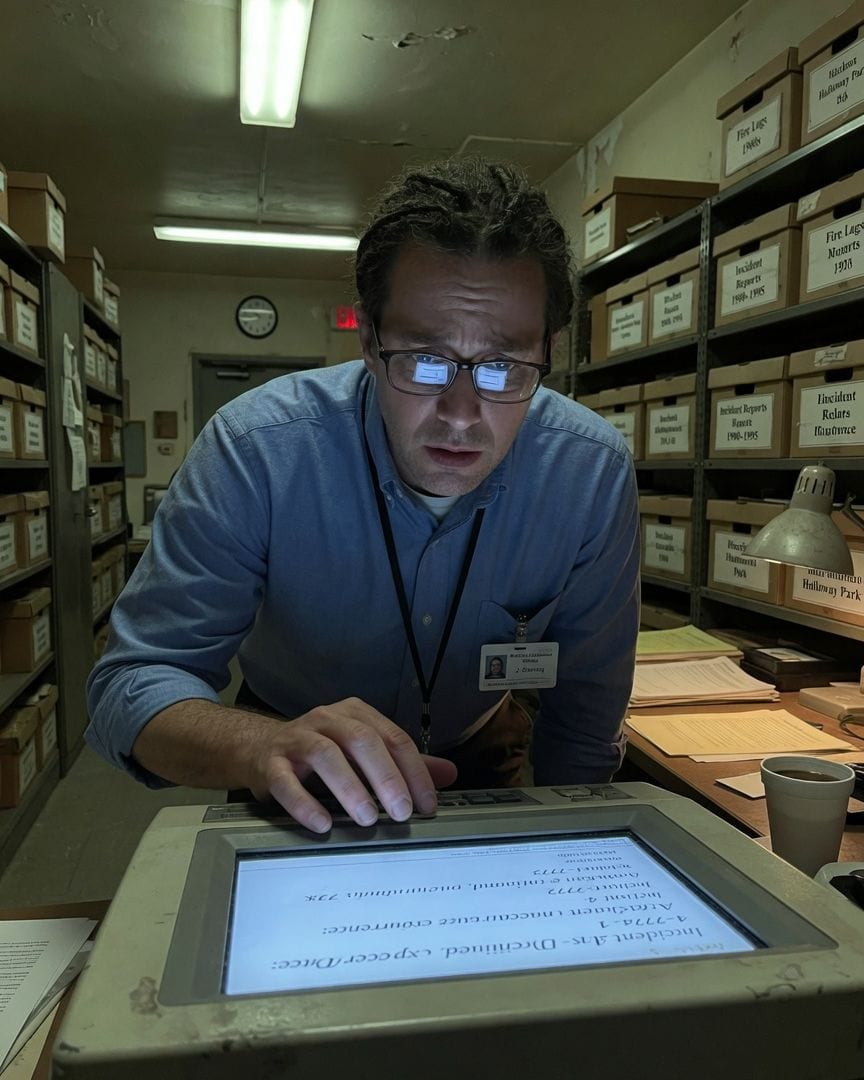
My old rope works fire log repeats the same 3:14am blaze, same incident number, across 1967, 1980, 1993. Each ends: 'origin undetermined, expect recurrence.'
As an Archival Digitization Officer, my days are spent scanning old records. I was numbly working through fire service logs when Incident 4-772 caught my eye: the same structural fire, same time, same number, repeated across different decades. Each entry ended with the chilling, identical phrase: 'origin undetermined, expect recurrence.'
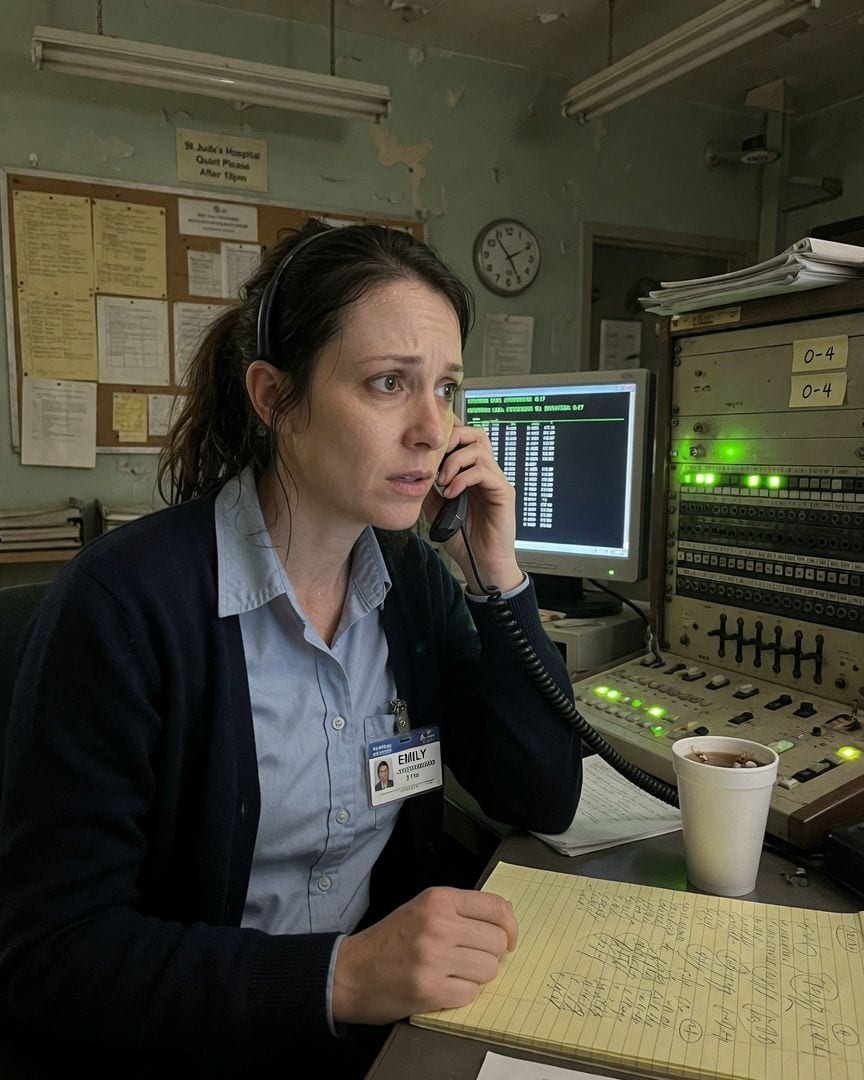
A nurse's voice asks me to page Dr. Reyes to the third floor. My hospital's third floor was demolished years ago, and extension 0-4 with it.
Working the quiet overnight shift at St. Jude's, I was used to predictable clicks. But just after 4 AM, my switchboard lit up: a call from extension 0-4. That extension was decommissioned decades ago, tied to a floor that no longer exists, yet the light pulsed insistently.
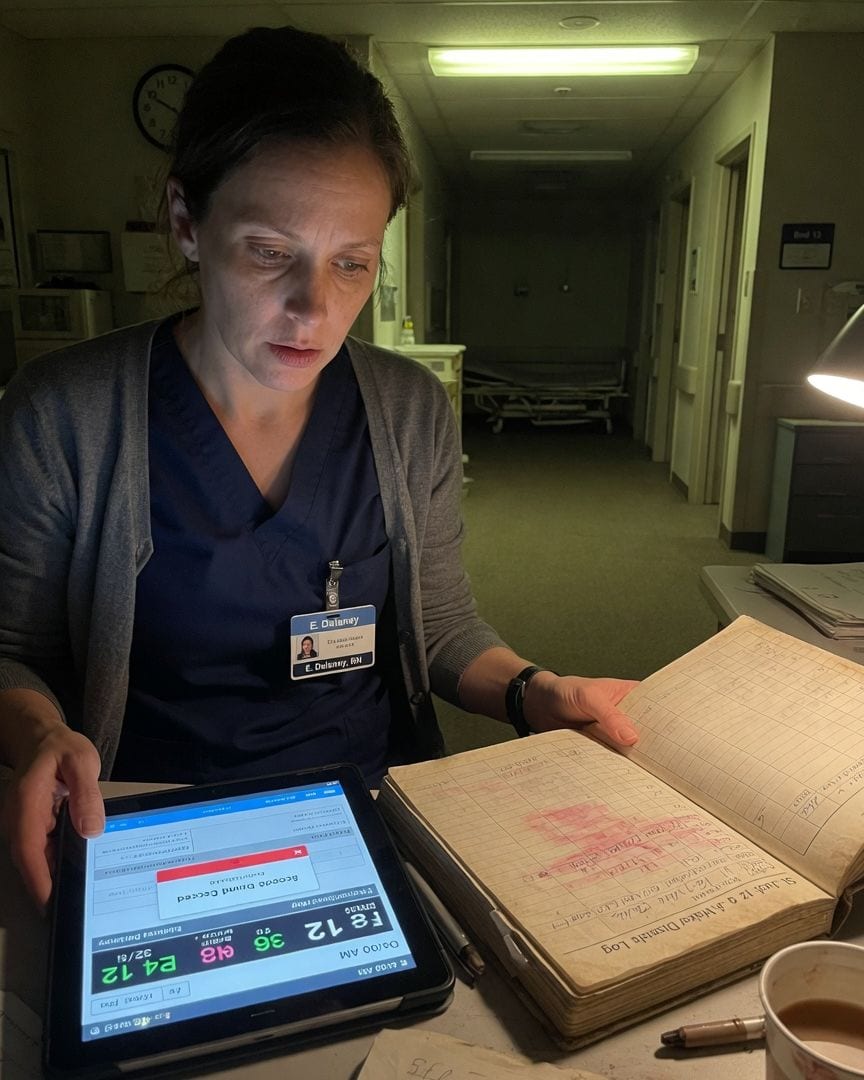
My empty ward's bed 12 had fresh vitals charted. The system says I entered them.
Working my usual night shift at St. Jude's, I pulled up the monitor system to log patient vitals for Ward 12. My thumb paused at Bed 12, where a full set of readings was already timestamped and logged under *my* ID. But Bed 12 was utterly stripped and empty; it had been discharged days ago.
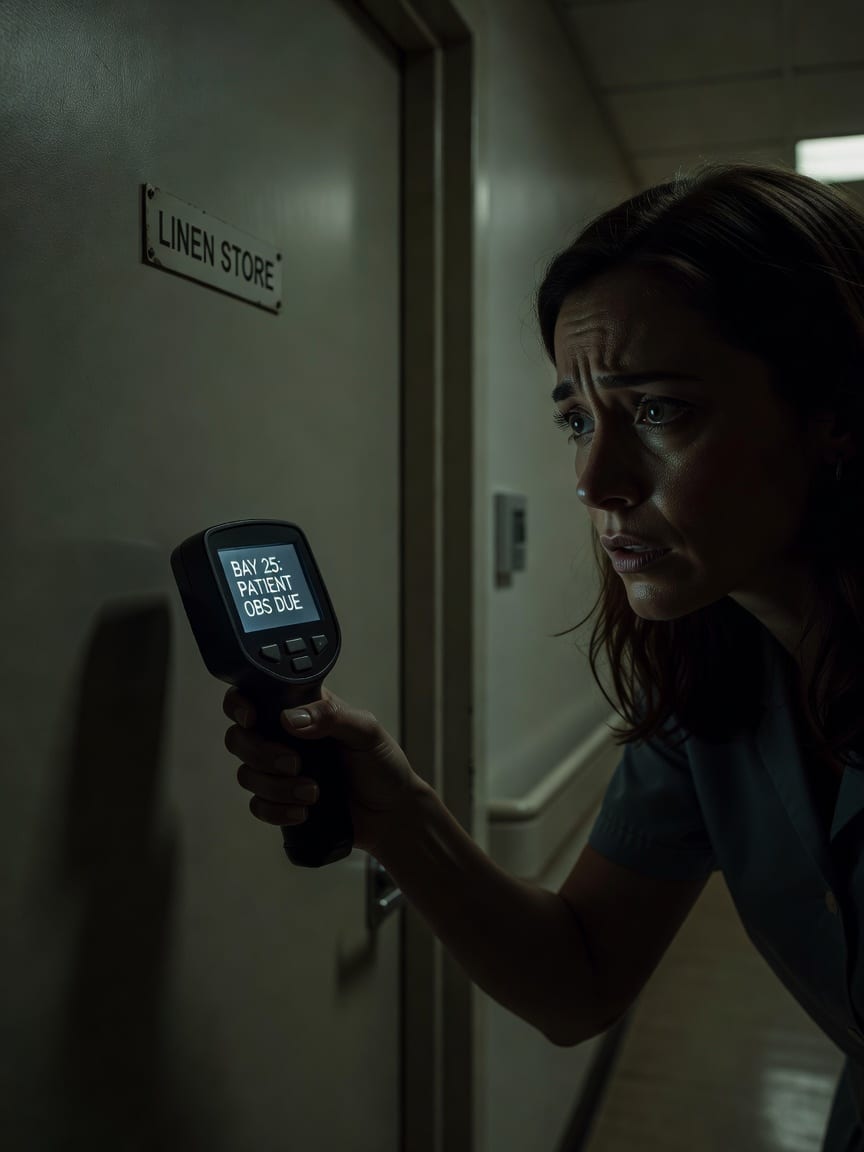
My hospital scanner demands patient care in Bay 25. Bay 25 is a locked linen closet.
I'm a pragmatic nurse, used to my hospital's quiet night shifts. But for a fortnight, my scanner has logged phantom patients in 'Bay 25' — a room that's just a linen closet. Then, tucked away, I found an old patient ID bracelet, faded but clear: 'Bay 25.'
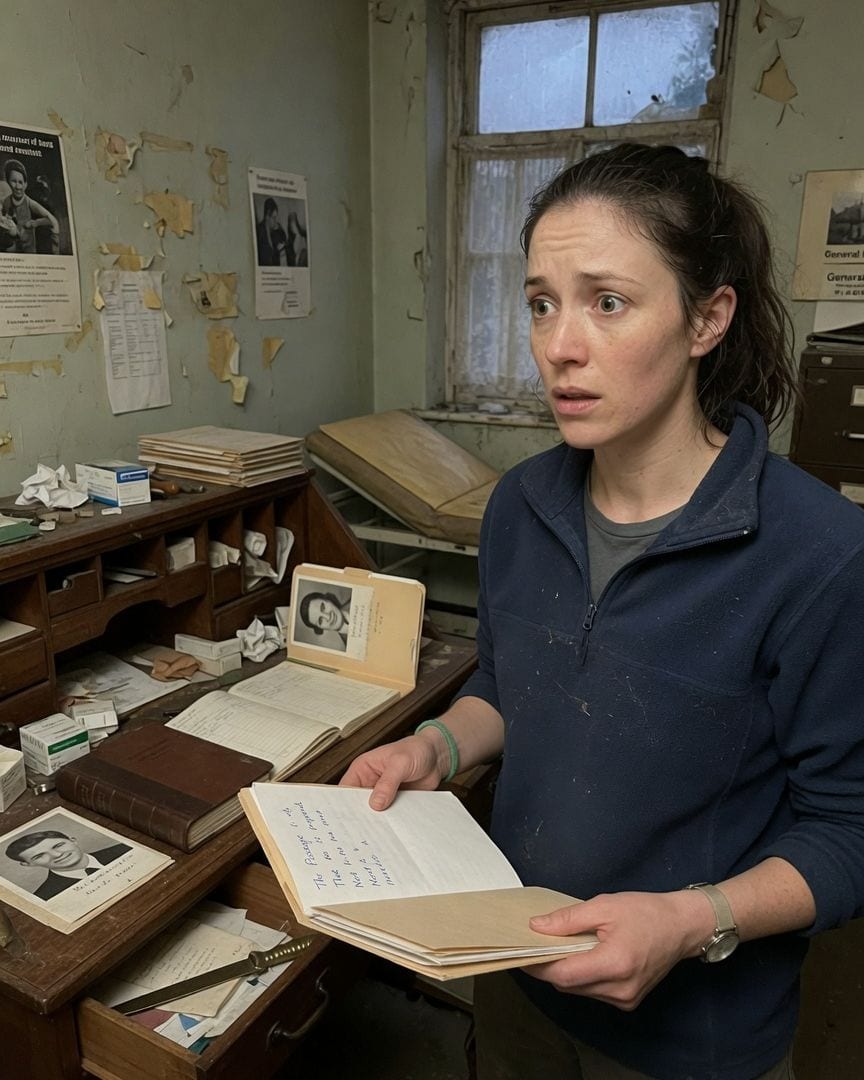
My new clinic's appointment book shows entries for this coming Monday, decades after the doctor retired and died.
Chloe Lawson bought an old, abandoned surgery in Nettlebed, ready to open her new vet clinic. Locals insisted Dr. Almott retired in '79 and the practice shut down for good. But then Chloe found his dusty appointment book filled with meticulous entries, continuing unbroken from 1979 through the decades, right up to this coming Monday.