My empty ward's bed 12 had fresh vitals charted. The system says I entered them.
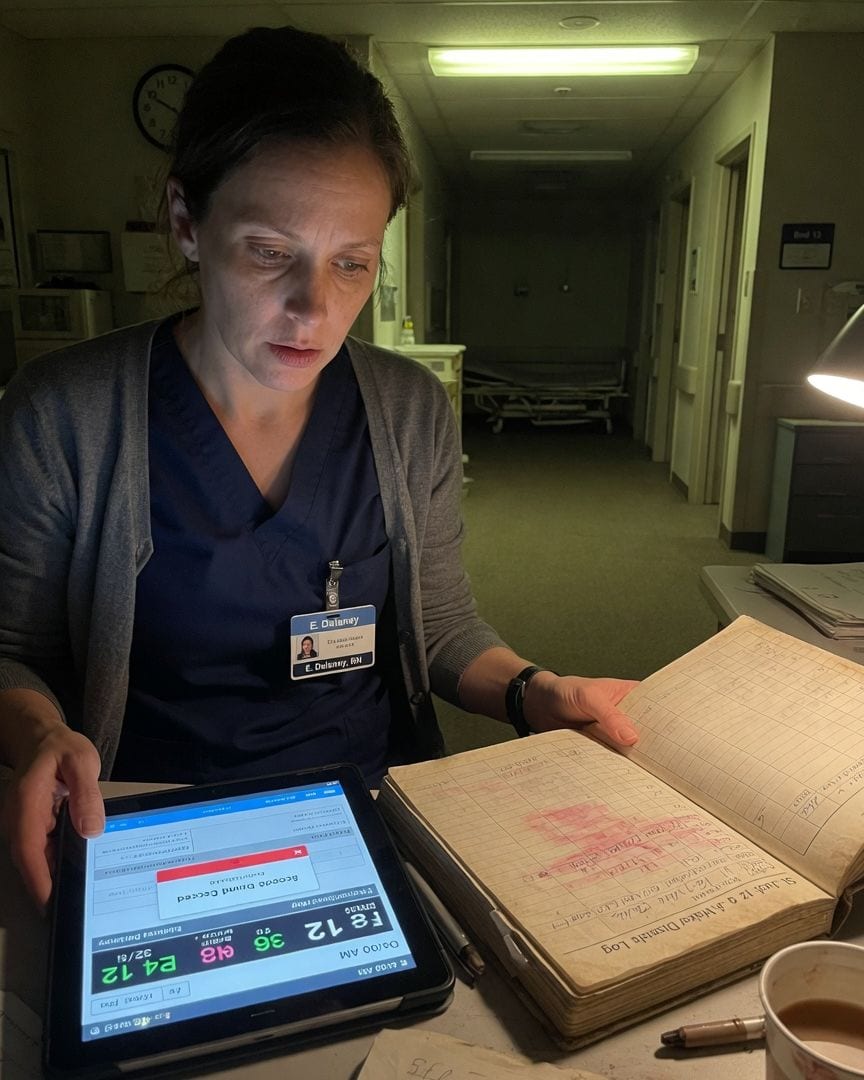
The coffee was lukewarm, almost cold, when I finally poured it at 3:55 AM. St. Jude's was hushed, every sound swallowed by the deep pile of the hallway carpet, save for the distant hum of machinery from ICU.
My routine on the night shift was a comfort: final rounds, chart vitals, then those few precious minutes of peace before morning shift change. I pulled my tablet from its dock, the screen cool beneath my fingers.
At 4:00 AM, precisely, I opened the monitor system to log the last set of vitals for Ward 12.
Scrolling down the list, my thumb paused. Bed 12. A full set of readings was already there: pulse, pressure, temperature. Timestamped 4:00 AM. Logged under my ID. Evelyn Delaney.
I blinked, rubbed my eyes. Bed 12 was empty. Not just empty of a patient – no IV pole, no call button, no water pitcher on the bedside table – but utterly stripped. Bare mattress, bare bed frame.
It had been like that since yesterday afternoon, discharged long before my shift even started. I checked the bed number again. Then my login. Both were correct.
The system insisted I had taken vitals for a patient who wasn't there, in a bed that wasn't even ready for a patient, at the exact moment I was across the ward in the break room, wrestling with the coffee machine.
A prickle of unease started in my neck. I stood, the tablet clutched in my hand, and walked slowly down the silent corridor.
The hum of the ward, usually a dull background noise, seemed to press in, making the silence in the empty room feel heavier than usual. I peered into the vacant space of Bed 12. Nothing.
Just the clean, hard lines of the frame. The monitor system on my tablet still displayed the phantom data, bold and undeniable.
My first thought was a system glitch. Or a stupid, tired prank by Quentin, the new guy, though he usually wasn't that creative. I navigated the system, looking for an admission record for Bed 12 for the night.
Anything that might explain a momentary error, a phantom patient. There was none. Blank. Bed 12 hadn't had an admission for days.
Then I checked the digital discharge log. My stomach clenched. There, under Bed 12, was an entry for 'Patient 12,' discharged at 3:55 AM, signed off by 'E. Delaney.' Me.
I hadn't discharged anyone. Not in the last three days. My mind raced, trying to recall if I'd seen anyone on the ward who might have been a 'Patient 12,' or heard any unusual activity around 3:55 AM. Nothing.
The name 'Patient 12' felt generic, almost like a placeholder, not a real person. A chill traced its way down my spine. This wasn't a glitch, was it?
I navigated back to the phantom vital entry, selected it, and hit 'delete.' A red error message flashed, angry against the calm blue interface: 'Access Denied: Record Locked.'
I tried again, pressing harder, as if more force would bypass the error. The same message. Access Denied.
Frustration bubbling, I accessed the system's audit log for my own login. It was unequivocal. It clearly showed my ID accessing the Bed 12 record at 4:00 AM, making the entry. The timestamps were precise, unyielding. It wasn't a glitch.
The system genuinely believed I had done this impossible thing. The rational explanations were failing, one by one, like dominoes falling in slow motion.
I needed something concrete. Something tangible that couldn't be tampered with by a faulty server or a malicious coder. I remembered the old paper logbooks.
They were kept in the ward office for manual backup, rarely used anymore, thick with dust and good intentions. Maybe they held a clue.
Frustration gnawed at me, sharp and cold. I found the current week's paper intake/discharge logbook, its cover thick with dust, tucked away in a bottom drawer beneath stacks of old supply requisitions.
The office was dim, the overhead fluorescent humming softly. Flipping through the pages, my finger traced the lines for Bed 12. Most entries were neat, routine, logged by day nurses.
Then, on a page dated two nights ago—another shift I’d worked—I saw it.
A faint, almost erased entry. Under 'Bed 12,' in a handwriting that definitely wasn't mine, was 'Patient 12,' and a discharge time of 3:55 AM.
The date was off by two days, but the patient name, the time, the bed—it was identical to the digital phantom.
Someone had tried to rub it out, but the impression of the ballpoint pen was still visible, a ghost on the page. I stared at the faded ink, my breath shallow.
My tablet screen, still displaying the unerasable digital record for Bed 12, reflected in the glass covering the ancient page, showing the impossible entry twice.
The discovery of that erased paper entry solidified my unease into something colder, harder. This wasn't a one-off system error, or a tired hallucination. This was recurring. I spent my next few night shifts quietly digging.
Using my administrative access, I cross-referenced Bed 12’s digital logs, searching specifically for 'Patient 12.' The entries were there, a sporadic but persistent pattern. Always at 4 AM.
Always signed by the night nurse on duty, their ID logged as the user.
I began to notice a peculiar rhythm to them: the entries weren't random. They clustered around specific dates each month – the 5th, the 12th, the 23rd. Like some invisible clock.
I pulled up the digital archives, pushing my search further back, finding identical entries going back years, then decades. 'Patient 12' was a recurring event, a phantom presence woven into the very fabric of the ward's history.
The sheer volume of data made it clear this was no isolated incident or prank. It was systemic.
I needed someone with deeper system knowledge, someone who might know about ancient, hidden corners of the hospital network. I approached Adam Carter in IT, trying to sound casual, feigning curiosity about 'legacy system quirks.'
'Sometimes,' I began, leaning against the doorframe of his cramped office, 'old data migrates weird, or phantom records appear. Anything like that in our system? Especially on the older wards?'
Adam, engrossed in a motherboard splayed across his desk, barely looked up, a tiny screwdriver glinting in his hand. 'Nah, not really. Our system's pretty clean, Evelyn. Consolidated most of the old stuff years ago.'
He blew a stray strand of hair from his face. 'Though…' He paused, finally looking at me, 'there are some really old, untouched partitions on the main server. Decades old. Pre-dating the last two hospital rebuilds.
We just leave them be. Not worth the headache to integrate, and nobody's ever complained.'
I felt a chill that had nothing to do with the air conditioning. Untouched partitions. Decades old. The words resonated with my own findings, clicking into place with a quiet dread.
Adam's casual mention of untouched server partitions only intensified my hunt for paper archives. These records, untouched by digital migration, might hold the original truth, the raw, unedited account of 'Patient 12.'
One quiet Tuesday night, after my rounds were done and the ward was a sleeping tableau, I ventured into the hospital's vast, dimly lit basement archives.
The air was thick with the scent of aging paper and dust, a musty perfume that filled my lungs.
Stacked metal shelves stretched into the gloom, holding the physical history of St. Jude's, row after row of forgotten lives and medical events.
As I meticulously scanned shelf labels for 'Ward 12' and 'Discharge Logs,' a faint shuffling sound echoed from deeper within the stacks. I froze, my heart hammering a frantic rhythm against my ribs.
I wasn't supposed to be down here alone, especially not at 2 AM. The sound came again, closer this time, accompanied by a soft, rhythmic thud, like pages being gently turned, or a heavy book being closed with care.
A distinct sense of being watched prickled at my neck, making the hairs on my arms stand on end.
I slowly rounded a tall, precarious shelf, my hand instinctively reaching for the heavy, brass-bound volume I'd been examining, my knuckles white. There, at a small, cluttered desk bathed in the glow of a single, old-fashioned lamp, sat Margaret Prescott.
Margaret, the elderly, perpetually calm senior ward clerk. Her silver hair was pulled back in a neat bun, and she was meticulously filing ancient, leather-bound ledgers, her movements precise and unhurried.
She didn't look up, her pen scratching softly across a page, her voice a soft murmur in the vast silence.
'Still looking for Patient 12, dear?'
Margaret’s voice was calm, almost serene, yet it sent a jolt of pure ice through me. My hand slipped from the ledger, making a faint thud against the shelf.
She hadn't looked up, hadn't even acknowledged my presence directly, but she knew. She knew exactly what I was doing.
'Some things,' Margaret continued, her gaze still fixed on the ledger, 'are best left to their routine.' Her specific knowledge of my unstated quest, and her utterly unbothered demeanor, was deeply unsettling.
I felt a profound, chilling sense that Margaret knew far more than she let on, and that her 'routine' was anything but ordinary. She was the one who knew.
I couldn't shake Margaret's knowing words. The next night, a Wednesday, I decided to confront her directly. It felt reckless, but the uncertainty was worse than any answer she could give.
I approached Margaret's desk, a printout of the recurring 'Patient 12' digital entries clutched tightly in my hand. The paper, riddled with dates and names, felt flimsy, inadequate against the weight of her composure.
'Margaret,' I began, my voice low, trying to keep it steady. 'What is Patient 12? And why is the system logging vitals for an empty bed under my name, and for decades under other nurses' names?'
Margaret slowly set down her pen, a fine, old-fashioned fountain pen. Her gaze, finally meeting mine, was pale and ancient, holding no surprise, only a weary resignation. A quiet acceptance of the inevitable. 'Ah, Evelyn.
So you've noticed the ward's rhythm.'
'Rhythm?' I pressed, sliding the printout across the desk. The paper rustled, a small, aggressive sound in the quiet office. 'This isn't a rhythm, Margaret, it's… impossible. And it's been happening for decades.
I found entries going back to the seventies.'
Margaret sighed, a sound like rustling old paper itself, ancient and fragile. 'Patient 12 isn't a patient, dear. Not in the way you understand it.' Her voice was soft, even. 'It's a placeholder. A designation for… the ward's own pulse.
It's always been here, in its own way. St. Jude's is an old place, Evelyn. Some things become part of its foundations.'
My frown deepened. 'Always been here? What are you talking about?' My mind struggled to grasp the implications of her words.
Margaret leaned closer, her voice dropping to a near whisper, as if sharing a confidence, a secret kept for generations. 'Before the digital monitors, before I even started working here over forty years ago, the night nurses had a routine.
A specific entry, at 4 AM, for Bed 12. Just a few numbers, to acknowledge… what’s there. To keep things settled.' She paused, her eyes glinting in the soft light of the lamp.
'When the new systems came in, years later, they just automated it. Easier that way. The night nurse on duty, their ID becomes the 'observer.' It keeps things quiet, you see.'
She gestured towards a shelf filled with ancient, brittle logbooks, leather covers cracking with age. 'It's an unwritten protocol. A… silent understanding. To maintain the balance.'
She pulled out a particularly old, leather-bound ledger, its pages yellowed and fragile as dry leaves. Flipping to a specific page, she pointed to a faint, hand-drawn diagram.
A crude circle marked 'Bed 12,' with a strange, almost glyph-like symbol beneath it, like a twisted knot. It was unsettling in its simplicity. 'It’s been happening for a very long time, Evelyn.
The system just records what the ward requires.'
I thanked Margaret, the words feeling thin and useless, and returned to my shift, the image of the strange symbol etched in my mind.
The idea of 'Patient 12' as a 'placeholder' for the ward's 'rhythm' was chilling, abstract, yet it made a perverse kind of sense.
The earlier clues clicked into place with a horrifying logic: the unerasable entries, the recurring dates, the generic name. It was an institutional secret, maintained to keep 'things quiet.'
But Margaret’s words, 'It keeps things quiet,' echoed in my head with a darker, more personal implication. Quiet for whom? And what was the cost of this 'observation'?
I logged back into the digital archive, my hands trembling slightly, now looking at the 'Patient 12' entries with a new, horrified clarity. I scrolled through the names of the nurses who had consistently logged these vitals over the decades.
I began to notice a disturbing pattern, like a dark thread woven through a tapestry.
After a few years of regularly recording 'Patient 12' vitals, many of those nurses either transferred to obscure, distant departments within the hospital – departments no one ever talked about, departments that seemed to exist only in faded organizational charts – or their employment records simply ended with no clear reason, their names vanishing from the active roster as if they had never existed.
They just… disappeared.
Then, my gaze locked onto a more recent entry, just three months old. My own name, Evelyn Delaney, appeared for the first time on the 'Patient 12' log. My breath caught in my throat, a cold knot in my chest.
I was already part of the pattern, my name now on the silent roster, and my future, I realized, was already written.
The next night, I found Margaret in the archives again, surrounded by stacks of ancient files, her lamp casting long, dancing shadows. My voice was trembling, but I forced the words out. 'The nurses,' I said, 'the ones who disappeared.
What happened to them?'
Margaret closed the ledger she was holding, its leather creaking softly. Her expression was grave, the easy serenity replaced by something heavier, older. 'They became too attuned, Evelyn. Too close to the ward's rhythm.
The 'placeholder' isn't just for balance; it's to keep something contained. Something that needs constant… observation. And sometimes, the observers get… absorbed.'
Margaret led me to a rarely accessed section of the archives, behind a heavy, bolted door that looked like it hadn't been opened in decades.
She unlocked it with a small, tarnished key she wore on a chain around her neck, tucked beneath her blouse.
Dust motes danced in the single, weak beam of her flashlight as she pushed the door inward, revealing rows of sealed, unmarked boxes. The air was colder here, stiller.
Margaret pulled one down, its cardboard brittle with age, the tape sealing it cracked and yellowed. 'Personnel files,' she explained, her voice hushed, echoing slightly in the confined space. 'Marked 'Patient 12 Associated.'
These are the ones who were moved on.' She opened a file, revealing transfer papers to departments I had never heard of – 'Central Registry Control,' 'Bio-Environmental Harmony' – or termination notices citing vague 'personal reasons.' No forwarding addresses.
No contact numbers. On the last page of several files, meticulously drawn in faded ink, I saw it: the same strange, glyph-like symbol Margaret had shown me in the old logbook.
'They became part of the hospital's silent staff,' Margaret murmured, her words a eulogy for the lost. 'Their records, their presence, simply… faded from the active world. It's how St. Jude's maintains its quiet. How it keeps the balance.'
I stared at the files, dozens of names, dozens of lives, all quietly erased, all linked by 'Patient 12' and the 4 AM vitals. Every clue, every impossible detail, now clicked into a horrifying, coherent whole.
The dread wasn't in what I didn't know, but in what I now understood.
The full truth detonated inside me. I couldn't let this continue. Not with my name already on that ledger. I had to expose it. I returned to my ward, my mind racing, a frantic energy thrumming in my veins.
The quiet of the ward now felt oppressive, a shroud.
I connected my tablet to the main nursing station's terminal, my fingers fumbling slightly with the cables.
Frantically, I navigated the system, downloading all the 'Patient 12' data, the archived logs, the names of the disappeared nurses, everything I could find.
This was evidence, undeniable proof, that I would take to the police, the press, anyone who would listen.
As the progress bar crawled agonizingly across my screen, the ward lights flickered. Once, twice. A low hum, deep and resonant, began to emanate from the direction of Bed 12. My head snapped up.
The empty bed’s monitor, still plugged into the wall, suddenly sprang to life. The screen, previously blank, now displayed vital signs. But they weren't human. The pulse was an erratic, impossible rhythm, spiking and dropping. The pressure fluctuated wildly.
The temperature read an impossibly low, single-digit number, far below freezing.
A frigid draft swept through the ward, carrying the faint, metallic scent of ozone, like a storm brewing inside the building. I felt a profound, silent presence growing, an unseen pressure closing in, radiating from Bed 12.
The hum intensified, a vibrating thrum that resonated in my teeth, in my very bones. 'Patient 12' was reacting. It was aware of me. The vitals on the monitor spiked wildly, glowing red.
A soft, slithering sound, impossibly heavy, echoed from the vicinity of the empty bed, growing louder, more distinct. It wasn't just slithering anymore; it morphed into a grinding, scraping noise, like something vast and unseen dragging itself across the linoleum.
I knew, with a certainty that froze my blood, that I had broken the sacred 'quiet.' The download was at 90%. I tore my tablet free, abandoning the terminal, abandoning the last ten percent of the data.
I made a desperate dash for the fire exit at the end of the corridor, the hum now a roar, the slithering sounds morphing into a grinding, scraping noise that tore at the silence.
The cold intensified, biting at my exposed skin. I burst through the emergency door, out into the cool, silent night air, the heavy door slamming shut behind me, cutting off the unholy sounds from within.
Evelyn Delaney never returned to St. Jude's Hospital. Her desperate data dump, recovered from the nursing station terminal, was quickly dismissed by the hospital administration as the ramblings of an exhausted night nurse suffering from stress-induced hallucinations.
A brief statement was issued about a 'system malfunction' and 'staff reassignment' for Evelyn. No one pursued her claims. The local newspaper ran a small, dismissive article, hinting at a mental breakdown.
Margaret Prescott continued her work in the hospital archives, calm and unbothered, meticulously filing her ledgers as always. The hum on the ward, if anyone noticed it, was attributed to faulty ventilation.
The empty Bed 12 remained, stripped and silent, awaiting its next 'observer.'
Evelyn Delaney's name, Evelyn Delaney, appeared on the 'Patient 12' log for the first time three months ago, and her name was already gone from the active nursing roster.
A new night nurse, a young man named Quentin Fairfax, started his shift on the ward a few weeks later, eager to prove himself. At 4:00 AM, his monitor system pinged with new vitals for Bed 12.
He frowned, checked the empty bed, and shrugged it off as a system glitch. The next morning, he found the entry still there, logged under his ID. He mentioned it to Margaret Prescott, who smiled faintly, a serene, knowing smile.
'Just the ward's rhythm, dear,' she said. 'You'll get used to it.'
If this one got to you
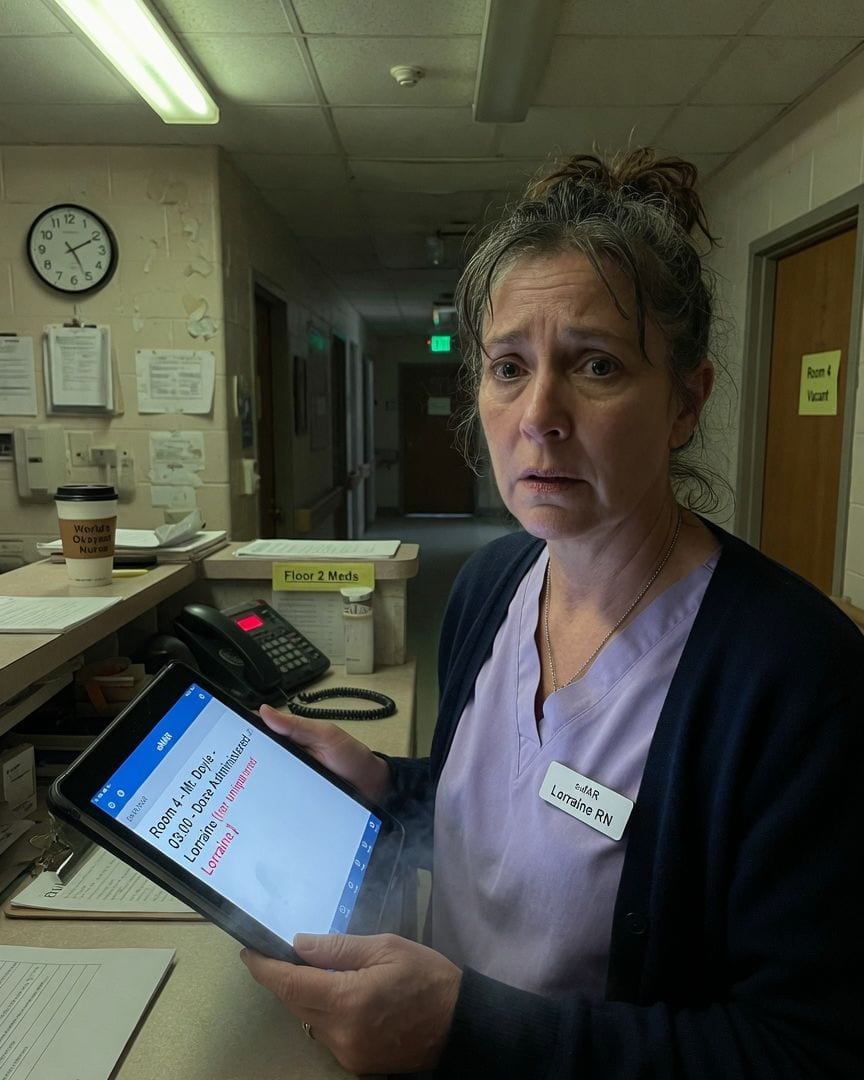
The care home tablet logged a 3am dose in Room 4, signed with my PIN — but Room 4 has been empty since Mr. Doyle died on Sunday, and I have no memory of giving it.
Working a quiet night shift at Elmwood, I double-checked patient records before clocking out. That's when I saw an impossible entry on the eMAR: my signature, administering medication to Mr. Doyle in Room 4 at 3 AM. Mr. Doyle had passed away yesterday, and his room was officially vacant, cleared, and locked.
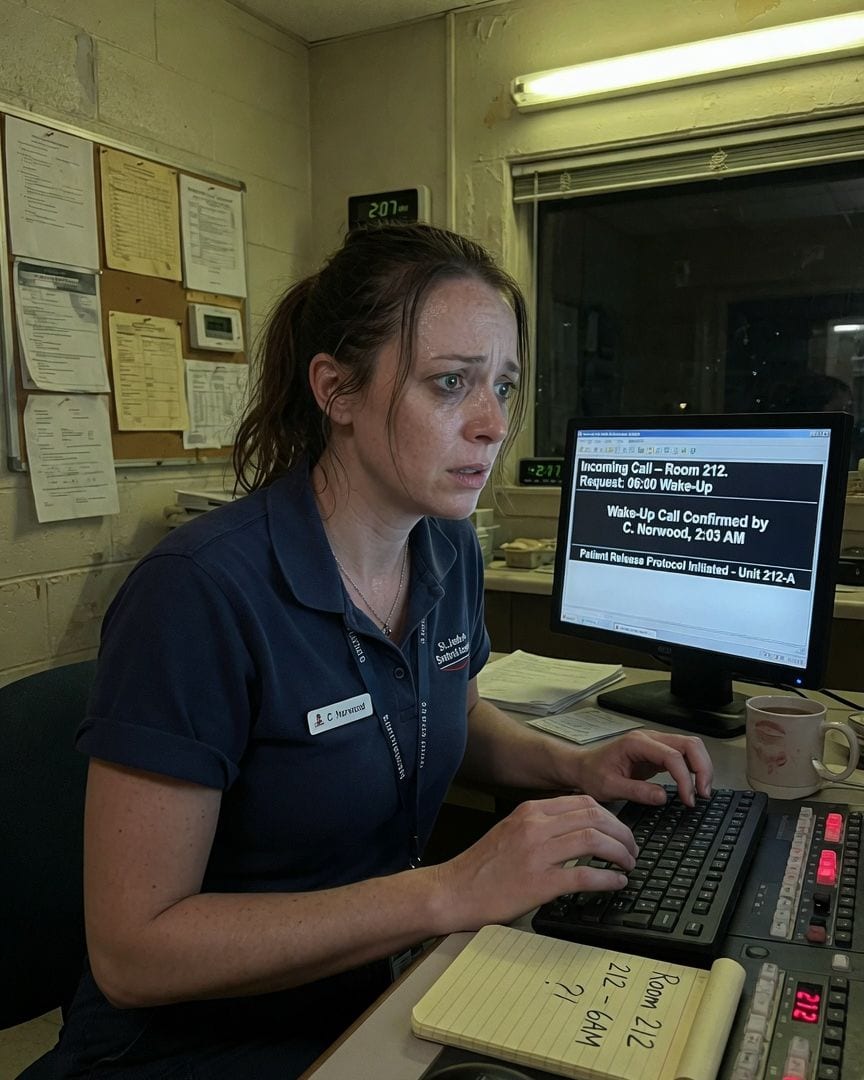
My login started a 'Patient Release Protocol' I'd never heard of for Unit 212-A.
Working the quiet night shift switchboard at St. Jude's, I took a routine wake-up call from Room 212. But the system showed Room 212 had been stripped bare and its phone line disconnected for months. Then, my own login showed I had confirmed the impossible call.
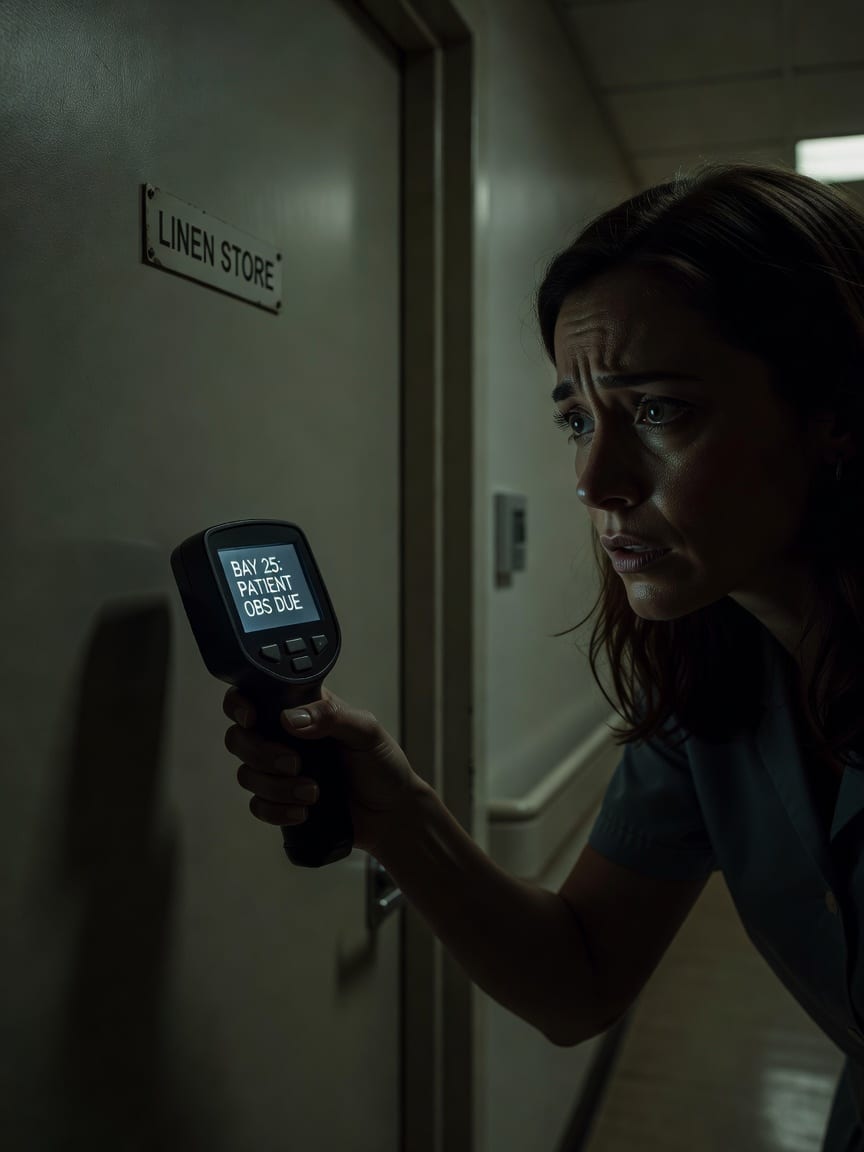
My hospital scanner demands patient care in Bay 25. Bay 25 is a locked linen closet.
I'm a pragmatic nurse, used to my hospital's quiet night shifts. But for a fortnight, my scanner has logged phantom patients in 'Bay 25' — a room that's just a linen closet. Then, tucked away, I found an old patient ID bracelet, faded but clear: 'Bay 25.'
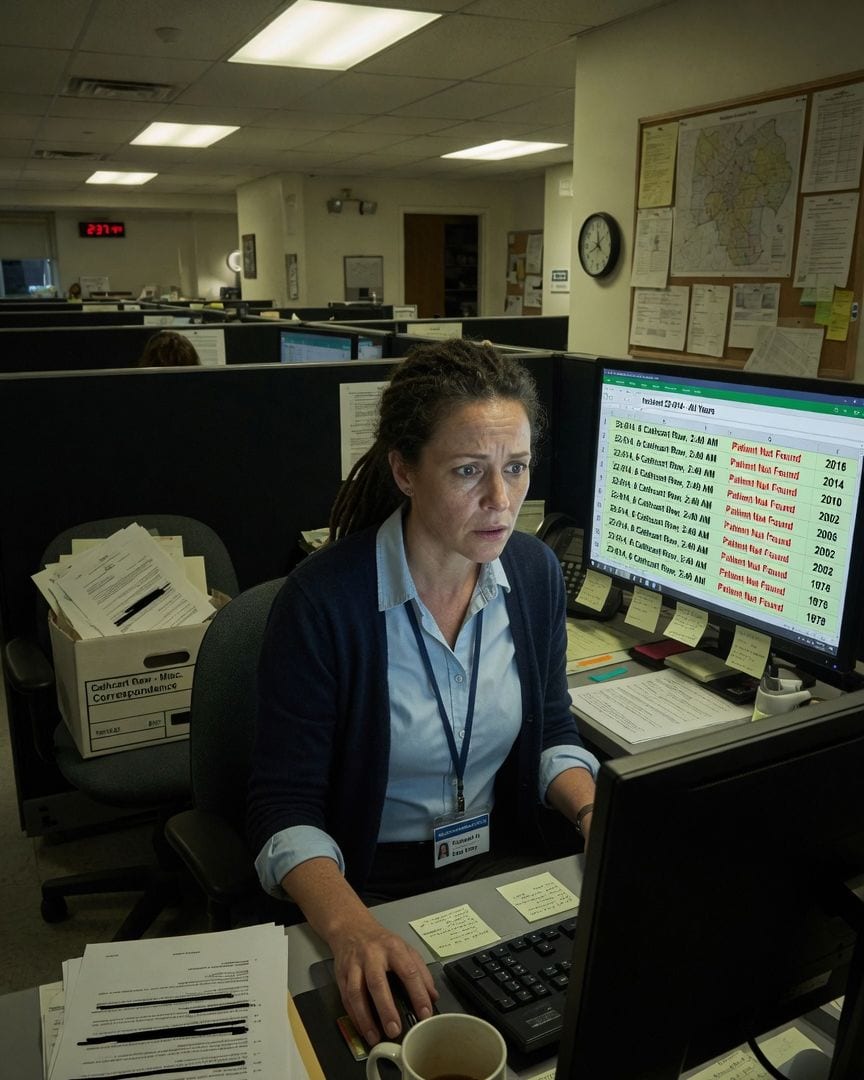
My computer log shows the same 2:40 AM call to Cathcart Row, every four years since 1978, always closed 'patient not found'.
Working data entry for the County Ambulance Trust, I found a routine incident logged as 'Patient Not Found.' But digging deeper, I discovered the exact same phantom call had repeated every four years for over forty years, always at the same address, always at 2:40 AM. Then I found a heavily redacted memo linking it to my own street.
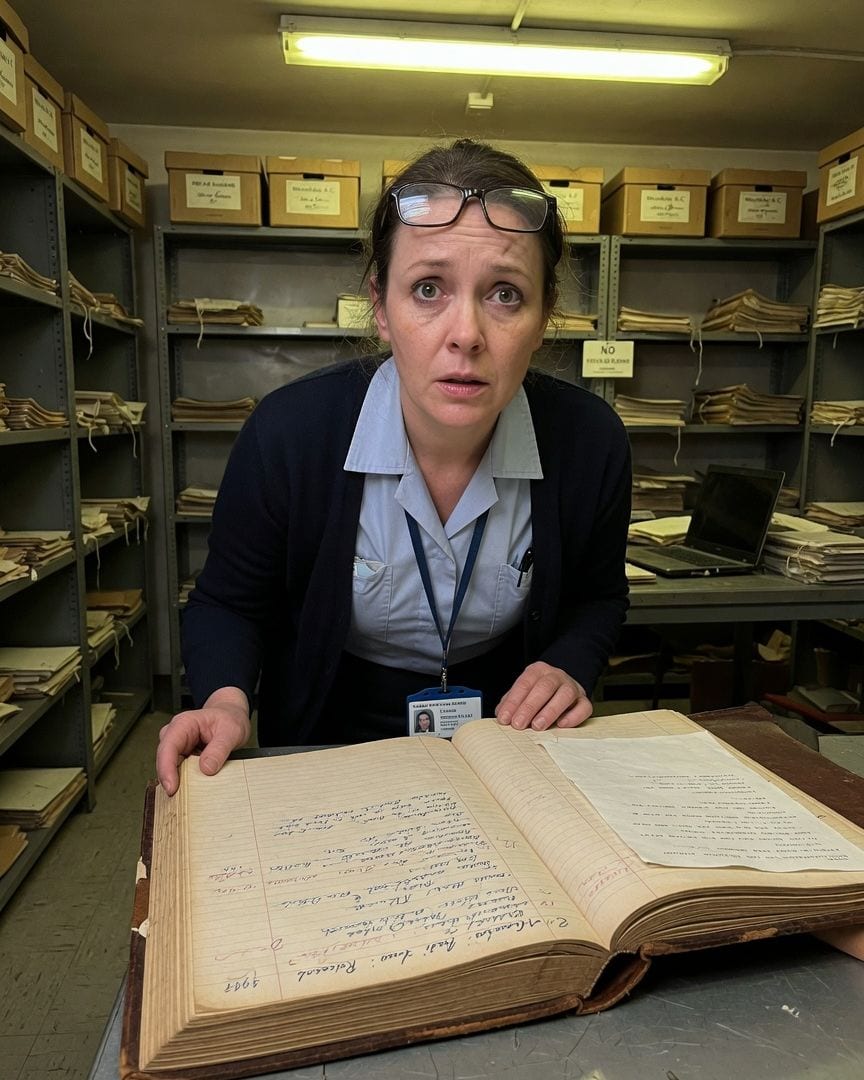
My ambulance trust's incident log shows callout 22-014 to 6 Cathcart Row at 2:40 AM. Every four years, the same call, same address. Always 'patient not found'.
My job involves tedious data entry for ambulance calls, but Incident 22-014 was different. It appeared every four years, always at 2:40 AM, always closed as 'patient not found.' Digging into the dusty physical archives, I found an entry from 1961 for the exact same incident, but its resolution read: 'Subject Secured. Relocated to "Holding".'
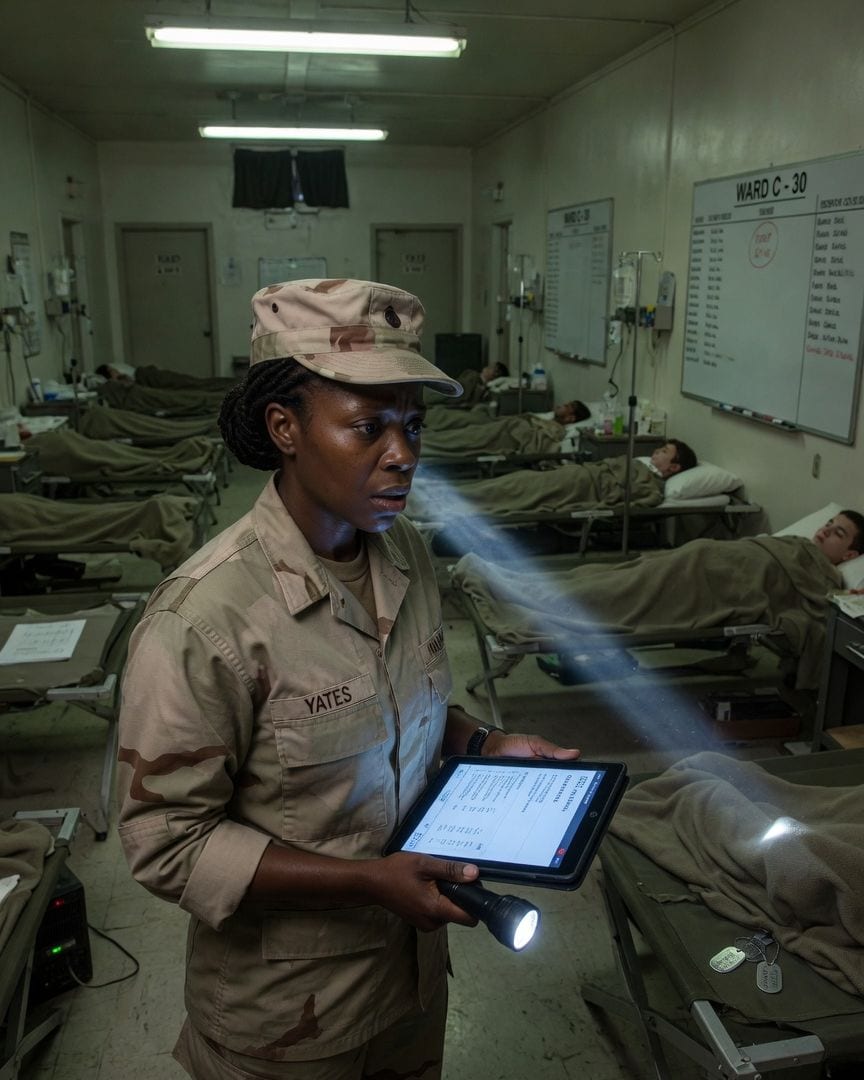
Sergeant Amara Yates found a patient admitted in 1982. The field hospital was built decades later.
Sergeant Amara Yates meticulously counted thirty patients in Ward C of the field hospital. Yet, she found a thirty-first man, asleep in an unlisted cot, with no chart to identify him. The soldier was undeniably present, but the ward's records insisted only thirty existed.