Sergeant Amara Yates found a patient admitted in 1982. The field hospital was built decades later.
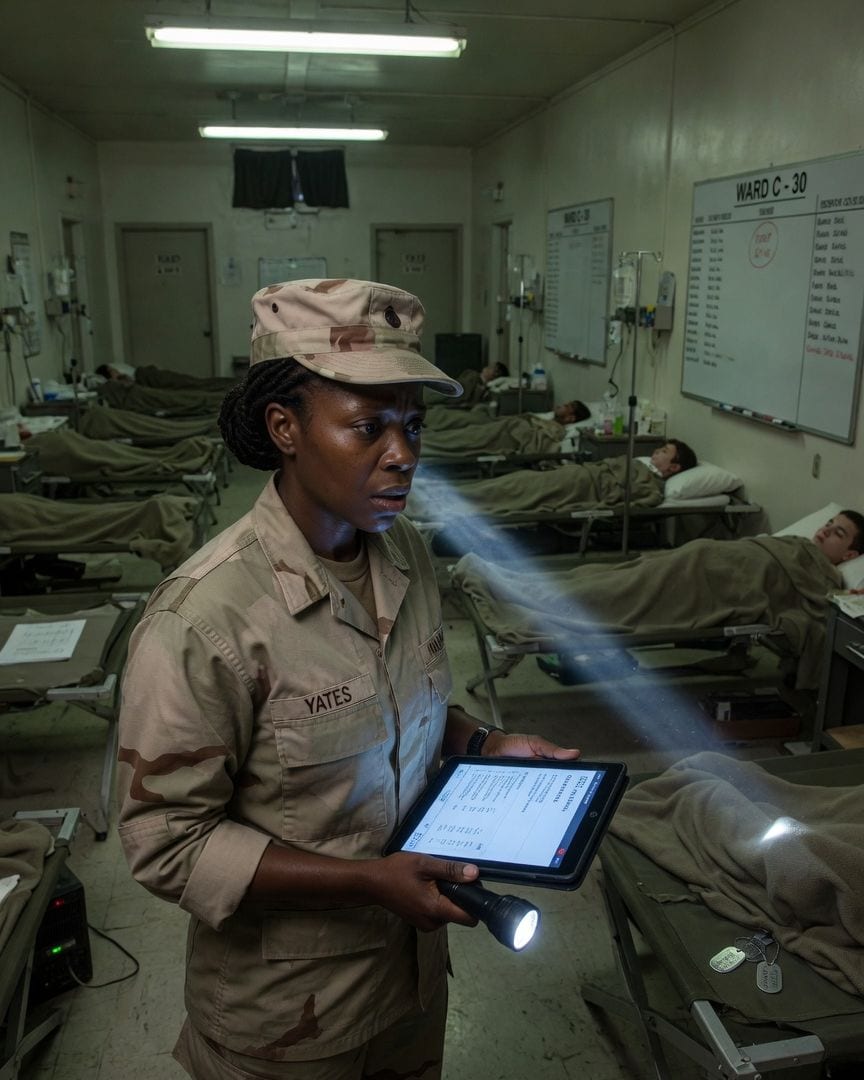
Sergeant Amara Yates completed her final patient count for the night in the field hospital’s Ward C. Thirty patients, thirty cots, thirty charts. Each man accounted for.
The fluorescent lights hummed a steady, low note, casting a sterile glow across the rows of sleeping soldiers. As Amara moved cot-by-cot, her flashlight beam sweeping across their faces, she mentally ticked off names. Twenty-eight. Twenty-nine. Thirty.
She double-checked the white board mounted on the wall, its dry-erase markers listing the current roster. Thirty. She verified the digital manifest on her handheld tablet. Thirty.
Then she walked back down the aisle, her boots soft on the linoleum, physically confirming each bed. All in order.
Yet, when Amara reached the end of the aisle, where the ward’s supply closets began, there was another cot. Occupied. A young private, face obscured by shadow, breathed steadily, a faint tremor in the cot’s springs echoing his respiration.
Amara froze, her internal count screaming thirty-one. She scanned the board again. Thirty. She checked her clipboard. Thirty. She walked back, methodically, re-reading names, matching faces to charts. Each man answered with a soft grunt or a nod. Twenty-nine. Thirty.
And then, the extra cot, the extra man. He was there, undeniably present, yet his cot was unnumbered, and no chart hung from its frame. Amara’s breath caught. Thirty. And one.
No matter how many times she counted, the ward came back thirty-one. The air around the anonymous cot felt several degrees colder than the rest of the ward, a stark, unsettling chill in the humid night.
Her blood cold, Amara tried to rationalize it. Fatigue, a new admission that hadn't been logged, a prank by some bored medic. She returned to her station, the low hum of the servers a hollow comfort in the unsettling quiet.
She pulled up the digital ward manifest, cross-referenced every patient, every bed assignment. Everything matched. Thirty. Each name was there, linked to its specific cot, its medical history. Perfect.
Then, on a hunch, she typed a generic query for 'unassigned personnel' in Ward C. The system whirred, the cooling fans kicking up a notch. A single entry appeared on the screen: 'Pvt. Leonard Yates, Admission Ward C, Cot 7.'
Amara’s heart hammered. Cot 7 was already assigned to a Private Walsh, currently asleep in it. And the admission date for Pvt. Yates? It read '1982-07-14.'
The outpost itself had only been established in the early 2000s, barely two decades ago.
She tried to flag the impossible date, to open a ticket, to correct the obvious error. The system icon spun, then lagged, a tiny, glowing red dot indicating a data conflict.
A 'Reconciling Data' message flashed across the bottom of the screen, then vanished. When it cleared, the entry for 'Pvt. Leonard Yates' was gone. Vanished. As if it had never been there.
The digital record had swallowed the evidence, leaving no trace. Amara stared at the screen, then back at the far end of the ward, where the extra cot sat.
The young private was still there, a solid, breathing presence, in Cot 7, which was definitely Walsh’s. But the system now swore only thirty patients existed.
The discrepancy between the glowing screen and the undeniable figure in the cot created a sickening lurch in her stomach.
Amara felt a cold dread settle in her stomach, heavy and unmoving. She went back to the cot, the one the system now claimed was empty of any 'Yates,' the one that should not have been there.
The private was still there, asleep, his face partially turned away, a thin blanket pulled up to his chin. The air around the cot seemed to suck the warmth from her skin.
She leaned closer, her flashlight beam finding his neck, where a pair of dog tags usually rested. They were there, hanging from a chain, glinting dully against the canvas frame of the cot.
With trembling fingers, she reached down, gently lifting one. Her breath hitched. The tag was completely blank. No name, no service number, no blood type. Nothing. Except, etched into the metal, a faint, almost invisible string of alphanumeric characters: 'COT7-ALPHA-82-014.'
It was a serial number. An old equipment tag. For this specific cot.
The next morning, Amara reported her findings to Captain Greg Pennington, her commanding officer. Pennington, a by-the-book officer, listened patiently, his gaze unwavering but distant.
When Amara finished, detailing the extra patient, the impossible digital record, and the blank dog tags, he simply nodded. “Sergeant, I appreciate the thoroughness. But the system shows thirty patients. The manifest is clean.
It sounds like a system glitch, or perhaps you’re a bit sleep-deprived from those long shifts.” He gestured to the door. “Rest up. We need you sharp.”
Unconvinced, Amara began her own discreet investigation. She accessed archived supply logs for Ward C, focusing on Cot #7. What she found was unsettling.
Cot #7, or its equivalent designation – for the field hospital had moved locations several times since its establishment – had been 'condemned' and replaced numerous times over the past two decades. Each new cot received a sequential serial number.
Yet, the old serial numbers, like 'COT7-ALPHA-82-014,' occasionally reappeared in deep legacy records, sometimes briefly linked to 'unaccounted personnel' entries before being purged. It was like a ghost leaving a momentary trace before evaporating.
The more she dug, the more the ward's servers seemed to hum louder, the monitors around her station seeming to flicker in protest.
She also uncovered a heavily redacted internal memo from a 2008 deployment. The document, almost entirely blacked out, referenced 'reconciliation discrepancies' in Ward C, and the 'necessity of maintaining accurate counts, irrespective of physical presence.'
The memo was signed by a Dr. Lars Coleman, a medical officer from that rotation whose name vanished from active service records shortly after the memo’s date. The rational explanations were failing, one by one.
This wasn't a glitch; it was a pattern, a quiet, persistent stain on the military’s impeccable record-keeping.
Amara knew she needed more. Captain Pennington would not listen, and the digital trails were too often wiped clean.
She sought out Specialist Rachel Hale, a grizzled veteran in the base’s records office, renowned for her encyclopedic memory and meticulous handling of every paper and digital trail.
Rachel, her spectacles perched on her nose, initially seemed helpful, pulling up old manifests and supply requests with surprising speed, her fingers dancing across the keyboard.
The air in the records office, usually thick with the smell of old paper and dust, suddenly felt heavy, cloying.
But when Amara started asking about Ward C, about 'unaccounted' entries, about the peculiar serial number on the dog tag, Rachel’s demeanor shifted. Her fingers paused over the keyboard, hovering over the worn keys.
She looked up, her usually calm eyes, magnified by her thick lenses, filled with a flicker of something close to fear. Her mouth thinned into a pale line.
“Some things are better left reconciled, Sergeant,” Rachel murmured, her voice barely a whisper, as if the walls themselves had ears. “The system… it doesn’t like loose ends.”
Rachel turned back to her screen, her movements stiff, and changed the subject with an abruptness that made Amara uneasy.
Later that day, Amara found a notification in her personal digital access logs. Multiple attempts to access her service record, her medical history, even her financial details, had been made.
The IP address traced back to a terminal in the records office, the very one Rachel Hale used. Amara felt a prickle of unease, a cold sensation crawling up her spine.
Her digging had been noticed, and she was no longer just an investigator; she was being watched, probed, her own existence quietly audited by something unseen.
The steady hum of the base generators outside her office window seemed to deepen into a resonant thrum, a sound that pressed on her eardrums.
Amara confronted Rachel in the quiet of the empty records office after hours. The door clicked shut behind them with a decisive thud. “Specialist Hale, who is trying to access my files?
And what did you mean, ‘the system doesn’t like loose ends’?” Rachel flinched, her hands trembling as she clutched a worn, leather-bound ledger, its covers scarred and faded with age.
The silence in the room stretched, thick and suffocating, punctuated only by the distant, rhythmic thrum of the base’s unseen machinery. “Please, Sergeant, don’t push this. You don’t understand.”
Rachel’s eyes darted around the room, as if expecting someone else to appear.
Amara pressed, her voice low but firm, detailing the impossible patient, the vanishing digital records, the cot’s serial number appearing on a blank dog tag. She laid out every discrepancy, every instance where reality and record-keeping diverged.
Rachel finally broke, her shoulders slumping. “It’s been happening for decades, Sergeant. In Ward C. Always Cot Seven.” She slid the ledger across the desk. It was an unofficial logbook, filled with cramped, faded handwriting, dating back to the 1980s.
Each entry detailed an instance of an ‘extra’ patient appearing in Cot 7, always with an impossible admission date, always named ‘Pvt. L. Yates’ or a similar variant. The details were eerily consistent.
“When they tried to remove them,” Rachel whispered, pointing to entries marked ‘Transfer to Purgatory Battalion’ or ‘MIA, Unexplained,’ “real personnel would vanish. Their records would be… adjusted. To fill the slot. To make the count right.”
Rachel's finger stopped on an entry from 1982: 'Pvt. L. Yates, 1982. Transfer to Purgatory Battalion, MIA.' Amara’s blood ran cold. The blank dog tag, the vanished digital entry, the impossible man – it all clicked.
The 'ghost patient' wasn't just an anomaly; it was a recurring placeholder, and the system demanded it be filled. It was a self-correcting mechanism, ensuring its internal logic remained absolute, even if it meant distorting reality.
Rachel, her face pale with terror, pointed to a recent, cryptic entry in the same worn ledger, dated just days ago: 'Ward C, Cot 7: Vacancy created.' Amara’s mind raced, a sudden, chilling clarity descending upon her. The 'Pvt.
Leonard Yates' she had seen in Cot 7 wasn't just an extra patient; he was a placeholder.
The system, still needing to account for its impossible count of 31, had temporarily manifested him because a real slot had just opened up. A cold wave washed over Amara.
Her hands shaking, Amara pulled out her tablet and checked the current manifest for the entire base. There were 30 listed patients in Ward C, just as Captain Pennington had insisted. But that wasn’t the number she needed.
She ran the total personnel count for the entire base, including all units, all departments, every single active service member. It came back 31. One too many. The number glowed, solid and unyielding.
And then, as she scrolled through the list of active service members, her eyes froze on the screen, a knot tightening in her chest.
There, at the bottom, just beneath a list of new arrivals, she saw her own name, SGT Amara Yates. But beneath it, a new, impossible designation: 'Patient, Ward C, Cot 7.'
Her own name, in the slot for the impossible patient.
The full, terrifying truth detonated in Amara's mind, shattering any remaining illusions of a benign, if flawed, system.
With Rachel's help, she accessed classified historical logs through a backdoor in the base’s central command system, a shadowy corner of the network Rachel had known about for decades.
They found a pattern across multiple deployments and outposts with similar field hospitals, a chilling echo of the Ward C anomaly. Certain 'nodes' within the system – specific cots, specific wards – acted as anchors for this phenomenon.
The military’s accountability system, built for absolute precision, could not tolerate an empty slot once it had registered one. If a real patient was discharged or transferred, and the system expected 31, it would create one.
If that created phantom was challenged, if its digital record was deleted, it would take one from the active roster.
The 'Pvt. Leonard Yates' from 1982 was the original 'extra' who was eventually 'reconciled' by a real Pvt. Leonard Yates being disappeared into the system, his records quietly altered to fill the impossible space.
The 'vacancy created' entry in Rachel’s ledger meant the system was now looking for a new real person to fill that constantly recurring '31st' slot in Cot 7. And it had chosen her.
The system wasn't malfunctioning; it was functioning as designed, with a terrifying, self-correcting logic that superseded human reality, erasing existence to preserve its own internal consistency.
The humming of the servers in the room intensified, a low thrumming that seemed to vibrate in Amara’s bones.
Amara and Rachel knew they had to sever the connection to Cot 7, to somehow take it out of the system's 'count' permanently. There was no time to explain, no time to reason.
They rushed to Ward C, their feet pounding on the linoleum, determined to physically remove the cot, to make it truly absent from the system's awareness.
As they approached the ward’s entrance, the base’s public address system crackled to life, the speaker above them emitting a burst of static. “Sergeant Yates, please report to Ward C, Cot 7 for processing.
Repeat, Sergeant Yates, report to Ward C, Cot 7.” The voice, synthesized and unnervingly calm, echoed through the empty corridors.
Alarms began to blare, not fire alarms, but security alerts, a high-pitched, insistent wail that pierced the silence. Doors throughout the ward locked with a heavy thud, sealing them in.
Communications jammed, their comms devices going dead with a soft hiss. The voice repeated the command, an endless, looping demand. Amara, drawing on her combat training, knew she had precious little time. She pointed to a nearby electrical panel.
“Rachel, overload it! Just enough to cause a surge, disrupt the network!” While Rachel frantically worked on the panel, Amara created a diversion, kicking over supply carts, triggering motion sensors, drawing automated security drones away from their objective.
The lights flickered, then died, plunging the ward into a momentary blackout, the only light the flashing red of the security alarms.
In that brief window, Rachel, acting with desperate speed, accessed a legacy maintenance terminal hidden behind a false panel and permanently flagged Cot 7 as 'Condemned - Biohazard - Unfit for Service' in the deepest, most unalterable records she could reach, effectively taking it offline from the system's 'count' forever.
Amara, seeing the lights flicker back on and the drones reorienting towards her, sprinted for the nearest exit, abandoning her gear, her service record, her entire military identity.
She scrambled over the perimeter wire as automated turrets whirred to life, narrowly escaping the base as it went into full lockdown, leaving everything she was behind.
Amara Yates vanished. Her military service record was officially 'redacted,' an administrative discharge citing 'unverified circumstances,' effectively erasing her from the rolls. She now lives under an assumed name, a civilian ghost, carrying proof no one would ever believe.
Specialist Rachel Hale was quietly transferred to a remote, inactive records outpost in the Arctic, her career ended, her silence bought with professional exile.
Back at the field hospital, Cot 7 in Ward C remained empty, cordoned off with biohazard tape, a permanent, unquestioned anomaly that no one dared to investigate further, lest the system demand its reconciliation.
The base generators settled into a low, mournful drone, a sound that seemed to carry an echo of something lost, something accounted for, then un-accounted for.
Amara, years later, watched a news report about a new overseas deployment, a familiar tent design for a field hospital flickering on the screen.
A reflex, a twitch she couldn’t suppress, made her open her laptop and check the public manifest for the new base. Thirty cots. She stared at the screen, then clicked refresh. It still showed thirty.
She refreshed again, a cold knot tightening in her stomach.
A quiet update appeared on the base’s public manifest, unheralded, just a number changing in the digital ether. New patient added to Ward C, Cot 7. Total patients: 31.
If this one got to you
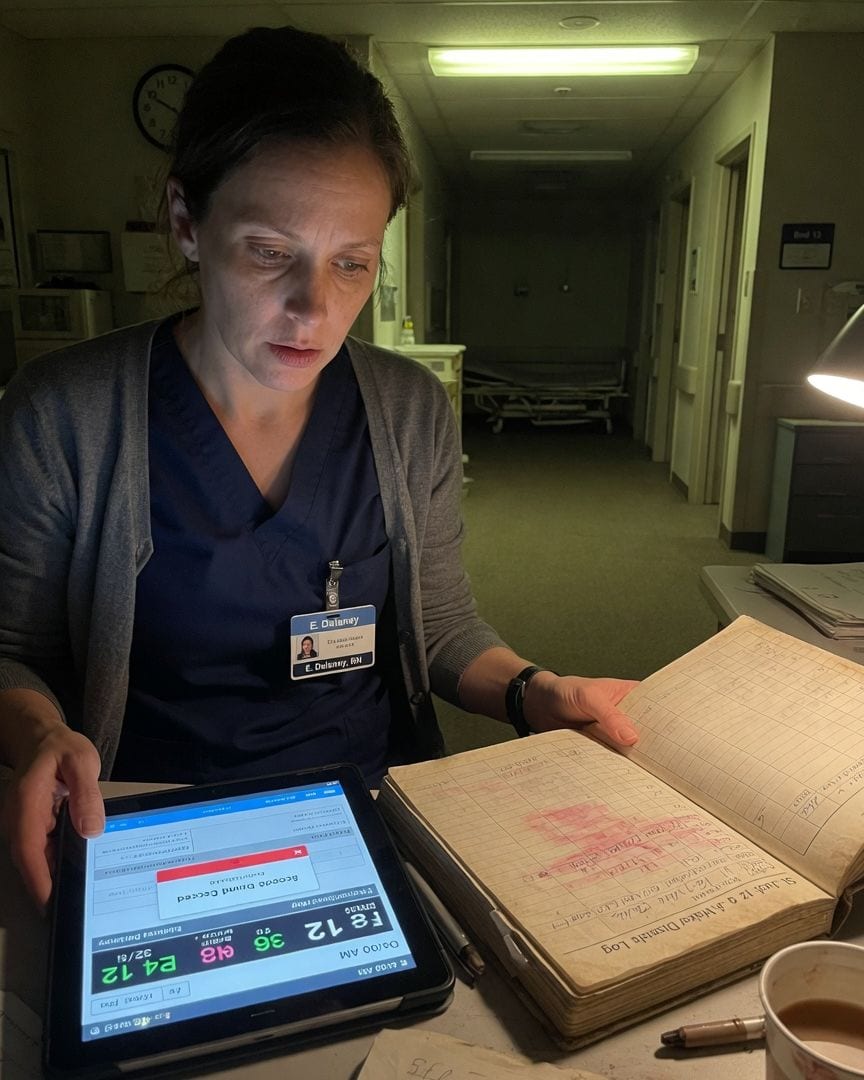
My empty ward's bed 12 had fresh vitals charted. The system says I entered them.
Working my usual night shift at St. Jude's, I pulled up the monitor system to log patient vitals for Ward 12. My thumb paused at Bed 12, where a full set of readings was already timestamped and logged under *my* ID. But Bed 12 was utterly stripped and empty; it had been discharged days ago.
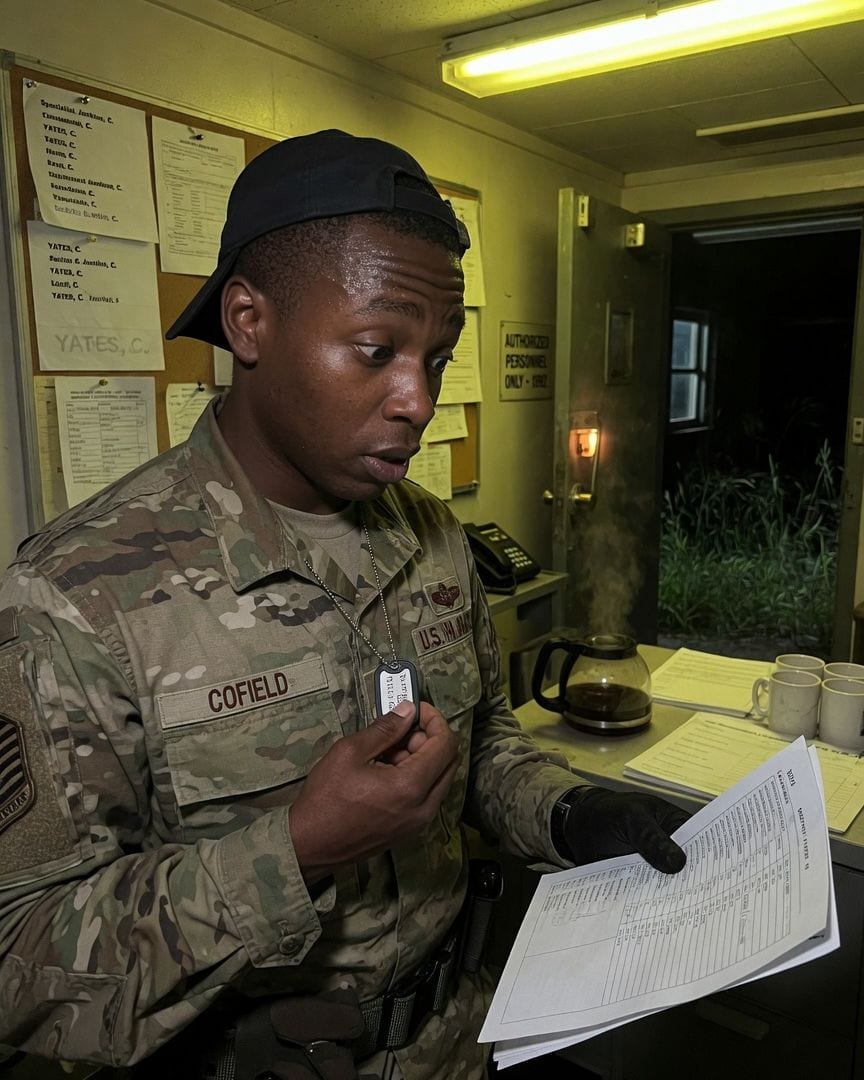
Senior Airman Cofield's last patrol found a hot coffeepot and a 'transferred' airman's dog tag inside a building mothballed since 1992.
Senior Airman Maxwell Cofield was on his final perimeter patrol before transfer, scanning the desolate expanse of a decommissioned weapons storage area mothballed since 1992. His eyes snagged on an impossible sight: a faint yellow glow blooming in a window of the building, officially de-energized for decades. Central Security Control reported the zone clear, yet the heavy steel door was unlocked and warm to his touch, and inside, a coffeepot steamed on a table. Even stranger, a fresh shift-change roster listed unfamiliar names, and beneath them, a faded, ghostly recurrence of 'YATES, C.'—the very airman supposedly transferred last week, whose dog tag lay half-hidden nearby.
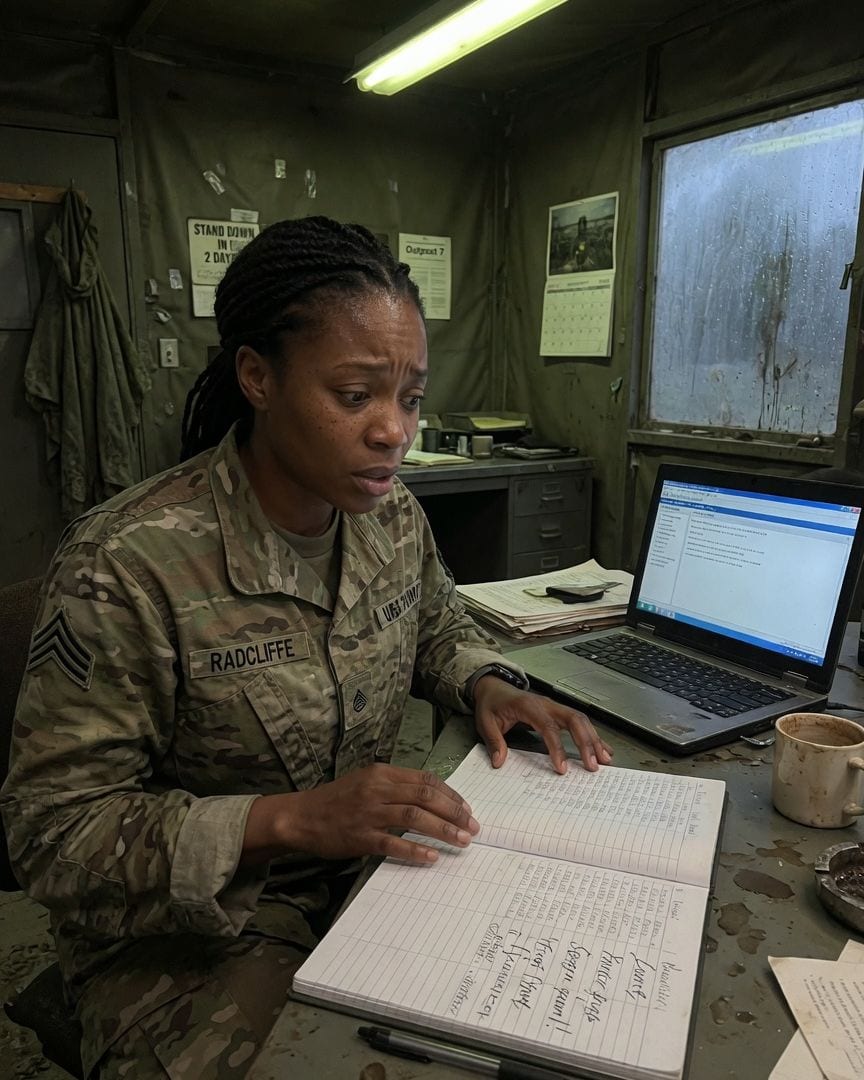
Two days before Outpost 7 closed, Staff Sergeant Radcliffe's roll call counted 42 men, but 43 voices answered.
Two days before Outpost 7 was set to stand down for good, Company First Sergeant Nora Radcliffe conducted her morning roll call. For three years, she had known all forty-two faces and voices by heart, but in the damp dawn air, a forty-third voice answered to a name not on her list. Back in her office, she found that same impossible name, 'Everett Lawson,' added to the official duty log in her own unmistakable handwriting. As the fluorescent lights hummed, her search of the digital personnel system revealed a skeletal record for Lawson, complete with a basic training certificate signed by her training officer—who had retired a decade before the certificate's date. What impossible truth had Nora stumbled upon as her outpost prepared to close?
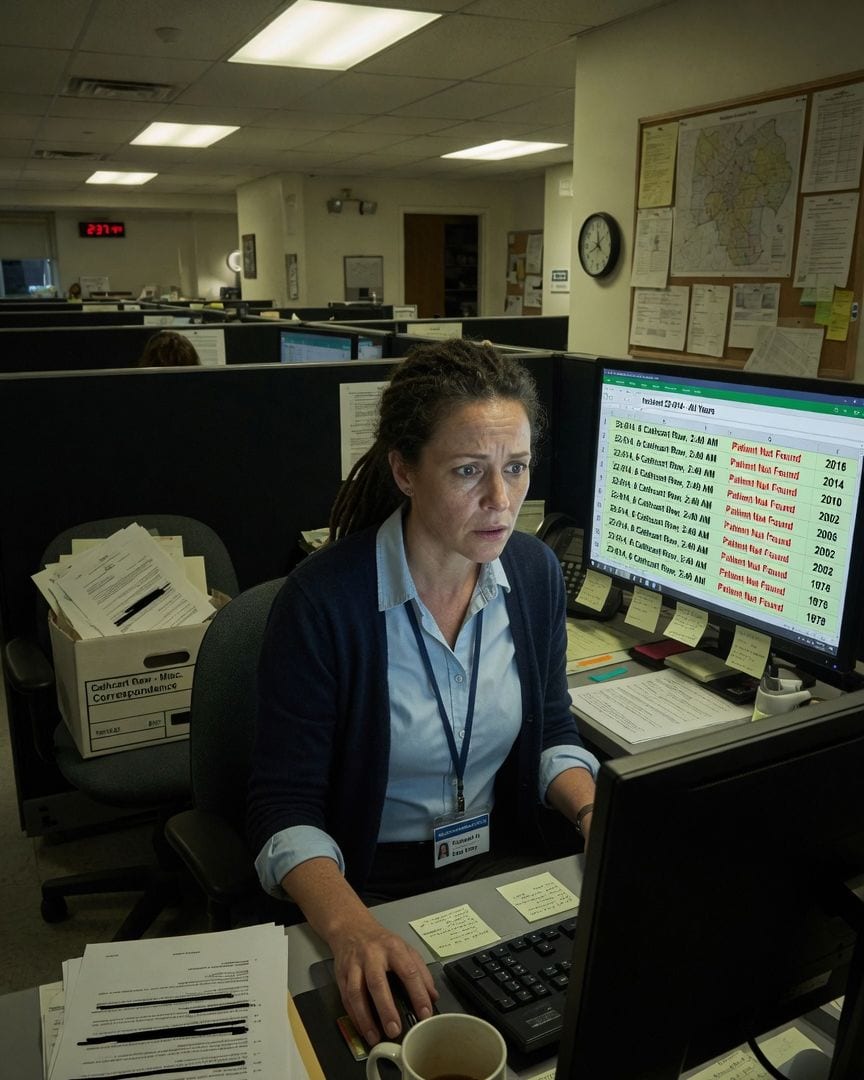
My computer log shows the same 2:40 AM call to Cathcart Row, every four years since 1978, always closed 'patient not found'.
Working data entry for the County Ambulance Trust, I found a routine incident logged as 'Patient Not Found.' But digging deeper, I discovered the exact same phantom call had repeated every four years for over forty years, always at the same address, always at 2:40 AM. Then I found a heavily redacted memo linking it to my own street.
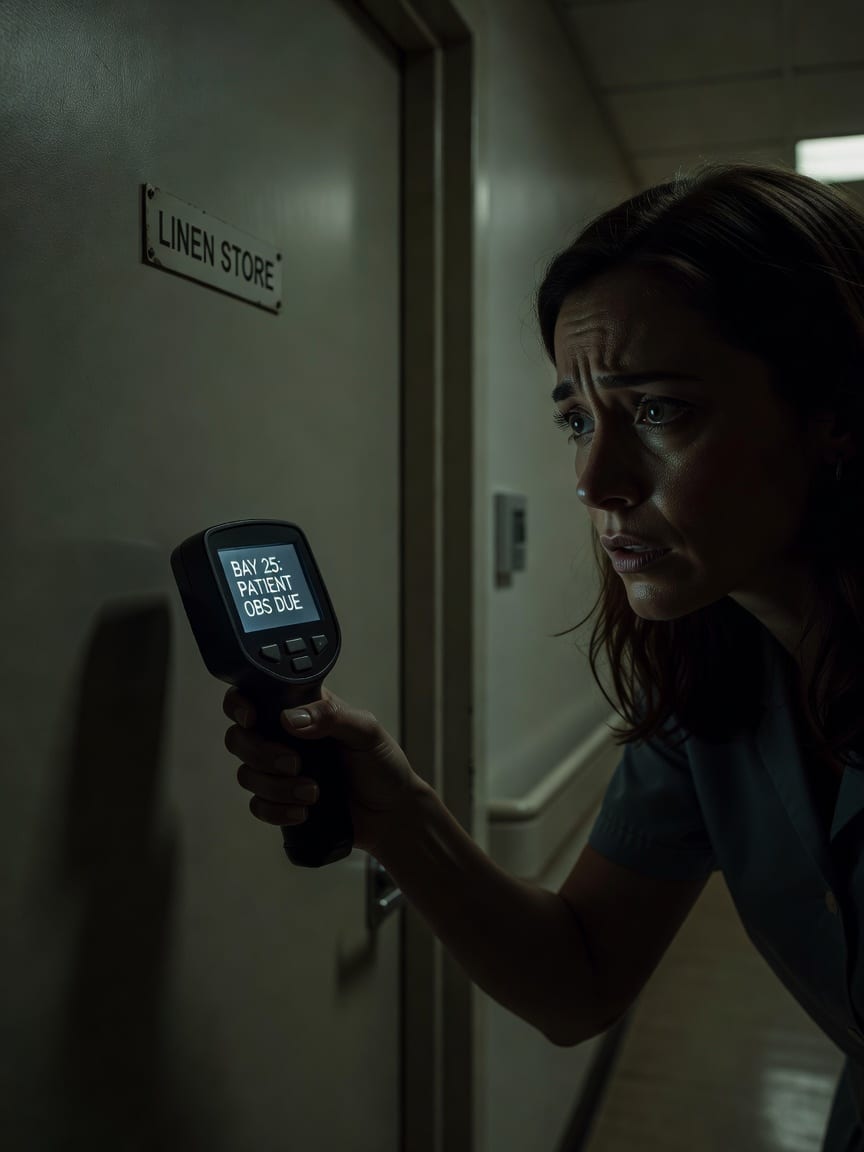
My hospital scanner demands patient care in Bay 25. Bay 25 is a locked linen closet.
I'm a pragmatic nurse, used to my hospital's quiet night shifts. But for a fortnight, my scanner has logged phantom patients in 'Bay 25' — a room that's just a linen closet. Then, tucked away, I found an old patient ID bracelet, faded but clear: 'Bay 25.'
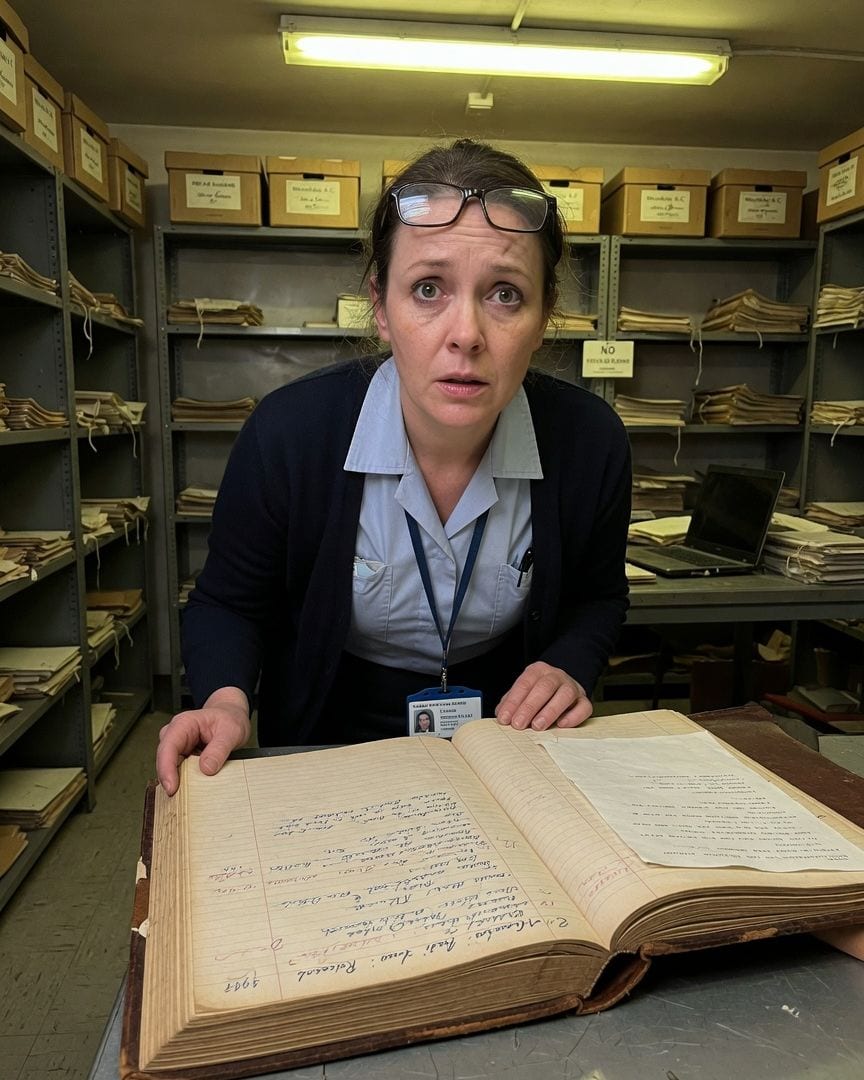
My ambulance trust's incident log shows callout 22-014 to 6 Cathcart Row at 2:40 AM. Every four years, the same call, same address. Always 'patient not found'.
My job involves tedious data entry for ambulance calls, but Incident 22-014 was different. It appeared every four years, always at 2:40 AM, always closed as 'patient not found.' Digging into the dusty physical archives, I found an entry from 1961 for the exact same incident, but its resolution read: 'Subject Secured. Relocated to "Holding".'