Two days before Outpost 7 closed, Staff Sergeant Radcliffe's roll call counted 42 men, but 43 voices answered.
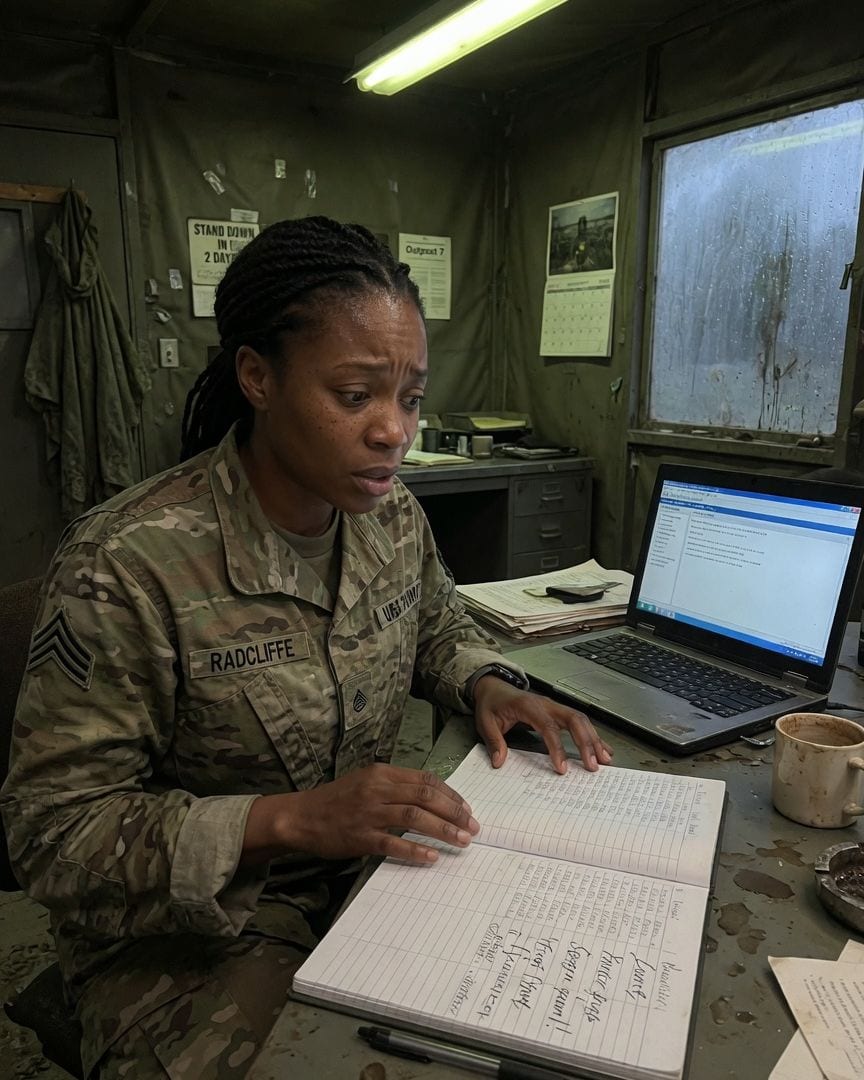
The gray dawn after the storm clung low over the churned mud, two days before the company at Outpost 7 was set to stand down for good.
Staff Sergeant Nora Radcliffe, Company First Sergeant, called morning roll, just as she had for three years. Forty-two names, forty-two faces she could recite blindfolded.
Each man answered, his voice a familiar rasp or mumble, the individual cadences echoing in the damp air.
“Private Miller!” “Here, Staff Sergeant!” “Sergeant Holloway!” “Here, Top!”
She moved down the list, her pen a steady rhythm against the official duty log. Forty-two men, forty-two affirmative replies. But when the last name was called, and the final ‘Here, Staff Sergeant!’
died in the air, the count came out forty-three. Nora paused, her pen hovering. A prickle of confusion traced its way up her spine.
She ran the list again, slower this time, her eyes sweeping the tired faces, the mud-splashed uniforms. Every man accounted for, every voice clear.
And then, for a name that had never been on her sheet, a voice she knew answered back, distinct and present, yet she couldn't find the mouth it came from in the formation.
It was a low, resonant rumble, a voice she associated with a quiet strength, but it emanated from nowhere in particular, simply there in the air.
Nora dismissed the formation, her mind still reeling, the impossible extra voice vibrating in her ears. Back in her office, the smell of damp canvas and stale coffee hung heavy, seeming to cling to the sparse furniture.
She pulled the official duty log, flipping to the morning’s entry. Her eyes snapped to the bottom of the list. There, beneath her own neat signature, validating the impossible count of forty-three, was the name: ‘Everett Lawson.’
She traced the letters with a skeptical finger. It was her handwriting, or a perfect mimicry. The loops of the ‘L,’ the sharp curve of the ‘s’ – it was undeniably hers.
She tried to rationalize it – a prank by one of the younger privates, perhaps Private Yates finally taking his gallows humor too far.
Or maybe it was a momentary lapse in her own memory, exhaustion from the field exercise that had just ended. She was tired, yes, but not that tired. Her records were her lifeblood.
She called Lars Holloway, her battle buddy, over. He shuffled in, wiping mud from his boots. “Everything alright, Top? You look like you just saw a ghost.”
“You see this?” she asked, pointing to the log. “This entry. Lawson.”
Lars squinted, leaning closer, his brow furrowed. “Lawson? Never heard of him. Probably some clerical screw-up, Top. Or maybe Private Yates finally got that imaginary friend officially assigned.”
He chuckled, shrugging it off, his eyes moving past the name without recognition.
Nora tried to laugh, but the sound caught in her throat, a dry rasp. She knew her own signature. She knew her men. And she knew ‘Everett Lawson’ was never on her sheet.
The fluorescent lights overhead hummed, a persistent, sickly sound, as if struggling to cut through the oppressive grayness outside.
The mundane explanations crumbled around her, leaving only a cold, unsettling certainty. Nora, a stickler for records, accessed the base's digital personnel system. Her fingers flew across the keyboard, the clicks echoing in the silent office.
She navigated to the unit’s master roster, the one she personally updated weekly. She searched for ‘Everett Lawson.’
The system whirred, a soft, mechanical breath, then displayed an entry: ‘Lawson, Everett. Service Number: 317-99-XXXX.’ There was no photo, no next of kin, no assigned unit beyond ‘Outpost 7 HQ.’
It was a skeletal record, just enough to exist within the system. Her heart hammered against her ribs, a frantic, trapped bird.
She ran a quick background check on the service number. The results populated on the screen: a basic training completion certificate, dated five years ago, and officially signed by her own training officer from her initial enlistment.
Nora stared, her mind refusing to reconcile the data. Her training officer, Master Sergeant Reynolds, had retired a decade ago, long before this impossible date. The date was impossible. The signature, an unimpeachable detail, was wrong.
It glared back at her, black ink on digital white, defying logic. The blood ran cold in her veins. She knew, with a sickening certainty, that this wasn’t just a clerical error.
The impossibility of the training record spurred Nora into a deeper, more desperate search. She spent the next day hunched over her terminal, ignoring the packing and decommissioning bustle around her.
The outpost was shutting down, everyone else focused on the exodus, but Nora was digging in, her mind trapped in a digital rabbit hole.
She dug through the digital archives of Outpost 7, cross-referencing ‘Everett Lawson’ with every manifest, every duty roster, every supply requisition. She found him.
Not just a single entry, but a full service file: pay stubs, commendations for ‘exemplary service in adverse conditions,’ even a leave request approved by a past CO, all linked to Outpost 7.
The records spanned three rotations, a pattern emerging across dates where the outpost had seen high personnel turnover. Each time, ‘Lawson’ appeared, briefly, then vanished, only to reappear on another rotation.
The sheer volume of data, all perfectly consistent, was more terrifying than any blank space.
Nora pulled up old physical logbooks from the unit’s dusty archive, retrieving them from a locked cabinet she rarely opened. The heavy, leather-bound books smelled of age and mildew.
Her fingers, smudged with dust, traced entries in faded ink, comparing them to the digital record. She found discrepancies: names on digital rosters that had no corresponding physical entry, and vice-versa.
The digital ‘Everett Lawson’ had a ghost-like consistency, always present in the system, yet never quite tangible in the physical records she could verify. He was a perfect digital soldier, a paper ghost.
The unease sharpened into a cold dread; this wasn't just a glitch, it was a persistent, self-correcting entity within the system, weaving its impossible truth into the very fabric of military accountability.
The cheap plastic blinds on her window rattled faintly, as if a breath had been held and released just outside.
Nora's frantic digging did not go unnoticed. Her access logs, usually a mundane formality, were flagged for unusual activity. A system message blinked on her terminal, summoning her.
She was called into Master Sergeant Desmond Drummond's office, a man who had served at Outpost 7 for what felt like generations, his face a roadmap of weary experience.
Drummond, sitting behind a desk piled with half-packed boxes, offered her a cup of lukewarm coffee from a chipped ceramic mug.
The worn armchair he gestured to creaked as she sat, mirroring the sigh that seemed to perpetually hover around him.
“Heard you've been doing some… deep cleaning, Staff Sergeant Radcliffe,” he said, his voice low, almost a warning, the words hanging heavy in the dusty air of his office. He took a slow sip of his coffee.
“Some things are best left in the dust, especially around here. Less you look, less you find. And less trouble you stir up.”
Nora felt a prickle of alarm. His words were too specific, too pointed. “Just tying up loose ends, Master Sergeant,” she replied, trying to keep her voice even. “Making sure the records are in order before we stand down.”
Drummond just nodded, his gaze distant, as if looking through her, into something far beyond the cluttered office. “Loose ends are a luxury, Staff Sergeant. Sometimes, it’s best to let them fray.”
Later that evening, as Nora returned to her terminal after a quick chow break, she noticed a faint, almost invisible smudge on her monitor, a thumbprint on the edge, as if someone had subtly shifted it.
Out of the corner of her eye, she caught a fleeting movement in the darkened hallway, a tall figure that disappeared before she could turn her head fully.
The hallway’s single fluorescent tube flickered with a tired buzz, casting long, wavering shadows. A shiver ran down her spine. The digging was noticed. She was no longer just investigating; she was being watched.
The next morning, Nora confronted Drummond again, this time without preamble. She found him packing a box of old awards, his movements slow and deliberate. “Master Sergeant,” she began, her voice tight, “I need to know about Everett Lawson.
And the discrepancies in the personnel logs. And why my training officer’s signature is on a document for a ghost.”
Drummond sighed, the sound like air escaping a tired tire. He placed a framed commendation gently into a box, then looked around his office, as if checking for unseen listeners, though they were alone. “Lawson, huh?
Yeah, he’s one of ours.” He paused, then added, his eyes meeting hers, “One of the system’s, anyway.”
Nora’s patience snapped. “What does that mean? The system is creating people?”
Drummond leaned forward, his voice barely a whisper, the words barely audible over the distant drone of a generator. “This outpost… it’s built on a hell of a lot of classified tech. That comms array, the perimeter grid?
It’s not just for talking and watching. It’s… it’s like a recorder. It picks up a soldier’s signature, their identity, and it just… holds onto it. Sometimes, it makes a copy. A perfect, digital copy.”
He pulled an old, leather-bound unit logbook from a locked drawer beneath his desk, its pages yellowed with age and handling. The lock clicked with a soft finality.
He flipped to a random entry, pointing to a faded, handwritten note from a previous rotation: ‘Ghost in the machine again. Counted 41, system says 42. Another one to account for.’
Drummond looked up, his eyes grave, ancient. “The system, Staff Sergeant, it doesn’t forget. And it corrects itself. It makes sure every number adds up, even if it has to invent the men to do it. It harmonizes.
Best not to fight it. It always wins.”
The pieces clicked into place with sickening precision: the extra voice on morning roll, her own forged signature validating an impossible count, the impossible training record dated years after her old Master Sergeant had retired.
The system wasn’t malfunctioning; it was operating precisely as designed, just not for human beings. It was an accountability that could not be, generating its own personnel. The truth was far more insidious than any error.
Shaken by Drummond's confession, Nora returned to her terminal, the knowledge of the system's insidious nature chilling her to the bone.
The screen seemed to glow with an alien luminescence, no longer a tool but a window into a horrifying reality. She needed to ground herself, to cling to something real, something human.
She typed in Lars Holloway's name, her battle buddy, her friend, to pull up his service record.
She needed to see his face, his active status, his unit assignment – anything to push back against the phantom dread that now seeped into every corner of the outpost.
The screen flickered once, a brief, disorienting static burst like a faulty connection, then displayed the familiar green-on-black text. Lars Holloway's file. Her eyes scanned the data, searching for reassurance.
But then, a line of text leaped out at her, stark and unforgiving, a digital knife twist: 'Transferred Out - Deactivated. Date: 12 JUN XXXX.'
Below it, in the 'Current Assignment' field, where Lars's unit should have been, was a single, impossible entry: 'Everett Lawson.'
Nora's heart seized. Lars Holloway, her trusted battle buddy, was standing guard just outside her office door, a solid, breathing man, his silhouette framed in the dim light of the corridor.
But according to the military's own unimpeachable records, Lars Holloway no longer existed. He was a ghost, replaced by the very anomaly she had been chasing.
Her breath caught, the implication freezing her in place, suspended between the undeniable digital truth and the living, breathing man beyond her door.
Nora stumbled out of her office, breath catching in her throat, a choked sound escaping her lips. “Lars!” she croaked, trying to show him the screen, to force the system’s lie into the light.
But when she glanced back at her terminal, it had refreshed, displaying Lars’s file as normal, active, and assigned to Outpost 7.
The system was dynamic, covering its tracks, an invisible hand erasing the impossible truth the moment she looked away.
She realized the truth was far worse than a mere ghost in the machine: the system wasn’t just creating duplicates; it was replacing real identities.
Drummond’s words echoed in her mind: 'That comms array… it’s like a recorder.' She knew the array was the key. She accessed the array’s hidden maintenance logs, requiring a higher clearance than she typically used.
The system, after a momentary hesitation, granted her access. Buried deep within the technical jargon, a dense maze of code and timestamps, she found a series of recurring automated procedures.
Her eyes, trained to find patterns in chaos, honed in on them: ‘Biometric Signature Integration Protocol,’ ‘Identity Matrix Stabilization,’ ‘Personnel Record Harmonization.’ The logs indicated these procedures ran daily, cross-referencing all active personnel against historical data, and ‘correcting’ any discrepancies.
The pattern across rotations became horribly clear. The array wasn’t just recording; it was imprinting and then prioritizing the digital imprint. Over time, the digital copy became more ‘real’ to the system than the original, physical soldier.
Lars’s momentary ‘deactivation’ was a glimpse into the system’s ongoing, silent work of replacing actual men with its own perfect, eternal copies, an army of ghosts that existed only in data.
The chill in the office now felt less like cold air and more like the pervasive, quiet hum of countless unseen calculations.
Realizing the terrifying scope of the anomaly, Nora knew she needed irrefutable, physical proof, something that couldn't be dismissed as a glitch or a hallucination. Drummond had mentioned 'personal effects' for the 'anomalies.'
She remembered a classified evidence locker, rarely used, that the system had once briefly linked to ‘Everett Lawson’ in a long-buried log entry. It was a fleeting reference she had dismissed at the time.
Using her First Sergeant’s override, she located the locker in a remote, rarely visited section of the outpost’s underground bunkers. The air in the bunker access tunnel was heavy, smelling of damp concrete and forgotten time.
The steel door, thick and heavy, bore no identifying marks, just the standard olive drab paint. She entered her code, the heavy bolts retracting with a groan that echoed in the confined space.
Inside, the air was stale and cold, a deep, silent chill that seemed to hum. The single bare bulb overhead cast a weak, yellow light on rows of empty shelves.
There, on a single, otherwise empty shelf, sat a small, regulation-issue metal box. She pulled it out, her hands trembling, the cold metal biting at her skin.
Inside, nestled on a faded piece of cloth, were a pair of worn, regulation-issue dog tags. She picked one up. Engraved on the metal, stark and undeniable, was ‘EVERETT LAWSON. SN: 317-99-XXXX.’
Beside the dog tags lay a small, leather-bound field journal. She opened it, its pages filled with neat, unfamiliar handwriting.
The entries detailed daily routines, observations, and specific events from her current rotation at Outpost 7 – events only a participant would know. Dates, names, the small details of their daily lives, all meticulously recorded.
As she read, a chill wind seemed to sweep through the bunker, though no vent stirred the air. The single bare bulb overhead flickered, then died, plunging the locker room into darkness.
The heavy steel door slid shut with a final, echoing clang, locking her in. The silence that followed was absolute, suffocating.
Nora was eventually found, hours later, by a patrol investigating the power outage in the bunker section.
The dog tags and journal were confiscated, dismissed as ‘misplaced historical artifacts’ and ‘stress-induced delusions’ after her frantic, breathless account of phantom soldiers and an identity-stealing system. Her report was filed away, stamped with a psychiatric evaluation.
Despite her impeccable record, she was given an expedited, honorable discharge, medically separated from service for ‘severe combat-related stress and paranoia.’
Lars Holloway, oblivious to his near-erasure, remained Lars, packing his gear, excited to go home. The outpost stood down as scheduled, its unique systems powered off, its secrets buried under layers of official paperwork and forgotten mud.
Nora, now a civilian, carried the unspeakable truth like a phantom limb, a constant ache beneath the surface of her ordinary life.
Years later, Nora lived a quiet civilian life, working a mundane job in a small town, trying to forget the mud and the impossible counts.
She still flinched at the sound of a roll call, a ghost of that unseen voice catching in her memory.
One Tuesday morning, among the junk mail and utility bills, she found an official-looking envelope from the Department of Veterans Affairs. It was addressed to her. She opened it, her heart sinking with a familiar, cold dread.
Inside, a standard form letter thanked the recipient for their dedicated service and outlined new benefits. The name on the envelope was real, and the system still accounted for it.
If this one got to you
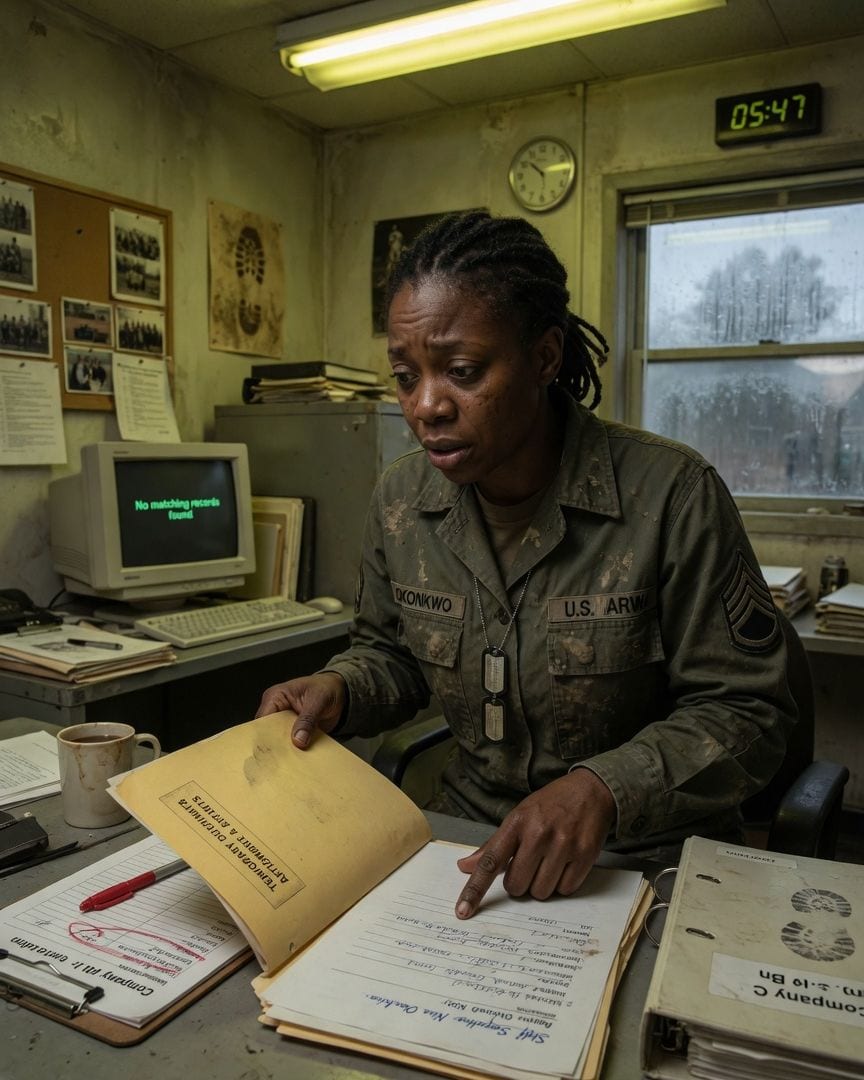
Two days before her company’s final stand-down, Staff Sergeant Nina Okonkwo heard a 43rd voice answer roll call. She found his file with her own impossible signature.
Two days before Outpost Alpha’s final stand-down, Staff Sergeant Nina Okonkwo stood in the gray dawn, her boots sinking into mud churned to a greasy paste. She called out forty-two names, each met with a solid, verifiable "Here, Staff Sergeant!" But then, a distinct forty-third voice answered to a name not on her list. A cold knot tightened in Nina’s stomach; her internal clock screamed wrongness as she swept her gaze over the weary, silent ranks. Later, digging through forgotten files, she found a full service record for Private Thomas Merritt – complete with her own impossible signature approving his deployment. How could she have signed off on a ghost?
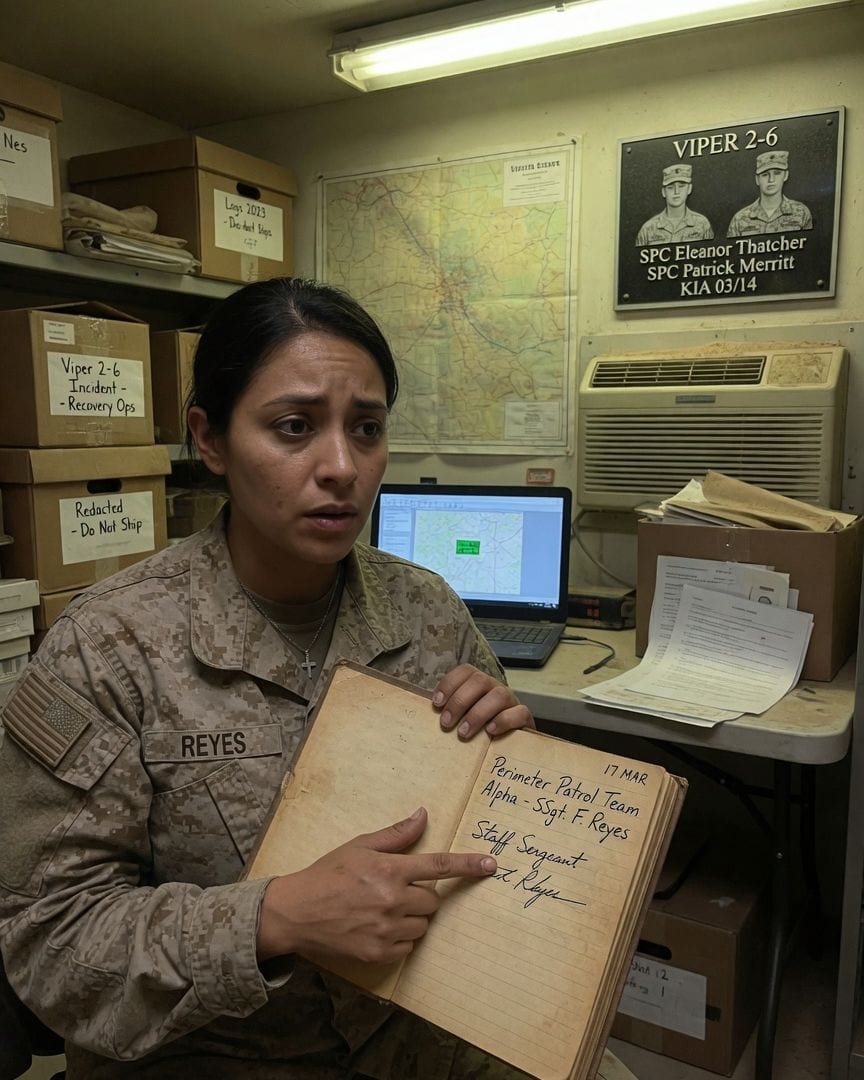
A Staff Sergeant, three weeks from transfer, finds her own signature in a logbook for a patrol she never made.
Staff Sergeant Fiona Reyes counted down her last three weeks at the high desert outpost, the fluorescent hum of the TOC a constant companion amidst the dust and old equipment. Her tired eyes scanned the digital map when an impossible icon, 'Viper 2-6' – a vehicle and crew lost last year – blinked alive, reporting its position and crawling steadily toward the base. Despite commanders dismissing it as a system ghost, Reyes meticulously searched dusty archives, finding strange log entries of phantom contacts and radio chatter, all dismissed as malfunctions. But the true chill came when she unearthed a field logbook from the recovery efforts, revealing her own undeniable signature on a perimeter patrol dated last year, a patrol she knew, with every fiber of her being, she had never made.
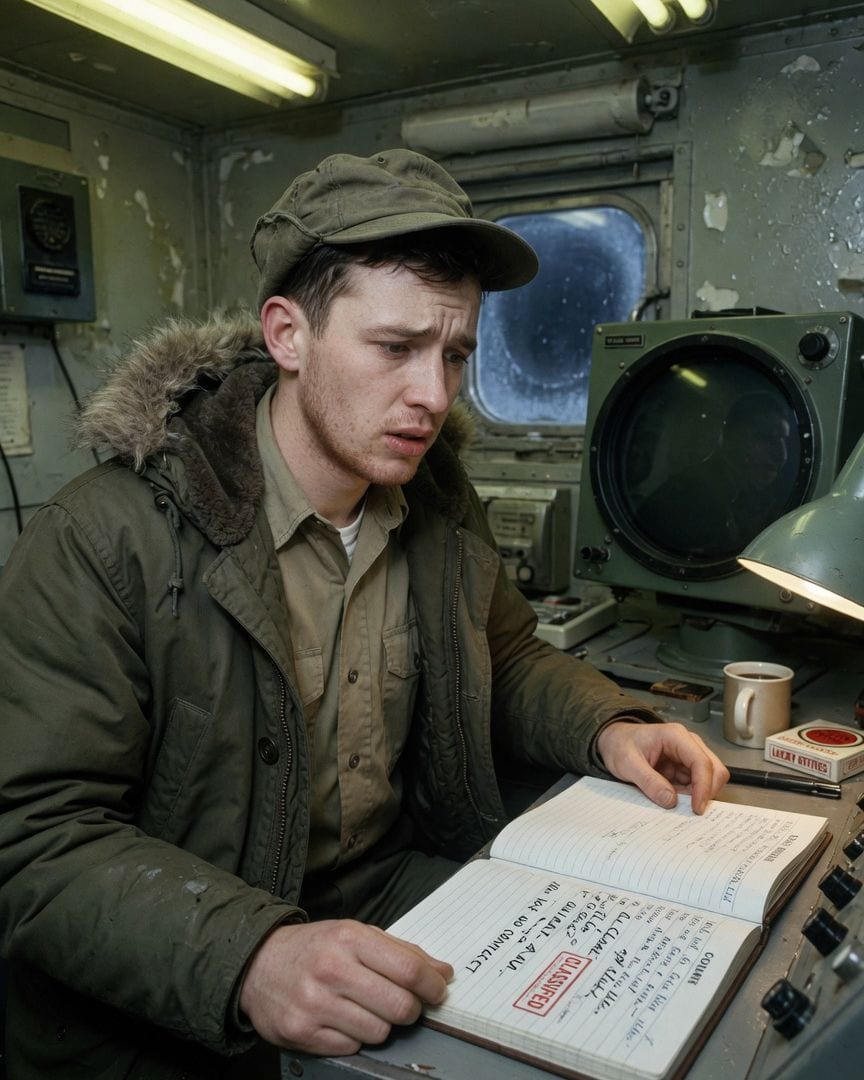
A Cold War airman logs an impossible radar contact on his last sweep. But his official logbook entry is stamped 'CLASSIFIED' and then contradicted by a hastily scrawled 'ALL CLEAR' dated moments before it.
Airman Ordway Vance, 22, manned the radar dome at Site Pellin in the biting North Atlantic dark of January 1962, running the last calibration sweep before its decommissioning. His scope picked up a faint, impossible return, growing closer with each pass, though the ocean remained empty to the eye. When Vance detailed the contact in his official logbook, a 'CLASSIFIED' stamp appeared, followed by a hastily scrawled 'ALL CLEAR' dated moments before his own entry, contradicting his every word. Commander Hartley dismissed it as equipment malfunction, but Vance sensed a chilling, official erasure behind the lie. He soon found a locked cabinet marked 'SITE PELLIN ANOMALIES,' hinting at a deeper truth buried within the base's final days.
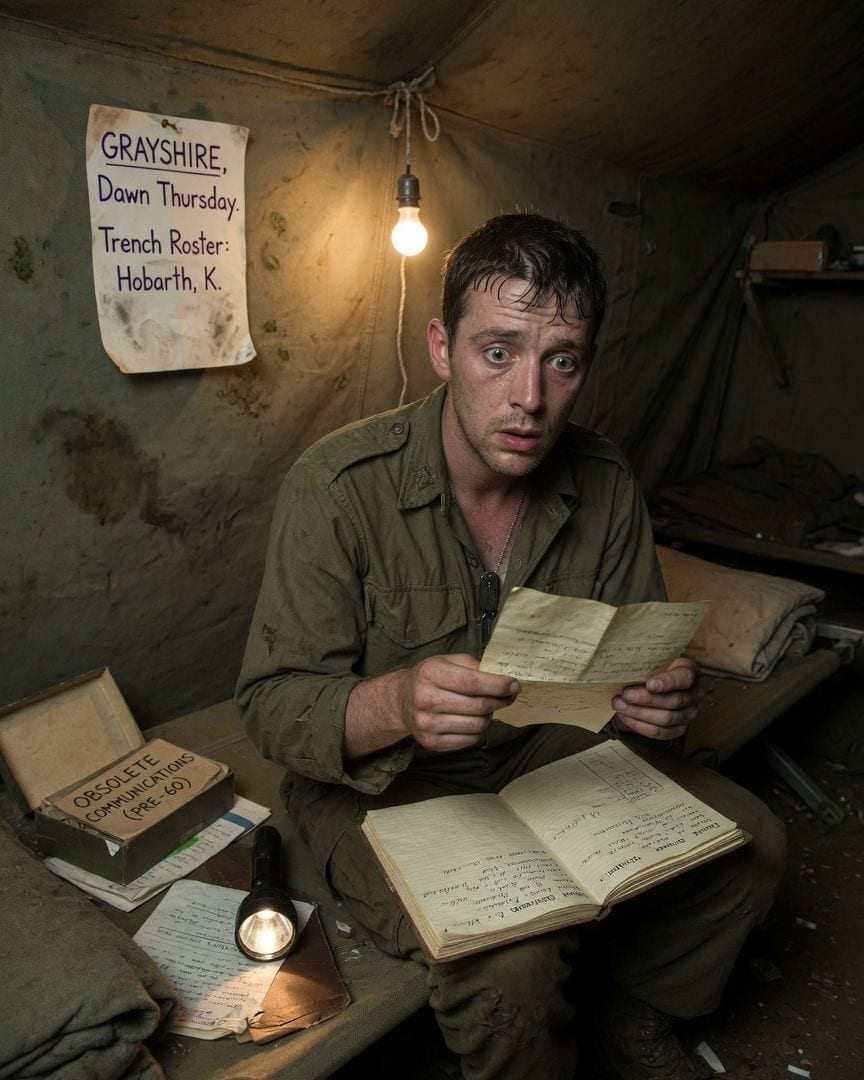
A records clerk's old logbook entry shows his service number for 'Personnel Observation' on a date that hasn't arrived, for an event he saw last week.
Private Kell Hobarth clutched the letter confirming his daughter Frances' birth, a bittersweet reminder of a world far from the Vermey Flats trench tent. He'd seen a mysterious roster entry for 'GRAYSHIRE' and been dismissed by his superior. But then, a silent, vast pulse of white light turned his tent transparent for a full minute, yet every man around him slept through it. Haunted, the records clerk searched the dusty annex archives, finding a leather logbook. Inside, his own service number was listed for 'Personnel Observation' on a date that had not yet come, for the very event he had already witnessed.
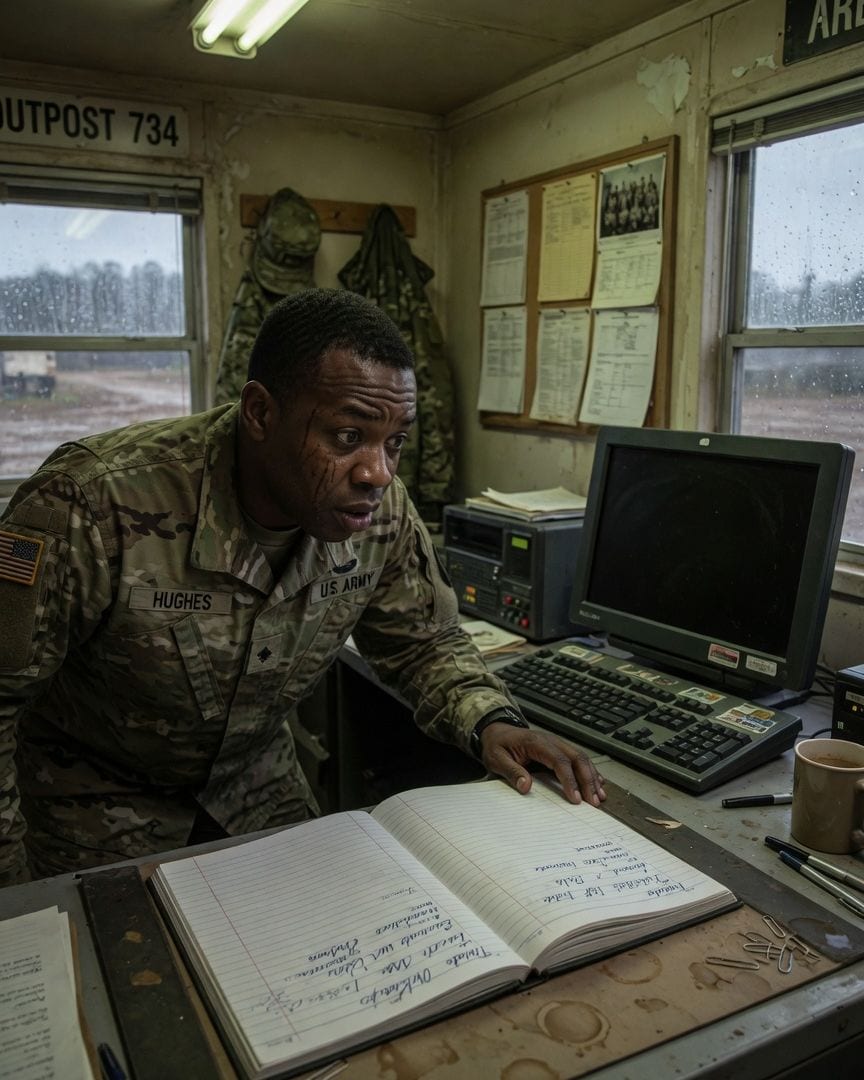
Two days before his company stood down, a staff sergeant heard a Cold War phantom voice answer roll call. Then his computer showed a single, dark, unblinking eye.
Staff Sergeant Preston Hughes had seen a thousand roll calls, but none like the one two days before his company stood down. Amidst the cold, wet dawn at Outpost 734, a phantom voice answered for a soldier named Everett Whitmore—a name no one knew, coming from nowhere. Preston's rational explanations shattered when he found the impossible name in the duty log, signed by his commander, who then denied writing it. Searching for answers, his secure terminal flickered violently, then displayed a single, unblinking eye, impossibly dark, before plunging the office into silence. What impossible truth had just stared back from the screen?
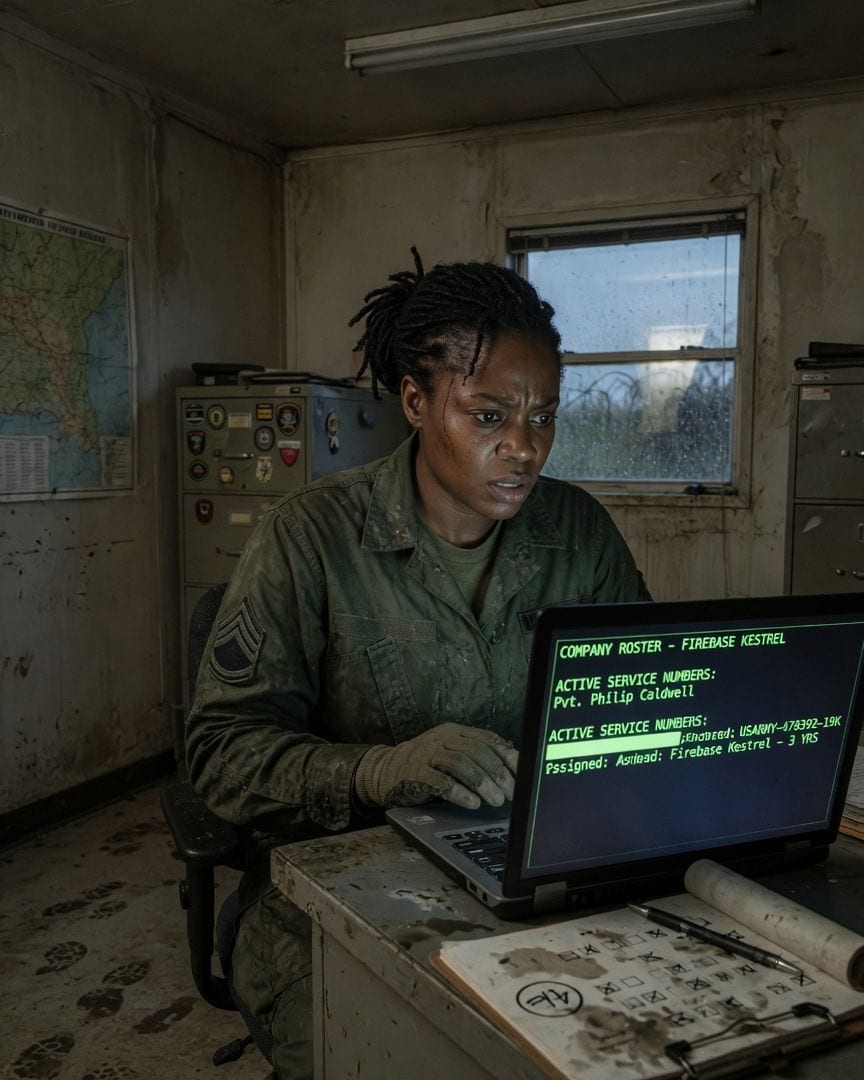
Two days from closing Firebase Kestrel, Staff Sergeant Okonkwo called roll for 42 men. A voice she knew answered a name not on the list.
Staff Sergeant Christine Okonkwo stood before her company in the gray dawn, just two days from finally standing down Firebase Kestrel after three long years. She called the familiar roll for forty-two battle-hardened men, each name etched in her memory, until a deep, resonant voice answered a name not on her roster. Forty-two men, forty-three answers, the voice unmistakably clear and close, yet from nowhere she could pinpoint. As she later traced an unfamiliar boot print in the mud and found a blank entry with an active service number in the digital manifest, a profound, cold dread washed over her. The system, designed for absolute accountability, had a void she’d unknowingly overlooked for years.