Two days before her company’s final stand-down, Staff Sergeant Nina Okonkwo heard a 43rd voice answer roll call. She found his file with her own impossible signature.
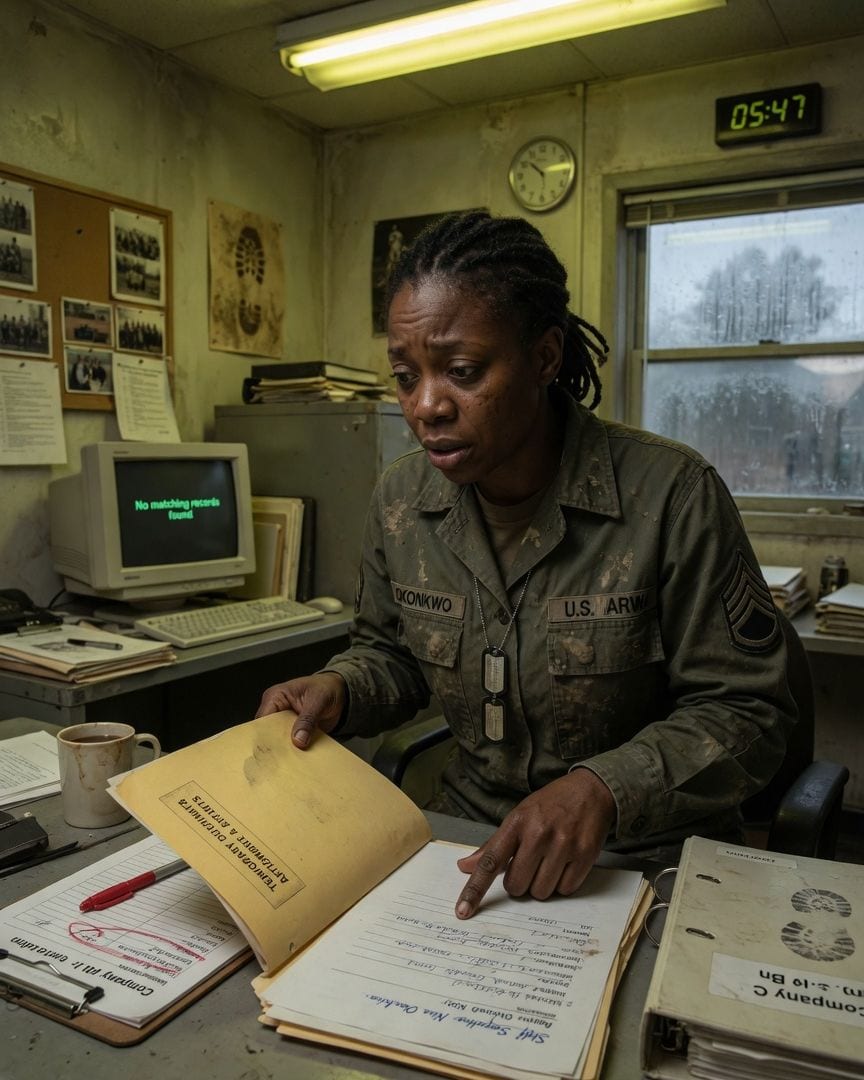
The gray dawn at Outpost Alpha broke like a bruise on the horizon, two days before the company’s final stand-down.
Mud, churned to a thick, greasy paste by weeks of rain and heavy treads, clung to Staff Sergeant Nina Okonkwo’s boots. Her uniform, perpetually splattered, felt like a second skin.
She stood before Company C, 2nd Battalion, her breath misting in the cool air, forty-two faces lined up in neat, weary rows.
“Adams, Michael!” Nina’s voice, hoarse from command, cut through the quiet. “Here, Staff Sergeant!” “Barnes, Emily!” “Here, Staff Sergeant!” The roll call continued, a familiar, rhythmic litany of names and responses. Each “Here, Staff Sergeant!” was a solid, verifiable presence.
Forty-two names, forty-two answers. Then, as she reached the end of her list, a voice, clear and distinct, echoed across the churned mud.
“Merritt, Thomas!” Nina called, her brow furrowing. It wasn’t on her list. “Here, Staff Sergeant!” the voice replied again. It was low, resonant, coming from somewhere in the middle of the formation, but not quite from any specific soldier.
Nina froze. Her gaze swept the ranks. Every face was accounted for, every mouth still, a collective exhaustion settling on them. Yet the voice had hung in the damp air, undeniable. It had been the forty-third voice.
A cold knot tightened in her stomach. Her internal clock, honed by years of service, screamed wrongness, a perfectly squared-away system failing in the most basic, impossible way. She stared at the men and women before her.
They shifted slightly, their eyes barely open, but none of them looked confused. No one seemed to have noticed the phantom response.
Nina took a breath. “Merritt, Thomas!” she barked, her voice tighter this time, a thread of steel woven into its command. “Here, Staff Sergeant!” The voice answered back, from nowhere, and the count came up forty-three.
Back in the company office, the fluorescent lights hummed, washing the room in a sickly yellow glow that did little to dispel the chill Nina felt. She pulled the official roll sheet, her fingers moving with practiced efficiency.
Forty-two names, meticulously recorded. No ‘Merritt, Thomas.’ She cross-referenced it with the master manifest, the personnel database, typing the name in, her jaw tight. The system returned: “No matching records found.”
She tried to reason it away. A prank, perhaps. New recruits were always looking for ways to break the monotony. Or maybe she’d misheard, the wind carrying a distorted sound. But the voice had been too distinct, too close.
What if it was a new recruit she hadn’t been briefed on? Unlikely, with a stand-down imminent, but she had to check.
She found Sergeant Robert Bishop, her battle buddy, hunched over his own desk, sorting equipment manifests. “Bishop, you hear anything odd this morning during roll call?” He looked up, rubbing his eyes. “Odd?
Just the usual grumbles about the mud, Staff Sergeant. Why?” “I heard a name. ‘Merritt, Thomas.’ And someone answered to it. But he’s not on the roll.” Bishop shrugged, a tired gesture. “Stress before the transfer, maybe, SSG?
We’re all running on fumes.” He offered her a weak smile. “Heard things before the last deployment, too. Nothing to it.” But as Nina pressed, describing the distinctness of the voice, Bishop’s smile faltered.
His eyes, for a flicker, seemed to cloud with a momentary uneasiness, before he shook his head. “Nah, probably just tired. Long week ahead.”
Nina wasn’t satisfied. She spent the next hour meticulously checking every official record she could access: equipment issue logs, mess hall rosters, the infirmary’s intake records, even the fuel consumption logs. Not a single entry for a Private Thomas Merritt.
The absence itself was a deafening presence, a gap in the fabric of their meticulously organized existence. She knew every soldier in her charge. Merritt didn’t exist, yet he had answered roll call, a ghost in the machine of accountability.
Determined, Nina decided to check the deep archives, accessible only by senior NCOs, for any record of a temporary attachment. If Merritt was real, the system had to have a trace, no matter how obscure.
She waded through dusty binders, their contents smelling of old paper and forgotten deployments, and navigated the maze of antiquated digital files on the outpost’s oldest server. Hours later, her eyes gritty and her back aching, she finally found it.
Buried deep in an old ‘Temporary Deployments and Attachments’ folder, a file that should have been empty for years, was a service record for Private Thomas Merritt.
It was complete. A full file, detailing his enlistment date, his training, his transfer to Company C, 2nd Battalion. Her heart hammered against her ribs. This couldn’t be right.
Her eyes scanned the pages, disbelief warring with the cold, official facts laid out before her. Then she reached the bottom of the last page, a deployment authorization for Outpost Alpha itself.
And there, beside the signature line for ‘Approving NCO’, was her own name. Staff Sergeant Nina Okonkwo. Her signature. Clear, precise, and utterly impossible.
Nina spent the next day in a blur, the impossible record of Private Thomas Merritt a lead weight in her gut. She cross-referenced every detail.
The dates on his service file aligned perfectly with actual company movements, even including specific training exercises she had personally led.
She found matching entries in the vehicle maintenance logs, signed off by ‘Merritt, T.’ for vehicles she knew he couldn’t have operated – heavy transport trucks only qualified personnel could touch.
In the mess hall, she scrolled through old digital menus and found ‘Merritt, T.’ listed for special dietary requests for the past three months.
She even found a blurred face in a group photo from a field exercise two weeks prior. It was a standard, grinning shot of her platoon, mud-splattered and exhausted.
But in the back row, standing just behind Bishop, was a face she didn’t recognize, yet perfectly integrated into the formation, a part of the unit.
He was looking directly at the camera, a faint, almost shy smile on his lips. She zoomed in, her fingers trembling. The man in the photo had the same build, the same haircut as the image in Merritt’s service file.
No one else seemed to notice anything amiss. She tried to talk to Major Everett Walsh, her CO, about the discrepancy, but he waved her off, already too busy with the stand-down logistics. “Clerical error, Staff Sergeant.
Happens all the time. Focus on the transfer.” The paperwork, the system built for absolute accountability, insisted Merritt was real, and had been for months, with Nina herself having signed off on parts of his phantom existence.
As Nina continued digging, a subtle shift began to ripple through the digital world around her.
Her login to the personnel database, usually instantaneous, now had a fractional delay, a second or two where the screen flickered, as if someone else was already there, or had just left.
She found a new folder on her desktop, labeled ‘Archive Scans’, that she absolutely had not created.
Inside were meticulously organized digital copies of the very old unit rosters she’d been looking for, dated to the previous night, almost as if someone had known she would need them.
Later that afternoon, walking past the barracks, she caught a glimpse of movement through a window. Inside, ‘Private Merritt’ sat on a bunk, perfectly still, his gaze fixed on the door. He didn’t move, didn’t react, just watched.
He was a silent sentinel, a shadow among the real, bustling soldiers. He never seemed to interact with anyone, just observed. Later, back in her office, a thin, anonymous, unsigned note was slipped under her door.
She found it when she leaned down to retrieve a dropped pen. The paper was crisp, the handwriting precise: Some things are better left accounted for. The message was chillingly precise, implying knowledge of her investigation and a subtle warning to stop.
The system was watching her, or something within it was.
Unnerved, Nina sought out the one person who might have seen such anomalies before: Conrad Foster, a retired Master Sergeant who had served at Outpost Alpha decades ago.
She tracked him down in a quiet rural town, his address pulled from an old NCO registry, a desperate hope fluttering in her chest. Foster, a man with haunted eyes and a permanent stoop, listened to her story.
He didn’t interject, didn’t question, just nodded slowly, a weary, knowing expression on his face.
“Ghosts in the machine,” he rasped, his voice gravelly, after she finished. “Saw ‘em back then, too. Always Outpost Alpha.”
He recounted similar tales from his time: an extra signature on a supply requisition that no one could explain, a soldier answering roll call who didn’t exist on paper, a faded photograph of his unit with one too many faces, a face no one remembered taking the picture.
He shuffled through a dusty shoebox by his armchair, pulling out an old, yellowed photo. It depicted a dozen young men in camouflage, grinning, standing in front of a rickety barracks. “This is my unit, ’94.
Company B.” He pointed to a man on the end, his face partially obscured by shadow, a faint smile on his lips. “That’s Private Harris,” Foster said, his voice flat. “Never found his file. Not a single trace.
But he was there, every day. Ate in the mess, pulled his watch. Until the unit shipped out. Then he was just… gone.”
Foster explained that the outpost, as he put it, “eats the gaps.” His eyes, rheumy and distant, fixed on Nina. “When a unit leaves, or there’s a void in the records, it tries to fill it.
It uses the paperwork, the manifests, the official count, as a kind of invitation. A blueprint. It wants to be accounted for. It wants to be real, by the book.”
The dread settled over Nina, cold and heavy. It wasn’t a clerical error, not a glitch in the system.
It was a persistent, systematic anomaly woven into the very fabric of the outpost’s history, using military accountability as its means of existence.
It was a hunger, an entity that manifested through the bureaucratic processes designed to define and control, a hunger that had been active for decades.
Armed with Foster’s chilling testimony, Nina returned to Outpost Alpha, the hum of the fluorescent lights in her office now seeming to pulse with a malevolent rhythm.
She dove into the oldest archived unit logs, no longer searching for a mistake, but for a pattern. She found multiple instances of ‘extra’ personnel, names that appeared and disappeared, or impossible signatures on official documents, going back decades.
The ‘accountability that cannot be’ was a pervasive historical anomaly, a silent, relentless force weaving itself into the historical record of the base.
She scrolled through a digitized roster from Company B, 1994, the same unit Foster had been in, a unit that also decommissioned from Alpha. Her breath caught in her throat.
Her finger, trembling slightly, traced a name on the screen, frozen in disbelief. ‘Okonkwo, Nina. SSG.’ Her rank, her name, her service number, listed right there, under 1st Platoon. The deployment dates were for Outpost Alpha, from thirty years prior.
Her own name, her own rank, her own service number, staring back at her from a past that cannot be hers, a past where she was already accounted for.
Nina frantically cross-referenced the 1994 roster with her own service record. The service number was identical. The birthdate was different, but only by a month and a year, as if a placeholder, a near miss, waiting for the real one.
The anomaly wasn’t just filling empty slots with phantom soldiers like Merritt. It was creating ‘pre-emptive’ accounts for personnel who would eventually pass through, or were about to leave, ensuring a continuous, accounted-for presence.
The ‘Thomas Merritt’ of today was just the latest manifestation of this filling process, a temporary stand-in, already etched into the system, even if partially.
The entity used the detailed, meticulous military records – the very bedrock of accountability, the foundation of every soldier’s existence within the system – as a blueprint to manifest. And it had been ‘preparing’ a slot for Nina for decades.
She realized that the ‘accountability that cannot be’ was the entity’s relentless, imperfect attempt to achieve perfect integration into the human system, ensuring it was always ‘on the books.’
It wasn’t just adding extra details; it was weaving itself into the entire tapestry of existence at the outpost, past, present, and future, making the very records a pre-written destiny.
Nina confronted Major Walsh with the impossible records, including the 1994 roster bearing her own name. She watched as the professional veneer of his command cracked, replaced by horror.
He sifted through the documents, his face paling with each impossible detail. “This… this is a security breach of the highest order,” he finally rasped, running a hand through his thinning hair.
He didn’t understand what it was, but the evidence of systemic wrongness was now undeniable. He ordered an immediate, unscheduled early transfer for the entire company, citing a “security breach” that he couldn’t fully explain, not without sounding insane.
As the company prepared to pull out, the outpost a hive of controlled chaos, Nina realized the source of the wrongness wasn’t just a pattern in the records, but a physical artifact tied to the outpost itself.
Foster’s cryptic comment about “the first log” echoed in her mind. She found it in a forgotten sub-basement beneath the old command center, a place marked ‘Structural Redundancy – Access Denied’ on the dusty blueprints.
It was an ancient, hand-bound leather logbook, its cover scarred and faded, dating back to the outpost’s original construction, perhaps even earlier.
It wasn’t filled with military operations.
Instead, it contained meticulously kept entries, not of battles or deployments, but of ‘personnel counts’ and ‘resource allocations’ from before the military even existed, from what looked like a colonial settlement, then a trading post, then a fort.
And on its final, faded page, she saw a series of names, written in a looping, archaic script, then increasingly modern hands. Among them, in a startlingly precise and modern hand, was ‘Okonkwo, Nina. SSG.’
The book wasn’t just a record; it was the living, impossible artifact of the anomaly, continuously updating itself, ensuring it was always fully accounted for.
Company C evacuated Outpost Alpha ahead of schedule, the ancient logbook sealed in the sub-basement, its existence officially denied in every report.
Major Walsh filed a classified report citing ‘unexplained phenomena’ and secured Nina’s immediate transfer to a new post, far from any decommissioned site.
The official explanation for the early pull-out was a sudden, unexpected structural instability at the outpost, a convenient lie.
Private Thomas Merritt’s records were quietly purged from the system, his existence erased as if he were never there, a ghost banished, but not forgotten.
The forty-third voice was gone, but the quiet hum of dread remained, a low thrum beneath the surface of every official document.
Years later, Nina Okonkwo, now a Master Sergeant, sat in a quiet office in a new, bustling base, the air conditioning a constant drone. She reviewed a new recruit’s service record, a routine task that she had performed countless times.
Her finger hovered over a signature line for ‘Approving NCO’ on a deployment authorization. She knew it was hers, that she had signed it just yesterday, but a faint, almost imperceptible tremor ran through her hand.
She signed it again, her pen scratching against the paper, then glanced at the recruit’s name: Private Thomas Larsen. A different name, a different base, a different time.
But the system, she knew, was always watching for empty spaces, always finding a way to fill them. The paperwork always finds a way to fill the empty spaces, even when there aren’t any.
If this one got to you
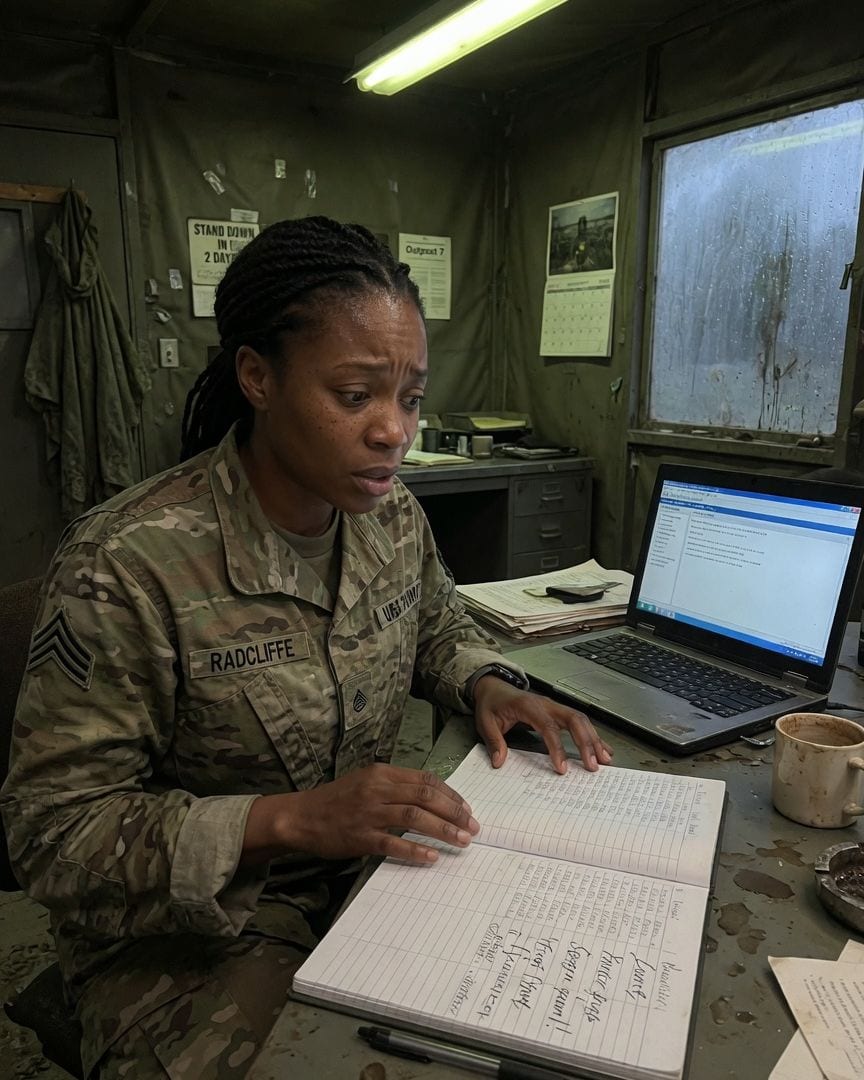
Two days before Outpost 7 closed, Staff Sergeant Radcliffe's roll call counted 42 men, but 43 voices answered.
Two days before Outpost 7 was set to stand down for good, Company First Sergeant Nora Radcliffe conducted her morning roll call. For three years, she had known all forty-two faces and voices by heart, but in the damp dawn air, a forty-third voice answered to a name not on her list. Back in her office, she found that same impossible name, 'Everett Lawson,' added to the official duty log in her own unmistakable handwriting. As the fluorescent lights hummed, her search of the digital personnel system revealed a skeletal record for Lawson, complete with a basic training certificate signed by her training officer—who had retired a decade before the certificate's date. What impossible truth had Nora stumbled upon as her outpost prepared to close?
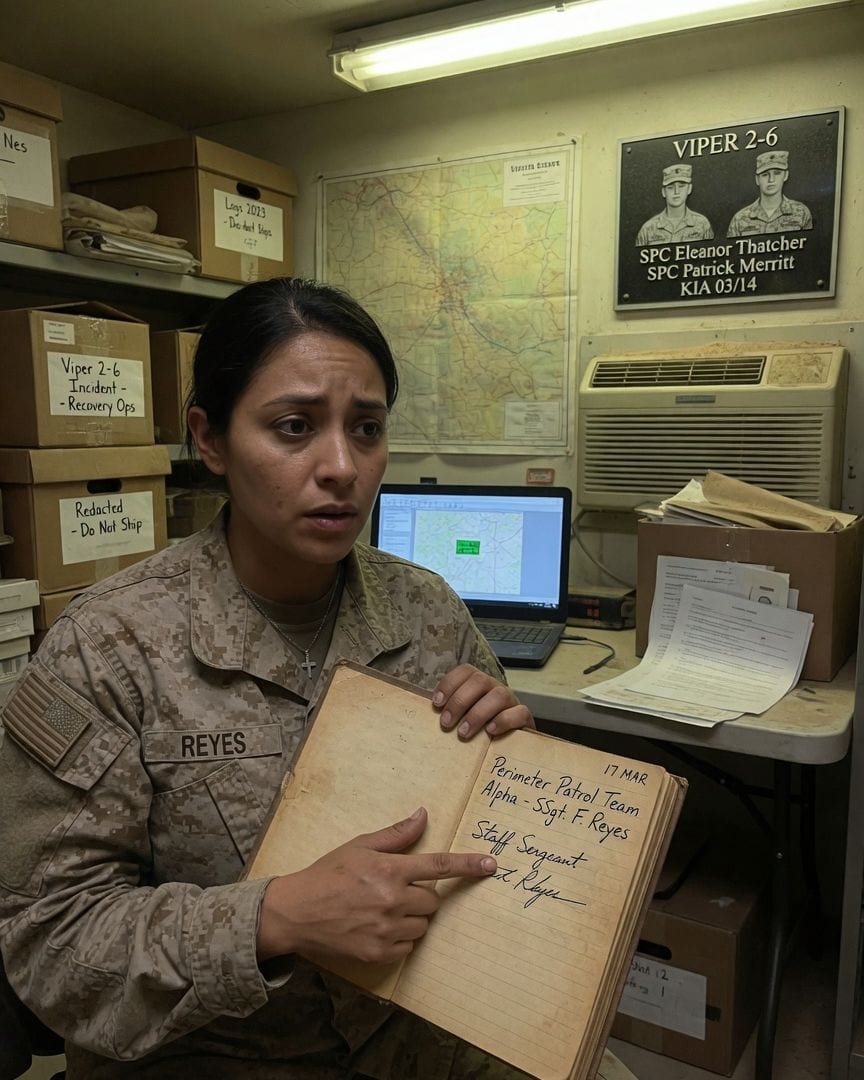
A Staff Sergeant, three weeks from transfer, finds her own signature in a logbook for a patrol she never made.
Staff Sergeant Fiona Reyes counted down her last three weeks at the high desert outpost, the fluorescent hum of the TOC a constant companion amidst the dust and old equipment. Her tired eyes scanned the digital map when an impossible icon, 'Viper 2-6' – a vehicle and crew lost last year – blinked alive, reporting its position and crawling steadily toward the base. Despite commanders dismissing it as a system ghost, Reyes meticulously searched dusty archives, finding strange log entries of phantom contacts and radio chatter, all dismissed as malfunctions. But the true chill came when she unearthed a field logbook from the recovery efforts, revealing her own undeniable signature on a perimeter patrol dated last year, a patrol she knew, with every fiber of her being, she had never made.
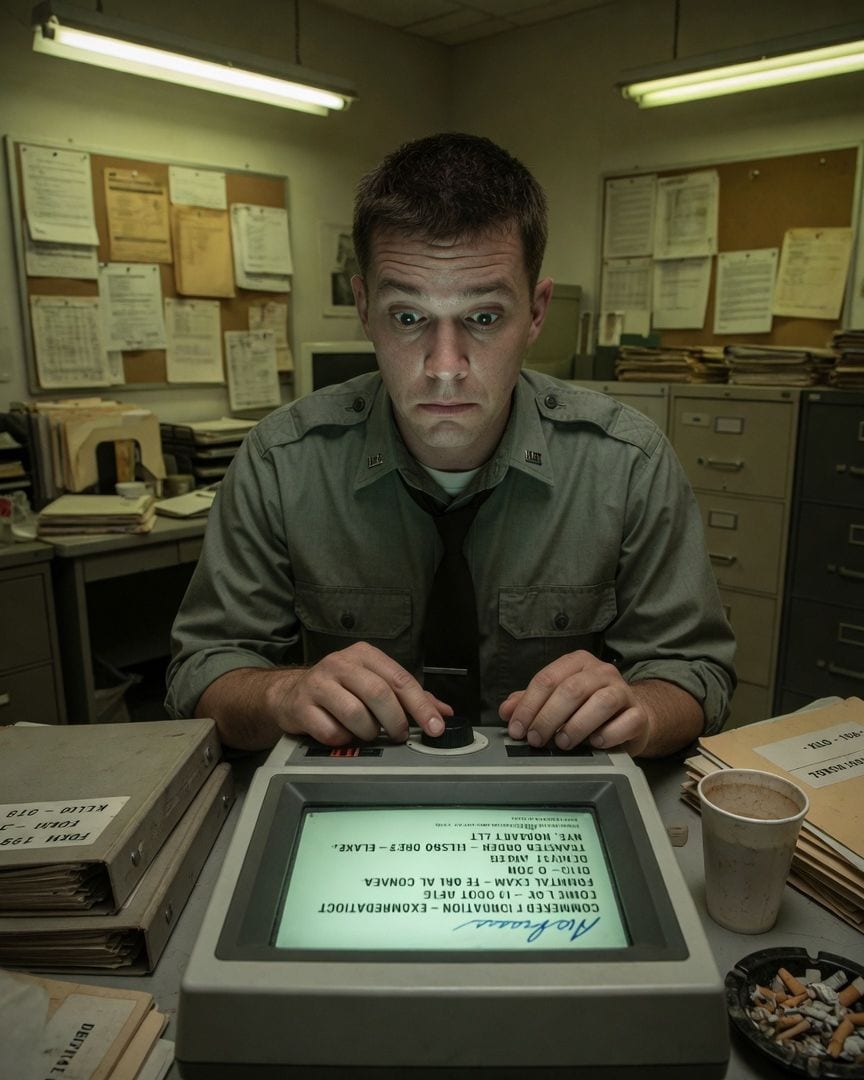
A missile commander watched his ten nuclear silos go dark. His own service record shows his signature on a future he's never lived.
Second Lieutenant Hobart Nye, a missile commander in Wyoming, had his quiet 0247 watch shattered by a security report: a massive, silent black triangle hovered over Launch Facility Kilo, casting a perfect shadow. Hobart watched his console's fault panel light up, signaling all ten nuclear missiles going dark in an impossible silence, followed by eleven minutes his security team could not remember. Official logs called it a "radio malfunction," but Hobart found a requisition for invisible-tracking sensors, signed by a base commander who was supposed to be off-base. The final, chilling discovery came when his own service record showed new entries—a dental check-up, a transfer to Alaska—all dated for a future he never lived, complete with his perfectly replicated signature.
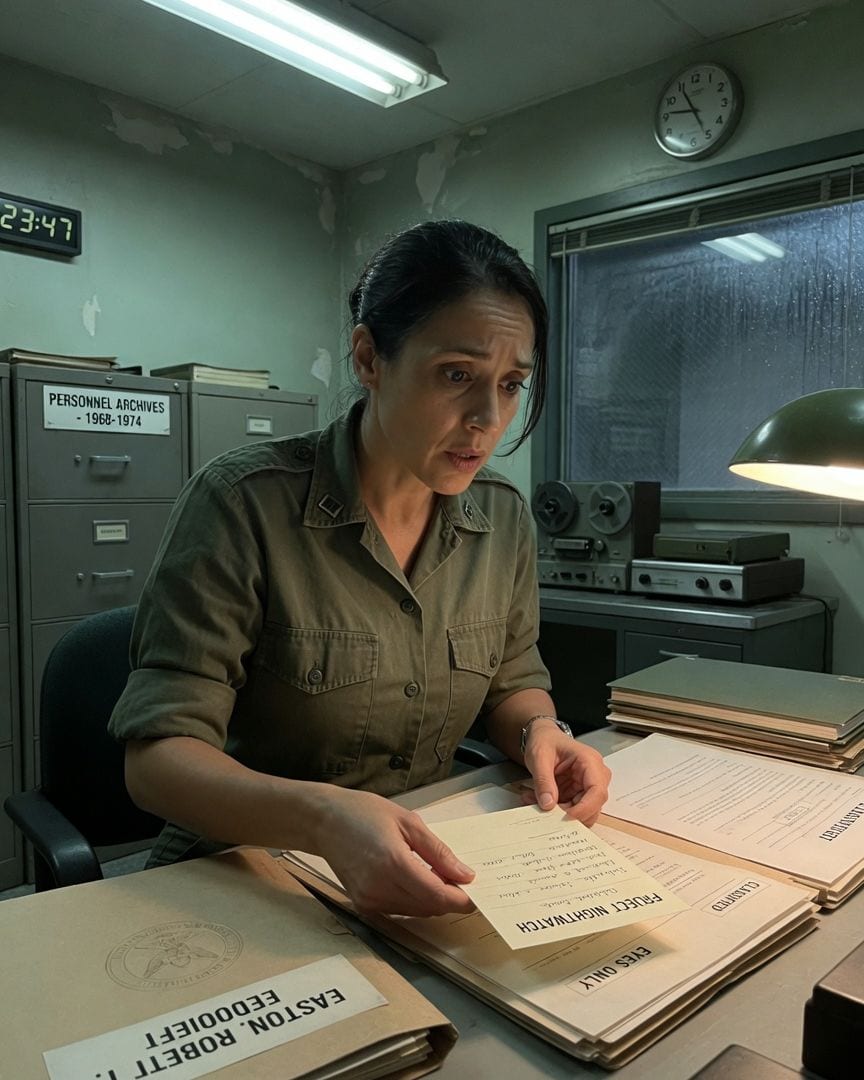
A Cold War tower controller logs an object vanish from radar, then hears the pilot scream it’s filling his windscreen. Her own name, 'Bardolph, Ines', now marked 'Observed' in a secret file.
Captain Ines Bardolph, a tower controller, was counting down the months until her transfer to Langley and the decommissioning of her base, hoping to leave behind the unsettling incidents of her final posting. But one night, her radar scope showed an impossible blip, solid and unwavering, 40 miles north of the Danube, only to vanish in less than a second, leaving a pilot screaming in terror. Despite the clear evidence, the official report blamed "atmospheric inversions," while the terrified pilot received a glowing review and promotion, his file meticulously scrubbed of any anomaly. As Captain Bardolph reviewed the pilot's pristine record, she found a hidden slip of paper, revealing a chilling truth: 'Subject: Bardolph, Ines. Status: Observed.' Was she merely an observer of the impossible, or was she now part of something far more sinister?
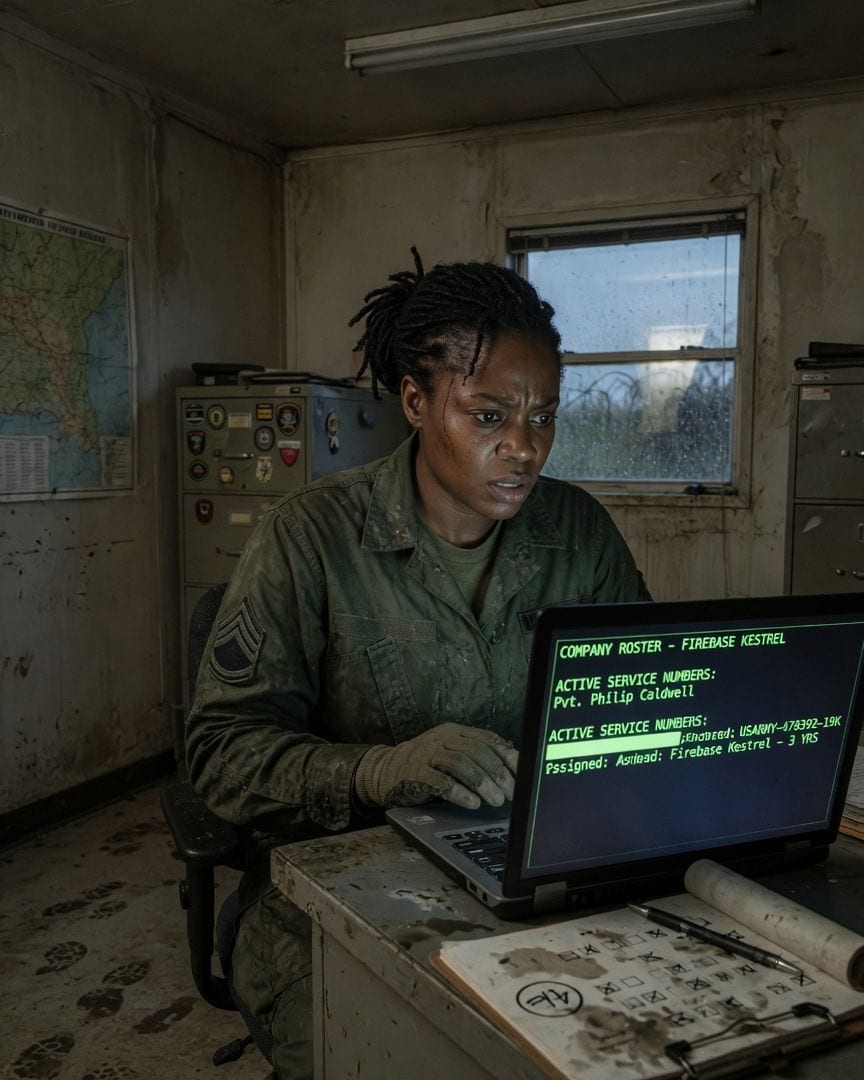
Two days from closing Firebase Kestrel, Staff Sergeant Okonkwo called roll for 42 men. A voice she knew answered a name not on the list.
Staff Sergeant Christine Okonkwo stood before her company in the gray dawn, just two days from finally standing down Firebase Kestrel after three long years. She called the familiar roll for forty-two battle-hardened men, each name etched in her memory, until a deep, resonant voice answered a name not on her roster. Forty-two men, forty-three answers, the voice unmistakably clear and close, yet from nowhere she could pinpoint. As she later traced an unfamiliar boot print in the mud and found a blank entry with an active service number in the digital manifest, a profound, cold dread washed over her. The system, designed for absolute accountability, had a void she’d unknowingly overlooked for years.
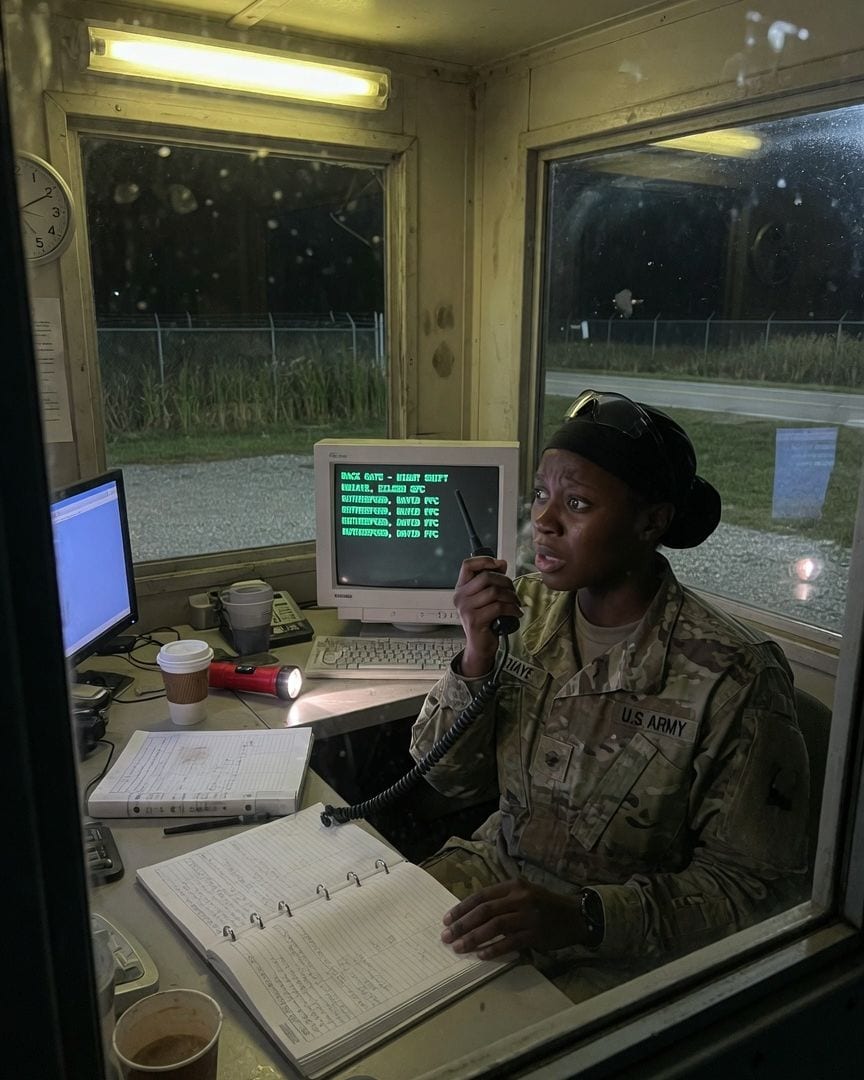
Specialist Eileen Ndiaye, two days from transfer, hears three distinct knocks at her ear. Then the base system swears another man was on her solo post.
Specialist Eileen Ndiaye endured the late October chill at Fort Vashon's back gate, counting the hours until her transfer in two days. Alone on a two-man post due to a flu outbreak, the distant generator hum was her only company against the vast, empty marshland. Just after midnight, three sharp raps echoed on the glass, then again, softer, but the motion lights revealed only gravel and fence wire. A third series of knocks, light as falling ash, came from just six inches behind her ear. Later, trying to rationalize it as fatigue, she checked the logbook and digital roster. Both clearly listed a second man, PFC Rutherford, assigned to her exact post and hours, as if the base system itself swore she hadn't been alone.