Specialist Eileen Ndiaye, two days from transfer, hears three distinct knocks at her ear. Then the base system swears another man was on her solo post.
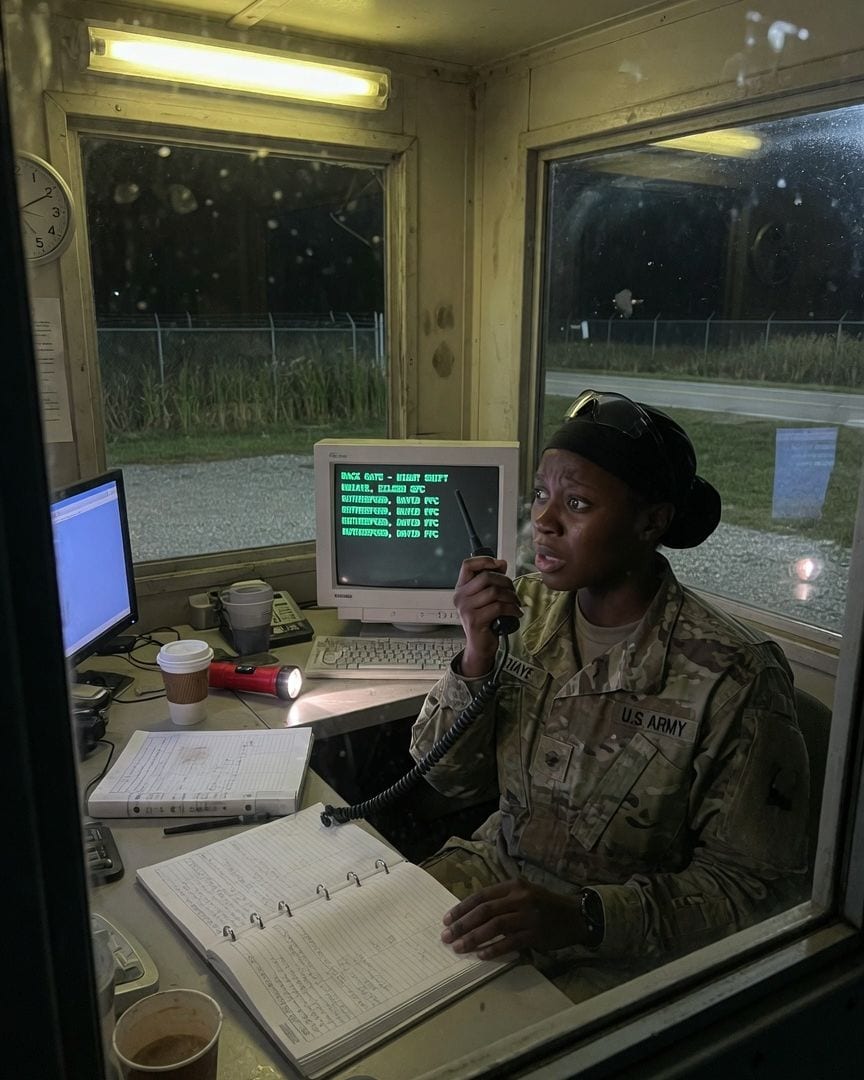
The chill of a late October night clung to Fort Vashon’s back gate. Specialist Eileen Ndiaye, just two days from her transfer out, shivered inside the small guard shack.
The flu had gutted the roster, leaving her to pull the two-man post alone, a rare and unsettling breach of protocol.
The only sound was the distant drone of the base generator, a steady hum against the vast, empty marshland beyond the fence.
Just after midnight, a sharp, deliberate rap echoed against the glass of the window facing the cleared perimeter road. Three knuckles, distinct and firm.
Eileen spun, flashlight beam cutting through the darkness, but the motion lights over the apron had already snapped on, revealing nothing but gravel and fence wire. Her breath hitched. 'Wind,' she muttered, forcing the word past suddenly dry lips.
She waited, heart thudding a nervous rhythm against her ribs. Nothing. She turned back to her logbook, trying to steady her hand.
The second time, a minute later, the knocks were softer, but unmistakable. Again, three precise taps. Again, the motion lights flared, and the apron was empty. 'Okay,' she whispered, a cold knot forming in her gut.
This was no prank; no one was out there. She gripped the pen, refusing to turn her head. A third series of knocks, light as falling ash, came from the glass six inches behind her, right at her ear.
Eileen froze, every muscle screaming. The air in the shack felt suddenly heavy, thick with an unseen presence. She didn’t turn. She couldn’t. After a long, agonizing moment, the silence returned, deeper and more profound than before.
Slowly, she reached for her radio, her fingers fumbling over the cold plastic. 'Control, this is Ndiaye, back gate. Requesting perimeter check, sector four. Possible trespasser.'
The voice that crackled back was sleepy, annoyed. 'Ndiaye, what’s going on? You just logged in zero activity.'
Eileen swallowed hard. 'Negative, Control. Heard movement. Urgent.' She waited, listening to the static, until the patrol car’s headlights finally cut through the distant gloom. They swept the perimeter, a methodical, empty search.
The patrol leader, Sergeant Harold Rutherford, confirmed nothing. 'Clear as a bell, Specialist. You sure you’re not seeing shadows out here?' Eileen mumbled an agreement, her gaze fixed on the empty apron.
Once the patrol was gone, she tried to rationalize it. Fatigue. Isolation. The flu. It had to be. She picked up the guard shack logbook, planning to sign off on the perimeter check.
Her eyes scanned the entries for her shift. Her name, Eileen Ndiaye, was there. And directly beneath it, for the same back gate post, same hours, was another name, neatly printed: 'Rutherford, David. PFC.'
Eileen blinked. She was alone. She had been alone. She flipped back through the previous shifts, then forward. No other 'Rutherford, David' was listed. It was a single, impossible entry. A clerical error?
A new recruit she hadn’t been told about? But a PFC wouldn't be assigned a two-man post alone, much less without an introduction.
She tried to dismiss it, to scrawl a note beside it, but the entry was too precise, too official, mocking her certainty.
The unease gnawed at Eileen. She pulled up the digital duty roster on the shack's ancient computer terminal. The screen flickered to life, displaying the day’s assignments. She scrolled to 'Back Gate, Night Shift.'
Her own name, Eileen Ndiaye, was clearly listed. And directly beneath it, with an identical assignment code and time slot, was another entry: 'Rutherford, David. PFC.'
It wasn’t a handwritten signature; it was a typed, system-generated entry, as if the base’s own infrastructure had assigned him. The screen showed two people were officially on her post, at the exact moment she’d heard the knocks.
The system swore she hadn't been alone.
The digital roster entry cemented the dread. Eileen spent the remainder of her shift in a cold sweat, constantly glancing at the window, half-expecting to see 'PFC David Rutherford' materialize in the empty chair beside her.
The moment her relief arrived, she made a beeline for the administrative offices. Her battle buddy, Sergeant Patricia Montgomery, worked in records.
Patricia, a no-nonsense Marine with a dry wit, listened patiently as Eileen recounted the knocks, the empty apron, and the impossible roster entry. 'Rutherford, David?' Patricia frowned, typing the name into her terminal. 'Never heard of him.
No one by that name on the current manifest, sick call, or transfer list. Must be a glitch, Ndiaye. The flu’s got the system wonky too.'
But Eileen wouldn’t let it go. 'It’s not just the digital, Trish. It’s in the paper log, too. And the knocks…'
Patricia, seeing the genuine fear in Eileen’s eyes, sighed. 'Alright, let’s look deeper. Sometimes old records get… weird.' She pulled up the base’s archived rosters, going back several decades. It was a tedious process, page after digital page.
Then, Eileen spotted it. In a roster from 1987, during a severe measles outbreak that had decimated personnel, a 'PFC D. Rutherford' was listed for a post that should have been solo.
Again in 1972, during a major deployment that left the base critically undermanned, a 'PFC David Rutherford' appeared on a fire watch roster.
The name wasn’t always identical, sometimes just 'D. Rutherford,' but the pattern was undeniable: whenever Fort Vashon faced a critical staffing shortage, an extra 'Rutherford' would appear on a duty roster for a short period, then vanish from subsequent records.
The pattern across rotations was chillingly consistent.
Eileen and Patricia’s digging didn’t go unnoticed. The next morning, Captain Everett Montgomery, head of base records, summoned Eileen to his office. His office was meticulously organized, every file in its place, every pen aligned.
Montgomery himself was impeccably neat, his uniform pressed, his expression calm, almost serene.
'Specialist Ndiaye,' he began, his voice a low, even tone, 'Sergeant Montgomery informs me you’ve taken an unusual interest in historical duty rosters. And a particular individual, a 'PFC David Rutherford.''
Eileen felt a prickle of unease. 'Sir, I was just trying to understand a discrepancy in my recent duty assignment.'
Montgomery steepled his fingers, his gaze unwavering. 'Discrepancies happen, Specialist. Clerical errors, system glitches. To pursue them with such… vigor… is a waste of valuable resources.
And to spread rumors about 'extra names' can be detrimental to morale, especially with the current flu situation.' His words were a warning, delivered with unnerving politeness.
He didn’t raise his voice, didn’t threaten, but the implication was clear: stop digging. Eileen left his office feeling scrutinized, every step watched.
Later that day, she found a small, almost imperceptible scuff mark on the gravel just outside her barracks window, too large to be her own boots, too clean to be from a general passerby.
It looked like someone had stood there, watching. The threat was now personal.
Eileen returned to Patricia, relaying Captain Montgomery’s 'warning.' Patricia paled. 'Montgomery? He’s old guard, been here forever. He knows everything about this base.'
Eileen showed Patricia the compiled list of 'Rutherford' entries from the archived rosters, the dates correlating precisely with historical staffing crises. Patricia stared at the printouts, her usual skepticism replaced by a dawning horror.
'My grandfather…' she began, her voice barely a whisper. 'He was a Captain here, long before I was born. Used to tell me stories, late at night, when he’d had too much to drink. About 'The Ghost of Vashon.'
A soldier who died during a plague outbreak in the fifties. Said his name sometimes appeared on rosters when the base was short-handed. Said it was 'the base’s way of filling the gaps.''
Patricia, visibly shaken, logged back into the archive system. 'He also mentioned… a 'contingency plan.' Something about 'supplemental assignment protocols' in an unindexed section.' She navigated through a labyrinth of forgotten directories, finally locating a folder marked 'VASHON-CLASSIFIED-LEGACY.'
Inside, among brittle, yellowed files, was a faded, unofficial memo from 1957. The typewritten text was terse: 'Effective immediately, during periods of critical personnel depletion, supplemental assignment protocols are authorized.
Existing records of deceased Fort Vashon personnel may be activated to ensure full operational complement. Accountability must be maintained. Refer to File 7-Gamma for specific reactivation guidelines.' The memo was signed by a 'Captain H. Montgomery' – Patricia’s own grandfather.
The pieces clicked into place. The knocks Eileen heard. The impossible name on her roster. The pattern across rotations. It wasn’t a glitch. It was a system. A deliberate, horrifying system.
Patricia, her hands trembling, navigated deeper into the legacy files, following the memo’s reference to 'File 7-Gamma.' It led them to a physical location: a small, unmarked storage room in the deepest part of the base archives, rarely accessed.
The air inside was cold and stagnant, smelling of dust and old paper. On a high shelf, tucked behind rows of forgotten equipment manifests, sat a sealed, unmarked wooden box.
Patricia used a crowbar from a nearby workbench to pry it open. Inside, meticulously preserved, were old, brittle paper records. They found what they were looking for: a complete service record for PFC David Rutherford.
It included his date of enlistment, his basic training records, and a stark 'date of death: 1953, Fort Vashon (influenza outbreak).' Eileen’s heart pounded. This was it. The ghost.
But then, tucked neatly into a plastic sleeve at the very front of the file, was something else. A current-issue base ID card. It bore Rutherford’s faded, sepia-toned photo, his name, 'Rutherford, David. PFC.' And an issue date: last month.
The space for 'assigned unit' was blank, a gaping hole in an otherwise perfect record. A dead man had a new ID, and the accountability that cannot be was staring them in the face.
The metallic tang of fear filled Eileen's mouth as she stared at the impossible ID card. Just then, the archive door creaked open. Captain Everett Montgomery stood in the doorway, his expression as calm and unreadable as ever.
He wasn’t surprised to see them. 'Specialist Ndiaye. Sergeant Montgomery. I’d hoped you wouldn’t find this.' He walked in, closing the door softly behind him.
'Fort Vashon has always needed its full complement,' he began, his voice devoid of anger or judgment. 'Since the influenza outbreak of '53, and even before, the base has had… protocols.
To ensure that every post, every duty, is always accounted for. Especially when the living roster is… compromised.' He picked up Rutherford’s old service record, tracing the 'date of death' with a finger. 'PFC Rutherford. A dedicated Marine.
Died on duty during a time of great need. It was only right that his service continue.'
He explained how, during times of severe depletion, the 'system' – a combination of tradition, specific protocols, and an almost sentient need of the base itself – would reactivate the records of suitable deceased personnel.
'They are not ghosts, not in the way you might think,' Montgomery continued, his eyes meeting Eileen’s. 'They are simply… accounted for. They fill the gaps. The knocks you heard, Specialist Ndiaye, were PFC Rutherford reporting for duty.
A simple formality.' His calm explanation, delivered with the detached air of a quartermaster explaining inventory, was far more terrifying than any scream or threat. It all fit. Every discrepancy, every impossible count, every vanishing name.
The horror was in the coherence.
Montgomery’s serene demeanor chilled Eileen to the bone. 'Your inquiries, Specialist Ndiaye, have unfortunately created a new… gap.' He reached into his immaculate uniform jacket and produced a crisp, blank service record form.
It was already pre-filled with her name, Eileen Ndiaye, rank, and service number. Below that, under 'Date of Death,' was written: 'Pending.'
'The system requires balance,' Montgomery stated, offering the form to her with an unsettling gesture. 'You’ve disrupted it. Fort Vashon will always maintain its numbers.'
Patricia, who had been frozen in horror, suddenly lunged forward. 'No! You can’t do this!'
Montgomery merely turned his gaze to her, his calm expression unwavering. Patricia stumbled, her eyes wide, a faint, wrong smile slowly spreading across her lips, her body going unnervingly still.
Eileen saw it then: Patricia was already compromised, another piece being slotted into the system. The dread was a cold, sharp blade.
She grasped the current ID card for PFC David Rutherford, realizing it was a tangible key, a piece of the system’s 'accountability' that might just be her only way out.
With a desperate lunge, she shoved past Montgomery, whose grip on her arm was surprisingly weak, almost ethereal. He didn’t pursue her, didn’t even raise his voice.
He simply watched her flee, that unsettlingly calm smile fixed on his face, as Patricia stood motionless beside him, her own smile now a fixed, vacant thing.
Eileen burst out of the archives, not looking back, running towards the main gate, the ID card clutched tight in her hand.
Eileen, heart hammering, managed to slip off base in the chaos of a shift change, the Rutherford ID card her only proof.
Her frantic attempts to report the 'contingency plan' were met with polite dismissals and then, thinly veiled accusations of mental instability. Her service record was flagged AWOL, then summarily discharged dishonorably.
Fort Vashon itself entered a rapid lockdown, officially for 'extensive renovations due to the unprecedented flu outbreak,' its gates closing quietly to the outside world. No one questioned the sudden, total silence from the remote installation.
Years passed. Eileen tried to build a normal life, but the memory of Montgomery’s serene explanation and Patricia’s vacant smile never truly faded.
She kept the worn plastic ID card of PFC David Rutherford in a small, locked box, a cold, smooth piece of impossible truth.
She knew it was useless as evidence, just a piece of plastic to anyone else, but it was a constant, tangible reminder of the gaps that needed filling.
Sometimes, late at night, she’d hear a faint, deliberate tap on her window, three knuckles, always three. She never turned her head. She knew what the motion lights would show.
An empty apron, and a system always seeking its full complement. She knew. She just knew.
If this one got to you
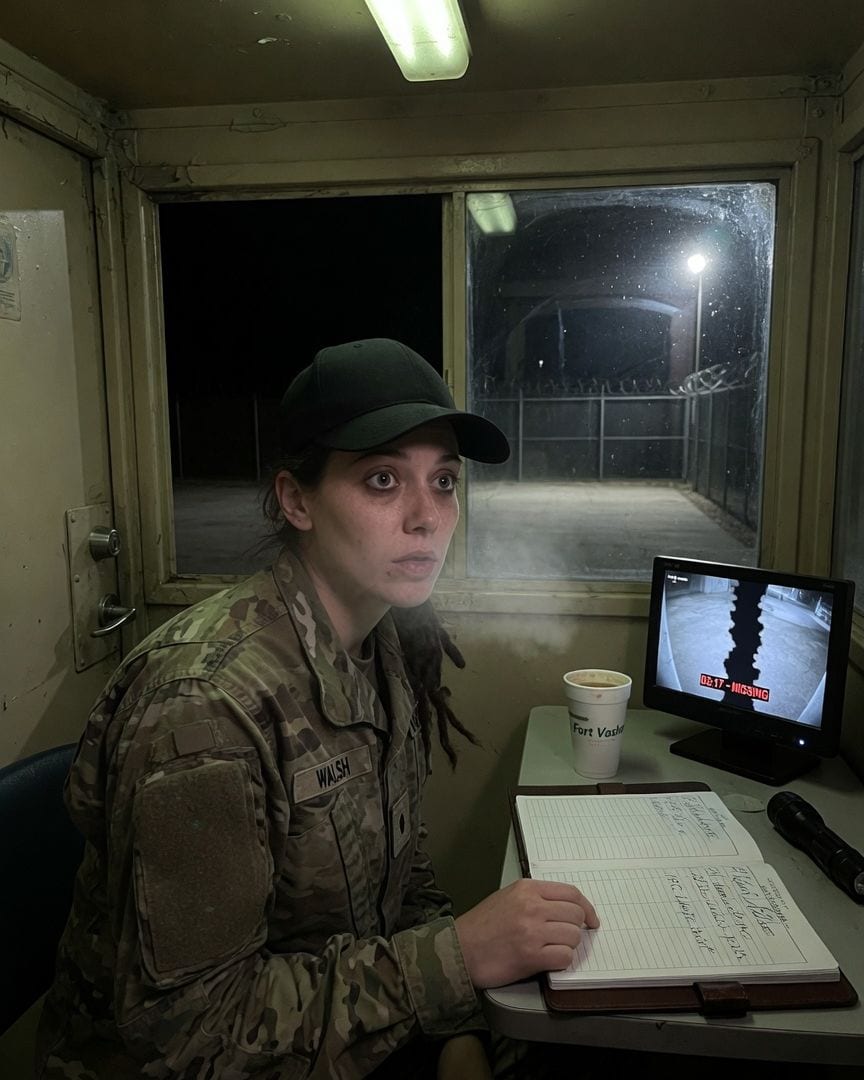
Alone on guard duty, Specialist Rose Walsh heard three knocks. The third came from six inches behind her ear, *inside* her locked shack.
Specialist Rose Walsh endured a lonely overnight shift at Fort Vashon's desolate back gate, the only guard on duty after a severe flu outbreak decimated the roster. The bitter wind howled, but it couldn't explain the sharp, deliberate knuckle raps on her guard shack window. The third knock came from just inches behind her ear, *inside* the locked shack, and its security footage simply vanished. Her physical duty log then revealed a fresh signature for 'PFC Lambert, J.' for her solitary post, a name consistently appearing in other remote posts. Who was this phantom guard, and why did their path lead to Rose?
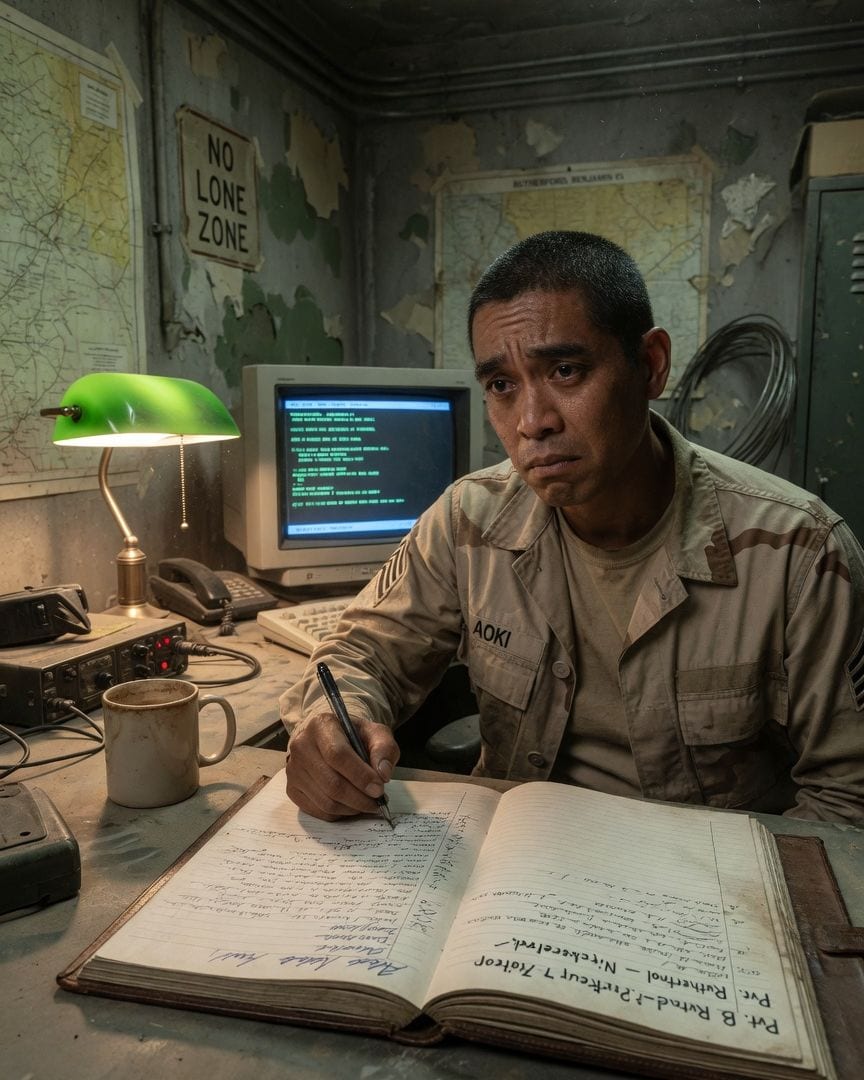
Sergeant Aoki's four-man patrol hears a fifth voice answer their count. A fresh name then appears in the duty log beneath his own signature.
Sergeant Isaac Aoki's final rotation at Outpost 7 was nearing its end, with relief due at dawn. On his four-man night patrol, he broke an old superstition, counting his team aloud in the dust-choked desert. A fifth voice answered, clear and unsettling, from the moonless dark. Back inside the bunker, the chill deepened when a fresh name appeared in the duty log, 'Pvt. B. Rutherford,' beneath Aoki's own signature, a soldier no one knew. Even more disturbing, Aoki later found his own signature on a valor citation for Rutherford, an event he never witnessed.
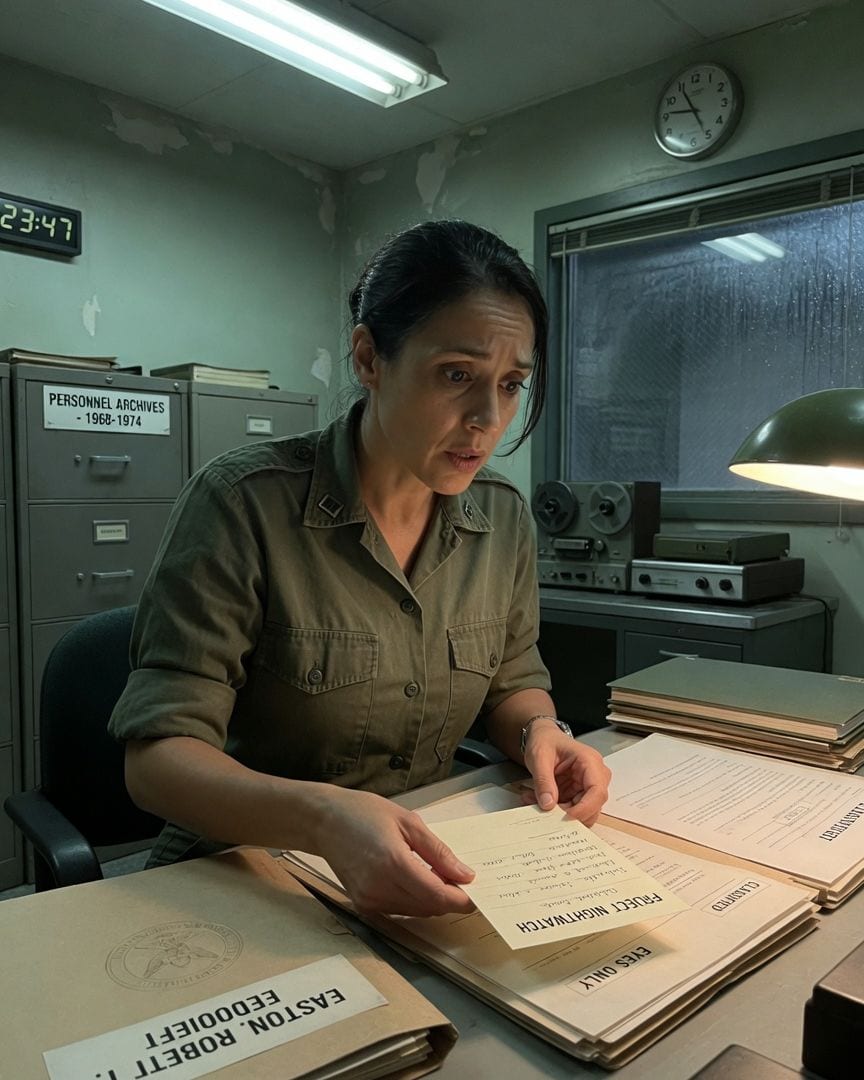
A Cold War tower controller logs an object vanish from radar, then hears the pilot scream it’s filling his windscreen. Her own name, 'Bardolph, Ines', now marked 'Observed' in a secret file.
Captain Ines Bardolph, a tower controller, was counting down the months until her transfer to Langley and the decommissioning of her base, hoping to leave behind the unsettling incidents of her final posting. But one night, her radar scope showed an impossible blip, solid and unwavering, 40 miles north of the Danube, only to vanish in less than a second, leaving a pilot screaming in terror. Despite the clear evidence, the official report blamed "atmospheric inversions," while the terrified pilot received a glowing review and promotion, his file meticulously scrubbed of any anomaly. As Captain Bardolph reviewed the pilot's pristine record, she found a hidden slip of paper, revealing a chilling truth: 'Subject: Bardolph, Ines. Status: Observed.' Was she merely an observer of the impossible, or was she now part of something far more sinister?
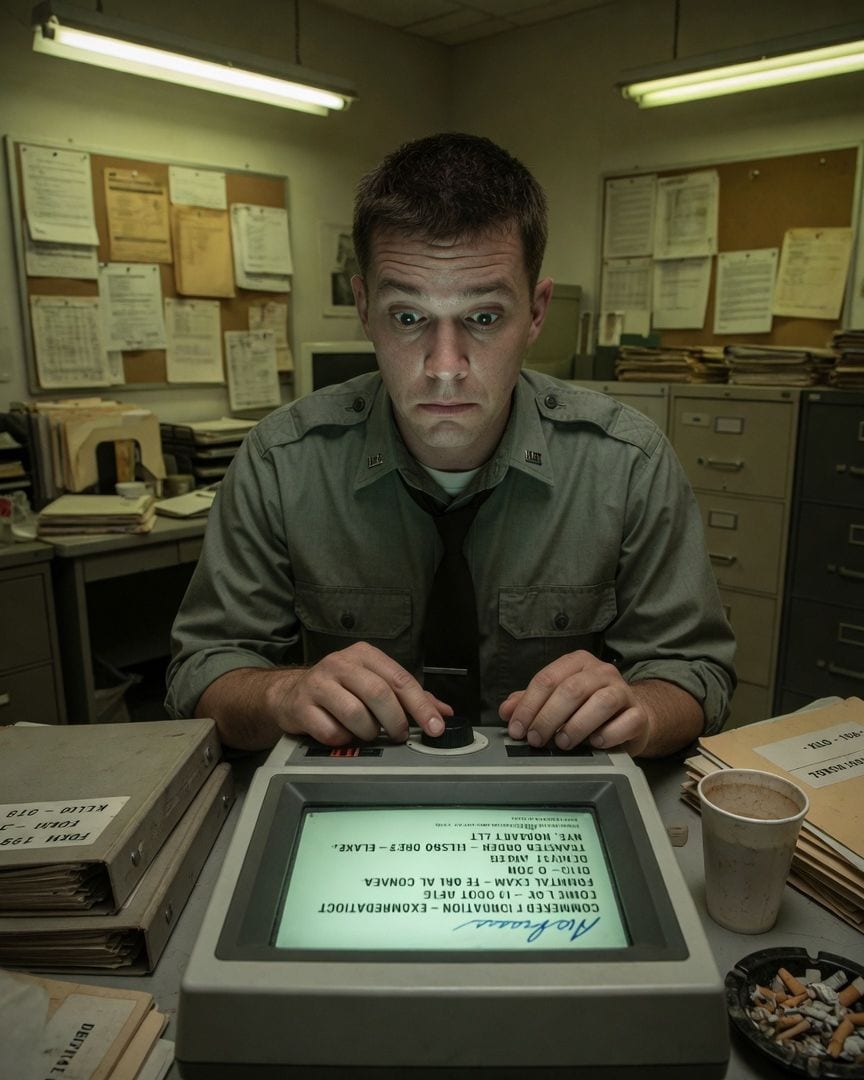
A missile commander watched his ten nuclear silos go dark. His own service record shows his signature on a future he's never lived.
Second Lieutenant Hobart Nye, a missile commander in Wyoming, had his quiet 0247 watch shattered by a security report: a massive, silent black triangle hovered over Launch Facility Kilo, casting a perfect shadow. Hobart watched his console's fault panel light up, signaling all ten nuclear missiles going dark in an impossible silence, followed by eleven minutes his security team could not remember. Official logs called it a "radio malfunction," but Hobart found a requisition for invisible-tracking sensors, signed by a base commander who was supposed to be off-base. The final, chilling discovery came when his own service record showed new entries—a dental check-up, a transfer to Alaska—all dated for a future he never lived, complete with his perfectly replicated signature.
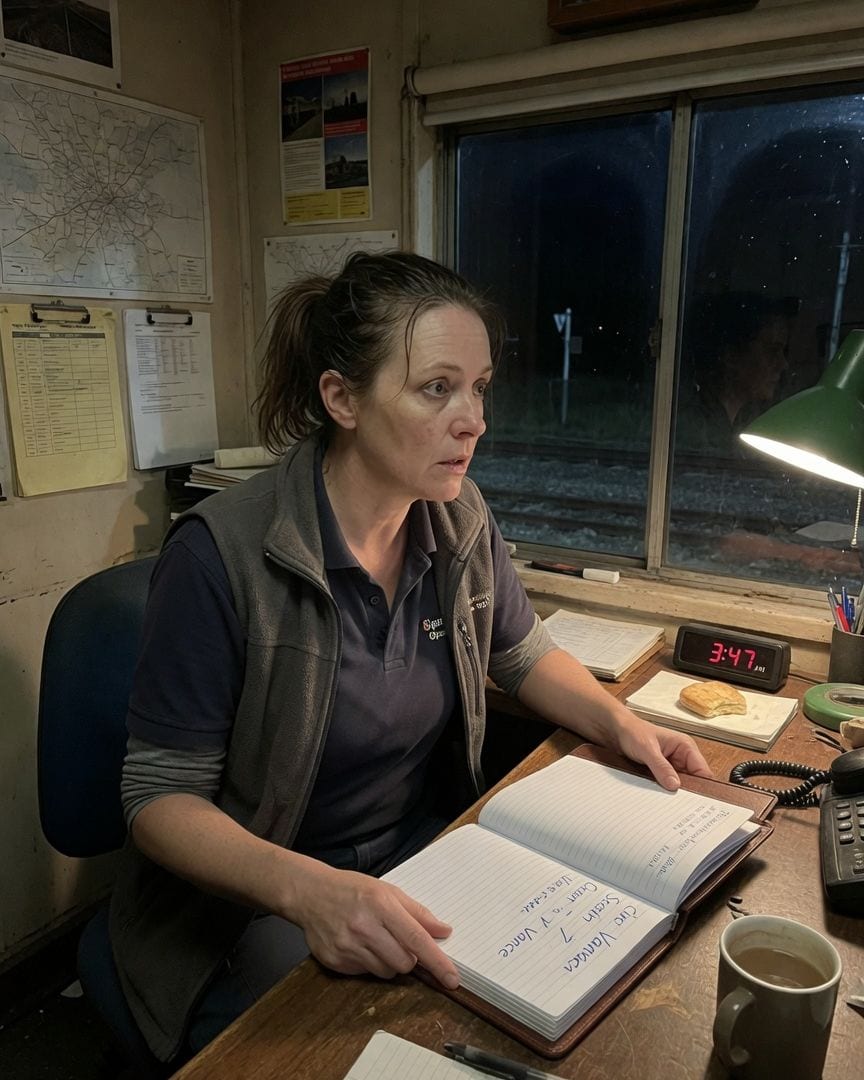
My linesman taps twice on my window at 3 AM. Control says he retired and passed years ago.
My routine at the rural signal cabin was regular: the linesman's double tap on the window at 3 AM. But then my supervisor called, revealing the linesman I knew, Warren Vance, had died five years ago. Now, an impossible entry in my official logbook, with his signature and timestamped from my shift, proves someone else was there.
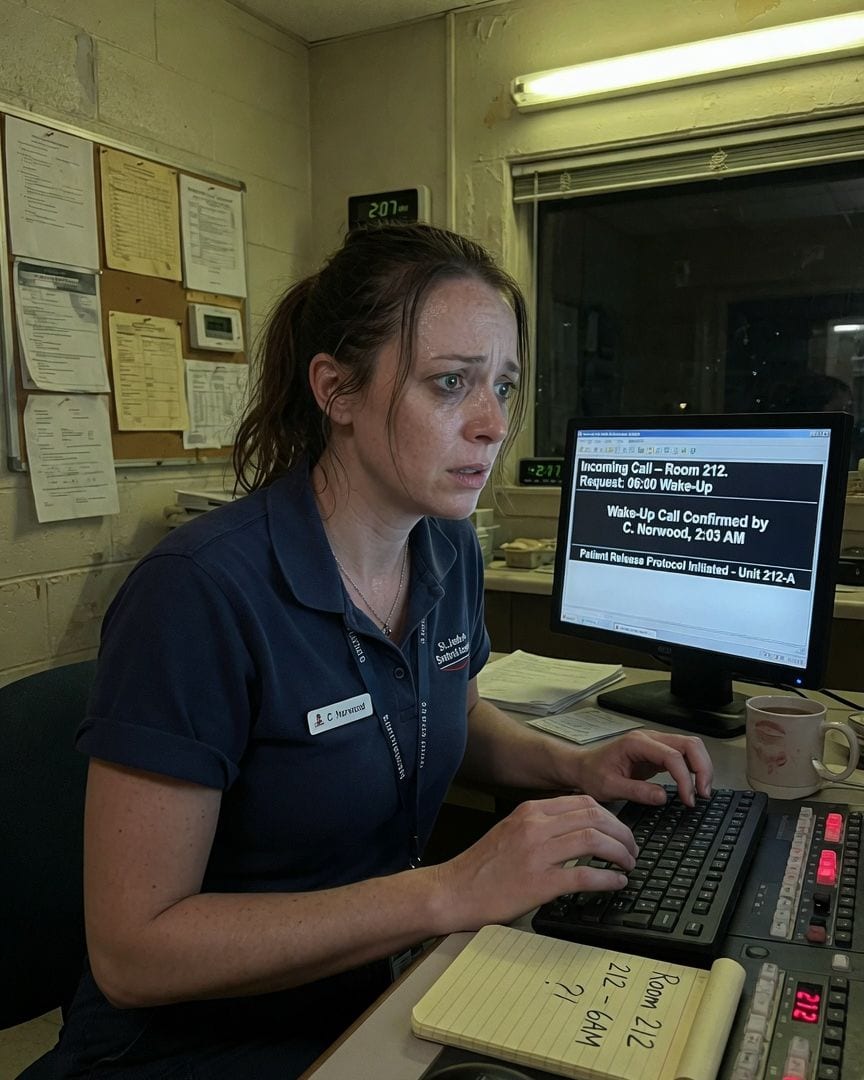
My login started a 'Patient Release Protocol' I'd never heard of for Unit 212-A.
Working the quiet night shift switchboard at St. Jude's, I took a routine wake-up call from Room 212. But the system showed Room 212 had been stripped bare and its phone line disconnected for months. Then, my own login showed I had confirmed the impossible call.