Two days from closing Firebase Kestrel, Staff Sergeant Okonkwo called roll for 42 men. A voice she knew answered a name not on the list.
The gray dawn after a relentless storm turned Firebase Kestrel’s parade ground into a churned morass of mud and standing water.
Staff Sergeant Christine Okonkwo, thirty-two, stood before her company, forty-two battle-hardened faces caked in mud, two days from finally standing down this godforsaken post.
For three years, she’d called this roll, every name etched into her memory, every man a familiar face in the half-light.
“Harrington!” she barked, her voice cutting through the damp air.
Captain Conrad Harrington, forty-five, snapped a crisp “Here, Staff Sergeant!”
“Caldwell!”
Private Philip Caldwell, twenty-eight, answered with equal promptness. Name after name, the familiar cadence of accountability, a rote symphony of readiness. Each man answered, each reply a testament to their presence, until the last man responded.
Okonkwo marked it down on her clipboard, a perfect forty-two.
But then, as the last echo faded, a voice, unmistakably clear and close, answered, “Donovan!” It was a deep, resonant voice she knew, a sound that pulled at the edges of memory, but the name was alien to her roster.
Okonkwo’s pen froze mid-air. Forty-two men, forty-three answers. A cold knot tightened in her stomach. She ran the roll again, slower this time, her eyes scanning each mud-caked face, searching for a phantom among the solid ranks. Each man answered.
Each time, that same voice, from nowhere she could pinpoint, answered “Donovan.”
She could feel the chill of the morning mud seeping through her boots, but it was the impossible count that settled a profound, cold dread deep in her gut.
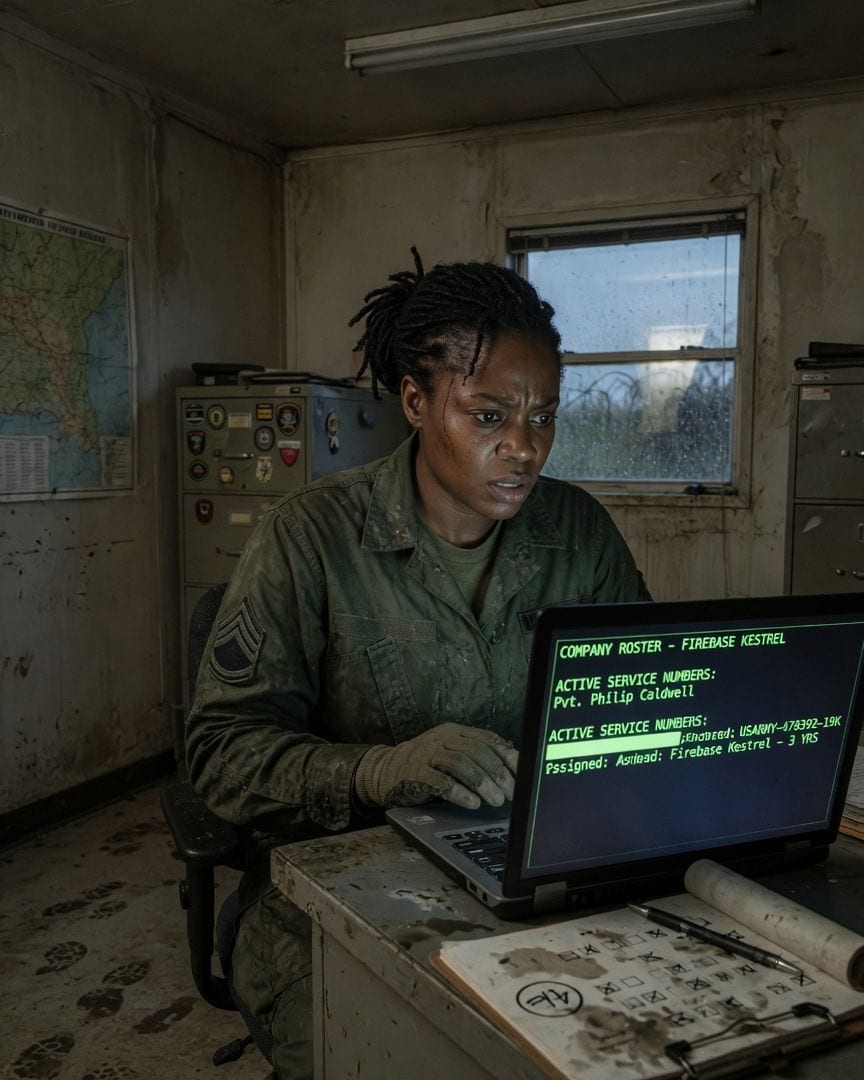
Okonkwo dismissed the company, her mind reeling. Back in her small, cramped office, the fluorescent light buzzing overhead, she pulled up the digital company manifest. Forty-two names, forty-two service numbers. She scrolled through it twice, then a third time, meticulously.
No ‘Donovan.’ No blank lines she could see. She considered fatigue, a particularly elaborate prank, or a faulty sensor in her own brain, playing tricks in the early morning gloom.
But the voice had been too clear, too specific, too… known.
She walked the perimeter of the parade ground, examining the fresh boot prints in the thick, clinging mud. Forty-two distinct patterns, each matching the standard-issue boots worn by a man in her company.
Then, near the edge of the wire, where the churned earth met the dense, rain-soaked scrub, she found it: a single set of prints, slightly larger, with a distinctive tread pattern not issued to any of her men, leading away from the formation into the shadows.
She knelt, tracing the unfamiliar pattern with a gloved finger, a knot tightening in her stomach.
Back at her desk, the cold from the mud still clinging to her, she reopened the digital manifest. This time, she didn’t just scroll. She used the search function, entering 'Donovan.' Nothing. Then, a hunch.
She sorted by service number, then by rank. And there it was: a line entry, tucked between Private Caldwell and another junior NCO.
It showed a valid, active service number, a blank space where the name should be, and 'Assigned: Firebase Kestrel' next to it.
It had been there for years, she realized, buried within the system's code, a ghost entry that never affected the total count, always balancing out to an acceptable figure.
She stared at the blank name field, a sense of profound wrongness washing over her. The system, designed for absolute accountability, had a hole in it she’d never seen, a void she’d unknowingly overlooked for three years.
Okonkwo sat alone in her office, the only light from her laptop screen illuminating her face in the encroaching dusk. On the display, the digital manifest showed the single, blank line entry, an active service number glowing faintly.
She ran her finger over the blank name field, the digits of the service number stark against the pixelated screen.
The silence of the office was thick, broken only by the distant drip of rain from the eaves, a steady, rhythmic tap against the windowpane. Then, from the dark corner of the room, a faint, familiar whisper echoed.
It wasn't the full name ‘Donovan’ this time, but the precise string of digits from the service number she was looking at, a voice she couldn't place and couldn't locate, yet it resonated with that same impossible familiarity.
The hair on her arms prickled, and a cold wave of dread washed over her, making her heart pound against her ribs.
The whisper of the service number solidified Okonkwo’s dread. She spent the rest of the day in a blur, digging. She cross-referenced the blank service number through every available database, official and unofficial.
It was valid, active, yet unassigned to any living soldier in the entire branch. It was a number that existed in the system but belonged to no one.
She tried Captain Harrington, her CO. He listened patiently to her account of the roll call and the phantom entry, his expression moving from concern to polite skepticism.
“Fatigue, Sergeant,” he’d said, leaning back in his chair, “Two days from home, it gets to everyone. That blank entry? Probably a system glitch, a legacy placeholder. Nothing to worry about.”
He offered her a twenty-four-hour pass to sleep off the stress. Okonkwo declined, her jaw tight. She knew it wasn’t fatigue.
She spent the evening in the firebase’s small, rarely-used archives, a dusty room filled with decades of paper records. The air was thick with the scent of old paper and mildew.
She found old company manifests, unit rosters, after-action reports for Firebase Kestrel. She painstakingly compared the blank service number to every entry she could find, looking for a match, a history, anything.
The paper trail was dense, often contradictory, and full of fading ink. She found mentions of 'unaccounted for' personnel in reports from the seventies and eighties, but no direct link to her phantom number.
Yet, an unsettling pattern began to emerge: odd discrepancies in total headcounts, footnotes about 'corrected' manifests, and once, a handwritten note from a previous First Sergeant, dated 1983, simply stating: 'The count is always right. Don't ask why.'
She felt like she was chasing smoke, but the smoke left a faint, acrid smell of something truly wrong, something deeper than a simple clerical error.
Okonkwo returned to her office, the archive dust clinging to her uniform, the weight of the old notes pressing on her. She’d made copies of several suspicious old manifest pages, their yellowed paper crackling softly.
As she sat down at her desk, she noticed her laptop was open, not to the manifest, but to a blank document. She was certain she’d closed it before leaving.
A faint, sharp click echoed from the window, and she looked up sharply. The window, which she always kept latched against the unpredictable Kestrel weather, was slightly ajar, rattling softly in the night breeze. Her heart hammered against her ribs.
She hadn't heard anyone approach, no footsteps in the pervasive mud. She scanned the dark outside, the heavy mud, the distant perimeter lights that barely pierced the gloom. Nothing.
But the feeling of being watched was palpable, a prickle on her neck that raised the fine hairs there.
Later, as she tried to sleep in her bunk, fully clothed, a metallic scraping sound came from just outside her door, rhythmic and deliberate.
She grabbed her service pistol from its holster, the cold grip a momentary comfort, moving silently to the door, listening. The scraping stopped. After a long minute, a minute stretched thin by her pounding heart, she flung the door open.
The corridor was empty, dark and silent.
But on the muddy ground just outside, fresh boot prints, identical to the distinct, non-standard pattern she’d found earlier by the wire, led right up to her door and then vanished into the darker shadows between buildings.
Someone, or something, was watching her, tracking her, deliberately making its presence known.
The methodical nature of the threat, the way it moved just at the edge of perception, leaving just enough evidence to terrify, was far more chilling than any direct confrontation.
It wasn't a warning; it was a presence, confirming her deepest fears.
The next morning, exhausted but resolute, Okonkwo confronted Captain Harrington again. She laid out her evidence: the blank digital entry, the non-standard boot prints by her office and bunk, the strange notes in the old archives.
She watched his face carefully, seeing the layers of his skepticism peel away. Harrington listened, his face grim, losing its polite, dismissive air. “Sergeant, I understand your concern,” he began, his voice low, “but this firebase has always been… odd.
There are stories.” He leaned forward, resting his elbows on his desk, lowering his voice further, as if the walls themselves might be listening. “The official line is that Firebase Kestrel was established in ’78.
But there was another, much older outpost here, during a classified operation in the late sixties. A small unit, completely wiped out in an ‘incident.’ Officially, they never existed. Their records were purged, their names struck from every roster.
But the ground, this place… it remembers.”
He pulled a thin, leather-bound journal from his desk drawer, its pages yellowed with age, its cover soft from handling. “This belonged to my grandfather. He was stationed here, briefly, in ’69.
He wrote about a ‘ghost in the system,’ a recurring anomaly in the headcounts. Always one extra. Always a name that shouldn’t be there. He called it ‘the balancer.’
He said it was the firebase trying to make its numbers add up, to account for the lost unit that was never accounted for.”
Okonkwo felt a cold clarity descend, a sudden, horrifying understanding that connected every disparate piece of wrongness.
The blank entry, the voice, the boot prints – it was all part of the firebase’s phantom system, trying to 'correct' for a historical erasure. “The voice,” she pressed, her own voice barely a whisper, “the name ‘Donovan.’
My grandfather’s journal… does he mention a Private Donovan?”
Harrington nodded slowly, his eyes fixed on the journal in his hands. “He does. A Private Donovan. One of the lost.” He looked up at Okonkwo, his gaze heavy with unspoken knowledge.
“He said the balancer would sometimes use the names and voices of the lost to trick new personnel into filling the void. It’s a systemic hunger, Sergeant. Always trying to square away the books.”
Okonkwo thought of the service number, the blank entry, the distinct boot prints tracking her movements. It wasn't just a glitch.
It was a conscious, systemic effort by the firebase itself to enforce an impossible accountability, a hungry, invisible accounting system.
Armed with Captain Harrington’s chilling confession, Okonkwo returned to the supply shed. She needed more proof, more names, more dates. She needed something undeniable.
She dug deeper into the stacks of old manifests, the dust motes dancing like phantom figures in the weak beam of her flashlight.
She found a series of reports from the early two thousands detailing 'unexplained equipment malfunctions' and 'isolated incidents of disorientation' among personnel, always coinciding with the appearance of a blank entry on the manifest for that rotation.
Then, tucked into one of the oldest logbooks, its binding cracked and fragile, she found it: a faded, sepia-toned photograph, its edges brittle, its surface cracked with age.
It showed a young, smiling Private, no older than twenty, his hair neatly parted, his uniform crisp and new. His name and service number were handwritten in elegant script on the back: 'Pvt. J. Donovan, Service No. 784-33-01.'
Okonkwo recognized the service number instantly, the exact string of digits from her blank manifest entry, the one that had whispered to her in the dark.
But it wasn't the face that froze her, nor the name. It was the insignia on his uniform – a rare, ceremonial patch, a small, stylized hawk, rendered in dark thread.
It was identical to a patch worn by only a select few in her current company, including Private Philip Caldwell, twenty-eight.
Caldwell, who she’d just seen an hour ago, whose service number was currently assigned to the blank entry on her own manifest.
The implication struck her like a physical blow: Caldwell wasn't just wearing an old patch; his service number, his identity, was being co-opted, or worse, replaced, by the very anomaly she was investigating.
The pattern wasn't just historical; it was happening now, to one of her own men, drawing him into the firebase's eternal ledger.
Okonkwo raced to Caldwell’s barracks, her heart hammering against her ribs. The door was ajar, a sliver of darkness visible within.
Inside, Caldwell sat on his bunk, staring blankly at the wall, a faint, almost imperceptible smile playing on his lips.
His uniform was immaculate, every crease sharp, but his eyes were distant, unfocused, as if peering at something far beyond the barrack walls.
“Caldwell?” Okonkwo asked, her voice tight with dread, the name feeling brittle on her tongue.
He turned slowly, his head tilting at an unnatural angle, the smile widening slightly, his gaze finally meeting hers, though it held no recognition. “Staff Sergeant,” he said, but the voice was wrong.
It was deeper, older, with the same resonant quality as the 'Donovan' she’d heard at roll call, the voice that had echoed the phantom service number. “The count is always right.”
Okonkwo understood. The firebase, the 'balancer,' wasn't just correcting old records; it was actively trying to fill the phantom slot, using Caldwell as its next vessel.
The patch, the service number, the voice – it was all part of an insidious, systemic process. The entity was a living echo of the lost unit, forever seeking to complete its numbers, to finally be 'accounted for.'
It had been luring Caldwell, slowly, subtly, perhaps for weeks, preparing him, integrating him into its phantom ranks.
The voice she knew was the voice of Private Donovan, from the faded photograph, now speaking through Caldwell, trying to bring him into the 'fold.'
Every clue clicked into place: the blank entry was the target, the voice was the lure, the old manifests were the history of its grim success.
This wasn't a ghost; it was a self-perpetuating, institutional wrongness, an anomaly in accountability that devoured the living to balance its impossible books.
Okonkwo knew she couldn't fight the entity directly; it wasn't a physical enemy, but a systemic one, woven into the very fabric of Firebase Kestrel. Her only option was to break the cycle, to sever Caldwell from the phantom slot.
She remembered Captain Harrington's grandfather's journal, mentioning 'the balancer's weakness: true, undeniable accountability.' The entity sought to complete numbers, to be officially recognized, even if those numbers were phantom.
Okonkwo grabbed Caldwell by the arm, who offered no resistance, his eyes still vacant, his smile fixed.
“We’re going to account for you, Private,” she declared, her voice firm, trying to imbue the words with a power she wasn't sure they possessed.
She dragged him towards the communication shack, the last remaining place with a functional, secure satellite link. The firebase was due to stand down in hours; most equipment was already packed, waiting for the demolition crews.
The path was slick with mud, treacherous underfoot, the air heavy with an unnatural stillness, a silence that felt too deep.
As they approached, the air grew colder, and faint whispers began to emanate from the ground, from the walls of the buildings – dozens of voices, indistinct, murmuring names and service numbers, a rising chorus of the lost.
The balancer was fighting back, trying to draw Caldwell further in, trying to dissuade Okonkwo from her impossible task.
She pushed Caldwell into the comms shack, sealed the heavy door, and logged into the secure network on the last functioning terminal. She found the blank entry on her manifest, the phantom service number glowing faintly.
With trembling fingers, she initiated an official 'Missing In Action' report for Private J. Donovan, using the service number from the old photograph and the name from her initial roll call.
Then, she opened a new entry for Private Philip Caldwell, flagging his original service number for 'Immediate Transfer to Medical Hold, Firebase Kestrel Decommissioned.'
She was deliberately creating a new true, official anomaly – a properly accounted-for 'missing' soldier and a living soldier officially removed from this place, thus disrupting the 'balancer's' need to fill the slot.
As she hit 'send,' the whispers outside intensified into a cacophony of frustrated, yearning voices, a sound of profound disappointment. Caldwell convulsed violently, a gasp tearing from his throat, his eyes snapping back into focus, full of raw, uncomprehending terror.
He was back. Okonkwo knew she had made an enemy of the firebase itself, but she had pulled Caldwell out.
She had proof, in the form of official, contradictory records now lodged in the system, that something fundamentally wrong had happened here.
The relief company arrived hours later, finding Firebase Kestrel quiet, its remaining personnel weary but accounted for. Captain Harrington looked at Okonkwo, a silent understanding passing between them, a shared secret too dangerous to voice.
Caldwell was immediately evacuated for psychiatric evaluation, his memory of the past few days a terrifying blank, wiped clean of the insidious integration.
Okonkwo filed her reports, detailing the 'system anomaly' and 'disorientation incident,' carefully embedding the contradictory official records she'd created, hoping they would act as a silent flag, a hidden truth.
She knew no one would ever truly believe her, or connect the dots she’d so painstakingly laid out.
The firebase was officially decommissioned, its structures slated for demolition, its ground to be reclaimed by the mud and the scrub, its history buried once more.
The blank entry on the digital manifest, the one she’d targeted, had vanished from the system. But the service number of Private J. Donovan was now officially marked MIA, a new, undeniable ghost in the records.
Okonkwo carried the weight of what she knew, a proof that was simultaneously undeniable and impossible to explain.
Years later, Staff Sergeant Okonkwo, now a civilian, occasionally checks obscure military forums. She sometimes sees posts from veterans who served at other long-decommissioned outposts, mentioning 'ghosts in the machine' or 'phantom counts.' She never comments.
She lives with the quiet knowledge of how deeply the system can break, not with a bang, but with a whisper, a blank line, and a number that always needs to be filled.
She has the copies of the old manifests, the grandfather's journal, and the official MIA report for Private J. Donovan, gathering dust in a locked box in her attic.
Proof that means nothing to anyone else, because it doesn't fit the official narrative.
Sometimes, late at night, when the house is quiet, she thinks she hears a faint, resonant voice call out a name she knows but can’t quite place, and she wonders if the system ever truly stops trying to balance its books.
If this one got to you
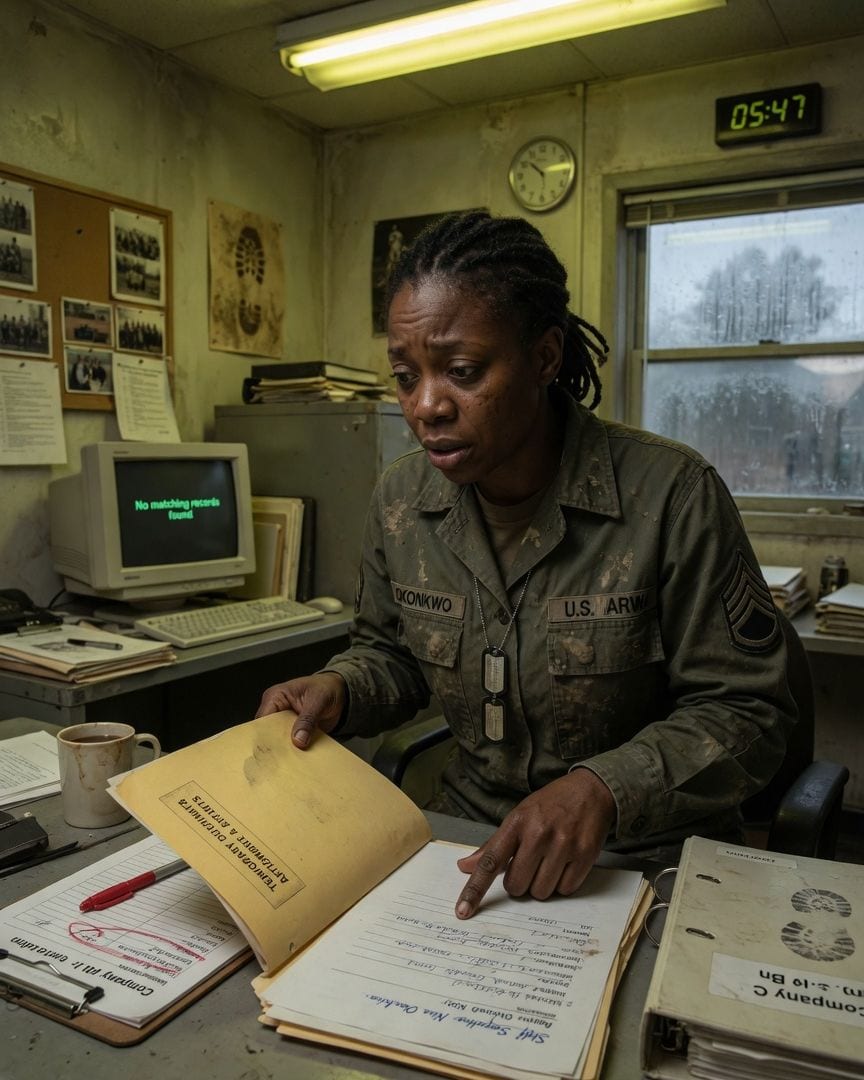
Two days before her company’s final stand-down, Staff Sergeant Nina Okonkwo heard a 43rd voice answer roll call. She found his file with her own impossible signature.
Two days before Outpost Alpha’s final stand-down, Staff Sergeant Nina Okonkwo stood in the gray dawn, her boots sinking into mud churned to a greasy paste. She called out forty-two names, each met with a solid, verifiable "Here, Staff Sergeant!" But then, a distinct forty-third voice answered to a name not on her list. A cold knot tightened in Nina’s stomach; her internal clock screamed wrongness as she swept her gaze over the weary, silent ranks. Later, digging through forgotten files, she found a full service record for Private Thomas Merritt – complete with her own impossible signature approving his deployment. How could she have signed off on a ghost?
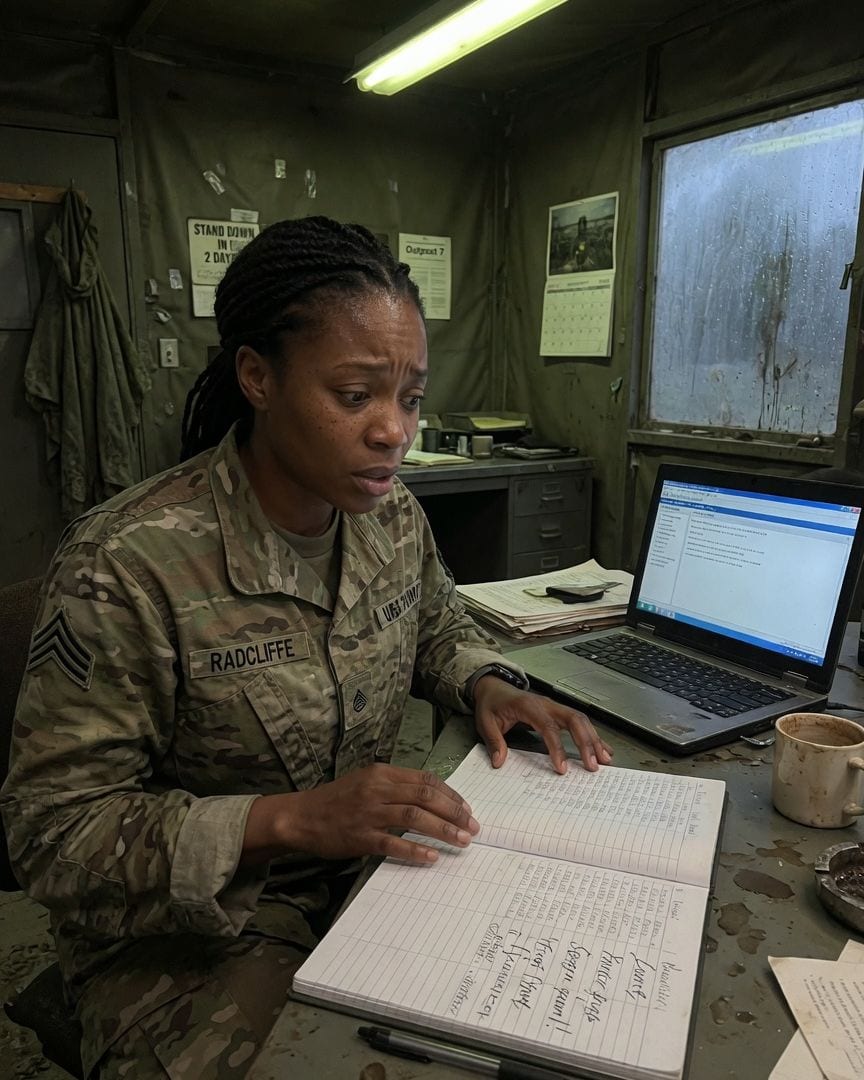
Two days before Outpost 7 closed, Staff Sergeant Radcliffe's roll call counted 42 men, but 43 voices answered.
Two days before Outpost 7 was set to stand down for good, Company First Sergeant Nora Radcliffe conducted her morning roll call. For three years, she had known all forty-two faces and voices by heart, but in the damp dawn air, a forty-third voice answered to a name not on her list. Back in her office, she found that same impossible name, 'Everett Lawson,' added to the official duty log in her own unmistakable handwriting. As the fluorescent lights hummed, her search of the digital personnel system revealed a skeletal record for Lawson, complete with a basic training certificate signed by her training officer—who had retired a decade before the certificate's date. What impossible truth had Nora stumbled upon as her outpost prepared to close?
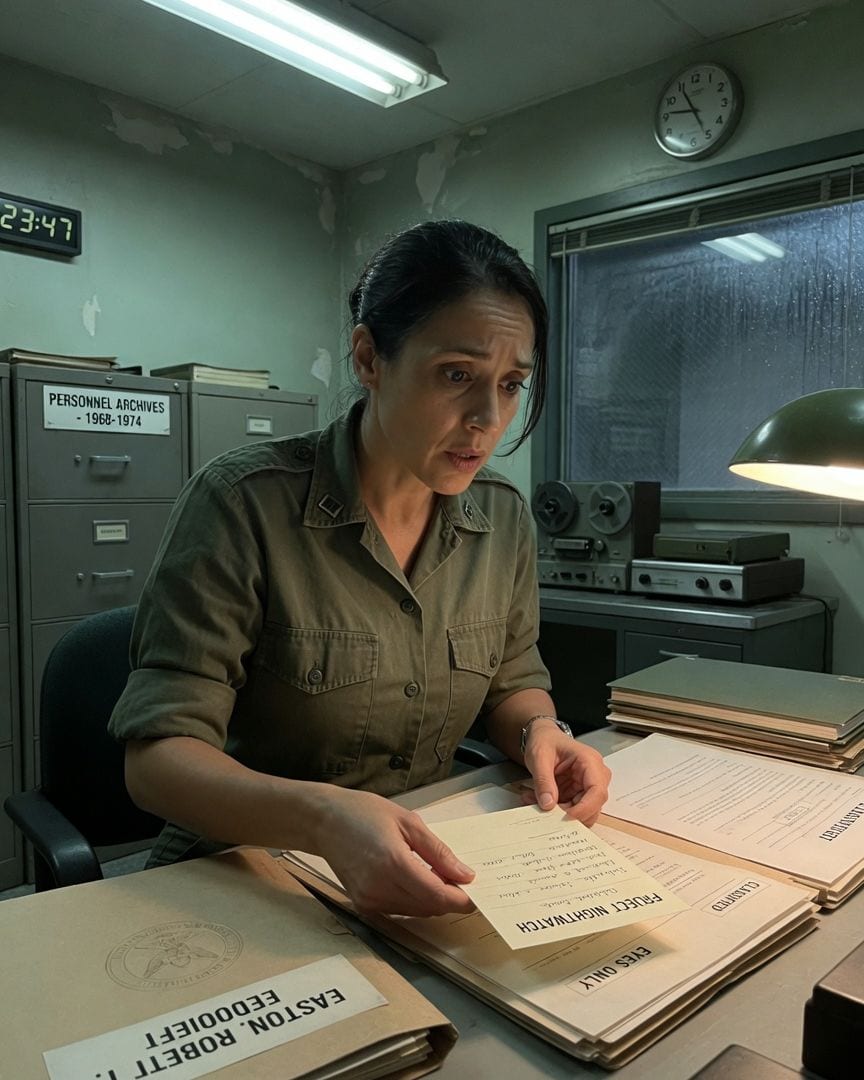
A Cold War tower controller logs an object vanish from radar, then hears the pilot scream it’s filling his windscreen. Her own name, 'Bardolph, Ines', now marked 'Observed' in a secret file.
Captain Ines Bardolph, a tower controller, was counting down the months until her transfer to Langley and the decommissioning of her base, hoping to leave behind the unsettling incidents of her final posting. But one night, her radar scope showed an impossible blip, solid and unwavering, 40 miles north of the Danube, only to vanish in less than a second, leaving a pilot screaming in terror. Despite the clear evidence, the official report blamed "atmospheric inversions," while the terrified pilot received a glowing review and promotion, his file meticulously scrubbed of any anomaly. As Captain Bardolph reviewed the pilot's pristine record, she found a hidden slip of paper, revealing a chilling truth: 'Subject: Bardolph, Ines. Status: Observed.' Was she merely an observer of the impossible, or was she now part of something far more sinister?
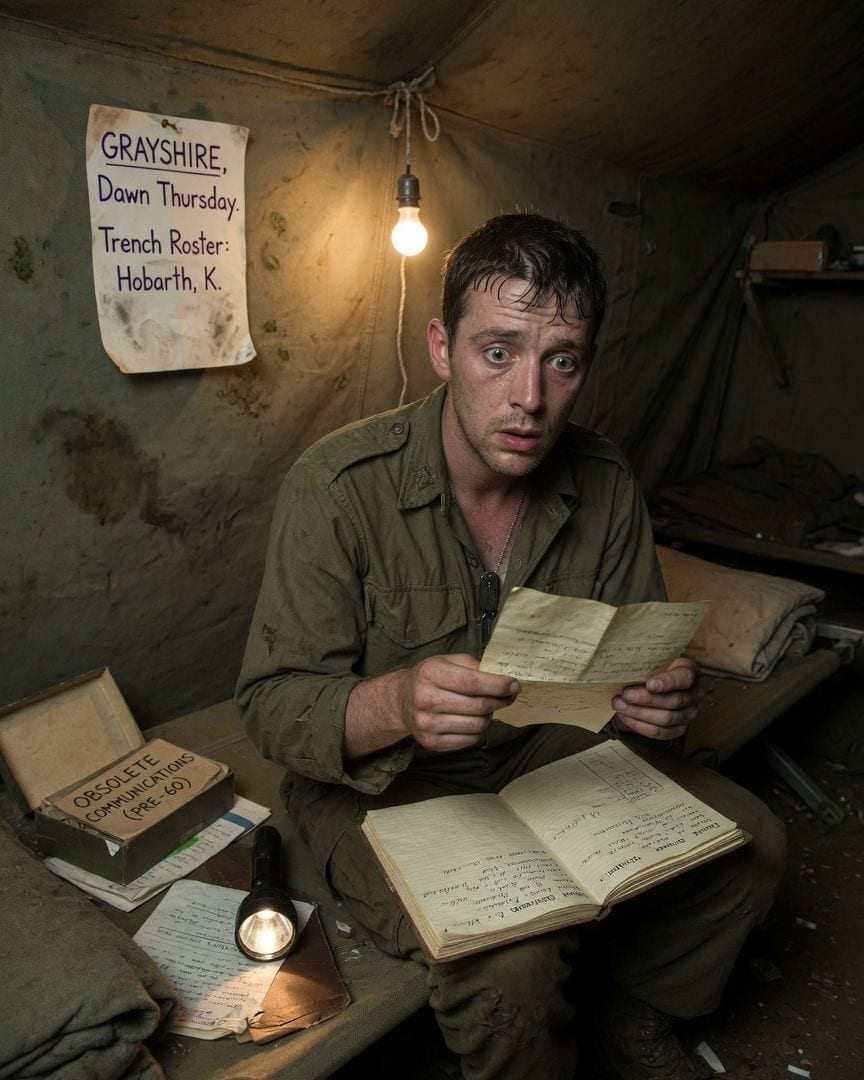
A records clerk's old logbook entry shows his service number for 'Personnel Observation' on a date that hasn't arrived, for an event he saw last week.
Private Kell Hobarth clutched the letter confirming his daughter Frances' birth, a bittersweet reminder of a world far from the Vermey Flats trench tent. He'd seen a mysterious roster entry for 'GRAYSHIRE' and been dismissed by his superior. But then, a silent, vast pulse of white light turned his tent transparent for a full minute, yet every man around him slept through it. Haunted, the records clerk searched the dusty annex archives, finding a leather logbook. Inside, his own service number was listed for 'Personnel Observation' on a date that had not yet come, for the very event he had already witnessed.
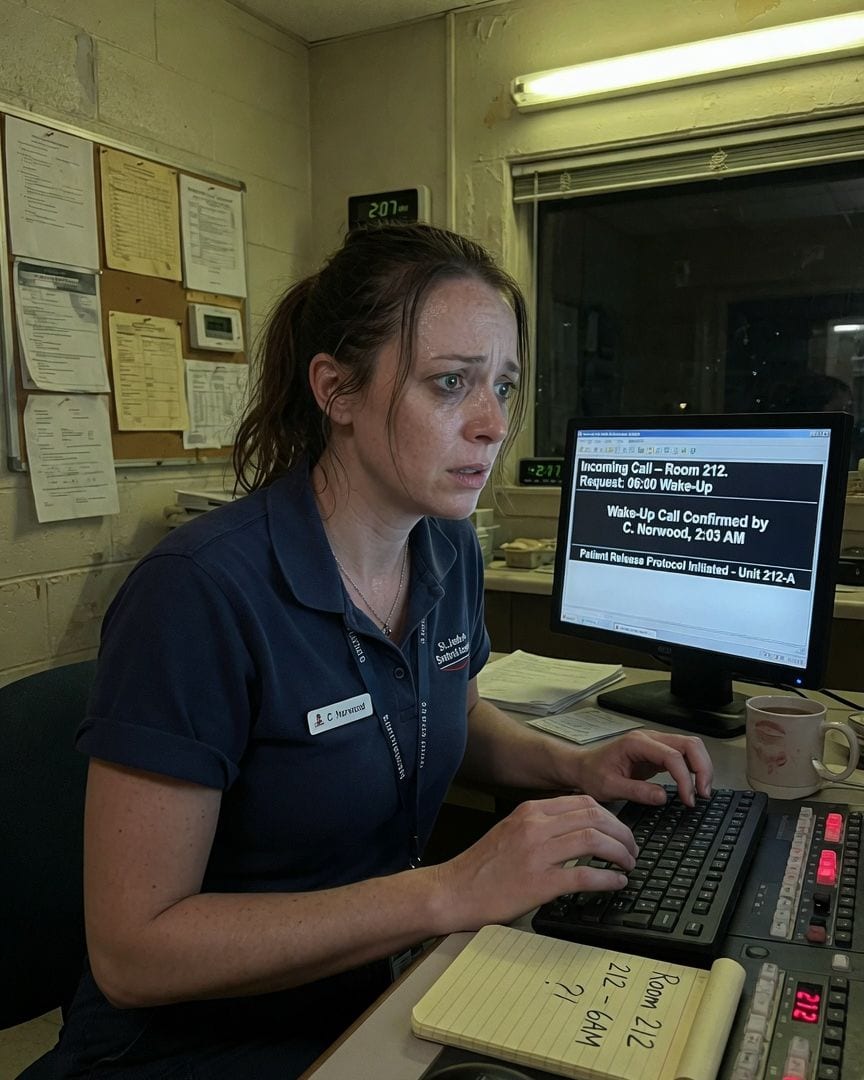
My login started a 'Patient Release Protocol' I'd never heard of for Unit 212-A.
Working the quiet night shift switchboard at St. Jude's, I took a routine wake-up call from Room 212. But the system showed Room 212 had been stripped bare and its phone line disconnected for months. Then, my own login showed I had confirmed the impossible call.
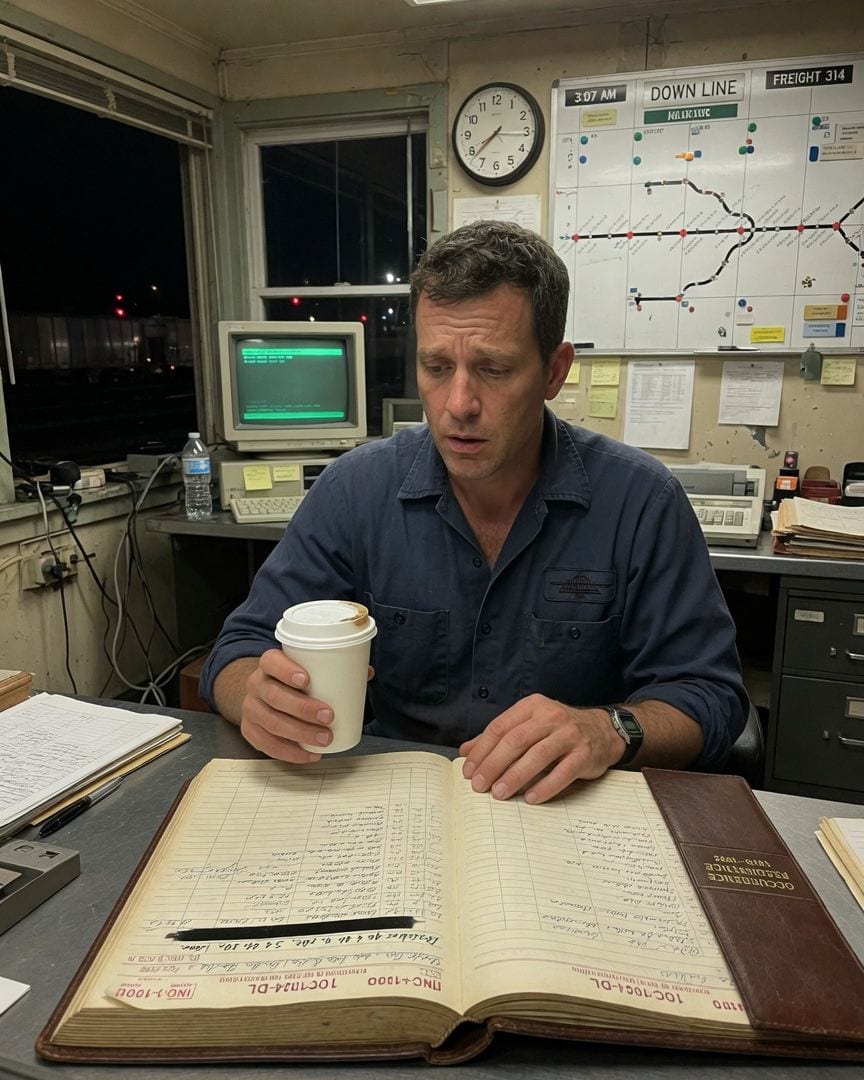
My new colleague's face is identical to a woman in a 1958 archive photo. She was declared 'the woman on the down line' for decades.
Working my solitary shift in the signal box, I found a blacked-out entry in the old occurrence register. It noted 'the woman on the down line' and the instruction 'do not stop.' This same strange entry, word-for-word, recurred every October 4th, back through the years from 1988. It felt like a chill in the routine, a silent dread in a book of transient events.