Two days before his company stood down, a staff sergeant heard a Cold War phantom voice answer roll call. Then his computer showed a single, dark, unblinking eye.
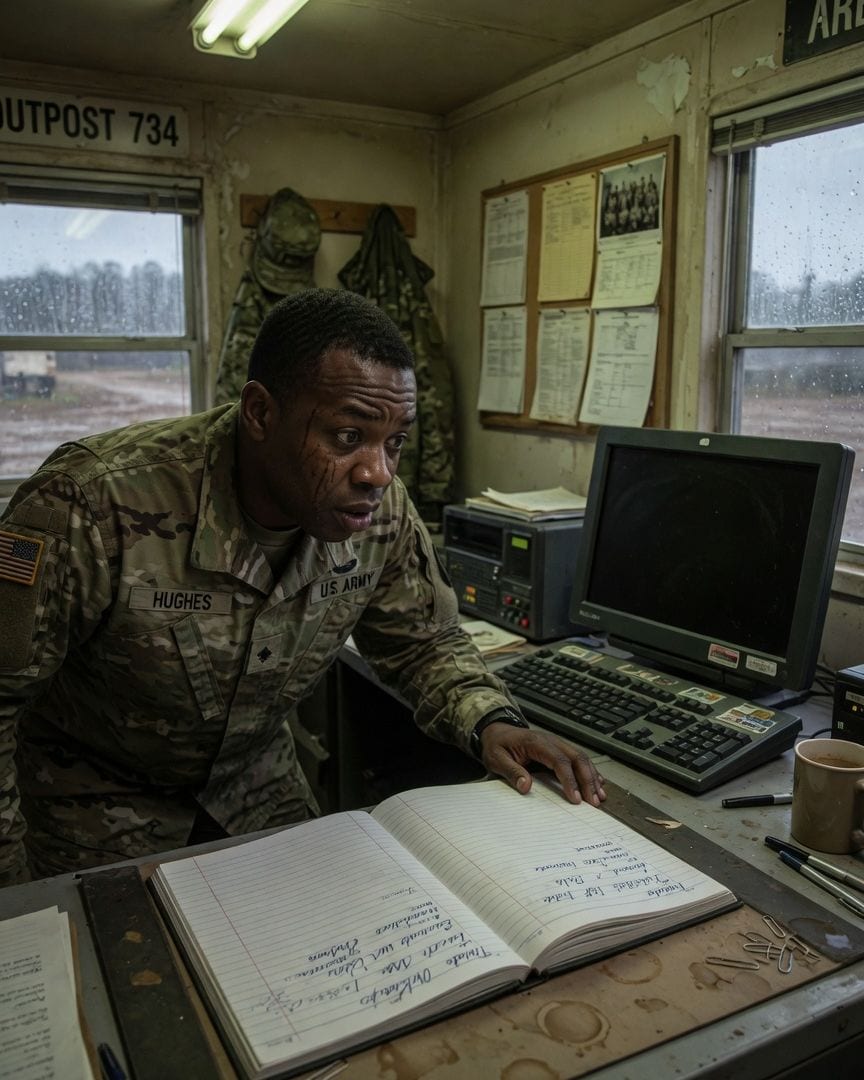
The gray dawn broke wet and cold, two days before the company stood down. Rain from the night's storm still dripped from the eaves of the barracks, and the muddy parade ground sucked at their boots.
Staff Sergeant Okonkwo called the same roll she’d called for three years, her voice crisp despite the chill. Forty-two names, forty-two faces lined up in neat ranks. Preston Hughes, Staff Sergeant, stood in the third rank, watching the routine unfold.
He’d seen this formation a thousand times, knew every man by the sound of his answer. Today, though, something shifted.
“Perez!” “Here, Staff Sergeant!” “Quinn!” “Here, Staff Sergeant!” “Roberts!” “Here, Staff Sergeant!”
The rhythm was off. Okonkwo paused, her head cocked, brow furrowed. She glanced down at her clipboard, then back at the formation. Her lips pressed into a thin line. Preston felt a prickle of unease.
He counted the men ahead of him. Forty-two. Exactly.
“I’m going to run that again,” Okonkwo announced, her voice tighter now, edged with an unfamiliar strain. The men exchanged glances. This was unprecedented. She started from the top. Every name was called, every man answered.
The mud squelched beneath their feet as they shifted, growing restless. Then, the same wrongness. A voice, clear and distinct, chimed in, yet seemed to emanate from nowhere specific. “Everett Whitmore!” Preston’s head snapped up.
No one in the ranks was named Whitmore. He scanned the faces, but every man looked as confused as he felt. The voice was familiar, though—a deep baritone, like one of their own, but not attached to any visible mouth.
Okonkwo’s face had gone pale. She ran the roll a third time. Same result.
Forty-two names, forty-three answers, and each time, that phantom voice, "Everett Whitmore," emerged from the damp air, leaving a chilling silence where its physical source should have been.
Her eyes, wide with disbelief and quiet horror, darted across the formation, searching, failing, finally settling on the gray, empty sky.
The incident rattled Okonkwo, leaving her pale and withdrawn for the rest of the day.
Preston Hughes, a rational man by nature, tried to dismiss it as nothing more than fatigue, perhaps a collective hallucination brought on by the pre-dawn darkness and the lingering storm.
Maybe the men were just messing with her, though that seemed out of character for the company, especially with decommissioning so close. But Okonkwo’s distress was too profound to ignore.
It clung to her like the camp’s pervasive dampness, seeping into the atmosphere of the office they shared. He decided he needed to do a discreet check.
Later that afternoon, after Okonkwo had left for a meeting, Preston sat at her desk. He found the morning’s duty log still lying open on the blotter.
He picked it up, his gaze scanning the neatly written entries, each name accounted for, each signature confirming presence. And there, tucked between 'Private Williams' and 'Specialist Zola,' was an entry that shouldn't exist.
Clearly written in blue ink, in what looked like Okonkwo’s neat hand, was ‘Everett Whitmore.’ There was no rank specified, just a generic 'Pvt.' written beside it, no service number, no unit designation, nothing else.
Below it, Staff Sergeant Okonkwo’s familiar, looping signature, confirming the roster.
Preston felt a cold knot tighten in his stomach. He’d seen her write reports for years. Her hand. He put the log back down and waited for her return.
When she walked in, pulling off her patrol cap, he pushed the log gently across the desk. “Staff Sergeant,” he said, keeping his voice even. “About this morning. And this.” He pointed to the name. Okonkwo glanced at the page.
Her eyes widened, and the color drained from her face again. “What is that?” she whispered, a genuine tremor in her voice. “I… I never wrote that name. I swear.”
She reached for the log, her fingers brushing the paper as if it were contaminated. “I signed off on the forty-two men present. This… this is impossible.” Her lie, if it was one, was unconvincing. Her fear was too real.
Preston didn't press. He logged into the digital personnel system, a secure terminal humming quietly in the corner of the office. He typed 'Everett Whitmore' into the search bar.
The system churned, the cursor blinking, then displayed a partial, corrupted file. It showed a name: 'Everett Whitmore.' A generic rank, ‘Private.’ And then, an impossible deployment date: March 12, 1983. Assigned to this very outpost, Outpost 734. Forty years ago.
The name of the commanding officer who signed off on the deployment was 'Walter Yates.' Preston’s rational explanation, the one he’d been clinging to, shattered. This wasn’t fatigue. This wasn’t a prank. This wasn't a clerical error.
The computer screen, usually a placid rectangle of green and black, seemed to hum louder, the fluorescent lights above flickering almost imperceptibly.
Preston tried to access more details of the ‘Everett Whitmore’ file, attempting to cross-reference it with other records from that distant deployment. He navigated through the system, selecting options, his fingers moving quickly, almost instinctively.
The computer screen flickered violently, a storm of static blooming across the display. The hum from the tower intensified, sounding like something trapped, buzzing against its casing.
For a split second, amidst the digital noise, a single, unblinking eye, impossibly dark and still, materialized in the center of the screen, staring directly out at him. It was an eye without a pupil, just a void.
Then, with a sharp crackle that made Preston jump, the screen went black, plunging the office into a deeper gloom.
He was alone in the dim room, the image of that impossible eye seared into his mind, the name ‘Everett Whitmore’ echoing in the sudden, heavy silence.
Shaken, Preston Hughes reported the computer glitch to IT, citing a power surge from the earlier storm.
He kept the unblinking eye to himself; even to his own ears, it sounded like a breakdown, a symptom of too many late nights. He couldn't, however, shake the impossible deployment date—March 12, 1983—to this very outpost. It gnawed at him.
With the company standing down in less than forty-eight hours, the entire base was a hive of activity, old archives being prepped for transfer or destruction. Hughes saw his chance.
He used the impending decommissioning as cover to dig deeper, to find a mundane, physical explanation for the digital ghost.
He found a dusty, forgotten storage room in the oldest sector of the base, tucked behind the old mess hall.
It was choked with physical logbooks, filing cabinets overflowing with yellowed reports, and boxes marked with faded dates stretching back decades. The air was thick with the scent of aged paper and dust, settling like a shroud over everything.
Among the clutter, he located a brittle, leather-bound unit logbook from the very period 'Everett Whitmore' supposedly deployed—the early 1980s. He pulled it from a shelf, the dry leather crumbling slightly at his touch.
Flipping through its yellowed, brittle pages, Hughes felt a chill climb his spine. He found the name: 'Everett Whitmore, Private, Duty: Perimeter Patrol.' The entry was dated March 12, 1983.
But the handwriting around the name was subtly different from the rest of the page, the ink a shade darker, as if added later by a different hand, pressed with more force. It stood out, stark and anomalous.
As he continued to pore over the meticulous records, he noticed faint, almost erased mentions in the margins of other pages from that era: 'unexplained additions,' 'phantom counts,' 'discrepancies in muster.'
These were usually followed by scrawled notes from various officers, dismissing them as 'fatigue,' 'bad accounting,' or even 'pranks by bored recruits.' He meticulously noted the recurring names and dates, tracing the faint marks like a detective.
He realized that 'Walter Yates,' the commanding officer from the corrupted digital file, was a prominent figure during that period, his confident signature appearing frequently throughout the logbook, sometimes right next to these strange, anomalous entries.
The pattern was beginning to form, a thread pulling him further into the outpost’s hidden, unsettling history.
Hughes's frequent trips to the archives did not go unnoticed. Staff Sergeant Okonkwo, finding him sifting through old files in the dim, forgotten room, pulled him aside abruptly, her face etched with a new kind of worry.
Her voice was low, urgent, barely above a whisper. "Hughes, you need to let this go. Some things are better left buried, especially at this place."
Her eyes darted nervously around the empty, cavernous hallway, as if expecting to be overheard by the dust motes dancing in the weak light. "This outpost… it has a history. Not the kind they write in reports.
Not the kind they want anyone to know." She wouldn't elaborate, but her fear was palpable, a cold wave washing over Hughes.
He felt a prickle of annoyance at her evasion, but the raw edge in her voice silenced his questions.
Later that night, back in the quiet of his barracks, the conversation with Okonkwo replayed in his mind.
He couldn't shake the strange feeling the old logbook had given him, the way the air in the archive room had seemed to press in, making his skin crawl.
He logged into a secure terminal, a routine habit, to check his own service record. He just needed something normal, something quantifiable, to ground himself.
As the data loaded onto the screen, a cold dread, worse than anything he'd felt in the archives, washed over him.
There, nestled between his legitimate commendations for good conduct and marksmanship, was a new, impossible entry: a valor citation for an action he never took, dated a day he was on leave, nowhere near the action described.
The details were specific, chillingly precise, yet utterly false. And the signature—a stylized, almost illegible scrawl—belonged to a commanding officer he'd never served under. Hughes stared at the screen.
The signature matched the partial one he'd seen on the corrupted 'Everett Whitmore' file, the same one attributed to Walter Yates in the digital record.
Someone, or something, was not just watching his investigation; it had left a calling card directly in his official history, a blatant, impossible alteration to his own life. The barracks room suddenly felt too small, the walls pressing in.
Preston Hughes confronted Okonkwo first thing the next morning. He found her at her desk, organizing final transfer papers, and without a word, laid his own impossible service record printout on the scarred metal surface.
His hand trembled slightly as he pointed to the phantom commendation. “This isn’t real, Staff Sergeant. I never earned this. I was on leave that day.
I never served under this CO. But the signature… it matches the one on a ghost file I found for a Private Whitmore from forty years ago.”
Okonkwo stared at the paper, her usual composure crumbling like dry earth. Her lips, usually set in a firm line, softened with disbelief. She ran a hand over her face, scrubbing at her eyes.
“I knew you wouldn’t let it go,” she murmured, her voice laced with an old, weary resignation. She pushed her chair back, the scrape of metal on concrete echoing in the tense silence of the office.
She stood, walked to a locked footlocker in the corner—a personal one, separate from the company’s—and pulled out a battered, unmarked ledger.
Its cover was faded canvas, its pages thick and yellowed, even older than the unit log Hughes had found.
“For years, Hughes,” she said, her voice low, almost a confession. “For years, I’ve seen them. Names that appear and vanish. Entries that shouldn’t exist. Reports that make no sense, but always, always tied to this outpost.”
She opened the ledger, revealing pages filled with a dense, meticulous handwritten list, column after column of names, dates, and cryptic notes. “This is my ghost roster.
Every impossible name, every strange date, every phantom deployment I’ve ever found in official records, all connected to this outpost. I started it when I realized the pattern.” She pointed to a series of entries, her finger tracing a line.
“Look. ‘Everett Whitmore.’ He’s been on and off the books half a dozen times since the 80s, sometimes as a Private, sometimes as a Specialist, sometimes just a name without rank.
The pattern is always the same: an ‘extra’ appears, usually during roll call, or a duty roster, usually when a unit is about to stand down or rotate out.” Her finger moved down the page, highlighting names from different decades.
“And then, within weeks, a real soldier from that unit… they just vanish.
Officially transferred to an ‘unknown unit,’ or declared AWOL, but their service records are often… pristine, like they were never here, or like they were always meant to be gone. Cleaned.”
She slammed the ledger shut, the sound sharp and final in the small room. “They fill a slot, Hughes. An account that needs to be balanced. It’s an old debt.”
The air in the office grew suddenly colder, and the ceiling fan above them seemed to whir with a new, grinding sound, like an old machine struggling.
Okonkwo reopened her ghost roster, her finger trembling slightly as she traced a line near the bottom of the last page, the ink still fresh.
“The last one I found,” she whispered, her voice barely audible, “just a few weeks ago, when we got the stand-down orders.” Hughes leaned closer, his heart pounding in his chest, a frantic drum against his ribs.
The entry, written in Okonkwo’s neat, precise hand, read: ‘Staff Sergeant Malcolm Hughes – Transferred, unknown unit.’
Malcolm Hughes. His older brother. Preston’s breath hitched. Malcolm had vanished from active service five years ago, officially listed as AWOL, though Preston always believed he’d been killed in action, that it was a cover-up.
And Malcolm’s last known assignment, the one Preston had always been told was classified, was this very outpost. The connection snapped into place, cold and brutal.
Okonkwo looked up, her eyes wide with a terrible, absolute certainty, reflecting the fluorescent glare from above.
“The extra always appears when a unit is about to stand down,” she repeated, her voice barely a whisper now, as if speaking a sacred, dreadful truth. “And someone disappears to fill the account for the next cycle.”
Her finger moved one line down from Malcolm’s name, to a blank space on the page. Then, with deliberate, slow strokes, she wrote: ‘Staff Sergeant Preston Hughes?’ She capped her pen, and added a chilling, solitary question mark.
The silence in the room screamed.
Preston knew, with a certainty that froze his blood to ice, that the extra voice during roll call wasn't just an anomaly; it was the outpost itself, asserting its claim, and his name was next.
The question mark next to his name, chillingly precise on Okonkwo’s ghost roster, solidified everything for Preston. He and Okonkwo stood in the hushed office, surrounded by the echoes of that revelation.
The ‘extra’ wasn’t merely an addition to a roll call; it was a replacement mechanism, a placeholder for a unit that never truly stood down.
The outpost wasn't just a place where anomalies happened; it was the anomaly, a localized phenomenon that acted as an 'accountant' for an eternal, phantom 'unit.'
This entity manifested as an 'extra' presence in organized military formations, creating impossible records that subtly influenced official documentation.
The extra voice during roll call, the impossible records like ‘Everett Whitmore’s’ deployment and Preston’s phantom commendation, the vanished soldiers – all were part of a monstrous, coherent pattern spanning generations.
‘Everett Whitmore,’ the name from the roll call, from the corrupted digital file, from the old physical logbook, was merely a recurring placeholder, a 'slot' that had been filled and refilled over decades, ensuring the 'unit' is always complete.
Malcolm hadn’t gone AWOL; he’d been ‘accounted for’ by the outpost, his service record wiped clean to fit the narrative, his name now just another entry on Okonkwo’s grim ledger.
The ‘unit’ wasn't made of flesh and blood, but of an eternal, insatiable accounting, drawing in actual personnel to fill its phantom ranks whenever a human unit prepared to disband.
The dread wasn't just about an extra man answering roll call; it was about an entire system, a silent, unseen bureaucracy that had been operating beneath the military's meticulous facade for decades, and they were caught inside its final calculation.
The very air in the office seemed to vibrate with a low, almost imperceptible hum, like a distant engine running tirelessly.
With the outpost hours from official decommissioning, a frantic urgency gripped Hughes and Okonkwo.
Armed with their service pistols, the only defense they could conceive against an unseen enemy, they made their way to the oldest, most abandoned sector of the base.
The air grew unnaturally cold, heavy with a silence that swallowed their footsteps, amplifying the crunch of their boots on fallen debris.
From deep within the crumbling structures, a faint, distorted roll call echoed, a chilling whisper of names, listing entries from Okonkwo’s ghost roster: ‘Everett Whitmore’… ‘Sergeant Thomas’… ‘Private Rodriguez’… and then, unmistakable, ‘Malcolm Hughes.’
The names seemed to hang in the air, each one a phantom, a ghost.
They found a hidden entrance to an ancient, sub-level record room, a forgotten space deeper than any blueprint showed, concealed behind a sagging wall panel.
Inside, dust motes danced in the single beam of Hughes’s flashlight, illuminating shelves of decaying ledgers, towering almost to the low ceiling. A chill seeped into the room from unseen cracks, making the hair on Preston’s arms stand on end.
On a stone table in the center of the room, stark and unsettling, an old, faded duty log lay open. Hughes reached for it, a terrible premonition tightening his chest.
As his fingers brushed the yellowed page, the ink began to subtly shift and reform, a slow, viscous crawl of black on paper.
The names on the log, including his brother Malcolm’s, began to blur, their letters merging, twisting into a new, composite name that seemed to hum with an unholy, silent energy.
Then, at the bottom of the list, he saw his own name, ‘Preston Hughes,’ begin to materialize, faint at first, then growing bolder, the ink bleeding into the fibers of the page.
The air grew heavy, pressing in on him, and he felt a distinct, chilling pull, a sense of being meticulously ‘accounted for,’ of being indexed and filed away.
“No!” Okonkwo screamed, her voice raw with terror, pulling him back with all her strength, her grip like iron on his arm. “It’s claiming you!” They stumbled backward, scrambling from the room, their boots slipping on the uneven stone floor.
The heavy, ancient door slammed shut behind them with a deafening thud that shook the very ground, sending a plume of dust cascading from the ceiling.
The distorted roll call was now muffled, but still echoed, a ghostly, persistent beat, from within the sealed stone.
The company stood down without incident. Okonkwo and Hughes were among the last to leave the decommissioned outpost, their faces grim, their secret unspoken, a heavy weight between them.
They reported nothing of what they’d witnessed, knowing the futility of trying to explain the impossible. The outpost was sealed, marked for demolition, its hidden record room now buried beneath tons of earth and concrete.
Preston Hughes’s service record remained clean, no impossible entries, no phantom commendations, as if the entity had simply erased the anomaly once its purpose was fulfilled, or perhaps, once he had escaped its immediate grasp.
But he knew, with a cold certainty, that his name had been etched, however briefly, onto that eternal ledger, onto that phantom roster.
Okonkwo kept her ghost roster, carefully hidden, now with a final, chilling entry on the last page: ‘Outpost 734 – Accounted For.’
The dread lingered, a quiet hum beneath the surface of their returned lives, a constant reminder of the unseen forces that had almost claimed them.
Years passed. Preston Hughes left the service, haunted by the outpost. He built a quiet life, moving away from anything military, trying to forget the shifting ink and the unblinking eye. But the memory never truly faded.
Sometimes, a distant siren or the sight of an old military document, even a faded photograph, would send a chill through him, reminding him of the unseen accounting that continued somewhere, always.
He never spoke of it, not to his wife, not to his closest friends. It was his burden, his ghost.
One afternoon, years later, while visiting a small, regional military museum on a whim—a lapse in his self-imposed avoidance—he paused before a framed, sepia-toned photograph of a unit from the 1980s.
The soldiers were lined up, stiffly smiling in their uniforms, a tableau from another era.
In the back row, slightly out of focus, stood a man whose uniform was just a shade too clean, too perfect, his face subtly, unnervingly blank, his eyes too dark, too still.
It was the face from the split-second static on the screen, the impossible eye, now fully formed and staring out from the past.
A small, brass plaque beneath the photo listed the names of the unit members, each one engraved with military precision.
Below the last name, etched almost invisibly, was a faint, extra name, 'Everett Whitmore.'
If this one got to you
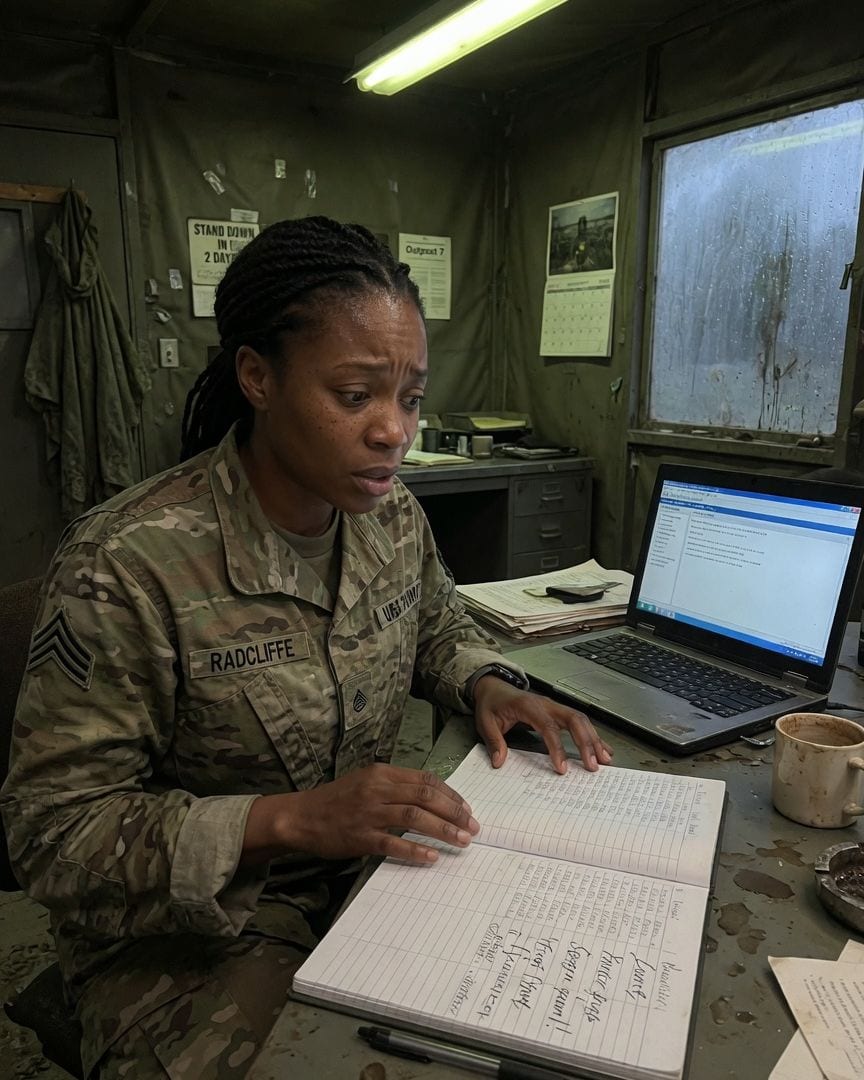
Two days before Outpost 7 closed, Staff Sergeant Radcliffe's roll call counted 42 men, but 43 voices answered.
Two days before Outpost 7 was set to stand down for good, Company First Sergeant Nora Radcliffe conducted her morning roll call. For three years, she had known all forty-two faces and voices by heart, but in the damp dawn air, a forty-third voice answered to a name not on her list. Back in her office, she found that same impossible name, 'Everett Lawson,' added to the official duty log in her own unmistakable handwriting. As the fluorescent lights hummed, her search of the digital personnel system revealed a skeletal record for Lawson, complete with a basic training certificate signed by her training officer—who had retired a decade before the certificate's date. What impossible truth had Nora stumbled upon as her outpost prepared to close?
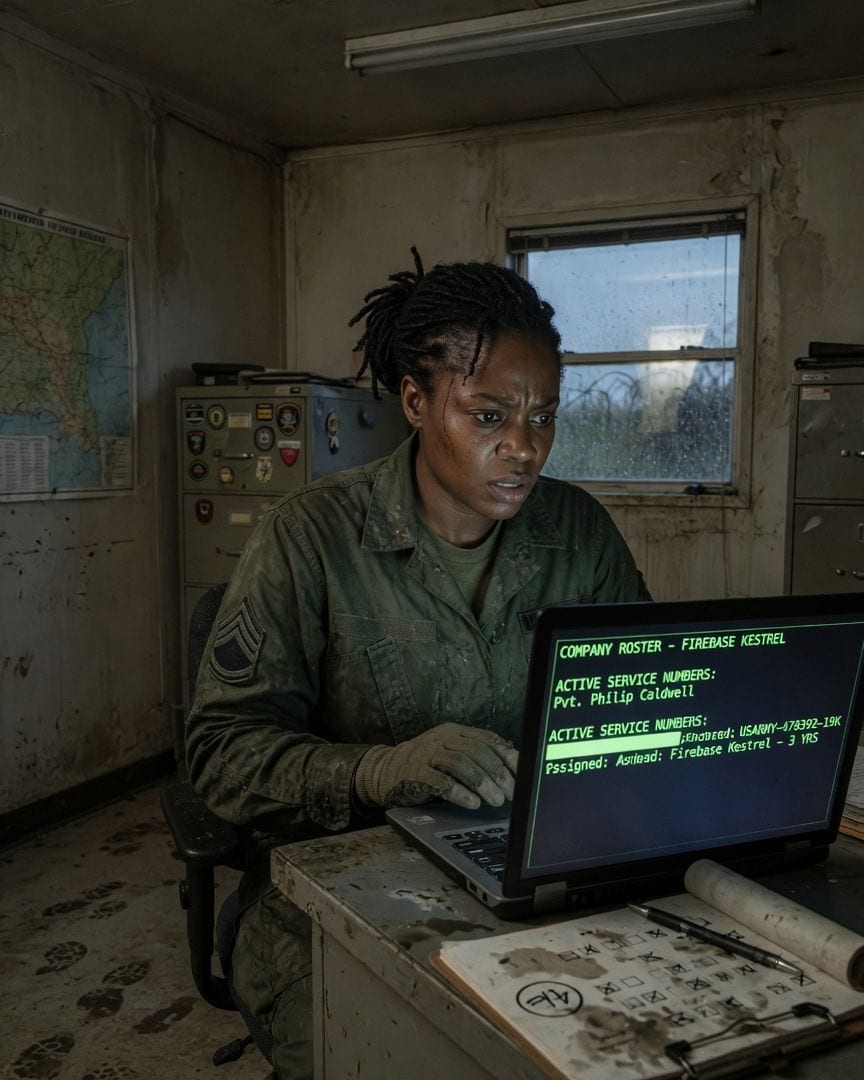
Two days from closing Firebase Kestrel, Staff Sergeant Okonkwo called roll for 42 men. A voice she knew answered a name not on the list.
Staff Sergeant Christine Okonkwo stood before her company in the gray dawn, just two days from finally standing down Firebase Kestrel after three long years. She called the familiar roll for forty-two battle-hardened men, each name etched in her memory, until a deep, resonant voice answered a name not on her roster. Forty-two men, forty-three answers, the voice unmistakably clear and close, yet from nowhere she could pinpoint. As she later traced an unfamiliar boot print in the mud and found a blank entry with an active service number in the digital manifest, a profound, cold dread washed over her. The system, designed for absolute accountability, had a void she’d unknowingly overlooked for years.
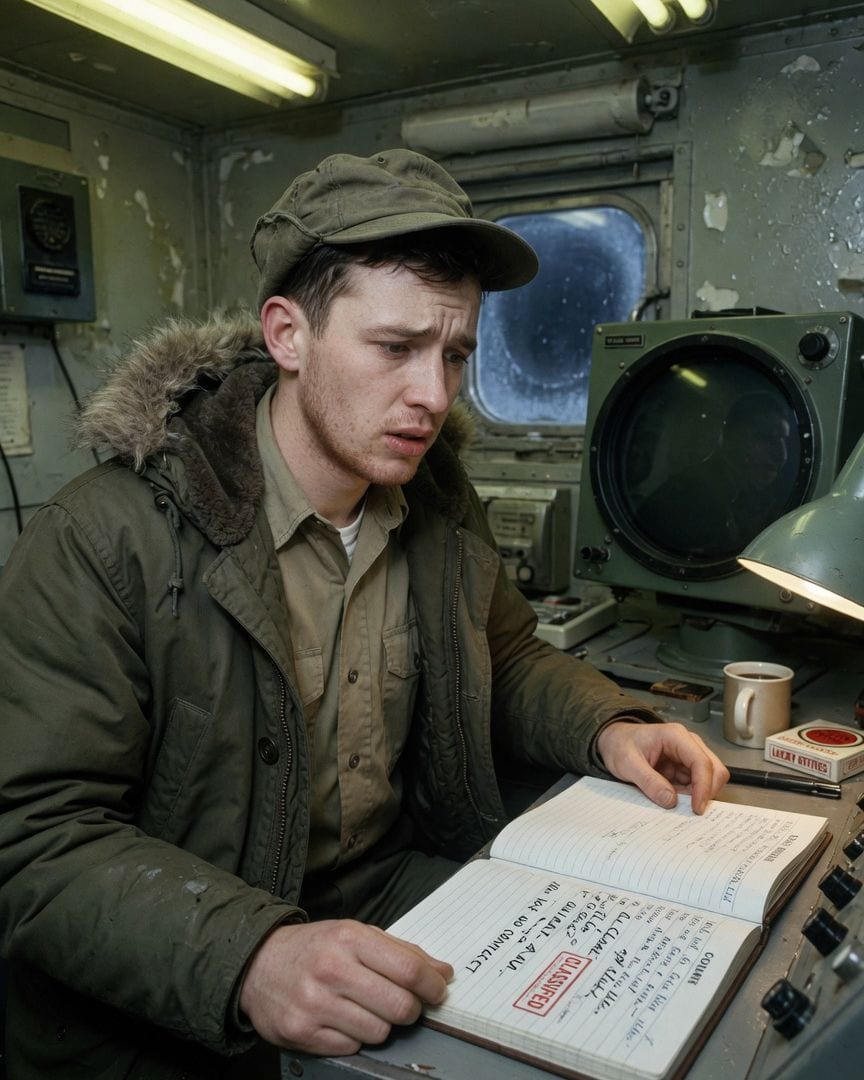
A Cold War airman logs an impossible radar contact on his last sweep. But his official logbook entry is stamped 'CLASSIFIED' and then contradicted by a hastily scrawled 'ALL CLEAR' dated moments before it.
Airman Ordway Vance, 22, manned the radar dome at Site Pellin in the biting North Atlantic dark of January 1962, running the last calibration sweep before its decommissioning. His scope picked up a faint, impossible return, growing closer with each pass, though the ocean remained empty to the eye. When Vance detailed the contact in his official logbook, a 'CLASSIFIED' stamp appeared, followed by a hastily scrawled 'ALL CLEAR' dated moments before his own entry, contradicting his every word. Commander Hartley dismissed it as equipment malfunction, but Vance sensed a chilling, official erasure behind the lie. He soon found a locked cabinet marked 'SITE PELLIN ANOMALIES,' hinting at a deeper truth buried within the base's final days.
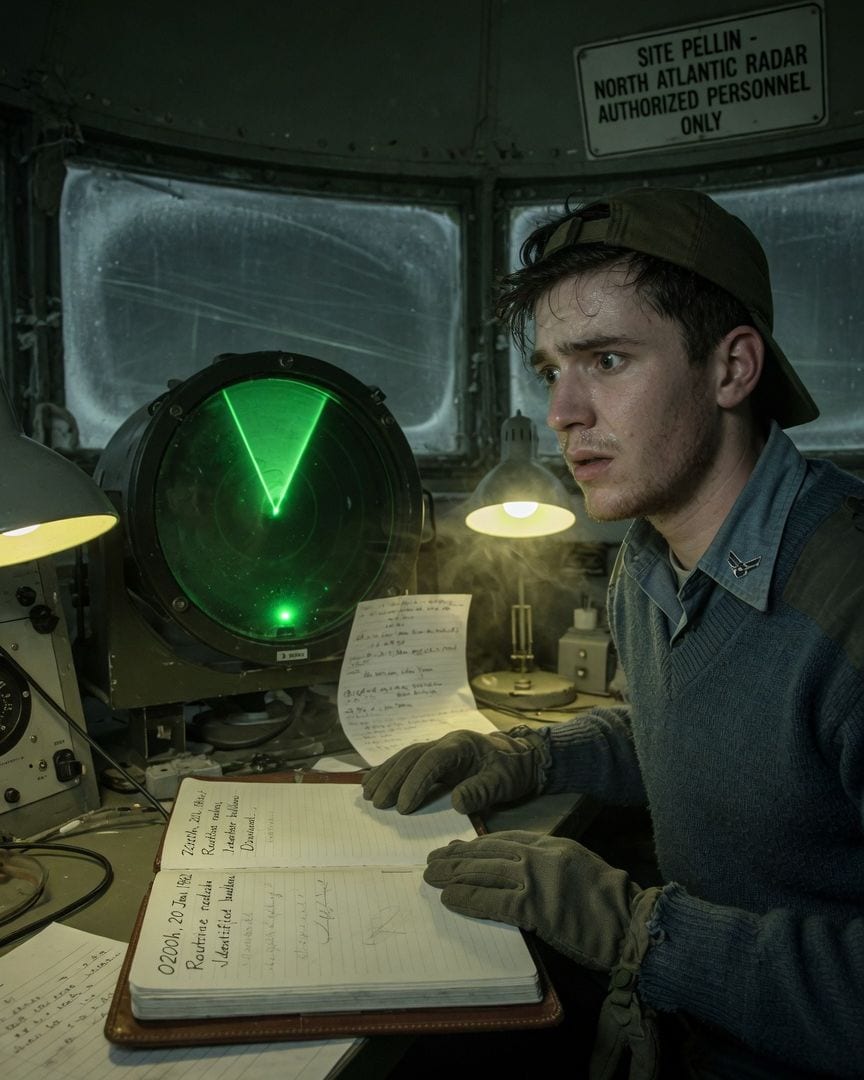
Nine days from closing, Cold War Site Pellin's Airman Vance watched his radar track a solid blip moving closer, dead in open sea where nothing could exist.
In the dimly lit dome of Site Pellin, Airman Ordway Vance, just days from discharge, ran his final radar sweeps before the base closed for good. Outside, the North Atlantic wind howled, but inside, only the hum of his console broke the silence. His last calibration had been clean, yet a single, unwavering green blip appeared on the scope, forty miles out, in open water where no vessel should be. The impossible return moved closer with each sweep, defying all logic and other sensors, until it sat static just beyond the coast fence line. What unseen presence did the radar truly hold in its unwavering green grip, contradicting the official record?
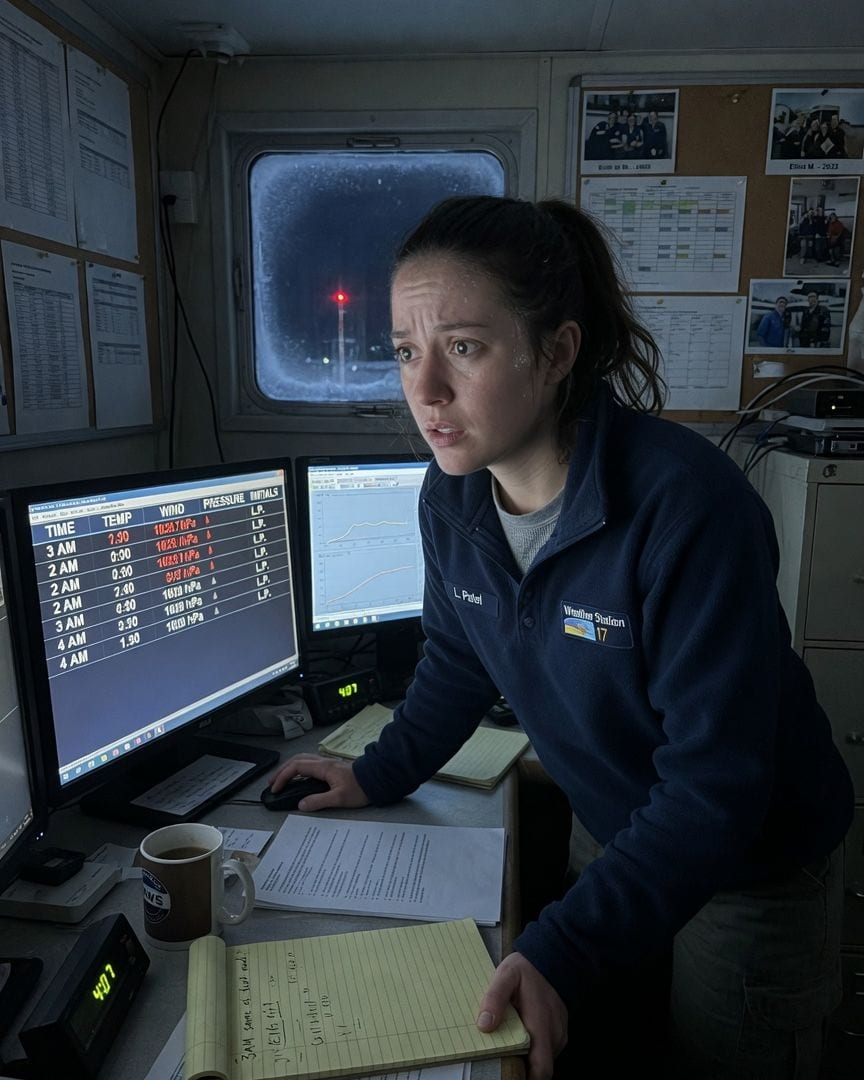
My weather station's 3 AM log shows a pressure reading I never made. My initials are on it, but the dials were dead still.
Working the overnight shift at the remote weather station, I routinely checked the digital logs. The 3 AM entry showed an impossible barometric pressure spike, a hurricane that simply hadn't happened. I distinctly remembered being outside at that time, calibrating a sensor, not making that entry. Yet, my initials, L.P., were clearly logged next to data I never made.
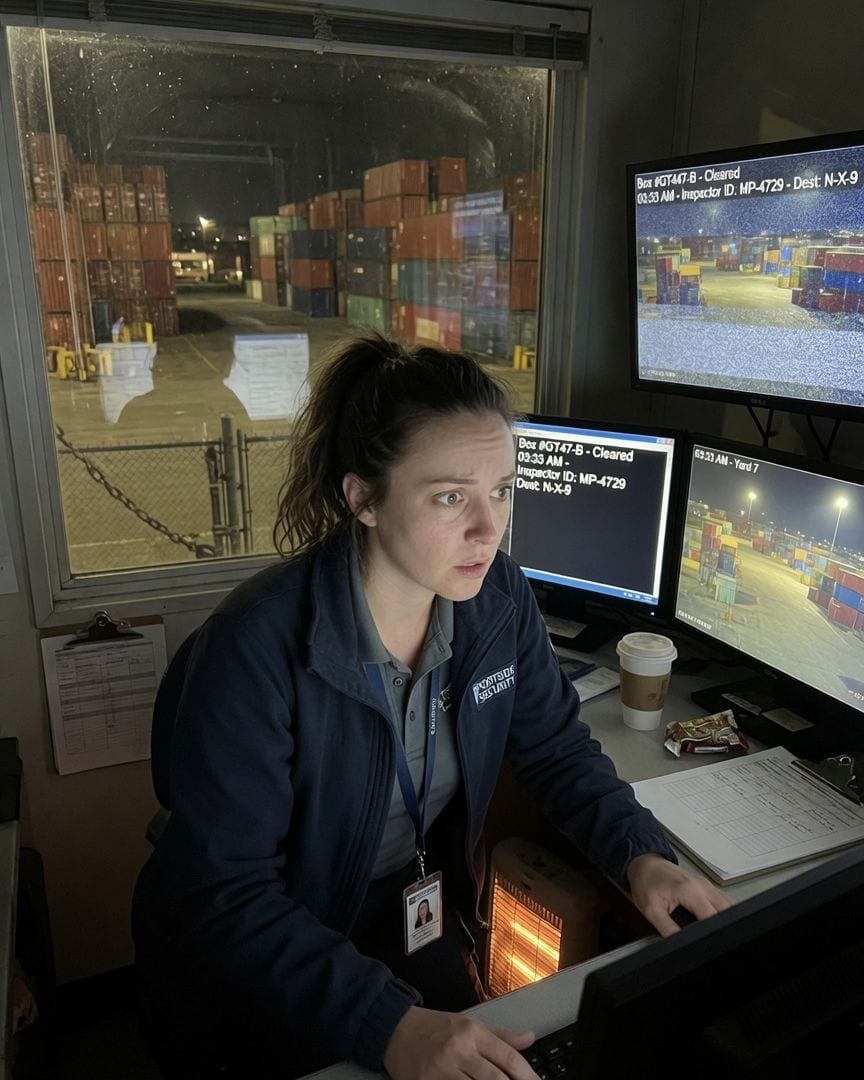
The log says a container cleared my gate at 3:33 AM, stamped with my ID — but the gate was chained and locked, and the yard beyond it was dark and empty. No truck was ever booked.
My night shift at Portside Container Terminal is usually a predictable drone of monitors and stale coffee. But then I saw a familiar guard, Arthur Larsen, on a live feed, smiling unsettlingly at the camera. The next morning, my supervisor searched for him; the employee database returned 'No results found.'