The log says a container cleared my gate at 3:33 AM, stamped with my ID — but the gate was chained and locked, and the yard beyond it was dark and empty. No truck was ever booked.
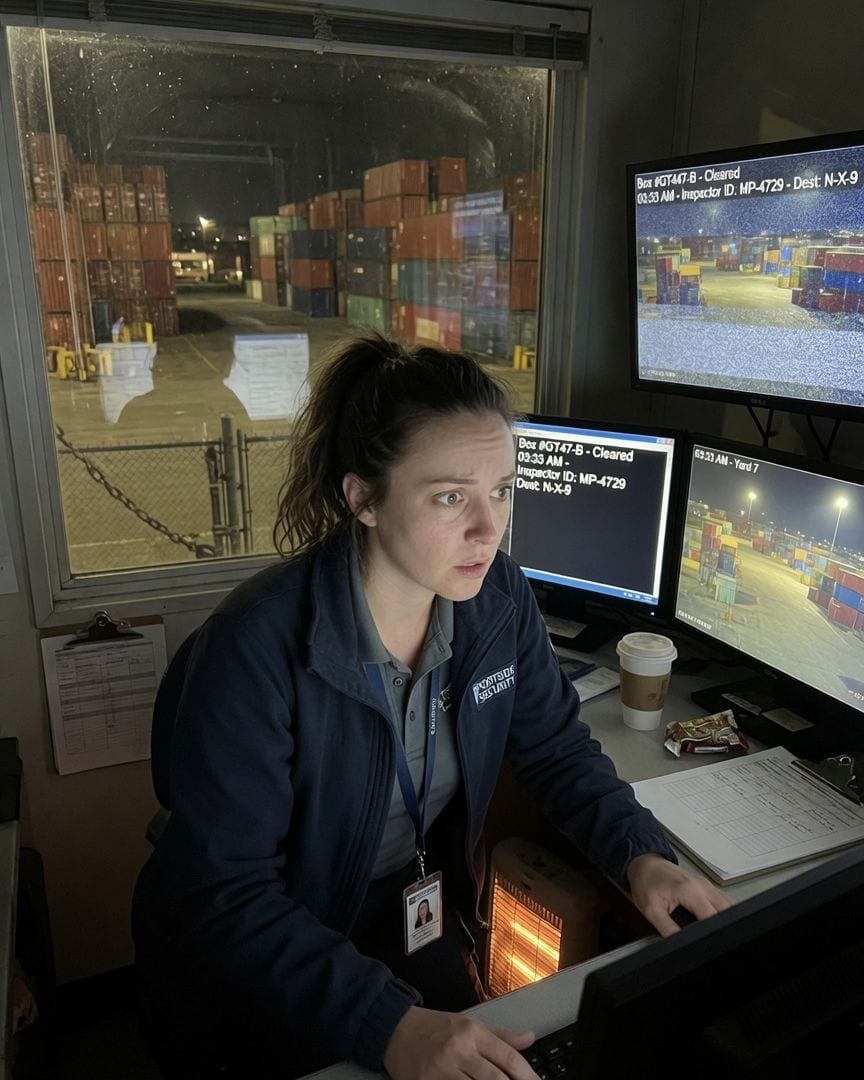
The drone of the terminal was usually a kind of lullaby. A steady hum of electricity, the distant clang of metal on metal, all part of the night shift at Portside Container Terminal.
My small booth was my world, lit by the glow of monitors, the air thick with the smell of stale coffee and disinfectant.
I was Megan Porter, 32, night gate guard, and nothing much ever happened between 2 AM and 5 AM. The main gate was locked down then, no scheduled departures or arrivals.
So when the new log entry blinked on my screen, my brow furrowed. Box #GT447-B, cleared at 3:33 AM. Stamped with my inspector ID.
It was impossible. The gate was secured, a heavy chain wrapped around the twin steel arms. I’d seen it with my own eyes at 2:00 AM, heard the satisfying clunk of the padlock.
The entire yard beyond the gate had been dark, silent, empty of any outgoing traffic. I’d been half-dozing, head on my arm, waking every fifteen minutes to check the feeds out of habit. No truck had moved.
I pulled up the security camera feed for that specific time. The screen flickered, then resolved into a grainy image of the main gate. Nothing. Just a blank, static-filled shot of the locked barrier.
The camera for Yard 7, which covered the main exit approach, was just as bad – a hazy, snow-like picture. I clicked to the physical gate status report. It showed 'Locked. Secure.'
My breath hitched. I checked the crane’s move log. A single entry. Box #GT447-B, lifted off Stack 12, exactly 3:33 AM. The system confirmed it. A cold draft curled around my ankles, despite the heater blasting in the booth.
It felt like the air itself was trying to contradict the digital record. The log was real, undeniable. But physical reality, the one I lived in, insisted it was a lie. I refreshed the screen, a stupid, hopeful gesture.
The entry just sat there, glaring back, a solid, tangible falsehood.
I spent the next hour scrutinizing the phantom log. The box number, GT447-B, was standard, a dull string of alphanumeric characters. But the destination code, 'N-X-9', was utterly unfamiliar.
I knew every port, every major client, every regional hub code by heart. 'N-X-9' wasn’t one of them. I tried cross-referencing it with the official shipping manifest database; nothing.
It wasn’t a standard port, not a known client, not even a regional code I could pull up a match for. The database just blinked, 'Entry not found.'
Frustrated, I zoomed in on the virtual map of Stack 12, the supposed origin of the phantom container. The map showed a grid of stacked metal boxes, dormant under the night lights.
Then, on one of the yard’s live feeds, a figure moved. A man, walking slowly between the towering containers. He wore a faded, dark jacket, the kind some of the older guards favored.
It was Arthur Larsen. I’d seen him around on other night shifts, a quiet, almost spectral figure. He never said much, always seemed to be just... there.
I could never quite place his face, never remembered his exact role, but he was familiar. He paused near where GT447-B was supposedly stacked. He turned his head, slowly, deliberately.
He looked up, directly at the camera I was watching, the one mounted high on the pole near Stack 12. A faint, unsettling smile touched his lips, a slow, knowing curl that didn't reach his eyes.
Then he turned, disappearing into the labyrinth of steel boxes, leaving me with a prickle on the back of my neck.
The next morning, I went straight to Nora Hayes, my supervisor. Nora, a no-nonsense woman with a permanent frown line between her brows, listened to my account of the phantom log and Arthur Larsen with a sigh.
"System quirks, Megan," she said, waving a dismissive hand. "Happens with these old systems. Probably a ghost entry from a deleted manifest. Don't worry about it. As for Arthur, I'm sure he was just doing his rounds."
"But the gate was locked, Nora. And my ID stamp was on it. And Arthur… he just seems different," I pressed, trying to convey the chill I’d felt.
Nora sighed again, reaching for her keyboard. "Alright, let's just make sure. Arthur Larsen, you said?" She typed his name into the employee database. The screen flashed. Then it displayed, stark and cold: 'No results found.'
Nora tried variations, checking for typos, even searching the full company directory. Nothing. "Are you sure about the name, Megan?" she asked, her voice tight, a flicker of something unreadable in her eyes.
I stared at the blank screen, the name I had just spoken hanging in the stale office air, knowing with a jolt of ice in my gut that the man I saw, the man who smiled at me from the camera feed, didn't exist.
Rattled, I spent my next shift not on gate duties, but buried deep in the terminal’s digital archives.
If Arthur wasn't on the employee roster, perhaps he was a contractor whose details were stored elsewhere, or maybe a phantom in the system itself, a glitch made manifest.
I started searching for his name, not in personnel, but in the general gate activity logs. It was a tedious process, sifting through millions of entries, looking for anything that might link to 'A. Larsen' or 'Arthur L.'
And I found them. Intermittently, almost buried beneath layers of legitimate data, partial, almost deleted entries. Always around the 3 AM hour, stretching back years.
Each entry was associated with an unusual destination code, similar to 'N-X-9' – codes like 'Z-0-4', 'M-J-7', 'P-V-1'. None of them matched anything in the current database. The dates formed an unsettling pattern: roughly once a month, for decades.
There was no truck ID, no cargo manifest attached, just the name, the time, and the impossible destination.
As I sifted through the digital detritus, I also noticed something else. A faint, metallic, almost burnt smell clinging to the air around Stack 12, the same area where GT447-B was supposedly lifted.
It wasn't there before, or at least, I hadn't noticed it. Now, it was a persistent, acrid tang that seemed to emanate from the very ground, a quiet, unpleasant stain on the familiar industrial scents of diesel and salt air.
It was faint enough that I could almost dismiss it as my imagination, a byproduct of late-night fatigue, but it was there, a sour, unsettling note in the hum of the terminal.
My fingers, driven by a growing unease, stumbled upon an obscure, unlabeled entry in the terminal's server directory: 'Yard 7 Archive.' It was an old file, neglected, probably forgotten.
Curiosity overriding caution, I managed to bypass the rudimentary security, a simple password no one had bothered to change in years. The feed began to work, flickering to life.
The footage was grainy, streaked with static, but it showed Arthur Larsen, clear as day, moving through the yard during the 3:33 AM incident.
He wasn't just walking; he was gesturing, as if directing an invisible truck, an empty expanse of asphalt before him. His movements were fluid, unhurried, almost balletic. Then he paused, his head turning.
He looked directly into the lens, his unsettling, blank gaze piercing through the static and the years. There was no smile this time, just an emptiness that felt like a punch to the gut.
The feed cut out abruptly, a burst of white noise filling the booth, leaving me staring at a blank screen, the silence that followed even louder.
A few minutes later, as the chill from the footage settled deep in my bones, I stood up to stretch. That’s when I saw it.
Taped to the inside of my booth door, where it hadn't been before, was a folded piece of paper. It was a plain, white note, handwritten in neat, block letters. My hand trembled as I peeled it off.
It read: 'Some things are better left unseen.' My breath caught in my throat. I was being watched.
I confronted Nora Hayes again, this time armed with printouts of the 'A. Larsen' log entries – the dates, the impossible times, the bizarre destination codes. I also held up the chilling note.
Nora’s dismissiveness faltered, her face paling slightly as she read the precise timestamps and the stark warning.
"These are... old system errors," she stammered, but her eyes flickered with something I hadn't seen before – not annoyance, but genuine unease. She wouldn't meet my gaze.
"System errors that involve a man who doesn't exist, Nora?" I pushed, my voice barely above a whisper, "And a warning note left in my booth, exactly when I started digging into those 'errors'?"
Nora sighed, running a hand through her hair, a gesture of exasperation that seemed to mask a deeper anxiety. "Look, Megan, I've been here a long time. There have been… incidents. Ghost entries. For decades. Always dismissed as quirks.
Or new guards getting spooked by the silence of the night shift."
"What about the guards who reported them?" I asked, a sudden chill creeping up my spine. "Did they just… get spooked and quit?"
Nora hesitated, her gaze darting away from mine, fixing on a spot just over my shoulder. The air in her office felt suddenly heavy, thick with unspoken things. "There was a Raymond Vaughn," she said, almost whispering, her voice strained.
"Night shift. Complained about similar things. Phantom logs. Figures in the yard. Said he saw things. Transferred out years ago. Said he needed a change of pace."
The way Nora avoided my gaze, the forced casualness of her tone, the way her hand still trembled slightly as she picked up a pen – it screamed lie. Raymond Vaughn didn’t transfer. Something happened. And Nora knew it.
I left Nora’s office, the word 'transferred' echoing in my head, a hollow sound. Back in my booth, I used my gate access credentials to dig into Raymond Vaughn. His personnel file was the first place I looked.
'File Corrupted,' the system flashed back at me. I tried again. Same error. It wasn't a glitch. Someone had deliberately made sure it couldn't be accessed.
I remembered the older, more obscure digital archives Nora had mentioned. A slower, clunkier system, but less often maintained, less often purged. After several attempts, battling ancient firewalls and deprecated file formats, a partial, fragmented file finally began to load.
It was mostly blank, corrupted data blocks filling half the screen. But one line, buried deep in a string of code, glowing ominously against the dark screen, caught my eye.
It wasn't a personnel record, not really. It was a log entry. Not for a container, but under Raymond Vaughn’s own inspector ID. The date was years ago, almost two decades, but the time… the time was 3:33 AM.
And the entry read: 'Box #GT447-B destination 'VOID' – personnel exit protocol initiated.'
The exact same phantom container number. The same impossible hour. But dated years ago. My blood ran cold. The record cannot be.
The full, horrific truth clicked into place with a sickening finality. Raymond Vaughn didn't 'transfer out'; he was the original 'personnel exit protocol'.
He was the one who logged Box #GT447-B years ago, and then he became part of the 'VOID' destination. Arthur Larsen wasn't just a ghost, not just some system error.
He was Raymond, or a manifestation wearing Raymond's semblance, now part of 'Whatever runs the night,' facilitating these grim transfers.
The terminal wasn't just moving containers; it was a gateway, a point of exchange where people who got too close to its operations were quietly replaced or simply vanished, their records scrubbed, their identities appropriated.
The metallic, burnt smell, the strange destination codes, the systemic 'glitches' – it all fit. Every impossible detail, every chilling coincidence, snapped into a coherent, terrifying whole.
This wasn't a shipping company; it was a funnel, operating in the dead of night, and I was the next potential 'transfer'.
I had to get out. Now. My heart hammered, a frantic drum against my ribs, each beat a warning.
I quickly snapped photos of the corrupted Raymond Vaughn log on my screen, the 'Yard 7 Archive' footage playing its silent, static-laced warning.
I pulled the 'Some things are better left unseen' note off my door and crumpled it into my pocket, my fingers shaking. My shift was technically ending, but I couldn't wait.
Every second I spent in that booth felt like another step closer to becoming just another corrupted file.
I grabbed my bag, throwing my phone inside, and bolted out of the booth. The main gate, which should have been locked and required my ID scan to open, was inexplicably open.
Not just ajar, but wide, the heavy steel arms pulled back as if inviting me out. The chain lay coiled on the asphalt, the padlock nowhere in sight.
Standing just beyond the gate, framed by the harsh yard lights and the black expanse of the night, was Arthur Larsen. He wasn't smiling. His face was a still, unreadable mask, his eyes like empty pools reflecting the industrial lights.
He simply watched me, his presence a heavy weight in the cold night air, an unspoken invitation or a final warning, I couldn’t tell which.
I didn't hesitate. I dropped my ID badge and my uniform jacket in a heap by the booth, a symbolic shedding of a life that was no longer safe.
I sprinted to my car, fumbling with the keys, my breath coming in ragged gasps. The engine roared to life on the first try.
I didn't look back as I peeled out of the terminal, leaving my entire life, my job, and what little remained of my sanity, behind me.
I reported my findings to the police, to a local journalist, even to a shipping oversight board.
The photos of the logs were dismissed as doctored, the 'Yard 7 Archive' footage deemed an old, unrelated security test, and my story, particularly the part about Arthur Larsen, was written off as stress-induced psychosis, a common affliction for night shift workers.
Nora Hayes confirmed I had 'resigned without notice' and was 'under a lot of strain.' No one believed me.
The terminal continued its operations, undisturbed, its gates opening and closing on schedule, except for those few hours in the dead of night. I never heard from Arthur Larsen again, but I never stopped looking over my shoulder.
I now work a quiet day job, far from any night shifts, far from shipping manifests or container terminals. I avoid anything that hums with industrial machinery. The sounds, the smells – they trigger something deep inside me.
But sometimes, late at night, in the quiet hours when the world seems to hold its breath, I hear a faint, distant grinding sound, like heavy machinery moving on unseen tracks.
I’ll glance at my phone, my thumb hovering over the screen, half-expecting a notification from a system I no longer belong to, a phantom log from a past I fled. I never get one, but the impulse remains.
The fear isn't gone; it's just quieter now, a low hum in the background of my life, a constant reminder of what I saw, what I learned, and what I escaped.
Her new colleagues sometimes comment on her habit. 'Megan, what are you looking for?' they'll ask, seeing her staring at her phone in the middle of the night. She just shakes her head.
Sometimes, she still catches herself checking her phone at 3:33 AM, waiting for a log that isn't hers.
If this one got to you
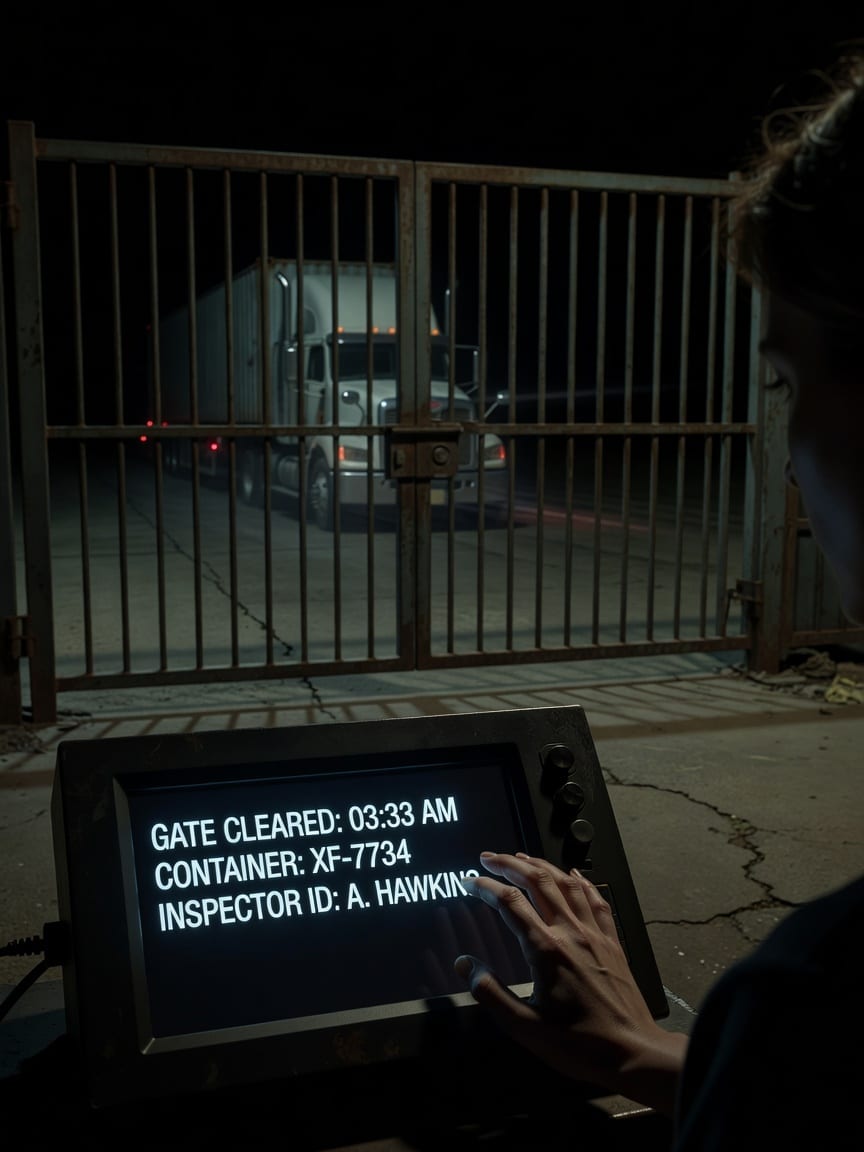
My gate log shows a container left at 3:33 AM, stamped with my ID. The yard was closed, the gate down, and I was asleep.
Audrey Hawkins' inspection log shows a container cleared at 3:33 AM, an impossible time when the gate was locked and no one was working. Her supervisor dismisses it as a glitch, but Audrey can't shake the specific details. Digging into old archives, she finds a handwritten ledger entry from 1974 for the exact same container, signed by a man who died half a century ago.
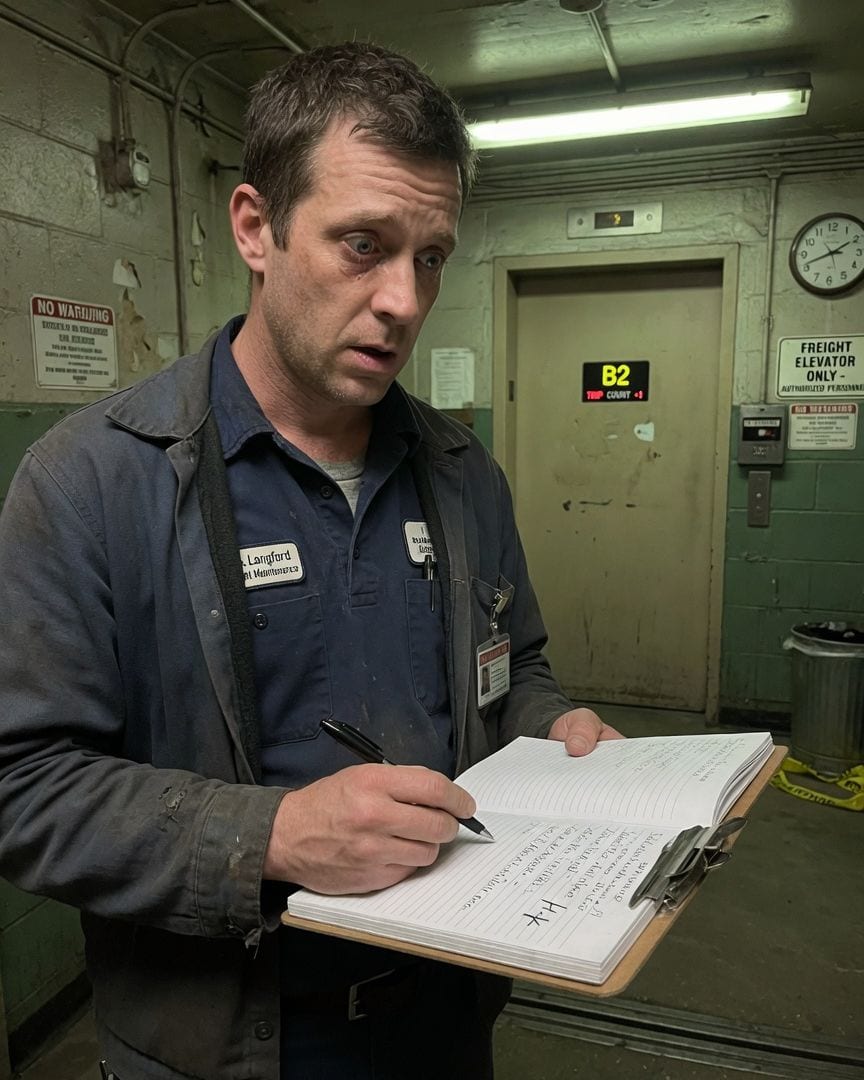
A man just took the elevator to the sealed sub-basement. He isn't on any staff roster, but my initials are in the logbook.
As a maintenance worker, my job is mostly routine, like signing the daily log for the old building's freight elevator. But one night, the log showed a trip to the sub-basement, sealed for a decade, timestamped with my key-switch and signed with my own initials, for a run I never made.
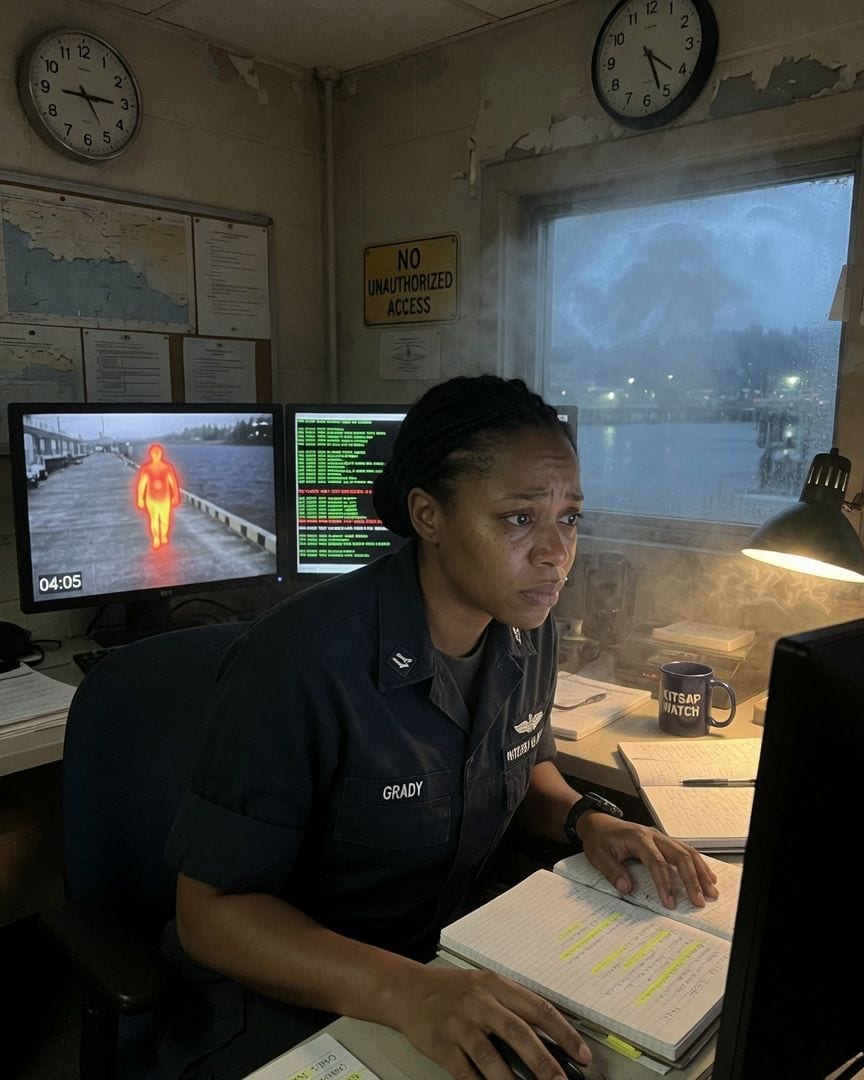
Petty Officer Olivia Grady found the base system logging impossible access at 0405. Every night for years, a blank ID walks Pier 7.
Petty Officer Olivia Grady stood her predawn watch on Pier 7, the cold mist of Puget Sound a familiar companion. Her routine scan of monitors at 0405 was shattered when an IR sensor flared with a man-sized heat bloom moving along the pier. Yet the camera feed showed only empty concrete and swirling mist. When historical logs confirmed the invisible presence had walked that exact path every night for years, Olivia dug deeper. She found a ghost "access log" entry with a unique ID but no name attached, meticulously aligned with the 0405 bloom. What impossible entity was the base system logging, night after night?
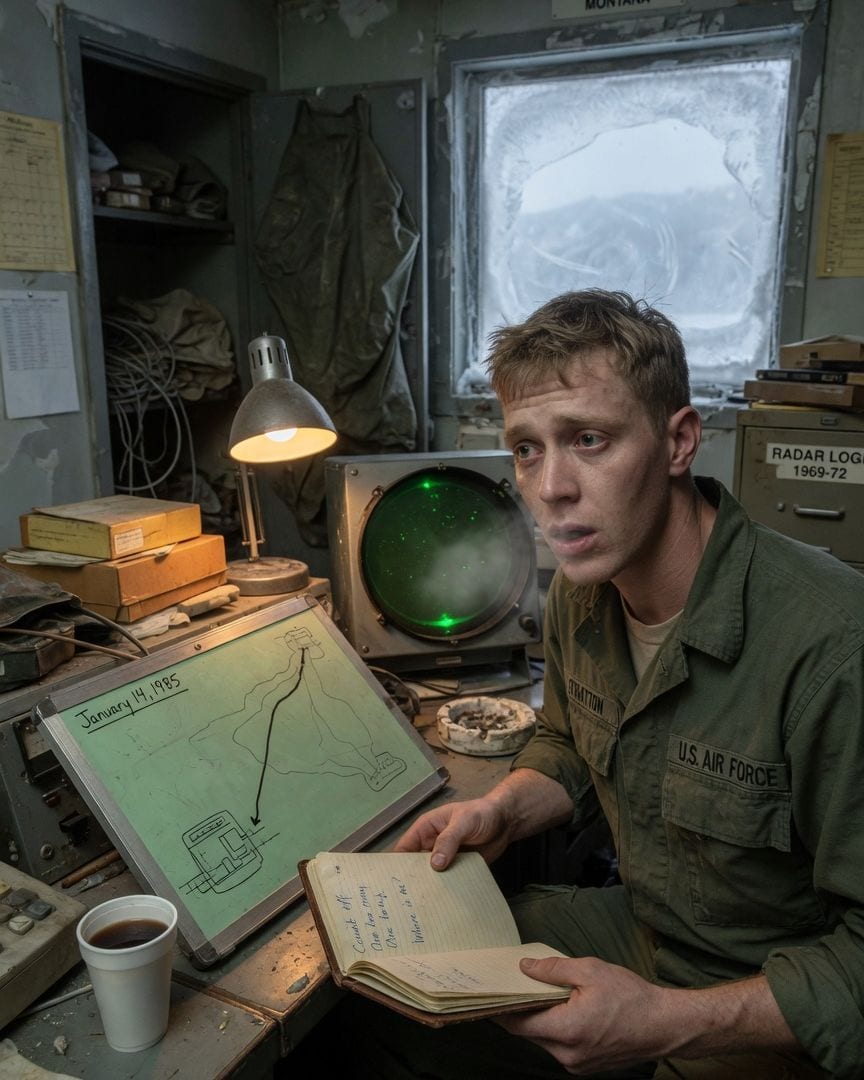
Airman Lars Stratton found an old Cold War manifest listing one name twice: 'Bernard Radcliffe' transferred and 'Bernard Radcliffe' still present.
Airman Second Class Lars Stratton was counting down his final weeks at Echo Station, a desolate Cold War outpost due for mothballing. He longed for home, far from the bitter Montana winds and the constant hum of static. Inside the dim radar shack, he logged the usual nightly ghost blip, a faint contact appearing at 2300, just as it had every winter since 1987. This night, a metallic tang like old blood lingered in the air, raising the hairs on his arms. Seeking distraction, Lars later discovered a leather-bound logbook from 1971, detailing the same 2300 contact, but with chilling notes and a manifest listing one airman's name, Bernard Radcliffe, twice—once transferred, once present. Was he truly alone in the silent, remote station?
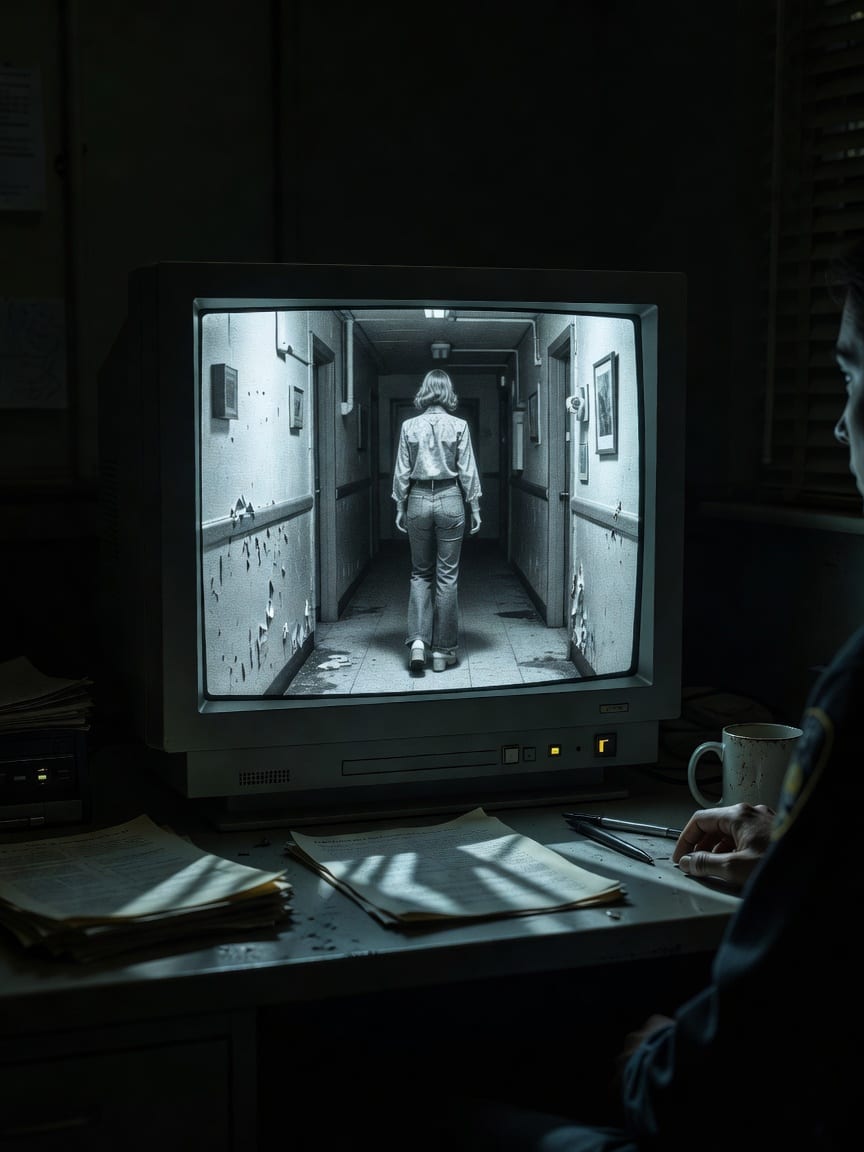
My intercom buzzed at 3 AM, a voice asking to step out for air. The station manager insists no one works the newsroom overnight, and no Cheryl is on payroll.
My shifts as the night security guard at WMVX are usually quiet, the TV station a tomb from 11 PM to 6 AM. But a late-night intercom call from a woman named Cheryl, who my manager says doesn't exist, was unsettling enough. The next night, my digital security log showed a new entry for 'Producer Cheryl Hartley'—a line I never typed, with details I couldn't have known.
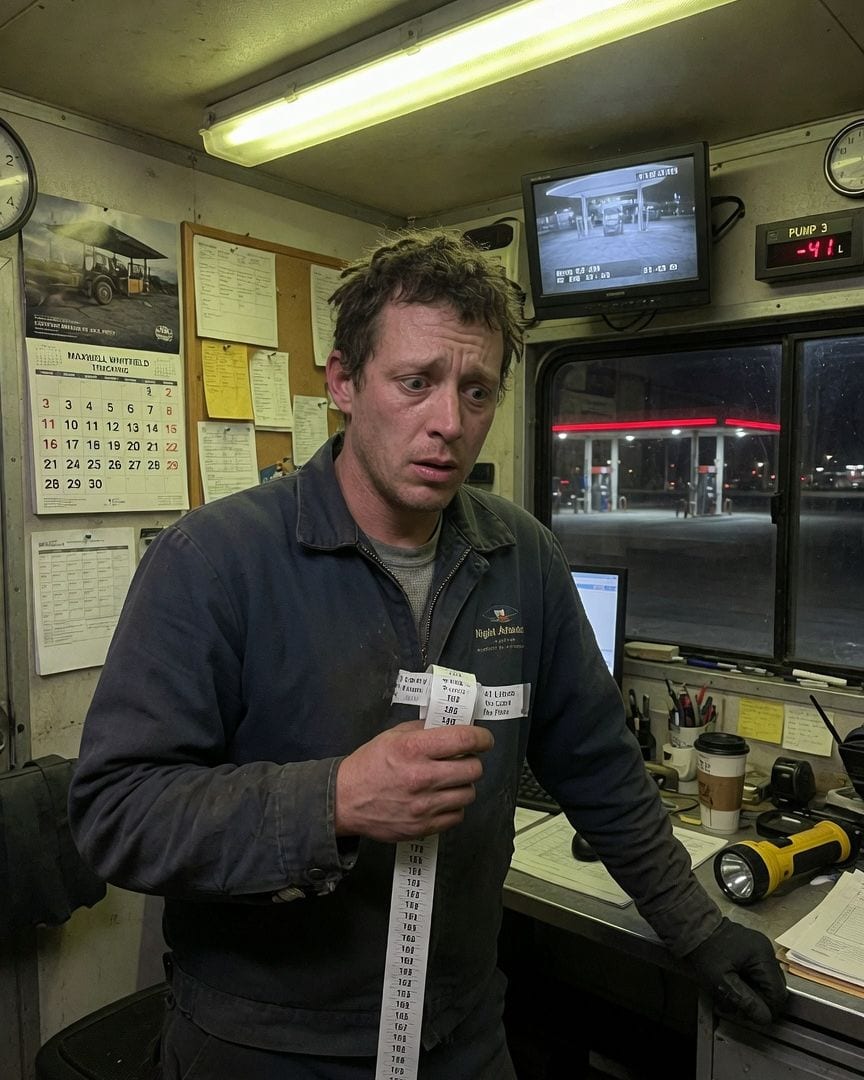
My fuel pump dispenses forty-one liters to nothing at 3:48 AM — and the nozzle was hung up and dry.
Closing out the truck stop for the night was a routine I'd done hundreds of times. But last night's totalizer tape showed an impossible entry: 41 liters dispensed from Pump 3 at 3:48 AM, with no card or plate. When I checked, the pump was dry, the ground empty, yet the tank gauge confirmed the fuel was gone.