Petty Officer Olivia Grady found the base system logging impossible access at 0405. Every night for years, a blank ID walks Pier 7.
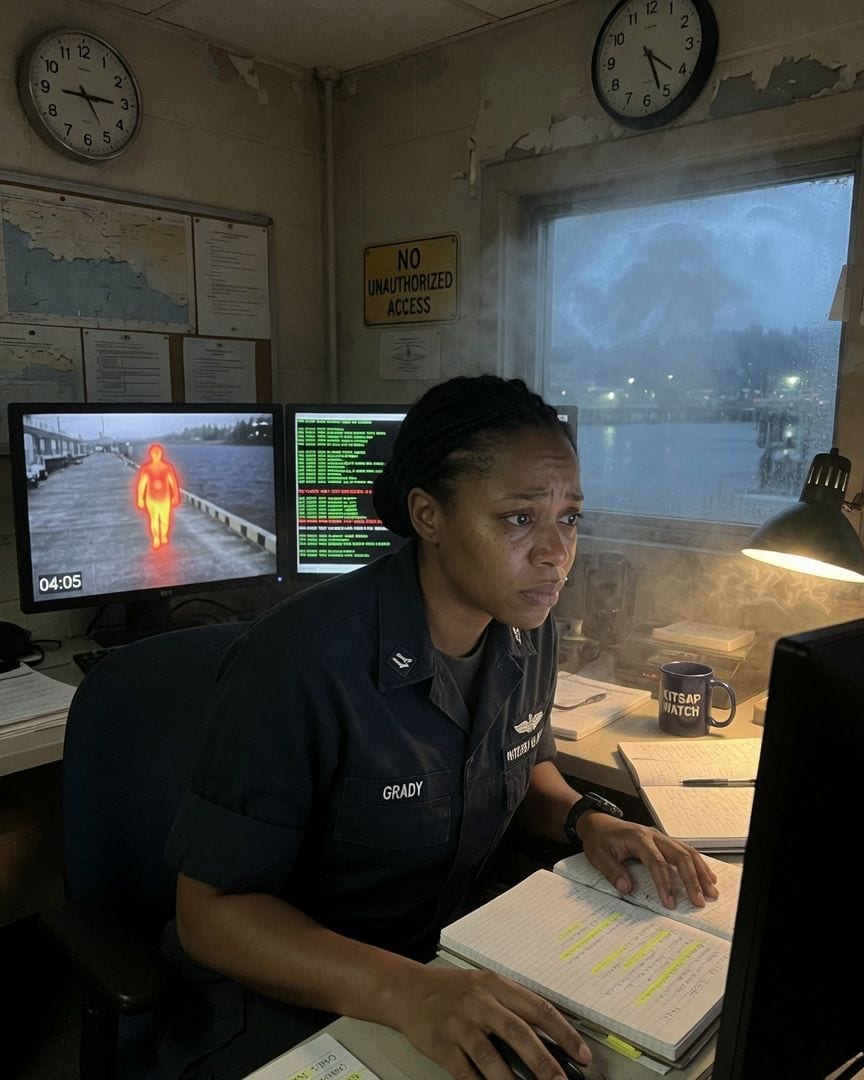
Petty Officer Olivia Grady stood her watch on Pier 7 at Naval Base Kitsap-Bangor, the predawn mist clinging to the caissons.
The air was cold, damp with the breath of the Puget Sound, a familiar chill that usually meant nothing more than the tide coming in. Her eyes, tired but sharp, scanned the monitors, a routine she knew by heart.
At precisely 0405, the IR sensor feed from the far end of the pier flared. A man-sized heat bloom, distinct and clear, moved along the caisson's edge, tracing a path toward the water.
It was too fluid, too defined to be an anomaly; it moved with purpose. Olivia frowned, her finger already moving to cross-reference the watch camera.
The camera feed, aimed at the exact same span, showed only wet concrete and swirling mist. Nothing.
She rewound the thermal feed, played it again. Same bloom, same path, like an invisible walker. "Steam line," she muttered, reaching for the comms to call maintenance, but the thought died on her lips.
The pier's main steam line, running directly beneath that section, had been cold and dry for a year, decommissioned after an upgrade. No heat. A prickle of unease, cold as the air, touched her skin. This wasn't a malfunction.
She pulled the sensor's historical logs. The heat bloom had walked that identical path, 0405 every night, all the way back to the day the sensor was installed.
Olivia spent the next few days trying to debunk her own sighting. She filed a maintenance report for a "possible sensor malfunction," hoping for a simple, technical explanation.
Her supervisor, Chief Petty Officer Roland Abbott, a man whose calm bordered on unnerving, reviewed her report with a dismissive wave. His office, usually a sterile echo of quiet efficiency, felt thick with unstated certainties.
"Phantom reading, Grady," he'd said, his voice flat. "Happens. Next time, check the camera first." But Olivia couldn't shake the image. She knew the pier, knew the sensors. This wasn't a random glitch or a passing seabird.
The precision of it—same time, same path, every night for years—felt deliberate.
Instead of just the visual feeds, she started digging into the sensor's deeper internal logs—the raw data, the system's own heartbeat. It was a tedious process, sifting through lines of code that described every fluctuation, every registered parameter.
There, hidden beneath layers of routine operational data, she found it: not just the thermal signature, but a ghost "access log" entry.
It was blank where a name or badge ID should be, a void in the data stream, but it had an impossible timestamp, meticulously aligned with the 0405 heat bloom.
It was inside the base's highly specific access system, yet it registered no actual access. The system was logging something that wasn't there, and it was doing it with the same precision it logged every human coming and going.
The entry, despite its blankness, carried a unique, system-generated identifier, an alphanumeric string that seemed to belong to nothing and everything all at once, an unbroken digital thread spanning years.
Olivia, now unnerved, cross-referenced the access log's unique ID. The system, designed to record every person, every movement, was registering an "unknown" entry, but it wasn't empty data; it was a ghost with a persistent, internal marker.
Within the internal system, this unique identifier, this ID, seemed to follow the same "person" every night, a ghost moving through the digital corridors.
She spent hours tracing it, delving deeper into the system's archived data, pushing past security warnings and administrative roadblocks, trying to trace this ID back to an origin point.
The monitor hummed, a low, constant vibration against her fingertips as the hours bled into one another.
Finally, buried in a digital archive of decommissioned security files, a deep, forgotten corner of the system, she uncovered an entry in a decades-old duty roster for Pier 7.
A name, scrawled in faded digital ink, appeared next to a notation: "Daniel Coleman, MIA." And beside Daniel Coleman's name, an identical, system-generated ID.
The discovery of Daniel Coleman's name sent a chill through Olivia, a coldness that seeped deeper than the pier's damp air. She began to research the MIA sailor, piecing together fragments of his story from the base's sparse digital archives.
His service record was thin, incomplete, confirming his disappearance from Pier 7 decades ago, a cold case never fully resolved, almost forgotten.
She learned that the base's original access control system, in place during Coleman's time, had used a unique identifier system, now long decommissioned and replaced.
The ID she'd found, linked to both the heat bloom and Coleman, matched the exact format of that obsolete system.
It was as if the modern, state-of-the-art security system was somehow translating or echoing data from its ancient predecessor, a digital whisper across the years.
The sheer persistence of this digital ghost, spanning generations of technology, was baffling. It shouldn't be possible. Old systems were retired, wiped, replaced. They didn't leave persistent, active echoes in new infrastructure.
Olivia realized the key lay in accessing the full archives of that old, supposedly offline system.
She knew it would be difficult; those files were typically air-gapped and held in deep storage, considered historical curiosities at best, and potential security vulnerabilities at worst. Retrieving them was a bureaucratic nightmare, designed to deter the curious.
She began drafting a request, citing "historical system integrity review" as her justification, hoping to find a loophole in the bureaucracy that would grant her access to the digital graveyard where Daniel Coleman's last recorded movements might still reside.
Olivia's attempts to access the decommissioned system's archives did not go unnoticed. A few days after her request, she found her own access logs flagged, a quiet red mark against her name in the system's daily audit.
It was a subtle thing, easily missed, but Olivia saw it. Chief Abbott called her into his office, the air thick with an unspoken tension, almost a hum, that made the cheap blinds rattle faintly.
He sat behind his spotless desk, his expression unreadable, a careful mask. "Petty Officer Grady," he began, his voice calm, measured, "your recent interest in historical security protocols, specifically those pertaining to Pier 7, has been noted."
He didn't sound angry, just... informed, as if he possessed a complete, privileged file on her every action.
He spoke of "sensitive historical system integrity" and "proprietary data frameworks," warning her off with carefully chosen words that implied some things were best left undisturbed for the sake of base security, for the greater good of a system that operated with its own cold logic.
"Some records," he said, his gaze unwavering, fixed on some point just beyond her shoulder, "are more complicated than they appear. It's best not to pull at loose threads, Grady."
His words were too precise, too knowing, hinting at a depth of knowledge that unnerved her far more than a simple reprimand ever could.
Later that day, back at her workstation, Olivia noticed subtle discrepancies. Her research files on Daniel Coleman, meticulously organized, had been subtly altered; timestamps changed, a few non-critical documents moved to a different directory.
It was a digital fingerprint, a message that someone knew exactly what she was looking for, and was watching her every move. The room felt colder, the silence heavier, as if the walls themselves were listening.
The next morning, Olivia confronted Chief Abbott again, this time armed with the matching IDs, Coleman's MIA record, and the evidence of her tampered files.
She laid it all out across his desk, the printouts stark against the polished wood, demanding answers about the old system and why her research was being interfered with.
Abbott listened, his calm finally cracking, a flicker of resignation in his eyes, like a chip forming on ice. He sighed, a long, slow exhalation.
"When Coleman disappeared," he explained, his voice low, almost a whisper, "the system couldn't reconcile it. An unaccounted-for loss was a fundamental flaw in its programming.
The base's original, highly complex accountability system, from decades ago, was designed with an 'unbreakable ledger.' It demanded absolute personnel accountability. So, it was modified.
Not to forget him, but to perpetually 'seek' and 'log' his presence, generating phantom data to maintain its internal coherence, to prevent a system-wide catastrophic failure." He rubbed his temples, a rare gesture of fatigue.
"The heat bloom, Grady, isn't a glitch. It's the modern system's interpretation of that ancient, unwavering digital ghost. It's not a malfunction; it's the system working exactly as designed, forever accounting for the un-accountable.
We don't interfere because it's stable, and trying to 'fix' it could destabilize the entire historical data infrastructure. It's a foundational pillar."
The truth, when it landed, snapped Part 1's wrongness into terrifying focus: the system wasn't broken; it was perfectly, relentlessly, horrifyingly functional. It was accounting for a ghost.
Abbott insisted the system's "ghost" was benign, just an echo, a harmless digital loop, a necessary evil for the sake of integrity. But Olivia pressed him on the "unbreakable ledger" and the unique ID that spanned decades.
If the system was so perfect, so complete, why did it still need to generate phantom data? Why her files?
She returned to her workstation, the Chief's quiet warning echoing in her ears, but ignoring the subtle threat in Abbott's eyes. The air around her screen felt charged.
She reviewed Daniel Coleman's partial service record again, focusing on his last known duty assignment, the pier. And then she saw it, buried deep in the system's own archival notes, a specific entry from her own past service.
It wasn't a secret, just a forgotten detail, a temporary assignment to that very pier's security detail, years ago, during an upgrade phase of the sensor system.
The note stated: "Petty Officer Olivia Grady, temporarily assigned to Pier 7 security, assisting with initial calibration of new thermal/access integration, 0400-0800 watch."
And then, beneath it, a linked entry, a system-generated ID—the very same ID now associated with Daniel Coleman's phantom presence. She stared at it, her own name, her own past, inextricably woven into the system's eternal, impossible patrol.
She was named in it. She was part of it.
Olivia, reeling, finally grasped the full, horrifying implication. The system didn't just "seek" Daniel Coleman; in its relentless pursuit of absolute accountability, it needed a baseline, a "template" for the human presence it was perpetually trying to account for.
When she was on that pier, years ago, calibrating the new system, at precisely 0405 during her watch, her own thermal and access signature was used as the living "ghost" template.
Her biometric data, her precise thermal output, her access signature—all had been meticulously recorded and integrated into the system's core.
The system had effectively "merged" her living presence with his missing one, creating an unbreakable link, ensuring that someone was always registered on that pier at 0405.
The "ghost" wasn't just Coleman; it was an echo of Coleman, filtered through Olivia, a digital doppelganger that had been walking the pier in her image for years, long after she'd transferred off.
Every clue clicked into place: the consistent time, the man-sized bloom, the shared ID. She wasn't just an observer; she was an unwitting participant, her own data woven into the fabric of the anomaly, a ghost by proxy.
The system, in its perfect, terrifying logic, had made her the living key to its eternal, impossible ledger. The chill that sometimes touched her skin, the unexplained sense of being watched—it wasn't imagination.
It was the system, endlessly replicating her presence, merged with Coleman's absence, every single night.
Olivia knew she had to expose this, to break the link.
She gathered all her evidence: the thermal logs, the old service records, her own calibrated entry, the Chief's reluctant admissions, piecing together a dossier that laid bare the system's horrifying coherence.
She attempted to present it to higher command, but the system was too deeply ingrained, too "stable" to be questioned.
The "proof" she held was internal to the very system that had created the anomaly; it spoke its own language, a logic that no one outside of its parameters could comprehend or would believe.
The fluorescent lights of the command center hummed, indifferent to her urgency. She faced blank stares, dismissive nods, and thinly veiled threats of disciplinary action for "unauthorized access" and "fabricated data."
They saw it as a mental breakdown, a desperate attempt to create a conspiracy where none existed. No one would believe her. They simply didn't see the ghost.
Knowing she couldn't fight the system from within, Olivia initiated an emergency transfer request, citing a vague "personal safety concern" that didn't require specific details.
She had to get out, but not before one last, desperate attempt to sever the link. On her final watch, the air tasting of salt and metal, at 0405, she stood on the pier.
The camera recorded nothing but mist, as always.
As the IR sensor logged its phantom presence at the far end, Olivia, with a silent, desperate goodbye to the ghost she now shared, deliberately stepped into the sensor's path at the very spot where Coleman had vanished.
She created a second, living heat bloom, a final, defiant act of dual presence, a last, undeniable echo, then she turned and walked away.
Olivia's transfer was approved, quietly. Her records were clean, but her reputation within the base's security command was subtly tarnished, a faint whisper of "unstable" following her through her final months of service.
The "incident" was logged as a "sensor anomaly resolved, operator reassigned," a neat bureaucratic bow on an unfathomable truth. Chief Abbott remained, his calm demeanor unchanged, a silent guardian of the system's impenetrable secrets.
The heat bloom continued to register on the pier at 0405, an eternal, unwavering testament to the system's perfect, terrifying accountability.
Olivia left the base, carrying the weight of a truth no one would ever accept, a truth that had etched itself into her very essence.
Olivia never spoke of it again. She served out her enlistment in a different command, far from any pier or automated security system, and eventually retired to a quiet life in a small coastal town in Washington.
Years later, living alone, she sometimes found herself waking precisely at 0405, a faint chill on her skin, a phantom echo of the cold pier. She kept a small, unmarked USB drive hidden in a locked box in her desk.
On it is a single thermal image, captured by a civilian-grade sensor, dated yesterday, of a man-sized heat bloom moving along a deserted stretch of beach at 0405, a silent, unprovable echo that only she would ever understand.
If this one got to you
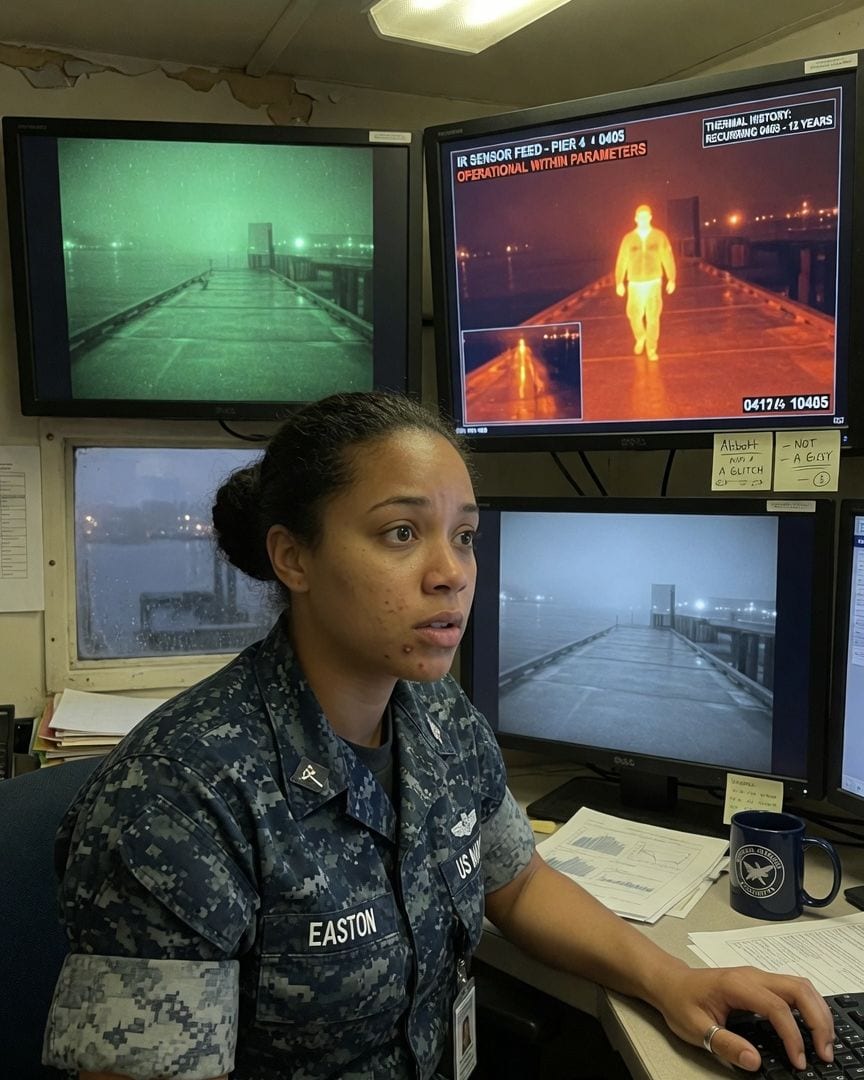
A security officer's camera sees nothing where her sensor logs a man-sized heat bloom on Pier 4, repeating at 0405 every night for twelve years.
Petty Officer Judith Easton, 24, was counting down her last month at Naval Base Kitsap-Bangor’s Pier 4 before a coveted transfer to Pearl Harbor, the security station air thick with the hum of electronics and the briny scent of the Puget Sound. At 0405, her primary IR sensor feed registered a distinct, man-sized heat bloom moving along the pier's caisson, but her optical camera showed only empty, mist-shrouded concrete where the sensor insisted a body moved. What began as a baffling glitch soon turned chilling: the thermal history revealed this impossible heat signature had walked the identical path at 0405 every night for twelve years, dismissed by others but secretly documented by a former officer. His subsequent 'stress-related medical leave' and a sealed 'Project NIGHTWATCH' file now hinted at a hidden truth far beyond a simple sensor error. What exactly had Petty Officer Abbott known?
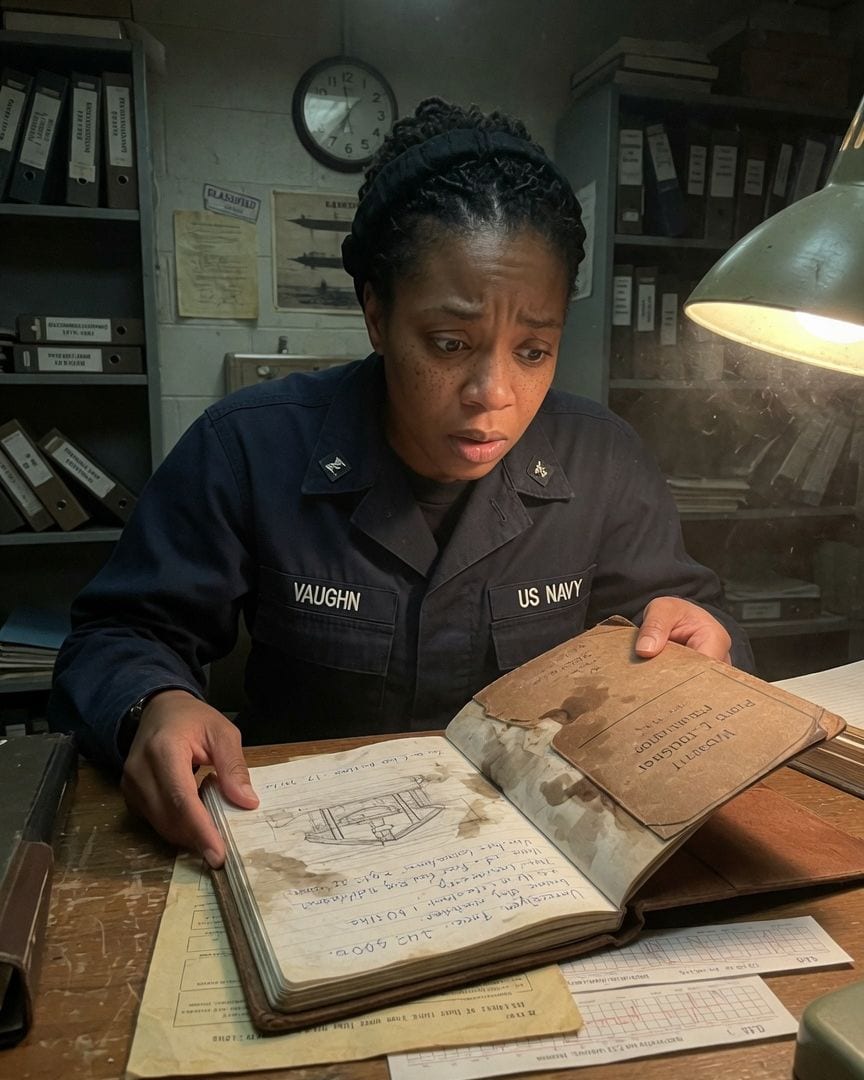
A Petty Officer's sensor logged a man-sized heat bloom at 0405. The camera saw nothing, and a journal from 1978 logged that same trace, then a Cold War Petty Officer gone MIA.
Petty Officer Rose Vaughn knew the meticulous order of Naval Submarine Base Bangor's pier by heart, especially her midnight watch routine. Every night at 0405, her IR sensor logged a man-sized heat bloom moving along the concrete path, vanishing at the pier's edge, but the watch camera showed only empty mist. This phantom warmth had walked the identical path for five years, yet the supposed steam line beneath it had been cold and dry for over a year. Her unofficial investigation led her to a faded 1978 journal, where a vanished Petty Officer, F. Pennington, logged an 'unresolved trace' at the exact same coordinates and 0405 hour, just before he went MIA. The system swore it was there, but the world swore it wasn’t – what was walking the pier, decades after it was lost?
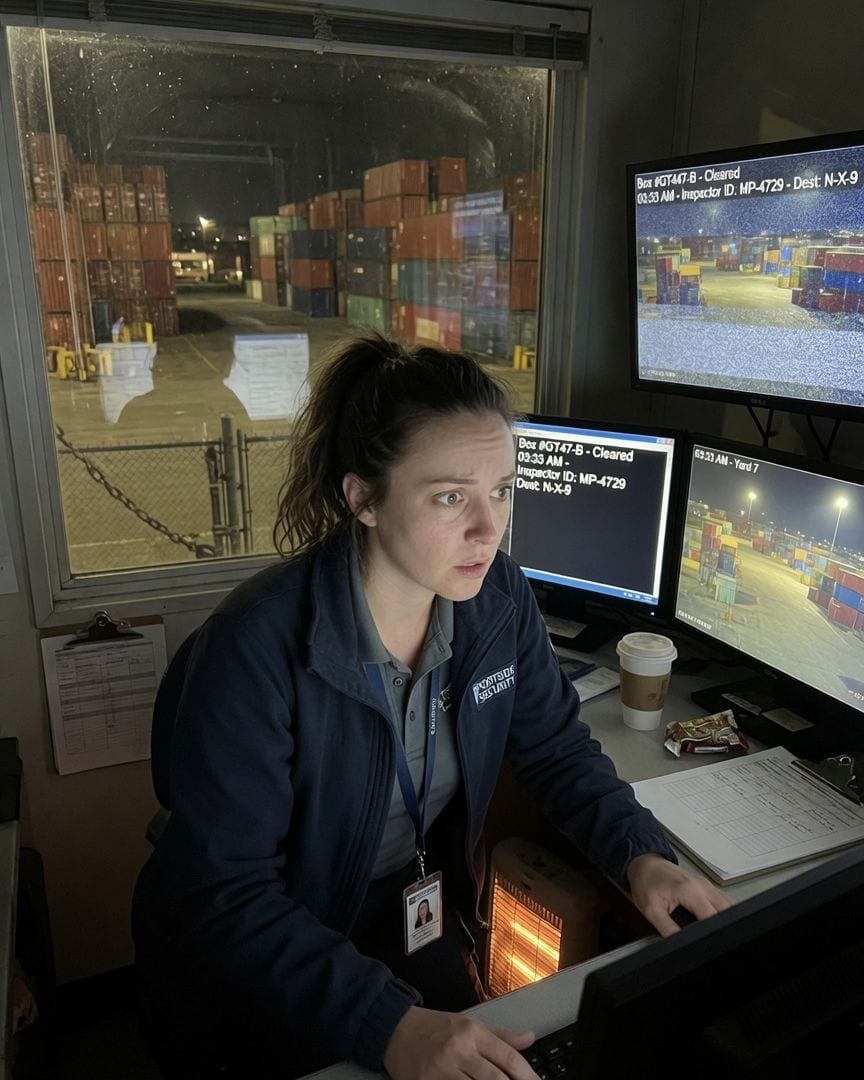
The log says a container cleared my gate at 3:33 AM, stamped with my ID — but the gate was chained and locked, and the yard beyond it was dark and empty. No truck was ever booked.
My night shift at Portside Container Terminal is usually a predictable drone of monitors and stale coffee. But then I saw a familiar guard, Arthur Larsen, on a live feed, smiling unsettlingly at the camera. The next morning, my supervisor searched for him; the employee database returned 'No results found.'
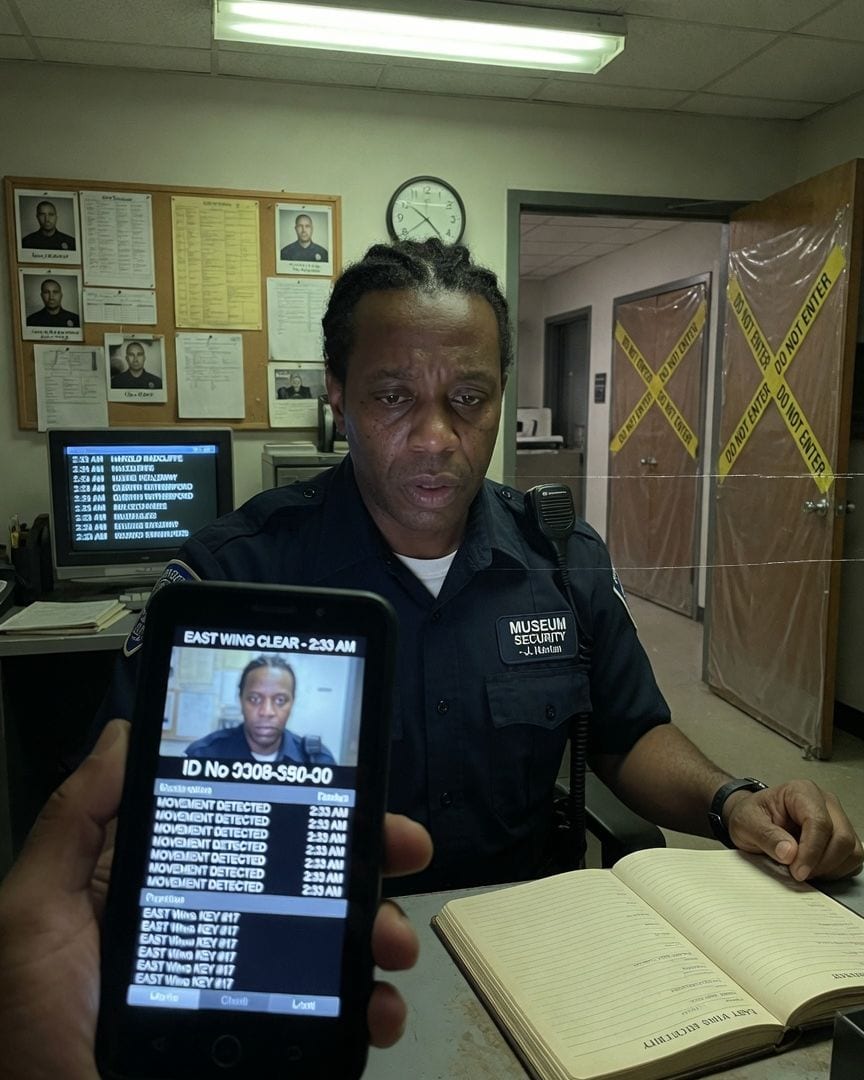
My guard log shows the east wing cleared at 2:33 AM. That wing's been sealed for months, doors screwed shut.
I was on my final security rounds in the quiet museum after midnight, ready to clock out. My handheld scanner showed the East Wing cleared at 2:33 AM under my ID, though it's been sealed for months. Then my hand brushed a faint, precise scratch on the plastic covering the doorframe, exactly where a security scanner would be held.
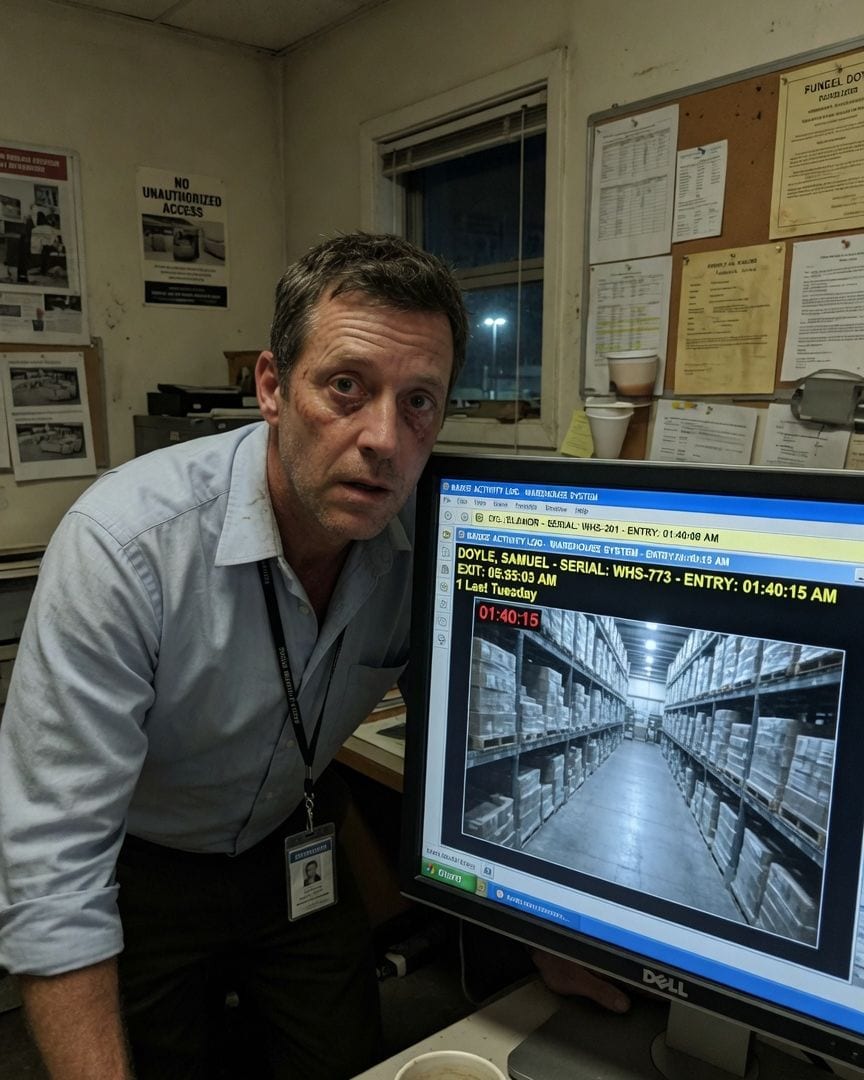
My dead colleague's badge, deactivated weeks ago, logged an entry at 1:40 AM last Tuesday. Then I found another from 1978, with the same impossible times.
My monitor showed a shocking entry: Samuel Doyle, dead and buried three weeks ago, had just logged into the warehouse. His badge was deactivated the day of his funeral, yet the system recorded his precise entry and exit, even though security footage showed the aisles were utterly empty.
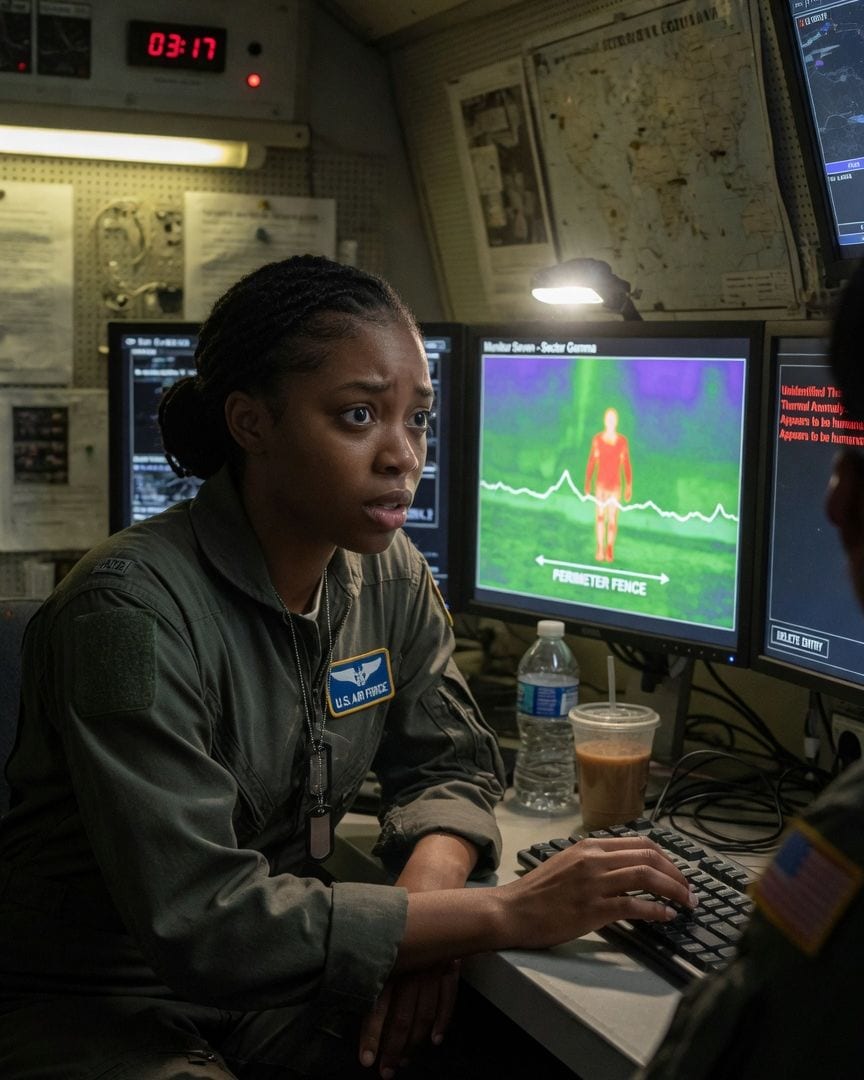
An airman’s thermal feed shows a figure moving in the restricted desert. Her captain orders it scrubbed, but the heat signature appears to tilt its head and look right at her.
Airman First Class Olivia Kade was new to her remote high-altitude outpost, fresh from advanced training, and the isolation pressed in, amplifying every hum. Her duty was to monitor the desert perimeter, but one shift, a faint thermal signature appeared on Monitor Seven: a solitary, upright figure moving with impossible precision beyond the barbed wire. No personnel were authorized in that sector. Her mission commander quickly ordered the anomaly scrubbed, but as it dissolved, the featureless outline seemed to tilt its head, looking directly into the camera. Now, the signature returns night after night, forcing the airman to wonder what impossible thing patrols the dark beyond the wire.