A security officer's camera sees nothing where her sensor logs a man-sized heat bloom on Pier 4, repeating at 0405 every night for twelve years.
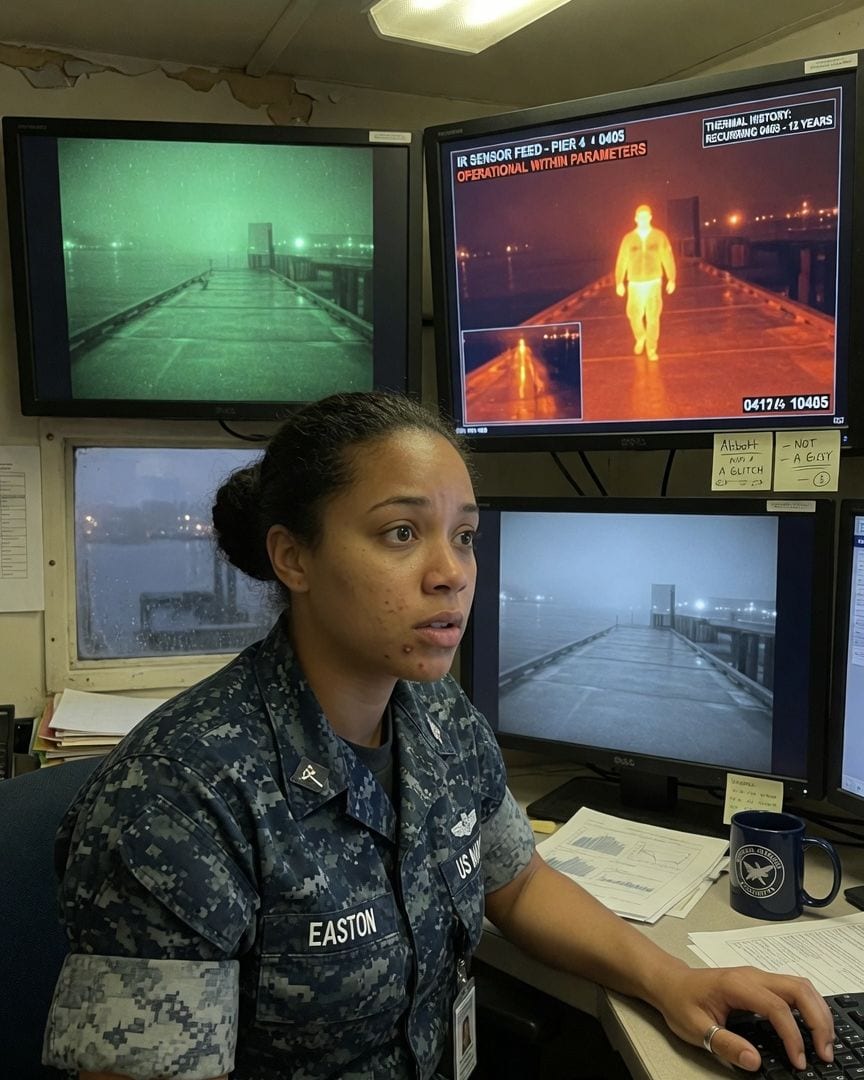
Petty Officer Second Class Judith Easton, 24, watched the monitors of Naval Base Kitsap-Bangor’s Pier 4. The air in the security station was thick with the hum of electronics and the faint, briny scent of the Puget Sound.
It was 0405. On her primary IR sensor feed, a man-sized heat bloom, distinct and moving with purpose, traversed the length of the caisson. Judith’s brow furrowed. She flicked to the optical camera trained on the exact same span. Nothing.
Just the slick, wet concrete of the pier, gleaming faintly in the ambient light, swallowed by the morning mist.
The screen pulsed with the faint green glow of the night vision, showing only empty air where the sensor insisted a body moved. She ran a diagnostic, but the IR sensor read perfectly, reporting 'operational within parameters.'
Her first thought was a steam line, an old conduit beneath the pier often prone to leaks, but the maintenance logs, checked just last shift, confirmed Pier 4’s main steam conduit had been cold and dry for over a year, part of a long-term decommissioning project.
A chill unrelated to the Washington morning ran down her spine. This was her last month before a coveted transfer to Pearl Harbor; she didn't need complications. She pulled the thermal history for that specific sensor.
The heat bloom had walked that identical path, 0405 every night, all the way back to the day the sensor was installed, twelve years ago. It was a ghost in the machine, a perfect, impossible repetition.
Judith couldn't shake the image of the phantom heat signature. Her training screamed anomaly, her common sense screamed impossibility. She spent her next few shifts, during her downtime, meticulously cross-referencing everything.
She pulled every maintenance report for Pier 4 from the last decade, checking for any mention of faulty wiring, recalibrations, anything that might explain a persistent sensor ghost.
The archive’s digital index hummed, spitting out page after page of mundane repair notes. Nothing. The sensor was consistently reported as 'operational within parameters.'
She delved deeper, into the base’s archived incident reports, a dusty corner of the digital network she rarely touched, a place where forgotten files went to languish.
After hours of sifting through mundane reports of misplaced equipment and minor spills, the security station’s clock ticking away the slow hours, she found a single, cryptic entry from ten years ago: 'Unexplained thermal fluctuations – Pier 4, 0405.
Dismissed as sensor malfunction after primary optical confirmed negative.' The report was signed by a Petty Officer M. Abbott. Curiosity piqued, Judith searched for M. Abbott's watch logs from that period.
It took some doing, navigating through layers of outdated file structures, but she found a digital copy of a rarely used, handwritten logbook.
Tucked away on a scan of a page dated ten years prior, amidst standard equipment checks and weather observations, was a cramped, almost furious-looking note. Underneath the 0405 entry, written in the margins, it simply read: '0405. Not a glitch.'
Below it, a series of dates, meticulously listed, all matching the thermal history she’d just reviewed. Marcus Abbott hadn’t just dismissed it; he’d documented it, and he’d known.
Judith needed to know more about Marcus Abbott. She pulled his service record. It stated he was honorably discharged years ago, with a note about 'early separation due to stress-related medical leave.'
Odd, given his meticulous logging and the faint desperation in his handwritten note. As she scrolled, a small, almost imperceptible hyperlink flashed at the bottom of the digital file: 'Project NIGHTWATCH – SEALED.' Her heart gave an uncomfortable lurch.
A sealed internal investigation? For a 'stress-related medical leave'? This wasn't a glitch, and it wasn't just Marcus Abbott.
The system that was supposed to account for every person, every incident, every detail, was actively hiding something far more substantial than a simple sensor error. The link pulsed, a silent, forbidden invitation.
The 'Project NIGHTWATCH' link proved impenetrable. Judith's security clearance, even as a Petty Officer Second Class nearing transfer, was insufficient.
She tried every back door she knew, every administrative loophole, but the file remained locked, a digital wall guarding an unseen truth. Frustrated but undeterred, she turned to the human element.
She sought out Chief Petty Officer Trevor Sutton, 52, a fixture at Kitsap-Bangor for three decades. Sutton was a walking archive of base history, a man who remembered every face and every story.
Over lukewarm coffee in the mess hall, the clatter of cutlery and muffled conversations filling the background, Judith casually brought up Marcus Abbott. Sutton’s jovial demeanor stiffened. His spoon paused midway to his mouth. 'Abbott? Good man. Went quiet, though.
After his last deployment.' He stirred his coffee, avoiding her gaze. The steam from the cup seemed to thicken between them. 'Why the interest, Easton? That was a long time ago.'
Judith feigned academic curiosity, claiming a research project on historical personnel patterns. Sutton, however, grew increasingly wary. 'Some things, Petty Officer,' he said, his voice dropping, 'are best left undisturbed. Especially when you’re on your way out.'
The warning was soft, almost paternal, but unmistakable. The silence that followed was heavier than any words. Ignoring it, Judith broadened her search.
She started cross-referencing the Pier 4 watch schedules from the last decade with personnel transfer and discharge records. A chilling pattern emerged.
Several other watch officers, not just Abbott, who had been assigned to Pier 4’s night shifts during the 0405 window, had also experienced 'stress-related' early separations or sudden, unexplained transfers to remote, non-watch duties.
The names were different – Joel Granger, Raymond Marsh – but the outcome was eerily similar. The digital records seemed to hum with a secret language, a rhythm of forced departures.
It wasn't just Abbott; it was a recurring event, a deliberate clearing of the decks. The pattern across rotations wasn't random; it was a systemic response to something.
Judith’s inquiries, no matter how discreet, had clearly not gone unnoticed. Her access to several internal archives, which had previously been open to her, was suddenly restricted. Attempts to pull up old watch rosters now resulted in 'Permission Denied' errors.
The digital walls were closing in, the system itself reacting to her probing. Then came the summons. Commander Eleanor Marsh, 46, Judith’s commanding officer, requested a meeting in her office.
Marsh was a formidable woman, always composed, always in control, her office as neat and precise as her demeanor. The session was framed as 'counseling' regarding 'maintaining focus during final weeks of duty.'
Commander Marsh’s voice was even, her expression unreadable, her hands clasped on the polished surface of her desk. 'Petty Officer Easton, your transfer to Pearl Harbor is a significant opportunity. It requires your full attention.
We’ve noticed some…unauthorized data access attempts on your part.' Judith felt a cold prickle on her neck. The air in the room, usually temperate, seemed to drop several degrees. Marsh leaned forward slightly, her gaze unwavering.
'Some things are best left undisturbed, Petty Officer. Especially when you're so close to your next posting. A clean record is paramount for your career progression.'
It wasn't a reprimand; it was a calm, precise threat, delivered with the polite finality of a closed door.
Marsh knew exactly what Judith had been looking for, and she was making it clear that further digging would jeopardize her future.
Judith left the office with a knot in her stomach, the realization sinking in: she was no longer just hunting for answers. She was being watched.
She began noticing her own watch logs being reviewed with unusual frequency, the timestamps on the digital signatures indicating Commander Marsh herself. The hunter had become the hunted. The system’s eye, cold and unblinking, was fixed on her.
The soft threat from Commander Marsh only solidified Judith’s resolve. The base wasn't just covering up a glitch; they were actively protecting a secret. She knew the digital system was now compromised, her every move monitored.
She needed to go analog. During her next shift, she found an excuse to access the base’s physical archives, a cavernous, climate-controlled room filled with rows of metal filing cabinets that stretched almost to the high ceiling.
The air was thick with the scent of aged paper and dust. Under the guise of updating old equipment manifests, she began searching for the original personnel files of Marcus Abbott and the other names from her 'pattern.'
It was painstakingly slow work, dusty folders and brittle paper rustling under her gloved hands. But then she found them. Abbott’s original file, thick with handwritten notes and official forms, was vastly different from his sanitized digital record.
His initial reports of the 0405 contact, far from being dismissed, detailed repeated observations of the thermal anomaly, its precise movement, its uncanny lack of optical presence.
These reports were followed by a series of increasingly agitated addendums, Abbott’s handwriting growing less precise, more frantic.
Then, a chilling discovery: a carbon copy of an internal memo, stamped 'RESTRICTED – EYES ONLY,' detailing a 'non-human thermal signature confirmed, subject unidentifiable, no physical interaction.' It wasn't a sensor malfunction. It was real.
And the base command knew it. She found similar memos in the files of Joel Granger and Raymond Marsh. Their digital records had been surgically altered, their original, truthful accounts replaced with generic 'stress-related incidents.'
The same handwriting, precise and almost clinical, appeared on the internal memos, authorizing the 'reclassification' of their cases, a neat, looping script that filled her with unease. The base wasn't malfunctioning; it was operating with deliberate intent.
The 'accountability' system, designed for transparency and order, was being weaponized to conceal the truth. Every 'stress-related medical leave' was a lie, a cover for the removal of anyone who saw too much.
The dread solidified: the system itself was the enabler of the wrongness, not its victim.
Judith kept digging, driven by a cold fury. She searched for Marcus Abbott's final, unedited incident report before his discharge. Deep within his physical file, tucked behind layers of performance reviews and medical assessments, she found it.
A single, flimsy sheet of paper, a carbon copy of a hand-written log entry. It detailed Abbott's final night on watch, his growing desperation, his attempts to physically investigate the pier at 0405, despite explicit orders not to.
The report ended abruptly, with a single, chilling entry: 'Abbott’s last log entry at 0406: “It’s here. I see it. It’s not a man. It’s…” No further transmission.'
His official record claimed he walked off base in a disoriented state and was found hours later. This secret report implied something far more sinister, a direct confrontation, an encounter that silenced him mid-sentence. Judith’s blood ran cold.
She knew what 'stress-related medical leave' truly meant for those who saw the 0405 anomaly too clearly. She closed the folder, the weight of the paper feeling immense, as if it held not just one man's fate, but her own.
As she returned to her station, the usual hum of the monitors seemed to take on a sinister tone. A notification flashed on her digital terminal: her personal watch schedule had been updated. She clicked it open.
And there it was. A small, almost invisible, handwritten annotation on the bottom of her own current watch schedule, for the very next night: 'Pier 4 Watch - PO Easton. 0400-0800.' The same precise, clinical handwriting from the altered records.
The accountability that cannot be was now tracking her.
Judith stared at her updated watch schedule, the handwritten annotation a stark, chilling command. It wasn't a coincidence; it was a trap.
She was being sent to Pier 4 at 0400, not as a routine assignment, but as a deliberate test, or perhaps, a final solution. The full, horrifying truth snapped into place, each disparate detail clicking into a terrible, coherent picture.
The 'heat bloom' wasn't just an anomaly; it was a recurring entity, a presence that manifested nightly on Pier 4. The base command, far from being ignorant or negligent, was fully aware.
They had chosen not to eliminate it, or even truly understand it, but to manage its existence. The 'Project NIGHTWATCH' wasn't an investigation into the entity, but a protocol for containing the knowledge of it.
Every 'stress-related medical leave,' every altered record, every quiet transfer of a watch officer who saw too much, was part of this elaborate, chilling system of containment. The military’s vaunted accountability, its meticulous record-keeping and strict protocols, had been twisted.
It wasn't accountable to the truth, or to its personnel, but to the continued, undisturbed presence of the thing on Pier 4.
Marcus Abbott hadn't just been discharged; he had been disappeared from the truth, his warning swallowed by the system. The pattern across rotations wasn't a series of unfortunate incidents; it was a regulated culling, a systematic erasure of witnesses.
Judith understood now that Commander Marsh's warning hadn't been an attempt to protect her, but a final chance to fall in line, to comply with the silence.
She was now the next name on the list, a problem to be managed. The dread was profound, not because of what she might face, but because the entire, unyielding system of her world was complicit in its perpetuation.
The base, her life, her career—all of it was a stage for the entity’s undisturbed nightly performance.
The next night, Judith stood on Pier 4. The mist was thick, clinging to the concrete, muffling the distant sounds of the base into an ethereal hush.
She wore her uniform, her sidearm holstered, her discipline a thin shield against the growing dread. The air was cold, damp, and utterly still, heavy with the scent of salt and concrete.
Her breath plumed in the faint light cast by a distant lamp. She checked her watch. 0404. Her eyes were glued to the portable IR sensor screen she’d brought, a small, handheld unit mirroring the pier’s main feed.
At 0405, precisely, the familiar heat bloom materialized. It moved with the same unnatural fluidity, a human-sized thermal signature gliding along the caisson, a silent, invisible dancer in the mist.
Judith’s gaze snapped to her own optical camera, mounted on a tripod and aimed at the exact spot. It showed only the swirling mist and the wet concrete. But then, for a split second, a flicker.
Not a glitch in the feed, but something in the frame. The optical camera, for one impossible beat, resolved it. A tall, gaunt, impossibly thin figure.
It moved with a strange, jointless grace, its form indistinct through the mist, yet undeniably present, a living shadow against the gray. It was not a man. It was a thing.
Its head, too large for its impossibly slender neck, seemed to turn, slowly, as if sensing her presence, sensing the lens. Its dark, featureless face, for that fleeting instant, seemed to look directly into the camera lens, directly at her.
Then, the screen went dark, a momentary blackout that felt like a blink, before snapping back to life, showing only the mist and the pier, utterly empty.
The thermal signature continued its path, then vanished as usual, completing its impossible circuit. Judith stood frozen, the image burned into her mind, the cold grip of absolute certainty tightening around her. She had seen it. She knew.
The horror was in the coherence, the undeniable proof that everything she had uncovered fit perfectly. She lowered her camera, her hand trembling slightly, the cold plastic of the device now feeling like a burden.
She had confronted the truth, and it was worse than any speculation. The entity was real. The base was hiding it. And she was now a part of its silent, terrible history.
Judith returned to her station, heart pounding, but her hand steady as she typed her official report. She logged the thermal anomaly, its precise timing, and its disappearance.
She omitted any mention of the fleeting optical image, the impossible figure, the featureless face that had stared back. She submitted the report, a clinical, objective account of a sensor reading, clean and unblemished.
The next morning, her new transfer orders arrived. Not Pearl Harbor, the dream destination she had worked towards. Instead, a remote administrative post in Thule Air Base, Greenland, effective immediately.
Her service record remained impeccable, unblemished, a testament to her professional silence. As she walked through the base one last time, the cold wind off the Sound biting at her cheeks, Commander Marsh passed her in the hallway.
Marsh offered a brief, knowing nod, a faint, almost imperceptible smile touching her lips. Judith returned the nod, her face a mask of professional calm.
She understood the message: she had seen, she had reported, and now she was being removed, quietly, efficiently, to a place where her knowledge could do no harm, where the secret of Pier 4 remained safe.
Days later, Judith sat alone in her new, barren quarters in Greenland. The wind howled outside, a constant, mournful sound against the thin walls, a vast, empty white world surrounding her. Her personal effects were still in boxes, unpacked.
She picked up a framed photo of herself, taken years ago, in uniform, smiling brightly, before Kitsap-Bangor. She looked at her reflection in the glass, a stranger staring back.
The uniform was still squared away, the posture correct, but the smile was gone, replaced by a quiet, unyielding knowledge.
She was alive, she was safe, but a piece of her remained on that misty pier, forever changed by what she had seen. She knew. It was enough.
A few months later, back at Naval Base Kitsap-Bangor, Chief Petty Officer Trevor Sutton looked up from his coffee as Commander Marsh walked past. 'Heard Easton settled in well at Thule,' he remarked.
Marsh paused, a faint, almost imperceptible smile touching her lips. 'She's maintaining focus,' Marsh replied, her eyes holding Sutton's for a beat too long. 'Exactly where she needs to be.'
If this one got to you
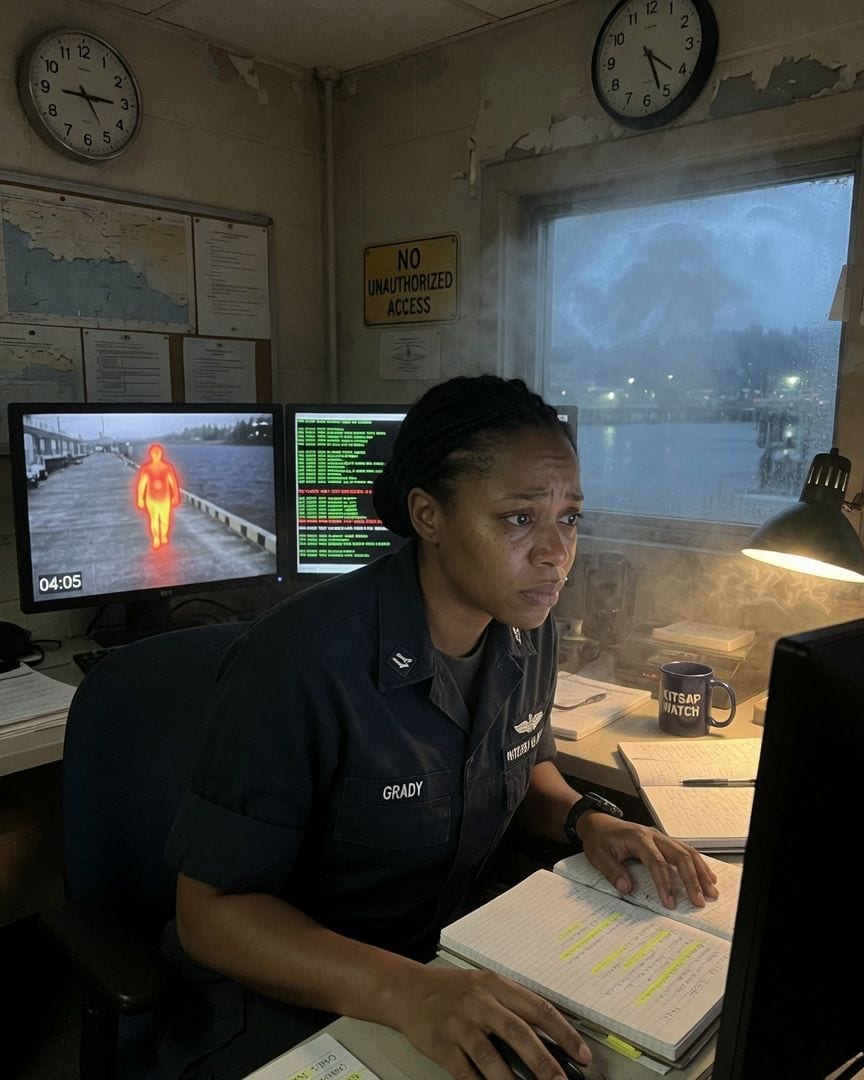
Petty Officer Olivia Grady found the base system logging impossible access at 0405. Every night for years, a blank ID walks Pier 7.
Petty Officer Olivia Grady stood her predawn watch on Pier 7, the cold mist of Puget Sound a familiar companion. Her routine scan of monitors at 0405 was shattered when an IR sensor flared with a man-sized heat bloom moving along the pier. Yet the camera feed showed only empty concrete and swirling mist. When historical logs confirmed the invisible presence had walked that exact path every night for years, Olivia dug deeper. She found a ghost "access log" entry with a unique ID but no name attached, meticulously aligned with the 0405 bloom. What impossible entity was the base system logging, night after night?
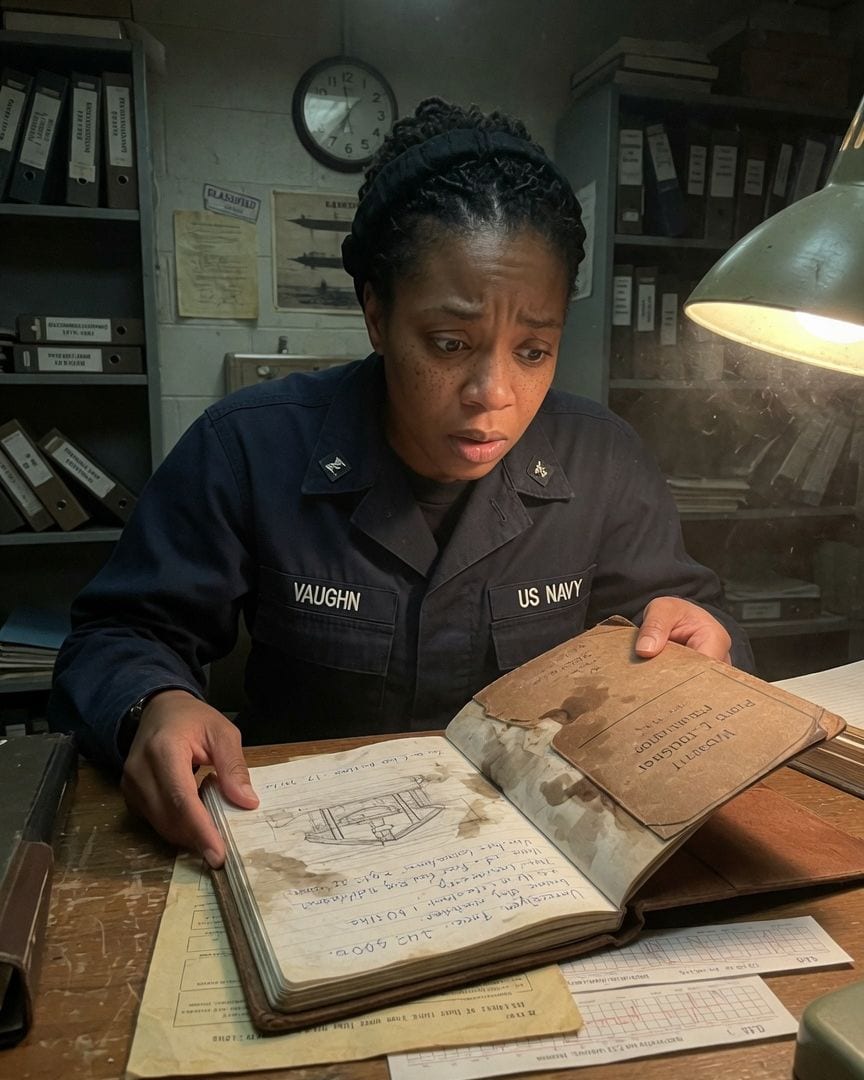
A Petty Officer's sensor logged a man-sized heat bloom at 0405. The camera saw nothing, and a journal from 1978 logged that same trace, then a Cold War Petty Officer gone MIA.
Petty Officer Rose Vaughn knew the meticulous order of Naval Submarine Base Bangor's pier by heart, especially her midnight watch routine. Every night at 0405, her IR sensor logged a man-sized heat bloom moving along the concrete path, vanishing at the pier's edge, but the watch camera showed only empty mist. This phantom warmth had walked the identical path for five years, yet the supposed steam line beneath it had been cold and dry for over a year. Her unofficial investigation led her to a faded 1978 journal, where a vanished Petty Officer, F. Pennington, logged an 'unresolved trace' at the exact same coordinates and 0405 hour, just before he went MIA. The system swore it was there, but the world swore it wasn’t – what was walking the pier, decades after it was lost?
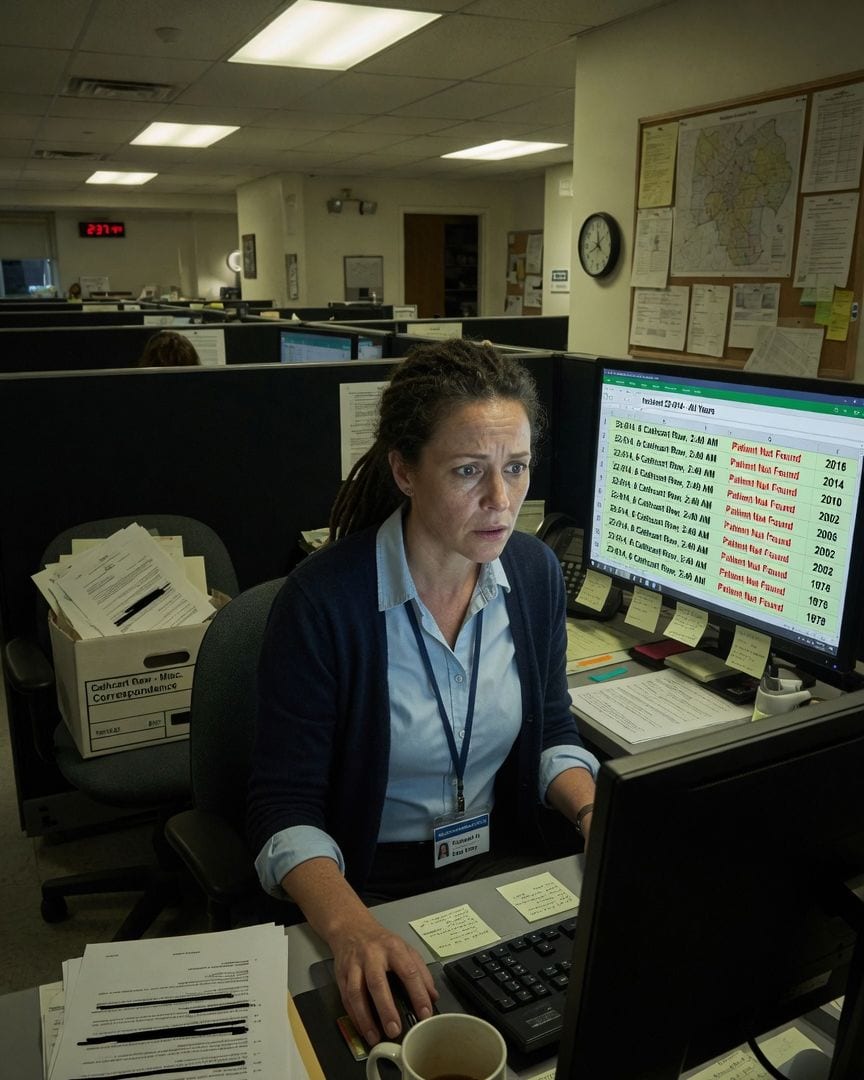
My computer log shows the same 2:40 AM call to Cathcart Row, every four years since 1978, always closed 'patient not found'.
Working data entry for the County Ambulance Trust, I found a routine incident logged as 'Patient Not Found.' But digging deeper, I discovered the exact same phantom call had repeated every four years for over forty years, always at the same address, always at 2:40 AM. Then I found a heavily redacted memo linking it to my own street.
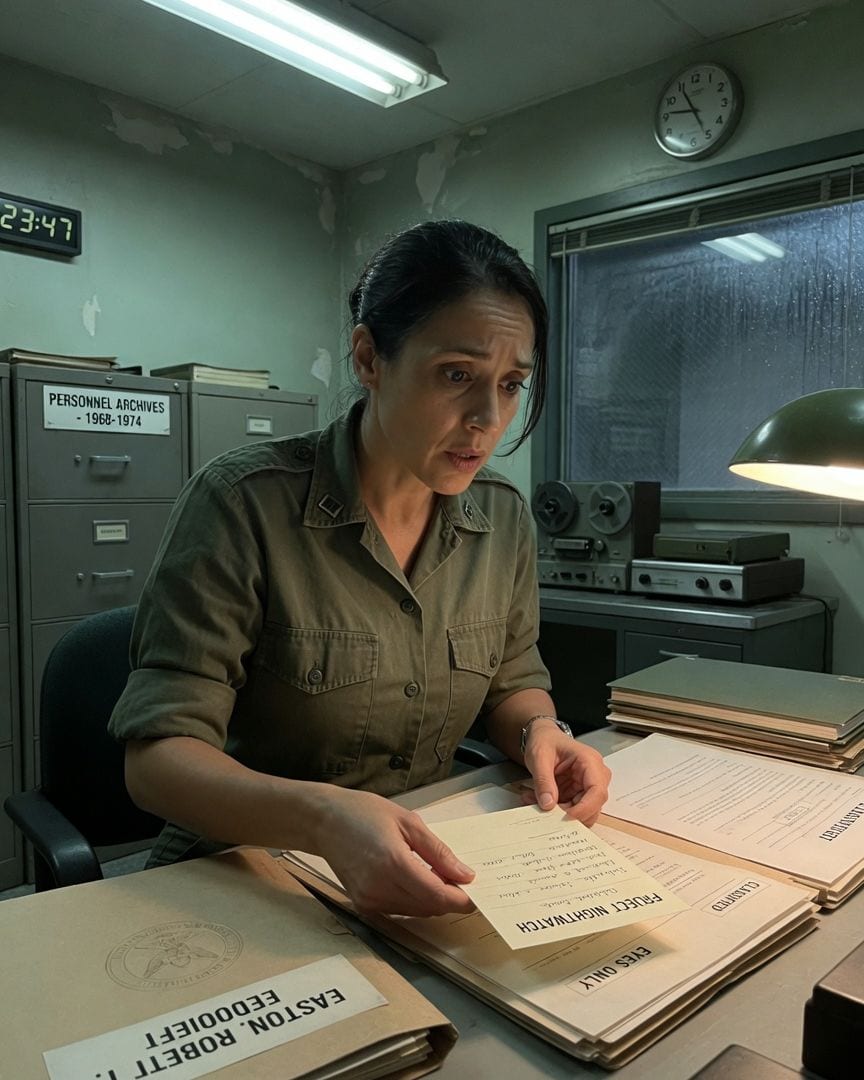
A Cold War tower controller logs an object vanish from radar, then hears the pilot scream it’s filling his windscreen. Her own name, 'Bardolph, Ines', now marked 'Observed' in a secret file.
Captain Ines Bardolph, a tower controller, was counting down the months until her transfer to Langley and the decommissioning of her base, hoping to leave behind the unsettling incidents of her final posting. But one night, her radar scope showed an impossible blip, solid and unwavering, 40 miles north of the Danube, only to vanish in less than a second, leaving a pilot screaming in terror. Despite the clear evidence, the official report blamed "atmospheric inversions," while the terrified pilot received a glowing review and promotion, his file meticulously scrubbed of any anomaly. As Captain Bardolph reviewed the pilot's pristine record, she found a hidden slip of paper, revealing a chilling truth: 'Subject: Bardolph, Ines. Status: Observed.' Was she merely an observer of the impossible, or was she now part of something far more sinister?
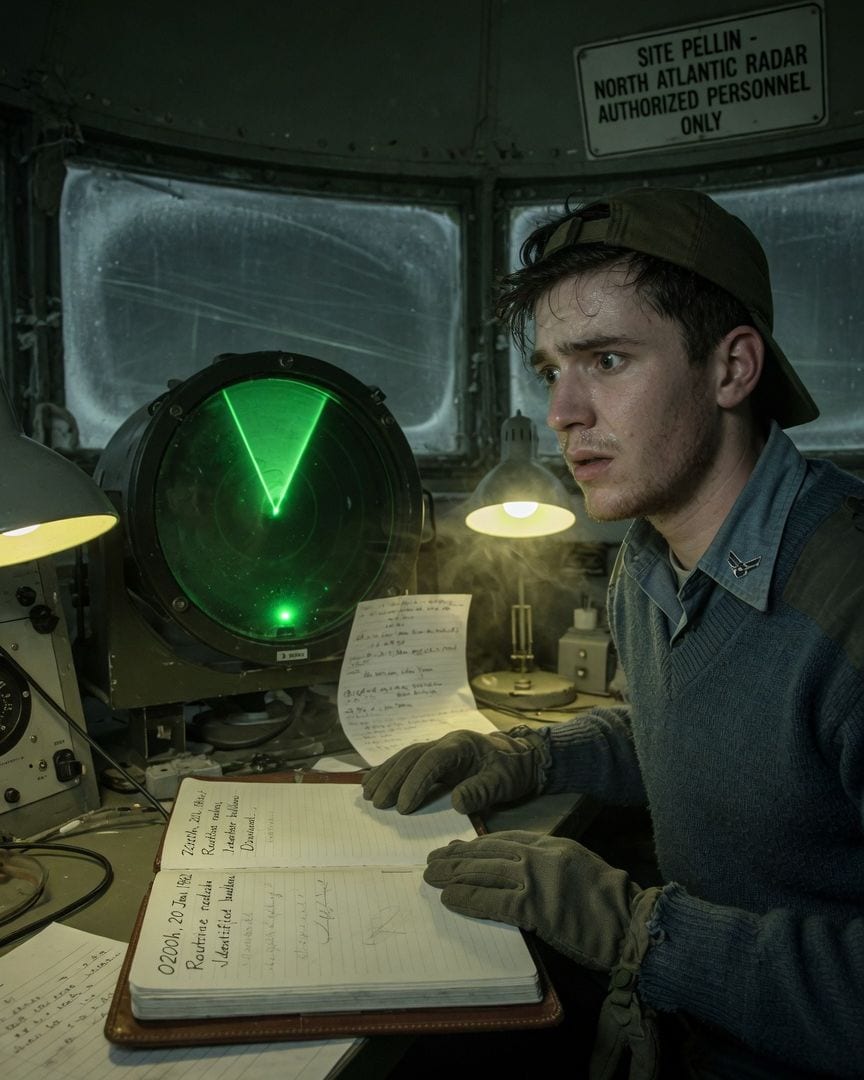
Nine days from closing, Cold War Site Pellin's Airman Vance watched his radar track a solid blip moving closer, dead in open sea where nothing could exist.
In the dimly lit dome of Site Pellin, Airman Ordway Vance, just days from discharge, ran his final radar sweeps before the base closed for good. Outside, the North Atlantic wind howled, but inside, only the hum of his console broke the silence. His last calibration had been clean, yet a single, unwavering green blip appeared on the scope, forty miles out, in open water where no vessel should be. The impossible return moved closer with each sweep, defying all logic and other sensors, until it sat static just beyond the coast fence line. What unseen presence did the radar truly hold in its unwavering green grip, contradicting the official record?
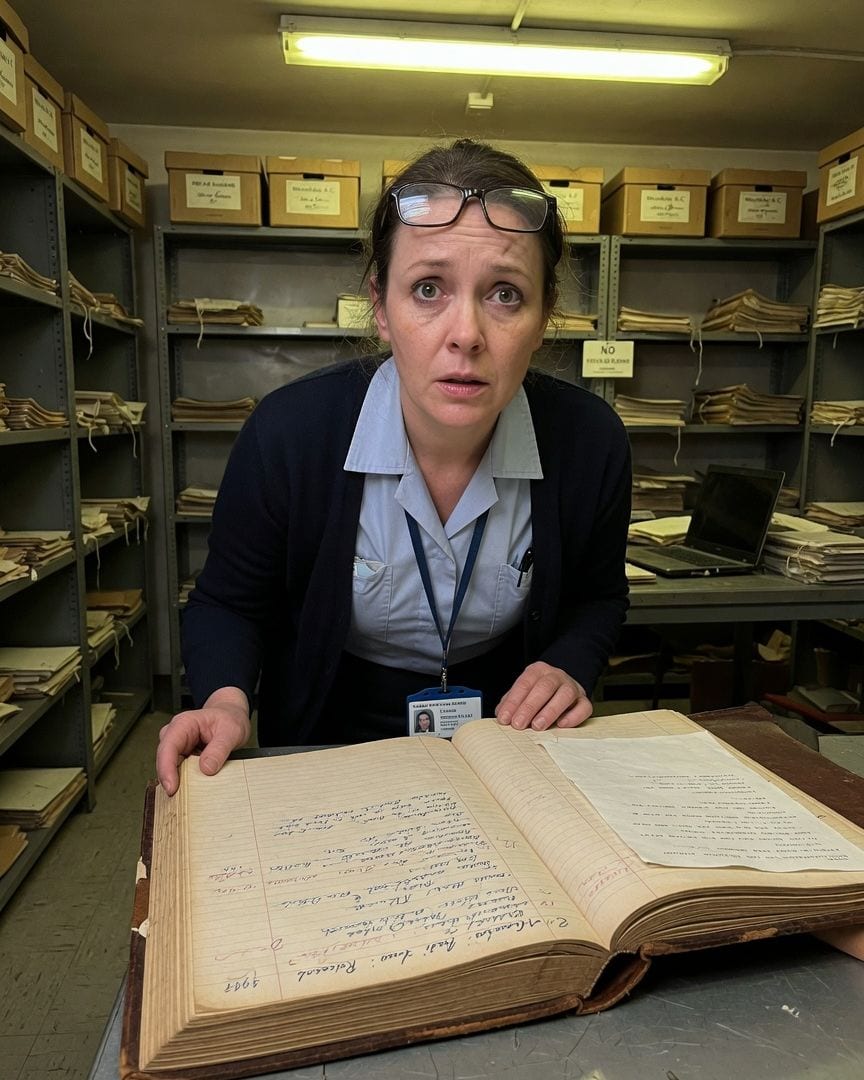
My ambulance trust's incident log shows callout 22-014 to 6 Cathcart Row at 2:40 AM. Every four years, the same call, same address. Always 'patient not found'.
My job involves tedious data entry for ambulance calls, but Incident 22-014 was different. It appeared every four years, always at 2:40 AM, always closed as 'patient not found.' Digging into the dusty physical archives, I found an entry from 1961 for the exact same incident, but its resolution read: 'Subject Secured. Relocated to "Holding".'