My ambulance trust's incident log shows callout 22-014 to 6 Cathcart Row at 2:40 AM. Every four years, the same call, same address. Always 'patient not found'.
It started like any other Tuesday. Another shift at the ambulance trust, another mountain of incident reports waiting for data entry.
My job, mostly, is to turn frantic 999 calls into neat digital records, a task that generally involves more tired sighs than actual detective work. But then Incident 22-014 landed on my screen.
The address was 6 Cathcart Row. Time of call, 2:40 AM. I keyed it in, standard procedure, but as my fingers hovered over the keyboard, a strange little flicker of déjà vu caught me.
It wasn't a strong memory, more like a faint echo from a dream I couldn't quite recall. I shook my head, probably just tiredness. Three hours of this, and my brain starts playing tricks.
Still, the feeling persisted. On a hunch, I backtracked, punching '22-014' into the archive database, just to see if I'd processed it recently. The screen stuttered, then filled. Not one entry, but dozens. My breath hitched.
Every fourth year, without fail, going all the way back to 1978. Always 6 Cathcart Row. Always 2:40 AM. And every single one of them closed with the same three words: 'patient not found.'
My first thought was a system error, a recurring phantom call, maybe. Some prankster with a very long memory and a peculiar sense of humor.
I refreshed the search, then tried refining the parameters, checking for different dispatch codes, anything that would break the perfect, unnerving symmetry. But the pattern held. Decades of identical records, a silent, rhythmic pulse in the system, utterly consistent.
It wasn't a glitch. It was… a record. Of nothing. Over and over again.
"Everything alright, Eileen?" Grace Mercer, from the next cubicle, leaned over. She was already halfway through her lunch, crumbs of a croissant dusting her keyboard.
"Yeah, just… look at this." I turned my monitor slightly. "Incident 22-014. Cathcart Row. Every four years. Always 'patient not found'."
Grace squinted. "Huh. Some kind of faulty alarm, maybe? Or a recurring prank call? We get those sometimes. Old system quirk." She shrugged, then went back to her sandwich. "Don't sweat it. Just file it like the others."
But I couldn't shrug it off. A faulty alarm wouldn't generate a callout every four years, precisely. And a prank call for decades, always at 2:40 AM, without a single variation?
That felt less like a prank and more like a ritual. Unconvinced, I logged a request for access to the physical archives.
The digital records only went so far back; the real deep history of the trust was locked away in dusty ledgers, microfiches, and paper files. Nobody really used them anymore, not unless something truly unusual popped up.
My request raised an eyebrow or two from my supervisor, but they approved it.
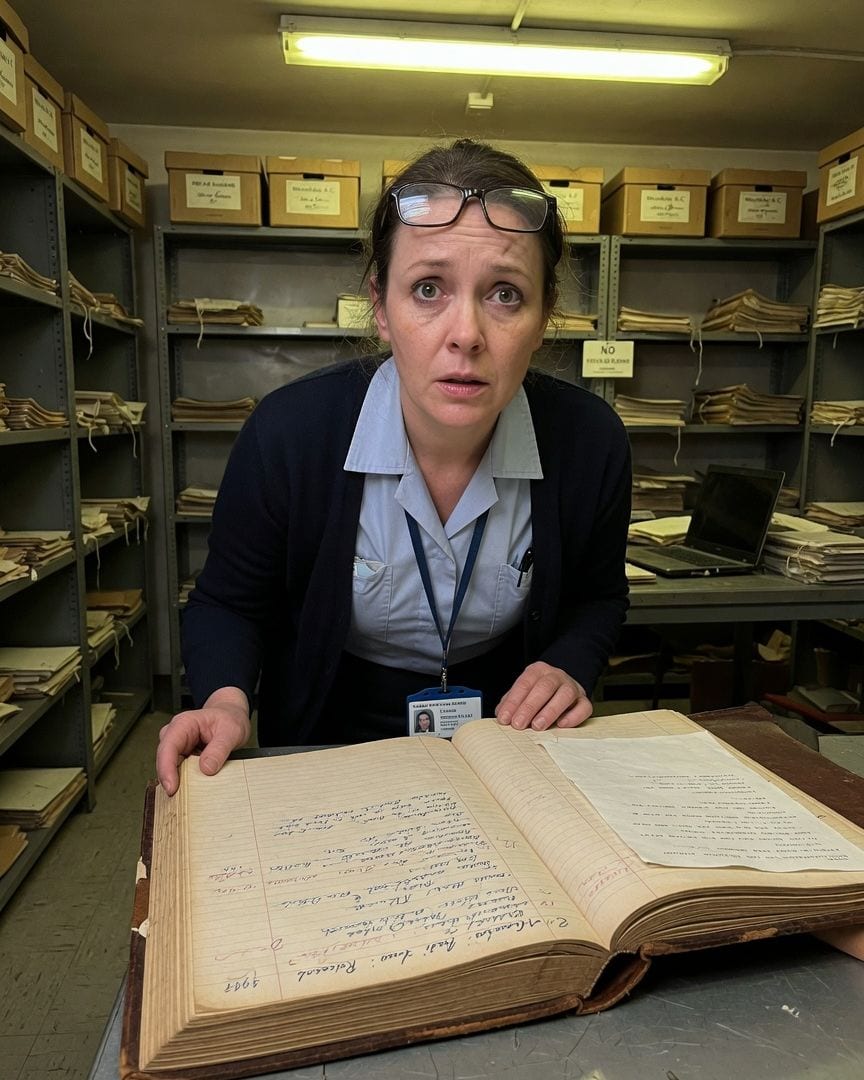
For the next few lunch breaks, I descended into the archives. It was a cold, quiet room in the basement, smelling of old paper, dust, and something else, something vaguely metallic and stale.
Fluorescent lights hummed overhead, casting a sickly yellow glow on rows of metal shelves. I started with the oldest records, searching for anything relating to Cathcart Row or the specific incident number.
Days blurred into a monotonous cycle of turning brittle pages, cross-referencing faded handwriting. My eyes stung, my fingers were permanently smudged with ink, but I found nothing. Not a single deviation from the 'patient not found' narrative.
Then, on the fourth day, buried beneath a stack of brittle, yellowed reports from the early 1960s, I found it. A thick, leather-bound ledger, its spine cracked, its pages almost tissue-thin.
The air around me seemed to chill as I carefully opened it. Inside, the handwriting was neat, precise, but definitely older, more formal.
Under a different, more archaic numbering system, I located an entry for 6 Cathcart Row, 2:40 AM, dated 1961. Scrawled next to it, crudely cross-referenced with a different colored ink, was '22-014'. My heart gave a thump.
But the resolution wasn't 'patient not found.' This time, in a stark, firm hand, it read: 'Subject Secured. Relocated to "Holding".'
My heart hammered against my ribs. 'Holding'? I flipped through the ledger, searching for an explanation, a definition, anything that would contextualize those two unsettling words. There was nothing.
Just page after page of incident reports, callouts for minor injuries, traffic accidents, the mundane tragedies of the city.
But then, on the very last page, tucked into a sleeve, I found it. A faded, typewritten memo, crinkled and brittle. It was a directive from 1962, referencing 'Post-Relocation Protocols' and 'Maintaining Discretion Regarding Holding Section.'
The memo was addressed to 'Select Personnel, Records Management – Restricted Access.' My finger traced the unnerving, faded words.
The 'Holding Section' was mentioned as a physical location within the trust's older building, now simply marked 'Storage' on current blueprints, its entrance bricked up decades ago.
The silence of the room seemed to press in around me, heavy and knowing.
The next day, the words 'Subject Secured. Relocated to "Holding"' echoed in my head. I tried to discreetly inquire about the 'Holding Section' with Grace during our morning coffee break.
"Hey, do you know anything about an old 'Holding Section' in the basement? From before the digital records?"
Grace just gave me a blank stare, stirring her sugar. "Holding section? You mean like, where they kept medical supplies? Or old files? No, not really. Never heard of it.
Sounds like you're spending too much time with those dusty old papers, Eileen. You'll start seeing ghosts." She laughed, a light, dismissive sound that did nothing to soothe my unease.
But I wasn't seeing ghosts. I was seeing records, blueprints, memos. Things that were, by definition, real. Undeterred, I decided to go deeper. Using my security clearance, I accessed the trust's original building blueprints, dated 1938.
It took a while to navigate the archaic schematics, but I eventually located the area now marked 'Storage' in the basement. And beneath it, in faint, almost erased pencil, were the words 'Holding – Access Restricted.'
The blueprints showed a subterranean level, accessible only via a single, heavily reinforced door. That door was now obscured by later renovations, likely bricked up or covered by newer walls.
I cross-referenced this with archived maintenance requests from the early 1960s. The files detailed unusual structural reinforcements and extensive soundproofing for that specific section, all marked 'Urgent – Classified.'
The sheer effort put into sealing a mere 'storage' area unnerved me. No ordinary storage needed that kind of secrecy or security.
I spent hours poring over old local newspapers, online archives, anything from 1961 that might relate to 6 Cathcart Row or a mysterious 'incident.' Nothing. No fires, no disappearances, no strange police reports.
The silence around the 'Holding Section' was absolute, a perfect, unbroken blank in the public record.
As I continued my quiet research, I started noticing subtle changes. My access to certain archived files became intermittently restricted, then, just as suddenly, it would be restored. My computer would log out unexpectedly, forcing me to re-enter my credentials.
Once, I came back from lunch to find my desk lamp subtly repositioned, its beam now directed away from my monitor, towards the wall.
It was small things, easily dismissed as coincidences or my own paranoia, but they piled up, a growing weight in the back of my mind. Someone knew what I was doing.
One afternoon, while I was reviewing a particularly old microfiche of 1960s memos, the shadow of a figure fell across my desk. I looked up to see Bernard Ingram, one of the trust's most senior administrators.
He was a man in his mid-sixties, always impeccably dressed, known for his meticulous, calm demeanor and decades of service. He was a fixture in the building, a quiet, almost spectral presence.
He didn't directly mention my research. Instead, he simply asked, his voice soft, almost conversational, "Still delving into the historical records, Miss Lambert? Fascinating, the things you can find. Just be careful not to disturb what's best left settled."
His eyes, though, held a knowing, unsettling stillness. There was no warmth there, no curiosity, just a deep, unreadable awareness.
He offered a faint, unreadable smile, a mere twitch of the lips, before turning and walking away, leaving me with a cold prickle of unease. My digging had been noticed.
And Bernard Ingram wasn't just curious; he knew exactly what I was looking for.
I couldn't let it go. Not after Bernard's warning, not after what I'd found. The sheer bureaucratic horror of it—a decades-long cover-up, a recurring anomaly, a sealed 'Holding Section'—was starting to make sense in the most unsettling way.
I decided to confront Bernard directly. I compiled my evidence: the dozens of recurring 22-014 entries, always 'patient not found'; the 1961 'Subject Secured' entry; the blueprints for the 'Holding Section'; the classified maintenance requests detailing structural reinforcements and soundproofing.
I bundled them into a neat, incriminating stack.
I scheduled a meeting under the guise of 'archival discrepancies needing clarification.' Bernard’s office was quiet, polished, almost unnervingly still.
He sat behind his large mahogany desk, hands clasped, listening patiently, his expression utterly unperturbed, as I laid out the pattern. My voice, I noticed, was steadier than my hands.
When I pushed the brittle, yellowed page from the 1961 ledger across the desk, showing him the 'Subject Secured' entry, he nodded slowly. "Ah, yes. The 1961 protocol."
"Protocol for what?" I pressed, my voice tight. "What was secured? What is 'Holding'?"
Bernard leaned forward slightly, a faint, almost regretful smile touching his lips. "It was an attempt, Miss Lambert. An attempt to… contain a recurring anomaly. A phenomenon that manifests at 6 Cathcart Row, every four years, at precisely 2:40 AM."
He spoke calmly, his voice even, as if discussing a routine budget report. He explained that the ambulance trust had a long, unacknowledged history of monitoring this 'manifestation.'
The 'patient not found' classification, he revealed, was not an error, a glitch, or a recurring prank. It was a later, more sophisticated directive.
"We tried to stop it, to move it, in '61," he continued, his gaze steady. "The consequences were… undesirable. Far more disruptive than simply letting it run its course." He gestured vaguely to the silent office around us.
"You see, the trust's role evolved into one of quiet management and documentation. Ensuring the 'incident' remains just that – an incident, not a catastrophe." He paused, his gaze fixed on mine.
"The records you found, Miss Lambert, are not a glitch. They are a carefully maintained system of observation."
A cold dread settled deep in my stomach, heavier than any physical weight. The calm, bureaucratic horror of it was worse than any monstrous revelation I could have imagined. "So, you're saying the trust actively allows this to happen?
That you just… let it manifest?"
Bernard simply nodded. "It is the most prudent course of action. Trust me, the alternative was… far worse." He then gestured to a thick, bound report on a high shelf behind him, its leather cover aged and dark.
"The 1961 containment effort was a significant undertaking. A special task force was involved. Many lives were… affected."
He stood, pulled the report down with a deliberate motion, opened it to a specific page, and slid it across the polished desk towards me. "You might find this of particular interest, Miss Lambert. Given your… family."
My eyes scanned the page, a confidential internal report from the '1961 Cathcart Row Relocation Attempt.'
Under a section titled 'Key Personnel and Witnesses,' a familiar name jumped out at me, stark and impossible, alongside a chilling designation: 'Lambert, Edward – First Responder, Witness to Relocation Failure.'
My father's name. The paper trembled slightly in my hand.
I stared at the name, 'Lambert, Edward – First Responder, Witness to Relocation Failure,' my father's name, on that confidential report. My mind reeled, trying to connect the quiet, gentle man I remembered to this chilling designation. "My father?
What happened to him?" My voice was barely a whisper.
Bernard sighed, a rare show of emotion that seemed to ripple through the carefully controlled stillness of the room. "Edward was a young, eager first responder then.
He was part of the team that went into 6 Cathcart Row in 1961 after the initial call. They found the… manifestation. The 'Subject Secured' entry refers to their successful but traumatic capture and relocation to the 'Holding Section'."
He paused, his eyes distant, as if reliving something unpleasant. "But the containment wasn't successful for long. The 'Subject' retaliated, not violently, but in a way that began to subtly unravel the very fabric of the trust itself.
Inexplicable system failures plagued our networks. There was widespread, inexplicable illness among staff – fevers that came and went, deep fatigue, chronic aches that doctors couldn't diagnose.
And a deep, pervasive sense of psychological dread began to settle over the entire institution, threatening to paralyze us. People couldn't focus, they couldn't work. The air itself felt heavy with an unseen pressure."
Bernard looked back at me, his gaze firm. "Your father… he saw the true cost of trying to control it. He was among the first to understand that some things are best left undisturbed, merely observed."
He clarified that Edward was deeply traumatized by the events of that year. He quietly retired a few years later, never speaking of it again, not to anyone, not even his family.
The 'patient not found' protocol, Bernard explained, was developed directly from Edward's and others' experiences, a pragmatic, if chilling, solution to prevent a repeat of the 'Relocation Failure' and its insidious aftermath.
The trust chose to simply file it, to manage its predictable recurrence, rather than provoke it again.
A profound, cold anger began to burn within me. "So, the trust is complicit. You're not just observing; you're enabling it, letting it continue to manifest because you're too afraid to try again."
Bernard's calm never wavered. "Complicit? Perhaps. But we learned. We learned that some things are better left to their own rhythms. The 'patient not found' protocol ensures its cyclical nature remains contained within a predictable, manageable framework.
It protects the institution, and by extension, the town, from a far greater, unpredictable chaos." He stood, walking to the window, looking out at the city spread below, oblivious. "You now know, Miss Lambert. You understand the choice we made.
And you have a choice of your own. You can forget what you've learned, return to your routine, and allow the system to continue as it has for decades. Or…"
He turned, his gaze meeting hers, a silent challenge in his eyes, "…you can become a part of it. The next generation of quiet managers.
The ones who understand that sometimes, the greatest protection is to simply file away the truth." The air in the office thickened, the weight of decades of quiet horror pressing down on her, palpable and suffocating.
The choice was not between right and wrong, but between ignorance and complicity, between a terrifying truth and a necessary lie.
I continued my data entry. The familiar hum of the computers, the fluorescent lights, the mundane rhythm of the ambulance trust. Nothing outwardly changed. The system remained intact, the records continued to flow, a relentless, quiet river of information.
I processed the next incident report, and the one after that. I no longer queried the archived files. My conversations with Grace remained superficial, polite, about the weather or weekend plans.
Bernard Ingram occasionally offered a knowing, silent nod across the office, a shared, heavy understanding passing between us that no one else could see. The clock ticked forward, marking the slow, inexorable approach of the next fourth year.
The next 2:40 AM on the fourth year arrived. I was on shift, as it happened. The call came in: 22-014, 6 Cathcart Row. I logged it. My fingers moved automatically, precisely. Later that shift, I processed the closure.
'Patient not found.' I typed the words, my fingers moving with an acquired, detached precision. The dread hadn't vanished, but it had transformed, settling into a hollow, permanent understanding, a quiet acceptance of the monstrous, bureaucratic peace.
I checked the archive, confirming the entry, another link in the long, unbroken chain. The system was maintained. The paper trail extended, quietly, into the future.
I glanced at my reflection in the dark screen, a faint, unreadable expression on my face. The quiet management continued.
Later that week, Grace Mercer asks Eileen if she wants coffee. Eileen smiles faintly, a small, knowing curve of her lips that Grace has never seen before. 'Is that so?'
If this one got to you
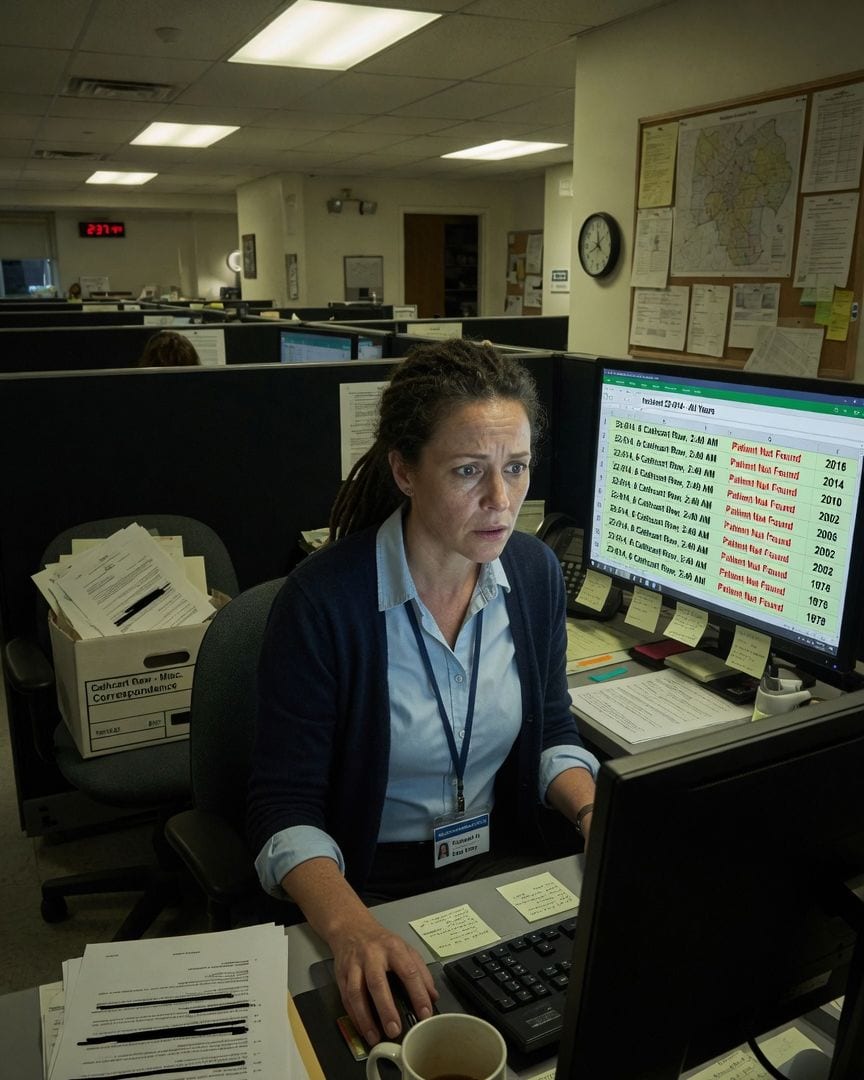
My computer log shows the same 2:40 AM call to Cathcart Row, every four years since 1978, always closed 'patient not found'.
Working data entry for the County Ambulance Trust, I found a routine incident logged as 'Patient Not Found.' But digging deeper, I discovered the exact same phantom call had repeated every four years for over forty years, always at the same address, always at 2:40 AM. Then I found a heavily redacted memo linking it to my own street.
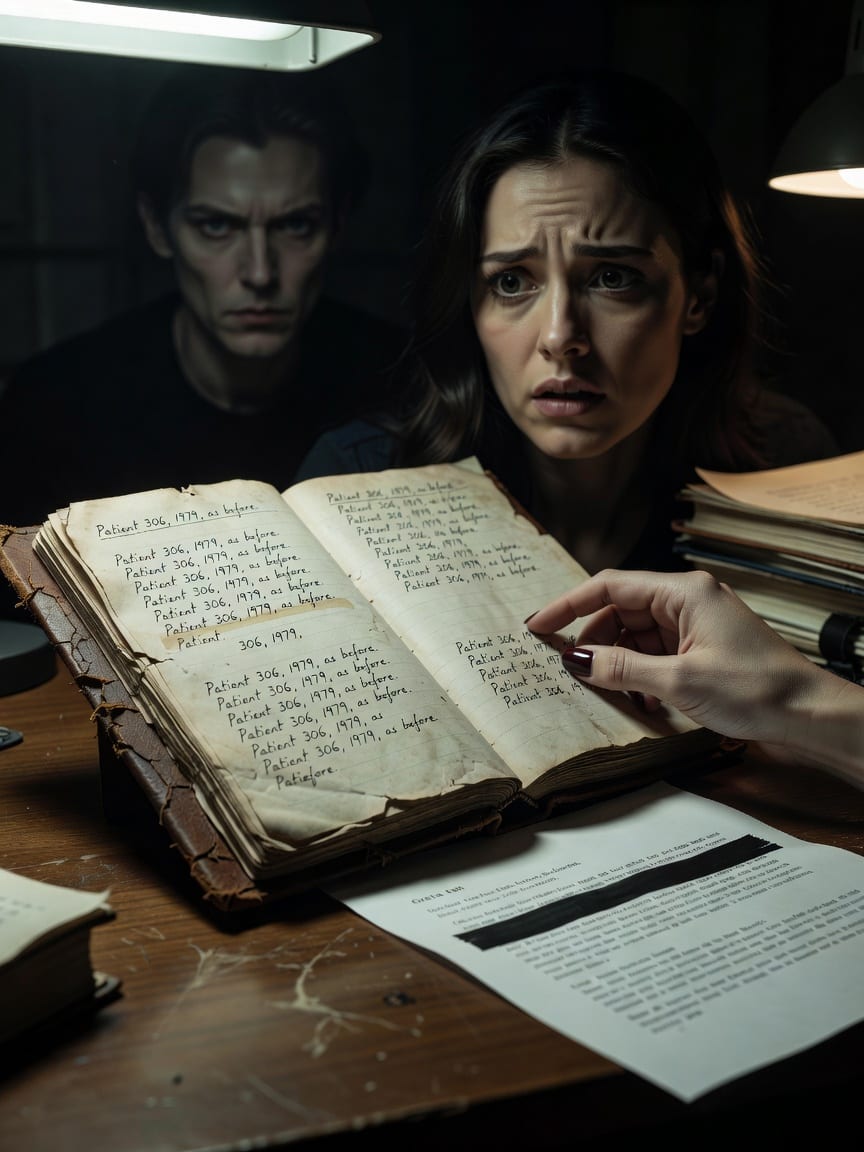
My archive ledger shows Patient 306 admitted in 1889, 1911, 1934, 1957, 1979 — same diagnosis, different names, and always, 'as before.'
My job as an archive transcriber is usually soothing, digitizing ancient admissions ledgers. But a recurring entry for 'Patient 306' caught my eye, noted 'as before' in the same hand for nearly a century. Digging deeper, I found a council file, dated 1998, outlining 'containment procedures' – and it named my own street and surname.
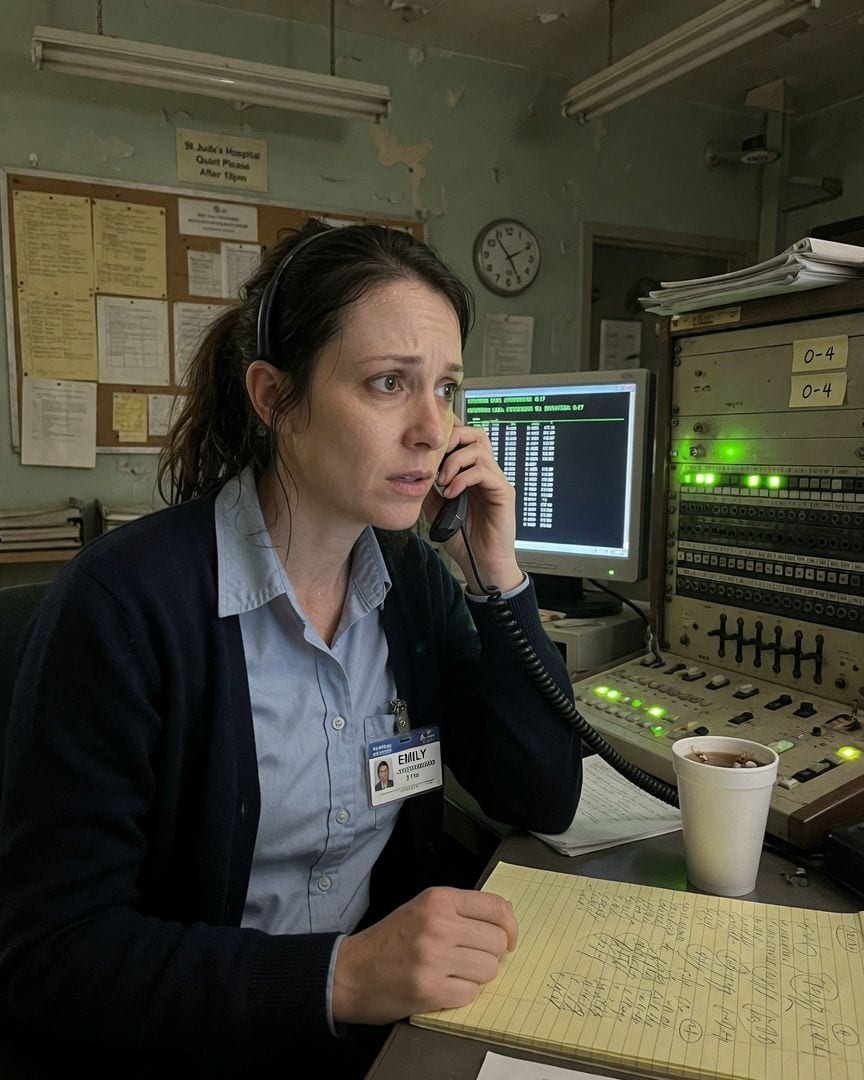
A nurse's voice asks me to page Dr. Reyes to the third floor. My hospital's third floor was demolished years ago, and extension 0-4 with it.
Working the quiet overnight shift at St. Jude's, I was used to predictable clicks. But just after 4 AM, my switchboard lit up: a call from extension 0-4. That extension was decommissioned decades ago, tied to a floor that no longer exists, yet the light pulsed insistently.
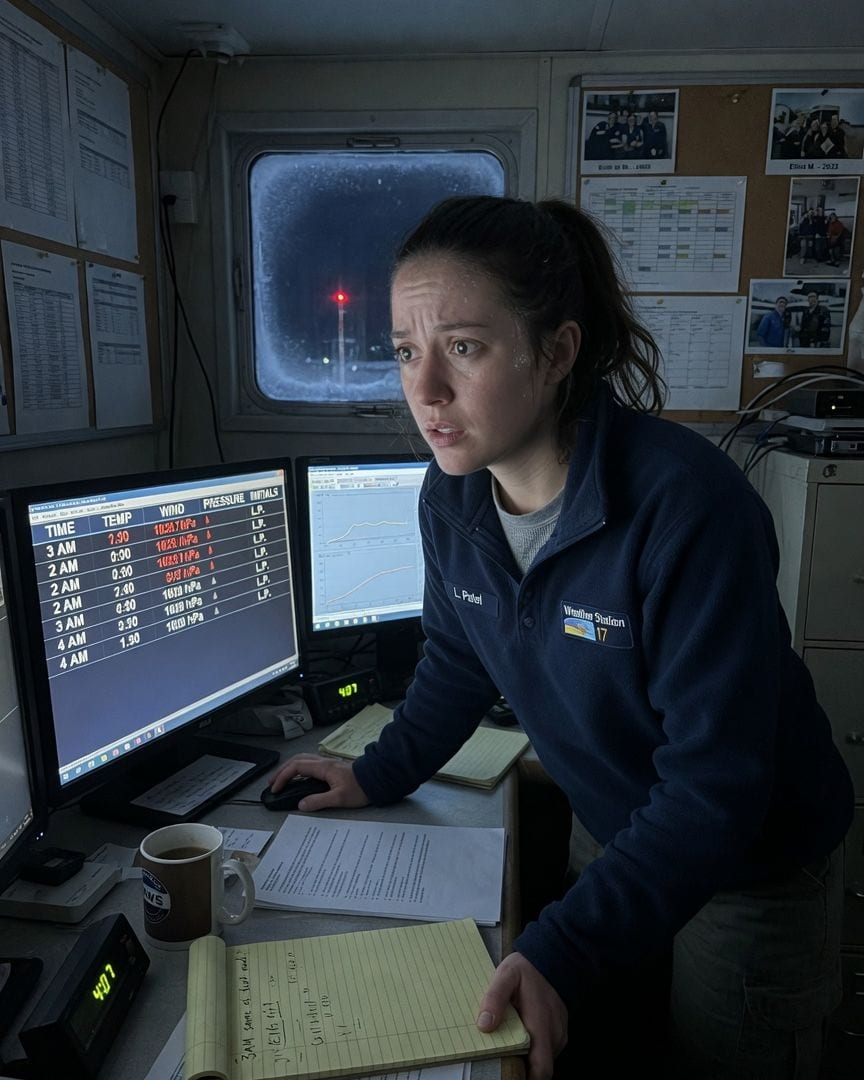
My weather station's 3 AM log shows a pressure reading I never made. My initials are on it, but the dials were dead still.
Working the overnight shift at the remote weather station, I routinely checked the digital logs. The 3 AM entry showed an impossible barometric pressure spike, a hurricane that simply hadn't happened. I distinctly remembered being outside at that time, calibrating a sensor, not making that entry. Yet, my initials, L.P., were clearly logged next to data I never made.
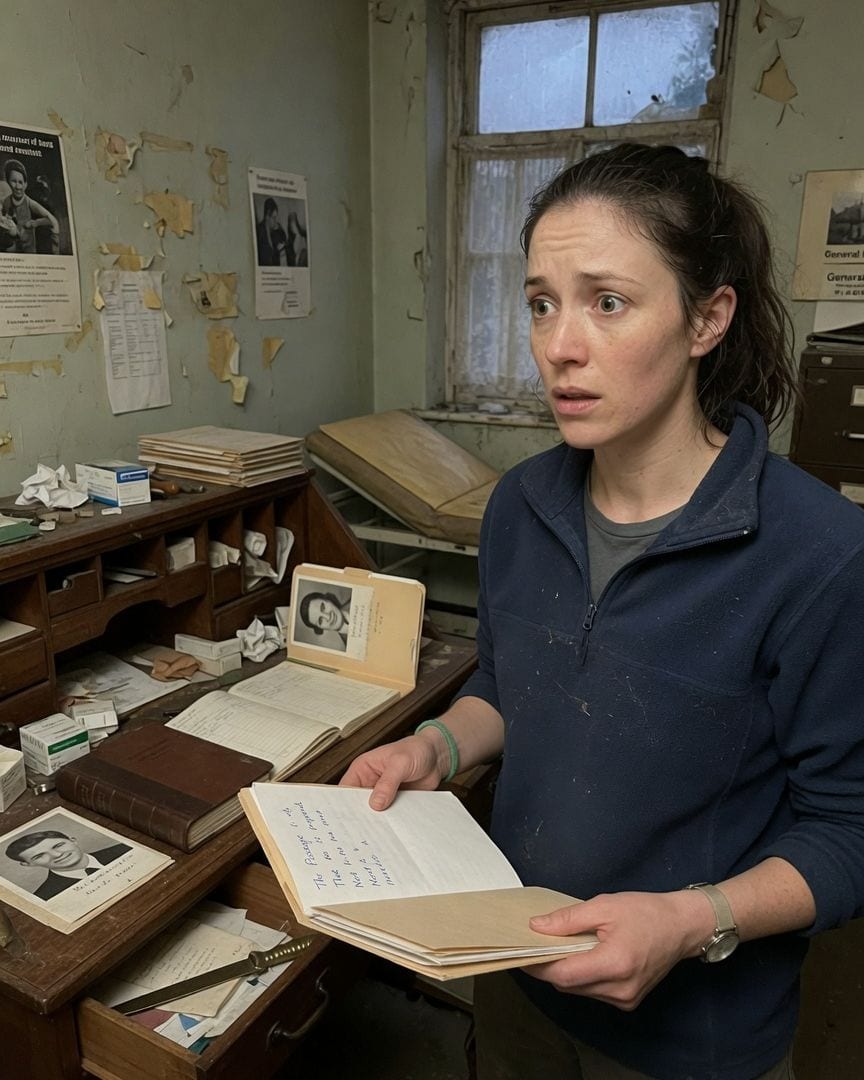
My new clinic's appointment book shows entries for this coming Monday, decades after the doctor retired and died.
Chloe Lawson bought an old, abandoned surgery in Nettlebed, ready to open her new vet clinic. Locals insisted Dr. Almott retired in '79 and the practice shut down for good. But then Chloe found his dusty appointment book filled with meticulous entries, continuing unbroken from 1979 through the decades, right up to this coming Monday.
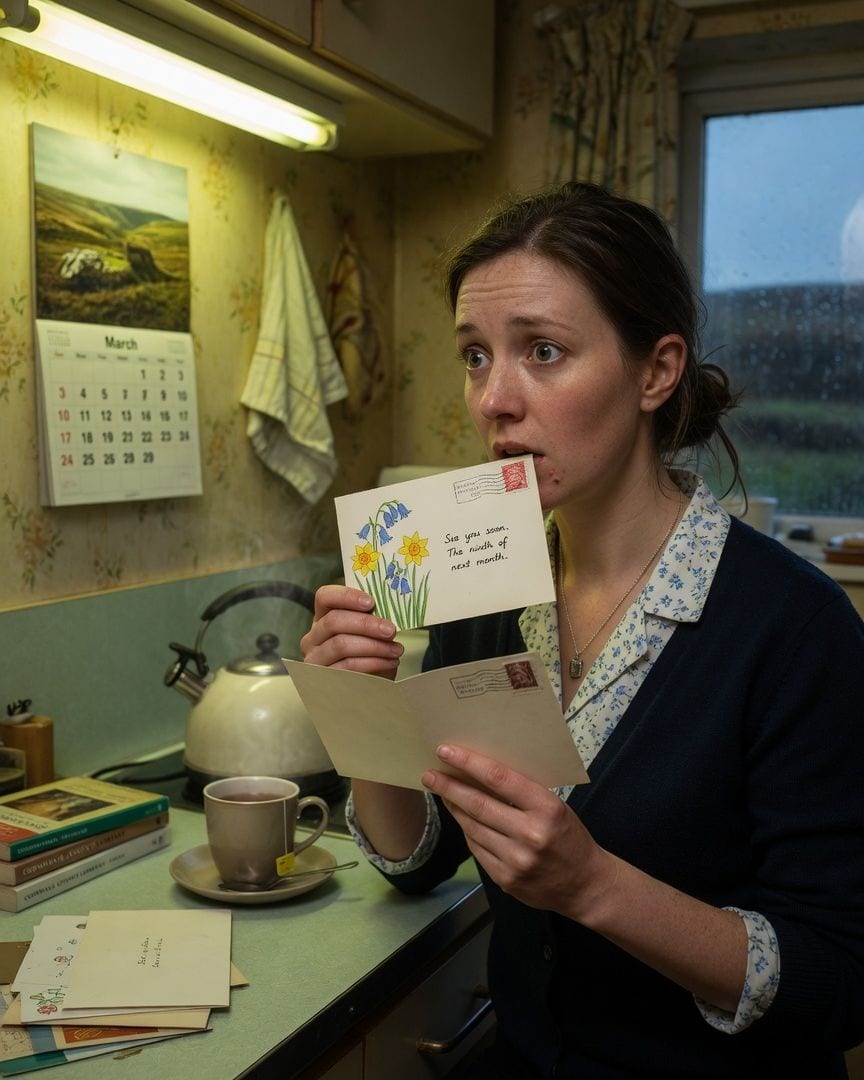
My get-well card arrived from a field, postmarked from a sanatorium that burned down in 1963. It wished me well for an operation I've never had, scheduled for next month.
I was just making tea on an ordinary Tuesday when a strange letter arrived. It was postmarked from Treneglos Sanatorium, a place that burned to nothing over sixty years ago, and contained a get-well card for an operation I'd never had. My research into this impossible message then led me to an old patient register where I found my own name, dated 1958.