A man just took the elevator to the sealed sub-basement. He isn't on any staff roster, but my initials are in the logbook.
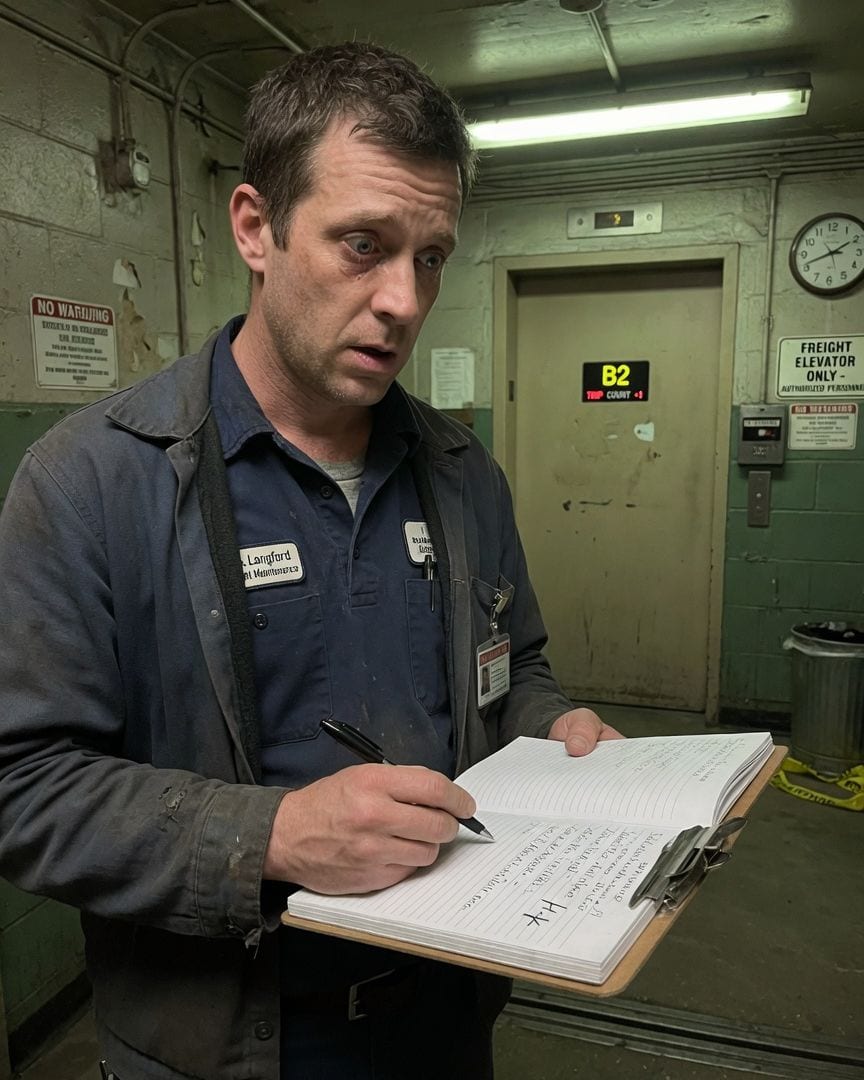
The shift was almost over, 5 AM, the quietest part of the night. I was in the freight elevator bay, clipboard in hand, ready to initial the maintenance logbook.
Just a formality, a daily check that the old Montgomery Building’s one and only freight lift was still operational. Most of my job was like that: routine, dull. Picked up the pen, felt its familiar weight in my hand.
Then my eyes snagged on the last entry, logged for just a few hours ago.
Today's readout showed a full run to the sub-basement. Time stamp: 2:40 AM. Doors held open for ninety seconds. My key-switch cycle activated.
The sub-basement. The one that’s been sealed for at least a decade, ever since the asbestos survey. Everyone knows that. There’s no access. Not officially.
But the logbook, right there, claimed I sent it down. Claimed I waited for it. The counter on the digital display above the door, sure enough, ticked up by one trip.
And next to the entry, scrawled neatly in black ink, were my initials: 'A.L.' A perfect match for my own, for the signature I’d been writing since I was old enough to hold a pen.
I stared at it. I distinctly remember where I was at 2:40 AM. On the 5th floor, checking fire exits, making sure the emergency lights were all functioning.
Miles from the freight elevator, which I hadn't touched since my last round, hours before.
I checked the elevator’s digital display again. It still confirmed the trip, mocking me with its mechanical certainty.
I rubbed my eyes, convinced it had to be a glitch, a phantom reading, maybe some stray electromagnetic interference in this antique building.
But the pen in my hand felt heavy, suddenly cold against my fingers, as if it knew a secret I didn't.
I signed the next line, the current one, my own initials feeling foreign under my thumb, then slammed the logbook shut. No way.
The next night, I made a point of being extra vigilant, keeping an eye on the freight elevator, like a hawk.
I rode it up and down, checking all floors, carefully avoiding the sub-basement button, which was supposed to be deactivated anyway. The logbook entry from the night before still nagged at me. It had to be a system error.
Nothing else made sense.
Later, in the breakroom, I mentioned it to Janet Reynolds. Janet’s 62, the night dispatcher, been here longer than anyone. She was hunched over her crossword puzzle, a mug of lukewarm coffee steaming beside her.
"The old girl acts up sometimes, Adam," she hummed, not looking up. Her pencil scratched against the paper. "Don't let it get to you. Just sign what you did."
"But I didn't do it, Janet," I insisted. "It signed my initials for a sub-basement trip I never made. The sub-basement is sealed."
She finally looked up, her gaze steady, but there was a strange, knowing quality to her eyes, like she was seeing something beyond me. She just nodded, then went back to her crossword.
"It's just the quiet of the night, Adam. Makes things seem stranger than they are."
I let it go, but the unease didn't. I couldn't shake it.
The night after that, around 2:30 AM, I was patrolling the ground floor near the freight elevator bay. And then I saw him. A figure in a faded maintenance uniform.
A man I’d seen before, usually just a quiet presence, moving through the building like a ghost, always heading towards the service areas. I thought his name was Arthur Montgomery.
He was a man in his late 50s, I guessed, with thin grey hair and a perpetually tired look. I’d never really spoken to him, just the usual nods. Tonight, I gave him a curt nod.
He returned it, his eyes meeting mine for a beat longer than usual. Then, to my surprise, he stepped into the freight elevator.
He inserted a key-card into the control panel—a master card, by the looks of it—and then, with a slow, deliberate movement, he pressed the sub-basement button.
My blood ran cold. The light next to the button glowed.
I watched, transfixed, as the indicator above the door descended, floor by floor, past 'G' for ground, past 'B1' for the first basement, then finally, to 'B2' – the sub-basement.
The light stayed there, holding for a full minute, maybe more. Then it started its slow ascent.
When the doors finally hissed open, Arthur emerged. He didn't carry anything. Didn't look any different. He just gave another small nod, a half-smile, and headed towards the maintenance bay, disappearing around the corner.
I waited until he was gone, then rushed to the logbook. Sure enough, there was a new entry. 2:40 AM. Sub-basement trip. And next to it, the initials: 'A.L.'
My initials. I didn't sign it. Arthur didn't sign it. And the sub-basement is sealed.
Driven by a gnawing unease, a cold dread that was starting to feel very real, I decided I needed to properly introduce myself to Arthur Montgomery. I needed answers.
I walked over to the maintenance bay, the fluorescent lights humming overhead. His small office was dark. No one inside. I checked the locker room, just off the bay.
A bank of lockers lined the wall, mostly old, dented grey metal, showing decades of wear. But then I saw it. One locker, clearly new, pristine grey, stood out from the others.
A brand-new, unused padlock hung from the hasp, glinting under the harsh light. No nameplate. No belongings visible through the vents. Empty.
I walked over to the staff roster hanging on the wall – a laminated sheet with names and photos of all current maintenance staff. I scanned it twice, then a third time, my finger tracing the columns.
John, Maria, Kevin, David. No Arthur Montgomery. I checked the shift schedule tacked up beside it, then the sign-in sheets for the last week. Nothing. No record of anyone named Arthur Montgomery ever working here.
I pulled out my phone, quickly searching the company directory. Empty.
I stood there, the fluorescent lights buzzing, the silence of the empty room pressing in, a chill creeping up my spine. Arthur Montgomery didn't exist.
And this man, this non-existent man, had just signed my initials to a logbook for a trip to a sealed level.
The next few nights blurred into a frantic, secret investigation. My rational mind screamed for a simple explanation—a prank, some elaborate joke—but the evidence kept piling up, each piece more unsettling than the last.
I started carrying a small, voice-activated recorder in my chest pocket, just in case. I staked out the freight elevator, hiding in stairwells, trying to catch Arthur in the act.
I never saw him use a pen, never saw him approach the logbook. Yet, every single night, at 2:40 AM, the sub-basement trip was logged, signed 'A.L.' My initials.
I became obsessed. I started digging through the building's historical records, down in the dusty HR archives in the basement, past the old boiler rooms.
I found no Arthur Montgomery, not in any of the employee files going back thirty years. But I did find a pattern. Prior to my own hiring, the night security position had a remarkably high turnover rate.
Several guards had transferred or resigned within six months, often citing 'unspecified personal reasons.' And then I noticed something else in the official elevator logbook. The initials, before mine, sometimes subtly shifted – from 'J.D.' to 'T.W.' and then 'A.L.'
– always correlating with the current night guard. It was too precise to be coincidence.
I even tried to access the sub-basement through the official sealed panel in the main ground floor corridor. It was triple-bolted and reinforced, cold to the touch. Nothing was getting through there. So how was the elevator?
The air around the freight elevator, especially around 2:40 AM, felt noticeably colder. Sometimes, a damp, earthy smell, like overturned soil after a rain, would waft from the shaft.
I tried to get Janet to open up again, asking more directly about 'Arthur.' She just shook her head, her gaze distant, like she was watching something unfold miles away. "Some things are better left alone, Adam.
The quiet of the night holds its own secrets."
My clandestine investigations didn't go unnoticed. I felt watched.
One night, while I was reviewing old security footage in a darkened office on the second floor, I saw a flicker in the periphery of a camera feed – a shadow that moved too fast to be human, just outside my office door.
I froze, rewinding the footage, but it was gone, swallowed by the low resolution.
Another night, as I was trying to discreetly photograph the elevator logbook with my phone, I felt a sudden drop in temperature, like a cold hand on my neck. The hairs on my arms stood up.
I spun around, but the corridor was empty, save for the hum of the old building.
The recorder I carried sometimes captured faint whispers when I was alone near the elevator. Just beyond intelligibility, like someone speaking through thick glass.
I played one back, isolated and amplified, the sound almost painful in my headphones: a low, guttural murmur that sounded unmistakably like a name, my name, drawn out and distorted, like a long, slow sigh of recognition.
I started seeing Arthur more frequently, not just near the elevator. He’d appear in the distance down a corridor, just watching me. Sometimes standing perfectly still in a darkened alcove, his face obscured by shadow, a silent, patient hunter.
I tried to approach him, to force a conversation, but Arthur always seemed to melt away, turning a corner or stepping into an unlit stairwell before I could close the distance.
His presence felt less like an unknown colleague and more like a silent, patient hunter.
One evening, I walked into my office to find a single, freshly-sharpened pencil lying on my desk, right next to the open elevator logbook. I’d distinctly remembered locking that logbook in my office drawer before my shift.
The pencil was poised, as if waiting for me to initial the next entry. I felt a profound chill, the kind that went bone-deep.
Whatever was doing this, whatever was behind Arthur and the logbook, knew exactly what I was doing. And it was playing with me.
I couldn’t take it anymore. I slammed the dusty HR files onto Janet's desk in the dispatch office. The thin stack of personnel records made a pathetic thump. "There's no Arthur Montgomery, Janet. Not in any of these files.
And this elevator log," I pointed to the official book on her console, "it keeps signing my initials for trips I didn't make. What's going on?" My voice was tight, a thin wire stretched to breaking.
Janet flinched, her usual calm finally cracking. Her eyes darted around the small office, as if checking for unseen listeners.
Then, with a sigh that seemed to carry years of weariness, she pulled a dusty, leather-bound book from a hidden compartment beneath her console. It looked ancient, its cover cracked and worn. "This isn't official, Adam.
This is… my own record."
She opened it to a brittle, yellowed page. It was an old logbook, mirroring the official one, but filled with dozens of different initials, all for the 2:40 AM sub-basement run. She ran a gnarled finger down a column. "T.W.
Trevor Walsh. Night guard, 1998. Said he had to move for family. Never heard from him again." She flipped pages, the brittle paper almost crumbling. "J.D. Janet Doyle."
She stopped, pointing to a familiar set of initials beside a faded entry. "That was me, before I married. I was the guard before Trevor."
I saw her initials, 'J.D.', clearly there, signed for the sub-basement trip, at 2:40 AM. My voice was barely a whisper. "You signed this, Janet?"
She nodded, a haunted look in her eyes. "I did. For a while. Until… I learned to adapt." She closed the book for a moment, then reopened it to a fresh page, still decades old.
She pointed to the initials again, tracing mine. "The initials… they're not yours, Adam. Not really. They’re the mark. The mark of the witness. It learns to mimic the current guard’s hand, his identity. Arthur… he’s just a shadow.
A memory of a previous witness, given form. It’s what stays down there, in the quiet, in the dark. It needs its maintenance."
My eyes scanned the pages she’d shown me, then darted to the official logbook on her desk. I saw my own 'A.L.' initials appearing consistently across multiple pages, signed by different names, different hands, different eras.
The cold, the whispers, Arthur's non-existence, the high turnover – it all snapped into place. A horrifying coherence.
Janet closed the unofficial logbook again, her hand trembling. "It wants a witness, Adam. Always has. Someone to acknowledge its presence, to facilitate its… routine." She looked at me, her eyes filled with a desperate, ancient fear.
"It doesn't kill them, not exactly. It… incorporates them. Their presence, their identity, their signature. Arthur… he was a guard once, just like you. And before him, someone else. This building… it keeps its own kind of staff. Perpetual."
My stomach clenched, bile rising in my throat. "So what happens to the ones who leave?"
Janet shook her head, a single tear tracing a path down her wrinkled cheek. "They don't leave, Adam. Not really. They just… become part of the quiet. Part of the routine. You've been here three months now.
That's usually when Arthur starts to show himself more clearly."
She opened the unofficial logbook one last time, her gnarled finger tracing a set of familiar initials – my initials – in the faded logbook, next to the name of a guard who vanished in '98.
She looked up, her eyes wide with a shared, terrible knowledge, and whispered, "It’s not your name it wants, Adam. It’s what you represent."
Janet pulled me closer, her voice a strained whisper, barely audible above the hum of the old dispatch equipment. "The sub-basement isn't sealed to keep things out. It's sealed to keep it in.
And the elevator… that's its only way to interact, to draw in a new… aspect."
She explained that the entity wasn’t some beast that tore and shredded. It was something far more insidious. It fed on presence, on recognition, on the quiet, unnoticed routine of the night.
The 'maintenance,' the nightly trips to the sub-basement, was its way of asserting control, of expanding its reach within the building. The 'witness,' the night guard, was its anchor to the waking world.
"Arthur is just the face it wears," she murmured, "a memory of a guard from the 1960s, a quiet man who was the first to truly disappear. Now it’s learned your cadence, your habits, your initials."
My mind raced, connecting the dots that Janet's words were illuminating: the cold spots, the whispers, the empty locker, the phantom trips, the ever-present Arthur Montgomery who didn't exist. It all fit.
The entity wasn't a monster in the traditional sense; it was a slow, insidious assimilation, a quiet horror that turned people into echoes, into parts of its own endless night shift.
The logbook wasn't just a record; it was a contract, signed by the entity through the hands of its current witness.
The 'maintenance' was the upkeep of its own existence, its own dark, quiet domain, expanding through the building, floor by floor, one night guard at a time.
I knew, with a sickening certainty, that I couldn't stay. I had to break the cycle. Janet, resigned to her own survival, told me the only way out was to refuse the signature. To break the pattern.
But it wouldn't be easy.
That night, I avoided the freight elevator like it was a gaping maw. I patrolled the farthest wings of the building, checking every fire exit, every secure door, trying to make myself scarce, trying to break the routine.
But the cold followed me. The whispers grew louder, clearer, calling my name, a low, guttural chorus that clawed at my sanity. I saw Arthur everywhere, a silent, menacing sentinel at the end of every corridor.
His form was more distinct now, the maintenance uniform clearer, but his face remained in shadow, his eyes glowing with an unnerving, patient intensity.
At 2:38 AM, just minutes before the scheduled 'maintenance' trip, I found myself cornered in a stairwell on the third floor. Arthur stood at the bottom, his form indistinct in the gloom, but his eyes were like twin coals.
"The log awaits," Arthur's voice rasped, a chorus of faint, echoing voices beneath his own, a whisper of a hundred previous witnesses. "The routine must be maintained."
I didn't run. I pulled out my master key-card, the one that operated the elevator, the one that granted me access to everything.
With a desperate surge of adrenaline, I jammed it into the emergency power cut-off for the entire freight elevator system, located high on the wall beside the stairwell door.
Sparks flew, spitting and hissing, the overhead lights flickered violently, and the old building groaned like a wounded animal. The elevator shaft, visible through the wire mesh, went utterly dark, plunging into absolute silence.
Arthur let out a sound that was both a gasp and a shriek, a cacophony of agony.
His form flickered, dissolving into the shadows at the bottom of the stairwell, as if his very existence was tied to the mechanism I had just broken. I didn't wait.
I sprinted out of the building, leaving my uniform, my recorder, everything behind, never looking back. I carried only the chilling certainty of what I had narrowly escaped.
I never returned to the Montgomery Building. I filed a terse resignation, citing 'unforeseen personal circumstances.' My story, when I tried to tell it, was met with polite disbelief, then concerned silence.
The company attributed the elevator system malfunction to 'electrical issues' and quickly replaced me with a new night guard. Janet Reynolds continued her shifts, her face a little paler, her eyes a little more distant.
The unofficial logbook vanished from her office. The freight elevator was repaired, its sub-basement access still officially sealed.
But every night, at 2:40 AM, the digital readout in the maintenance bay still quietly ticks up one trip, to the sub-basement, doors held ninety seconds.
I moved to a different city, started a new job, far from any old, quiet buildings.
I still wake in a cold sweat sometimes, hearing the phantom hum of an elevator, the rustle of a maintenance uniform, the echo of my own name.
I carry the knowledge of what truly runs the night, a truth no one will ever believe. I know the building is still out there, quietly assimilating. I know it learned my initials.
I just hope it never learns my new address.
Months later, a comment appeared on an old, forgotten Facebook post of Adam's, a blurry selfie from his night shift days. It read: 'A.L. is still on duty.'
If this one got to you
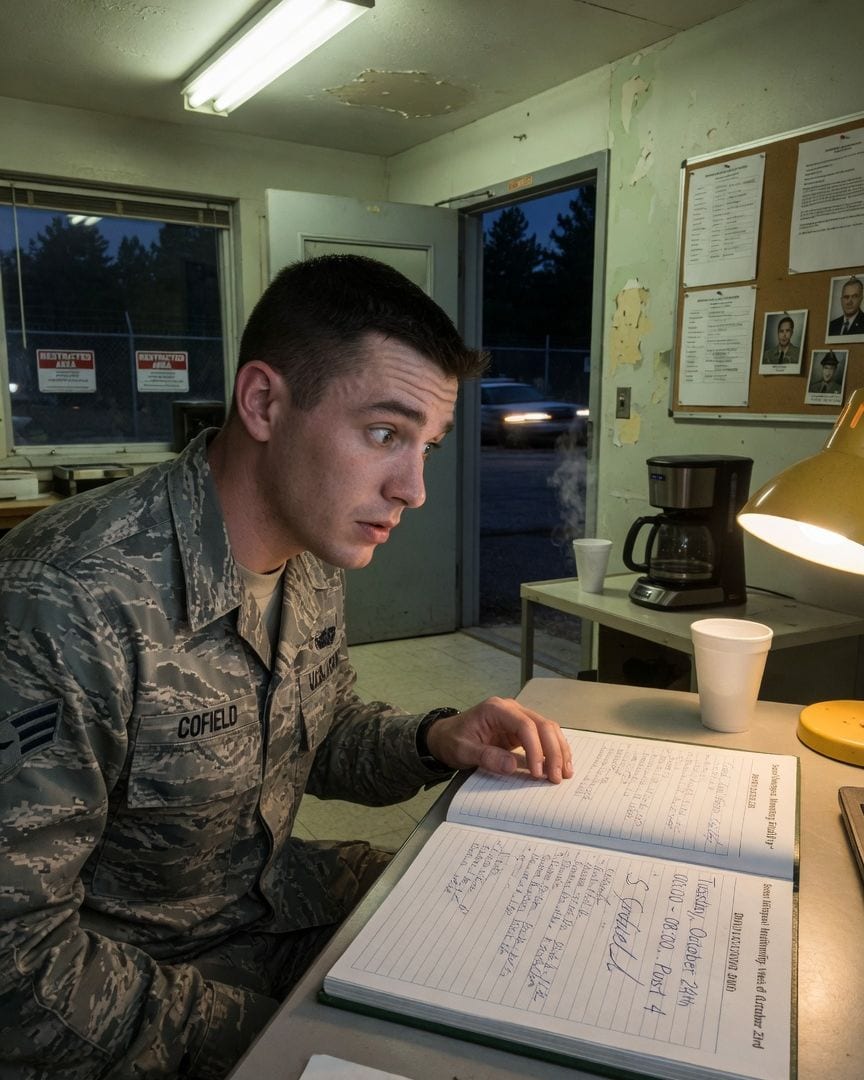
Two weeks from discharge, Senior Airman Cofield found his own signature on a logbook for an impossible shift at a facility mothballed decades ago.
Senior Airman Simon Cofield was just two weeks from discharge when he patrolled the quiet, forgotten perimeter of a mothballed weapons storage area. On a night thick with pine scent, he spotted a faint yellow light in a building officially powered down for over three decades, its alarm system inert. Inside, the building hummed with power, spotless, with hot coffee brewing and a crisp shift-change roster on the wall. But Cofield froze when he found a duty logbook with current entries, including his own name and signature, assigning him to an impossible shift next Tuesday. A cold dread settled as he realized something had just claimed him for a duty that no longer existed.
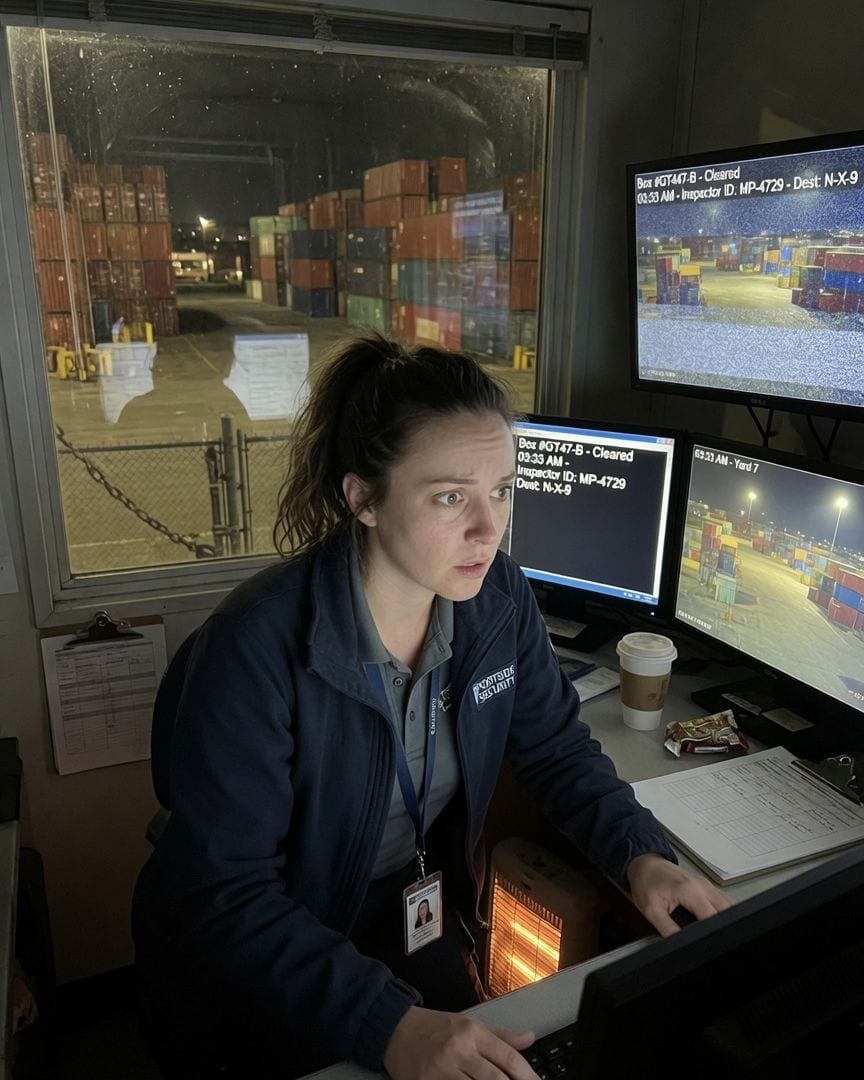
The log says a container cleared my gate at 3:33 AM, stamped with my ID — but the gate was chained and locked, and the yard beyond it was dark and empty. No truck was ever booked.
My night shift at Portside Container Terminal is usually a predictable drone of monitors and stale coffee. But then I saw a familiar guard, Arthur Larsen, on a live feed, smiling unsettlingly at the camera. The next morning, my supervisor searched for him; the employee database returned 'No results found.'
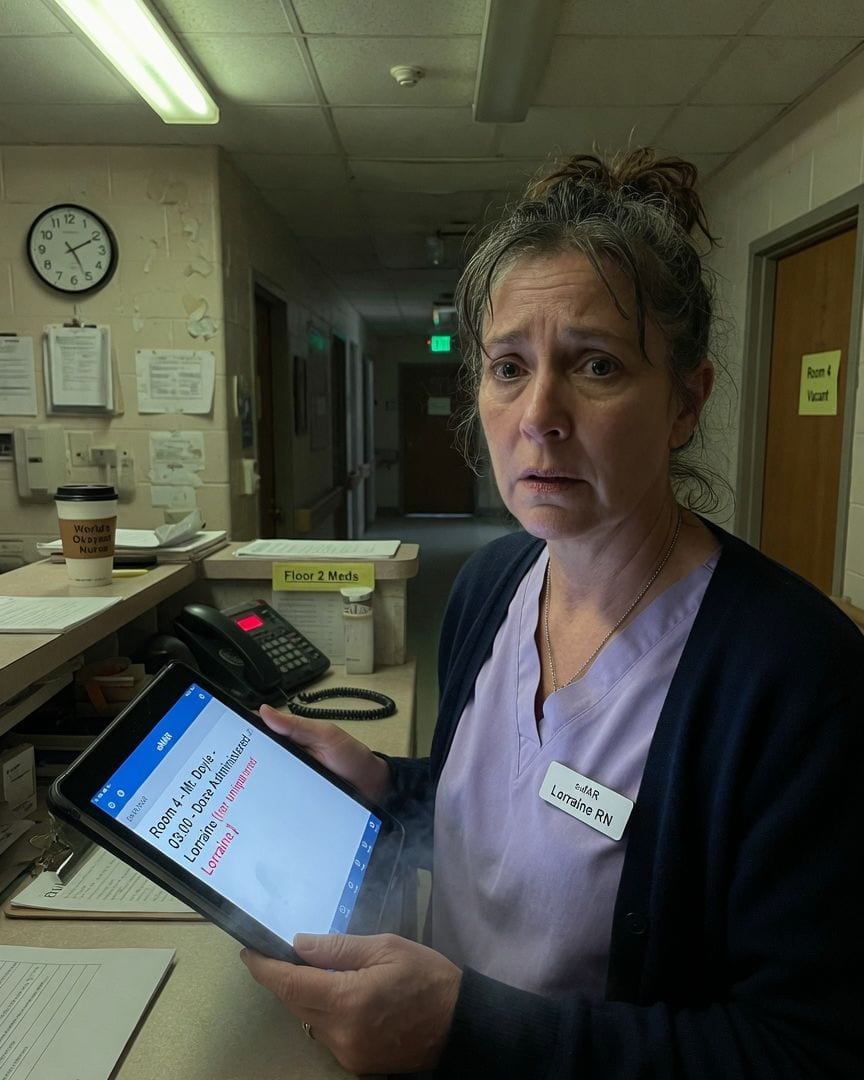
The care home tablet logged a 3am dose in Room 4, signed with my PIN — but Room 4 has been empty since Mr. Doyle died on Sunday, and I have no memory of giving it.
Working a quiet night shift at Elmwood, I double-checked patient records before clocking out. That's when I saw an impossible entry on the eMAR: my signature, administering medication to Mr. Doyle in Room 4 at 3 AM. Mr. Doyle had passed away yesterday, and his room was officially vacant, cleared, and locked.
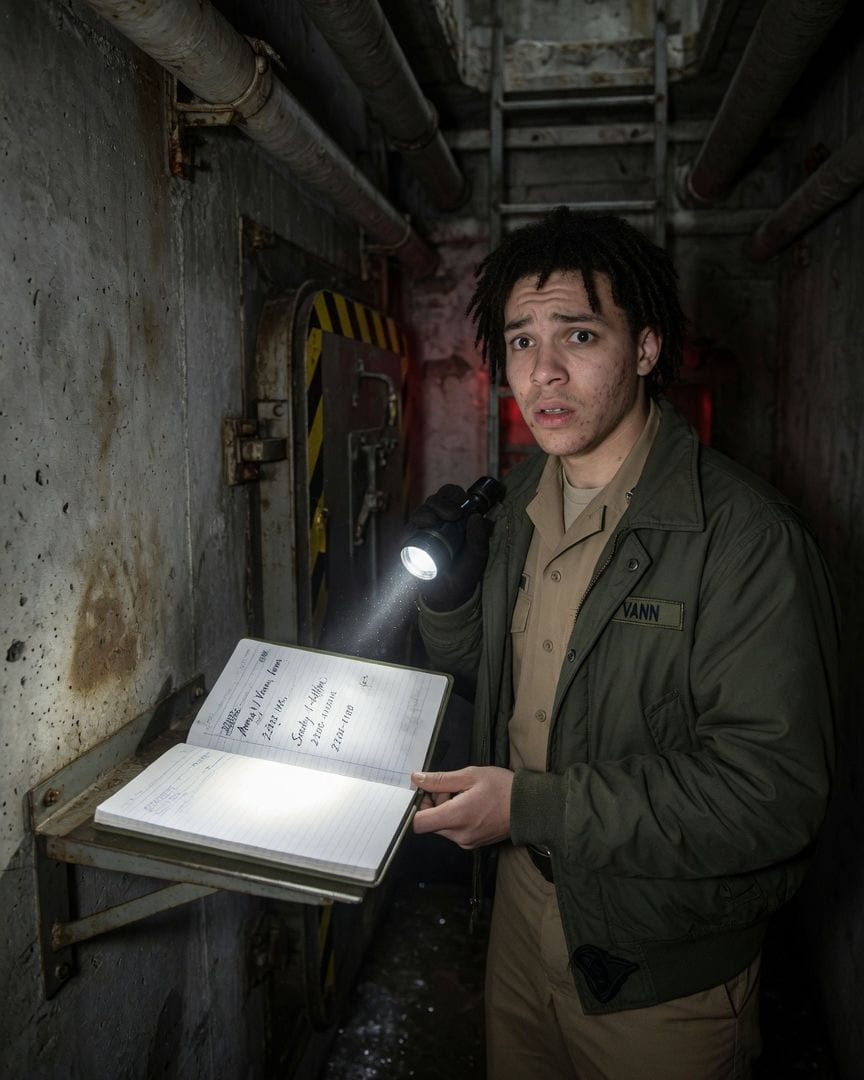
On his last patrol, Airman Vann sees a Cold War silo hatch light up from *inside*—it was welded shut a decade ago.
Airman Vincent Vann was on his last patrol across a vast, desolate Cold War missile field in the Dakotas, the cold, starless sky mirroring the emptiness of the landscape before his transfer. His routine check of eight hardened silo caps was shattered when a red fault light pulsed on Silo 4’s access panel, signaling an impossible breach from *inside* a hatch sealed for a decade. As more silos lit up, ignoring base orders, Vann found the hatch unlocked from within and descended into the dark shaft, where he discovered a pristine logbook bearing his own signature next to a chilling entry from a non-existent sentry, dated for *that very night*. Now, a steady *thump* echoed from deeper within the sealed concrete, leaving the Airman desperate for an explanation that simply wasn't there.
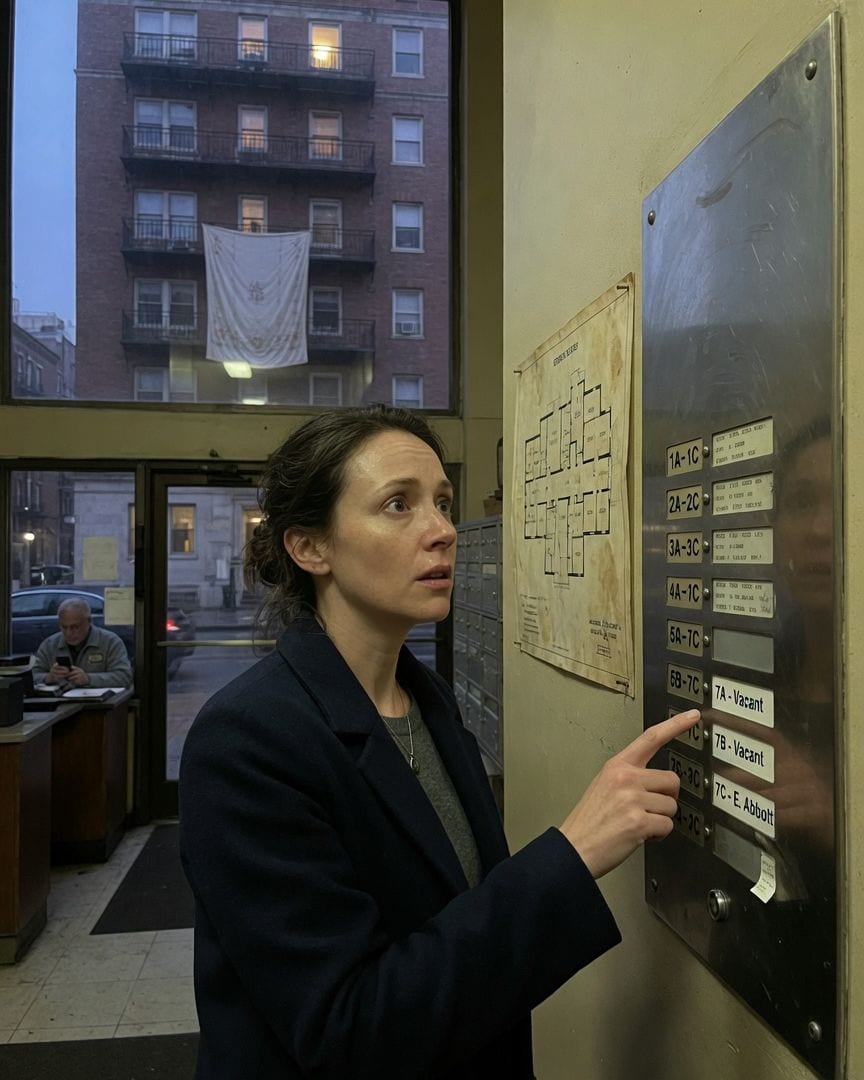
My building grew a seventh floor today, where only sky should be. On its darkest door, a nameplate reads 'E. Abbott'.
For three years, I've lived in apartment 3B of The Sterling Arms, a familiar six-story building. Every morning, I glance up at my window from the parking garage, a routine check. But this morning, my breath caught: a seventh floor, complete with balconies and a soft yellow light, now sat impossibly above the familiar roofline where only sky should have been.
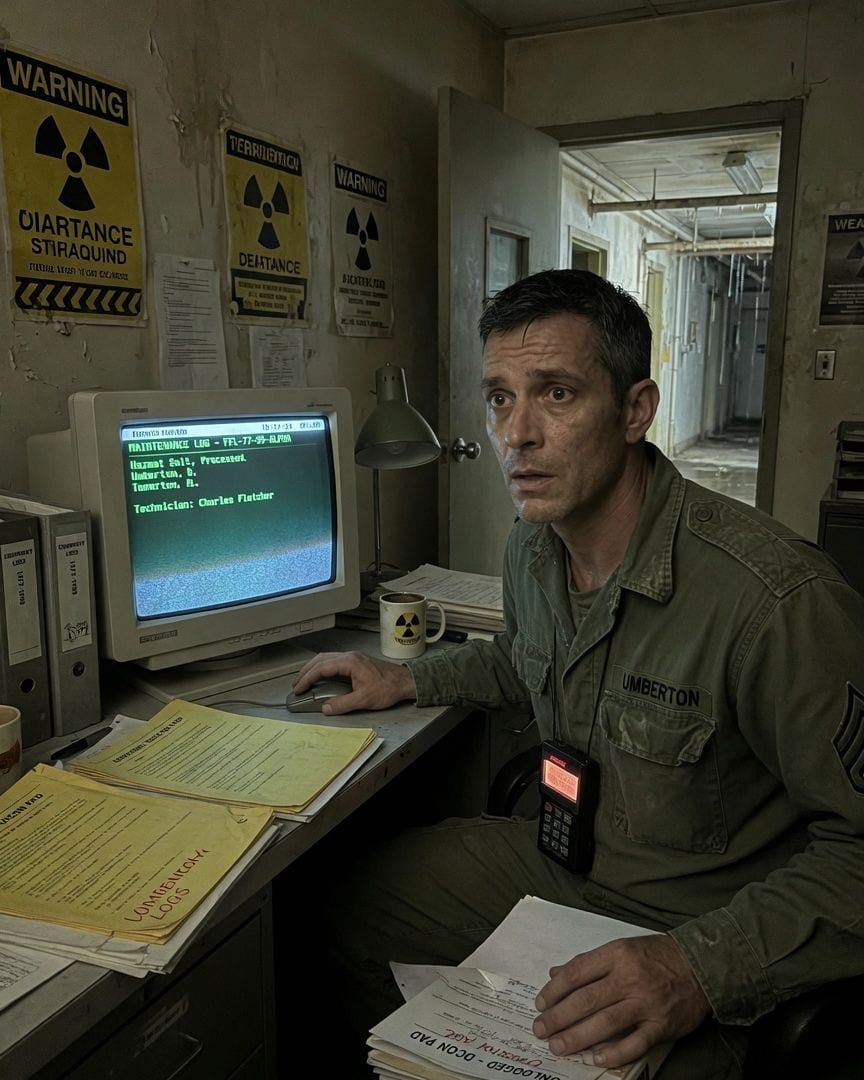
On his last shift at the closing Cold War facility, Sergeant Umberton found a hazmat suit glowing hot with his own name.
Sergeant Blaise Umberton walked his final shift at the soon-to-be-shuttered Ferriday Flats decontamination pad, the predawn air thick with ozone and the heavy silence of a closing era. His peace with the desolate site shattered when he discovered a hazmat suit, glowing faintly and shrieking on his Geiger counter, laid out with his own name stitched perfectly on the breast. Dismissed as a prank by his superior, Umberton followed protocol, but a cold dread compelled him to check the digital records of the facility's Cold War bureaucracy. There he found an entry for a hazmat suit processed under his name, dated for *tomorrow*, and signed by a technician who had retired a decade ago.