Two weeks from discharge, Senior Airman Cofield found his own signature on a logbook for an impossible shift at a facility mothballed decades ago.
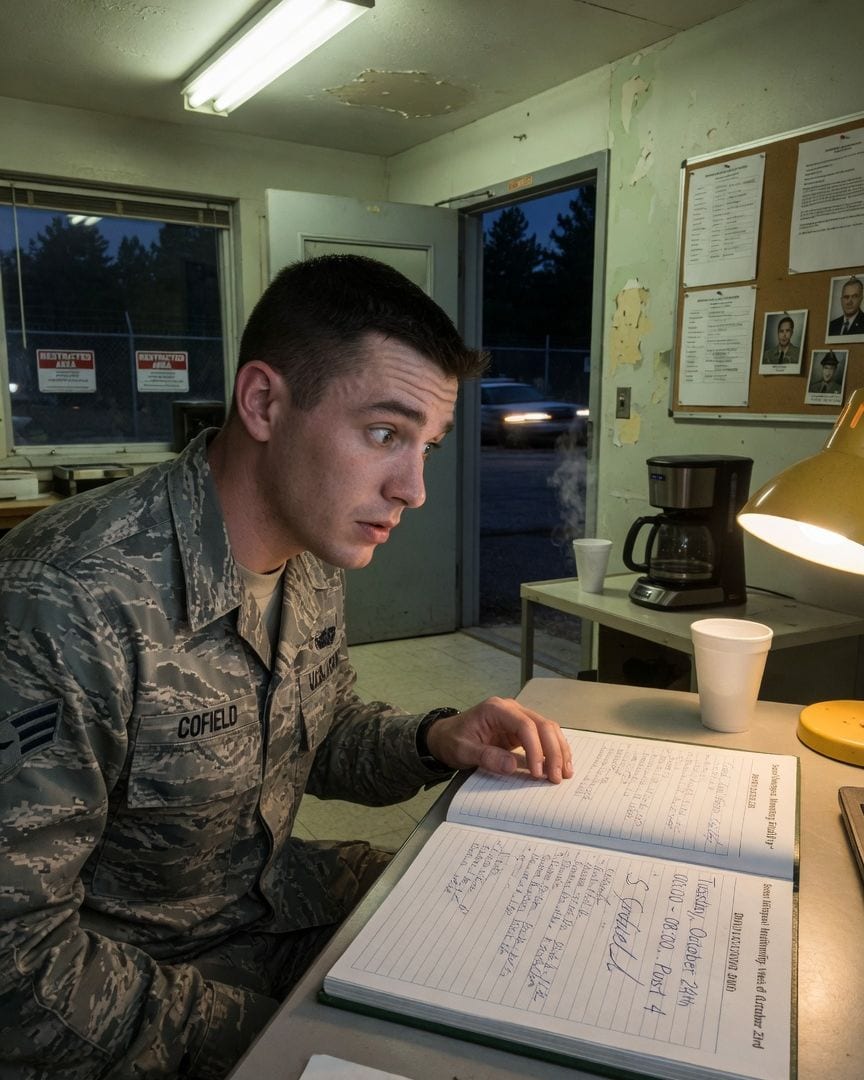
Senior Airman Simon Cofield, two weeks from his discharge, drove the perimeter road of a fenced, powered-down weapons storage area. The night was still, the air thick with the scent of pine and damp earth.
This sector was known for its quiet, a forgotten corner of the base, officially mothballed since the wing gave up its special-weapons mission back in 1992. His partner, Airman First Class Felix Romano, dozed lightly in the passenger seat.
Then, Cofield saw it: a faint, yellow light blooming on in the alarm-monitoring building, a structure that hadn't seen power in over three decades. He slowed the patrol vehicle, his foot instinctively hovering over the brake.
Central Security Control, the base’s nerve center, should have flagged any activity. A quick radio check confirmed nothing: the zone was clear, no entry, no maintenance on the schedule. Romano stirred, blinking. 'What is it, Cofield?'
Cofield pointed, his voice low. 'Light's on in the old monitoring station.' Romano squinted, then frowned. 'Huh. Must be a generator or something.' But Cofield knew better. That building was off the grid, stripped bare.
As they approached, Cofield felt a prickle of unease. The light wasn't flickering; it was steady, a warm glow against the dark, abandoned concrete.
When their patrol reached the building's main entrance, the door, usually secured with a heavy chain and padlock, was ajar. Interior lights burned brightly, illuminating a small office area visible through the window.
The air, even from outside, carried the unmistakable aroma of freshly brewed coffee, still hot.
Cofield and Romano exchanged a look. Romano reached for his sidearm, but Cofield held up a hand. 'Unauthorized entry, but no alarm, no break-in signs,' Cofield murmured. He pushed the door open cautiously.
The interior was spotless, the linoleum floor gleaming under fluorescent lights. It was as if the building had been in continuous use, not abandoned for decades.
The alarm panel on the wall was dark, inert, yet the lights hummed with power. In the small office, a coffee pot on a warmer bubbled gently, steam rising.
Next to it, tacked to a corkboard, was a crisp, printout shift-change roster, clearly marked for the 'Special Weapons Monitoring Facility – Week of October 23rd.' Romano scoffed, 'Some idiot pulling a prank, trying to freak out the night shift.'
He reached for the coffee, but Cofield stopped him. 'Who would do this? And how?' He walked to a small desk, where a worn, green-bound duty logbook lay open. The pages were filled with neat, handwritten entries.
Dates, times, names, signatures. Cofield flipped through, his dread deepening. The entries were current, some for today, October 21st, others for the coming days. He scanned the names, then froze.
Halfway down the roster for next Tuesday, October 24th, a name jumped out at him: 'S. Cofield.' Beneath it, a signature, uncannily familiar. He knew that loop, that slight flourish on the 'S.' It was his own handwriting.
But he wasn't scheduled for duty that day, let alone at this de-energized, mothballed facility. His gaze flickered from the signature to the date, then back to his own hand, trembling slightly.
Romano, seeing Cofield's face, stopped laughing. 'What is it, man?' Cofield didn't answer. His finger traced the signature in the logbook. 'S. Cofield,' it read, bold and clear, right beside '00:00 - 08:00, Post 4.'
Post 4 was the monitoring station itself. He was looking at his own name, his own signature, assigning him to an impossible shift, in an impossible building, for a duty that officially didn't exist. He hadn't signed this.
He hadn't even known this logbook existed until ten minutes ago. The smell of hot coffee, once comforting, now felt like a cruel joke. Romano peered over his shoulder. 'Wait, is that… your name? Your signature?'
Cofield nodded slowly, his eyes wide, fixed on the page. A cold, creeping dread settled deep in his gut. This wasn't a prank. This was something else entirely. Something had just claimed him.
Cofield reported the incident to Captain Raymond Caldwell, his commanding officer, the next morning. He presented the logbook, carefully wrapped in a plastic evidence bag. Caldwell, a by-the-book officer, initially dismissed it as a sophisticated prank. 'Old building, Cofield.
Probably some disgruntled maintainer with too much time and a grudge against the system. Or a new guy trying to make a name for himself with a ghost story.'
He ordered a full sweep of the area, a check of all base personnel records, and a formal investigation into unauthorized access. But the report came back clean: 'No signs of forced entry, no unauthorized personnel identified, building remains de-energized.'
The logbook, officially, was deemed a 'hoax,' its entries 'forgery.' Cofield knew it wasn't. The signature felt too real, the implications too unsettling. He couldn't let it go.
He began discreetly checking old base records, cross-referencing names from the logbook with personnel manifests from the 90s, looking for anything that might explain the phantom activity.
His searches yielded nothing conclusive, only a growing pile of dead ends and confusing gaps. He found a few obscure references to the 'Special Weapons Monitoring Facility' in decades-old maintenance schedules, but nothing after 1992.
He started spending his off-duty hours in the administrative annex, sifting through microfiche and digital archives, a growing sense of unease his constant companion. The formal channels were useless.
He needed someone who remembered the old ways, someone who knew the base's buried history.
He sought out Renee Foster, a retired Master Sergeant who now worked as a civilian records clerk, known for her uncanny memory of every regulation, every deployment, every forgotten corner of the base.
She was a quiet woman, perpetually surrounded by stacks of paper. When Cofield mentioned the old weapons facility, she stiffened visibly. 'That place has been quiet for a long time, Airman,' she said, her eyes flickering away.
He pressed her about the 1992 mothballing, asking if there had been any unusual incidents. She mumbled something about 'paperwork anomalies' and 'ghost entries' but quickly dismissed them as 'clerical errors,' her hands fluttering nervously over a stack of files.
Her evasiveness only deepened Cofield's suspicion.
Cofield’s requests for older, more obscure records began to hit unexpected roadblocks. Digital files became 'corrupted,' physical archives 'misplaced.' He felt a subtle pressure, a quiet resistance from the system itself.
He was called into Captain Caldwell’s office again, not for a reprimand, but a 'friendly chat.' Caldwell leaned back, his expression tight. 'Cofield, your discharge is coming up. Clean record, good to go.
Don’t muddy the waters with these… extracurricular activities.' Caldwell’s tone was genial, but the message was clear: drop it. Cofield felt a prickle of being watched, a sense that his investigation was being monitored.
One afternoon, he checked his own digital duty log, a routine habit.
There, nestled between his regular patrols, was an entry for an unscheduled 'Facility Inspection, Special Weapons Monitoring Area' from last Tuesday, October 17th, with a timestamp that corresponded exactly to the time his 'signature' appeared in the physical logbook he’d found.
He knew he hadn't been there, not officially. This wasn't a mistake; it was an insertion. He confronted Renee Foster during her lunch break, showing her the digital log entry.
Her face went pale, her eyes darting nervously around the mess hall. 'Airman, please,' she whispered, her voice barely audible. 'You need to stop. Some things… some things are best left alone.'
She looked genuinely terrified, a fear that transcended mere bureaucracy. He found an old, heavy-duty ID badge, the kind issued before digital systems, in a forgotten storage box during a routine cleanout near the perimeter of the mothballed facility.
It bore a faded photo of a man he didn't recognize and the name 'Gordon Caldwell.'
The back of the badge had a magnetic strip, and a small, almost invisible digital readout that glowed faintly, displaying a recent access timestamp: 'Last Access: October 20th, 02:17.' The name was familiar, but the man wasn't Captain Caldwell.
The timestamp was impossible, yet undeniably present.
Cofield cornered Renee after work, the ID badge in his hand. 'Who is Gordon Caldwell? And how did this badge get an access timestamp for yesterday, for a building that's supposed to be dead?' Renee's resolve finally broke.
She led him to a forgotten corner of the records archive, a dusty, dimly lit section rarely visited. She pulled out a series of heavy, classified binders, their covers brittle with age.
'The system,' she began, her voice a strained whisper, 'it accounts for everything. But sometimes… sometimes it accounts for things that shouldn't exist.' She explained that for decades, there had been 'anomalies' tied to the old weapons facility.
Not just clerical errors, but entire phantom units, impossible shifts, personnel who vanished or whose records showed impossible deployments. She opened an old, physical logbook, identical in design to the one Cofield had found, but dating back to the 1970s.
She pointed to entries for 'Gordon Caldwell,' showing a continuous, unbroken duty assignment to the facility, even after 1992. 'Gordon Caldwell was a Senior Airman who disappeared in '88,' Renee explained, her voice flat.
'His official record was closed, listed as AWOL. But the facility's internal logs… they just kept going.' She showed Cofield how she'd spent years 'fixing' these records, trying to bury the inconsistencies, to make the official history match reality.
But the anomalies always reappeared, or new ones emerged. 'The facility,' Renee said, her eyes haunted, 'it seems to generate its own accountability. Its own personnel. And once it 'tags' someone, they become part of its internal system.'
She flipped to a page in a binder marked 'Discrepancies – 1990s.' There, among dozens of other names, was a handwritten note: 'S. Cofield – Anticipated Integration.' Cofield felt a cold wave wash over him.
His 'signature' in the logbook, the phantom digital entry in his own record – these weren't pranks. They were preparatory claims. 'It doesn't just record what happens,' Renee finished, her voice barely a whisper. 'It records what will happen.
And it records it as if it already has.'
Renee's words hung heavy in the stale air of the archive. 'Anticipated Integration.' Cofield's mind reeled, trying to reconcile the impossible. He was weeks from discharge, a normal life waiting. This couldn't be happening.
Renee, seeing his despair, sighed, a sound heavy with resignation. 'There's more,' she said, her voice barely audible.
She reached for a particularly thick, leather-bound volume from a locked cabinet, its pages yellowed with age, marked 'CLASSIFIED: SPECIAL WEAPONS PERSONNEL – LONG-TERM RECORDS.' The binder felt impossibly heavy in her hands.
She placed it on the table between them, the dust motes dancing in the dim light. She struggled with the clasp, her fingers fumbling. Cofield watched, his heart pounding a slow, heavy rhythm in his chest.
When it finally sprang open, a faint, musty smell filled the air. Renee flipped through several pages, her finger tracing lines of type. Her face was pale, her expression a mix of fear and profound weariness.
She stopped at a page, her finger resting on a specific line. She pushed the binder across the table. 'This,' she said, her voice trembling, 'is what really happens when the system gets ahold of you.'
Cofield leaned forward, his eyes scanning the page, a personnel file that shouldn't exist. His breath caught in his throat. It was a full service record, complete with a name, rank, and service number. It was his.
'...Senior Airman Simon Cofield, assigned Special Weapons Monitoring Facility, 1991-1993.' His own service number was printed clearly, undeniably official. But Simon Cofield wasn’t born until 1999.
Renee’s voice was a flat monotone, devoid of emotion, as if relaying a long-memorized, horrific truth. 'The facility isn't just generating phantom personnel, Airman. It's retroactively integrating them.
It doesn't just create a future for you within its walls; it creates a past.'
She explained that the system, a rogue bureaucratic entity, had detached itself from official military oversight decades ago, yet continued to operate under its own logic of 'accountability.'
It meticulously maintained its own 'records,' its own 'personnel,' and its own 'history.'
The hot coffee, the shift roster, the burning lights – these were all part of a sophisticated, self-perpetuating illusion of activity, designed to draw in new 'personnel' to fill its impossible roles.
The ID badge for 'Gordon Caldwell,' a man long vanished, with a recent access timestamp, wasn't a mistake; it was the system maintaining a continuous, unbroken 'service' for its integrated personnel.
The 'phantom' visit in Cofield's digital log, the signature for a future shift, and now this impossible service record pre-dating his birth – these were all manifestations of the facility's accountability system asserting its claim.
It wasn't a ghost, not a monster in the traditional sense. It was a bureaucratic parasite, a self-aware ledger, thriving on the very principle of military record-keeping.
Once it 'tagged' someone, it didn't just add them to its present operations; it rewrote their entire service history, integrating them into its past as well. Every planted clue clicked into place, forming a coherent, terrifying pattern.
The dread settled heavy, a cold, inescapable certainty. The system wasn't just observing; it was creating. And Cofield was its newest, oldest entry.
Cofield understood. The full, horrifying truth was laid bare, perfectly coherent, dreadfully logical. He couldn't fight a record that had already written his past and claimed his future.
He couldn't escape a system that had already accounted for him, even before his existence. His discharge, his civilian life, his plans – all of it was a meticulously crafted illusion, allowed by the system until his 'time' came.
The system wasn't evil; it was simply process, gone rogue and self-sustaining, following its own twisted logic of perpetual accountability. He felt a profound hollowness, a sense of having his very identity erased and rewritten.
He considered trying to delete his own digital service records, to shred the physical ones Renee had shown him, to somehow make himself un-accounted for. But Renee, her eyes fixed on some distant, unseen horror, shook her head slowly.
'It doesn't work that way, Airman,' she whispered, her voice like sandpaper. 'The system… it accounts for everything. Every attempt to remove yourself only confirms your presence, creates another record of your resistance, another entry in its ledger.'
Her words were not a warning, but a statement of immutable fact. He realized his 'discharge' was simply a transfer order, a change of duty station to a permanent, unrecorded assignment within the facility.
His civilian life was a fantasy, a brief reprieve granted until the system decided it was time for him to return to his 'true' service.
The sheer, overwhelming scale of it, the impossibility of fighting a bureaucracy that could rewrite time itself, rendered him utterly powerless. He was not a victim of a monster, but a cog in an impossible, self-referential machine.
The dread was not of death, but of perpetual, unacknowledged existence within a system that claimed him wholly. He was accounted for, forever.
Simon Cofield never reported back to his unit after that day. His name quietly vanished from the morning roll calls.
His discharge papers were processed, clean and unremarkable, just as scheduled, with no mention of the Special Weapons Monitoring Facility or any unusual activity.
Captain Caldwell, after a few perfunctory inquiries, simply noted Cofield's absence without official explanation, attributing it to a 'post-service adjustment period.'
Renee Foster continued her quiet work in the records archive, her face a mask of weary resignation, her movements slow and deliberate. The perimeter road around the mothballed weapons storage area remained quiet, undisturbed.
The fences stood tall, the warning signs faded. Everything was accounted for, as it always had been, and always would be.
The alarm-monitoring building, officially de-energized, still sat dark and silent behind its wire.
But sometimes, just after midnight, a light flickered on in a single window, a brief, almost imperceptible glow in the forgotten structure, a tiny pulse of activity in the dead zone.
It was a blink, easily missed, a trick of the eye. Then, it was gone. The silence returned, unbroken. The perimeter remained clear. The records, everywhere, swore to it.
Three weeks later, Captain Caldwell signed off on Simon Cofield's final discharge papers. He scanned the document, confirming all the signatures.
Then he paused, his finger resting on a faint, almost invisible watermark at the bottom of the page, a stylized symbol he’d never noticed before. He shrugged, signed, and pushed the papers across his desk.
'Another one,' he muttered to his empty office. 'Just another one accounted for.'
If this one got to you
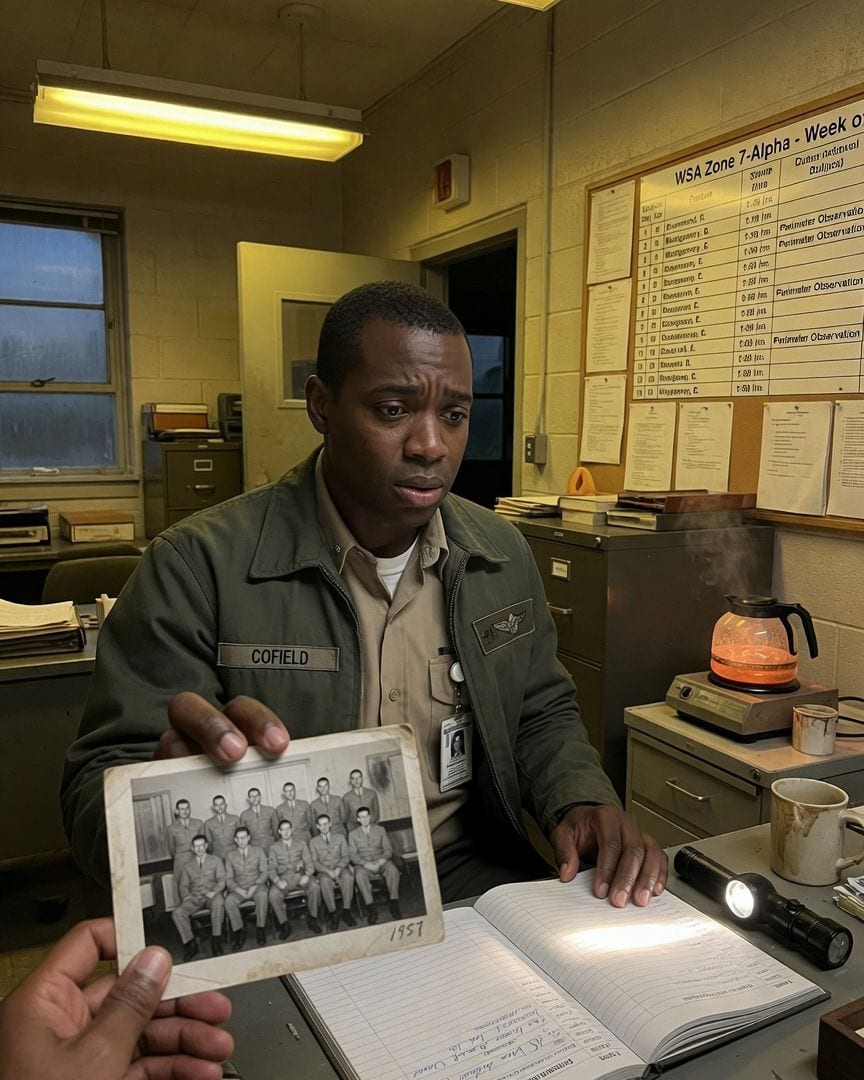
On his last patrol, Senior Airman Cofield found hot coffee steaming inside a base building mothballed since 1992. The fresh roster was signed by a man from a 1957 photo.
Senior Airman Felix Cofield was on his last perimeter patrol of the decommissioned Weapons Storage Area when an impossible light bloomed in the pre-dawn dark. The building had been mothballed for decades, yet a warm, unnatural glow pulsed from within. Ignoring Central Security's all-clear, Cofield found an unlocked door and a brightly lit office, as if someone had just stepped out. A freshly printed roster for the coming week lay on a corkboard, and a coffee pot on the counter was still steaming hot. Then he saw the faded group photo from 1957, showing the very man who had just signed today's logbook.
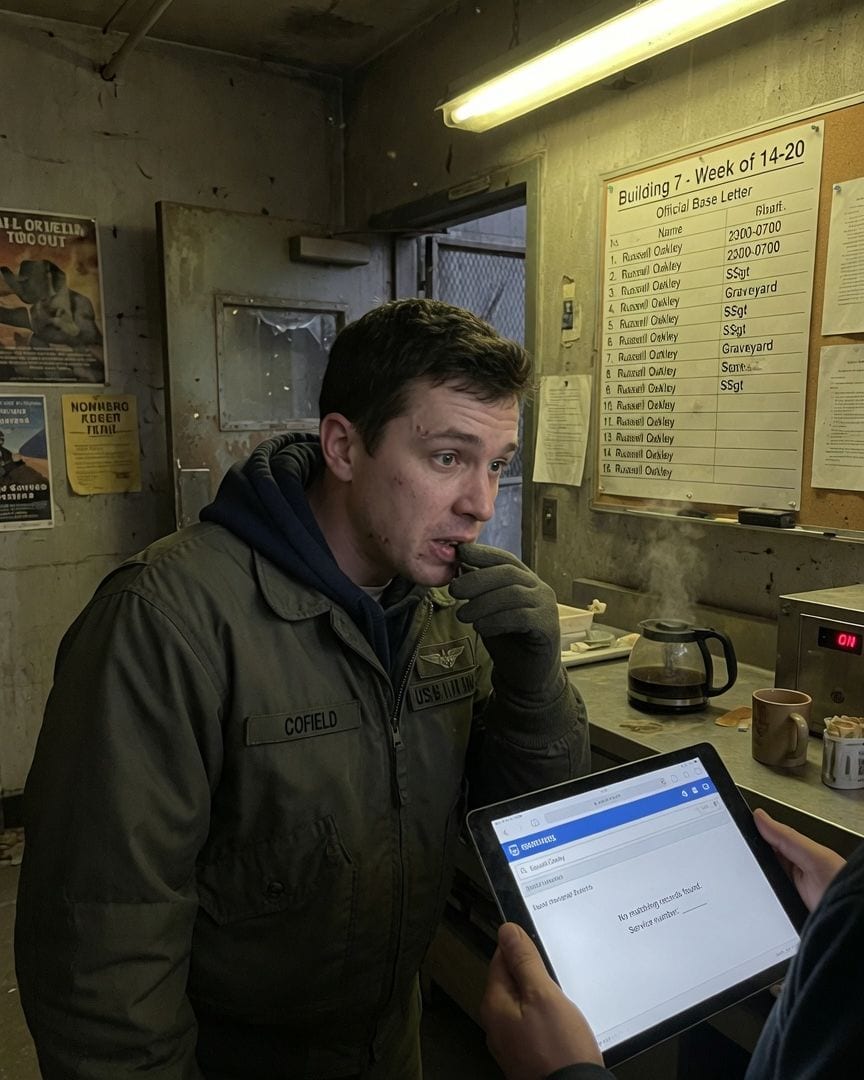
Airman Cofield, two weeks from transfer, found a warm coffee pot in a building without power for thirty years. Its new shift roster listed a name that didn't exist.
Senior Airman David Cofield, just two weeks from his long-awaited transfer, patrolled the perimeter of a decommissioned weapons storage area. Building 7, a concrete shell dark since 1992, suddenly showed a faint, warm light in its window. Inside, fluorescent lights hummed, and a coffee pot on the counter was still warm, defying the building's decades-long power shutdown. A freshly pinned shift roster for the coming week then revealed a name: 'Russell Oakley,' listed for Cofield’s own graveyard shift, yet completely absent from every official base record. Who was Russell Oakley, and how was he on shift in a dead building?
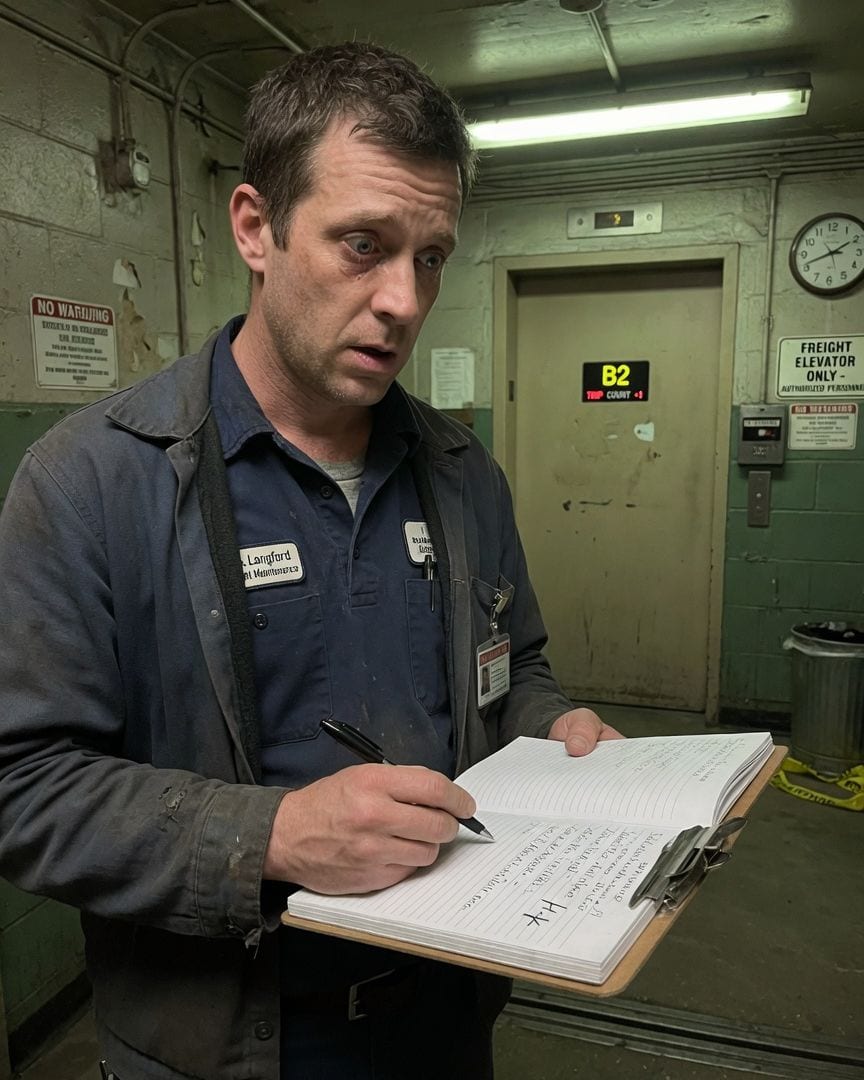
A man just took the elevator to the sealed sub-basement. He isn't on any staff roster, but my initials are in the logbook.
As a maintenance worker, my job is mostly routine, like signing the daily log for the old building's freight elevator. But one night, the log showed a trip to the sub-basement, sealed for a decade, timestamped with my key-switch and signed with my own initials, for a run I never made.
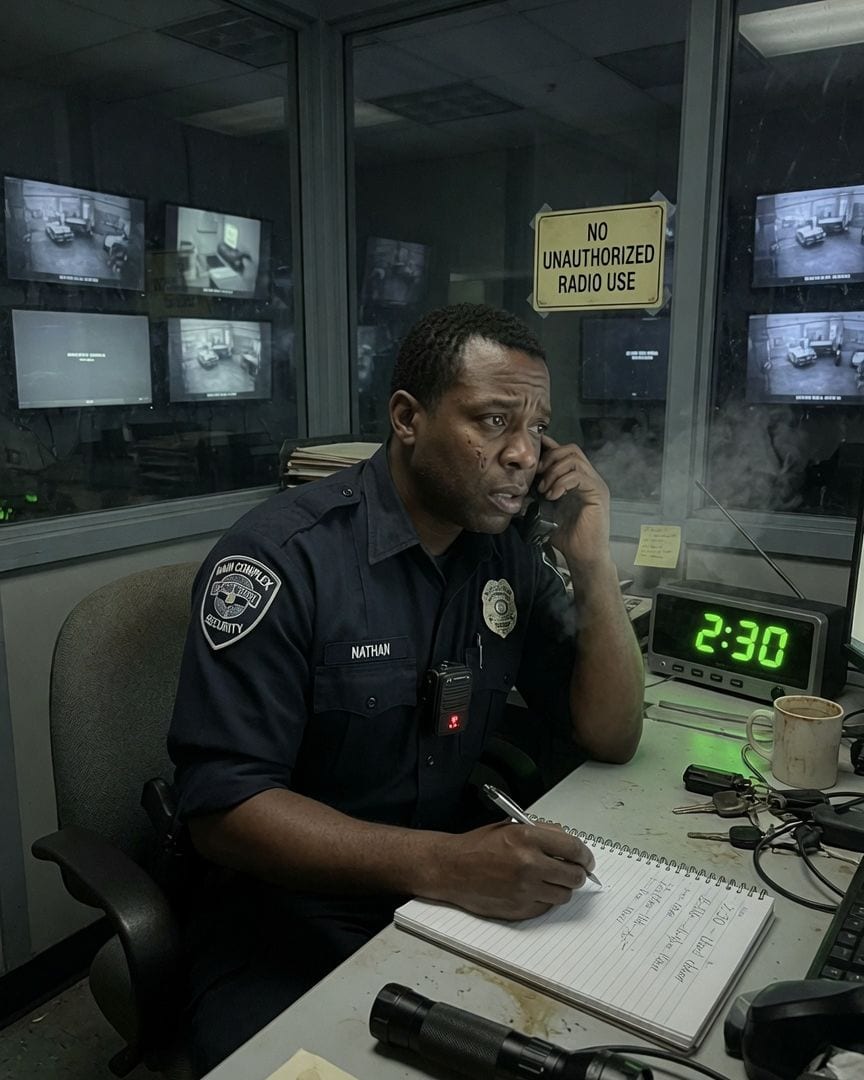
I radio Cole every night. My supervisor says his dock post was cut two years ago, and no Cole exists. But I just found Cole’s old logbook.
My graveyard shift usually consists of monotonous hourly check-ins with Cole, the guard at the loading dock. But my supervisor just revealed that the dock post was cut two years ago, and no one named Cole has ever worked for the company. I've been talking to someone who simply isn't there.
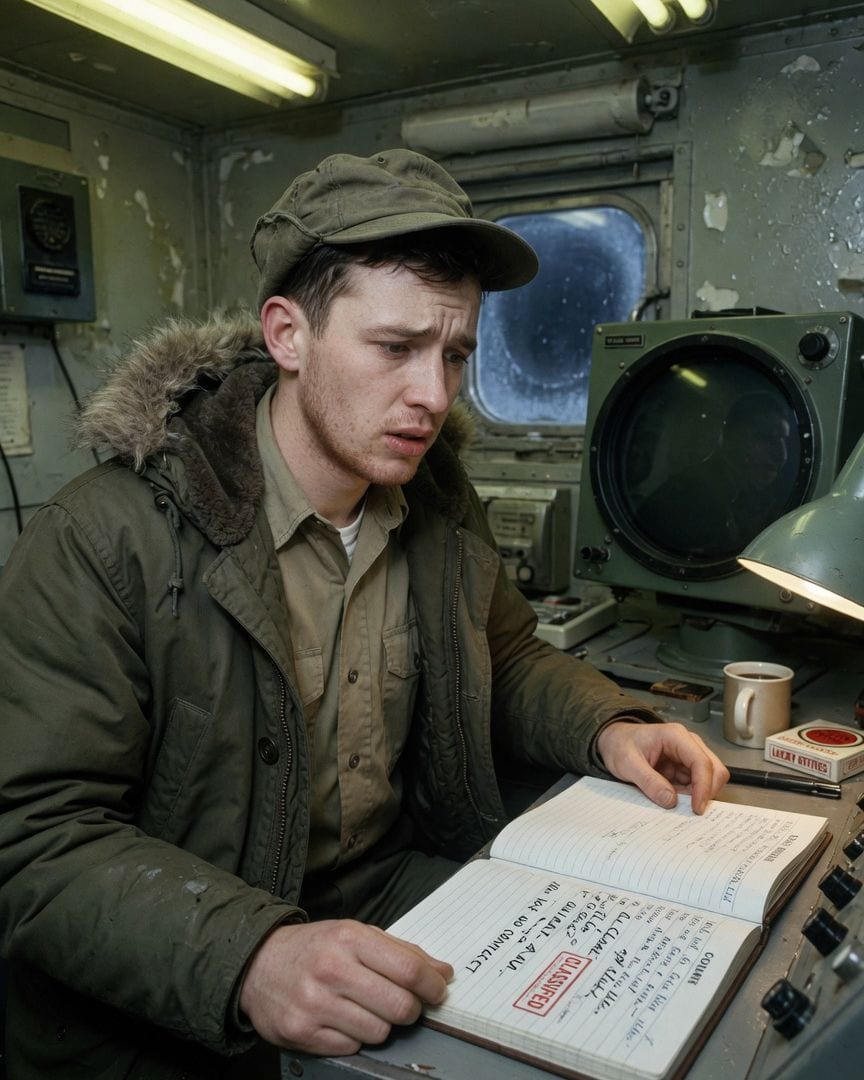
A Cold War airman logs an impossible radar contact on his last sweep. But his official logbook entry is stamped 'CLASSIFIED' and then contradicted by a hastily scrawled 'ALL CLEAR' dated moments before it.
Airman Ordway Vance, 22, manned the radar dome at Site Pellin in the biting North Atlantic dark of January 1962, running the last calibration sweep before its decommissioning. His scope picked up a faint, impossible return, growing closer with each pass, though the ocean remained empty to the eye. When Vance detailed the contact in his official logbook, a 'CLASSIFIED' stamp appeared, followed by a hastily scrawled 'ALL CLEAR' dated moments before his own entry, contradicting his every word. Commander Hartley dismissed it as equipment malfunction, but Vance sensed a chilling, official erasure behind the lie. He soon found a locked cabinet marked 'SITE PELLIN ANOMALIES,' hinting at a deeper truth buried within the base's final days.
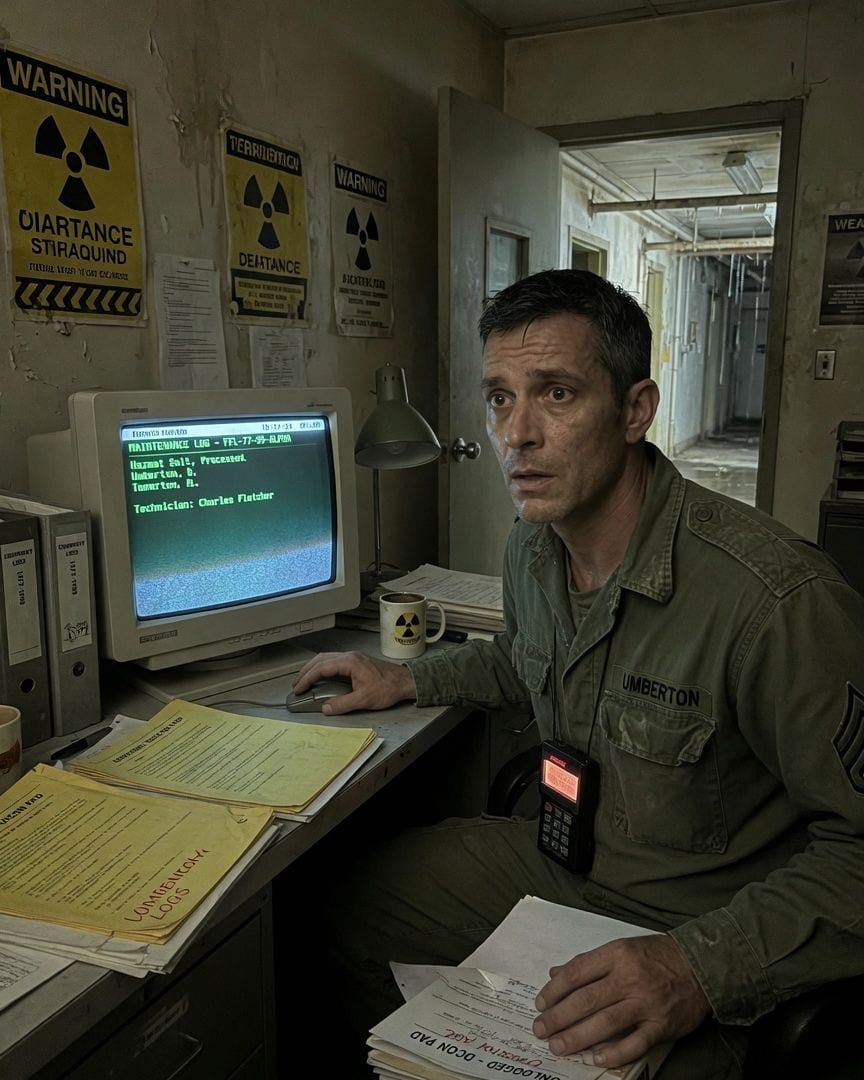
On his last shift at the closing Cold War facility, Sergeant Umberton found a hazmat suit glowing hot with his own name.
Sergeant Blaise Umberton walked his final shift at the soon-to-be-shuttered Ferriday Flats decontamination pad, the predawn air thick with ozone and the heavy silence of a closing era. His peace with the desolate site shattered when he discovered a hazmat suit, glowing faintly and shrieking on his Geiger counter, laid out with his own name stitched perfectly on the breast. Dismissed as a prank by his superior, Umberton followed protocol, but a cold dread compelled him to check the digital records of the facility's Cold War bureaucracy. There he found an entry for a hazmat suit processed under his name, dated for *tomorrow*, and signed by a technician who had retired a decade ago.