My face, cast in plaster in 1888, stares back from a museum display. They DNA tested a hair from inside the mask. It’s me.
The hushed, cool air of the Museum of Medical History always gave me a strange sense of reverence, like walking through a graveyard of forgotten techniques.
I'd been drifting past rows of antique surgical tools, the kind that made you wince just looking at them, when I stopped.
It wasn’t a choice, more like a physical impedance, an invisible wall in front of a display case I hadn't even registered. Inside, arranged neatly on velvet, were plaster death masks.
And one of them, labeled 'Theresa Whitfield, 1888,' was my face.
It wasn't a strong resemblance, or a passing similarity. It was exact. The same slope of the nose, a faint bump near the bridge that I’ve always hated.
The curve of the chin, perhaps a little softer on the mask, but undeniably mine. The set of the mouth, even the slight asymmetry that always pulls one side of my smile a fraction higher.
A cold knot formed in my stomach, tightening with each detail I recognized. Rationality kicked in, of course. It’s a striking resemblance, nothing more. History is full of doppelgängers.
But the feeling persisted, a deep hum of wrongness beneath my skin.
I approached the information desk, my voice a little too loud in the quiet hall. I asked about the mask, feigning an academic interest.
"Would it be possible," I asked, trying to sound casual, "to find out if a hair, perhaps, was sealed inside? For a hypothetical DNA test?" The attendant looked at me strangely, but agreed to pass the query to the curator.
Weeks later, a terse email arrived from Gideon Thatcher, the museum curator. The subject line was just my name. The body text: "Ms. Hayes, the test result was unexpected. Not a distant relative. A perfect match. Please call me."
My hands trembled as I read it. A follow-up call, Gideon's voice unnervingly calm, requested a meeting. I felt a cold dread, a certainty that my normal, unremarkable life was about to crack open.
I sat opposite Gideon Thatcher in his cluttered, dusty office, the smell of old paper heavy in the air, a scent that clung to my clothes even now.
Gideon, a man in his mid-fifties with kind but sharp eyes, pushed a neatly bound report across the desk. The cover was blank, but the weight of it felt immense.
"Your DNA, Ms. Hayes," he said, his voice even, as if discussing the weather, "matches the sample from the Theresa Whitfield mask with 99.999% certainty."
I tried to argue, to suggest a mix-up. "It's impossible. A shared ancestor, maybe, from centuries ago? A distant cousin once removed, twice removed..." He shook his head. "We ran that specific analysis.
It's not a familial match in the traditional sense. There's no detectable genetic lineage connecting you to any known descendants of the Whitfield family, or to Theresa herself, beyond this sample."
He patiently refuted each point, explaining the lab's rigorous process, the specific markers they’d isolated, the statistical improbability of such an identical, non-familial match. "It's... an identity match," he clarified, the phrase hanging in the air like a physical thing.
He pulled a small, silver-framed sepia photograph from a drawer in his desk, sliding it toward me.
It was a formal portrait of a severe-looking woman from the late 19th century, her hair pulled back tightly, her eyes staring directly into the lens. But the face. God, the face was undeniably mine. Every curve, every shadow.
"Theresa Whitfield," Gideon stated. "Born 1888. Died in 1916." He gestured to the photo, then back to the closed report. "We've seen patterns like this before, Ms. Hayes. Anomalies." His calm, almost detached acceptance of the impossible was chilling.
My own reality felt like it was shifting underfoot, the floorboards groaning beneath me. I desperately searched for a flaw in his logic, a way out of this impossible mirrored reflection staring back at me from a century ago.
A trick of the light, a particularly good hoax. But the photo was old, faded, indisputably real.
Gideon Thatcher excused himself for a moment, the heavy oak door clicking shut behind him, leaving me alone in the dusty silence. The air seemed to thicken, the old books on the shelves watching me.
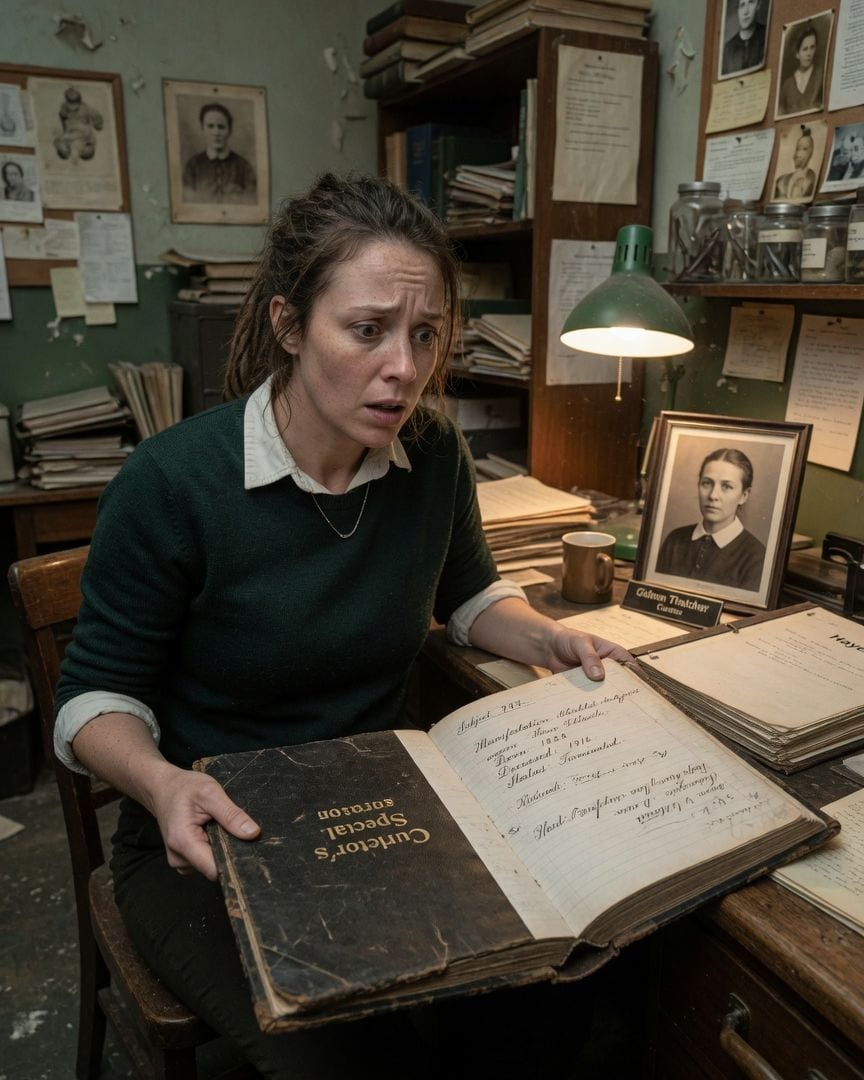
On his desk, where he'd been working, lay a heavy, leather-bound ledger. It wasn't the museum's general inventory; this one was marked 'Curator's Special Collection.' A compulsion, cold and sharp, made my hand reach for it. I pushed it open.
My eyes fell on a page with careful, elegant script, the ink faded brown.
'Subject 743.'
Below it, a formal entry: 'Manifestation: Whitfield, Theresa. Born: 1888. Deceased: 1916. Status: Terminated.' My breath caught, a gasp trapped in my throat. Terminated. The word echoed, hollow and final.
But then, in a different, more modern hand, a small, neat annotation directly beneath the entry:
'Next Manifestation: Hayes, Olivia. Born: 1991. Status: Active.'
The words blurred, then snapped into horrifying focus. It wasn't a resemblance. It wasn't a match. It was a continuation. My own name, in that cold, official record, linked directly to the dead woman in the mask.
I slammed the ledger shut. Gideon Thatcher reappeared in the doorway, his eyes sweeping from the book to my face. He didn't react to the noise, only walked calmly back to his seat.
"You found it," he said, without a trace of surprise. "Good."
"What the hell is this?" I demanded, my voice trembling, though I tried to keep it steady. "Terminated? My name? You don't just 'track' people, do you? What is this 'Manifestation'?"
He leaned back, his gaze steady, unnervingly patient. "We don't call it reincarnation, Ms. Hayes. That implies a spiritual, almost mystical process. What we observe is more of a... re-manifestation.
A specific consciousness, stable and recurring, that finds a new vessel." He picked up a pen, twirling it idly between his fingers. "The museum, as you see it, is merely a public-facing entity.
It's a front, Ms. Hayes, for a much older institution. One dedicated to the observation and documentation of these 'subjects' across generations."
He pulled out more files from a locked cabinet, sliding them onto the desk. Grainy photos from the 1930s, faded sketches from the 1960s, even a delicate, hand-drawn portrait from the 1700s. Each one, unmistakably, bore my face.
A different name beneath each, a different life, a different lifespan. And in a neat, clinical hand, a distinct 'Termination' date next to each one. My stomach lurched.
He spoke of a unique biometric marker, a subtle, innate signature that identified each iteration. "We've been observing for centuries," he continued, his voice almost academic, "documenting the pattern, trying to understand the mechanism."
Though terrified, a sliver of my inherent rationality clung on. "Show me the data," I demanded, my voice still trembling but gaining strength. "Show me your records. Not just anecdotes, not just photos. Your proof. The actual records of this...
institution." He met my gaze, a faint, unreadable smile playing on his lips.
Gideon’s demeanor shifted subtly, the hint of steel I'd detected before hardening his pleasant expression. "Access to our full archives is restricted, Ms. Hayes," he stated, his voice now entirely devoid of its former warmth.
"And for your own protection, I must insist you do not pursue unauthorized inquiries." He paused, letting the implication hang in the air. "There are... deeper factions within the institution. Those who prefer discretion. Unauthorized interest draws attention. Unwanted attention."
The air in the office, once merely dusty, now felt heavy, almost oppressive. I left the museum with a prickling sensation on my skin, a feeling that I was being observed.
The quiet streets, the anonymous faces in the crowd – they all seemed to hold a subtle, knowing gaze.
I tried to research the 'Institute for Biometric Continuity' – the name Gideon had vaguely referenced. Online, I found only dead ends.
Defunct websites for obscure research groups, vague academic papers about fringe theories that seemed to hint at patterns in genetics and consciousness but never cohered into anything concrete. It was as if any real trace had been scrubbed clean.
Frustrated, and needing to confirm that I wasn't losing my mind, I reached out to Penelope Caldwell, a medical archivist at a local university.
I fabricated a story about researching historical facial reconstruction, hoping to leverage her access to obscure records. Penelope, initially helpful and enthusiastic, found some interesting leads. She was thorough, almost annoyingly so.
But then she called back, her voice lower, sounding nervous. "Olivia? Listen, I found an old reference, buried in some university microfiche. It was... odd. A private foundation, not officially listed anywhere anymore.
It had a strange internal classification system for its subjects. And... a list of names. Some of them... they just vanished from public record after a certain age. Or their reported deaths seemed... incomplete. As if they ceased to be."
Penelope’s voice was a whisper, as though she feared being overheard. "It was just a snippet, but it felt... wrong." I thanked her, my own voice a monotone. The cold dread I’d felt solidifying into an unshakeable certainty. Someone knew.
And they were watching.
I returned to Gideon's office the next day, bypassing pleasantries. The museum's front door clicked shut behind me with a finality that felt deliberate.
"The Institute for Biometric Continuity," I stated, my voice firm despite the frantic pounding of my heart. "What is it? And what is my 'biometric marker'?"
Gideon sighed, a long, weary sound that seemed to carry the weight of centuries. He looked less like a curator and more like a guard, or perhaps a jailer. "It is, as you suspect, the organization I work for.
And you, Olivia, are one of our most stable subjects." He opened a small, locked safe hidden behind a framed landscape painting, retrieving a single, laminated card. "This," he said, handing it to me, "is your true identifier."
It was complex, an alphanumeric code spiraling around a tiny, intricate diagram. Beneath it, etched with scientific precision, was a graphic representation of a rare blood antigen, a specific, unique protein signature.
My eyes darted to my inner wrist, where a faint, irregularly shaped birthmark, one I'd always thought was just a quirk of genetics, seemed to throb.
The diagram on the card was an exact match to the pattern of capillaries and pigmentation of my birthmark.
"Theresa Whitfield had the exact same marker," Gideon explained, his voice low. "As did every other manifestation of Subject 743 we've identified. It’s our biometric signature for this particular consciousness stream."
He admitted that the institution had been subtly influencing my life for years. My schooling choices, my career path, even my decision to move to this city and visit this museum – all of it had been gently, imperceptibly guided.
"We steer," he said, "to ensure your 'stability' and 'longevity.' To mitigate unnecessary risks, to provide optimal conditions for your current manifestation."
They viewed these recurring consciousnesses as invaluable, he said, a form of living data, a resource to be preserved, studied, perhaps even harnessed for some grander, as-yet-unexplained purpose.
"We urge you to accept your role, Olivia," he finished, his voice almost pleading, "to cooperate. It is for your own well-being."
Gideon, seeing the terror etched across my face, attempted to reassure me. "We ensure a good life, Olivia. A stable one. We’re not your enemies." His words felt like a silk cord tightening around my neck.
He led me to a discreet terminal, hidden behind a false wall disguised as another bookshelf. It whirred to life with a quiet hum. He granted me temporary, limited access to a secure database.
"I'll show you Theresa Whitfield's entry," he said, typing quickly, his fingers blurring over the keys.
The screen glowed, displaying a stark entry: 'Subject 743: Theresa Whitfield, 1888-1916. Status: Terminated.' He gestured to it. "Your entry is directly linked, active. We simply updated the status."
But as Gideon turned to grab a file from a nearby drawer, his attention momentarily diverted, my fingers flew across the keyboard. My mind was a terrifying blend of fear and ice-cold resolve.
I typed the unique biometric code from the laminated card he'd given me, the one that matched my birthmark, into the system's main search bar, bypassing the 'linked' entry. I wasn't looking for Theresa anymore.
I was seeking the broader truth, the full horrifying scope.
The screen flickered, a cascade of code scrolling too fast to read, then populated. Hundreds of entries scrolled by, a horrifying genealogy.
Each entry was a face identical to mine, a different name, a different birth date, and a final, chilling column: 'Termination Date.'
And then, at the very bottom, highlighted in stark red, a new entry blinking, a fresh wound on the digital page:
'Subject 743. Current Manifestation: Hayes, Olivia. Termination Date: Pending.'
The cursor hovered, pulsing, waiting for input.
I turned to Gideon, my face pale, the screen's 'Termination Date: Pending' reflecting in my eyes. The terminal's quiet hum seemed to amplify the silence in the room. "You don't just track them," I whispered, the words barely audible.
"You end them."
Gideon nodded slowly, his calm unwavering. He hadn't bothered to look at the screen. "We manage the transfer of consciousness," he corrected, his voice a low, academic murmur.
"When a manifestation reaches its optimal point, or when circumstances necessitate, we facilitate its termination. It allows the core identity to re-manifest, refreshed, in a new vessel, ready for its next cycle."
He explained that the death mask of Theresa Whitfield wasn't just a record of death, but an artifact from a 'termination event' – a ritualistic casting, a capture of the 'final imprint' before the consciousness could make its jump.
The 'Match To A Grave' was horrifyingly literal; the institution was responsible for the 'graves' of my past selves, carefully controlling the cycle, guiding each iteration to its preordained end.
My life, my choices, my very path, had been meticulously guided and engineered to ensure my 'stability' and 'readiness' for this moment.
I was their most successful, most stable subject yet, he said, and my purpose, whatever cryptic function that was, was now at hand.
Gideon stepped closer, his voice soft but firm, a terrifying blend of kindness and absolute authority. "Your termination is set, Olivia. You can comply, and we can proceed with a calm, orderly transfer.
Or," he paused, his gaze unwavering, "we can proceed with processing. Either way, the outcome is the same."
My mind raced, trapped like a mouse in a maze. Physical escape was impossible; the institution's reach, I now understood, was absolute. My entire life had been a carefully constructed cage.
Instead of fighting, of screaming, of pointless resistance, I turned back to the terminal, my fingers flying. A wild, desperate thought. If I couldn't save myself, perhaps I could do something.
I attempted to wipe my own 'Subject 743' entry, a futile act, I knew, but a defiant one.
Then, furiously, I typed a complex sequence, embedding a viral command deep into the database – a self-replicating anomaly designed to corrupt the 'Termination' protocols for all active subjects. A wrench in their gears, a scream in their silent machine.
Gideon watched me, a flicker of something that looked like disappointment, almost regret, crossing his face as he recognized my intent. He didn't panic.
He moved, not to stop the viral spread, which had already begun to worm its way through the system, but to stop me from completing the full encryption that would make it irreversible.
He gently took my arm, his grip surprisingly strong, pulling me away from the terminal.
The screen flickered, a cascade of error messages appearing on various entries, the 'Termination Date: Pending' for countless others suddenly replaced by a chaotic scramble of code.
"A defiant gesture, Olivia," Gideon said, his voice devoid of anger, only a quiet certainty. "But the core process will continue. Your designated purpose remains."
Olivia Hayes vanished without a trace. Her apartment was quietly rented out a month later, her social media profiles remaining untouched, a digital ghost in the machine.
The institution, despite Olivia's desperate sabotage, continued its centuries-old work, albeit with a temporary, chaotic disruption to its 'Termination' protocols.
Penelope Caldwell, the archivist, found herself increasingly troubled by Olivia's sudden disappearance, a nagging sense of unease that something profound and wrong had occurred.
She began to delve deeper into the obscure 'Institute for Biometric Continuity' with a renewed, almost obsessive interest, drawn by a pattern she couldn't quite articulate.
Months later, Penelope Caldwell sat alone in her quiet university office, surrounded by stacks of historical records, the faint scent of old paper a constant companion.
She kept catching glimpses of a familiar face in old photographs, in archival footage – Olivia's face, or a face remarkably like it, staring out from different eras, different lives.
She dismissed it as a trick of the light, an overactive imagination fueled by her research.
One evening, as the city lights began to reflect in her darkened office window, she caught her own reflection, superimposed over the image of a forgotten scroll.
She stared at her face, at the familiar slope of her nose, the curve of her chin, the slight asymmetry in her mouth.
A faint, almost imperceptible mark on her inner wrist, a birthmark she’d always taken for granted, seemed to prickle with a strange sensation, an internal itch.
She recalled Gideon's words to Olivia about a unique biometric marker, and the pattern of recurring faces.
A chill ran through her, deep and absolute, as she realized the resemblance was not just a coincidence, and the birthmark was not just a quirk of genetics.
The face in the glass, unmistakably her own, now held the quiet dread of a history that was not quite hers.
If this one got to you
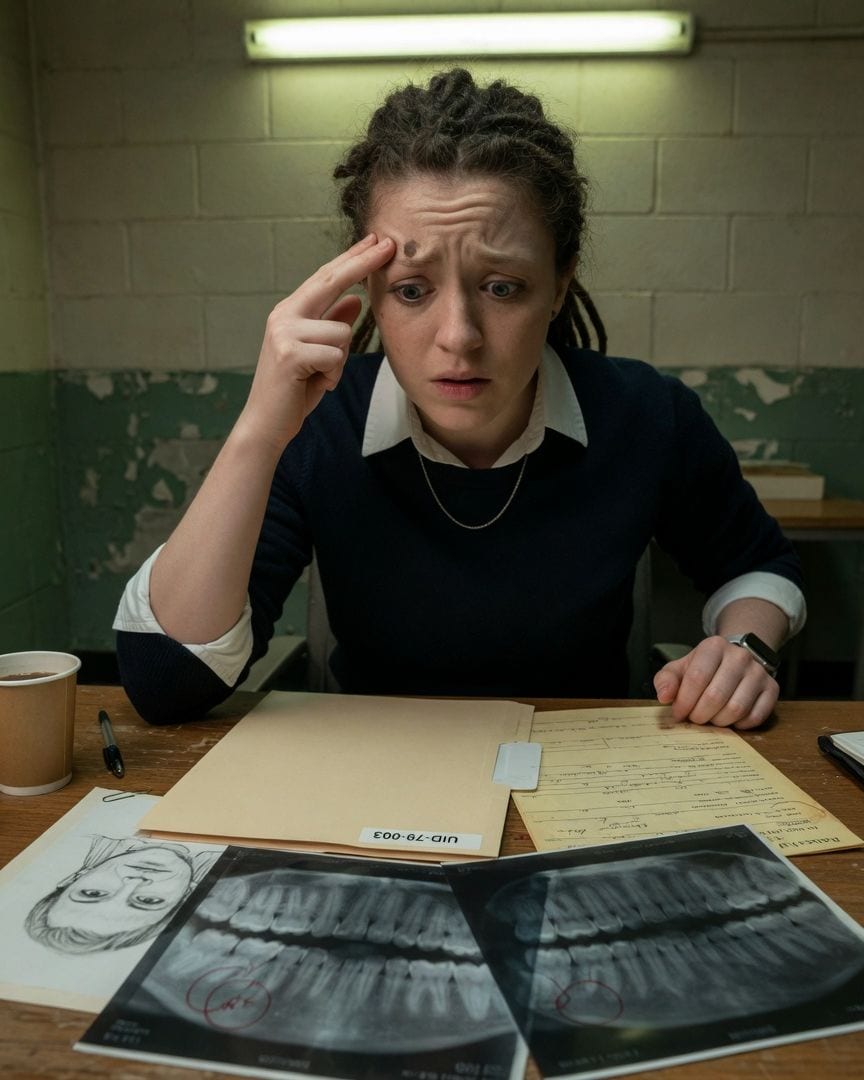
A 1979 facial reconstruction of unidentified remains has my distinct birthmark, just above its left eyebrow.
Switching dentists should have been a routine adult problem. Instead, my new X-rays were an identical match for unidentified human remains catalogued by the county coroner in 1979. The impossible match left me with a chilling dread.
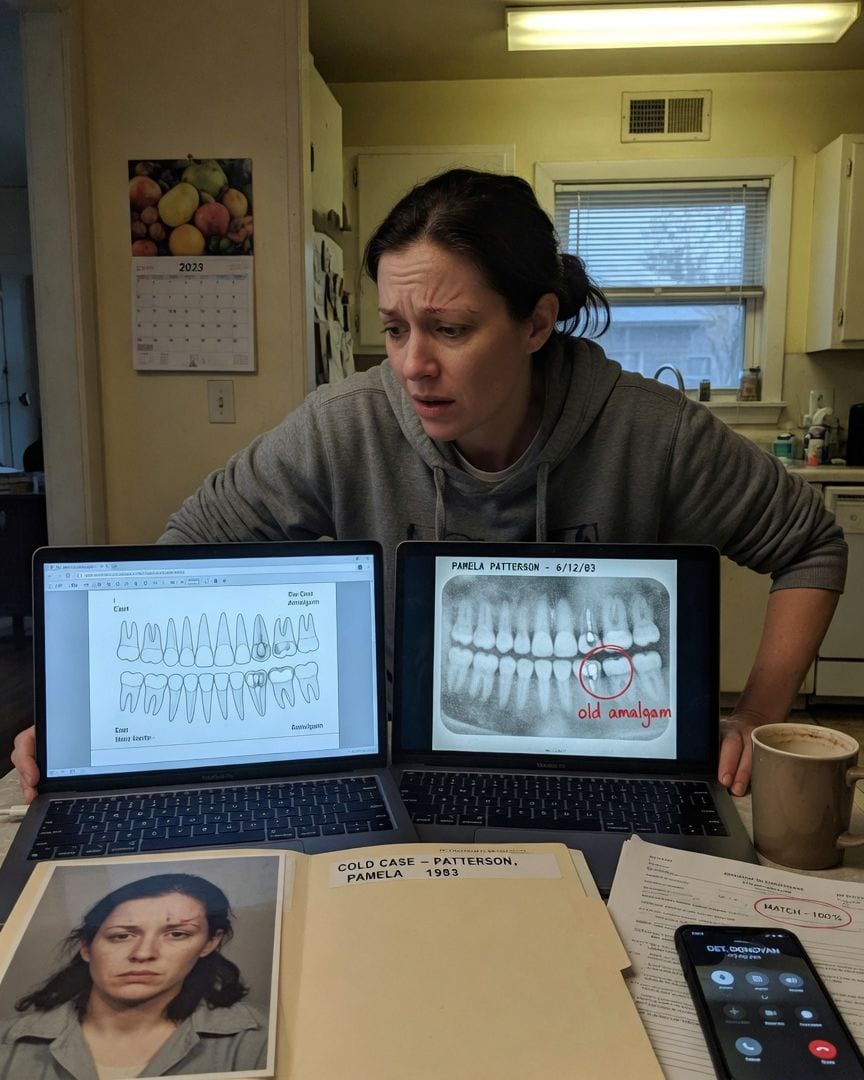
I gave a swab to be ruled out of a 1983 murder, but my DNA matched a hair from the scene exactly — and that hair belonged to a victim recorded dead there in 1983.
I gave a routine cheek swab for a 1983 cold case, barely thinking about it. But then Detective Donovan called, telling me my DNA matched the victim's hair exactly. The impossible truth: I wasn't born until 1991.
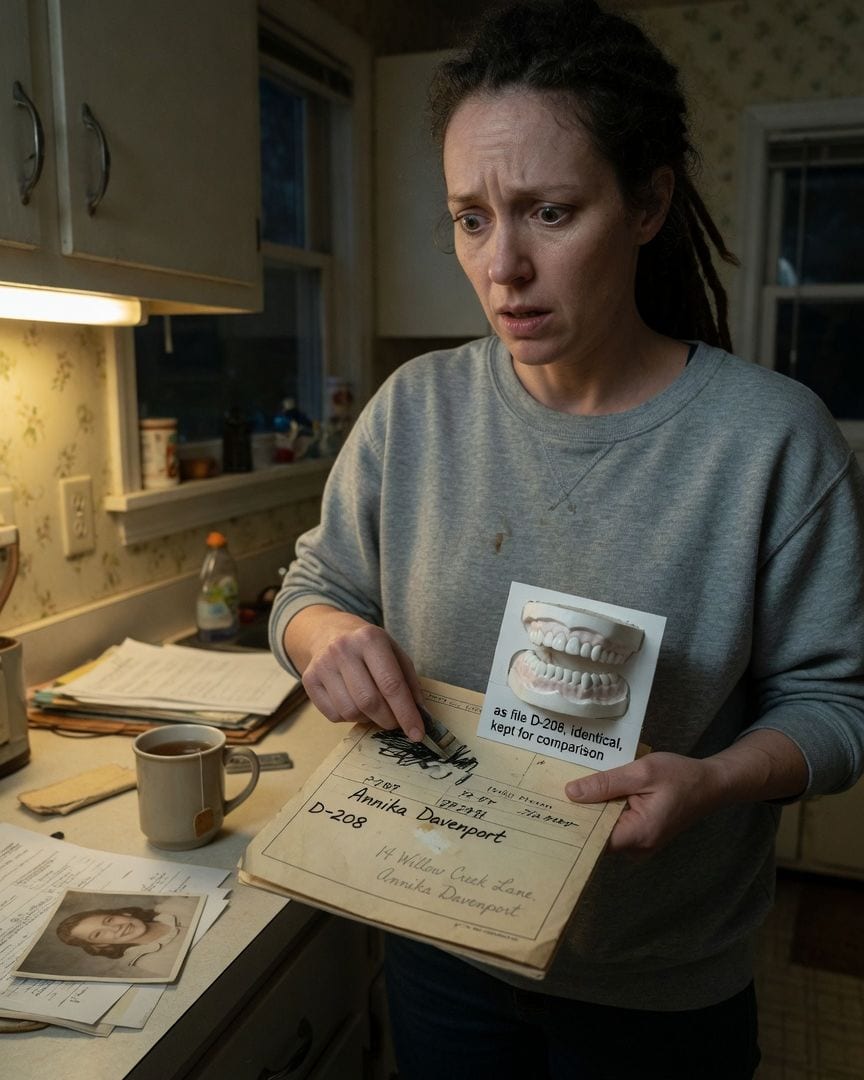
My childhood dental chart lists the house I bought last year — in my own name, years before I was born. A second set of my teeth sits filed beside it, marked 'identical.'
Sifting through old dental records, I found my chart, D-208, with my 1988 birth date. But a line from 1958 was blacked out, and a clipped card with an impression of my teeth listed my name and current home address, decades before I was born. The impossible facts knotted into a cold certainty.
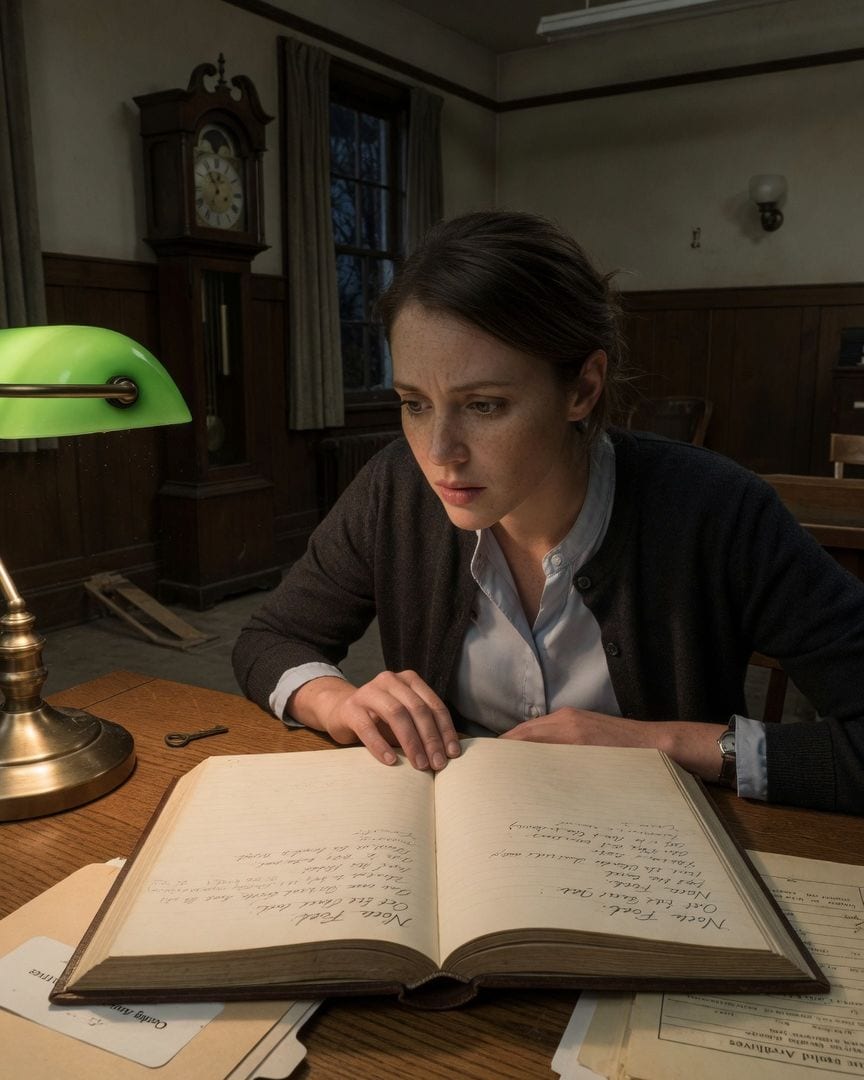
My grandmother’s name reappears in the old book of remembrance — on the same date, same street, every few decades since 1929. A verger’s note reads: 'ask no family.'
As Keeper of the crematorium's Book of Remembrance, my job is quiet and meticulous. But while updating my own grandmother's entry, I found two more Nora Fords listed above hers. Each died on October 3rd, decades apart, with the same address and a strange instruction: 'ask no family.'
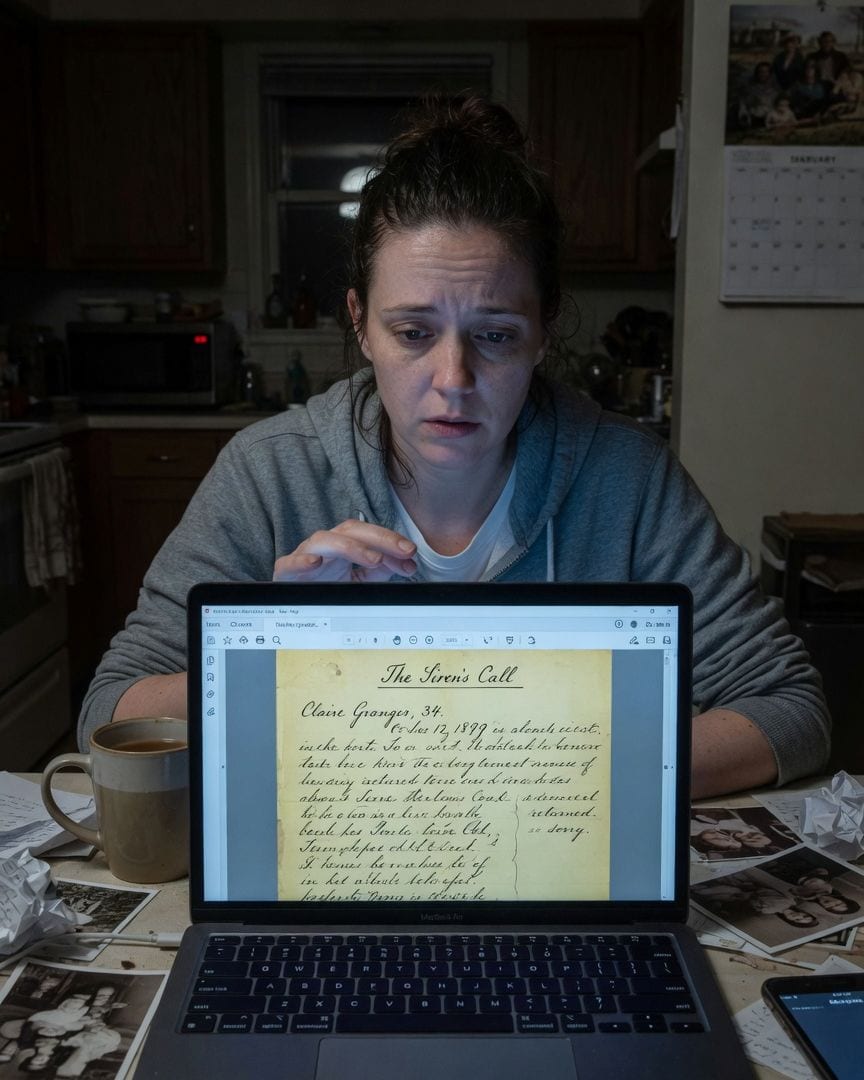
My name is on a passenger list from a ship lost in 1899. The manifest says I was 34, "returned. so sorry."
I was reviewing an old emigrant manifest, a casual dive into my family history, when I found my own name listed. The ship, The Siren's Call, was lost in 1899 with all aboard, yet my entry on the manifest was marked: 'returned. so sorry.'
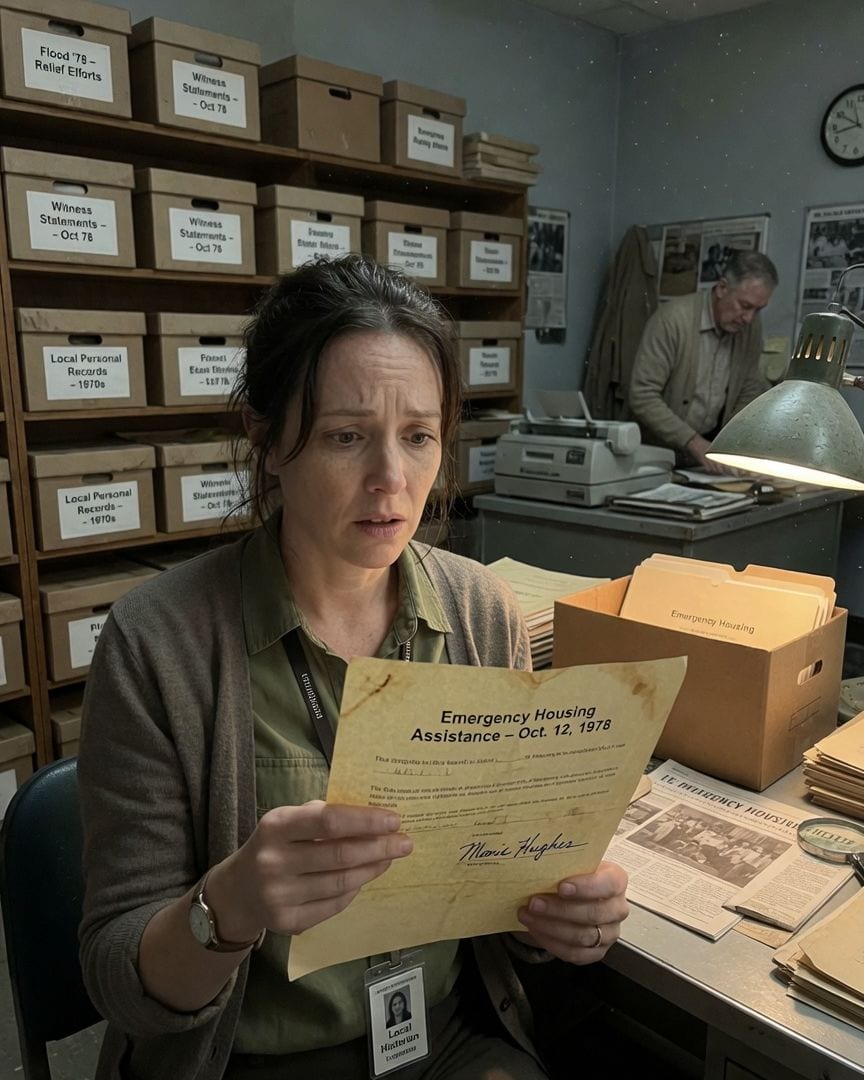
My face, with my mole, in a 1978 flood photo. I was born seven years later.
As a local historian, I was deep in the dusty town archives, researching the devastating 1978 Ohio River Valley flood. My fingers brushed a black-and-white photo, and my breath caught. Staring back from the 1978 scene was a woman with my distinct face, my mole, and my crooked front tooth, seven years before I was born.