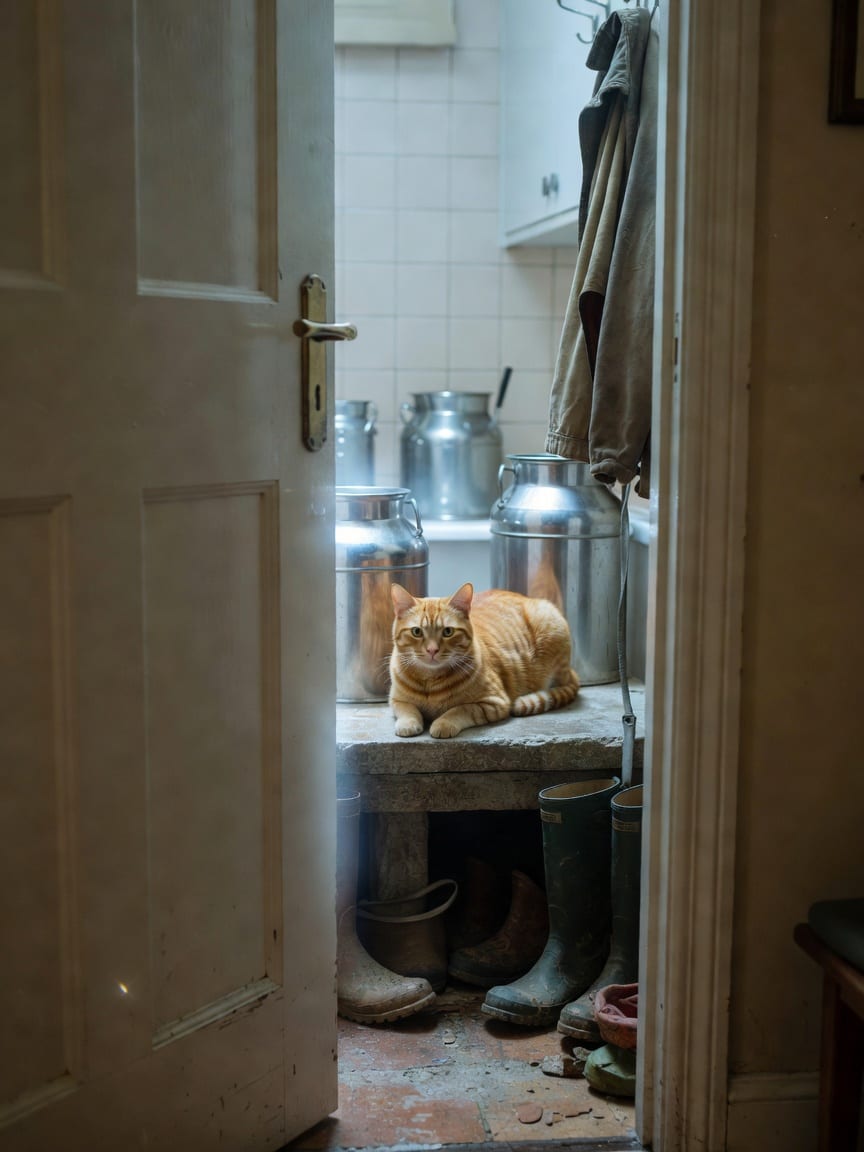
This morning, my boot room door opened onto a dairy, churns and a cat on a cooling slab. Raw milk cold poured in. My auction catalogue calls the room 'derelict'.
I’d only been in the Mitchell House for three weeks. Inherited it, a place that felt solid, practical, built for purpose. My distant relatives, the Mitchells, were long gone, but their sensible habits seemed to linger in the very walls.
Nothing more than that, I told myself. Nothing to be spooked by. My favorite room was the boot room, just off the kitchen.
It had a deep Belfast sink and a sturdy, peeling green door that led straight to the yard. Muddy boots, gardening gloves, that sort of thing. Ordinary.
Then came the first hard frost. The air outside bit with a crispness that promised winter, made your breath plume out like smoke. I pulled on my wellies, reached for the yard door handle, and twisted.
Instead of the overgrown, autumn-brown tangle of my new yard, the door opened onto a pristine, bustling dairy.
Churns gleamed, polished metal reflecting the soft, milky light of the room. A long, grey cooling slab dominated the space, holding shallow pans of cream, thick and still.
And right there, curled up in the middle of the slab, was a ginger cat, fast asleep, its breathing barely disturbing the surface of the cream.
The cold that poured in wasn't just frosty air; it was thick with the unmistakable, slightly sour scent of raw milk, so vivid it made my stomach clench. It was real, damn it. Visceral.
I blinked. Then I slammed the door shut, my heart hammering a frantic rhythm against my ribs. What the hell? I took a breath, counted to three, forcing myself to be calm, to be rational. Maybe I was tired.
Maybe it was a trick of the light. I opened it again.
The yard, muddy and leaf-strewn, was back. No churns, no cat, no raw milk smell. Just the familiar, damp cold of late autumn.
I closed it. Opened it again. Dairy. Shut it. Yard. My hands started to tremble. A prickle of cold fear, not from the air, but from the impossible sight, began to spread through me.
My mind raced, desperate for explanations – a trick of the light, residual memory, a waking dream. But the smell had been too real, the cold too sharp.
And I remembered the 1982 auction catalogue, its dry, factual entry for this very room: 'former dairy, now derelict.' Derelict. Not operational. Not bustling. A cold dread settled into my bones, refusing to be reasoned away. It wasn’t a dream.
The impossible vision churned in my mind, a sour taste like the milk itself. I decided the boot room needed a serious deep clean. Perhaps scrubbing away decades of grime would scrub away the uncanny feeling, too.
I attacked the walls with a stiff brush and a bucket of disinfectant, trying to erase the ghost of the raw milk smell.
As I knelt by the Belfast sink, a deep ceramic basin with chipped edges, attacking a stubborn patch of mildew beneath its rim, my fingers brushed against a section of the old pine floorboards.
One was slightly loose, yielding with a faint creak under my weight.
Curiosity, a desperate need for a mundane distraction, overrode my lingering unease. I fetched a screwdriver from the toolbox and carefully pried the board up.
Tucked into the dusty recess beneath, wrapped in a brittle, yellowed piece of linen, was a small, faded, hand-stitched sampler. It looked older than anything else in the house.
I carefully unwrapped it. The embroidery depicted the boot room, unmistakably, but as a vibrant, working dairy. Tiny churns, gleaming. A cooling slab, pristine and grey.
And a ginger cat, eerily similar to the one I’d seen, lay asleep on it, a small, intricate detail. In the bottom corner, meticulously stitched in fine black thread, was a date: 'Oct 1897'.
My breath hitched. My gaze dropped to the Belfast sink, now exposed in the full, unforgiving light of the room.
Beneath years of grime and paint, I noticed a faint, almost imperceptible carving in the porcelain – a small, unique symbol, like a stylized knot, worn smooth but still visible. I looked back at the sampler.
There it was, tiny but distinct, stitched into the pattern near the cat, just above the date.
A wave of cold, terrible certainty washed over me. This wasn't a hallucination. This wasn't a trick of light or mind.
Someone, over a century ago, had seen this exact room, this exact dairy, with this exact symbol, in October of 1897. But the vision had been so real, so immediate. The auction catalogue had called it 'derelict' in 1982.
How could a room from over a century ago appear as a living, breathing space, then be captured in a sampler, only for me to see it again today?
The rational explanations crumbled, leaving only the chilling, undeniable fact of the sampler, a physical piece of proof for an impossible event.
My fingers traced the date 'Oct 1897' on the sampler. The vivid details of the vision – the gleam of the churns, the quiet breath of the sleeping cat – replayed in my mind, now imbued with a terrifying authenticity.
This wasn't just an old picture; it was a snapshot of a specific moment, a specific day. I turned the sampler over, gently, my heart thudding a slow, heavy drumbeat.
On the reverse, almost invisible against the faded linen, was a name, stitched in tiny, barely discernible cross-stitch: 'Deborah Mitchell'. The same surname as the house's original owners, my own distant relatives.
The dread deepened, a cold weight settling in my chest. This wasn't just a vision, not just a date. It was a person, tied to the house, tied to the past, and somehow, now, tied to me.
I stared at the name, a hidden connection suddenly revealed, promising something far worse than a mere trick of the light.
Armed with Deborah Mitchell's name, I dove into research. Local online archives yielded census records: Deborah Mitchell, aged 28, listed as residing at the Mitchell House in 1897. Property deeds confirmed the lineage, my tenuous connection to her.
The records then abruptly ceased for Deborah after October of that year. No death certificate, no marriage. Just… gone. I felt a growing unease, a cold tightening in my gut.
I decided a trip to the local historical society was in order. The building smelled of old paper and dust, a comforting scent that usually calmed me, but today it just felt heavy.
I found Eugene Fletcher, 68, the society’s long-serving archivist, a man with a quiet demeanor and unnervingly still eyes. He looked like he’d seen everything and forgotten nothing.
He listened impassively as I, carefully, inquired about the Mitchell family and specifically Deborah. When I, testing the waters, described my 'dream' of the boot room as a dairy, complete with churns and a cat, Eugene merely nodded.
“Ah, yes, the Mitchells were known for their small-scale dairy operation,” he said, his voice even, unhurried. “Ceased quite abruptly, around the time Deborah… well, she left. Said to have run off.”
He pulled out a large, leather-bound volume from a shelf behind him. “Some folk around here used to call that room ‘the house’s breath.’
Said it was a ‘thin place’ where the veil between… well, between one time and another, was a bit worn.”
He offered a small, unreadable smile, dismissing it as quaint superstition, but the casual way he spoke, the flicker in his eyes, suggested he knew more than he let on. Much more.
I felt a chill that had nothing to do with the drafty archives. The rational explanation of a runaway felt flimsy, almost deliberately so, against the weight of Eugene’s words and the strange, knowing look in his eyes.
Returning home, the house felt different, heavier. I stepped through the front door, and a cold gust of air brushed my face. The boot room door, which I distinctly remembered closing and locking before I left, was slightly ajar.
A faint, almost imperceptible scent of raw milk hung in the air. My stomach clenched. I rationalized it as my imagination, a lingering residue from my earlier 'dream,' a memory I was imposing on the present.
I closed the door firmly.
Later that evening, hunched over my laptop in the kitchen, I delved deeper into online newspaper archives, searching for any mention of Deborah Mitchell's disappearance. The old scanned pages, grainy and faded, blurred before my eyes.
My neck ached from staring at the screen. Suddenly, the screen flickered violently, not just a blink, but a full, jarring distortion.
For a split second, a single, highly pixelated image flashed, burning itself into my retina: a blurry, dark photograph of the boot room, unmistakably the dairy. The churns, the cooling slab, all of it.
A figure stood by the Belfast sink, head bowed, obscured by shadow. It was gone as quickly as it appeared, too fast for me to grab my phone for a photo, too fast to even process it fully.
My browser history showed nothing. No record of what I’d just seen.
I felt a cold prickle on the back of my neck, the hairs rising. I spun around, heart pounding, but the kitchen was empty, silent.
Yet, the small window above the sink was open, just a crack, letting in a cold, damp draft that carried, undeniably, the faint, sour whisper of raw milk. It wasn't just in my imagination. It couldn't be.
Someone, or something, knew exactly what I was looking for. The image wasn't from any archive I had accessed, its source utterly unknown. I was no longer just investigating; I was being observed.
And the house itself, it seemed, was reacting to my search.
I returned to Eugene Fletcher the next day, the sampler clutched tight in my hand like a talisman. I laid it on his desk, the faded stitching a contrast to the polished wood.
Then I recounted my vision of the dairy, the exact date, the name on the back. And finally, the terrifying flash of the image on my screen, the open window, the raw milk smell. I watched his face carefully.
Eugene’s impassive facade finally cracked, a subtle shift in his posture, a tightening around his mouth. He picked up the sampler, his thumb tracing the stitched symbol near the cat.
“I feared this,” he murmured, more to himself than to me. His eyes, though, were fixed on me.
He walked to a locked cabinet behind his desk, older and more ornate than the others, and retrieved a thick, leather-bound book, its cover worn smooth with age.
“This is the Mitchell family ledger,” he said, placing it gently on the desk between us. “A record of their daily lives, their farm, their family. What some called ‘the record that cannot be.’ Too many uncomfortable truths, perhaps.”
He opened it to a section dated 1897. I saw Deborah Mitchell’s neat handwriting, detailing dairy yields, household expenses, then, abruptly, the entries became erratic, the hand less steady, then stopped entirely. Eugene turned a few pages, slowly, deliberately.
“And then, this,” he said, pointing to an entry in a different, heavier hand, dated late October 1897, days after Deborah was officially recorded as having 'run away.' The entry read: 'The cold in the dairy, the churns, the cat on the slab… as if she never left. A vision, or the house’s breath again?'
I gasped, a raw, involuntary sound. It was my vision, described by someone else, over a century ago. The cold. The churns. The cat. All of it.
“The 'thin place' at the dairy,” Eugene explained, his voice low, almost a whisper. “It doesn’t just remember. It… holds. It cycles. Others have seen it, felt it. Not a ghost, but a fixed point in time, repeating.
A vanishing point, perhaps.”
He turned more pages, pointing to similar abrupt cessations of entries by other female occupants – Dorothy Radcliffe in 1932, for instance – always followed by official 'disappearance' records and cryptic notes about 'the cold' or 'the breath' in the boot room.
Each time, the next entry was in a different hand, as if a record-keeper had taken over, documenting the echoes.
The ledger was a chilling record of not just one vanishing, but a pattern, a trap that had sprung repeatedly within the very walls of my new home. It wasn’t just a house. It was a collector.
I flipped through the ledger, my hands trembling, the weight of generations of vanished women pressing down on me. Each name, each date, each chillingly similar 'disappearance' entry cemented the horrifying truth Eugene had unveiled.
I noticed a small, almost invisible ink stain on one of the earlier pages, next to an entry about Dorothy Radcliffe, who had vanished in 1932.
The stain was the exact shape of the unique symbol carved into my Belfast sink and stitched on Deborah’s sampler. The symbol wasn't just a mark; it was a signature of the house's peculiar hunger.
But then, as I reached the back of the ledger, I found a section bound with a brittle, faded ribbon. It was dated much more recently – the 1970s, then the 1990s.
The entries here weren't about the occupants of the Mitchell House, but about local women who had vanished from other houses in the surrounding valley.
Each entry had the same, unsettling symbol drawn beside it, a stark, undeniable confirmation that the pattern was not isolated. My gaze locked onto the last entry, dated only two years ago: 'Genevieve Ingram, vanished from Foxglove Farm.'
Foxglove Farm was barely two miles away, a derelict, forgotten place, but I knew it for its old, unused dairy. The truth was far bigger, far more insidious than I had imagined.
The house wasn't just a singular trap; it was part of a network, a repeating, active hunger, and the last victim was terrifyingly recent, the threat still very much alive.
I returned to the Mitchell house, the heavy ledger clutched tight in my trembling hands. The cold dread had solidified into a terrible, coherent understanding.
The house wasn't merely 'haunted' by residual energy; it was an active participant in a cyclical, temporal bleed.
The boot room, with its 'Door Onto The Wrong Year,' was a focal point, a 'thin place' where the past could rupture into the present.
The raw milk smell was the signature of these ruptures, a sensory anchor for the vanishing points, a calling card.
Deborah Mitchell, Dorothy Radcliffe, and all the others hadn't simply disappeared; they had been drawn into these moments, their presence forever echoed, trapped within the house's 'memory' at the precise instant they ceased to be.
The symbol, carved into the sink, stitched into the sampler, marked in the ledger, was not a warning but a signature of the phenomenon itself, a pattern of collection.
Genevieve Ingram, who vanished two years ago from Foxglove Farm, was merely the latest. Foxglove Farm, I knew, had its own disused dairy, its own 'thin place.'
The horrifying coherence of it all clicked into place: the houses in the valley, with their specific architectural features, were not just passively haunted.
They were active collectors, feeding on these moments, repeating them, waiting for the next cycle, the next hard frost.
The terror wasn't supernatural in the traditional sense; it was a horrifying, mechanistic truth, a pattern that had been running for generations, hidden in plain sight, recorded in ledgers, marked by symbols.
I knew I couldn't simply abandon the house. The pattern would find someone else, or worse, find me. The knowledge I now carried felt like a magnet, drawing me in.
I had to break the cycle, at least for myself, at least here. I went directly to the boot room. The air was heavy, thick with the cloying, sour scent of raw milk, even though there was no frost outside.
The yard door was slightly ajar, just as it had been when I first saw it. Through the crack, I could see the dairy, clearer, more vibrant than ever before.
The churns gleamed, the cooling slab was pristine, and the ginger cat stretched, its eyes now open, looking directly into the room, as if seeing me. And there, by the Belfast sink, stood a figure, back to me.
A woman in an old-fashioned dress, her silhouette unmistakable: Deborah Mitchell.
I knew, with a chilling certainty that went bone-deep, that if I took one step through that doorway, I would join the echoes, become another captured moment in the house's perpetual memory.
I remembered Eugene's quiet words about 'disrupting the anchors.' The Belfast sink, the sampler, the ledger – these were the physical anchors, the focal points for the recurrence. This was the moment.
With a desperate surge of resolve, a primal scream of refusal coiling in my gut, Marie grabbed a heavy, wrought-iron poker from beside the old, disused fireplace.
I raised it high, my muscles screaming with the effort, and brought it down with all my might onto the porcelain rim of the Belfast sink.
The impact was deafening, a shriek of shattering ceramic and grinding metal that echoed in the small room.
I struck again, and again, aiming for the faint, carved symbol, chipping away at it until the sink was a jagged, ruined mess, shards of porcelain flying like shrapnel.
The dairy vision through the door shimmered violently, distorting like a faulty projector. With trembling hands, I tore Deborah’s sampler into shreds, the delicate threads giving way with satisfying rips.
Then, using a match from the kitchen, I set fire to the brittle pages of the ledger, dropping the burning fragments into the broken sink. Smoke billowed, acrid and sharp, stinging my eyes, filling my lungs with a bitter taste.
As the last page curled into ash, the vision through the door flickered one final time, then, with a sound like a thousand panes of glass shattering, the mundane, overgrown yard returned.
The oppressive smell of raw milk vanished, replaced by the scent of dust, damp earth, and burnt paper. The cold receded, leaving only the normal chill of the late autumn air.
The echo was broken, at least here, at least for me.
I had the boot room completely renovated. A new, modern stainless-steel sink replaced the shattered Belfast. The floorboards were sealed, the walls repainted. The room was now sterile, functional, devoid of any trace of its grim history.
I never opened the yard door on a frosty morning again, or any morning for that matter, preferring the kitchen’s back entrance.
Eugene Fletcher, hearing of the 'extensive renovations,' visited once, offering a small, knowing smile that never quite reached his eyes. He left me with an unexpected gift: an old, hand-drawn map of the valley, yellowed with age.
Circled in faint, almost illegible ink were several locations, each marked with the familiar, unsettling symbol from the sink and sampler. Other small, forgotten dairies, other 'thin places' in the valley. A chilling legacy.
I still live in the Mitchell house. The boot room is just a boot room now, a quiet, functional space. I find a strange, almost peaceful resolve in knowing the truth, in having, perhaps, saved myself from becoming another echo.
But the map hangs in my study, a constant, unsettling reminder. I trace the faded circles, each one a potential site, a potential trap, a place where the cold, raw milk smell might linger.
I sometimes find myself wondering about Genevieve Ingram, about the other names Eugene had hinted at, the ones not even in the ledger.
On particularly frosty nights, when the wind howls through the valley, I can almost imagine a faint, sour-sweet scent on the air, a cold breath that isn't from the weather. I know the house is quiet, for now.
But the valley? The valley remembers. And the valley, she knows, remembers too many names.
If this one got to you
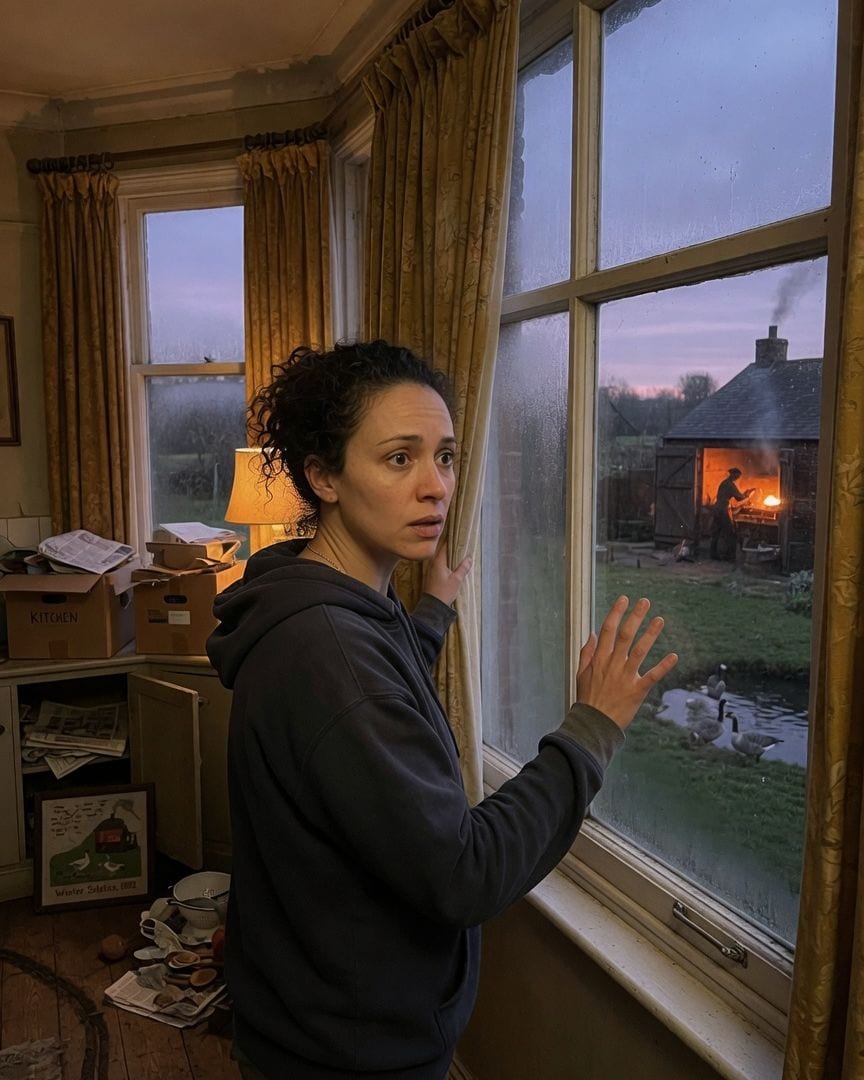
My bay window shows an impossible village green. I found a sampler of it, dated 1892, inside my 1920s house.
Settling into my 1920s house, I discovered a hidden recess in a built-in cupboard. Inside, I found an old, hand-stitched sampler depicting a village green and a smithy, dated 'Winter Solstice, 1892'. This scene, and its date, should have been impossible for a house built decades later.
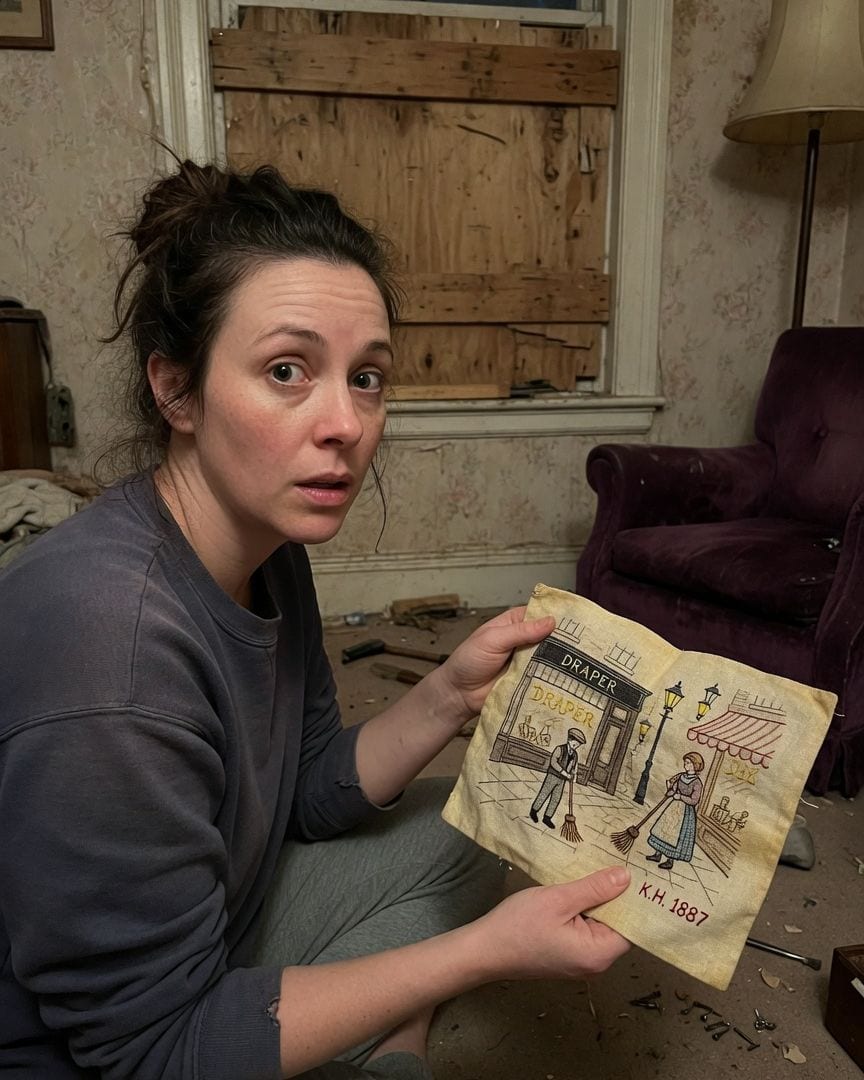
My flat's window shows a gaslit Victorian street across a brick shaft. The nails I hammered back into its frame went into wood soft and new.
My new flat came with a boarded-up window, which the agent dismissed as just an old lightwell. Driven by curiosity, I removed the boards, expecting brick or darkness. Instead, my window opened directly onto a bustling, gaslit street from 1887, a vision that defied all sense.
Milk appears daily by my lychgate. The dairy closed in '79. My address is handwritten into their old delivery book, starting the day we moved in.
Moving to Blackwood Creek, I loved the quaint charm, especially the unexpected morning milk delivery to my lychgate. But when I mentioned it to Eleanor at the village shop, her smile froze. She told me Willow Creek Dairy closed decades ago, in '79.
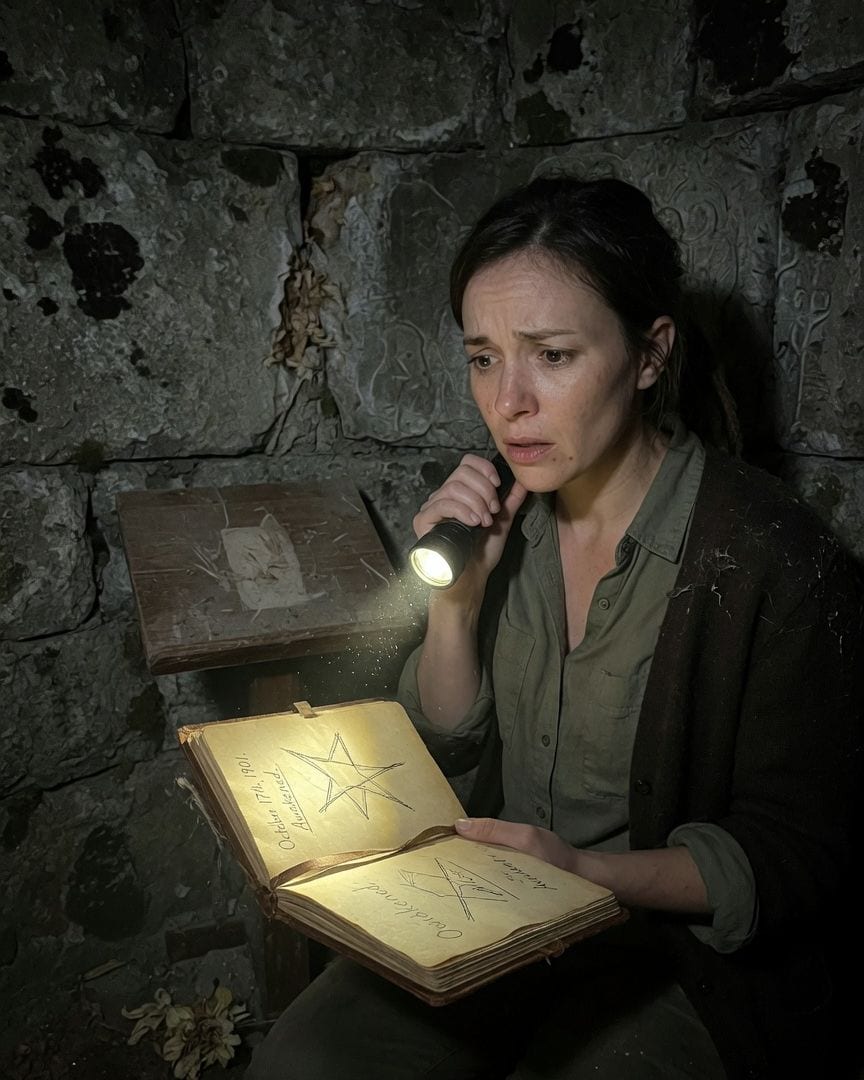
Marden's 'old dairy' shows up in the 1901 census as a chapel. Its minister was 104 that year. Everyone here looks at me oddly when I call it a chapel.
As a new resident in Marden, I quickly found an old stone building the town called its 'dairy'. My historian's research showed it was a chapel, listed in 1901 with a minister aged one hundred and four. When I finally broke into the building, I found a hidden room, and inside, a leather journal with a single, chilling 1901 entry: 'Awakened'.
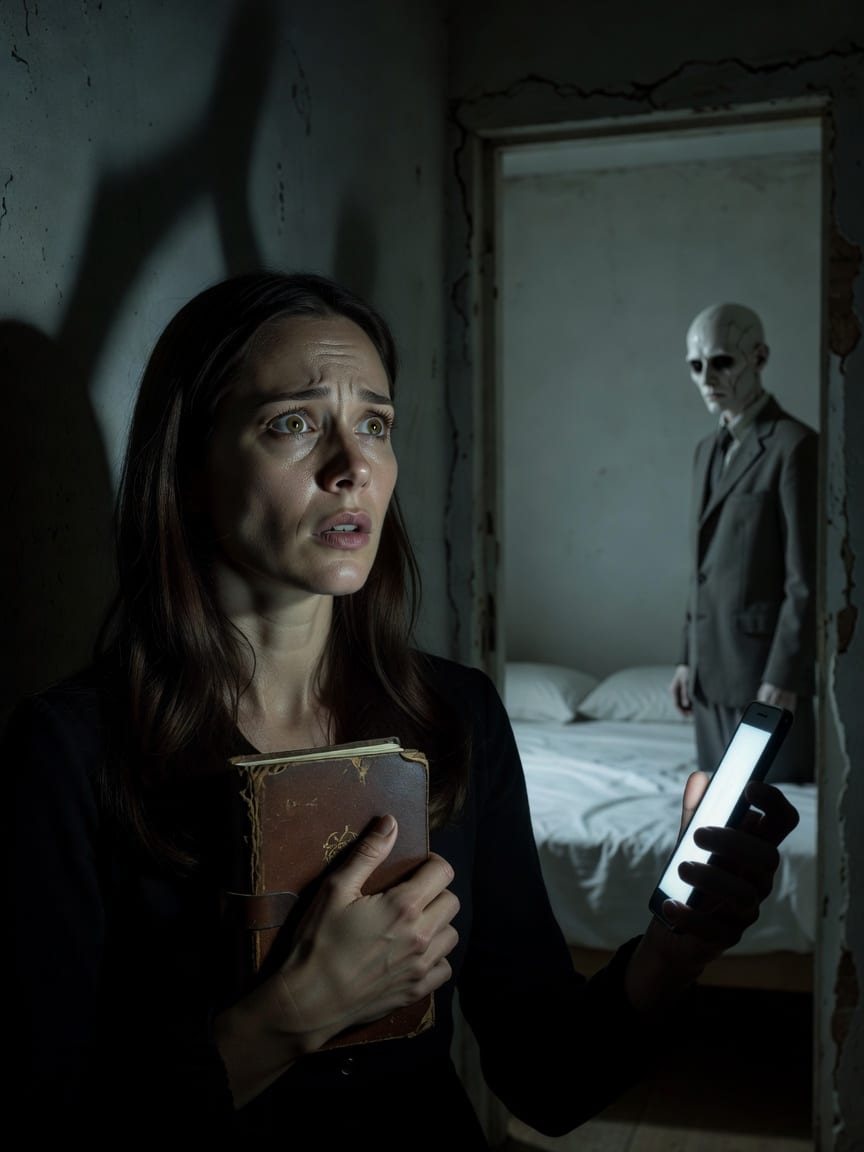
Behind a plastered-over doorway, I found a room. Papered, carpeted, and furnished with a made bed, sealed for decades. The air was dead still, but the bed wasn't dusty. My council tax bill only lists five rooms.
I'm Claire, an architect, meticulously planning my new Victorian terrace renovation. But when I uncovered a hidden room behind a wall, everything I knew about time and decay shattered. The bed was perfectly made, the air still, yet there was no dust, only an unnerving cold.
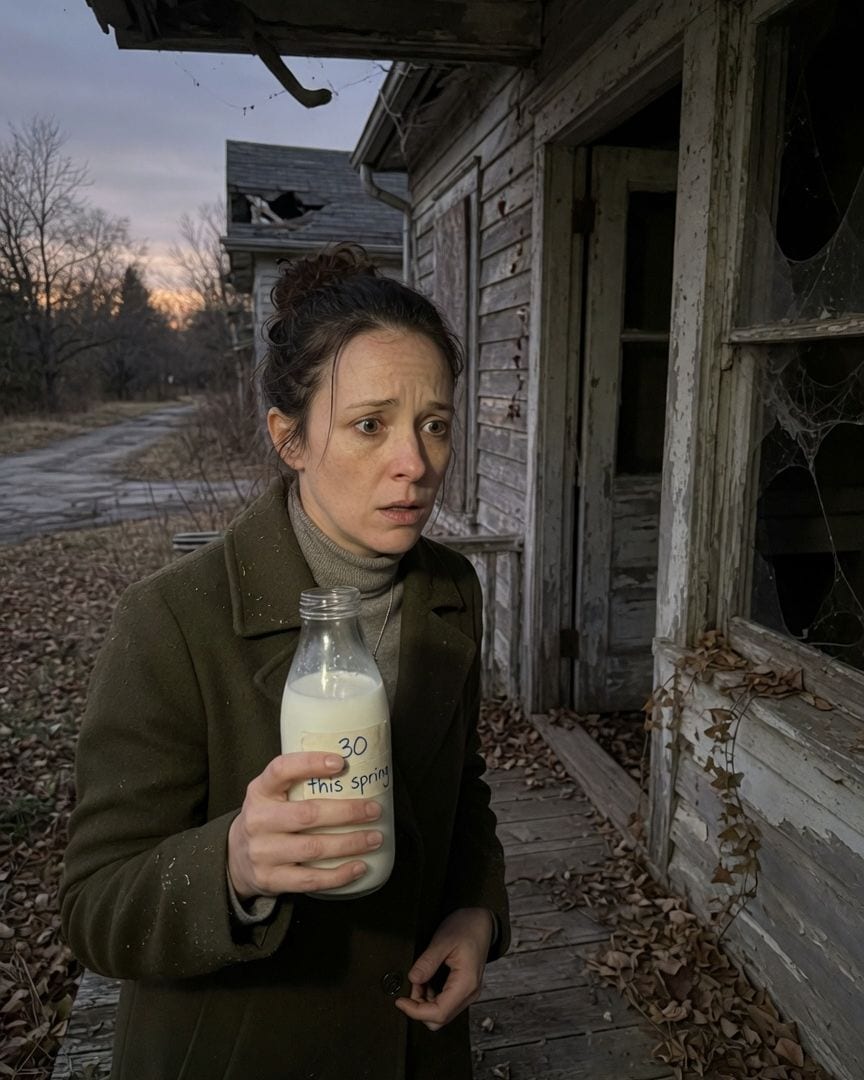
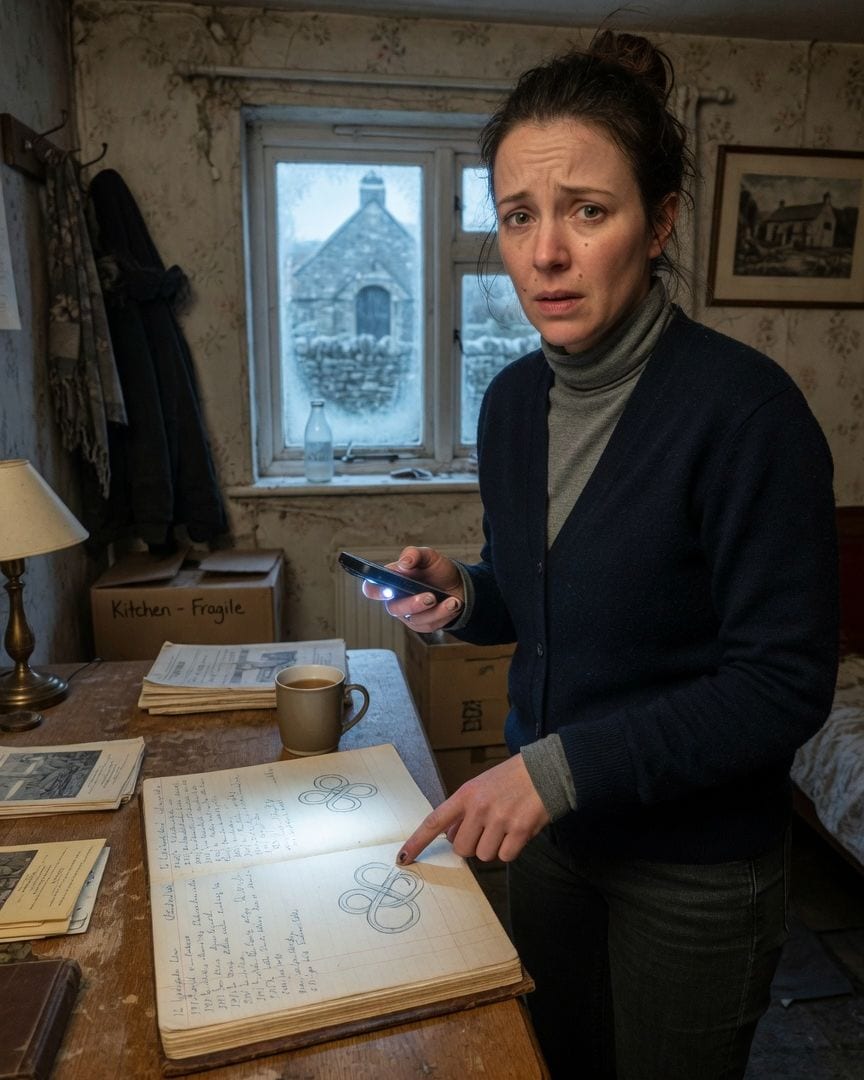
My grandfather's old milk ledger shows Account 30 reissued to the same house every ten years since 1930. Different names, same number. The last entry, unpaid, is dated this spring.
Sifting through my grandfather Howard's old things, I found his milk ledger. One account for a house long abandoned on Foldyard Lane showed a strange pattern of recurring 'stopped taking milk, gone' entries, ending with 'unpaid' this spring. Driving out to the decades-old ruin, I found a pristine, sealed milk bottle, dated 'this spring,' on its crumbling porch.