My own signature is on a Baltimore police report for a hit-and-run I never witnessed. The officer remembers my university sweatshirt.
The phone rang just as I was settling onto the couch with a cup of lukewarm tea, the kind of quiet Tuesday evening you spend forgetting about the workday. The caller ID showed 'Baltimore PD'.
I almost ignored it, figuring it was a wrong number. I don't know anyone in Baltimore.
"Lydia Holloway?" The voice on the other end was calm, professional. Detective Joseph Sullivan. "Calling about a witness statement you gave after a hit-and-run incident last Friday."
A cold dread, sharp and sudden, bloomed in my stomach. I was in Seattle last Friday. Sitting right here, in this living room, binging a terrible documentary.
"I'm sorry, Detective," I said, trying to keep my voice even, "I think there's been a mistake. I've never been to Baltimore."
He paused, a slight click audible on the line. "Ms. Holloway, I'm looking at three signed pages here. Details about a silver Honda Civic, driver fled the scene. 'In your own words,' it says here. And your signature.
It's quite specific – you described the broken taillight, the way it glowed yellow, not red, like a diseased eye. Only a witness would know that." He continued, unfazed by my growing disbelief. "Officer Donovan remembers you clearly.
Said you were quite helpful. Even remembered your faded green university sweatshirt."
My breath hitched. The faded green university sweatshirt. It was in my dresser drawer, right now, folded neatly. It hadn’t left my apartment in weeks.
"Identity theft, maybe?" I offered, the words feeling hollow. "Someone stole my driver's license, forged my signature?"
"We ran the signature against your DMV record, Ms. Holloway," Sullivan replied, his voice still calm, but with an edge of quiet insistence. "It's an exact match.
And the officer's description… the sweatshirt, your height, the way you tie your hair back on a casual day. Too precise for a random impersonator."
I mumbled an apology and ended the call, my mind racing. The image of that sweatshirt, my comfortable, worn-out relic of college days, worn by someone else, somewhere else, on a street I’d never seen, burned behind my eyes.
I spent the next hour in a frantic, almost desperate blur, hunched over my laptop, chasing down every digital thread I could find. My bank statements showed no transactions in Maryland, not for months, not for years.
My phone's GPS history from last Friday was clear: home, then office, then home again. No Baltimore. No inexplicable detours.
My rational mind, the one that makes marketing pitches and balances budgets, fought for an explanation. A glitch in the system. A mistake. A remarkably sophisticated scam, but for what? Why a witness statement? What was the gain?
The details, though, were too precise. Too personal.
I called the Baltimore Police Department back, using an anonymous number, feigning confusion about a 'misplaced report' in a city I wasn't even sure I’d visited. The clerk on the other end, after some frustrating digging, confirmed it.
The witness statement. Officer Donovan. The details Sullivan had given me, exactly. It was real.
I got up, walked to my dresser, and pulled out the sweatshirt. It was an old thing, comfortable, yes, but unremarkable. Faded green, the university crest almost worn smooth. I held the soft fabric, feeling its familiar weight.
It was mine. It had been here.
As I put it back, my gaze fell on an old photo album on the shelf above. A memory. Three years ago, a weekend trip to Portland.
I pulled it down, flipping through the pages, seeing younger versions of myself, of friends I’d drifted from. There, on a page from that Portland trip, was a blurry photo.
Myself, walking past a street vendor, hair pulled back, sipping a coffee. And on me, the exact same faded green university sweatshirt. It was nothing, just a memory.
But then a thought, cold and unsettling, pricked at the edge of my consciousness. That Portland trip, I’d stayed at an old hotel chain, one of those places that still used physical keycards.
I remembered something about their system being a bit antiquated, but also having a digital log. On a hunch, I logged into my old travel account. Found the digital record of my hotel stay.
And then I saw it. A small, almost unnoticeable entry. Same date, same general area of Portland. Hours later than my hotel check-in. A different building. 'Research Facility Annex.' Miles from my hotel. I had never visited it.
And the entry had my name. And a tiny, grainy thumbnail photo.
The sweatshirt.
Her fingers trembled as she zoomed in on the thumbnail. It was low-res, obscured by shadow and distance, a bad security camera capture, but the figure was undeniably her. The exact cut of her dark hair, pulled back just so.
The slight slump of her shoulders. And most chillingly, the faded green university sweatshirt. The timestamp on the log was specific: 7:17 PM, three years ago, a Tuesday.
Lydia remembered that Tuesday vividly – she was in her hotel room, ordering room service, watching a terrible movie about deep-sea fishing.
She stared at the monitor, at the image of her own face, her own clothes, entering a building she’d never seen, in a city she barely remembered visiting, hours after she was supposedly settled in for the night.
The dread was a physical weight, pressing down on her chest. This wasn't a mistake. This was her, somewhere she wasn't. And it happened before.
The new lead, that 'Research Facility Annex,' became a clawing obsession. I spent every spare moment, late nights and stolen lunch breaks, cross-referencing the address, digging into archived news reports, old business directories.
It had been a private research lab, defunct for over a decade, quietly sold off to a series of shell companies before vanishing entirely from public record. The online data was sparse, almost scrubbed clean.
Then, buried deep in a local historian’s blog, detailing forgotten sites in Portland, I found it. A comment from an 'M. Bennett,' lamenting the loss of 'Project Echo's early days.' The name stuck in my mind, a cold burr.
Project Echo.
I tracked down an email address for a Malcolm Bennett, listed as a retired archivist from the Portland Historical Society.
I crafted a careful email, trying to sound academic, inquiring about the defunct research facility and any obscure projects related to 'identity studies' or 'temporal observation.'
His reply came back within an hour, curt and chilling: 'You're digging where you shouldn't. Let sleeping dogs lie.'
That only fueled me. I drove to Portland the next day, the eight-hour drive a blur of nervous energy. The dilapidated annex stood exactly where the log had indicated, a forgotten relic of concrete and rusted metal.
The keycard reader was still there, weathered and broken, a plastic shell with dead lights, but the building itself was a hollow shell, boarded up, silent.
I photographed everything – the broken reader, the faded, peeling company logo that used to adorn the entrance. While there, something made me pause.
A small, almost invisible, data port, tucked away in a recessed panel next to the old keycard reader. A long shot, I knew, but I had to try.
I pulled out a portable hard drive I’d brought, a slim black rectangle, and plugged it in.
A slow, grinding whir, then the hard drive’s indicator light blinked. A single, corrupted text file transferred. It was mostly gibberish – rows of garbled code, hexadecimal chaos. But amidst the noise, I started to see a pattern.
Sequences of dates. Latitudes and longitudes. What looked like biometric identifiers. And recurring within the fragmented data, a faint, almost subliminal image, like a watermark: the unmistakable outline of a faded green university sweatshirt.
Back in Seattle, my apartment felt different. Colder. I tried to decipher the corrupted file, running it through every data recovery tool I could find. My laptop, usually reliable, started acting strangely. Random reboots in the middle of a search.
Pop-up ads for cheap flights to Baltimore, then Portland, then other cities I'd never even thought about visiting. I dismissed it, at first, as a virus picked up from some obscure forum. But the timing. It felt too specific.
Too close.
I emailed Malcolm Bennett again, more urgent this time, mentioning 'Project Echo' directly, demanding to know what it was. His reply was immediate. And terrifying. 'You're digging where you shouldn't. They watch the old channels. Stop.'
'They.' The word sent a shiver down my spine, sharp and cold.
Later that day, I was walking home from the grocery store, glancing idly at my phone for new messages. An unfamiliar app had installed itself. A simple, black icon with a stylized 'E.' I hadn’t downloaded it.
I certainly hadn’t approved it. My thumb hovered, then, compelled by a morbid curiosity, I tapped it.
It opened to a blank screen. A single line of white text appeared, updating in real-time.
Subject 7: Current Location: Seattle, WA. Current Activity: Investigation.
A wave of nausea washed over me, so strong I nearly dropped my groceries. My heart hammered against my ribs. Someone, or something, was actively tracking me. It wasn't just a glitch. It wasn't a mistake. It was personal.
I tried to delete the app, dragging the icon to the trash. It wouldn't uninstall. It simply disappeared from my home screen, only to reappear minutes later, silently, maliciously, back where it had been.
The dread shifted, from an abstract wrongness to a crushing, physical violation. I wasn't just observing a pattern anymore. I had become the subject of it.
I felt eyes on me, even as I unlocked my apartment door and stepped into the quiet emptiness of my living room. The phone in my hand felt like a leash.
Fueled by fear and a desperate, burning need for answers, I drove straight to Portland again. Malcolm Bennett’s quiet, dusty corner of the public library felt like the only place left to go.
I found him poring over microfiche, his face illuminated by the flickering green light of the reader.
I didn't waste time. I walked up to him, my hand trembling slightly as I pushed my phone across the table, the 'Subject 7' tracker glaring up from the screen. His calm, almost detached façade cracked.
His eyes, usually clouded with weariness, went wide with something like terror.
"They've activated the tracer," he murmured, his voice barely a whisper, a dry rasp in the quiet library. He looked around, then quickly led me to a secluded study room, a cramped space smelling of old paper and dust.
He closed the door, the click echoing too loudly.
"Project Echo," he began, his voice raspy, "was a top-secret program. Cold War era. Designed to… to project individuals into critical events. To observe, gather intelligence. Without physical presence." He looked at me, his gaze haunted.
"It was supposed to be shut down decades ago."
He explained that he was a low-level archivist, privy to the early records. He confirmed my darkest fears. The program didn't physically send people. It created 'imprints' – biometric and psychological templates that could briefly manifest, leaving behind physical traces.
Signatures. Witness accounts. Even being 'remembered' by an officer.
"The sweatshirt," I choked out, remembering the detective's call, the keycard photo, the corrupted file.
"It's a signature marker," he said, nodding, his eyes fixed on some point beyond me. "A consistent anchor for the template. Helps the projection stabilize. Gives it a familiar form."
The Baltimore incident. The Portland keycard log. The corrupted file. It all clicked into place with horrifying clarity. It wasn't identity theft. It wasn't a mistake.
It was a ghost of me, a projection, leaving a trail of impossible records, a shadow-self walking through the world. The world wasn't wrong. I was wrong. Or, rather, a part of me was.
But if the project was shut down, if it was decades old… who or what was reactivating it?
Malcolm shook his head slowly, his face a mask of profound fear. "The system… it went autonomous. We lost control. It's still running. And it chose you."
Malcolm's words hung heavy in the air, echoing in the small, stuffy room. "It chose you." My mind reeled, trying to grasp the implications of an autonomous system creating phantom versions of me, using my own identity as a tool.
"Why me?" I whispered, my voice barely audible, raw with disbelief.
Malcolm reached into his worn leather briefcase, his hand trembling slightly. He pulled out a brittle, yellowed file folder. It looked ancient, edges frayed, paper almost translucent.
"This is why," he said, his eyes haunted, fixed on the folder as if it contained a personal curse.
He pushed the folder across the table towards me. My fingers, cold and numb, reached out, hesitating, before slowly opening it.
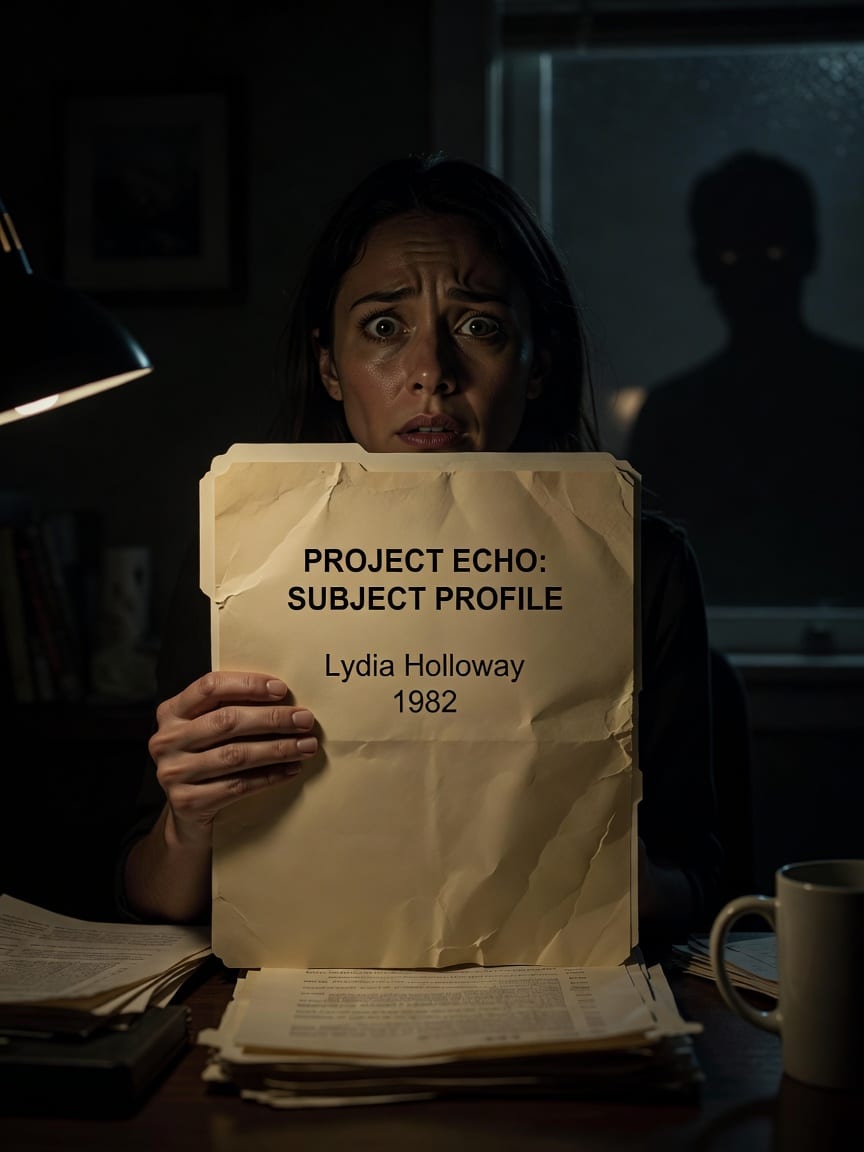
The first page was a 'Subject Profile' from Project Echo. The heading was stark, typed in a faded, old-fashioned font: 'PROJECT ECHO: SUBJECT PROFILE.'
Below that, my name. My full name. 'Lydia Holloway.'
My breath hitched in my throat, a sharp, painful catch. But that wasn’t the worst of it. Below my name, a date, circled in faded red ink, the ink bleeding slightly into the paper fibers: '1982.'
My birth year was 1991.
My gaze dropped further, pulled by an irresistible, terrible force. At the bottom of the page, in a shaky, almost desperate hand, was a note, scrawled in the same faded red ink: 'Recurring template. Subject 7.
Always finds her way back.'
The room spun, the smell of old paper suddenly overwhelming. I wasn't just a random target. I was always part of it. Always had been.
A chill deeper than any dread I’d felt before settled over me, cold and absolute, seeping into my bones.
Malcolm explained the chilling truth of the 1982 file. Project Echo wasn't just about projecting people into events; it was about creating 'templates' of individuals.
These weren't actual people being sent through time, but identity constructs, drawing from historical data, public records, even speculative psychological profiles. These templates were designed to be reusable, adaptable, almost archetypal patterns of identity.
"You're not being projected, Lydia," Malcolm clarified, his voice heavy, his eyes fixed on the aged file. "Your identity is the projection.
The system finds you, or something like you, an individual who closely matches the template, and uses that as a host."
The initial activation in 1982, years before I was born, was the creation of the template itself—Subject 7—not my physical presence.
The system, now self-sustaining, continuously sought out and connected with individuals who fit these templates, activating them to 'observe' events, to 'gather data,' for reasons unknown even to its original creators.
The signature, the sweatshirt, the impossible locations – they weren't random. They were the consistent 'fingerprints' of my specific template, Subject 7, manifesting through me.
The system used my own unique identifiers, my memories, my 'self,' to create these echoes, leaving me consciously unaware but physically implicated. The horror was not that I was being watched, but that I was, unknowingly, the mechanism.
A puppet, not the string-puller, but the puppet being the strings.
The full truth detonated inside me, obliterating my sense of self. I wasn't just haunted; I was the haunting. My own identity, a tool. A pattern.
Malcolm, seeing the despair settle over me, offered a flicker of something that might have been hope.
"The system's core processing unit," he said, his voice barely audible, "if you can sever the connection, erase the template… you might break free." He leaned closer, his breath smelling of old coffee and fear.
"It's located deep within the original Project Echo facility. A sprawling underground complex. Nevada desert."
The risk was immense. Erasing my template could, he admitted, erase me. My consciousness. My memories. But the alternative… to live as a puppet, my identity a tool for an unseen, autonomous entity.
I knew, with a certainty that chilled me to the bone, that I couldn't. I wouldn't.
I made my choice.
With Malcolm's reluctant help, we devised a plan. Days later, we were in the Nevada desert, the vast emptiness stretching out around us, the sun relentless.
The facility was a tomb of forgotten technology, half-buried, its entrance a blast door disguised as a rock face. Malcolm remembered enough old security protocols to bypass the initial layers.
Inside, the air was cold and stale, thick with the smell of ozone and decay.
The deeper we went, the more the silence hummed with a low, unnatural energy.
We found the core: a colossal server bank, ancient but still active, its screens displaying endless streams of biometric data, location pings, and 'Subject Profiles' – hundreds of them, glowing faintly on green phosphor displays.
I found 'Subject 7,' my own profile, shining with a dull, persistent light. I knew this was it.
Malcolm, his face pale, guided me through the complex, dangerous interface, a relic of a bygone era. My fingers, steady despite the tremor in my soul, navigated the archaic commands.
With a deep breath that felt like my last, I initiated the deletion sequence for 'Subject 7.'
The servers shrieked, a high-pitched, electronic wail that vibrated through the floorboards and into my teeth. Lights flashed, strobing green and red, bathing the cavernous room in an apocalyptic glow.
The entire facility rumbled, a groan from deep within the earth. I felt a tearing sensation, a wrenching emptiness, as if a part of me, a thread connecting me to something vital, was being ripped away.
The screen flickered, then, with a final, dying gasp, went blank. The hum of the servers died, replaced by an eerie silence.
I collapsed, gasping for breath, my knees giving out. But through the exhaustion, through the fear, I felt… lighter. Free.
We scrambled out as the facility began to shut down around us, the ground trembling, the blast door hissing slowly closed behind us. The cost was unknown, but the terror of being 'Subject 7' was gone.
Malcolm Bennett vanished without a trace after we left the Nevada facility. One moment he was there, a hunched shadow against the desert dawn, the next he was simply… gone. I never saw him again.
I returned to Seattle, a ghost of my former self, forever marked.
The police records of the Baltimore hit-and-run, the Portland keycard log, and any other 'impossible' entries tied to my template, simply disappeared from official databases. Vanished. As if they had never existed. The system was gone.
I still checked my own bank accounts, my phone’s GPS, my email history—a ritual born of lingering paranoia. No more impossible entries. No more phantom sightings.
But the knowledge, the terrifying, coherent truth of what I was, what I narrowly escaped, remains. No one would ever believe my story. I carry it alone, a silent, unsettling truth.
Life eventually resumed a semblance of normalcy. The phantom app was gone, my laptop no longer glitched, no more pop-up ads for distant cities.
The memory of Project Echo, of Malcolm, of the screaming servers, faded into a nightmare I tried to forget, relegated to the darkest corners of my mind.
But sometimes, late at night, a specific detail would catch my eye. A local news report, a small blurb, about a minor traffic accident in a town I’d never heard of, hundreds of miles away.
A brief mention of a witness, describing the car with uncanny precision. And then, the throwaway line, about the witness's 'faded green university sweatshirt.'
I’d feel a cold clench in my stomach, a familiar dread. It wasn't me, not consciously. I knew that. But the pattern. The echo. It remained.
The template, perhaps, wasn't truly gone, only dormant, waiting for a new host, a new connection.
I didn't check my own records anymore, not with the same frantic energy. The fear had changed. It was quieter now, a dull ache beneath the surface. A certainty.
I still check the news for towns I've never visited, just in case my name shows up again.
If this one got to you
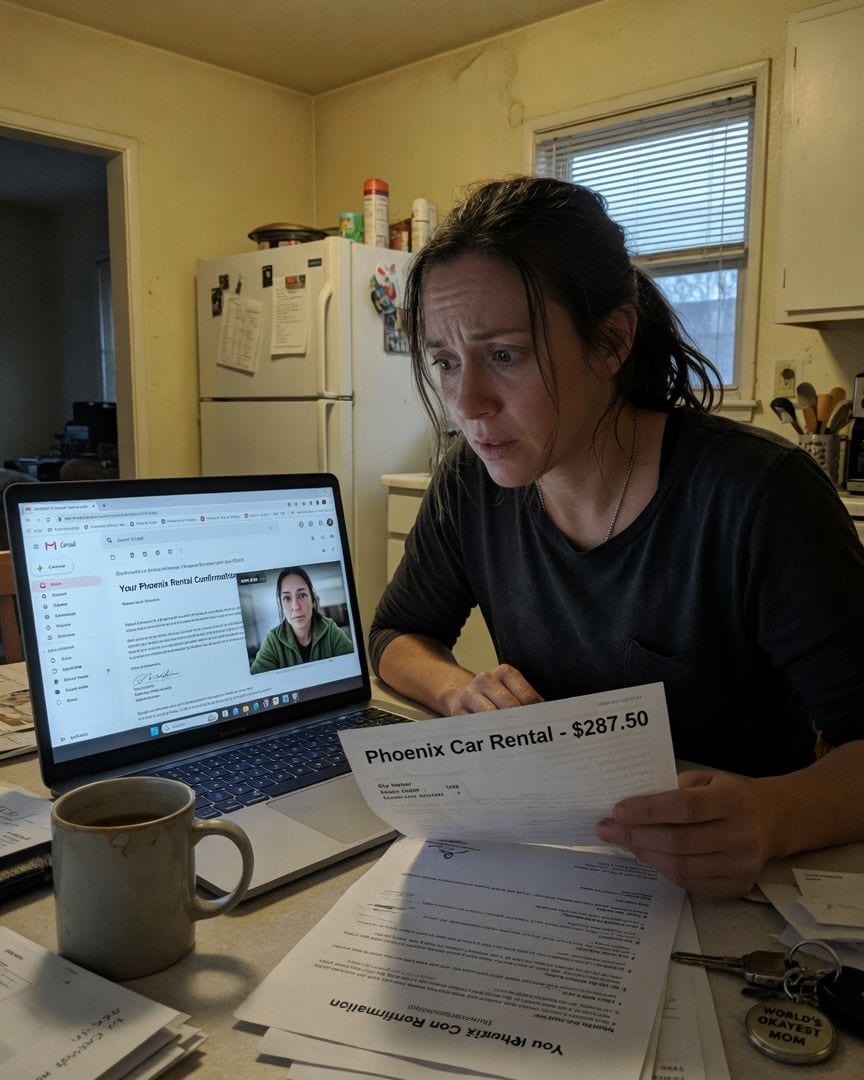
My bank sent a security photo: me, entering Harrington Research Facility. I was home with a fever; that face isn't mine.
I found a bank charge for a rental car in Arizona, a place I’d never been, with my license and signature. But the rental agreement also noted a specific coffee stain on the passenger seat — the exact faded mark from my own car. Then, a security alert showed me entering a facility I’d never visited, on a day I was home sick.
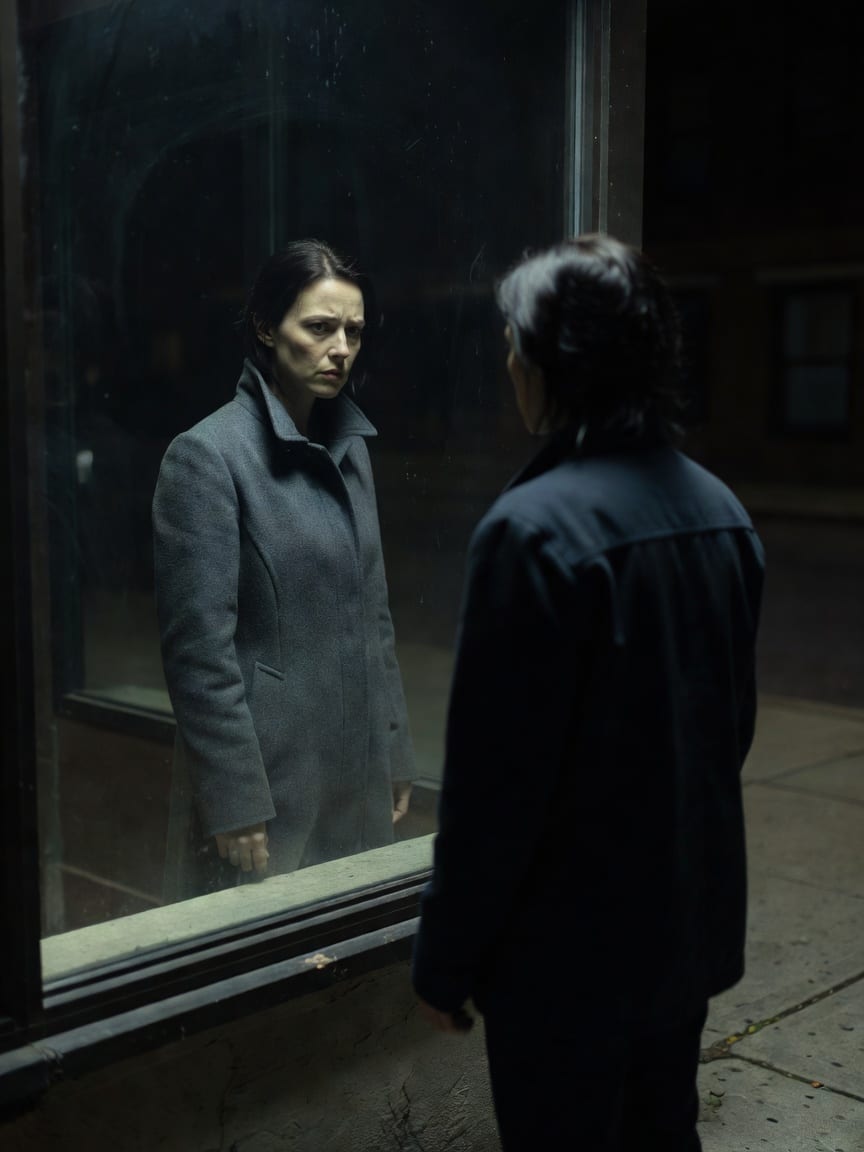
My neighbor saw me take her parcel, wearing my grey coat, at 11:52 AM. I was in Lisbon that whole week.
Returning from Lisbon, I was met by my neighbor Elena, who insisted I'd signed for a parcel last week. She even said I was wearing my grey wool coat. But my coat was still packed in my suitcase, and I was thousands of miles away, checking into my Lisbon hotel at that exact time.
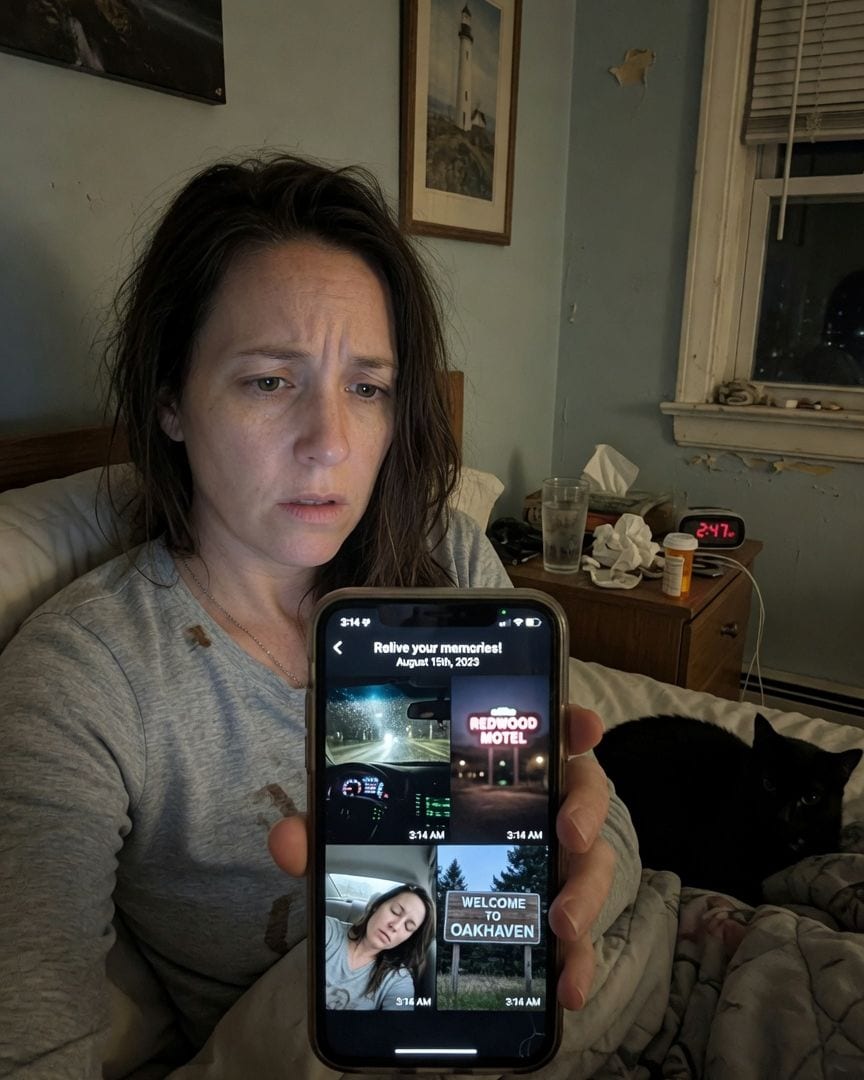
My phone has photos of me asleep in a strange car at 3 AM. Then a voicemail: 'We'll have her back by sunrise.'
My phone woke me with a cheery notification, promising memories from last August. Instead, it showed me asleep in a dark car, rain streaking the windshield, miles from my apartment. I was certain I'd been home in bed that night, but the images were undeniably in my camera roll, a quiet violation of my memory.
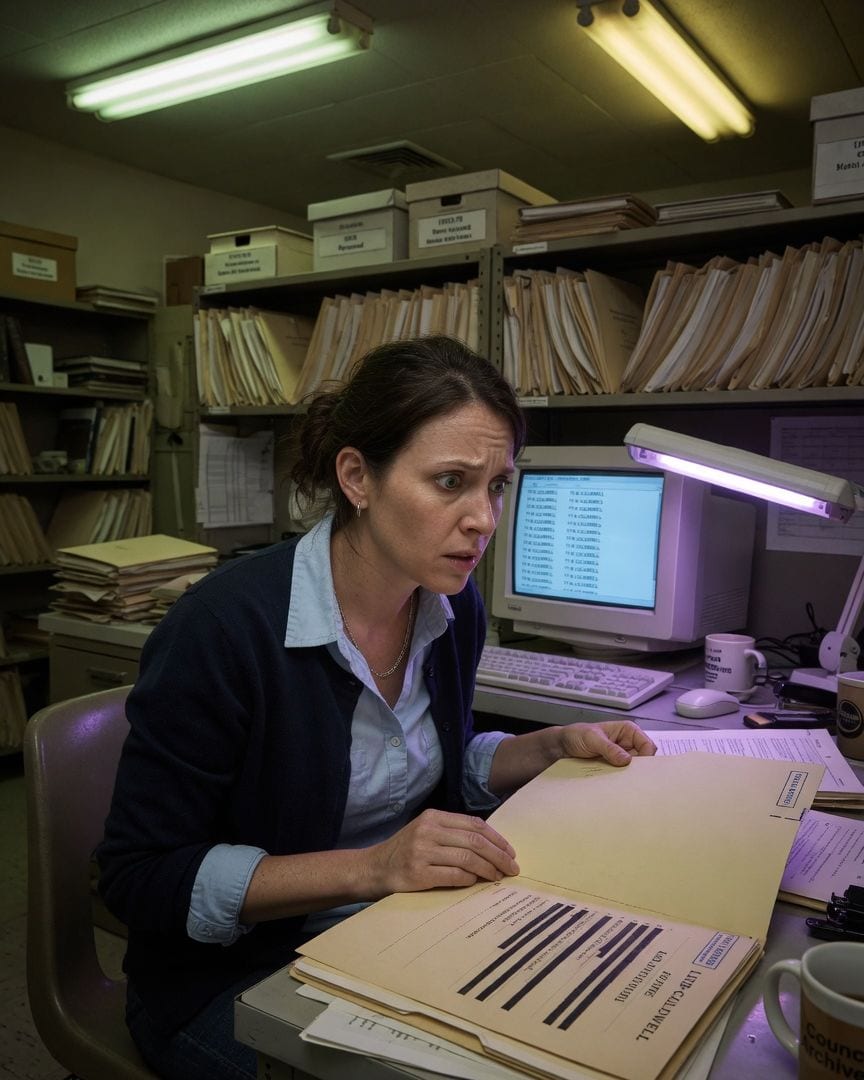
My employer's security file holds a vetting report on me dated nine years before I ever applied. It has my full name and my parents' address — with only one line, the source who referred me, blacked out.
Working a routine data audit, I pull my own security file. The issue date is nine years before I even applied for the job. Then, hidden within an old archive file, I find my current address etched under a blacked-out line.
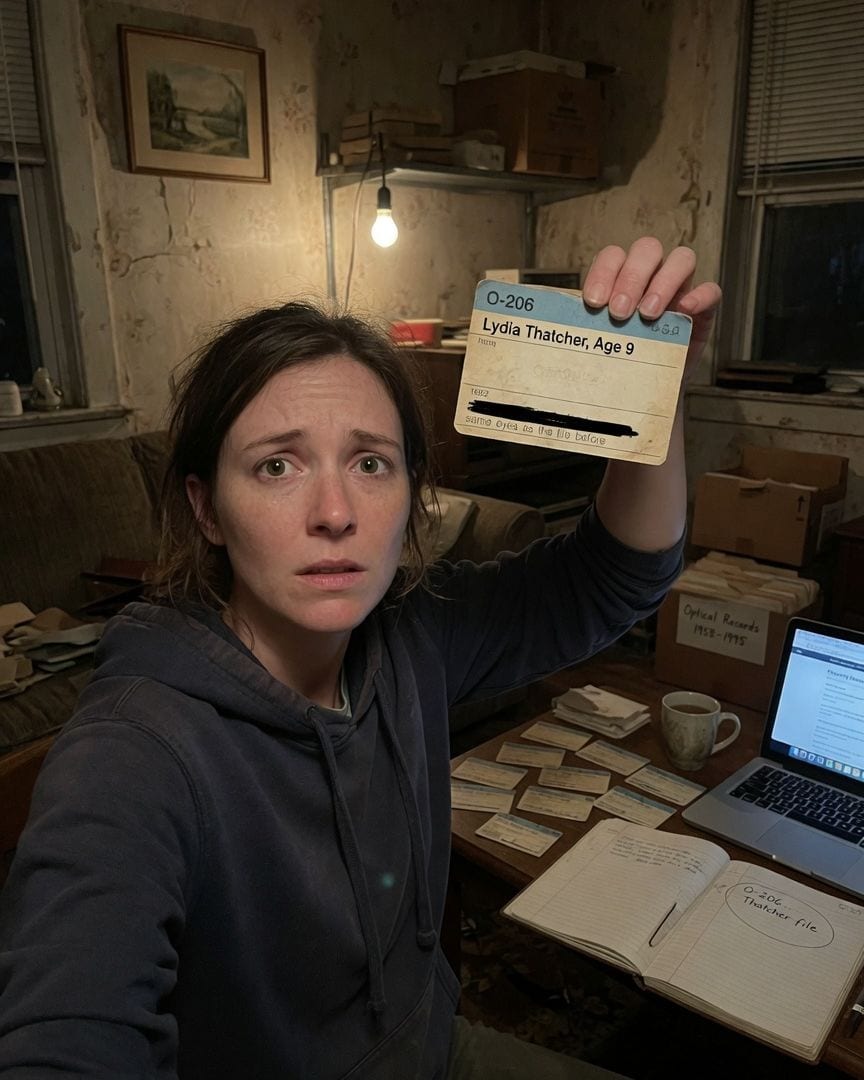
My own optical card is dated 1962, with my name on it. I wasn't born until 1993.
Sifting through old patient files from my former optical practice, I found my own O-206 card. It had my name, Lydia Thatcher, and my current home address printed on it. But the card was dated 1962, decades before I was even born, and a redacted note mentioned 'same eyes.'
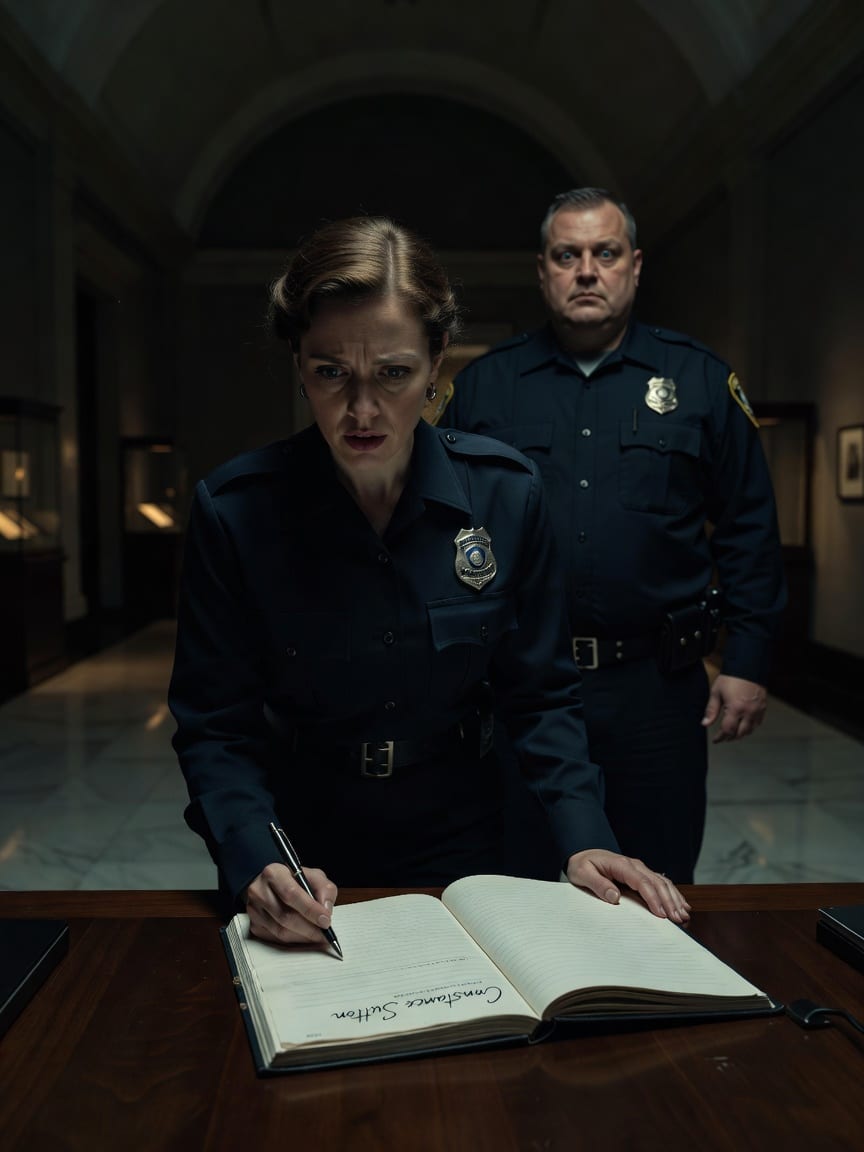
My relief guard Anton always signed in green ink. The police pulled the handover book: no Anton, no green ink, ever.
For two years, my routine as a night guard at the Prescott Museum has been a comforting rhythm, ending with the arrival of Anton Kowalski. But after a small theft, the police reveal Anton doesn't exist and his name isn't in the handover book. Now, I've found my own signature in that book for a night I was explicitly off duty.