My bank sent a security photo: me, entering Harrington Research Facility. I was home with a fever; that face isn't mine.
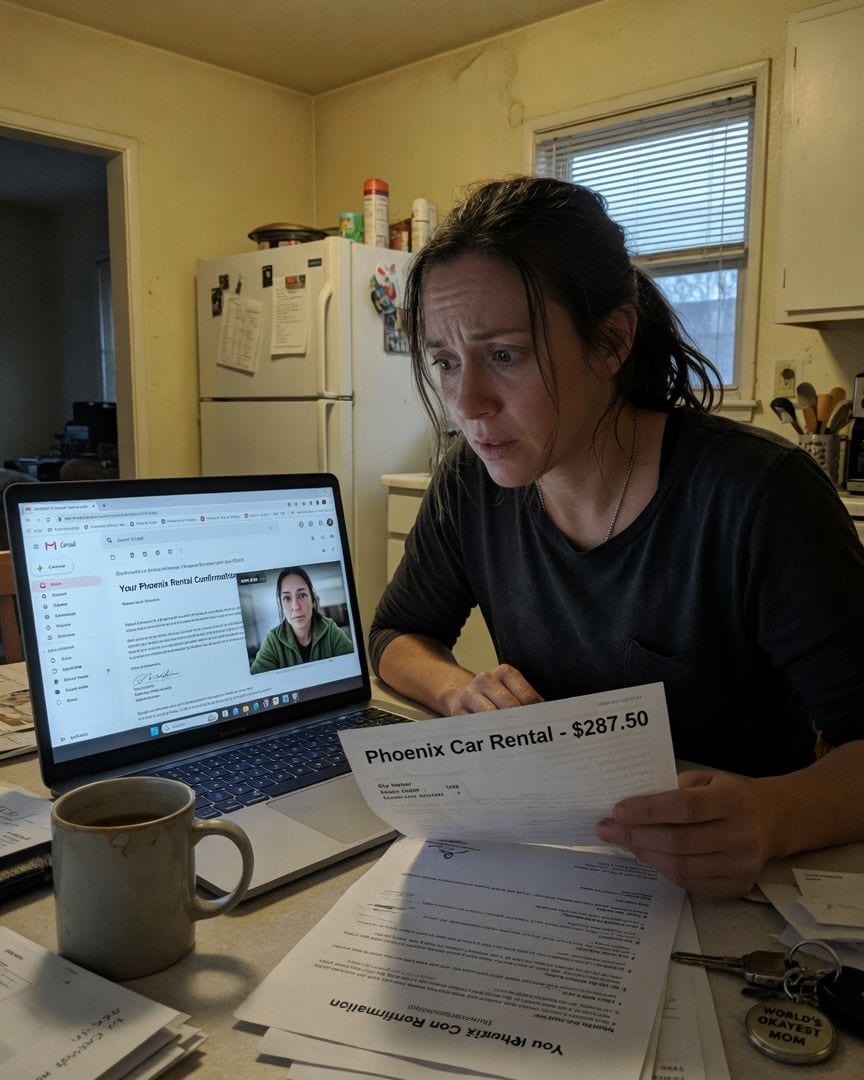
I stared at the bank statement on my kitchen table, the light from the window catching the glossy paper. The line item, mocking me in bold, black print: 'Phoenix Car Rental - $287.50.' I’d never been to Arizona.
Not once in my thirty-four years. My heart, already thrumming with a nervous energy, tightened further.
A quick call to the rental company confirmed it. A Nissan Altima had been taken from their Sky Harbor lot for six days, then returned with a full tank, no damage. They promised to email me the agreement.
When it arrived, a PDF attachment in my inbox, the cold knot in my stomach solidified. My driver's license number was there, accurate down to the issue date.
My signature, or a damn good forgery of it, scrawled at the bottom of the counter receipt.
And then, in the small print of the return inspection notes, a detail that stole the breath from my lungs: 'coffee stain, passenger seat.'
My apartment was quiet, the hum of the refrigerator suddenly too loud. I stood up, walked to the garage, the concrete cool under my bare feet.
I opened the passenger door of my own sedan, a familiar metallic click echoing in the enclosed space. And there it was.
A faint, faded coffee stain, a ghost of a spill from last spring, right there on the fabric of the seat. The outline was unmistakable.
I traced the familiar, impossible mark with my finger, my skin prickling with a dread that was too specific, too personal.
I spent the next hour on the phone, trying to dispute the charge. Pamela, the rental company’s agent, sounded patient, almost weary. "Ms. Galloway," she explained, her voice calm over the phone, "the evidence is airtight.
Your license, your signature, the car returned in perfect condition. We have nothing to indicate fraud."
I insisted it had to be identity theft, but my wallet, with all my cards and ID, was securely in my purse, exactly where I’d left it. No recent breaches on my credit report.
The bank, equally unhelpful, advised me to file a police report, but offered little hope given the 'irrefutable' documentation. Each refusal felt less like a bureaucratic wall and more like a carefully built one, designed to keep me from something.
A creeping sense of violation settled over me. Not from a thief, but from something far more intimate, something that knew the particularity of a coffee spill in my own car.
I checked my email again, sifting through spam and unread newsletters, almost hoping to find a mistake. And then I found it: an email confirmation for the Phoenix rental.
It had been sent to my own address, dated two weeks prior, nestled between an online shopping receipt and a work memo. I’d never seen it, never opened it.
It detailed the Nissan, the six days, the full tank, even the model of coffee maker used at the rental desk's complementary station – an unnecessary detail, precise and chilling.
It was a ghost in my own digital life, a meticulously documented event I had no memory of.
Just as I was about to dismiss it all as an elaborate, inexplicable fraud, my phone pinged again. A security alert from my bank, but this time it wasn't a charge.
It was a notification from the Harrington Research Facility—a local, highly secure institution on the other side of town, a place I’d never set foot in.
A keycard log, under an employee ID that bore my name (but I didn’t work there), recorded my entry and exit for 3:00 PM yesterday.
Yesterday, I’d been home all day with a fever, wrapped in a blanket on the couch, watching old movies. Attached was a grainy security camera photo.
It was me, wearing my green jacket, the one I’d worn the week before, my hair pulled back just like I often did.
But the eyes in the image were flat, devoid of my usual spark, and the posture too rigid. I zoomed in, a cold dread seizing me, focusing on the small, almost imperceptible differences. The face is hers, but it isn't.
My attempts to contact the Harrington Research Facility were met with a wall of polite confusion. HR had no record of a 'Kathleen Galloway' ever being employed there, let alone having a keycard.
Security assured me their system was impenetrable, dismissing the alert as an obvious phishing attempt, despite its origin direct from my bank.
I tried accessing the log system remotely with the ID number from the alert, only to find my credentials immediately blocked, my home IP flagged as a security risk. The unease sharpened into a specific, tangible fear.
This wasn’t an error. This was a cover-up.
I drove by the facility that afternoon, a sprawling complex of dark glass and concrete, feeling an inexplicable pull, as if a part of me had truly been inside.
The building seemed to watch me, its windows reflecting the gray sky like unblinking eyes. I called Russell Merritt, a former colleague who’d worked at Harrington years ago, hoping for some insight, some back-channel access.
He chuckled at my mention of a keycard log. "Harrington's old guard," he said, his voice crackling slightly over the phone, "they still keep physical archives, deep in the basement.
Rumor was, they held records of 'experimental personnel' back in the day. Weird stuff. Don't go poking around there, Kathleen. Some things are best left alone." The warning, delivered with a casual shrug, only fueled my resolve.
This wasn't identity theft; it was something deliberate, something hidden within those walls.
Ignoring Russell's caution, I fabricated an excuse about a lapsed research grant application and talked my way past the initial security desk at Harrington. The woman at the reception looked at me with a vague familiarity, which chilled me.
I navigated the labyrinthine corridors, the hum of unseen machinery a constant, low thrum, like a sleeping giant.
Following Russell's vague directions, I found the archives: a dusty, dimly lit section of the basement, shelves overflowing with old files and heavy, bound ledgers.
The air was thick with the smell of aging paper and something else, something metallic and cold, like static electricity.
As I tried to bypass a locked door marked 'Restricted Access - Personnel Records,' my fingers fumbling with the old-fashioned latch, a calm, unhurried voice spoke from directly behind me. "Looking for something, Ms. Galloway?"
I froze, my hand still on the cold doorknob. My breath caught in my throat. Walter Blackwood, a man in his late sixties with an impeccably neat, if slightly dated, suit and an unreadable expression, stood there.
He wasn't security; his posture was too relaxed, too unconcerned. Nor did he look like a researcher, lacking the frantic energy common to the others I’d seen. He held a bound, leather ledger under one arm, its edges worn smooth.
He didn't look surprised or angry, just… expectant. The silence stretched, heavy and knowing, the low hum of the building vibrating through the floor.
Walter, without a hint of malice or urgency, gestured towards a small, meticulously organized office tucked away in the archives. He invited me in, closing the heavy, soundproof door behind us.
The room was filled with old files, neatly stacked and labeled, the air still and quiet, as if sound itself was absorbed by the paper.
He placed the leather ledger he’d been carrying on his desk, the soft thud echoing in the stillness.
"The Phoenix rental, the keycard log," he began, his voice even, almost academic, "they are not errors, Ms. Galloway. They are records of enactment."
I felt a jolt, as if struck by something invisible. "Enactment? What are you talking about?" I demanded, my voice tight, too loud in the quiet room.
Walter's gaze was steady, unwavering. "A registry. And doubles." He explained, in a measured tone, as if detailing a mundane administrative process, that some lives were simply… recorded.
Not just documented, but mapped out in intricate detail, from major decisions to the most mundane habits. And then, sometimes, for reasons he didn't fully disclose, those recordings were 'played out' by temporary proxies.
"The coffee stain," he said, picking up a pen and tapping it against the Phoenix agreement printout I’d brought, which lay on the desk between us, "is a hallmark of fidelity.
A detail so specific, so accidental, it confirms the accuracy of the enactment."
I stared at him, my mind struggling to process. My life, on file. These events, not a mistake, but a reflection of that file. The world tilted on its axis, a sick, dizzying sensation. "Who… who does this? Why?"
I stammered, my throat suddenly dry.
Walter merely offered a faint, almost imperceptible shrug. His face, calm and utterly devoid of emotion, was the most terrifying thing I had ever seen. "It's just the way it is. Your life, Ms. Galloway, is on file.
These events are merely a reflection of that fact." The quiet certainty in his voice chilled me to the bone.
Numb with a terror deeper than any I'd ever known, I managed to push out, "Are there others? Other lives… on file?"
Walter, with that same faint, unreadable nod, pushed the heavy, leather-bound ledger he'd been carrying across the desk towards me. Its cover was unmarked, plain leather, worn smooth with age, hinting at decades of use.
He opened it to a random page, the binding creaking softly. My eyes scanned the handwritten entries. Names, dates, and brief, mundane descriptions of events – 'Broken Teacup, 14:00, Elm Street Cafe,' 'Spoke 'Is that so?'
to grocer, 10:15, Main St. Market,' 'Car parked exactly three feet from curb, 08:30, Bank of America lot.' Each entry was terrifying in its precise, ordinary detail.
Then I saw it. A name that made my heart seize, a name that pulled me from the general horror into something acutely personal: 'Hannah Whitmore.'
Hannah, my college roommate, who had recently moved to another state after a series of bizarre, minor mishaps she'd attributed to bad luck.
Beneath Hannah's name was an entry about a specific, unusual pattern of toll charges from a cross-state highway – a pattern Hannah had once complained to me about, insisting it wasn't her, that she’d never driven that route.
I looked up from the ledger, my blood running cold. Hannah Whitmore, staring back from an impossible entry, a mundane detail about peculiar toll charges that Hannah herself had once dismissed.
I glanced at Walter, whose placid face revealed nothing but a quiet, chilling inevitability. The ledger is full of them.
Walter, observing my horrified recognition of Hannah's name, calmly explained the 'registry of lives.'
"It is an ancient, self-sustaining institution," he began, his voice a low monotone that seemed to absorb all the light from the room, "documenting and sometimes actualizing the potential trajectories of select individuals. A way of ensuring coherence."
He clarified that the 'doubles' were not clones, but temporary, almost ephemeral projections, given just enough form to 'enact' the record.
"They are not truly alive in the way you understand it," he said, "which is why the security footage showed a subtle… stiffness. An imperfect mimicry."
The coffee stain, he reiterated, was a detail from my 'file,' its appearance in the Phoenix rental a confirmation of a successful 'enactment.' He spoke of it as a natural, almost bureaucratic process, a necessary function to maintain patterns.
I realized the horror wasn't a glitch, or a random act of identity theft, but an entire system, an unseen mechanism that had quietly been operating for centuries, meticulously charting and occasionally living out the lives of others, myself now among them.
Every inexplicable detail, every impossible record, now clicked into a terrifying, coherent whole. The room itself seemed to expand, the walls pressing in on me, revealing an immensity of hidden, pre-ordained paths.
Numb with dread, I demanded to know why my life was being duplicated, why I was chosen. Walter merely stated, "It's just the way it is. Some lives simply… resonate with the pattern. Your pattern is particularly strong."
He offered me a choice, delivered with chilling detachment: accept it and live my life as documented, or fight it and become an 'anomaly,' which he advised against.
He gestured to another section of the ledger, pointing out entries that ended abruptly, marked with a red 'X'. "Those," he said, "chose to diverge."
His voice held no threat, only a quiet, chilling inevitability, as if he were discussing a minor inconvenience.
I looked at the ledger, then at Walter's placid face, which betrayed no emotion, not even a flicker of empathy. I knew, with absolute certainty, that I could not accept this.
I could not live a life pre-written, a life with a double already living out my mundane moments, my most intimate accidents. The thought was a violation of my very being.
As I stood to leave, a desperate, defiant resolve hardening within me, Walter reached out, his hand resting gently on my arm. His grip was surprisingly firm, almost proprietary, and the chill from his touch spread through my body.
"You're a very strong pattern, Kathleen," he murmured, his eyes, though calm, holding a depth of knowing that froze me to the spot. "It would be a shame to see it broken."
Kathleen Galloway disappeared from her apartment two days after her visit to the Harrington Research Facility. Her car was found in her usual parking spot, the coffee stain still on the passenger seat, untouched.
Her bank account remained active, with no further impossible charges. Her phone was found on her kitchen counter, the last message sent a fragmented email draft to Russell Merritt, ending mid-sentence, its final words garbled and indecipherable.
No official missing persons report was ever filed. The apartment stood empty, her carefully organized life suddenly, quietly, vacant.
A week later, a new entry appeared in Walter Blackwood's ledger, under Kathleen Galloway's name. It simply read: 'Pattern resolved. New enactment initiated.'
Later that month, Russell Merritt ran into 'Kathleen' at the grocery store. She smiled, a little too wide, and asked if he'd heard anything from Hannah Whitmore. 'She's doing fine,' Russell replied, 'last I heard.'
Kathleen nodded, her eyes lingering on him for a moment too long. 'Is that so?' she murmured, a faint, wrong little smile playing on her lips.
If this one got to you
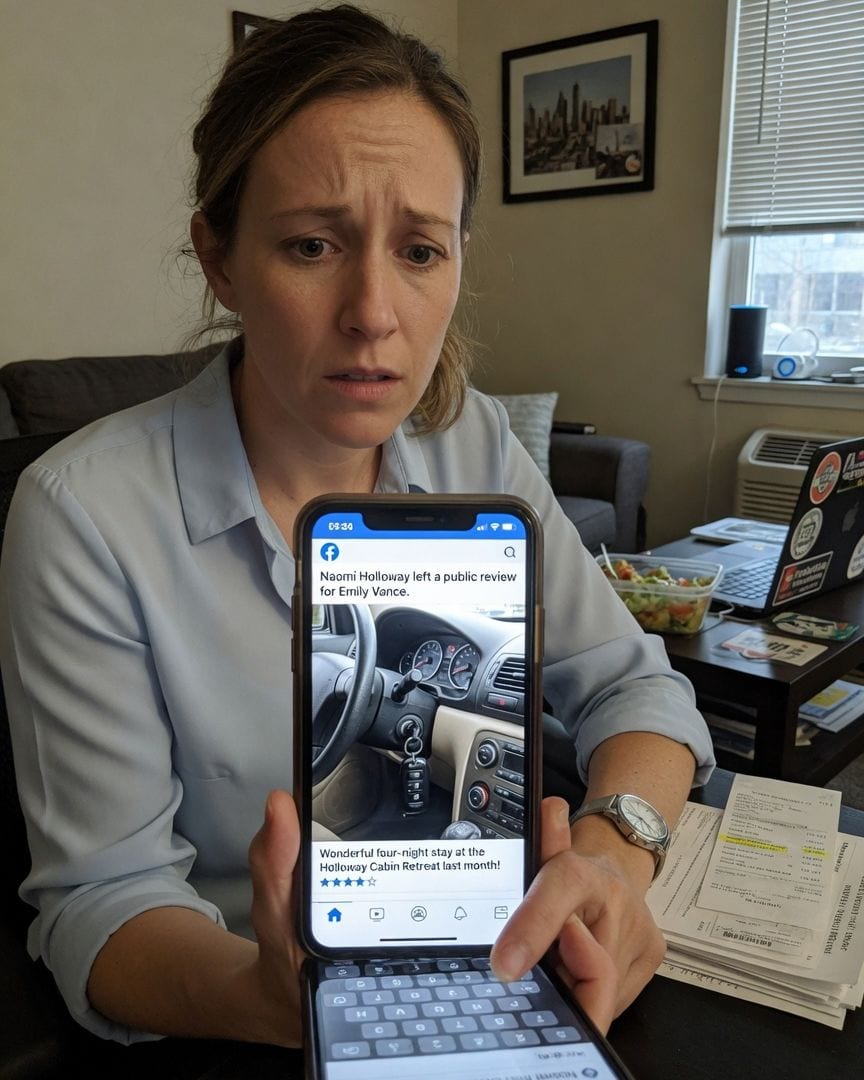
A host publicly thanked me for a four-night stay at her Montana cabin I've never visited — booked under my verified ID and paid from my card.
I was catching up on Facebook during my lunch break when an Airbnb review popped up, thanking 'Emily Vance' for a stay in Montana. I stared, bewildered. My name, but I’ve never been to Montana. Then I saw the photo: my car keys and my silver watch, on a rental car dashboard, hundreds of miles away, while both items were physically on me.
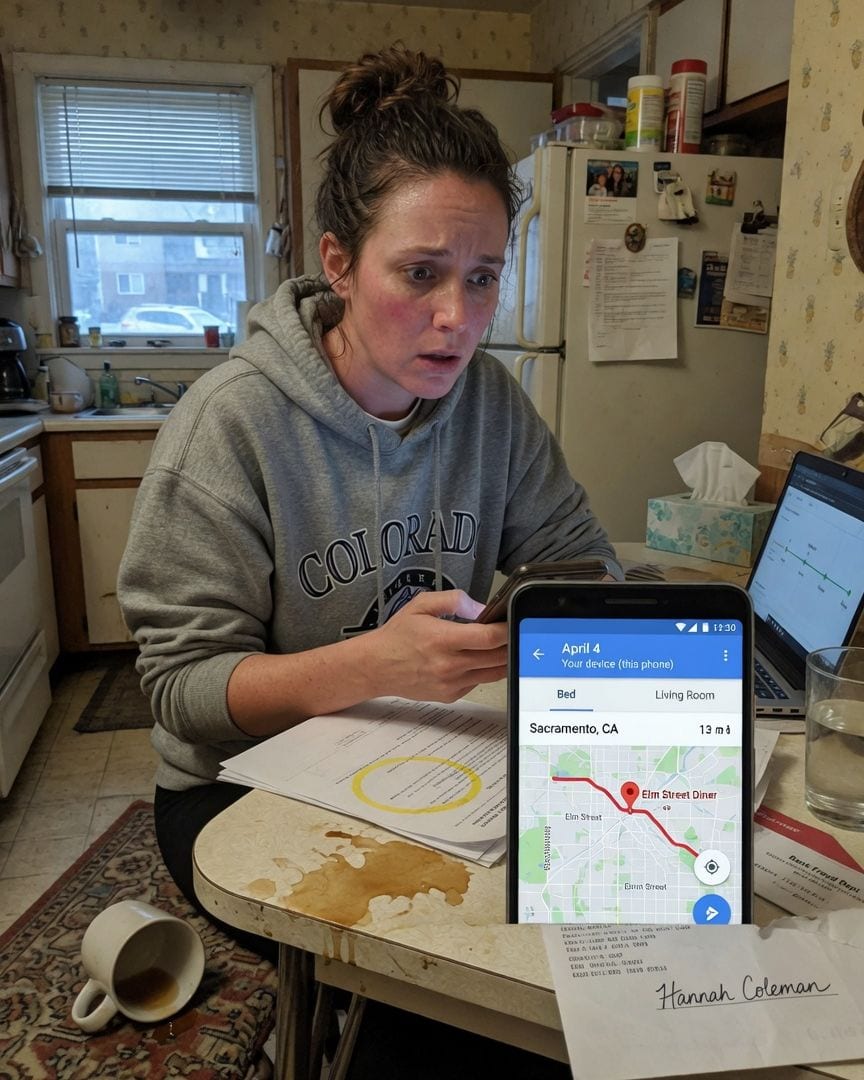
My phone's GPS places me in Sacramento every fourth of the month, driving a street I've never seen. I'm always home in Denver.
My Google Location History showed a phantom trip to Sacramento on a day I was home sick in Denver. I dismissed it as a glitch, until a bank statement revealed a charge from that diner. When the receipt arrived, it bore my exact signature for a coffee I never ordered.
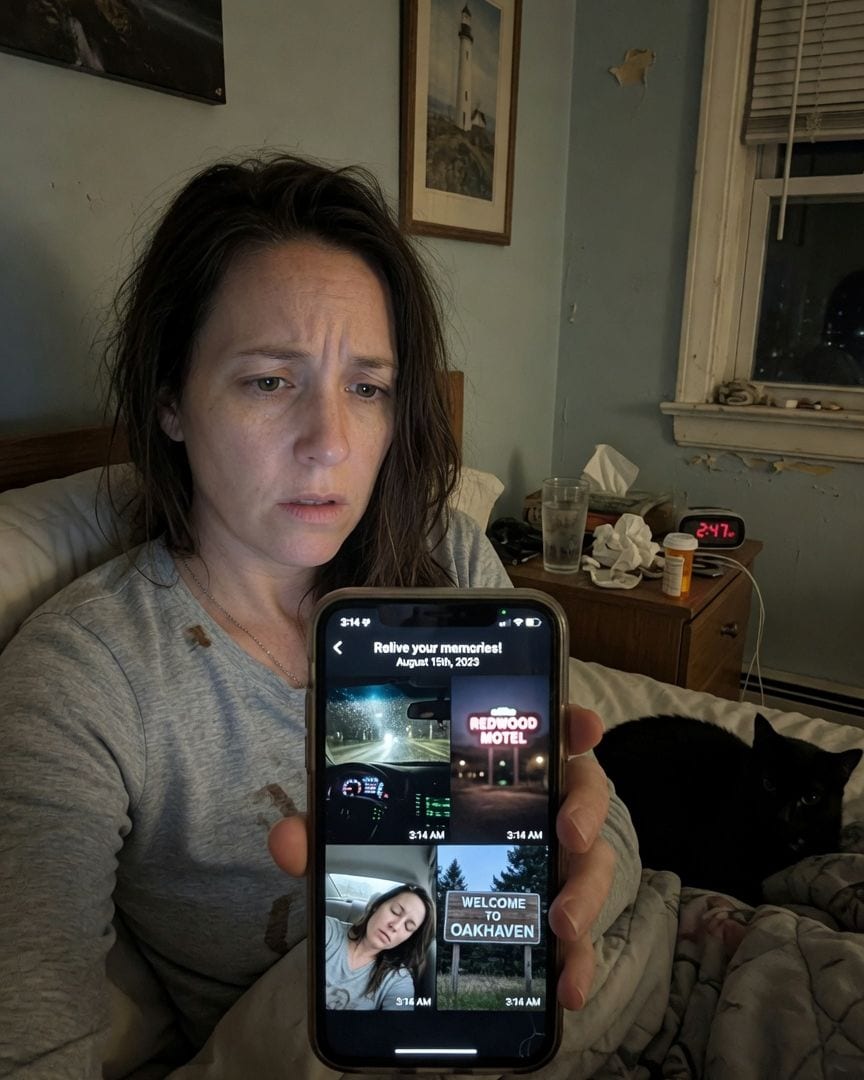
My phone has photos of me asleep in a strange car at 3 AM. Then a voicemail: 'We'll have her back by sunrise.'
My phone woke me with a cheery notification, promising memories from last August. Instead, it showed me asleep in a dark car, rain streaking the windshield, miles from my apartment. I was certain I'd been home in bed that night, but the images were undeniably in my camera roll, a quiet violation of my memory.
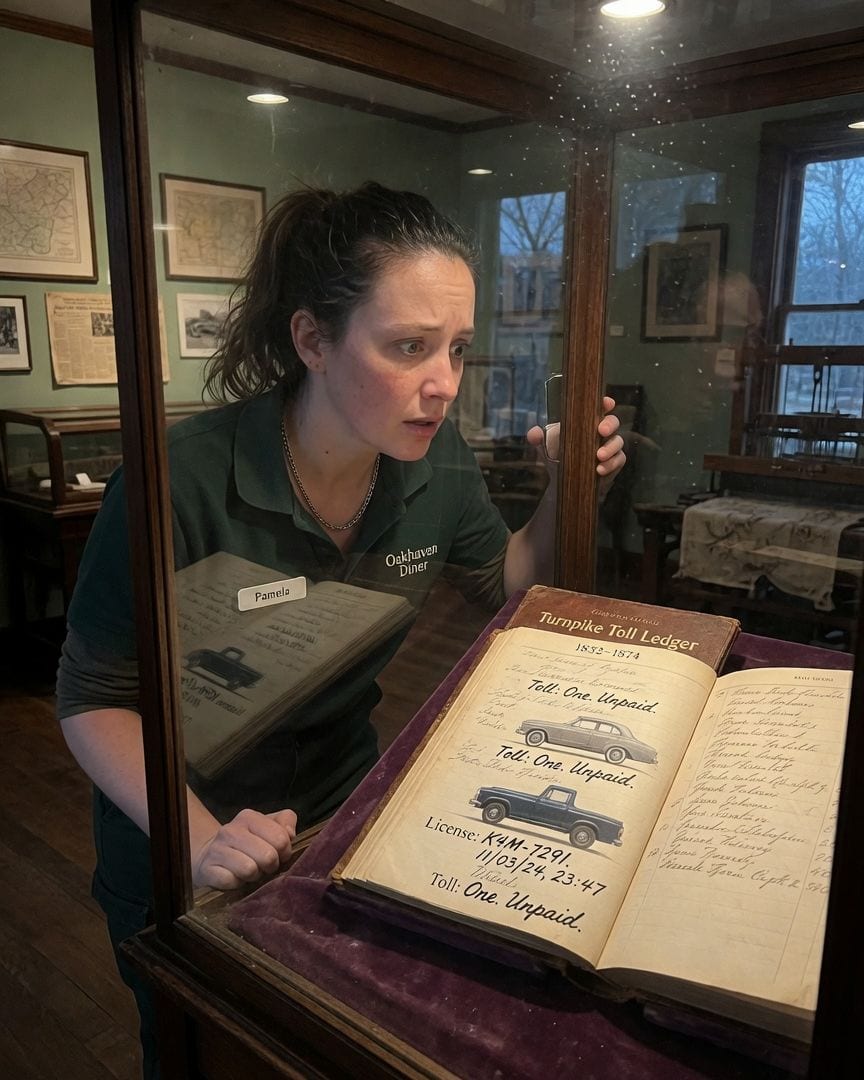
My car stalled at the old turnpike milestone, after dark. The toll ledger, closed in 1874, then listed my car, my stall time, and a toll of one, unpaid.
I had just moved to Oakhaven when my old sedan died on a dark, winding road by an infamous turnpike milestone. The next day, I found my car's exact registration and stall time written in fresh ink in a 150-year-old, locked museum ledger, marked 'Toll: One. Unpaid.' The curator dismissed it as a prank, but her white knuckles and strained voice hinted at something far more unsettling.
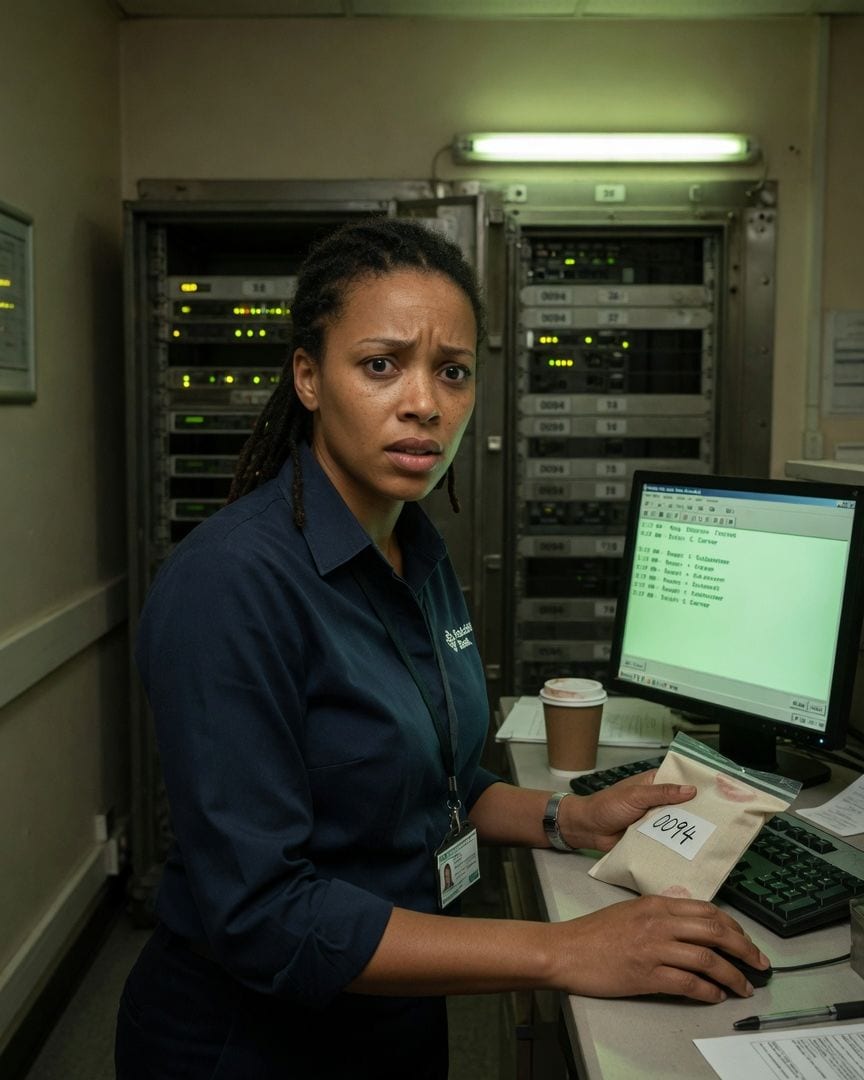
My night-deposit log shows a bag posted at 3:17 AM. My teller number, my count. Bag 0094 is still sealed in the safe, untouched.
I prided myself on precision as a night teller, logging every entry. But at 3:17 AM, a deposit appeared logged under my teller number that I never processed. Security footage then revealed a figure in my uniform, wearing my ID badge, with a blank photo slot.
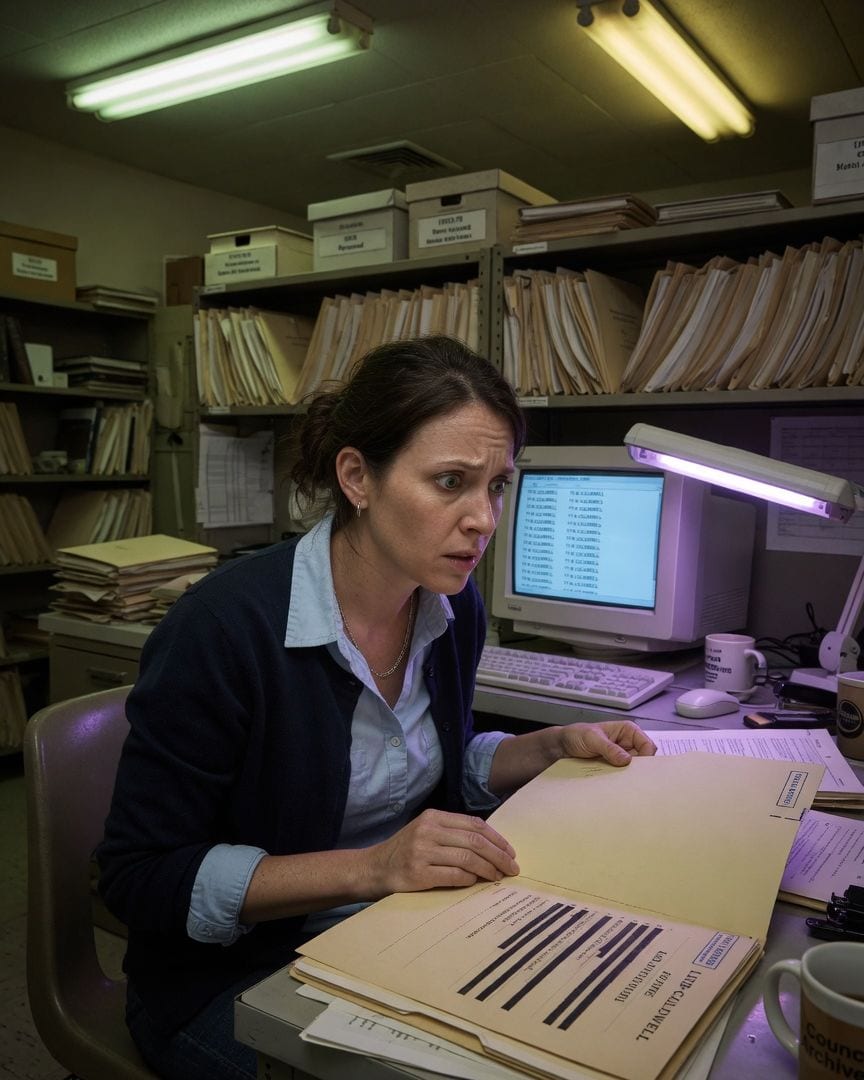
My employer's security file holds a vetting report on me dated nine years before I ever applied. It has my full name and my parents' address — with only one line, the source who referred me, blacked out.
Working a routine data audit, I pull my own security file. The issue date is nine years before I even applied for the job. Then, hidden within an old archive file, I find my current address etched under a blacked-out line.