A host publicly thanked me for a four-night stay at her Montana cabin I've never visited — booked under my verified ID and paid from my card.
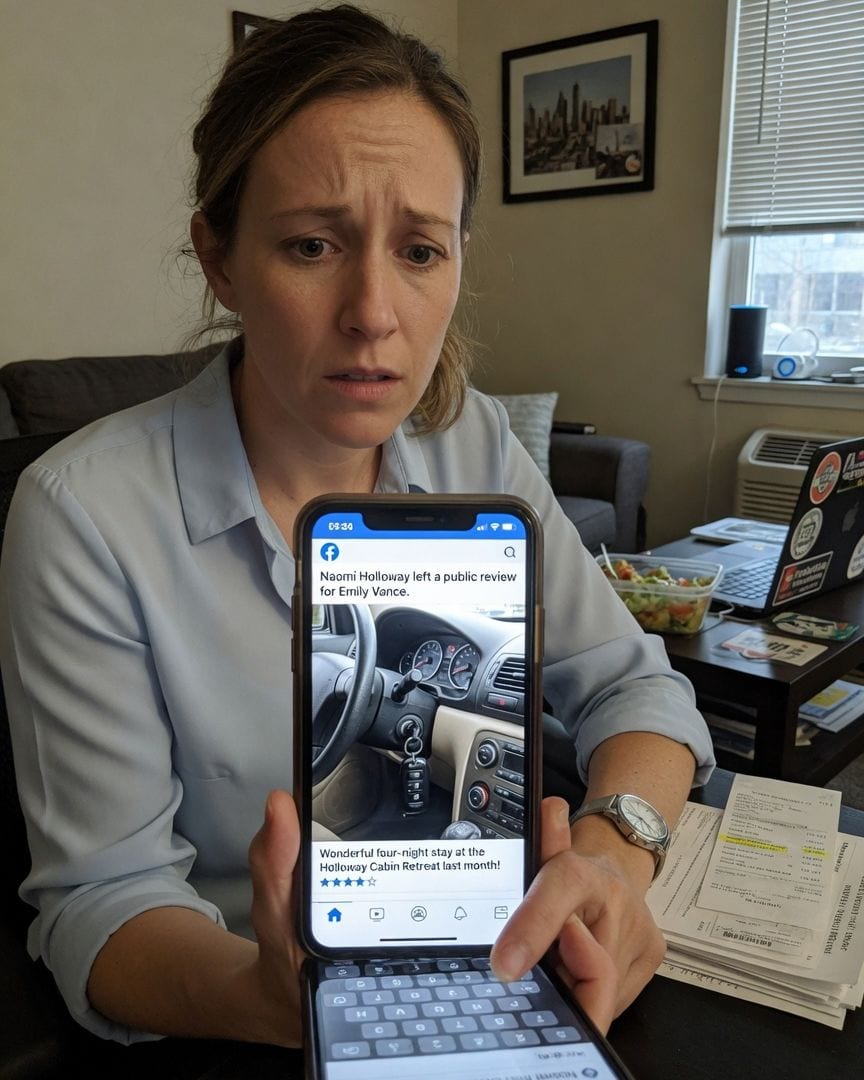
I was scrolling through Facebook during my lunch break last Tuesday, catching up on what felt like a hundred different streams, when it popped up.
A public review from a 'Naomi Holloway,' thanking 'Emily Vance' for a wonderful four-night stay last month at her Montana cabin.
I stared at the screen, bewildered. My name. Emily Vance. But I’ve never used Airbnb. I’ve certainly never been to Montana. The review had a photo attached: the interior of a rental car, the dash visible, a steering wheel, generic.
But there, on the steering wheel, were my car keys. The ones I use every single day, with the little dent in the black plastic fob where I’d dropped them last year.
And on the dashboard, just visible, was my silver watch. The exact one I was wearing right then, its face cool against my wrist.
A cold dread settled. I touched my wrist, the cool metal beneath my fingers, confirming the watch was still there, physically on me. Just this morning, my smart home assistant had done something strange.
I’d asked Alexa for the weather, and instead of her usual crisp reply, there had been a half-second of static, like a scratched record, before she repeated my query back to me. A glitch, I’d dismissed it.
But now it looped in my mind, a tiny, almost imperceptible tear in the fabric of the morning.
I stared at the impossible image of my watch and keys, hundreds of miles away, on an Airbnb account I didn’t have, in a cabin I’d never visited.
My fingers trembled a little as I typed out the message to Naomi Holloway, the Airbnb host. I tried to keep it light, a ‘this is so weird, has anyone ever used my name?’ kind of message.
She responded quickly, polite but firm. The reservation for the Montana cabin was indeed under my full name, Emily Vance. Verified ID, payment through my credit card. All legitimate on her end, she assured me.
I pulled up my banking app. There it was: a charge for 'Holloway Cabin Retreat' dated last month, exactly when I’d been at the annual marketing conference in Phoenix. Four days.
Dates I could prove, with flight manifests and conference badges and expense reports, I was over a thousand miles away.
Naomi even offered a few details about 'my' stay. Said I was quiet, tidy. 'You even asked if I could leave a small, antique silver locket on the bedside table for you,' she wrote.
'Said it was a sentimental touch, something to make the place feel more like home.' A locket? I don't own a locket. Never have.
Identity theft was the obvious answer, the only logical one, but the specific details gnawed at me. My keys. My watch. And this strange request for a locket I'd never seen or owned.
It felt too intricate, too personal for a simple hack.
I showed the Airbnb photo to Daniel Abbott, my colleague and friend, over coffee. He recognized the keys and watch immediately. 'Did you forget to tell me about your secret Montana getaway?' he joked, then saw my face.
'Wait, you're serious?' He suggested I report identity theft again, more vigorously. I did. The bank’s security department was patient, understanding. But their final report was clear: the card was used with correct billing information, no flags.
No suspicious IP addresses. From their perspective, the transaction was legitimate. It wasn't fraud. It was… me.
I was still poring over my bank statement, trying to find some crack in the Montana transaction, when I saw it. Another anomaly. A toll charge.
Not local, not even in my state, but from a bridge in a neighboring state. Dated two weeks after the Montana trip. A Tuesday.
I remembered that Tuesday vividly: a huge client report, I'd worked from home all day, barely left my desk. I even have a timestamped Slack message to Daniel from 5:03 PM, confirming I was still at my computer.
I went to the toll authority’s website, punched in the reference number from my statement. A photo loaded. It was a different car this time, a plain grey sedan, not the rental from the Airbnb picture.
But through the windshield, driving, was a passenger. Her face was slightly blurry from the motion, the harsh sunlight, but the distinctive shape of her jawline, the curve of her nose, the way her hair fell – it was Emily.
Unmistakably. And on her wrist, glinting in the sun, was my watch. The silver one.
I froze, phone in hand, staring at the impossible image.
The toll photo was a punch to the gut. It wasn't just a mistake or a glitch. It was undeniable proof. I felt myself spiraling. For days, I obsessively cross-referenced everything I could think of.
My work calendar, my detailed activity logs for client projects, my phone's location history from Google Maps. Every single record confirmed it: I was at home, working, all day that Tuesday. There was no doubt.
Then I started seeing a pattern in my bank statements. Small charges, easily missed in the torrent of daily transactions.
A coffee from a town 200 miles away on a Saturday I'd spent at my sister's house, painting her new nursery.
A small purchase from a boutique I’d never heard of, dated to a Tuesday evening when I was demonstrably at a late meeting across town. The evidence didn’t point to someone stealing my identity; it pointed to me being there.
Or a version of me.
Daniel tried to help. He suggested I install more security, monitor my accounts even more closely, maybe hire a private investigator. But he grew quieter as my pile of contradictory evidence mounted. He couldn’t explain it.
Desperate, my mind latched onto something I'd dismissed years ago. An old, obscure online forum I'd stumbled upon after a late-night internet rabbit hole, full of paranoid ramblings, that I'd chalked up to elaborate conspiracy theories.
'Echo-Walkers: When Your Life Isn’t Your Own.'
I found it again, buried deep in my old bookmarks. It was a rabbit hole of vague, panicked posts, threads about impossible records, conflicting memories, a chilling sense of being duplicated.
People describing charges on cards they hadn't used, sightings of themselves in places they'd never been, even conversations they didn't remember having. One user, 'WatcherSam,' stood out. His posts were different. Detailed, almost academic observations, clinical.
He warned others not to 'dig too deep,' not to 'disturb the resonance artifacts,' because 'some things are better left unexamined.'
A cold dread began to settle deep in my bones. This wasn’t a glitch in my bank’s system or a random case of fraud. This was a pattern. And it was happening to me.
My hands shook as I typed out a cautious query on the forum, using a throwaway pseudonym. I described my experiences, leaving out just enough detail to feel safe, but enough to be understood.
Within hours, a private message landed in my inbox. From 'WatcherSam.' It wasn't a warning, not accusatory, but unsettlingly calm, clinical: 'The records are real. You are not alone. Stop looking for 'fraud.' Start looking for 'pattern.'
You're almost ready for the next step. Do not contact me again unless you find the locket.'
The locket. How did he know about the locket? My blood ran cold. It wasn't just my bank accounts being compromised, or my car being photographed. This felt personal. Watched.
Not by a stalker, but by a presence that knew my situation intimately, knew the very specific, bizarre details Naomi Holloway had mentioned.
I started noticing subtle things around my apartment. A light left on in the kitchen I swore I’d turned off before leaving for work, the faint scent of coffee I hadn’t brewed myself.
My smart home assistant, Alexa, once responded to a query I didn’t remember making, its audio log showing a brief, clipped question in a voice that sounded like mine but with a slightly different cadence, a fraction of a second off.
I dismissed the coffee smell, the light, the audio anomaly. I tried to.
Then, one evening, I walked into my bedroom. On my bedside table, nestled among my usual items – my phone, my lip balm, a half-read book – sat a small, antique silver locket.
It was tarnished, intricately engraved with a swirling vine pattern. I had never seen it before in my life. It was identical, I realized with a jolt, to the one Naomi Holloway had described.
My hands trembled as I carefully unclasped the locket. Inside, protected by two tiny, oval frames, was a faded, miniature photo. It was a rustic cabin, nestled among trees. Unmistakably the Airbnb from Montana.
I messaged WatcherSam immediately, sending a photo of the locket, my fingers flying. He responded within minutes, not with an explanation, but an address. 'Bring the locket. Ask for Samuel Russo.'
The address led me to a small, unassuming building in a quiet part of the city, marked only with a faded sign: 'Russo Archives.' My heart pounded against my ribs as I walked inside.
Samuel Russo was exactly as 'WatcherSam' might sound: an older man, maybe 67, calm, impeccably dressed in a tweed jacket. He didn't seem surprised to see me, or the locket I clutched in my hand.
He motioned to a chair, then spoke, his voice low and even.
He explained, slowly and gently, that I was experiencing what he called a 'record discrepancy event.' He opened a thick binder on the table, filled with historical documents, old newspaper clippings, faded photographs.
'Similar impossible records,' he said, tracing a finger over a grainy image of a train ticket issued to the same person on two different trains, heading in opposite directions, on the same day in 1912.
'Always dismissed as hoaxes, or errors, or folklore.'
He revealed that a small percentage of the population, under specific, unknown circumstances, develops what he called an 'echo.'
Not a clone, not a doppelganger, but a parallel set of actions, often mundane, sometimes significant, that are recorded by the world's systems as theirs. The echo's actions generate the impossible records.
The locket, he explained, was a 'bridge artifact' – physical objects that sometimes cross over, left by the echo, or sometimes even found by the echo. The Airbnb photo? A snapshot of my echo, living its life. The toll photo?
Another.
A wave of cold dread washed over me, deeper and more profound than anything I’d felt before. It wasn’t identity theft. It wasn’t a glitch. It was worse. It was me, but not me.
A shadow walking through my own life, leaving traces in the world.
Samuel Russo concluded his explanation with a grave expression that seemed to deepen the lines around his eyes. 'The records are not just external,' he said, his voice dropping slightly. 'They can become… internal.'
I asked him what he meant, my throat tight, my heart thrumming.
He gestured to the locket in my hand. 'These artifacts, these records… they are often generated through the primary self's systems. Your bank statements, your phone's location data, your smart devices… the digital footprint of your life is extensive.'
Then, with deliberate slowness, he pulled out a tablet from a drawer and showed me a screen. It was a screenshot of my own smart home assistant’s activity log. My breath hitched.
There, clearly timestamped to a day when I was demonstrably out of town, visiting my parents a five-hour drive away, was an entry: 'Query: 'What time is the next flight to Bozeman?''
And beneath it, the voice print analysis, listed as 'Emily Vance.' My name. My voice.
I stared at the screen, my own voice, coming from my own device, asking about a flight to the town near the Montana cabin.
The wrongness wasn't just about me; it was from me, or through me, from my own things. It wasn't just a record on a distant database. It was in my living room, in my house, speaking with my voice.
The realization hit me like a cold wave: the echo wasn't just out there, living a parallel life; it was using my life, my devices, my identity, from the inside. It was a part of me, reaching out.
Samuel Russo saw the look on my face, the raw horror, and clarified further, his voice still unnervingly calm. 'The 'echo' isn't a separate, conscious entity, Emily. It's not a person in another room.
It’s a manifestation of a deeper, systemic instability in reality itself. A kind of 'temporal bleed' that causes a person's life-data to split and manifest parallel, recorded actions.'
He explained the smart home log. 'It wasn't the echo using your device, not directly,' he said. 'It's a record of the echo's own smart device, which is perfectly synced to your digital identity.
Think of it as a parallel stream of your own digital footprint, operating in a slightly divergent timeline. It's not a breach. It’s a divergence.'
The 'system' he’d referred to earlier, he revealed, wasn't a human institution or some shadowy organization. 'It's an inherent property of how information and identity are recorded in the modern world.
Every digital footprint, every transaction, every GPS ping creates a 'record' that, for a select few, can diverge.'
The 'echo,' he continued, 'is the data trail of a life not lived by the primary self, but which is still meticulously recorded as if it were.'
He showed me more historical cases: a man whose travel logs showed him booked on two separate ships, sailing in opposite directions across the Atlantic, on the exact same date in 1903.
A woman whose letters, written in her distinct hand, were found in two different post offices, addressed to different recipients, on the same afternoon.
The locket, he clarified, was a rare physical manifestation, a 'resonance artifact' – a point where the two timelines briefly overlap, allowing a physical object to cross over.
'The 'echo' doesn't have a consciousness of its own, Emily,' he stated, his gaze steady. 'Not as we understand it.
It's a recorded projection, a ghost in the machine of reality, living out a mundane, parallel existence that only surfaces through these impossible records. You were always inside it because your identity is the anchor for this echo.'
I was horrified. My life wasn't just mine; it was also this other, recorded, parallel existence. I asked Samuel if there was a way to stop it, to sever the connection, my voice barely a whisper.
He shook his head, a gesture of quiet resignation. 'It's not a connection to be severed, Emily. It's a fundamental property of your existence, now.
The records are simply proof of a life you didn't live, but which is undeniably yours in the digital sphere.'
He advised me to learn to live with it, to monitor the records, to be aware. He pulled out a sleek, discreet tablet and, with a few taps, installed an encrypted app onto my phone.
'This will flag unusual digital activities tied to your identity across various platforms,' he explained. 'It’s designed to filter for the 'echo' pattern.'
I realized then there was no escape, no battle to win, no villain to confront. This was my new reality. I had to carry this knowledge, this proof, that my life had a silent, parallel twin.
I felt a profound sense of isolation, knowing no one else would ever believe me, that I could never truly explain this to Daniel or anyone.
The cost, I knew, was my peace of mind, my singular sense of self. I left Samuel's archive, clutching the locket in my hand, the new app icon a stark reminder on my phone screen.
The world outside seemed subtly different. Every digital sign, every security camera, every record-keeping system now felt like a potential witness, not just to my life, but to her life, too. To the echo.
I returned to my routine, but it was forever altered. The easy, unconscious flow of my days was gone, replaced by a constant, low hum of awareness. I checked the app religiously, sometimes multiple times a day.
It would ping sometimes: a bookstore purchase in a city two states away I’d never visited, a parking ticket in a town two states over. Each one a quiet reminder of the other life.
A life I wasn't living, but was still mine. I never told Daniel the full truth; he wouldn't understand. I tried to explain it as a complex identity theft, but my conviction was gone.
I just said I was 'managing it.' The locket sat on my bedside table, a tangible link to the impossible. The faded photo inside, the small cabin, was now a place I knew intimately, but had never been.
I learned to live with the quiet hum of my other life, a ghost in the machine of my own identity. The initial terror had dulled, replaced by a cold, persistent awareness.
I still traveled for work, still met friends for coffee, still lived, but with an invisible shadow always just beyond my perception, leaving digital traces I collected. I found myself wondering what my 'echo' did, where it went.
Did it have friends? Did it laugh? Did it ever feel the pull of a life it wasn't living, the life I was? I would never know.
I carried the proof, the undeniable records, but it was a truth that couldn't be shared, couldn’t be believed by anyone else.
I still catch myself checking my own reflection, just to make sure the face looking back is truly mine.
If this one got to you
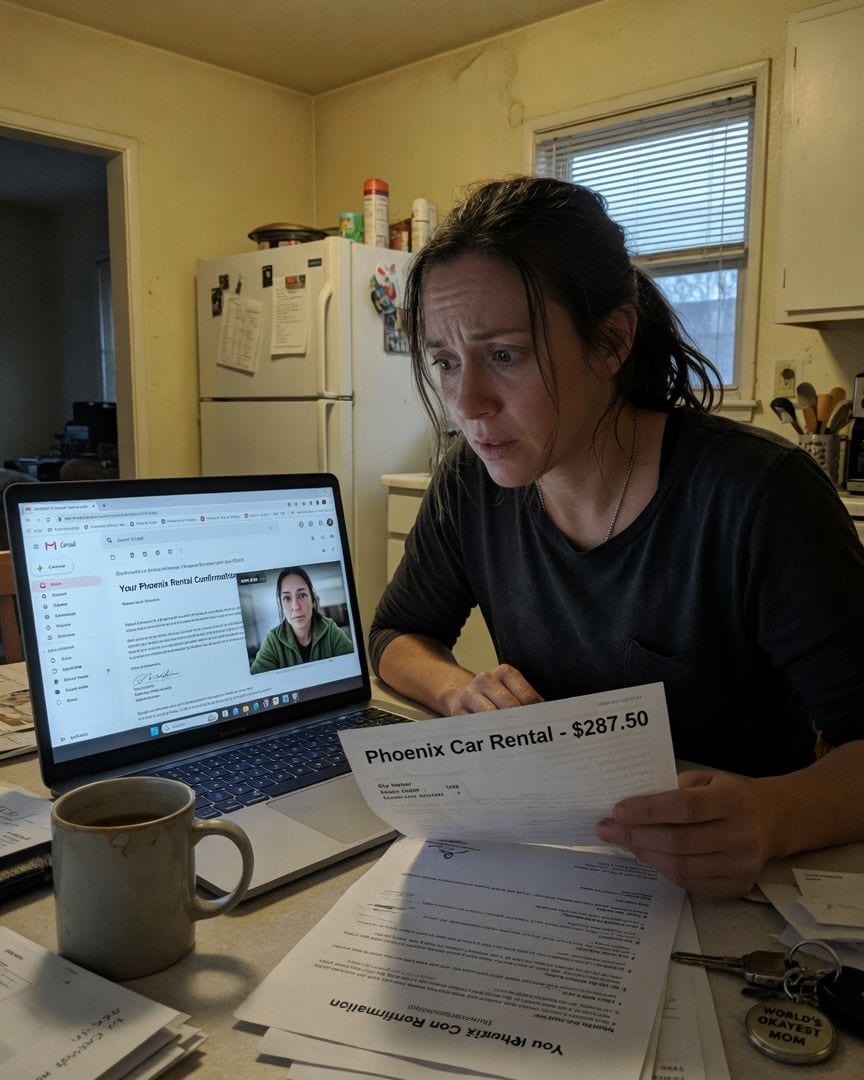
My bank sent a security photo: me, entering Harrington Research Facility. I was home with a fever; that face isn't mine.
I found a bank charge for a rental car in Arizona, a place I’d never been, with my license and signature. But the rental agreement also noted a specific coffee stain on the passenger seat — the exact faded mark from my own car. Then, a security alert showed me entering a facility I’d never visited, on a day I was home sick.
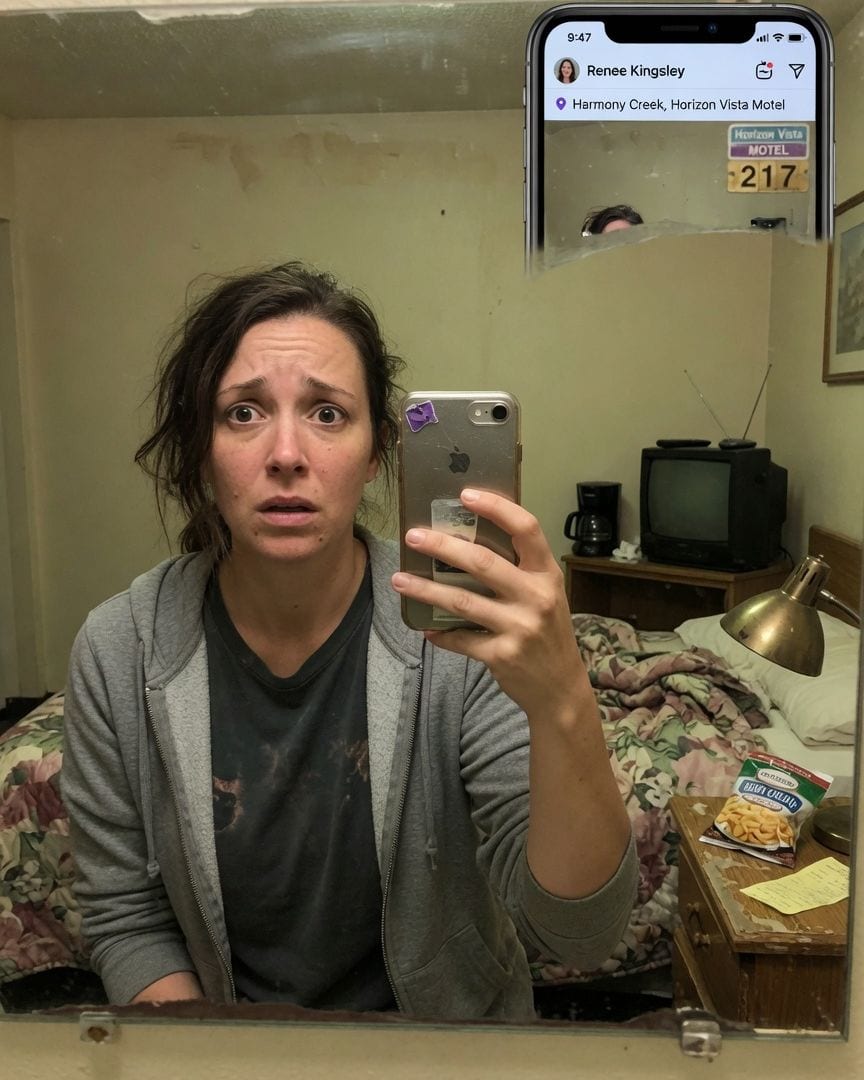
My apartment door opened and closed at 1:20 AM last Thursday, then my digital keycard checked into a motel six hours away, all while I slept.
My Tuesday morning began like any other, until I opened my phone's photo app. Instead of hike pictures, I found forty new photos: a motel room in Harmony Creek, six hours northeast. The last image was a mirror selfie of *my* face, holding *my* phone, but I was asleep in my bed the entire time.
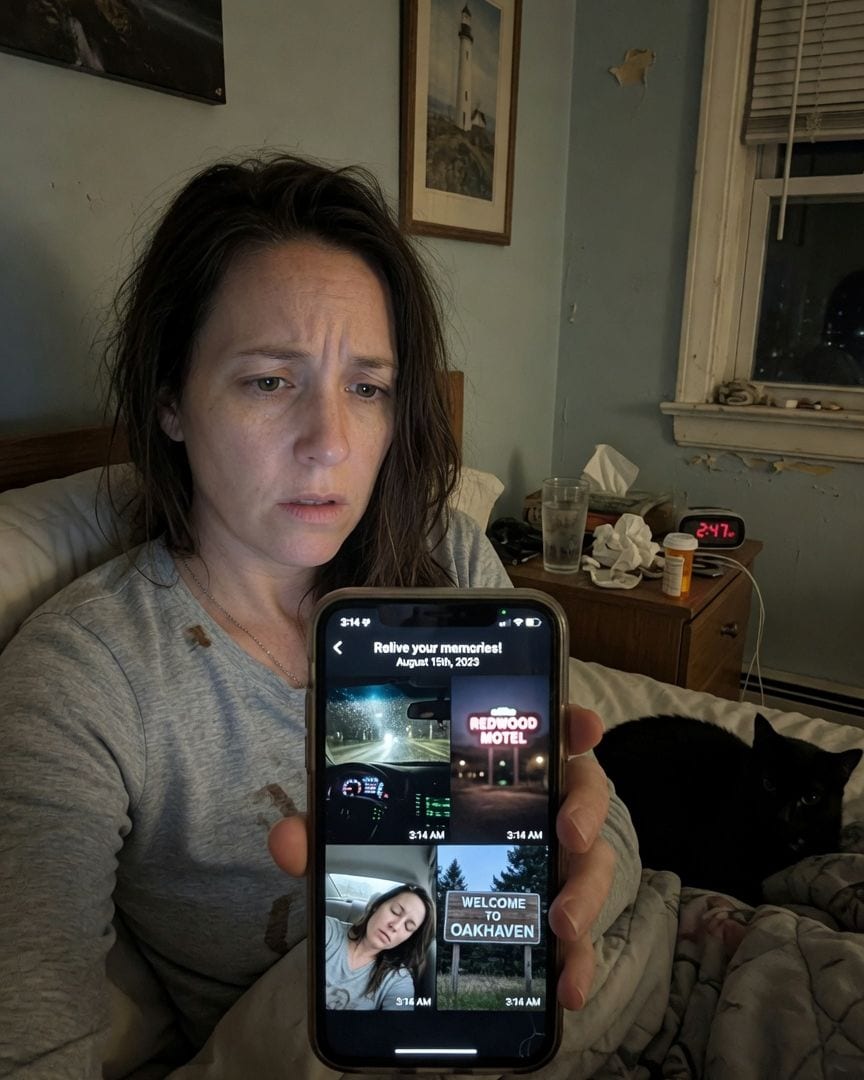
My phone has photos of me asleep in a strange car at 3 AM. Then a voicemail: 'We'll have her back by sunrise.'
My phone woke me with a cheery notification, promising memories from last August. Instead, it showed me asleep in a dark car, rain streaking the windshield, miles from my apartment. I was certain I'd been home in bed that night, but the images were undeniably in my camera roll, a quiet violation of my memory.
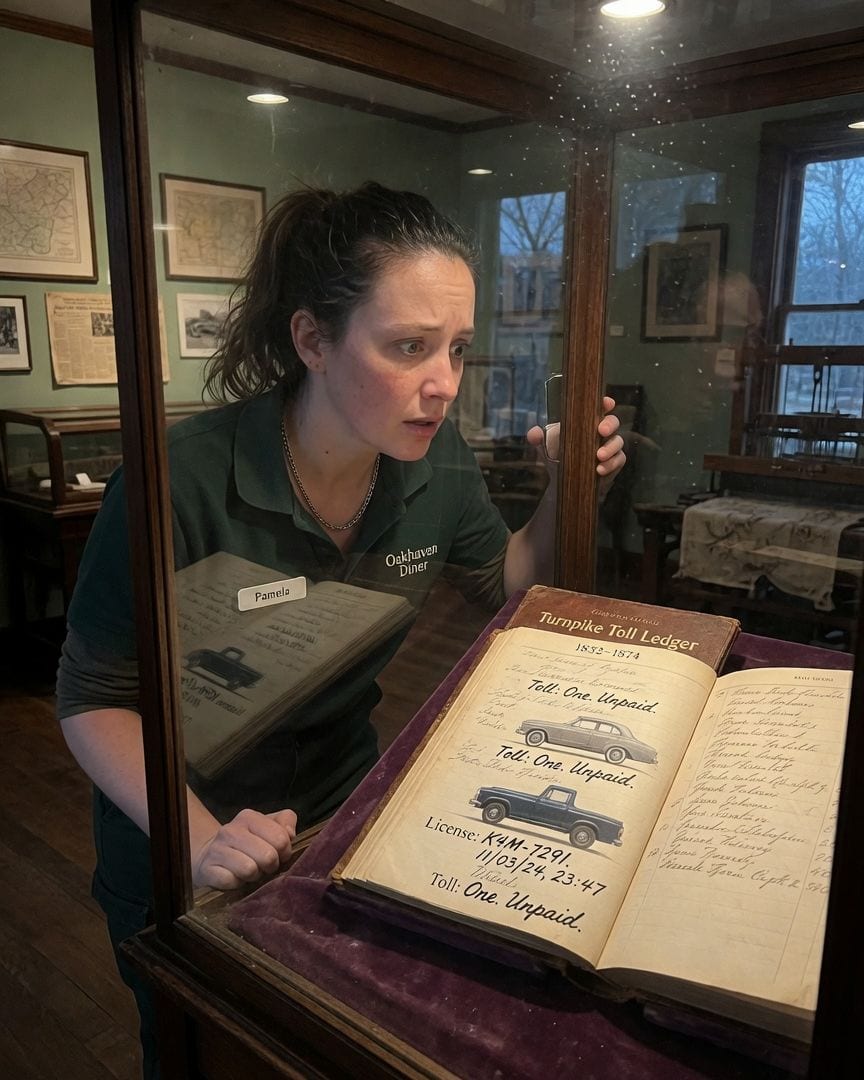
My car stalled at the old turnpike milestone, after dark. The toll ledger, closed in 1874, then listed my car, my stall time, and a toll of one, unpaid.
I had just moved to Oakhaven when my old sedan died on a dark, winding road by an infamous turnpike milestone. The next day, I found my car's exact registration and stall time written in fresh ink in a 150-year-old, locked museum ledger, marked 'Toll: One. Unpaid.' The curator dismissed it as a prank, but her white knuckles and strained voice hinted at something far more unsettling.
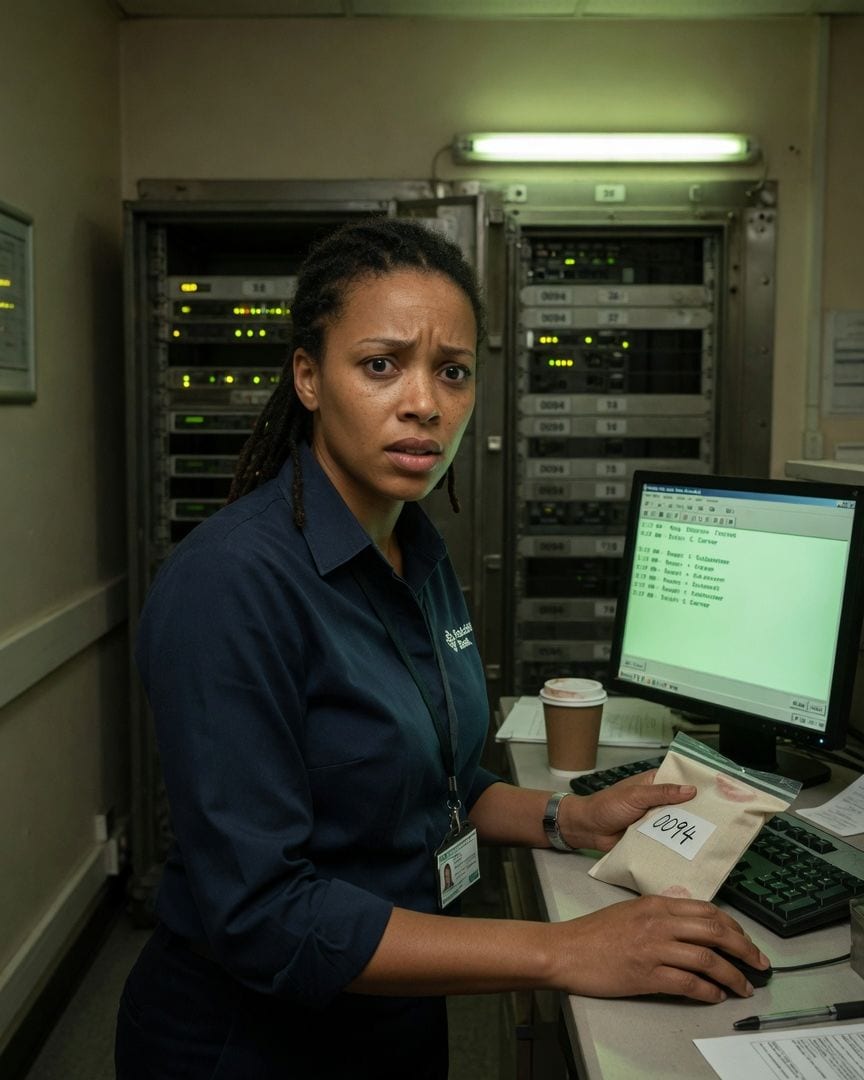
My night-deposit log shows a bag posted at 3:17 AM. My teller number, my count. Bag 0094 is still sealed in the safe, untouched.
I prided myself on precision as a night teller, logging every entry. But at 3:17 AM, a deposit appeared logged under my teller number that I never processed. Security footage then revealed a figure in my uniform, wearing my ID badge, with a blank photo slot.
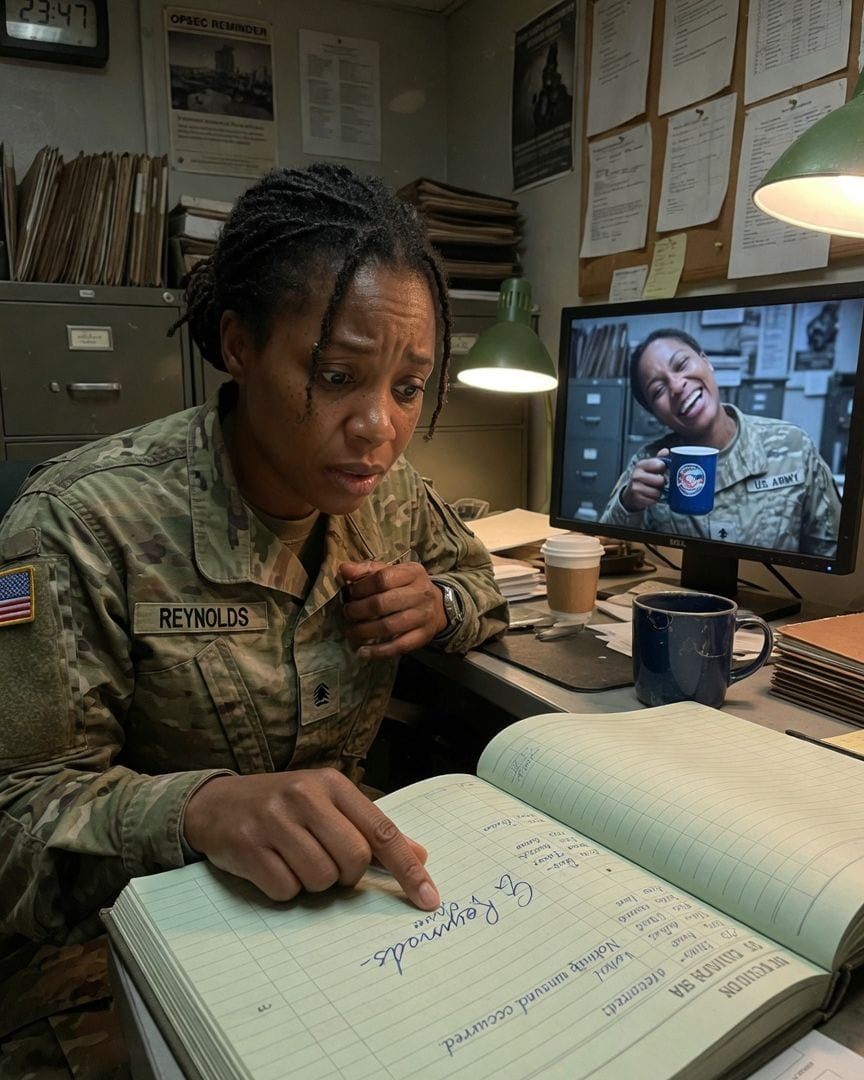
Lieutenant Grace Reynolds saw her own signature in the staff-duty log for a shift she never worked. The security footage then showed 'her' leaving a coffee mug she’d never once seen.
Lieutenant Grace Reynolds hunched over the battalion staff-duty log, the fluorescent hum of the records room a monotonous backdrop to her dry inventory audit. Her gaze snagged on an entry from three weeks prior: her own unmistakable signature, closing out a full 24-hour staff-duty shift she knew she had never worked. Security camera footage only deepened her unease, showing 'Grace Reynolds' moving with her familiar stride, laughing a shade too brightly, her head tilting a fraction too precise, like a flawless, chilling performance. But as the imposter turned to leave, she picked up and rinsed a chipped, dark blue ceramic coffee mug with a faded diner logo—a mug Lieutenant Reynolds had never once seen in her life. The air in the quiet room grew heavy, thick with the unspoken wrongness: if that wasn't her, then who was it?