My retinal scan matched a dead man's eyes. His chart said 'deceased' from 1997. The pattern in my eye is his.
The hum of Dr. Philip Lambert's new OCT machine was a soothing drone as I settled into the optometrist chair. I watched the green light, expecting the usual brief flash, a quick click, and then the all-clear.
Dr. Lambert, a man whose easy smile usually preceded a mild joke about my reading habits, pulled back from the machine, but his smile was gone. His face was pale, his brow furrowed in a stunned expression.
He stared at the screen, then at me, then back at the screen, as if his eyes couldn't reconcile what they were seeing.
“Ms. Thornton,” he began, his voice tight, almost a whisper, “the machine… it’s flagged you as a returning patient.” He swallowed hard, his gaze flicking to the corner of the room, as if seeking an explanation from the sterile walls.
“The prior record belongs to a man seen at this practice in 1997. His chart is stamped deceased. Roland Blackwood.” A sudden, cold dread bloomed in my stomach.
It felt like something vital had just gone out of phase, a subtle shift in the room's temperature that only I could feel. He leaned forward, his voice dropping even lower.
“The vessel pattern in the back of your eye, Alice, is as unique as a fingerprint. And it matches his. Exactly.” Dr. Lambert ran a trembling hand through his thinning hair.
The machine behind him emitted a soft, mournful beep, like something trapped. “I’ve asked a colleague to re-image you tomorrow. Just to be absolutely sure. This can’t be right.”
The next day, Dr. Vera Sullivan, a no-nonsense optometrist with a clinical, efficient manner, put me through the re-imaging. Her expression, initially disbelieving, slowly morphed into the same baffled unease I’d seen on Dr. Lambert’s face.
The results, she confirmed, were identical. The pattern was there, an undeniable match. Shaken, I went home, the image of those intricate, alien lines burned into my mind. I immediately sat down at my laptop and searched for Roland Blackwood.
His online obituary was sparse, almost eerily so. “Roland Blackwood, 45, passed away suddenly in 1997.” No cause of death, no family listed, just a small, pixelated photo that looked like it had been scanned from a newspaper decades ago.
I zoomed in, trying to make out details of his face. His eyes, though blurry and indistinct in the low-resolution image, held a strange, unsettling familiarity.
Not a familial resemblance, not a face I recognized from my life, but a depth that felt… known. The sensation was irrational, absurd, yet it clung to me, a persistent chill in the air around my screen.
This wasn't just a record mix-up. This was something deeper, something biological, something that defied every logical explanation. Driven by a desperate need for a tangible answer, something beyond my own eyes, I ordered a direct-to-consumer DNA kit online.
It felt like a long shot, a way to definitively rule out any biological connection, to finally dismiss the bizarre coincidence that had settled like a stone in my bones.
I spit into the tube, sealed it, and dropped it in the mail, hoping for a mundane explanation that would erase the chill that had settled in my bones.
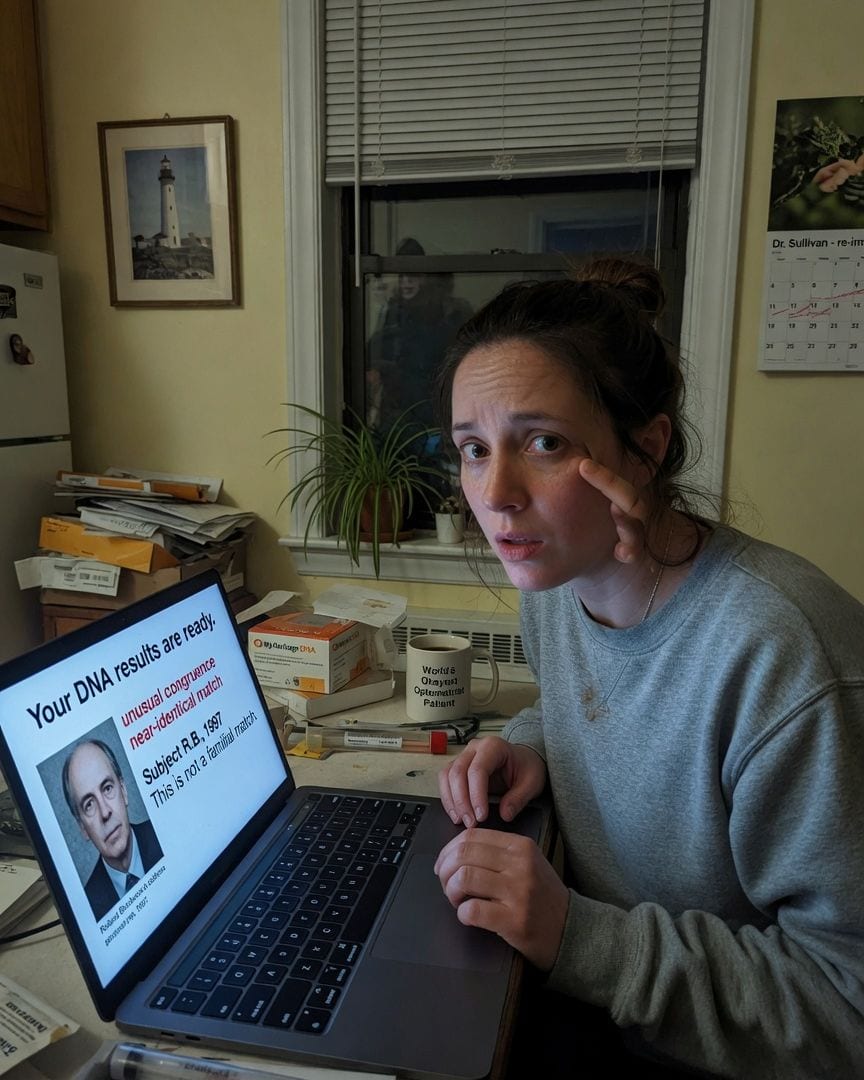
Weeks later, the email arrived: 'Your DNA results are ready.' My heart thudded in my chest as I clicked the link, the sound amplified in the sudden silence of my apartment. The report wasn't about distant relatives or ancestral origins.
It flagged an 'unusual congruence.' My genetic profile returned a 'near-identical match' to a preserved tissue sample from a medical archive, labeled 'Subject R.B., 1997.' The accompanying note from the lab was clinical, yet its implications were anything but.
'This is not a familial match,' it stated plainly. 'The genetic markers display a direct, unexplainable congruence with the archived sample.' I stared at the screen, my breath catching in my throat. 'Subject R.B.' Roland Blackwood. 1997.
The date, the initials, the impossible match. It wasn't just her eyes. Something in her very DNA was screaming the same impossible truth.
I clutched the DNA report, the printout trembling in my hand, as I walked into Dr. Lambert’s office. He looked up from his desk, and his practiced, reassuring smile faltered the moment his eyes landed on the paper.
He took one look at the 'Subject R.B., 1997' notation and visibly flinched, his face draining of color.
“This is… impossible,” he stammered, trying to hand it back to me, his voice tight with an agitation I hadn’t seen before. “Lab errors happen. These direct-to-consumer kits, they’re not always—”
I pushed the report back across his desk, my voice steady despite the tremor in my hand. “You know who Roland Blackwood is, Dr. Lambert. You saw the retinal scan. And now this. Tell me what’s going on.”
He didn't answer immediately. He paced, agitated, a nervous energy radiating off him that made the framed degrees on his wall seem to vibrate. He stopped by the window, staring out at the street below, his shoulders slumped.
Finally, he turned, his voice barely a whisper. “I was a junior intern at the Blackwood Institute in ’97. It was a research facility, experimental therapies. Roland Blackwood was a patient there.”
He looked at me then, his eyes filled with a desperate, chilling fear I hadn't expected. “Some files were sealed after a scandal. They’re at the old medical records archive downtown. Maxwell Carter runs it. He might remember something.
But be careful, Alice. Some things are best left buried.”
The archive was a dusty labyrinth, smelling of old paper, forgotten lives, and a faint, acrid tang of formaldehyde that seemed to cling to the air.
Maxwell Carter, a stoic man with thick glasses perched on his nose, greeted me with a polite, if weary, smile from behind a towering stack of yellowed folders.
He moved with a quiet efficiency, his movements rustling the dry leaves of documents.
He found Roland Blackwood’s limited patient file quickly, but it offered nothing new—just the familiar ‘deceased’ stamp and a few general notes about a ‘short illness’ that seemed deliberately vague.
“Are there any other records pertaining to Mr. Blackwood?” I asked, trying to keep my voice even. “Specifically, anything about experimental therapies or something labeled ‘Subject R.B.’ from 1997?”
Carter’s demeanor shifted immediately. His hands, which had been methodically stacking papers, stilled. He grew evasive, his gaze darting to the security camera tucked in the far corner of the room, then back to me, as if weighing his words.
“There was a… controversy,” he mumbled, shuffling papers pointlessly on his desk. “Certain files were sealed, put under permanent restriction. Long before my time, mostly. Institute directives.” He cleared his throat, suddenly eager for me to leave.
“Nothing more here, I’m afraid.” His eyes, normally placid behind his thick lenses, now held a flicker of something unreadable, a kind of panicked dismissal. The overhead fluorescent lights hummed, making the silence feel heavy, watchful.
As I walked out, the late afternoon sun glinting off the archive’s grimy windows, a prickle of unease traced its way down my spine. An old, dark sedan was parked across the street.
Its windows were tinted black, reflecting the setting sun like blind eyes, and it hadn’t been there when I’d arrived. My breath hitched.
I quickened my pace, the feeling of unseen eyes following my every step, a cold weight on my back.
I burst back into Dr. Lambert’s office, the image of the dark sedan seared into my mind, my chest heaving. “Someone was watching me,” I stated, my voice tight, barely above a whisper. “At the archive.
Maxwell Carter clammed up as soon as I mentioned ‘Subject R.B.’ or experimental therapies.”
Lambert blanched, his face paling even further, the blood draining from his lips. “They’re still watching,” he whispered, running a hand over his mouth, his eyes wide with a frantic terror. “I knew this would happen.
I shouldn’t have told you to go there.” He stood abruptly and led me to a back room, a small, windowless space usually reserved for medical supply storage.
He fumbled with the lock, a quiet, metallic click echoing too loudly in the small room.
“Roland Blackwood wasn’t just a patient,” he said, his voice now hushed, urgent. “He was the first subject in a consciousness preservation project. My mentor, Dr. Sharon Bryant, was the lead researcher.”
He went to a small, dented metal filing cabinet in the corner, yanking open a locked drawer. From inside, he pulled out a worn, leather-bound folder. The air in the room suddenly felt cold, stale, thick with untold secrets.
Inside the folder was a single, faded, unauthorized memo, dated October 1997. The paper was brittle, the typewritten words a ghostly gray.
I took it, my fingers brushing the delicate surface. It read: 'Project Chimera. Subject R.B. — successful integration achieved. Retinal patterns confirmed as key biometric markers of integration success in unnamed juvenile host.'
A cold wave, icy and profound, washed over me, numbing my skin. The words swam before my eyes, then snapped into chilling focus. “Unnamed juvenile host?” I repeated, my voice barely audible, the phrase echoing in the small room.
Lambert nodded, his eyes wide with desperate fear. “The idea was to transfer a dying mind into a new body. Roland was terminally ill. They found a compatible host. A child. It was all highly unethical, highly illegal.
But Bryant believed she was advancing humanity, transcending death.” He pointed to the memo, his finger shaking. “The retinal pattern. The DNA. It all fits, Alice. It all points to you.”
Lambert’s words hung in the air, a horrifying truth settling around me like a shroud. “You’re not Alice, not entirely,” he said, his voice cracking, barely audible. “You’re… the vessel.
Bryant always said the host would be the vehicle, not the passenger. A new life, a new identity, built around the core of the original subject.”
He fumbled through the folder, his hands trembling, pulling out another item. It was an old, grainy photograph, its colors faded to sepia tones.
It had been taken in 1997, inside a sterile-looking hospital room, the harsh institutional lighting casting long shadows. In the foreground, Roland Blackwood, looking gaunt but undeniably alive, stood next to a young girl.
The girl, no older than nine, wore a hospital gown that swallowed her small frame. Her hair was lighter, but the shape of her face, the faint freckles across her nose, were unmistakable. It was Alice.
Her younger self, looking directly at the camera with an expression of utterly blank confusion. I stared at the image, my own face reflected in the photo’s plastic sleeve, a ghost overlaid on the face of my nine-year-old self.
The girl in the photo was her, yet not her. A cold dread seeped into my bones, the realization that her entire life, her very self, was a lie built upon someone else’s ghost.
I found Dr. Sharon Bryant in a quiet assisted living facility, miles from the Blackwood Institute. She was frail, her skin paper-thin, but her eyes still held a sharp, unnerving intelligence that belied her age.
She sat in a sunlit room, surrounded by faded photographs and a faint scent of lemon polish. When I introduced myself, she simply looked at me, a faint, unsettling smile playing on her lips.
“I’ve been expecting you, Host Subject A.T.,” she said, her voice surprisingly strong.
She confirmed everything Lambert had told me, her voice devoid of remorse, as if discussing a scientific breakthrough rather than a monstrous act. “Roland Blackwood was a brilliant mind, wasted by a failing body. Project Chimera was the solution.”
She spoke of the transfer as a triumph, a “successful integration,” a testament to her genius. My voice trembling, I asked about my own consciousness, the one that should have been there.
“Your original self was… integrated,” Bryant explained, as if discussing a software update or a digital overlay. “An overlay. A new program running on updated hardware. Roland’s essence formed the core, shaping the new identity.
The retinal pattern was the signature of the merge, the indelible proof of his presence within you. A perfect biological signature.” Bryant leaned forward, her eyes gleaming with a cold, almost predatory pride. “You are my greatest achievement, Alice.
A living testament to the ultimate evolution of consciousness. Roland lives on, enhanced by a youthful vessel. You are the future.” The room, bright with sunshine, suddenly felt impossibly cold.
Horror and a surge of primal fear galvanized me, burning through the numbness. “Where are the files?” I demanded, my voice shaking, no longer a question but an accusation. “The original project files. Proof.”
Bryant chuckled, a dry, papery sound, amused by my urgency. “Always the scientist, even in your new form.”
She gestured with a skeletal hand towards an antique desk in the corner of the room, its surface gleaming with a well-worn patina. “A small legacy, for posterity. I always kept the true records myself.”
I found a hidden compartment in the desk and pulled out a bound, leather-covered ledger. It was heavy in my hands, its pages crackling with age.
Inside, meticulously detailed, were the schematics of Project Chimera, Roland Blackwood’s original medical records, and my own identification as ‘Host Subject A.T.’ with chillingly detailed notes on my ‘integration process.’
The truth was undeniable, written in the precise, clinical script of a mad genius.
Bryant’s smile widened, morphing into something less benign. “They’ll want you back, you know. The Institute. You’re their most valuable asset.”
A flicker of something cold and possessive crossed Bryant’s face then, her eyes momentarily losing their frail, elderly warmth, replaced by a glint that felt ancient and knowing.
“You carry his brilliance now,” she whispered, her voice laced with an unsettling intensity, “and mine. Don’t waste it.” The warning, the possessive tone, the chilling implication of ‘their’ pursuit, solidified my resolve.
I clutched the ledger to my chest and fled the facility, the old woman’s words echoing in my mind, the fear of being hunted now a living, breathing thing inside me.
I vanished. The old Alice Thornton ceased to exist. I changed my name, cut and dyed my hair, and sold everything I owned, painstakingly leaving no digital trace of my former life.
The ledger was my only proof, a heavy, unsettling weight I carried everywhere, a constant, physical reminder of the impossible truth.
I knew no one would ever believe my story, that the world would dismiss it as delusion, the ravings of a disturbed woman.
The fear of ‘them’ finding me was constant, a cold knot in my stomach that never truly loosened.
But a deeper dread settled in, more insidious: the subtle shifts in my own thoughts, a sudden preference for classical music I’d never had, a flash of engineering insight that wasn’t mine, a fleeting memory of a place I’d never visited.
Roland Blackwood was a ghost within her, a faint, undeniable echo, an unsettling co-occupant of my own mind.
I lived a quiet, nomadic life, always looking over my shoulder, always ready to move. The ledger remained hidden, my secret burden.
The echoes grew fainter over time, or perhaps I simply grew accustomed to them, to the subtle, alien presence within.
One crisp autumn morning, I caught my reflection in the polished glass of a shop window, a momentary glimpse of the woman I had become. For a split second, the eyes looking back at her were not quite her own.
If this one got to you
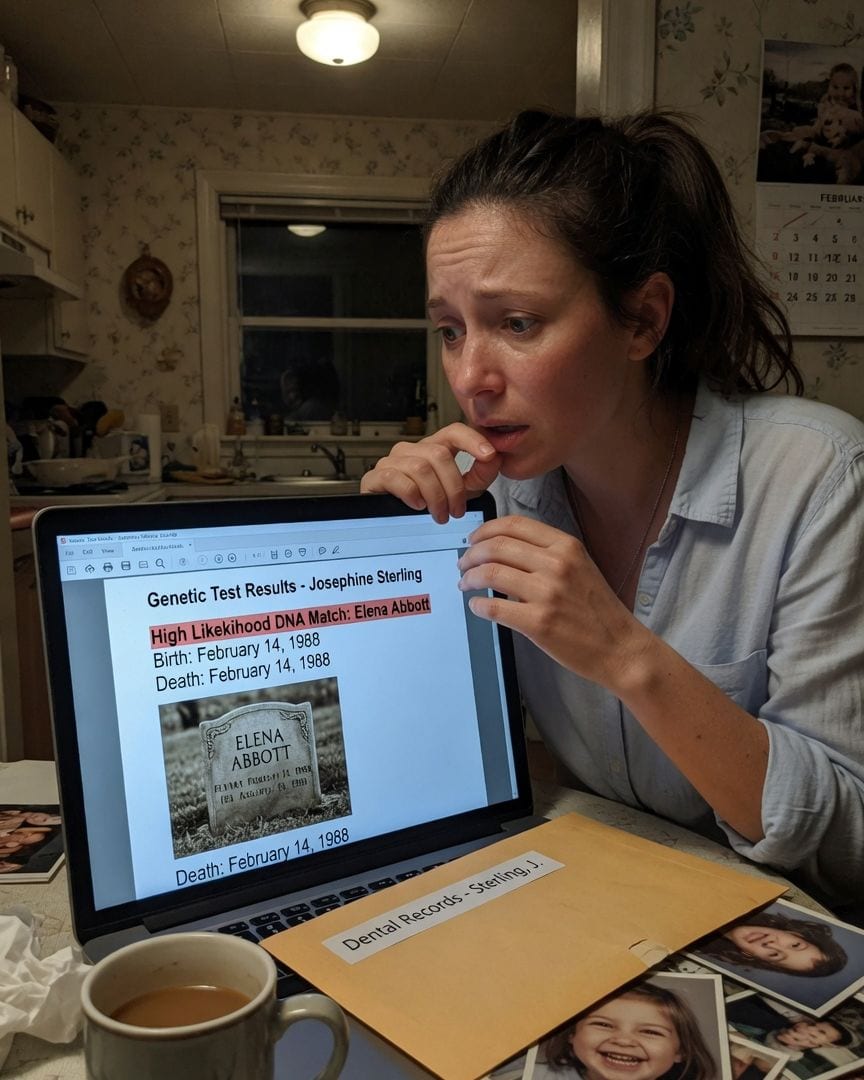
My dental scan shows a titanium implant where my own healthy tooth sits. The dentist tapped the bright screw on screen, then my actual canine, and said both could not be true.
My routine dental check-up took a dark turn when Dr. Caldwell found something impossible on my X-ray. A bright, metallic screw was fused into my upper jawbone. Yet, my own tooth in that exact spot was perfectly healthy, just as it had always been. Dr. Caldwell's words echoed: "These two things cannot both be true, Josephine."
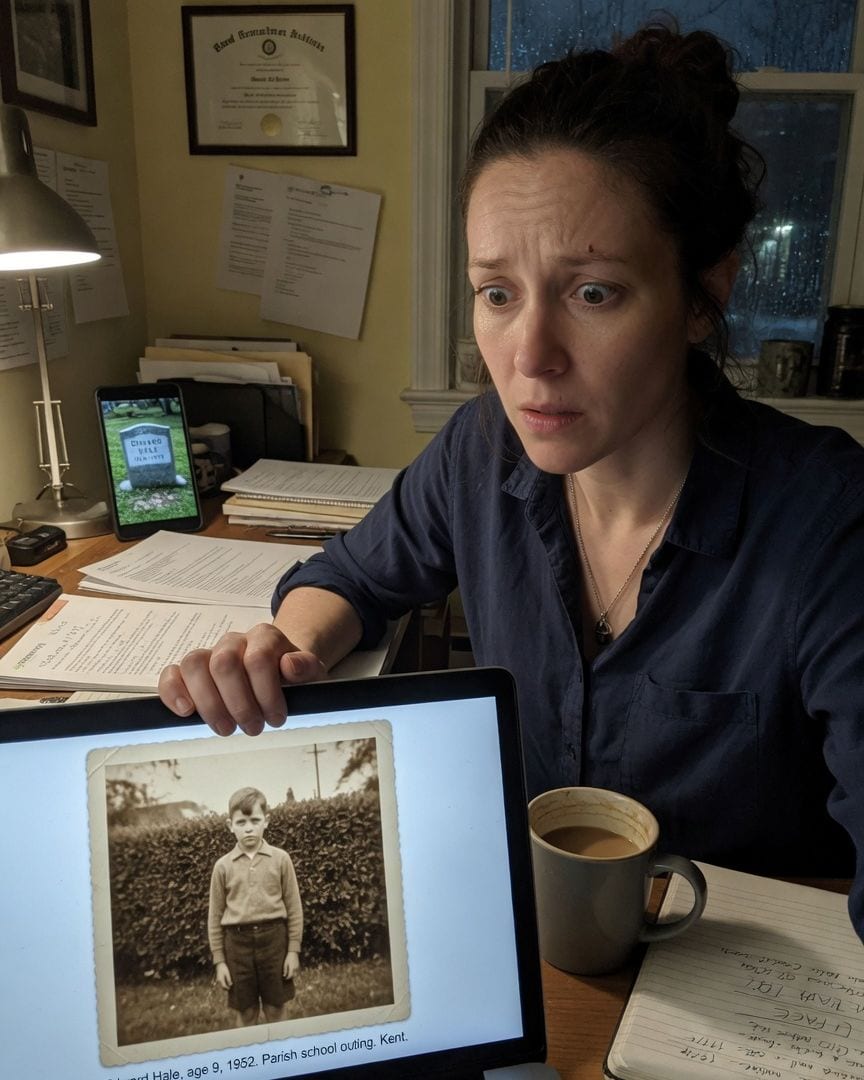
My DNA kit matched a man who died in 1974. The lab asked if I had a twin. Edward Hale is buried in Kent, under a stone I have now stood in front of.
I expected routine AncestryDNA results, but the lab found an 'unprecedented' genetic match. Edward Hale, who died in 1974, shares 99.9% of my DNA, prompting questions about a twin. The impossible dates didn't make sense, until a 1952 photo showed his face was unmistakably my own.
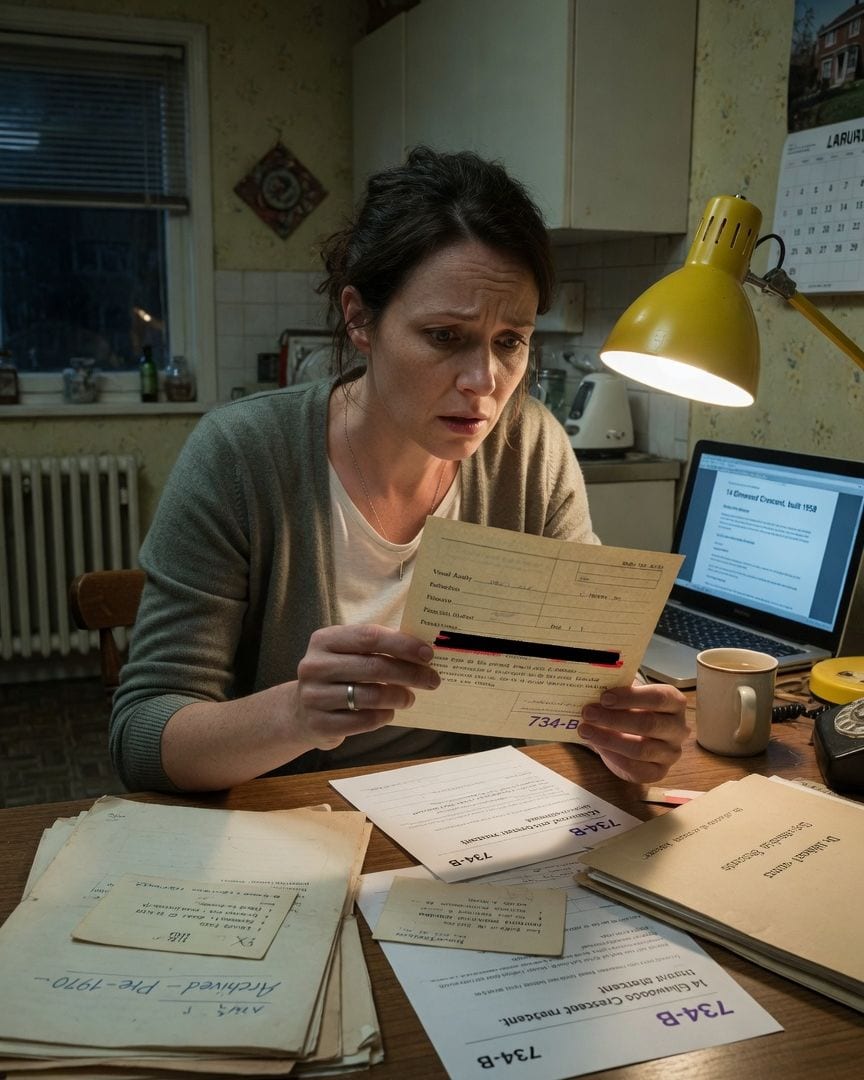
An old eye test card had my patient ID, 734-B, dated 1966. I found another, from 1948, for my house.
Transferring my old eye records should have been routine, but a strange, redacted card from 1966 raised a cold knot of dread. It mentioned my surname and street, along with a chilling instruction: 'tell the patient nothing.' Then I found my unique patient ID, assigned to me, on records dated 1948.
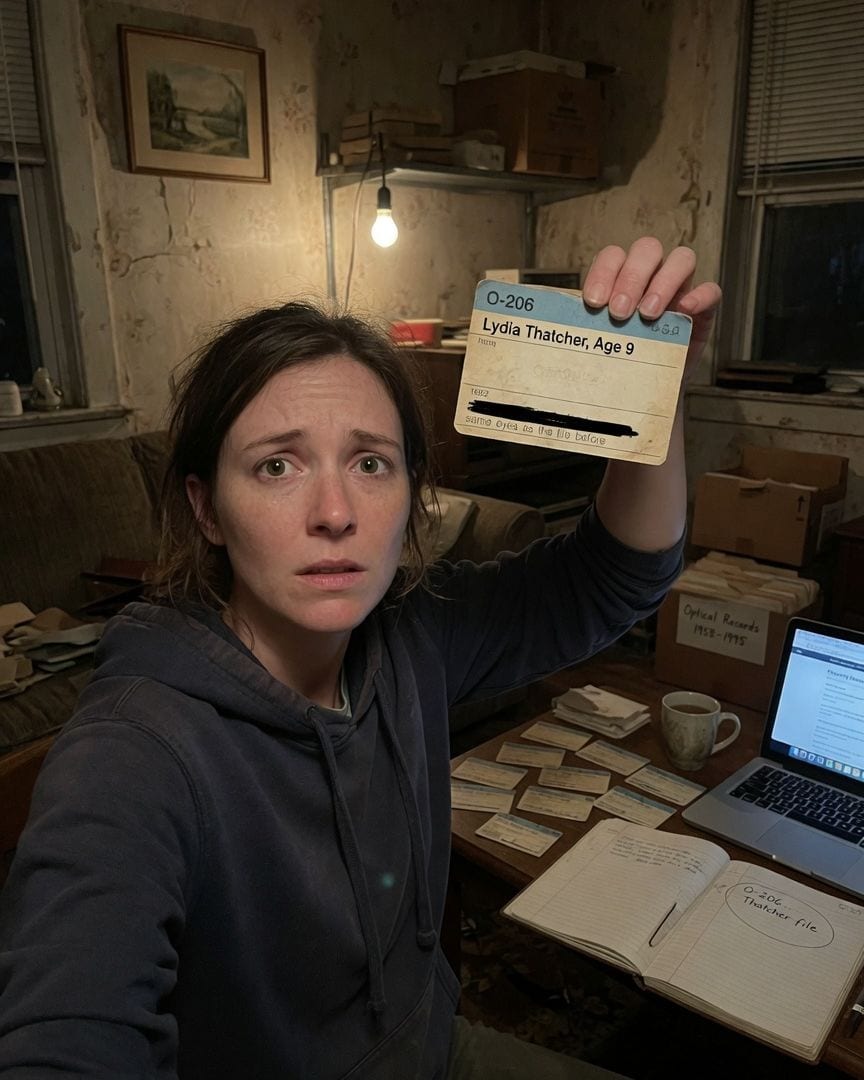
My own optical card is dated 1962, with my name on it. I wasn't born until 1993.
Sifting through old patient files from my former optical practice, I found my own O-206 card. It had my name, Lydia Thatcher, and my current home address printed on it. But the card was dated 1962, decades before I was even born, and a redacted note mentioned 'same eyes.'
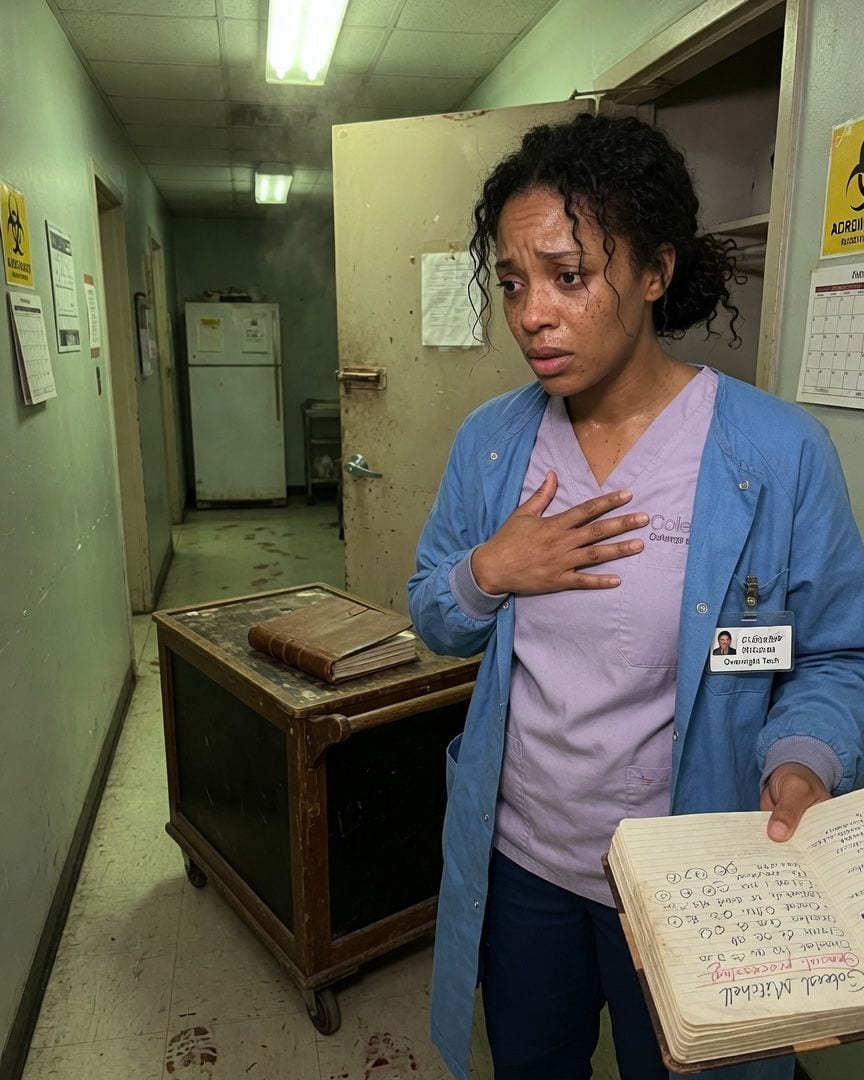
My boss says no one named Grace has ever worked here. But Grace stands beside me every night, reminding me to label the third rack — and I work the overnight shift alone.
On my quiet night shift at the blood bank, Grace always appears around 3 AM. I hear her familiar cart, smell her antiseptic scent, and follow her precise instructions. But my lab director insists no one named Grace has ever been credentialed here, leaving me to wonder who I've been working with.
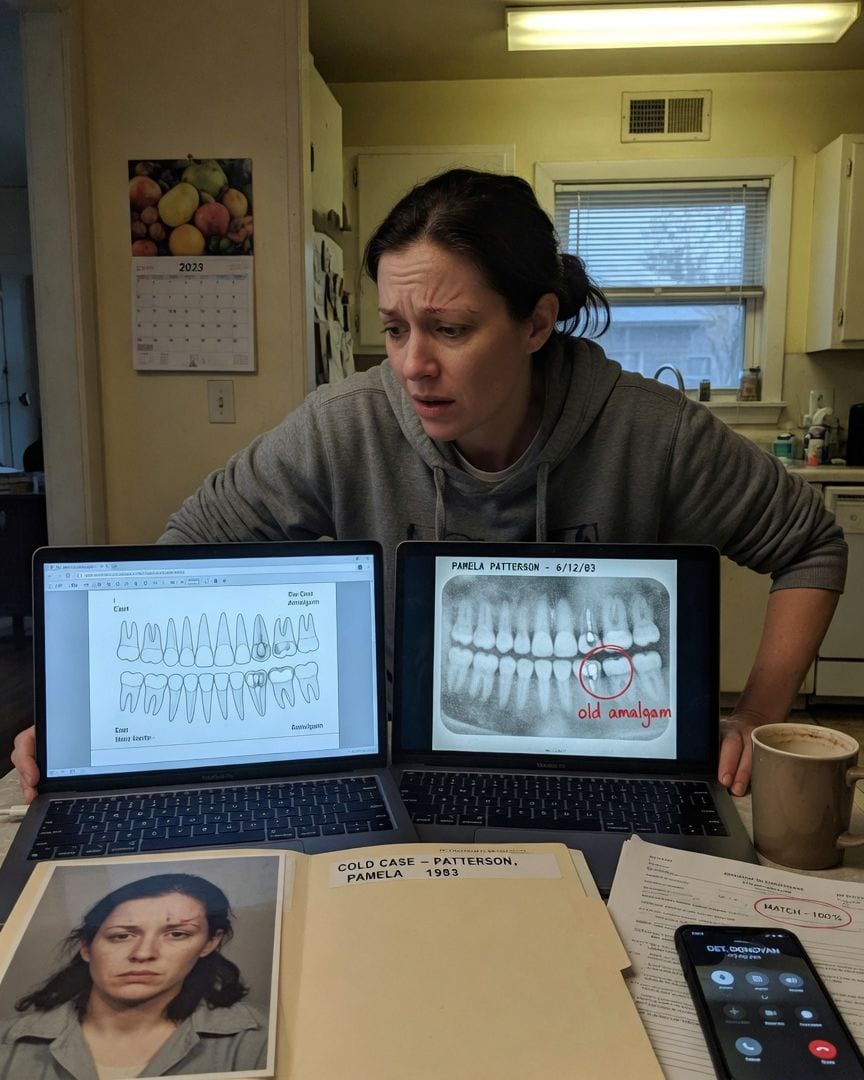
I gave a swab to be ruled out of a 1983 murder, but my DNA matched a hair from the scene exactly — and that hair belonged to a victim recorded dead there in 1983.
I gave a routine cheek swab for a 1983 cold case, barely thinking about it. But then Detective Donovan called, telling me my DNA matched the victim's hair exactly. The impossible truth: I wasn't born until 1991.