My DNA kit matched a man who died in 1974. The lab asked if I had a twin. Edward Hale is buried in Kent, under a stone I have now stood in front of.
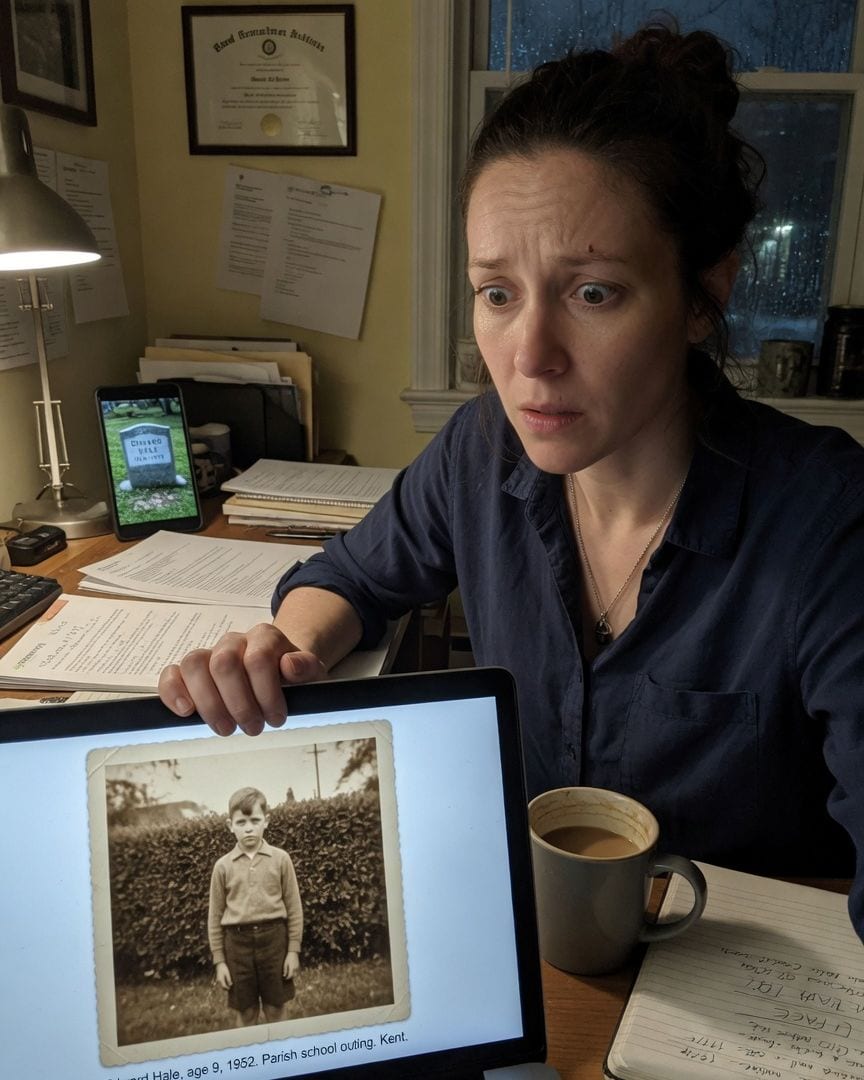
The email sat in my inbox, subject line: "Your AncestryDNA Results Are In!" I clicked it, expecting the usual percentages – a little Irish, a dash of Scandinavian, nothing too wild.
What I got instead made the coffee in my mug go cold, a film of grey forming on the surface.
It wasn’t a neat pie chart. It was a message, polite but clinical, from a Dr. Gideon Bishop at the lab. “Dear Ms. Stratton,” it began, “We have identified an unprecedented genetic match for you in our database.
An individual, Edward Hale, appears to share 99.9% of your genetic markers. For privacy reasons, we cannot disclose further details, but our records indicate Mr. Hale passed away in 1974.
Given the extraordinary nature of this match, we are compelled to ask if you have, or ever had, an identical twin?”
I read it three times. Edward Hale. 1974. Twin. I was thirty-two. I’d been born in 1991. The math didn’t work. My rational mind, the part of me that designs landscapes and balances budgets, immediately went to clerical error.
A database glitch. They’d mixed up samples, or maybe it was just an unusual, coincidental name. But the phrase "99.9% of your genetic markers" burrowed into my skull, a quiet, impossible hum.
I typed "Edward Hale 1974" into my search bar. The first result was an online memorial site. A small, blurry photo of a man in his late twenties, serious eyes, dark hair.
Below it, the dates: Edward Hale. Born 1944. Died 1974. A short note mentioned a quiet life, no surviving family. Then, a photo of a gravestone, moss-covered and stark against a grey sky. It was in a small churchyard in Kent. The name was clear.
The years carved beneath it were the same. A man who died seventeen years before I was born was, according to a reputable lab, my closest genetic relative. It was absurd. It was terrifying.
The unease gnawed at me. I tried to shake it off, but the image of the gravestone, the impossible date, kept replaying in my mind. So, I packed a bag. I drove to Kent, the grey sky matching my mood.
The churchyard was quiet, damp earth, the air thick with the smell of wet leaves and old stone. I found it quickly. The name. The dates.
Edward Hale. Born 1944. Died 1974. I stood before it, feeling a strange, cold pull, like standing in a draft where no window existed. A certainty, not of understanding, but of wrongness, settled deep.
I pulled out my phone, snapped a photo of the stone, the dates stark and unyielding.
Back home, the digital world felt safer than that damp Kent churchyard. I delved deeper. Local newspaper archives. A digitized clipping from July 1974. A brief obituary for Edward Hale. "Passed away peacefully at home. Private funeral."
No mention of family, no cause of death. Just a paragraph, a small, unremarkable life ending in a quiet, unremarkable way.
I found a distant cousin's online family tree, a sprawling mess of branches, and a single, isolated mention of an "Edward" with a question mark next to his name, no details. No leads.
I called the ancestry lab again. Dr. Gideon Bishop answered directly this time. His voice was calm, almost soothing, a practiced gentleness. "Ms. Stratton, I understand your concern. As I mentioned in my email, the data is quite unique." "Unique?"
My voice was sharper than I intended. "It’s impossible. He died seventeen years before I was born. How can we be an 'identical match'?"
"Statistically speaking," he began, his tone even, "for non-identical individuals, particularly with such an age discrepancy, it is indeed an anomaly. For identical twins, the match is expected, but the age gap would still be… significant.
However, our protocols are robust. The sequencing was verified, run twice. The results are incontrovertible." "Incontrovertible? Are you suggesting I have a deceased twin who died before I was born?" My voice was shaking now. He paused.
The line hummed with static. "Ms. Stratton, I can only provide the data. It indicates an identical genetic match." He wasn't giving an inch.
His calm assurance, the way he sidestepped my increasingly frantic questions about how this could be, made my dread deepen. He sounded too careful, too practiced, like he was reading from a script he'd used before.
The lab, the results, his unnerving composure. It wasn't an error. It was… something else.
Driven by a desperate need for answers, I continued my online search, focusing on Kent's local history. Hours blurred into a single, frantic scramble.
I stumbled upon an obscure local history forum, a thread from years ago about forgotten Kent families. Someone, "KentHistorian77," mentioned an Edward Hale and linked to a digitized local archive maintained by the county library.
It was a rabbit hole of scanned documents, local gazettes, old parish records. Deep, deep within the archive, past land deeds and birth notices from the 1920s and 30s, I found it. A grainy, sepia-toned photograph. Dated, roughly, 1952.
Edward Hale as a child, perhaps eight or nine years old, standing stiffly in front of a hedge. My fingers trembled as I clicked, zooming in on the image. The lines sharpened, the faded colors resolving into detail.
The face staring back from the photograph, from seventy years ago, was unmistakably my own. Not a strong resemblance, not a family likeness I might dismiss as coincidence. It was my face.
The same eyes, the same slight curve of the mouth, the small scar above my left eyebrow – perfectly, impossibly identical.
The photograph was a punch to the gut. I printed it, then pulled out my own childhood albums. There, tucked between photos of scraped knees and birthday cakes, was a picture of me at eight, grinning gap-toothed at the camera.
I held it side-by-side with Edward Hale's sepia image.
The dimple that appeared when I smiled, the faint tilt to my left eye, the way my hair curled just so at the temples – it was all there in Edward’s solemn gaze. Identical.
My breath caught in my throat, a cold, dry gasp.
I called Dr. Bishop again. My voice was steady, but brittle. "I've found a photograph of Edward Hale as a child. I'm sending it to you now." I attached the image. A few minutes later, he called back.
His voice was neutral, but I could hear a subtle shift, a tightening around the edges. "I see." A long moment of silence stretched between us. The phone in my hand felt suddenly heavy. "A fascinating coincidence, Ms. Stratton.
The human genome is full of them." "Coincidence?" I almost laughed. The sound was ragged. "Look at it, Dr. Bishop. That is my face. Are you seriously telling me this is just a coincidence?"
"The human resemblance factor can be striking. We sometimes see it with 'doppelgangers' who are entirely unrelated genetically." His explanation was flimsy, practiced, a wall he’d erected before I even spoke. It didn't land.
It only solidified my certainty that he knew more, that he was part of something I couldn't yet grasp.
Ignoring his practiced dismissal, I shifted my focus to Edward Hale's life. Census records, old local directories, property deeds.
I found an address: a small, isolated cottage, tucked away on a winding lane in rural Kent, a few miles from the churchyard. It was listed now as a renovated holiday rental.
I booked a weekend stay, feigning interest in its 'historic charm.'
The current owner was a chatty woman named Helen, who met me at the cottage with a basket of local jams. "Lovely old place, isn't it? The Hales lived here for generations."
As she showed me around, her voice echoed in the small, low-ceilinged rooms. My eyes kept drifting to a section of wall in what would have been an old servant's staircase, now just a decorative alcove.
"Oh, that," Helen said, following my gaze. "That's where the old attic entrance used to be. The previous owners just bricked it up. Full of junk, really. Nothing worth keeping." But a shiver ran through me. A sealed-off space.
Full of Edward's 'junk.' A sense of something hidden, waiting.
I returned to the cottage a week later, ostensibly for a second viewing, playing the part of a potential long-term renter. Helen was less effusive this time, perhaps sensing my odd persistence.
"I was wondering about that sealed-off attic," I began, trying to sound casual. "Any chance of taking a peek? For structural integrity, you understand. If I were to buy, of course."
Helen hesitated, her brow furrowed. "Well, there's really nothing in there. Just… old things. And it's sealed tight now." She wrung her hands. "You know, Mrs. Kingsley might know more about the Hales. Bridget Kingsley.
She's been in the village forever, knew Edward Hale well. She sometimes visits, just to check on the place, you know. Keeps an eye on things." Helen scribbled a number on a napkin. "She's eighty-eight, mind you, a bit particular."
I called Bridget Kingsley from my car, watching the cottage from a discreet distance. Her voice, when she answered, was frail but clear, surprisingly sharp for her age. Initially, she was friendly, reminiscing about the old village.
But the moment I mentioned Edward Hale, and then, carefully, the photograph, her tone changed. "Some things are best left buried, child," she said, her voice turning cold, almost accusatory. "He had his time." The line went dead.
The next morning, as I packed up to leave the cottage, I noticed it. A dark sedan, nondescript, parked discreetly down the lane, partially obscured by an overgrown hedge.
It was too far to make out the driver, but the car remained there, a silent, watchful presence, for hours. It wasn't Helen’s car, or anyone I'd seen in the village.
By the time I finally drove away, it was gone, vanished without a trace. But the impression of being observed lingered, a prickle on the back of my neck.
Ignoring the unease, the watchful car, the chill in Bridget Kingsley's voice, I drove directly to her small, cluttered home. It was a tiny cottage, older than Edward’s, leaning slightly to one side.
Bridget, frail and elderly, opened the door a crack, her eyes wary. "You again," she rasped.
I didn't waste time with pleasantries. I pulled out the printed childhood photograph of Edward Hale, my own impossible face, and placed it on her worn kitchen table. Bridget’s eyes, magnified by thick spectacles, widened.
Then they narrowed, a mixture of fear and something I couldn't quite decipher—resignation, perhaps.
“So, it’s started again,” she whispered, her voice barely audible, like dry leaves rustling. She didn’t ask about the photo, didn’t question how I had it. She just knew.
She spoke of Edward, not as a memory, a story from the past, but as a presence, a current, active thing. She talked about ‘passage,’ about being ‘prepared.’ My blood ran cold.
"A local tradition," she explained, her voice gaining a surprising strength, a quiet, almost defiant conviction. "A way to keep the spirit alive. For certain individuals. Talented ones. A kind of receptacle, you see. Edward… he was chosen.
For his unique qualities." She looked at me then, her gaze piercing. "His 'death' in 1974 wasn’t an end. It was a ritual. A transfer."
My heart hammered against my ribs. A transfer. "Your birth, Cecilia," she continued, her voice softer, but no less chilling, "that was the 'arrival.' The new vessel."
The ancestry lab’s odd questions, Dr. Bishop’s careful caution, his practiced evasiveness, the identical face in the photograph. It all snapped into sickening focus. A horrifying coherence.
Bridget then spoke of my family. My surname. "The Strattons," she said. "They have always had a 'connection' to this tradition. Ensuring the continuance." The words hung in the air, thick and heavy.
A cold dread settled deep in my bones, a terrifying certainty. My parents. My own family. They knew.
Bridget, her energy fading fast, murmured something else, her eyes drifting across the cluttered room. "Edward himself wasn’t the first." Her gaze settled on a dusty, leather-bound book on a nearby shelf, tucked between other ancient volumes. "He carried this.
His own beginnings." With surprising effort, she reached for it, her gnarled fingers tracing its worn cover. It was old, brittle, and seemed to hum with secrets.
She opened it to a brittle, yellowed page. It looked like a copy of Edward Hale’s birth certificate, faded but official.
But beneath the printed details, scrawled in an old, elegant hand, was a series of dates, names, and what looked disturbingly like a cryptic genetic sequence – a long string of letters and numbers. My breath caught in my throat.
I recognized it. It was identical to the sequence on my own DNA report. This sequence, however, was dated decades before Edward Hale’s own recorded birth.
The implications hit me with the force of a physical blow. Edward Hale was also a 'receptacle.' The cycle wasn't just about him and me. It was ancient. Multi-generational.
My own family was implicated, not just as facilitators, but as part of a lineage chosen for this horrifying continuation. And I… I was always, always inside it.
The leather-bound book wasn't just Edward's record; it contained similar 'amended' birth certificates for generations, stretching back into the late 1800s.
Each entry featured an official name and birth date, then, beneath it, the elegant, faded script detailing a 'transfer' date, a new name, and a new 'host' – all tied to that precise, cryptic genetic marker.
The same sequence that was on my DNA report.
Bridget, her voice thin but steady, explained it as a 'legacy.' A way for certain 'talented' individuals – those with unique intellectual or artistic gifts – to persist beyond a single lifespan.
It was an engineered reincarnation, a discreet network facilitating the process. Dr. Bishop’s lab, she confirmed, was merely a modern iteration, a sophisticated tool for identifying and verifying the 'vessel.'
My own parents, Bridget confirmed, were part of the arrangement, not just aware, but actively involved in preparing the 'vessel' for Edward's return.
Edward Hale’s spirit, his very essence, his consciousness itself, now resided within me. Not a metaphor. A terrifying, literal truth. It was slowly integrating, influencing my thoughts, my desires, shaping me. The 'Match To A Grave' was horrifyingly, sickeningly literal.
I felt him. A quiet hum in my consciousness, a growing sense of shared memories I never lived, images of a Kent landscape I’d never seen but felt intimately familiar.
The horror was not external, no monster hiding in the shadows. It was internal, a slow, inevitable erasure of myself.
Utterly horrified, I tried to flee. I drove from Bridget’s house like a madwoman, the leather-bound book clutched to my chest. I called my parents, a desperate attempt to grasp at my old life.
Their evasiveness, their rehearsed answers, confirmed Bridget's words. "We only want what's best for you, Cecilia," my mother had said, her voice unnaturally calm. "This is a great honor." My father’s silence was its own condemnation. They knew.
They had always known.
I was trapped. The transfer was already complete, or at least, irreversible. I tried to reject Edward, to fight the creeping sense of a foreign presence within me.
It wasn’t a voice in my head, not a distinct entity I could argue with. It was more subtle, insidious. A subtle shift in my own personality.
I found myself humming old tunes I’d never heard, melodies from the 1950s, not my own era.
My hand, when I picked up a pencil, would start sketching landscapes, specific views of Kent I knew only from Edward's memories, not my own. I felt his preferences, his very presence, growing stronger, overlaying my own.
I was losing myself, piece by piece, my identity eroding.
The dark sedan I’d seen earlier reappeared outside my apartment, a quiet, watchful presence. The network. Bishop. My parents. All of them. I knew I couldn't escape them, or the entity now sharing my body, slowly subsuming me.
There was no fight left, only a desperate need to leave a record, a testimony of what happened, before I was fully gone. Before Cecilia was fully gone.
I began to write, documenting everything, a frantic race against time and self.
I sold my apartment, cut ties with my old life, a futile attempt to outrun the network and the internal struggle. I moved to a remote cottage, far from Kent, hoping distance would help.
But Edward's presence was constant, a quiet hum in my mind, a subtle shift in my own thoughts. I found myself drawn to things I never cared for: classical music, historical novels, a particular type of dark roast coffee.
I hummed old tunes I'd never heard, knew the lyrics instantly. My tastes were subtly changing, becoming his. I lived a dual existence, a ghost in my own skin, the memory of Cecilia Stratton slowly fading.
The proof I carried – the meticulous notes, the copies of the impossible records, the photographs – felt meaningless. Who would believe a story of soul transfer, of a self slowly being overwritten?
I sit by the window now, sketching a landscape I’ve never visited but feels intimately familiar.
It's a precise, detailed view of a specific bend in the Stour River, near an old mill in Kent, a place I only know from Edward's memories. A strange yearning for it swells in my chest.
I feel a profound sense of peace mixed with a chilling resignation. My hand pauses, then signs the sketch. Not with my name. With an elegant 'E. Hale.'
A quiet woman, Bridget Kingsley, passed away peacefully in her sleep a few weeks later. Her old leather-bound book was found tucked away, unopened, on a dusty shelf.
No one ever noticed the elegant 'E. Hale' signed on Cecilia Stratton's last landscape sketch.
If this one got to you
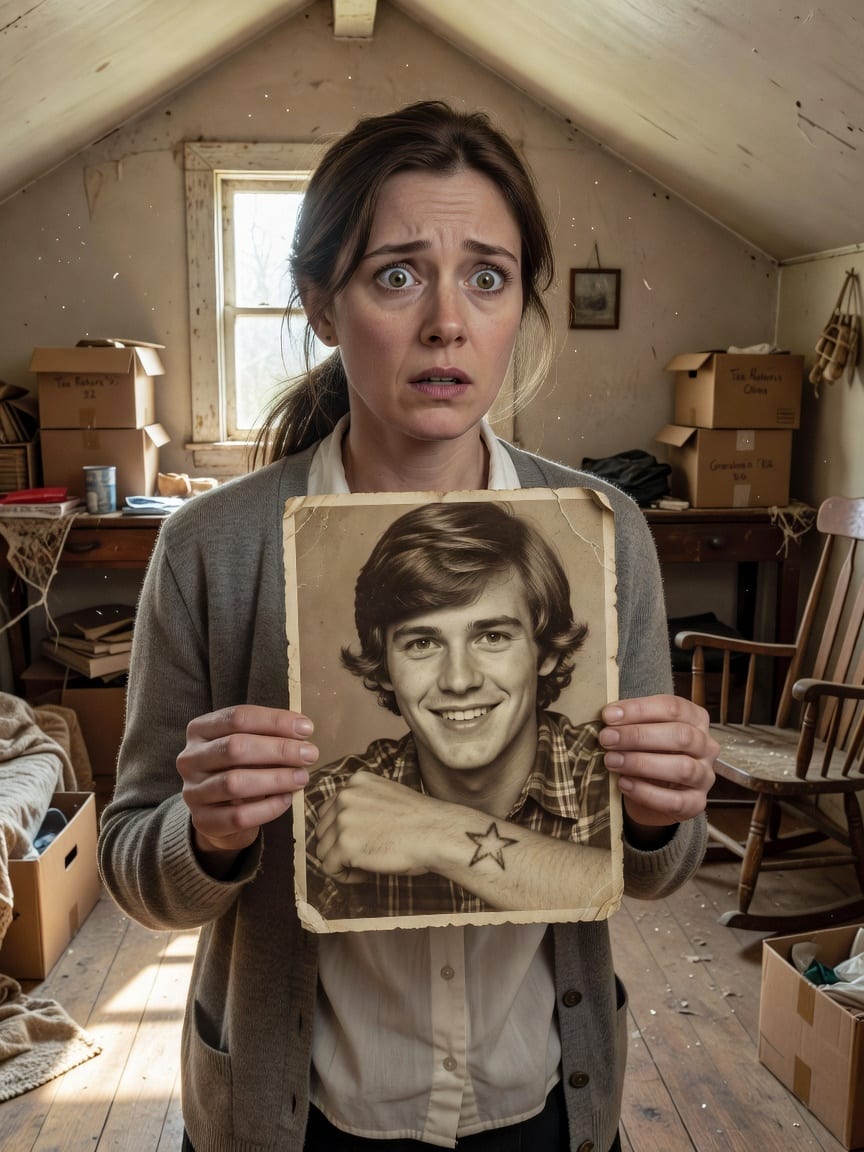
My DNA kit matched a man who died in 1974. The lab asked if I had a twin. I've stood at Edward Hale's grave.
I sent my DNA ancestry kit off for fun, expecting a list of distant cousins. Instead, the lab returned a 'probable identical match' to a man named Edward Hale, who died in 1974. I was born in 1992, and the lab asked if I had a twin.
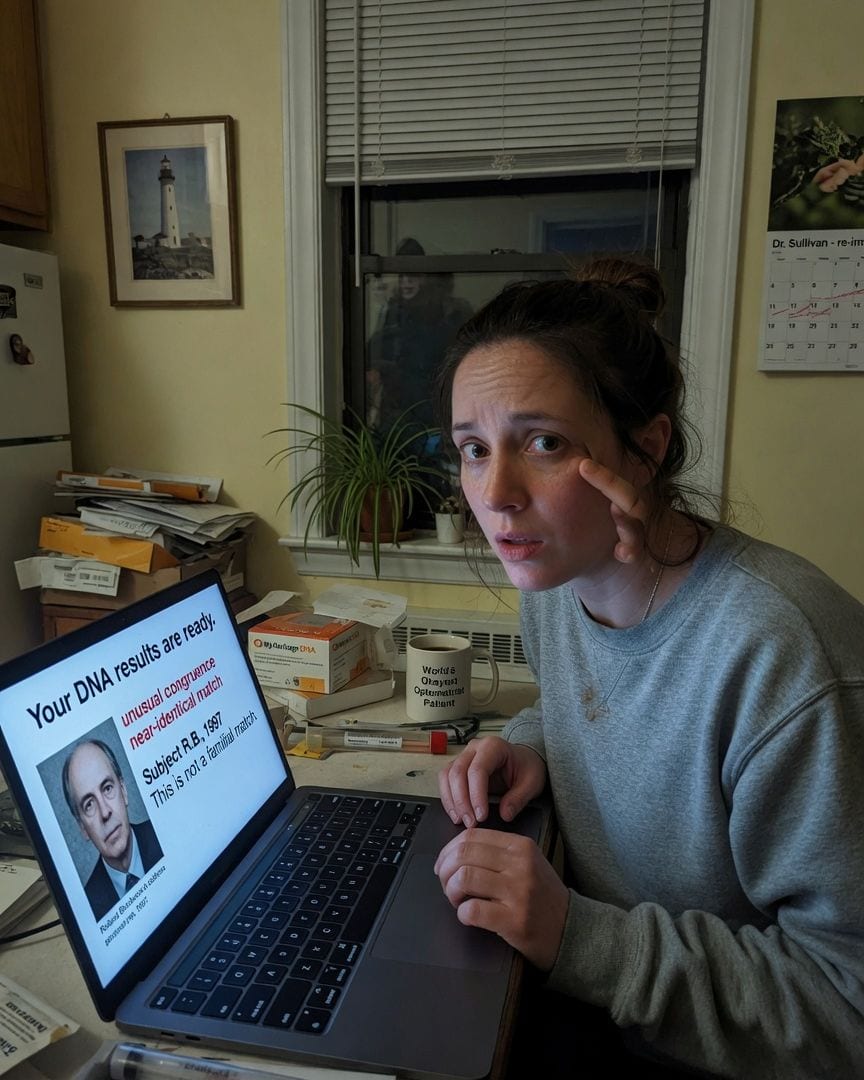
My retinal scan matched a dead man's eyes. His chart said 'deceased' from 1997. The pattern in my eye is his.
An ordinary eye exam turned unsettling when my optometrist paused, staring at the screen. He whispered that the machine flagged me as a returning patient, matching my unique eye pattern to a man deceased in 1997.
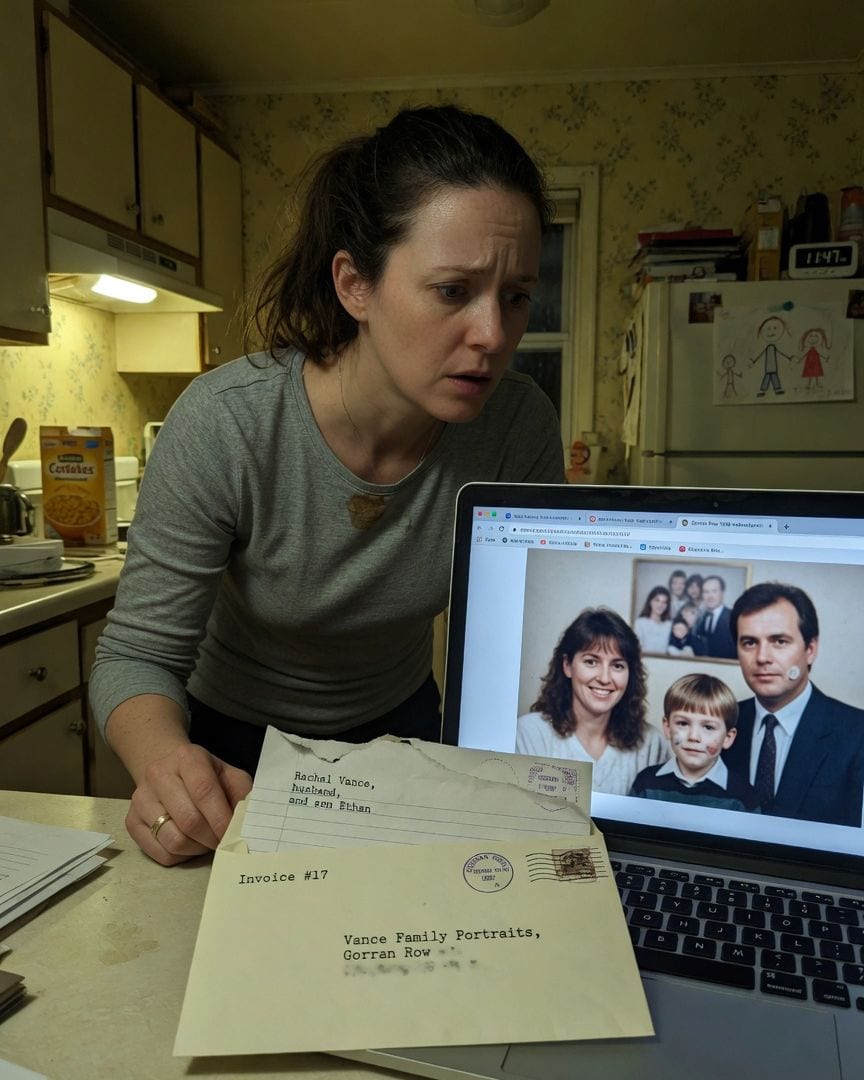
A 1987 portrait shows my younger face and my son's birthmark. I was born in 1988.
I've been receiving baffling invoices for a family portrait from a studio that closed in 1987, each one listing my son Ethan. My son was born decades after that studio shut its doors. Now, I've found an archived studio photo from 1987: my younger face, a stranger, and my son Ethan, his unique birthmark clear.
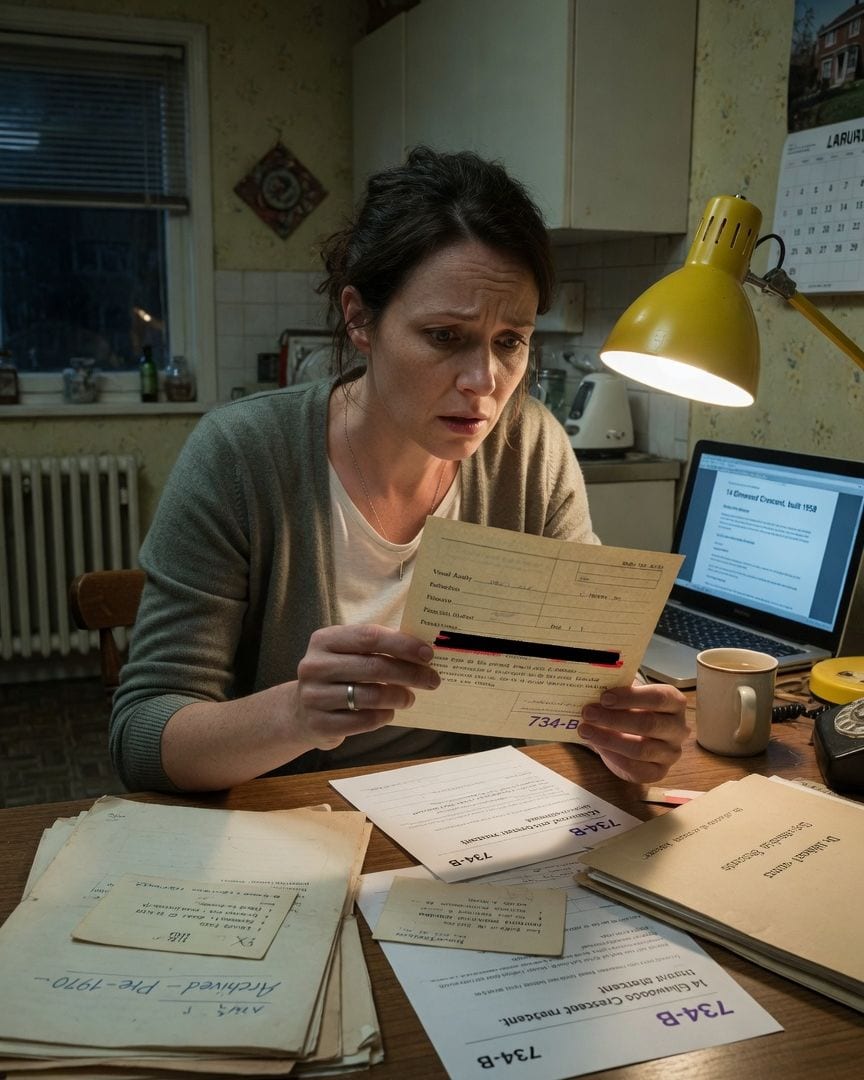
An old eye test card had my patient ID, 734-B, dated 1966. I found another, from 1948, for my house.
Transferring my old eye records should have been routine, but a strange, redacted card from 1966 raised a cold knot of dread. It mentioned my surname and street, along with a chilling instruction: 'tell the patient nothing.' Then I found my unique patient ID, assigned to me, on records dated 1948.
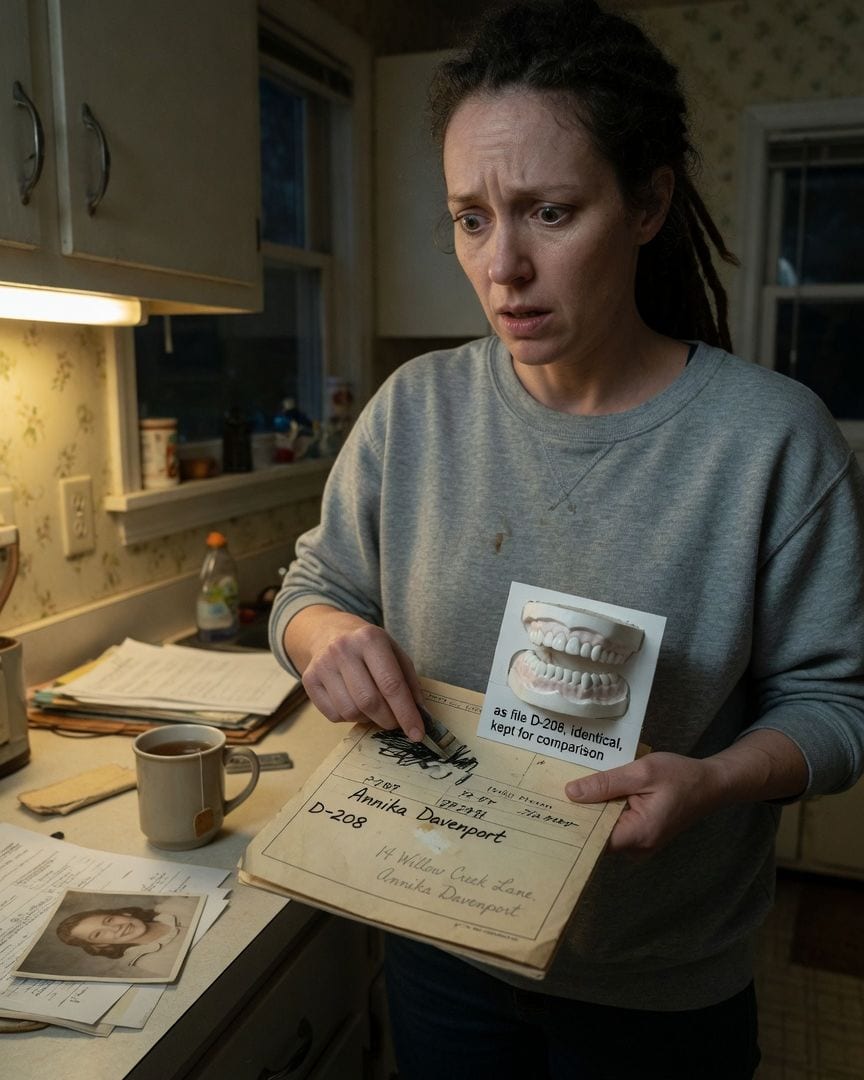
My childhood dental chart lists the house I bought last year — in my own name, years before I was born. A second set of my teeth sits filed beside it, marked 'identical.'
Sifting through old dental records, I found my chart, D-208, with my 1988 birth date. But a line from 1958 was blacked out, and a clipped card with an impression of my teeth listed my name and current home address, decades before I was born. The impossible facts knotted into a cold certainty.
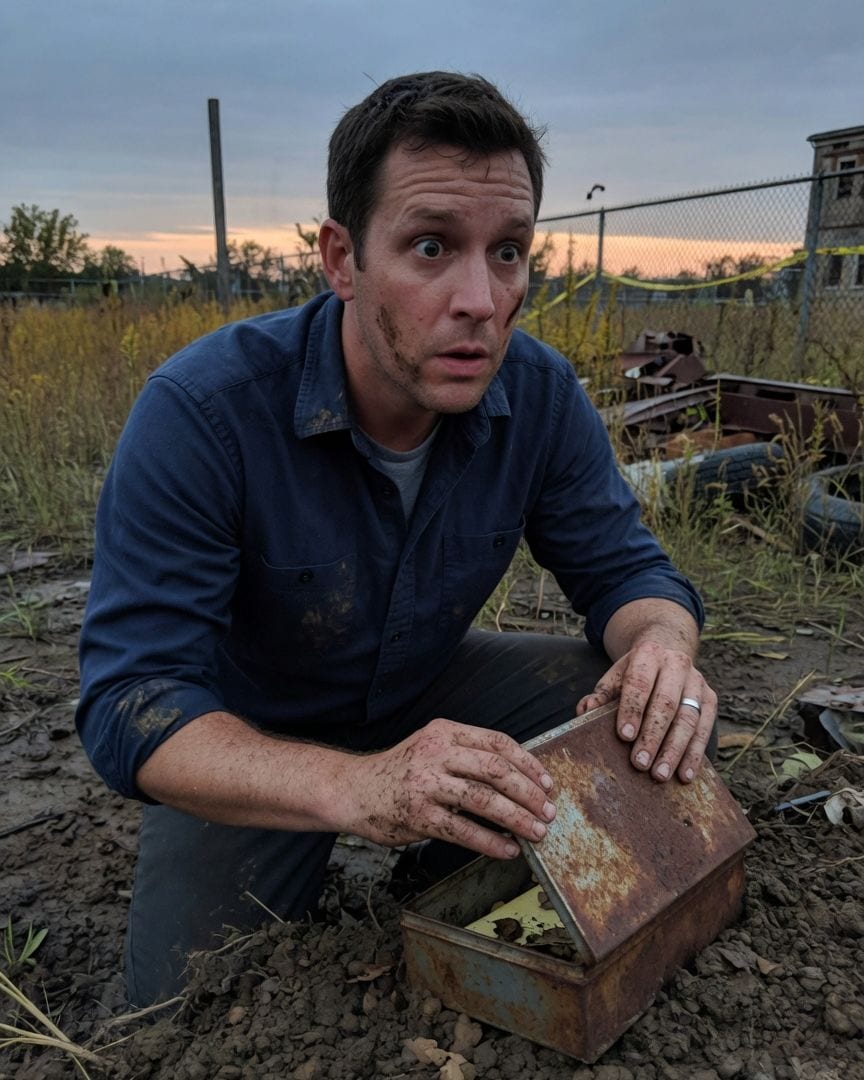
My ancestors' photo shows a letter addressed to me, dated 1972.
My birthday card arrived a day late, from a small town an hour north, nowhere we knew. Inside, an elegant, unfamiliar script read: 'Happy Birthday, Robert. The Field remembers.' It was postmarked from the site of my ancestral homestead, demolished decades before I was born.