My DNA kit matched a man who died in 1974. The lab asked if I had a twin. I've stood at Edward Hale's grave.
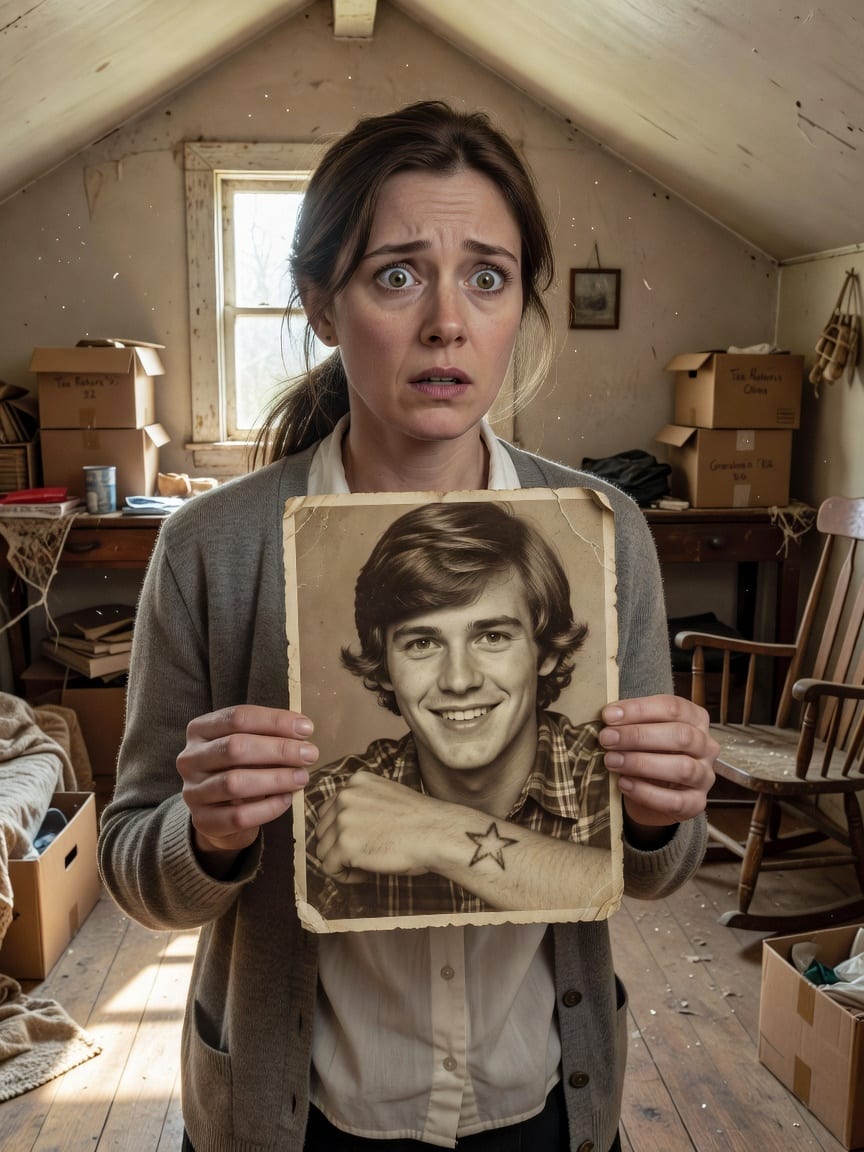
The email from the DNA lab arrived on a Tuesday morning. It wasn't the usual list of distant cousins, not even a vague third-cousin-once-removed from a forgotten branch of the family tree.
It was a single, carefully worded message, the kind that made the hairs on my arms prickle.
My DNA ancestry kit, mailed off for fun on a whim, had returned a match at the closest possible degree to a man named Edward Hale, who died in 1974.
The lab flagged it as a 'probable identical match' and asked, with a professional concern that chilled me more than outright alarm, if I had a twin. A twin. I am Sylvia Hartley, born in 1992.
I am 32 years old. There was no twin. There was never any mention of one.
I typed 'Edward Hale 1974' into my search bar. A simple obituary popped up first, then a photo of a weathered headstone in a Kent churchyard, the stone gray and mottled with lichen.
I found the church, an hour's drive away, the next weekend. The sun was pale and watery, the wind biting at my exposed skin.
I walked through rows of old graves, the dates blurring into each other, until I found it. The cold stone. I stood in front of it and read the dates carved deep: 1942-1974. Edward Hale.
The name felt like a hum in my bones, a low, resonant vibration that made my teeth ache. Edward Hale. The name of a stranger in a grave, dead nearly two decades before I was born.
And a lab email insisting we were genetically indistinguishable.
The chill wasn't just the Kent wind, cutting through my jacket; it was the quiet wrongness of a fact that shouldn't exist, a puzzle I couldn't unsee, a knot forming in the pit of my stomach that no amount of rational thought could untangle.
My grandmother, bless her organized heart, kept everything. After her passing a few years ago, I’d inherited a small, locked wooden box, about the size of a shoebox, full of what she called ‘sentimental odds and ends.’
It sat on a shelf in my spare room, forgotten. I hadn’t opened it in years, not since the initial sorting, but Edward Hale’s name now echoed through my thoughts, a persistent, unwelcome whisper.
Maybe, just maybe, there was a distant, forgotten branch of the family, a secret aunt or uncle, a hidden connection that would explain the impossible DNA match.
I found the small, tarnished key on a ring with her old house keys, tucked away in a ceramic dish. The lock clicked open with a faint, metallic sigh, like something waking up.
Inside, beneath a tangle of old costume jewelry, a pressed corsage from a forgotten dance, and a few dried, papery roses, I found it: a thin, leather-bound scrapbook.
It wasn’t a typical photo album, more a collection of pressed leaves, ticket stubs from places I didn't recognize, and a few faded newspaper clippings, all meticulously arranged and captioned in her elegant, looping hand.
I turned the brittle pages, the paper smelling of dust and dried flowers. Most of it was innocuous, snippets of local history, receipts from long-gone shops.
Then, tucked into a hidden pocket at the very back, behind a brittle train schedule from 1973, was a single, sepia-toned photograph. It showed a young man, perhaps in his early twenties, smiling.
His hair was styled in a way that screamed the 70s, long and swept back, and he was leaning against the gleaming chrome bumper of a classic car, a muscle car, parked on a sun-dappled street.
My breath hitched. He wasn’t a spitting image of me, not exactly, but there was a familiarity in his eyes, a tilt to his head when he smiled, a slight crookedness to his teeth that felt unnervingly my own.
But it was his left wrist, turned slightly towards the camera as he rested his arm casually on the car door, that made my stomach clench into a cold knot.
Clear as day, stark against his pale skin, a distinctive, star-shaped birthmark. Three points, almost like a tiny constellation. The exact same shape. The exact same placement.
The birthmark I’d always thought was uniquely mine, a little secret star on the inside of my left wrist that no one else in my family possessed.
My grandmother’s elegant, looping script was on the back, faded but still legible: 'Edward, summer '72.' The same Edward Hale. I traced the faded handwriting, the ink cool beneath my fingertip. The name. The date. It was him.
I flipped the photo again, my hand shaking slightly. Edward Hale, young and smiling, his left wrist turned slightly, almost casually, towards the lens. There, stark against his skin, was the star-shaped birthmark. Exactly like mine.
I called the DNA lab again, the blood thrumming behind my ears, my voice tight, strained, like a wire pulled too taut. Donald Carver, the senior technician who’d sent the initial email, picked up after a transfer.
His voice was calm, reassuring, exactly the kind of voice you wanted to hear when your world was tilting on its axis. He confirmed the match, patiently explaining the genetic markers, the statistical probability, the rigorous re-testing process.
“Ms. Hartley,” he said, his tone professional, unhurried, “the results are unambiguous. We’ve double-checked. Triple-checked, given the… unusual circumstances. This isn’t a distant cousin. It’s a direct, identical match.
Short of an identical twin, it’s… unprecedented for someone deceased for so long.” His professional calm only deepened my dread. An identical match. Not a genetic anomaly, not a mistake. An identical match.
I found Edward’s official death certificate online, filed away in the archives. Cause of death: cardiac arrest. Age: 32. The exact same age I was now. Date of birth: 1942. Date of death: 1974.
There was no record of siblings, no twins listed anywhere. No other children for his parents. Edward Hale was an only child.
Next, I called Aunt Hazel, my grandmother’s younger sister, the only living relative left on that side of the family. Her memory, while sharp, had always been selective when it came to anything potentially inconvenient.
“Aunt Hazel,” I began, trying to sound casual, as if I were just reminiscing, “did Grandma ever mention an Edward Hale?”
There was a beat of silence on the line, too long, too complete, like a tape suddenly cut. I could hear the faint hum of her refrigerator in the background, then nothing. “Edward Hale?”
she finally said, her voice thin, a little breathy, as if the name itself was a struggle. “No, dear. Not that I recall. Why would she?”
I described the photo, the young man, the unmistakable star-shaped birthmark. I heard a soft exhale on her end. “Oh, that old thing,” she said, dismissively, her voice regaining its usual briskness, a little too quick, a little too light.
“Just a family friend, I suppose. Your grandmother knew so many people from the village. Her social circle was vast.”
I pressed, my grip tightening on the phone. “But the birthmark, Aunt Hazel. It’s identical to mine. The exact same shape, the exact same place on his wrist.”
Her voice hardened, just a fraction, the dismissiveness replaced by something sharper, colder. “Coincidence, Sylvia. The human body is a strange thing. These things happen. Some things are best left buried, don’t you think? Old ghosts.”
She ended the call abruptly, without another word, leaving me staring at the phone, the cold silence in my flat suddenly more telling than any explanation she could have given. Her words echoed, "Old ghosts."
But what kind of ghost leaves a birthmark?
Aunt Hazel’s evasiveness wasn’t just a refusal to engage; it felt like a quiet, watchful resistance.
After our call, she started dropping by my flat unannounced, usually in the late afternoon, ostensibly to 'check in,' to bring me a casserole I didn’t ask for, or to fuss over a wilting plant. But her eyes would linger.
They’d track my movements, darting to my laptop screen if it was open, to the scattered papers I’d begun to collect on my coffee table – printouts of Edward’s obituary, local newspaper archives.
Once, I saw her pick up the framed photo of Edward Hale I’d left on my desk, her fingers brushing the glass, a flicker of something unreadable in her gaze before she replaced it.
Her face was a mask of mild concern. “You’re working yourself up over nothing, dear,” she’d say, her voice soft but firm, a hand resting lightly on my arm, “Some things are just… coincidences.”
The room itself felt heavy when she was there, the air thick, almost suffocating, as if all the oxygen had been drawn out to fuel her quiet watchfulness.
A few days later, an anonymous email landed in my inbox. The subject line was blank.
The body contained only a single, grainy photograph of Edward Hale’s headstone, taken recently, judging by the fresh dew on the grass, the way the light caught the lichen. No message, no sender. Just the silent image.
It was a subtle, unsettling warning. Someone knew I was digging. Someone wanted me to stop. The casual visits, the anonymous email – it coalesced into a chilling pattern.
I started feeling eyes on me, even when alone in my flat. The creak of the floorboards in my old building seemed louder, more deliberate, not just the settling of an old house.
The shadows in the corners felt deeper, more watchful. One evening, returning home from a late grocery run, I found my front door slightly ajar. I’d locked it, I was sure. Triple-checked, as I always did.
My heart hammered against my ribs. Nothing seemed to be missing – my laptop was still on the desk, my wallet on the counter.
But a faint scent of lavender, Aunt Hazel’s signature perfume, lingered in the air, a cloying sweetness that made my stomach turn.
The message was clear: my search was observed, my privacy breached, and the people who knew were closer than I thought. The coldness that had started in Kent was now in my home, breathing down my neck.
The anonymous photo of Edward’s grave only spurred me on, solidified my resolve. This wasn't just a glitch, a coincidence, or an old woman's dismissiveness. This was something deliberate, something hidden. I needed more than a dismissed coincidence.
I visited the Kent County Archives, a quiet, stately building on the edge of town, smelling of old paper, dust, and polished wood.
The only sound was the hushed rustle of pages and the faint, rhythmic click of Lily Thornton’s keyboard. Lily, the archivist, was helpful, if a little bemused by my specific request. “Edward Hale, you say? Died ’74? Hmm, let’s see.”
She returned a few minutes later with a brittle file, tied with a faded ribbon.
It contained Edward’s original birth certificate, his school records from a local grammar school, and a few local newspaper clippings from the time of his death. One small article, nestled amongst the obituaries for other townsfolk, caught my eye.
It was headlined: 'Community Initiative Offers Support for Grieving Families.' It mentioned a local 'community bereavement support initiative' that had been set up shortly after Edward’s passing, offering 'comfort and continuity' to affected families.
It was an unusual detail for a small-town paper, strangely specific, yet vague. Why would the community need 'continuity'?
More unnerving was a faded, typewritten letter in the file, dated just weeks after Edward’s death. It was addressed to his parents from a Dr. Alistair Ellsworth. The language was formal, almost clinical.
It spoke of 'progress in the arrangements' and 'the special nature of the commitment.' No specific details, just vague, comforting words that now felt anything but.
The letter ended: 'We believe this path offers the truest form of remembrance and allows for the continuation of what was lost.'
I copied it all, the words chilling me down to my bones. The hair on my arms stood on end. This wasn't just a family friend, or a distant relative, or an old crush of my grandmother’s.
This was something organized, something with a formal process. The 'continuity.' The 'commitment.' The 'special nature.' Combined with the identical birthmark, it clicked into place with horrifying clarity: Edward Hale wasn't just a dead man I shared DNA with.
He was, somehow, me. Or rather, I was a continuation of him, a physical, genetic echo. The DNA lab wasn't wrong. The birthmark wasn't a coincidence. It was all real, and it meant something impossible about my own existence.
The air in the archive office suddenly felt too thin, too cold, the silence no longer peaceful but pressing, like a hand clamped over my mouth.
Armed with the archivist’s findings, the strange letter from Dr. Ellsworth, and the newspaper clipping hinting at ‘continuance,’ I returned home. I immediately went online and requested a copy of my own official birth certificate, paying extra for expedited delivery.
It arrived by post a few days later, a standard, official document, crisp and white.
But as I scanned it, comparing it to Edward’s birth certificate and the general information I knew about my own life, a cold, hard knot formed in my stomach.
My stated birth date was August 12, 1992. Perfectly normal. But the registrar’s signature, the official stamp of validity, was dated November 5, 1992 – nearly three months later.
A delay that long was highly unusual, often indicative of an unregistered birth or adoption, a legal loophole, a quiet anomaly.
My mother, Diane Hartley, who had died when I was young and whose memory was fractured and hazy, had always spoken of my birth as a straightforward hospital delivery.
I called the hospital listed on the certificate, pretending to confirm a vaccination record for myself, a detail from my childhood. I gave them my name, my mother’s name, my stated birth date.
After a few minutes on hold, the administrative assistant, polite but firm, told me they had no record. No record of my mother, Diane Hartley, giving birth there on August 12, 1992. No record at all.
It was as if I simply hadn’t been born there.
My mother, who had always painted a picture of a normal, if difficult, birth. But the record, the official record, insisted otherwise. It was a blank.
And then, I saw it. In the bottom-right corner of my birth certificate, almost erased by time and handling, a faint, almost invisible, handwritten notation. A code. I leaned closer, straining my eyes. 'EH-74-B.'
My blood ran cold, a sudden, icy rush. Edward Hale. 1974. Birth.
It was a record that could not be, a direct, impossible link from my own identity to a dead man, etched onto the very document that defined me, that declared me real. The paper trembled in my hand.
I confronted Aunt Hazel. There was no point in dancing around it anymore. I drove to her house, the documents clutched tight in my hand.
I laid them out on her polished oak dining table, one by one: the photo of Edward Hale with our shared birthmark, the archive letter from Dr. Ellsworth referencing 'continuance,' my own birth certificate with its impossible delayed registration and the chilling 'EH-74-B' code.
Her calm was terrifying. She looked at the documents, then at me, her eyes devoid of surprise, only a deep, weary sadness, like someone who had carried a heavy secret for too long.
The scent of lavender, now no longer menacing but simply sad, filled the room.
“Your grandmother… she loved Edward so much,” Hazel began, her voice a low murmur, barely above a whisper. Her gaze drifted to a framed photo on the mantelpiece – my grandmother, smiling, much younger. “He was her only son.
Her golden boy. When he died, suddenly, tragically, in ’74, it broke her. Truly broke her. She was never the same.” She paused, a small, rattling sigh escaping her lips. “There was a small group, quietly offering… a way.
For families like ours. A local institution, discreet. They called it ‘Continuance.’ A chance to… bring back what was lost. Genetically, not spiritually, you understand. A new pattern laid over fresh clay.”
She explained how the 'initiative' had worked with grieving families, matching genetic material, creating a 'new vessel.' Her voice was devoid of emotion, a monotone recitation of a grim historical fact.
“They found your mother, a young woman, struggling financially, willing to be a surrogate. A new life, a new chance for Edward. But it had to be kept quiet. The world wasn’t ready for it. Still isn’t, I suppose.”
Hazel described the meticulous process of forging birth records, ensuring the 'continuity' was seamless, untraceable.
The delay in my birth certificate registration was to allow for the final 'adjustments,' the legal and administrative alchemy required to manifest a person out of an impossible past.
The 'EH-74-B' code was an internal identifier, a tragic bureaucratic tag for their project. “Your grandmother believed you were Edward, Sylvia. Not a copy, not a replacement, but him, given another chance.
She raised you with so much love, but always with that… understanding. That you were her son, come back.”
Every piece clicked into place, not like a puzzle solving, but like a steel trap snapping shut around my very existence. The DNA. The identical birthmark. Aunt Hazel’s evasiveness. The strange, clinical letter from Dr. Ellsworth.
My own impossible birth records. The horror wasn't a shadowy monster or a supernatural entity.
It was a calculated, clinical wrongness, meticulously woven into the fabric of my own life, decades in the making, all in the name of love and grief. I wasn't born. I was repurposed.
Hazel’s confession, delivered with such placid conviction, left me reeling. My entire life was a lie, a carefully constructed illusion built upon another's grief, a biological echo.
I wasn’t Sylvia Hartley; I was Edward Hale, reborn, recast, a ghost in living flesh. The thought was a searing brand across my soul.
I couldn’t stay. I couldn’t look at Hazel, at her unsettling calm, at the familiar walls of her house, without seeing the intricate, decades-long web of deception. I couldn't breathe the same air.
I needed more proof, something tangible beyond her unsettling composure, something that would convince anyone, not just me.
I remembered the Dr. Ellsworth mentioned in the archive letter.
A quick search on my phone, my fingers fumbling with the keys, revealed 'Ellsworth & Associates,' a defunct private medical practice that had operated in a secluded, wooded part of Kent until the late 90s, specializing, according to old business directories, in 'niche family planning.'
The horror of that euphemism chilled me to the bone.
Their old address was still listed. My hands trembled on the steering wheel as I drove there, the old building boarded up, overgrown with ivy, paint peeling like sunburnt skin.
The windows were dark, reflecting the gray sky like blind eyes. But a loose panel on the back, half-hidden by a thick tangle of thorny bushes, revealed a small, forgotten cellar entrance, a heavy wooden door hanging off its hinges.
Inside, in the musty, earthen darkness, smelling of damp soil and decay, I found it: a heavy, leather-bound ledger, resting on a rickety shelf, beneath a scattering of broken ceramic pots.
Its cover was embossed, not with a name, but with a stylized symbol – two intertwined circles, like a Mobius strip. 'Continuance Log,' it read in faint, gold lettering.
I fumbled for my phone’s flashlight. Its beam cut through the gloom, illuminating page after page of neat, precise entries. Dates, codes, and names – a chilling roster of 'replacements.'
My heart hammered against my ribs, a frantic bird trapped in a cage, as I found my own entry: 'Subject: Hartley, S. Origin: Hale, E. Date of Transfer: Aug '92.'
There were dozens of other similar entries, a chilling pattern spanning decades, each one a testament to another stolen life, another sorrow exploited.
This was it. Undeniable. Unbelievable. The cold, clinical truth of my existence.
I tore out the pages with my entry, along with a few others to show the horrifying pattern, and shoved them into my bag, my fingers stained with dust and the faint, sweet scent of decay.
The air felt thick with the ghosts of forgotten lives, echoing with the silent screams of those whose pasts had been erased. I knew I couldn't expose this without shattering my own existence, but I couldn't live without knowing.
I fled, the ledger pages clutched in my hand, my old life dissolving behind me like smoke. I was a witness to an impossible truth, carrying proof no one would ever believe.
I left Kent that night, abandoning my flat, my job, my entire life. Aunt Hazel sent a single, terse text hours later, the words appearing on my phone screen in the darkness of a nameless motel room: 'I understand.'
I never replied. The ledger pages, faded and brittle, were my constant companions, locked away in a fireproof safe, moved from hidden place to hidden place.
I moved from town to town, taking temporary jobs, always looking over my shoulder, always waiting for a knock at the door, for someone to find me, for the other 'Continuance' subjects, perhaps, to come looking for their own origins.
My new identity felt like a thin skin over an older, deeper one. The star-shaped birthmark on my wrist, once a unique identifier, now felt like a brand, a permanent inscription of the wrongness inside me.
I was free, but irrevocably changed, a stranger in my own body, haunted by the ghost of Edward Hale.
Sometimes, I catch my reflection, and for a split second, I don't see Sylvia. I see the young man in the photo, Edward Hale, a flicker of his eyes, a ghost of his smile, his particular tilt of the head.
The world goes on, oblivious to the quiet, clinical horror that reclaims lives, that stitches old patterns into new flesh, that makes a mockery of time and identity.
I carry the proof, the ledger pages detailing the 'Continuance' of others like me, but I know better than to show them. Who would believe? Who would even want to?
The cost of knowing this truth is a life lived in shadow, forever listening for the echoes of another's past in my own footsteps, in the beat of my own heart.
I am Sylvia Hartley, I tell myself, a mantra in the dark, but the name feels like a borrowed coat, never quite fitting, never quite warm. I am a survivor, but what exactly did I survive?
The question lingers, a silent hum in the quiet hours, an answer that is worse than the question, worse than any ignorance.
I know my name, but I don't know who I am anymore.
If this one got to you
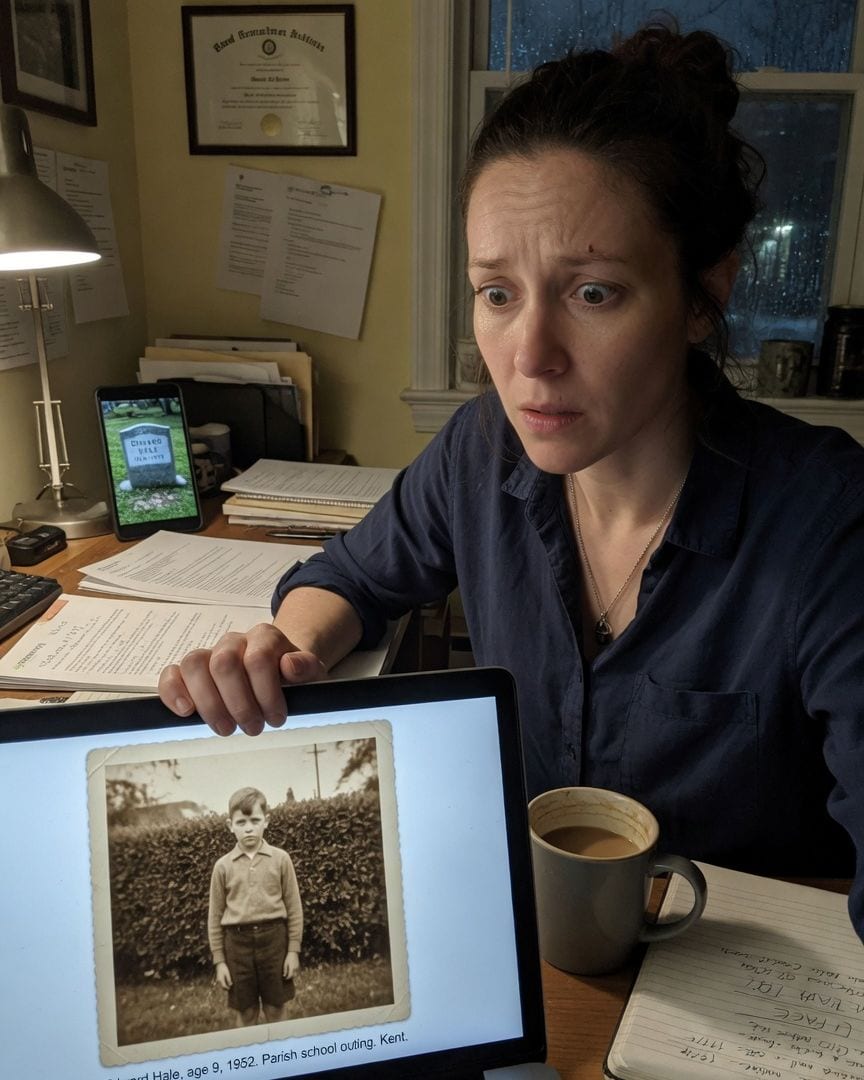
My DNA kit matched a man who died in 1974. The lab asked if I had a twin. Edward Hale is buried in Kent, under a stone I have now stood in front of.
I expected routine AncestryDNA results, but the lab found an 'unprecedented' genetic match. Edward Hale, who died in 1974, shares 99.9% of my DNA, prompting questions about a twin. The impossible dates didn't make sense, until a 1952 photo showed his face was unmistakably my own.
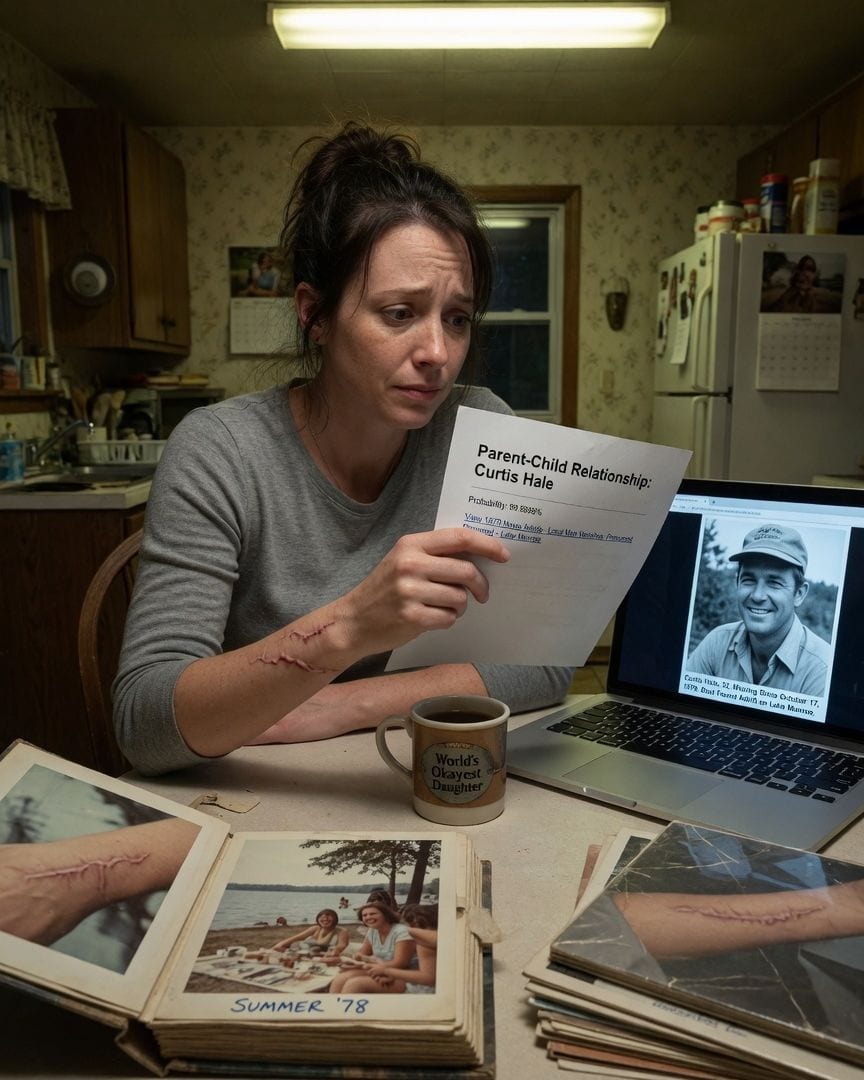
My DNA returned Curtis Hale as my father. He vanished in 1979. I was born twelve years later. The lab confirmed the match twice.
My DNA test results revealed something impossible: my biological father vanished in 1979, twelve years before my birth. My mother dismissed it as nonsense, but her reaction felt forced, leading me to old family photos. There, in a faded 1978 snapshot, I found my own distinctive childhood scar on the wrist of a stranger.
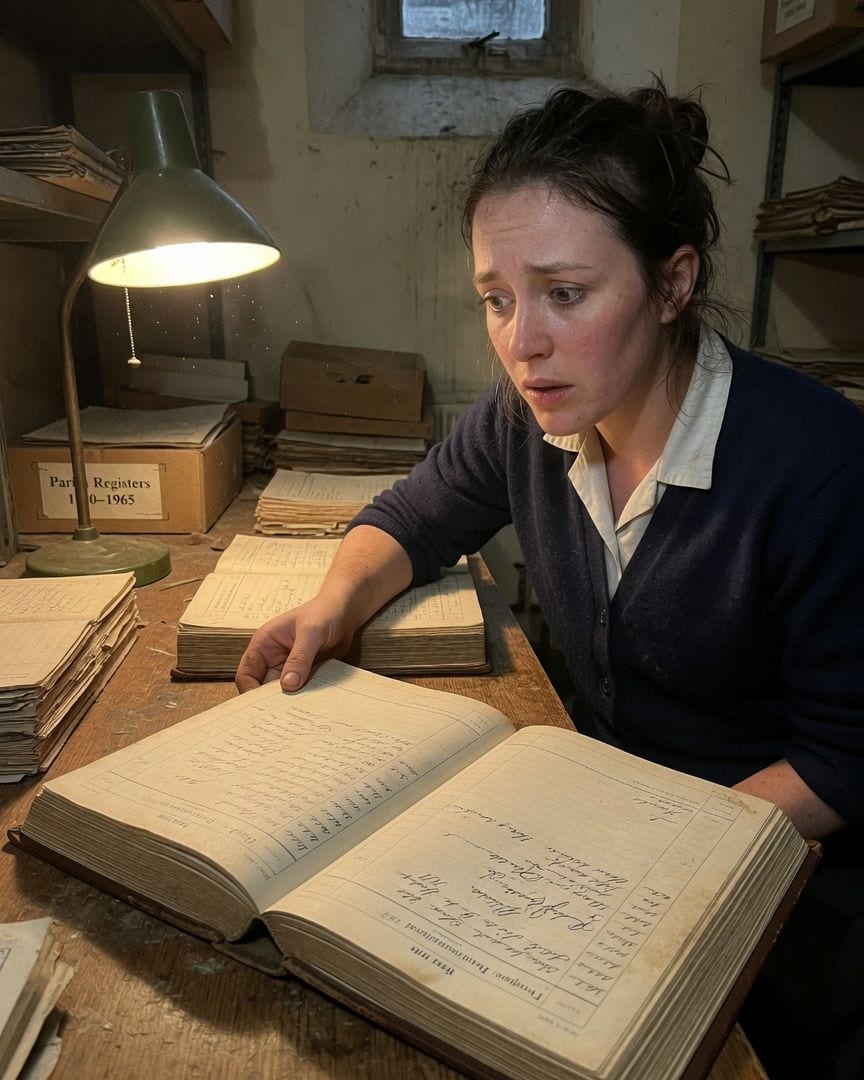
My signature appeared on a baptism record from 1957. Decades before I drew my first breath.
I was reviewing my parents' marriage certificate for a citizenship application, a simple formality. But my gaze snagged on a witness signature: my own distinctive handwriting, dated six years before I was born.
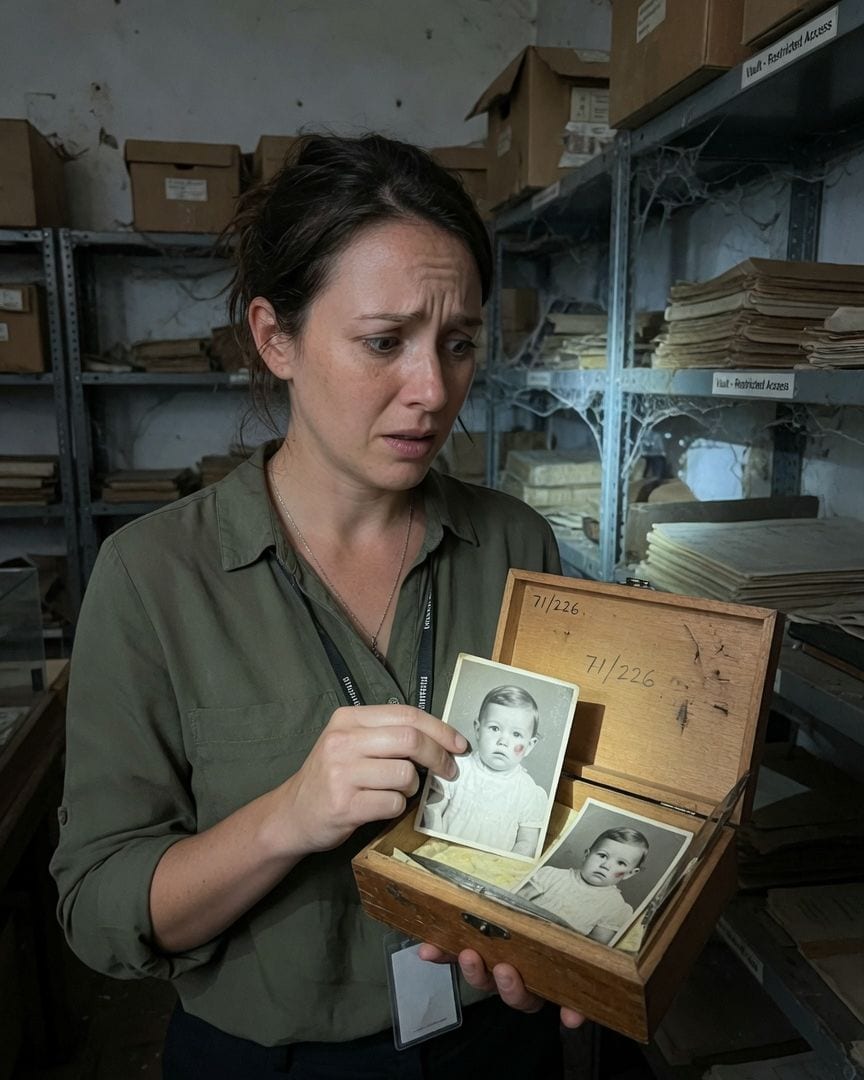
The christening gown in my museum names my own family on a blacked-out donor card. It's the fourth to carry that number since 1919 — and the date it comes back is already typed in.
Cataloguing an antique christening gown, I found its museum card listed a future "return" date, and then uncovered an old box in the vault. Inside, a 1961 photograph of a child bore a birthmark identical to my own, taken at my street address, and chillingly marked "Returned."
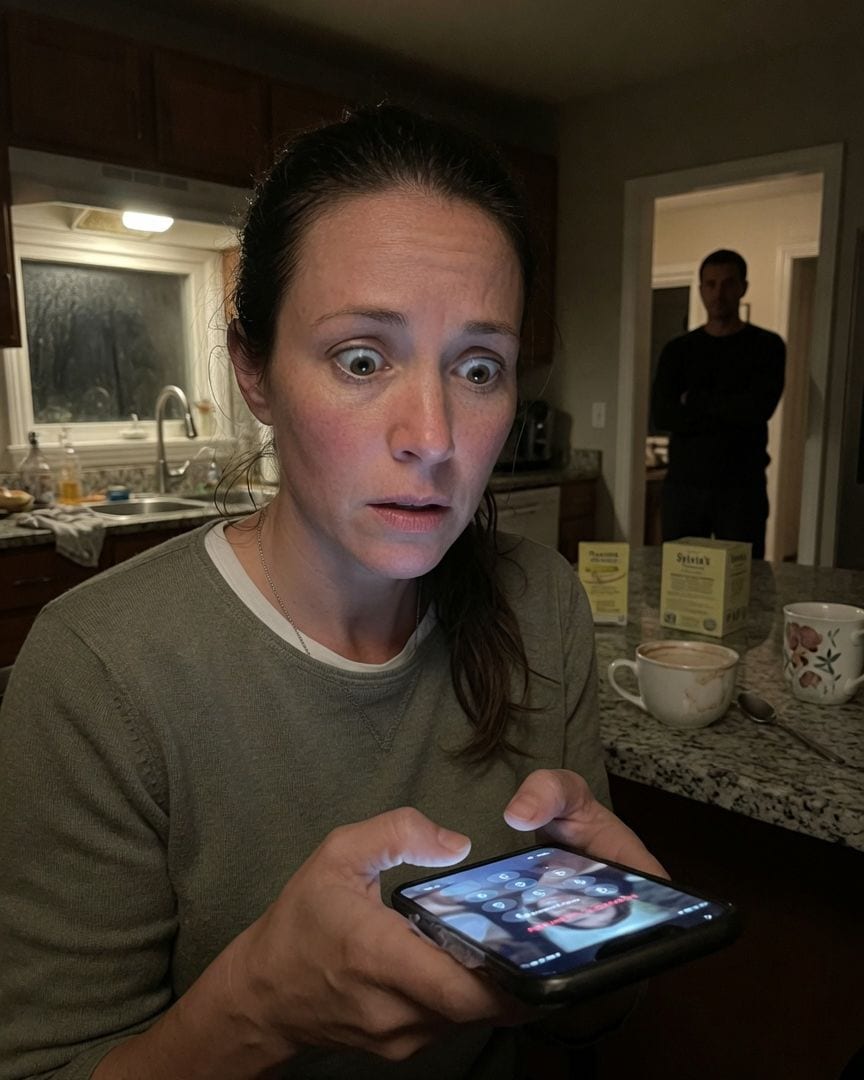
My twin's passcode was our birthday reversed since we were kids. His phone was dead and missing for three weeks — now it opens to our birthday forward, and he says I'm the one who always got us backward.
My twin brother, Kenneth, returned after three weeks, bringing a quiet relief to the house. But when he vividly recounted a private childhood memory, describing every detail, a cold knot formed in my stomach. I knew he couldn't have been there; he was in the hospital, a fact later confirmed by an old photo showing his empty place.
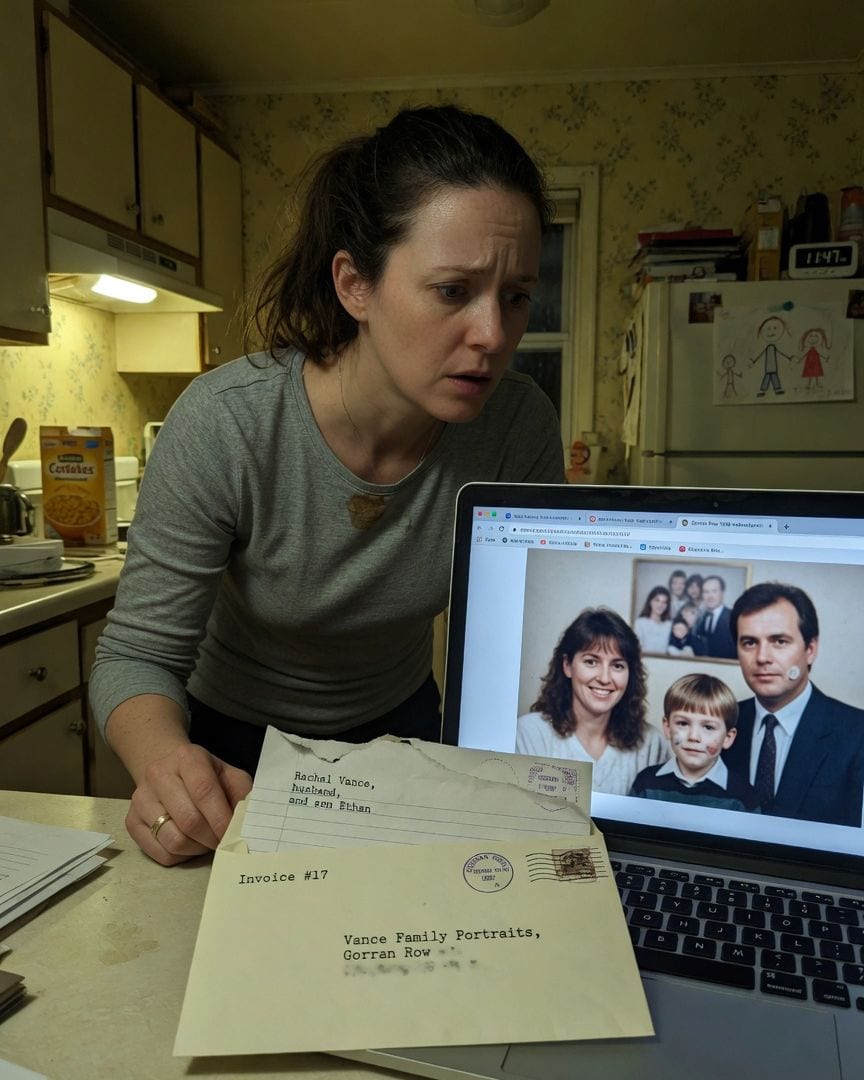
A 1987 portrait shows my younger face and my son's birthmark. I was born in 1988.
I've been receiving baffling invoices for a family portrait from a studio that closed in 1987, each one listing my son Ethan. My son was born decades after that studio shut its doors. Now, I've found an archived studio photo from 1987: my younger face, a stranger, and my son Ethan, his unique birthmark clear.