My robot vacuum spent forty minutes cleaning a room off the landing last night. Our house doesn't have that room; it was squared off, with a door.
The Whirly hummed its satisfied tune on its charging dock. I tapped the tablet, bringing up last night’s cleaning log. Every night, the little disk-shaped vacuum diligently mapped our three-bedroom house, learning the contours of our living space.
I, Penelope Sinclair, an engineer by trade, appreciated its methodical precision. It was predictable, efficient.
Except for last night.
The app displayed the familiar layout of our ground floor, the kitchen, living room, and our study. But then, on the main landing of the second floor, a new addition blossomed.
A perfectly squared-off room, complete with a clear doorway leading into it, where only a solid wall had ever stood. It wasn't a smudge or a glitch in the mapping software.
The app showed virtual furniture layouts, a small table, a chair. And the log was concrete: 'Cleaning cycle: Landing_Room_West. Duration: 40 minutes.'
Forty minutes. My heart gave a strange little lurch. Michael and I lived alone. Our house didn't have that room. It never had.
I zoomed in on the tablet, my finger tracing the phantom room’s outline. The detail was unnerving. I walked to the landing, my steps echoing a little too loudly. The wall was smooth, painted a soft cream, undisturbed.
My hand met only plaster, cool and unyielding. On the screen, the door was open, a welcoming dark rectangle. In reality, there was nothing. Just solid wall.
It had to be a glitch. It was the only rational explanation. I tried the obvious first. I opened the Whirly app, navigated to settings, and initiated a full reset. No change.
The map remained, dated to 3:00 AM last night’s cleaning cycle. I uninstalled the app, then reinstalled it, hoping for a clean slate. Still there. Even rebooting the router, a desperate last resort, made no difference.
The phantom room persisted, an undeniable digital scar on our home’s blueprint.
I pulled the Whirly into the bright light of the kitchen, turning it over, examining its array of sensors. There was no visible damage, no stray hairball or piece of lint obstructing its pathfinding lasers. It looked perfectly fine.
Michael walked in, rubbing sleep from his eyes. He poured coffee, eyeing my intense focus on the little robot.
“Everything alright, love?” he mumbled, taking a sip.
“The vacuum,” I said, pointing to the tablet. “It mapped a room that doesn’t exist.”
He peered at the screen, then at the Whirly. “Huh. Software bug, probably. These smart devices, they’re always doing something odd. Remember when the fridge started ordering six gallons of milk a week?” He chuckled, but I didn’t.
I couldn't shake the image of that perfectly detailed, impossible room. The forty minutes it spent cleaning it. The precision of the map. It felt too real for a mere glitch. Then I remembered.
The Whirly had an internal memory card. It was mostly for firmware updates and diagnostics, a hidden compartment beneath a small rubber flap.
I found a tiny screwdriver, carefully removed the flap, and ejected the micro-SD card. My hands felt clumsy. I connected it to my laptop. The card held more than just system files.
There were dozens of small, timestamped audio snippets, labeled with coordinates. The vacuum's microphone, I realized, used them for obstacle detection and spatial awareness. Every bump, every pivot, every swish of its brushes – recorded.
My breath hitched. I scrolled through the files, filtering by location, focusing on the coordinates of that impossible room. There were several files, all marked 'Landing_Room_West,' timestamped between 3:00 AM and 3:40 AM.
Most were just the drone of the motor, the soft whir of the brushes against the floor. I clicked on one, 'Landing_Room_03:47AM,' a slightly longer clip. I pulled on my headphones, pushed the volume up high.
The audio file began, the familiar mechanical hum filling my ears, amplified, intimate. I heard the soft thud of the vacuum bumping against a phantom wall, the whir of its brushes against a non-existent floor.
Forty seconds in, the hum dipped slightly, as if the vacuum paused, or perhaps moved over a different surface. A different sound emerged, almost imperceptible beneath the motor's drone.
I leaned closer, adjusting the equalizer on my laptop, trying to isolate it.
It was a breath. A faint intake of air, followed by something else. Thin, reedy, almost a sigh, but undeniably a whisper. It repeated a single, unfamiliar name, drawn out, like a forgotten lullaby. My blood ran cold.
I ripped the headphones away, my hand trembling, heart pounding. The whisper echoed in my mind, a ghost in the machine.
The name, 'Isabella,' became a splinter in my mind. It haunted me, a quiet hum beneath every thought. For days, I scrubbed the internet, a frantic archaeologist digging through digital dust. Local obituaries, missing persons archives, property records.
I cross-referenced everything I could find for anyone named Isabella connected to our address, to Ashwood Lane.
Michael grew concerned. He'd find me at the laptop at 3 AM, a coffee growing cold beside me. "Penelope, you need to sleep. It was probably just static, or... a neighbor's radio bleeding through." But I knew it wasn't.
The whisper had been too clear, too specific.
I found nothing recent. No Isabella within the last fifty years connected to our house. Then, a faded newspaper clipping from 1968 surfaced. 'Prescott Girl Vanishes Near Ashwood Lane.' My stomach dropped. Ashwood Lane was our street.
The article mentioned Isabella Prescott, seven years old, last seen playing in her yard. Just a few houses down from where our property now stood.
The house numbers had been reconfigured over the decades, I knew that, but the location was unsettlingly close. No trace, only a frantic search. The details were sparse, the outcome grim: presumed fatality, no body ever found.
I dug deeper, requesting old property deeds and blueprints from the City Planning Office. The official documents for our lot, dated to the early 1970s, showed a clear, empty space where a previous structure had been demolished.
But one page, a faded, almost illegible attachment, seemed to indicate an 'unregistered foundation' beneath the intended build site, hastily crossed out. The official stamp was smudged, the signature illegible. For anyone else, it would be a dead end.
For me, it was a trail. A faint, almost invisible trail, but a trail nonetheless.
My persistent inquiries at the City Planning Office began to draw attention. I'd made multiple calls, each time asking for increasingly specific, obscure documents related to the 'unregistered foundation' and the Prescott case.
I must have sounded like a broken record, or a conspiracy theorist.
One afternoon, my phone rang from an unknown number. I answered cautiously, my pulse quickening. A calm, measured voice, male and elderly, spoke. "Ms. Sinclair, your interest in the Ashwood Lane properties is... thorough."
My blood ran cold. "Who is this?" I demanded, my voice tighter than I wanted.
"Let's just say I'm an admirer of diligence," the voice replied, a dry chuckle rattling in the receiver. "Some things are better left undisturbed. The past has a way of staying buried for a reason." He paused.
"Especially on Ashwood Lane."
The line went dead. I felt a tremor of fear, a primal unease that someone knew exactly what I was looking for, and was watching me. I tried calling back, but the number was disconnected, dead air.
The room suddenly felt colder, the silence heavier. Michael, returning home an hour later, found me pale and shaken, clutching the phone like a lifeline.
"Someone knows, Michael," I whispered, my voice raw. "Someone knows about Isabella, and they don't want me to find out why." The phone felt like a hot coal in my hand, its presence a physical confirmation of the threat.
Driven by the chilling call, I knew I needed undeniable proof. The robot vacuum's map was digital, a phantom. The whisper was audio, easily dismissed as a trick of sound. But what about the physical space itself?
I remembered the 'Footage of Nowhere' description I'd read about – the unsettling idea of a device capturing a place that shouldn't exist.
I ordered a high-resolution thermal imaging camera, the kind used for home inspections, for finding drafts or hidden moisture.
Michael, though still skeptical, helped me set it up. He saw the fire in my eyes, the stubborn set of my jaw. He knew by now that I wouldn't stop.
We aimed it at the wall on the landing, the exact spot where the phantom room appeared on the vacuum's map. The screen glowed, showing the internal studs, the faint outlines of wiring, the insulation behind the plaster. Nothing unusual.
It was just a wall.
I was about to give up, my hope faltering, the dread of being wrong settling in, when Michael pointed. "Wait, look there."
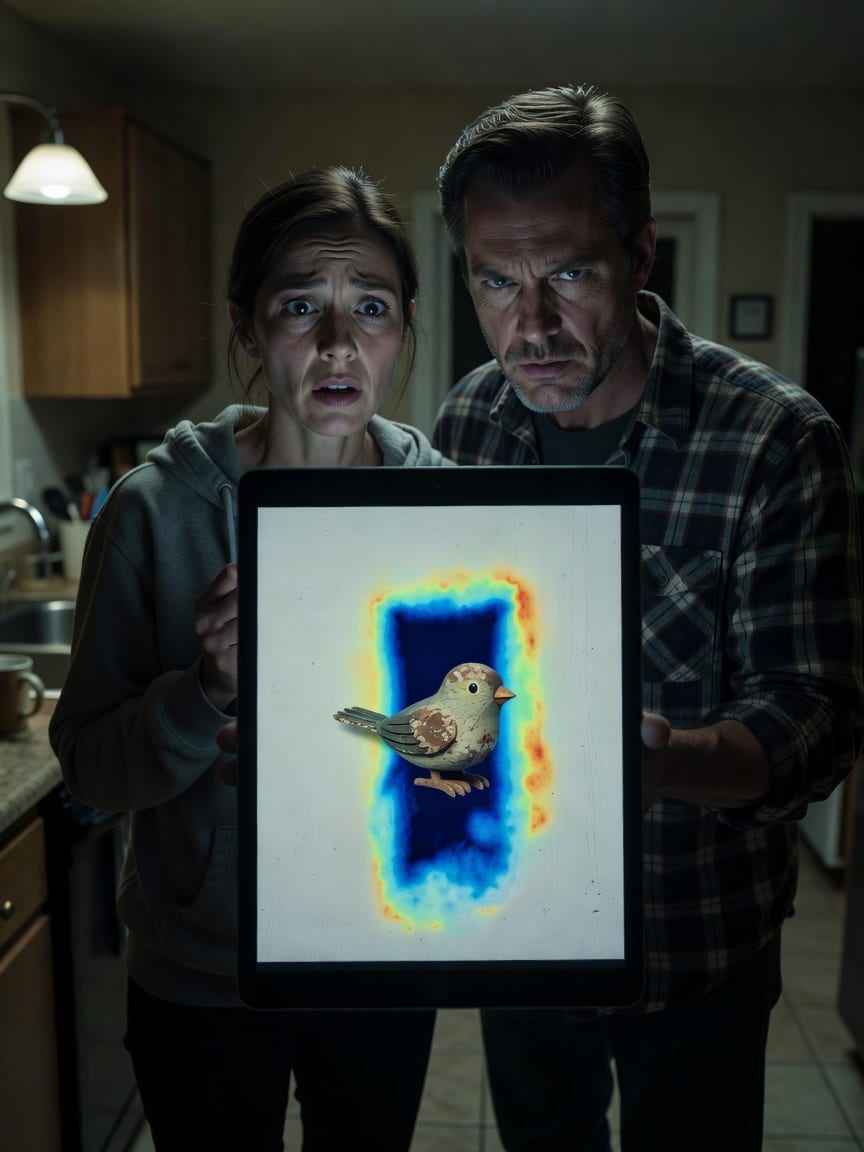
On the thermal display, a distinct, rectangular patch of cold bloomed in the center of the wall, exactly where the 'doorway' on the vacuum's map was marked. It wasn't a draft, not a ventilation issue.
It was a solid, consistent pocket of lower temperature, too perfect to be random. It was the exact shape of a door frame, extending inward. Penelope felt a surge of cold dread, confirming the physical anomaly.
The air around the camera’s lens seemed to shimmer with the invisible cold.
"It's there," I breathed, my voice barely a whisper. "The room... it's really there." I pressed my palm against the plaster; it felt no different, but my mind now saw the cold outline.
The thermal camera had captured the impossible, a glimpse of a physical space that defied explanation. The cold spot pulsed on the screen, a silent, chilling confirmation that the impossible was real.
I was still staring at the thermal camera’s display, a new, deeper chill blooming inside me, one that had nothing to do with the cold spot on the wall. The impossible doorway was clear, undeniable.
But as I adjusted the camera’s focus, pushing its limits, I noticed something else within the thermal signature of the ‘doorway.’
A faint, almost imperceptible indentation, perfectly outlined within the plaster and wood. It was small, no bigger than my thumb. I zoomed in further, enhancing the resolution, bringing the impossible object into sharper relief.
It wasn't a structural anomaly; it was a distinct, three-dimensional shape. The image sharpened, resolving into fine details.
A small, worn wooden bird, its painted eye staring out from a room that shouldn't exist, embedded deep within the wall.
It was identical to the description of Isabella Prescott's favorite toy, mentioned in that old newspaper article, the one she was clutching when she was last seen.
The impossible object was real, and it was tied directly to the missing girl.
Armed with the thermal image and the impossible object – a printed photograph of the wooden bird, an undeniable, chilling link – I returned to the City Planning Office.
This time, I demanded to speak to someone in authority, mentioning the name 'Howard Stratton' from the mysterious phone call. To my surprise, a quiet, elderly man with sharp eyes, Mr. Howard Stratton himself, met me.
He didn't seem surprised to see me, only resigned.
He led me through a maze of dimly lit corridors to a dusty, forgotten annex filled with old ledgers. The air was thick with the smell of paper and time.
"I suppose you’ve found enough to necessitate a full explanation, Ms. Sinclair," he said, his voice as calm and unbothered as it had been on the phone. His composure was unsettling.
He pulled a heavy, leather-bound book from a locked, metal cabinet, its spine labeled 'Properties: Anomalous Overlays.' My heart hammered against my ribs. He opened it to a section marked 'Ashwood Lane,' his finger tracing a line.
"This property, your property, was built over an ancient, undocumented root cellar, part of a much older homestead. It was supposed to be fully demolished, but... complications arose." He looked up at me, his gaze unblinking. "Instead, it was sealed.
Buried. But these 'bleed-throughs,' as we call them, occasionally occur. The structure isn't entirely gone; it just… shifts. It exists in a kind of superposition. Sometimes it manifests on technological sensors, like your little robot. Sometimes, it takes things."
He turned a page, the paper rustling softly. "Isabella Prescott. 1968." He pointed to an entry. "She was playing near the original cellar entrance. Her wooden bird was found days later, inexplicably embedded in the newly poured foundation wall.
Her body was never recovered. We've had a few others over the decades. People, objects… parts of memories. The 'room' isn't just a phantom; it's a gateway."
He closed the ledger with a soft thud, the sound echoing in the silent annex. He looked at me, his gaze unsettlingly knowing, like a doctor delivering a grim diagnosis. "And you've been looking very intently into that gateway."
I stared at the ledger, the cold facts in black and white confirming my deepest dread. The institution had known for decades, calmly documenting the disappearances, the anomalies, and the cover-ups. My throat was dry. "What happens to them?"
I whispered, my voice barely audible. "The people? Isabella?"
Stratton sighed, a sound of ancient weariness. "They become... part of the overlay. Sometimes they return, or a trace of them does, but they are never quite whole. The space takes a piece, or replaces it with something else.
It absorbs them, you see. Blurs the lines between what is and what isn't." He gestured vaguely toward the wall, as if it were a window to another reality. "It's a subtle process. A presence, a memory, a feeling.
It draws you in. It feels like home, in a strange way."
I felt a prickle of unease, a cold sensation spreading from my scalp down my spine. I remembered the nights I’d spent by that wall, trying to feel for the room, trying to understand.
The way I’d started to linger there, almost drawn to it, the strange sense of comfort I sometimes felt, a quiet invitation. My hand went to my head, a sudden, sharp ache behind my eyes, a fleeting sense of disorientation.
"You've been exposing yourself to it, Ms. Sinclair. Probing it. Standing there night after night, listening. It's only natural it would… respond." His voice was flat, devoid of judgment or emotion.
He was simply stating facts, observations of a natural phenomenon.
I stood abruptly, the room suddenly too small, too oppressive, the scent of old paper and something else, something earthy and damp, pressing in on me. The facts were clear, the pattern horrifyingly coherent.
I had my answer, but it came with a chilling new understanding of my own position. I was no longer just an observer. I had opened the door, and something was looking back.
I left Howard Stratton and the City Planning Office in a daze. The ledger, dated decades back, was a chilling testament to institutional knowledge and deliberate silence. The afternoon sun, usually a comfort, felt too bright, too harsh.
I returned home, the house now feeling alien, every shadow a potential 'bleed-through.' The air inside felt heavy, thick with unseen presences.
Michael met me at the door, concern etched on his face. I tried to explain, to articulate the impossible truth, but the words felt hollow, inadequate, like trying to describe a dream.
The robot vacuum's map still showed the room, a constant digital scar on our tablet. I found myself standing by the wall, not trying to find it anymore, but just… listening.
For the hum, for the whisper, for the presence I now knew was there, waiting. It was always waiting.
Days turned into weeks. I stopped talking about the room, the vacuum, Isabella. Michael noticed the change first. I was quieter, often lost in thought, my gaze frequently drifting towards the landing wall.
I'd spend hours there, sometimes just standing, sometimes running my hand over the smooth plaster, a faint, almost imperceptible smile playing on my lips. It was a private smile, one that didn't quite reach my eyes.
Michael would try to engage me, to pull me back. But my answers became shorter, my eyes a little too distant, too soft.
One evening, Michael found me by the landing, humming a tune he didn't recognize, a child's lullaby, low and sweet. He asked me about my day, about work.
I turned, my smile widening just a fraction, and the light in my eyes seemed to shift, becoming deeper, older, and strangely content. She knew something he didn't, and it had changed her. She was no longer entirely Penelope.
Her voice, when she spoke, was soft, almost a whisper, and utterly calm. I smelled faintly of damp earth, a scent that now seemed to cling to me. I was home.
Michael watched her, a knot of dread tightening in his stomach, as she began to slowly hum the lullaby again. He recognized the tune now.
It was the same one he’d sometimes heard faintly through the walls, late at night, since she’d started looking into that old story. He didn't know where it came from. He didn't know where she came from.
He just knew she wasn't entirely his Penelope anymore. He asked her, 'Is that so?' and her faint, wrong little smile was the only answer he needed.
If this one got to you
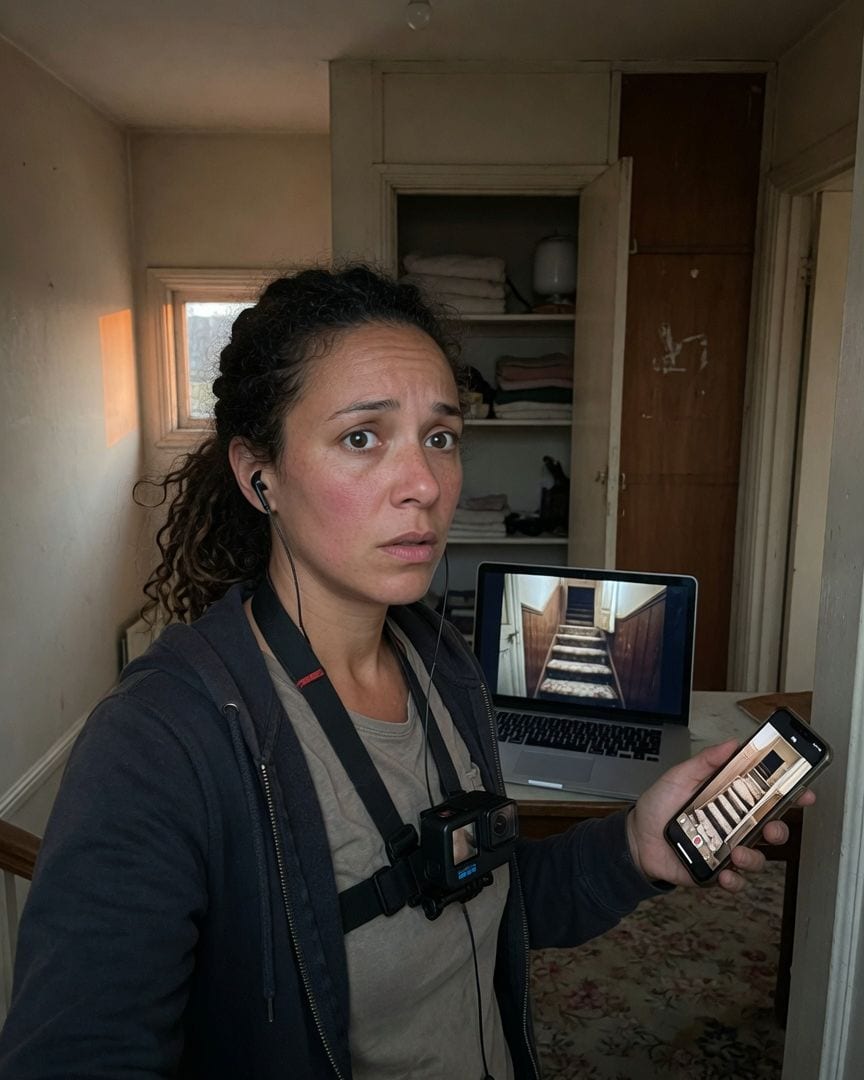
My GoPro footage shows a panelled staircase climbing into the dark where our airing cupboard actually is. It lingers there for a full minute, but there's no such staircase.
I was just recording routine storm damage, walking through my house with a GoPro. Everything seemed normal until I reviewed the footage from upstairs. Where my familiar airing cupboard had always been, the camera showed an impossible, panelled staircase climbing into absolute dark.
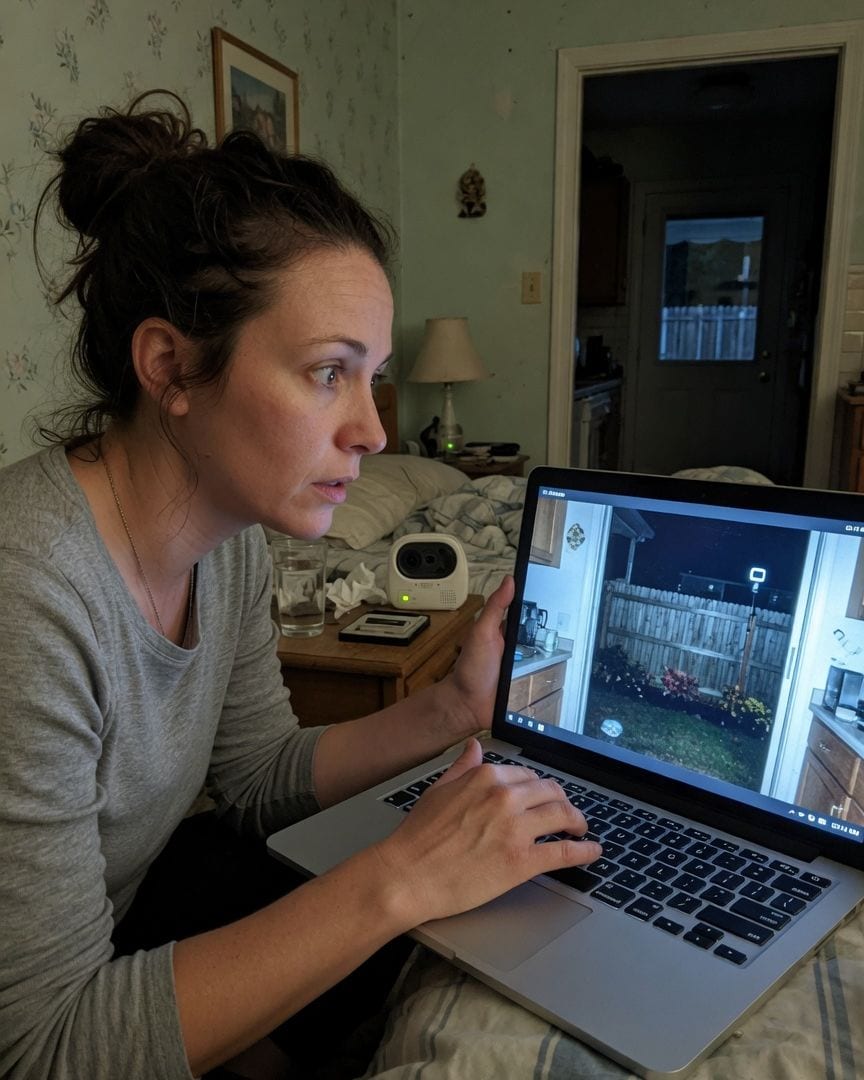
My game camera caught my back door from the inside. For three nights, it showed my door from the yard, getting closer. The last picture is from inside the glass, looking out at the fence.
I had set my game camera on the back fence, aimed at my house, to catch whatever I'd seen moving outside my kitchen window. But the last photo, taken after midnight, showed my kitchen from *inside* the locked back door, looking out.
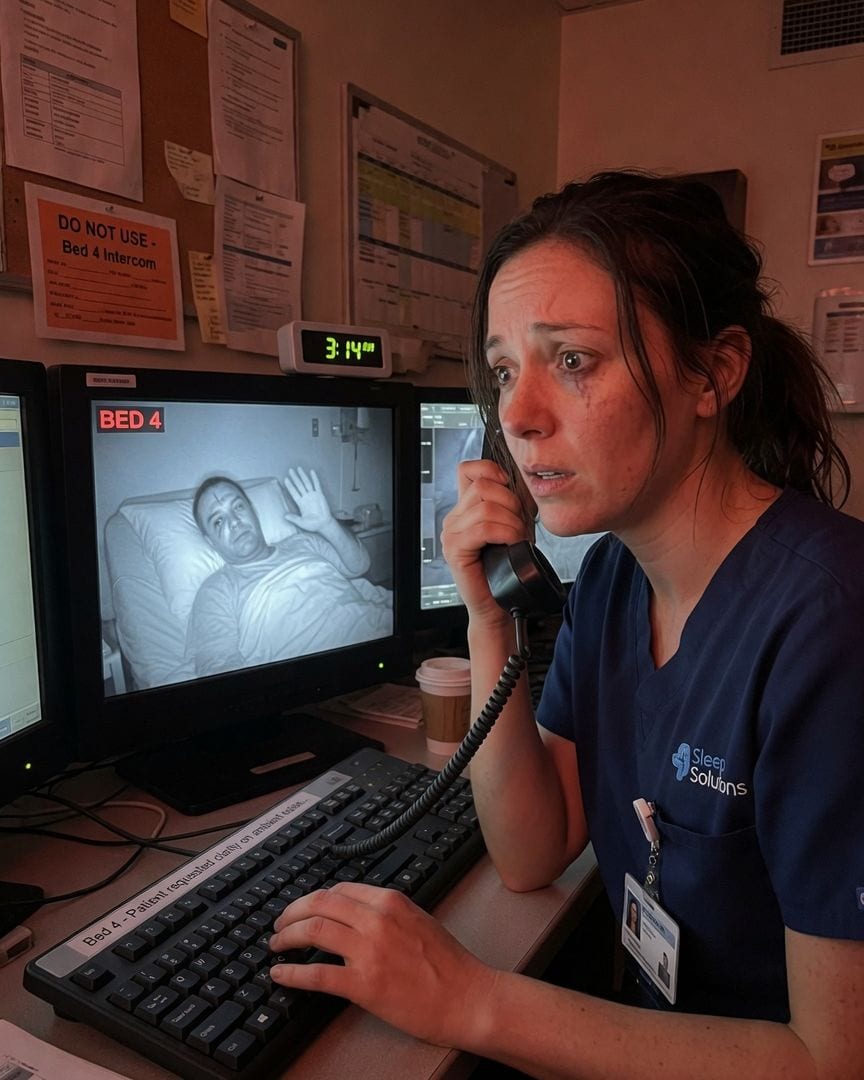
Bed 4's patient always waves at my camera, asking if I hear the humming. Bed 4 was never booked.
As an overnight nurse, my shift at Sleep Solutions is usually routine. But after interacting with a patient in Bed 4, my manager insists the room has been off-limits for deep cleaning all week with its intercom disconnected for months. Yet, I found a faint, warm indentation on the new mattress where the patient had been.
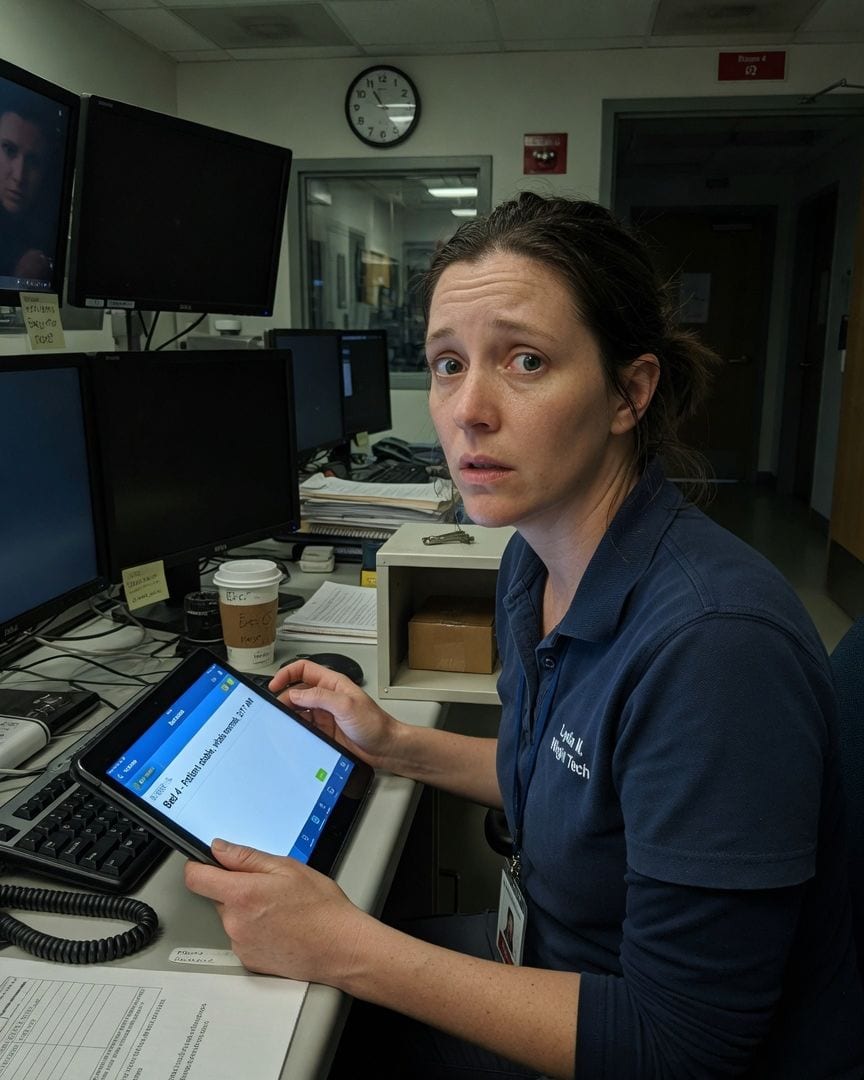
My sleep clinic's Bed 4 patient waves and asks about the humming — but the bed's empty, and its intercom was disconnected.
It was 3 AM, and the sleep clinic should have been empty, especially Bed 4, which was officially offline for repair. But for the third night in a row, a patient in Bed 4 was waving at me, their voice asking about a humming sound through a disconnected intercom.
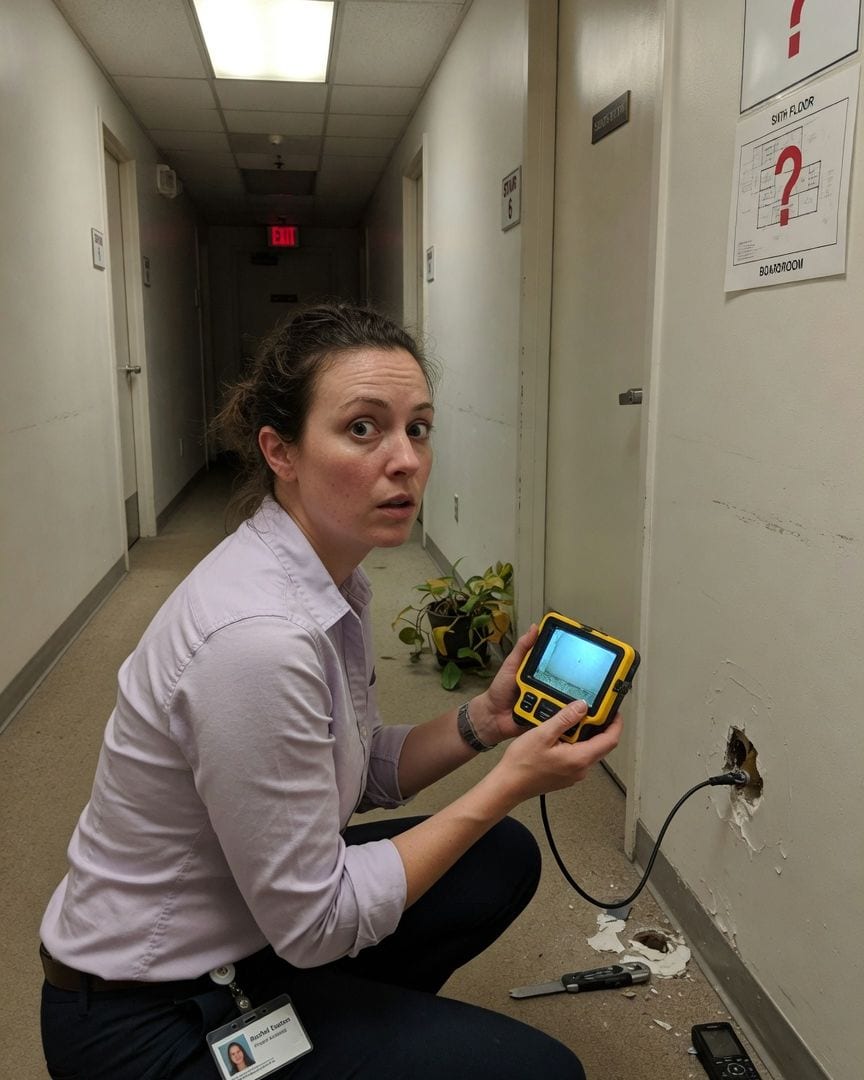
Footsteps cross our boardroom ceiling every evening at six – directly over the empty space where the office plans show a room that doesn't exist.
I'm a project architect who discovered an unlabeled room on our new office plans, a space on my floor that simply wasn't on any old blueprints. Now, every night at 6 PM, faint, rhythmic footsteps cross the boardroom ceiling, exactly where that phantom room should be. Security logs confirm no one is ever there.
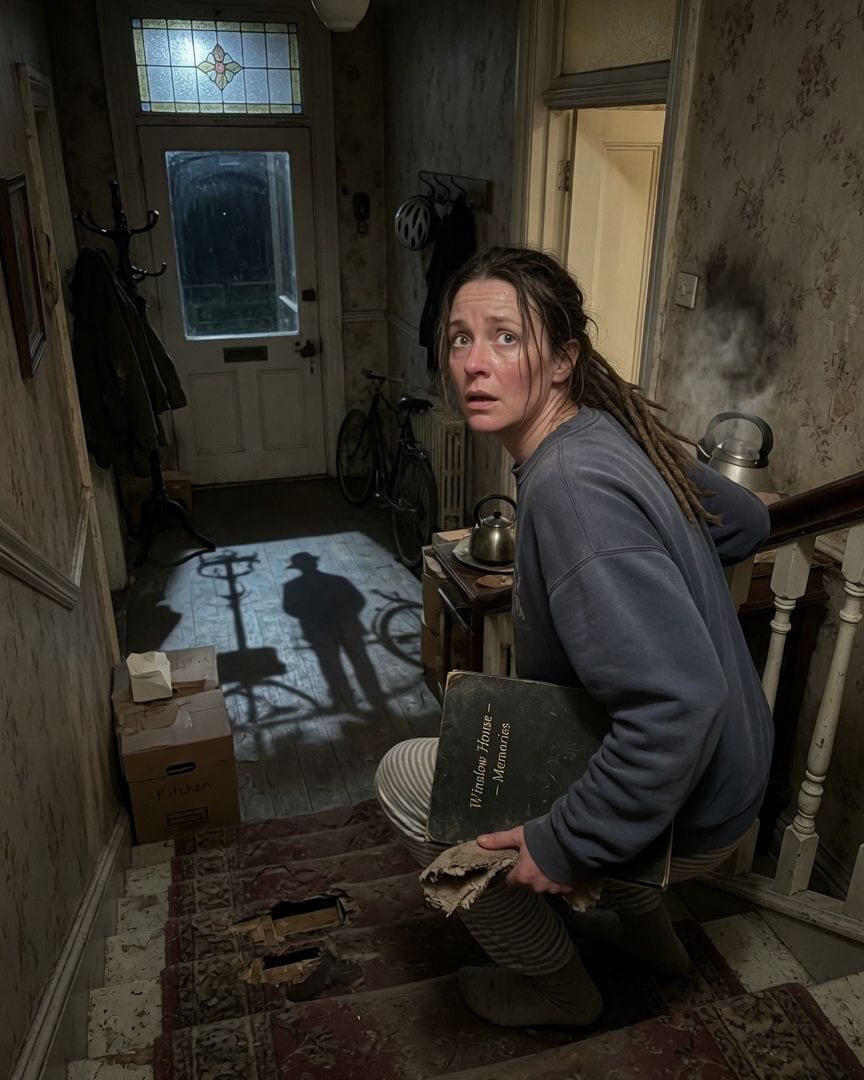
At 3am my dark porch throws grey shadows onto my hall floor — a coat-stand, a bicycle, and the outline of a man standing outside. I open the door and no one's there.
I'd just moved into Winslow House, struggling with new-house jitters and sleep. Then, at 3 AM for the second time, a stark grey light woke me, casting distorted shapes onto my hall floor. The undeniable shadow of a man stood beyond the threshold, impossibly still, even though I lived alone and the porch light was off.