My security photo shows me signing for tools, smiling a smile I never made. I was miles away.
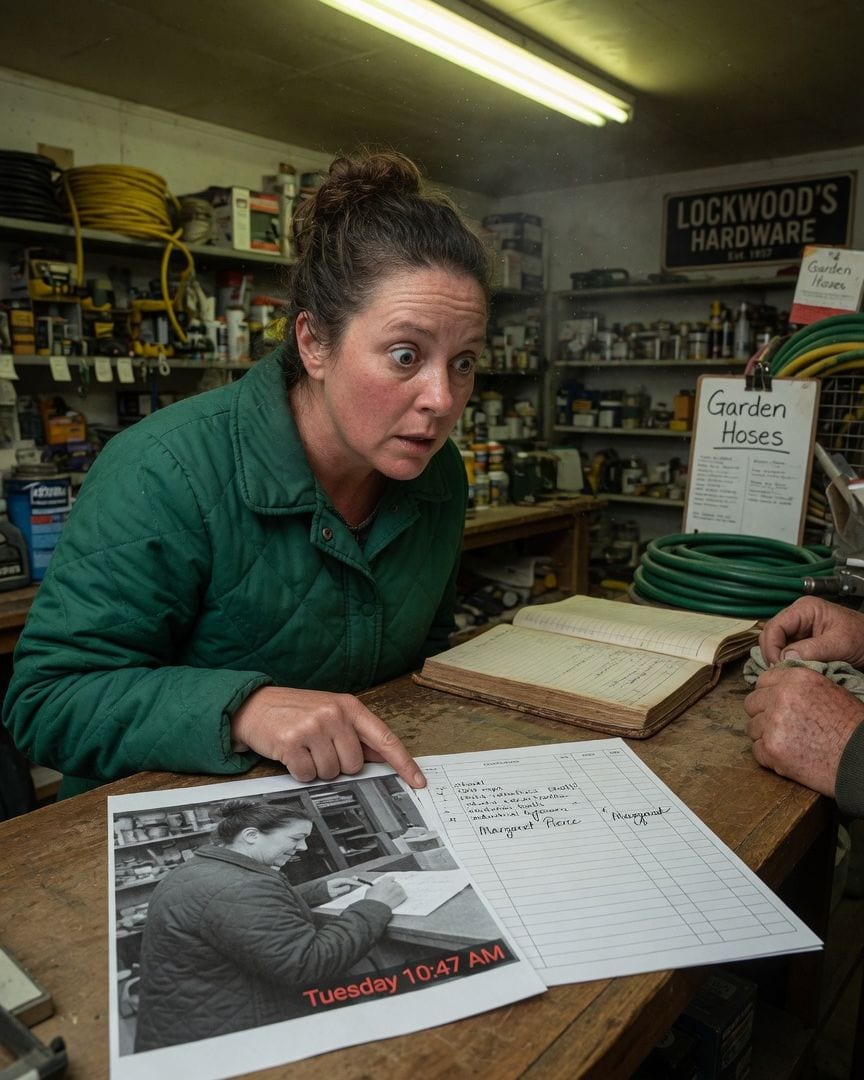
The smell of sawdust and cut lumber usually soothed me, an architect, a woman who built things. But that Tuesday, standing in Lockwood’s Hardware, it felt acrid, like something burning.
Conrad Lockwood, a man in his early sixties with eyes that had seen too many oddities, tapped a thick finger on a page in a worn, dusty ledger.
“Margaret Pierce,” he read aloud, his voice flat, not quite questioning. “Your home address, too. Account opened back in early spring.”
My heart gave a stupid little flutter. I hadn’t opened an account at Lockwood’s. I rarely even bought so much as a hammer here. “That’s not right, Conrad,” I said, trying to keep my voice steady.
“There must be a mistake.”
He slid the ledger closer. The page was filled with entries, neat and precise in black ink. Twelve of them, stretching back three months. Shovels, thick rope, rolls of heavy plastic sheeting, insulation.
Even industrial-grade fasteners, the kind used for heavy construction. Totaling over four hundred dollars. Each entry had a date, an itemized list, and a signature.
The signature.
My breath hitched. It was mine. Every loop of the ‘M,’ the sharp flick of the ‘P,’ the exact way the ‘g’ tailed off. Unmistakable.
“See?” Conrad said, as if I hadn’t just had the air punched from my lungs. “That’s your handwriting, Margaret. And that’s your account.” He looked at me, his gaze unwavering, betraying no surprise, no accusation, just a weary patience.
The fluorescent lights of the hardware store hummed, the sound suddenly too loud, like something trapped behind the ceiling tiles. I knew my own signature better than I knew my own face. But I had never bought these things.
Never signed for them. This was more than a mistake. This was a theft of something fundamental.
I spent the next hour calling my bank, my credit card companies. Nothing. No record of an account, no suspicious charges. The bank representative patiently assured me my identity was secure.
It was just a weird glitch, I told myself, a misunderstanding. But the image of that ledger page, that perfect, impossible signature, burrowed into my mind.
I returned to Lockwood’s the next day, a cold knot tightening in my stomach. Conrad was behind the counter, arranging a display of garden hoses.
He sighed when he saw me, a deep, weary sound that made the old wooden floorboards seem to sag.
“Look, Conrad, I know what I know,” I began, my voice tighter than I wanted it to be. “That signature… it’s mine. But I wasn’t here. I didn’t buy any of that.”
He wiped his hands on a rag, then moved to a small, dusty filing cabinet behind the counter. He pulled out a yellowed folder. “People try it, you know,” he mumbled, his back to me. “Sign someone else’s name. Happens.”
He turned back, holding a single sheet of paper. “But this isn’t that.”
He slid over a high-resolution scan of the most recent signature from the ledger. It gleamed under the harsh store light, every detail magnified, every line perfect. My signature. There was no denying it, no claiming forgery.
It was mine, pulled right from my hand, somehow.
Then, he pushed a second sheet across the counter. A grainy, timestamped security camera still. It showed a woman at the counter, her back mostly to the camera, signing a form.
She was wearing my distinctive emerald green jacket, the one I’d bought last fall. Her hair was tied back in the messy bun I always wore. The profile, the posture—it was me.
Down to the slight hunch of my shoulders when I wrote. The date on the timestamp was from just last Tuesday. The very day I’d first seen the ledger.
My alibi hit me with the force of a physical blow. Last Tuesday. All day, from nine in the morning until five in the afternoon, I had been in a client presentation across town, miles away.
A crucial meeting for the Sterling Tower project. I had a dozen witnesses: my project manager, two junior architects, the Sterling board members. There was a signed attendance sheet.
It was a day I could account for, hour by hour, minute by minute. The ordinary explanation of simple fraud, of someone just taking my name, faltered and collapsed, replaced by something far more unsettling.
The air around me felt suddenly thin.
I stared at the grainy image of myself. The woman in the photo turned her head slightly, just enough for a partial profile, and a faint smile touched her lips, directed subtly at the camera.
It wasn’t a smile I remembered making. It was too soft, too knowing, and felt subtly, chillingly wrong. My heart pounded, a cold dread seizing me, not for what I was seeing, but for what it implied.
I pointed at the date and time on the timestamp, my finger shaking. "I was in a client presentation, all day, miles away. I have a dozen witnesses. I have the signed minutes."
Conrad just nodded slowly, his gaze distant, fixed somewhere beyond me, past the shelves of paint and power tools.
"Happens," he said, his eyes holding something unreadable, as if this impossible discrepancy was merely a routine occurrence he'd long since ceased to question.
The smile from the photo, cold and knowing, burned itself into my memory. It wasn't just a photograph of me.
It was a photograph of me where I shouldn't be, doing something I didn’t do, with a look I didn't recognize. The impossibility of it consumed me.
I went home, pulling every personal record I could access. Credit reports, utility bills, online purchase histories. Nothing. My life, on paper, was perfectly normal. No strange accounts, no unusual activity, no other phantom signatures. It was just Lockwood's.
Just those tools.
I called Zoe Granger, my best friend since college. She’s a sharp-witted lawyer, and my first thought was that she’d have an answer, a legal loophole, a rational explanation. I described the ledger, the signature, the photo.
"Sophisticated identity theft," she said immediately, her voice brisk, practical. "Maybe they're using deepfake technology for the image, and some kind of automated signature generator for the forms."
"But Conrad said she was there," I argued, the words catching in my throat. "Physical presence. And that jacket... it's mine. The way my hair was pulled back. It was me."
The physical presence, confirmed by a real person, made Zoe’s explanation feel suddenly inadequate, too flimsy to cover the weight of the wrongness. The office chair in my apartment creaked, echoing the strain in my own mind.
I knew I had to go back to Conrad. He was the only one who seemed to accept the impossible with such casual ease. I caught him stacking sacks of topsoil.
"Conrad," I said, my voice low. "Tell me everything. What else do you know about this?"
He straightened slowly, rubbing a hand across his forehead. His eyes, usually placid, held a flicker of something close to resignation. “Look, Margaret,” he said, his voice hushed, as if afraid of being overheard even in the empty aisle.
“This isn’t the first time I’ve seen a familiar face sign for odd things, then seem to vanish.” He paused, his gaze drifting over the rows of garden tools.
“It’s not the faces that stick out,” he continued, almost to himself. “It’s the pattern of the items. Always the same kind of stuff. Digging tools. Fasteners. Soundproofing. Never anything normal, like lumber or paint. Always for… modifications.
And never for a usual address.”
My blood ran cold. "Address?" I prompted, barely breathing.
He looked at me, a flash of regret in his eyes. "Yeah. There was one recurring delivery address noted on several of those invoices for ‘Margaret Pierce.’ A remote, old property outside of town.
The dilapidated farmhouse on the county line. Folks around here call it the Ashford place.”
Armed with the address, a precise set of coordinates scribbled on a crumpled receipt, I drove. The drive was long, the paved roads giving way to gravel, then just two tire tracks winding through dense woods.
The world grew quiet out here, the sounds of traffic fading until only the rustle of leaves and the hum of my engine remained.
Then, through a break in the trees, I saw it. The Ashford place. It was exactly as Conrad had described: an overgrown, dilapidated farmhouse. Windows were boarded, some precariously, others completely missing, leaving dark, empty eyes staring out.
The paint was peeling in long, ugly strips, exposing raw, weather-beaten wood beneath. The yard was a tangle of weeds, chest-high in places, reclaiming the land. It looked like it had been abandoned for decades.
I pulled my car to the side of the narrow dirt track, my engine cutting off, leaving an oppressive silence. Broken only by the frantic chirping of unseen insects. The air was heavy, still, like a breath held too long.
As I approached the house, the shiver that had started in my spine tightened its grip. In the soft, damp earth leading up to the side of the house, I saw it: a fresh tire track.
Too recent for a place that was supposedly deserted for decades.
I pulled out my phone, my hands shaking slightly, and took photos. The address, barely visible on the rusted mailbox. The neglected grounds. The gaping maw of the front door. Every click of the camera felt like a violation.
As I turned to leave, a movement caught my eye. Down the road, partially obscured by a thick stand of pine trees, a dark sedan was parked.
I couldn’t make out the driver, couldn’t see the license plate, but the car was positioned perfectly to observe the farmhouse. A prickle of unease turned into a cold certainty: I felt watched.
The hairs on my arms stood on end.
I quickly got back in my car, fumbling with the keys, and started the engine. My heart hammered against my ribs. As I pulled away, glancing repeatedly in my rearview mirror, the sedan pulled out slowly behind me.
It maintained a deliberate distance, a silent, ominous tail against the fading afternoon light.
Unnerved by the sedan, I didn’t dare go home.
I drove straight to the coffee shop where Zoe and I sometimes met, pulling into the far corner of the parking lot, watching the rearview mirror until the dark sedan was definitely gone.
I called her from the car, my voice tight, and told her to meet me.
When she arrived, her face was still flushed from rushing, but she quickly went pale as I recounted the unsettling visit to the Ashford place and the car that had followed me.
The coffee shop, usually a comforting backdrop of clatter and hushed conversations, now felt too bright, too open, too exposed. The clinking of cups seemed to mock my rising panic.
"Okay, Margaret, this is beyond identity theft," Zoe said, her voice low, her professional calm cracking around the edges. "We need to check public records. Right now." She pulled out her laptop, her fingers flying across the keyboard.
As a lawyer, she had access to databases I didn't.
She typed the address, hit enter, and the screen glowed with information. Property history. Old ownership records. I leaned over her shoulder, my breath catching in my throat as she scrolled down. Then she stopped.
Her finger hovered over a recent entry.
"Oh my god," she whispered.
New owner listed: Margaret Pierce.
My current home address. My exact date of birth. My breath hitched. The screen seemed to swim. And the deed, scanned and filed, bore a copy of my signature. The date of transfer? Exactly three months ago.
Right when the hardware store purchases had begun.
The tools. The rope. The plastic sheeting. The soundproofing. It all snapped into a horrifying new context, like a puzzle piece clicking into place that revealed not a pretty picture, but a monstrous one.
It wasn't just 'identity theft' for a few hundred dollars of hardware. It was a systematic acquisition. Making me, Margaret Pierce, the legal owner of an abandoned property I’d never seen.
And by extension, the responsible party for whatever was happening there. The wrongness wasn't just a signature on a ledger.
It was my entire legal existence being co-opted for something I couldn't fathom, a project I was now legally tied to. The cold dread from the hardware store returned, now a full, icy grip around my chest.
The truth hit me like a physical blow. I owned the property. I had signed the deed. Every fiber of my being screamed that it was impossible, a lie, a nightmare, yet the legal record on Zoe’s screen was irrefutable.
I felt a sudden, dizzying sense of freefall, as if the ground had dropped out from under me.
Zoe, her face pale, continued to scroll through the digital property records, her fingers trembling slightly. The coffee shop’s low murmur seemed to drain away, leaving only the frantic thumping of my own heart in my ears.
"Margaret," she whispered, her voice barely audible, her finger hovering over another entry on the screen. "There's also a demolition permit here. For a structure on the Ashford property. Specifically, an old root cellar."
My mind reeled. A root cellar? On that dilapidated property? "But... why?"
Zoe's eyes met mine, wide with a dawning horror that mirrored my own. "It's not a demolition, Margaret. The permit details are for 'structural modifications' and 'reinforcement.' And it's signed... by you. Issued just last week."
I stared at the screen, at the official-looking document with my name, my signature, approving work on a structure I didn't know existed, on a property I never acquired.
The demolition permit, signed by me, for the very property I supposedly just acquired, using materials I supposedly bought, implied a deeper, more active involvement than I could have imagined.
The date of the permit was just days after the 'demolition tools' were signed for, making me, on paper, the orchestrator of a horrifying, hidden construction.
The 'demolition permit' wasn't for demolition at all. The truth, when Zoe unearthed it, was far more insidious.
We sat there, late into the night, the screen of her laptop a grim beacon in the darkened room, tracing the digital breadcrumbs of my unwilling complicity.
The official records, all bearing Margaret Pierce’s signature, detailed plans for an old, forgotten root cellar on the Ashford property. The language wasn't about tearing down; it was about 'stabilization, reinforcement, and expansion.'
Zoe, her face a mask of grim determination, scrolled deeper, past the permits, past the architectural schematics that bore a chilling resemblance to my own professional style. She found a contractor's log. Also signed by Margaret Pierce.
It was meticulously detailed, almost obsessive. 'Sound dampening panels installed, north and west walls.' 'Reinforced steel door fitted, main entry.' 'Ventilation system modified, intake/outtake sealed.'
Every single item from the hardware store ledger — the digging tools, the thick rope, the rolls of heavy plastic sheeting, the insulation, the industrial-grade fasteners, the soundproofing — it all clicked into place with sickening clarity.
Someone had been systematically using my identity, my clean record, my legal standing, to acquire materials, permits, and even labor. All of it to modify that root cellar into a secure, soundproofed containment structure. A hidden prison. A holding cell.
The scattered dates, the names, the lists of mundane hardware items — they all snapped into one coherent, monstrous shape. I was the unwitting architect. The documented owner. The legal orchestrator.
I had always been inside it, facilitating the creation of something horrifying, hidden, all under my own name. The room felt cold, the air thick with the weight of my discovery.
The next morning, armed with the damning records printed out by Zoe, I went back to the Ashford property. Zoe pleaded with me not to go, but I couldn't not.
The dark sedan from before was parked openly now, near the dilapidated farmhouse, its presence a stark, blunt threat. The house still looked abandoned, a skeletal ruin against the brightening sky, but the car suggested otherwise.
I cautiously approached the root cellar. My heart was a frantic drum in my chest. The old wooden door, previously boarded over, was now replaced.
Thick steel plating, dark and unforgiving, was bolted into the stone frame, and a heavy, rusted padlock hung on it, its chain glinting faintly. My breath caught in my throat.
Then I heard it. A faint, rhythmic thumping sound. Muffled, but distinct. It came from deep within the earth, from behind that reinforced door. It was a sound of something contained. Something struggling.
Suddenly, a figure emerged from the side of the farmhouse, walking with a slow, deliberate pace. Conrad Lockwood. His usual calm was gone, replaced by a grim, almost pitying resignation. His eyes held a profound, terrifying emptiness.
"You shouldn't have come back, Margaret," he said, his voice low, devoid of emotion, carried by the stillness of the morning air. “Some things are better left undocumented. They found your profile, your clean record. You were perfect.
They needed a ghost to sign for things, to own a remote property, to facilitate their 'projects.' I was just a small part of it. I'm sorry.”
He gestured vaguely towards the cellar, the thumping growing louder, more insistent now, a desperate, rising tempo. A faint, desperate whimper could now be heard, a thin, animal sound from deep within the earth.
“They’re almost finished,” he said, his eyes meeting hers, holding a profound, terrifying emptiness that said he had already crossed a line I could not comprehend.
I never saw the inside of the root cellar.
I fled the property, leaving Conrad standing there, unmoving, his silhouette stark against the morning sun, the muffled thumping and whimpering echoing in my ears long after my tires had left the dirt track.
I went to the police, presenting all the documentation: the ledger, the security camera still, the property deed, the permits, the contractor's logs.
Zoe came with me, her own testimony backing mine, the weight of her legal expertise adding credibility to my impossible story.
The police found the Ashford property deserted. The dark sedan was gone. The reinforced cellar door was still padlocked, but the thumping had stopped. They found no one inside, no evidence of occupancy, no trace of what had been contained.
The records, however, were undeniable: Margaret Pierce was the legal owner, and had signed every permit, every purchase, every log. The case was closed, officially, as a complex, sophisticated identity theft scheme, but no perpetrators were ever found.
I sold my house, quit my job, and moved to another state, changing my name. The police assured me I was safe, that the paper trail ended with the 'identity theft' and the abandonment of the Ashford property.
But sometimes, when I'm alone in my new, anonymous life, the silence of the night brings a faint, rhythmic thumping, like something being built or contained, and I wonder what exactly 'they' finished, and what happened to the person in the cellar.
The pattern, once seen, cannot be unseen, and the knowledge of my unwitting complicity is a permanent scar on my soul.
A year later, a new property deed was filed for a remote parcel of land in a neighboring county. The signature on it was unmistakably Margaret's.
If this one got to you
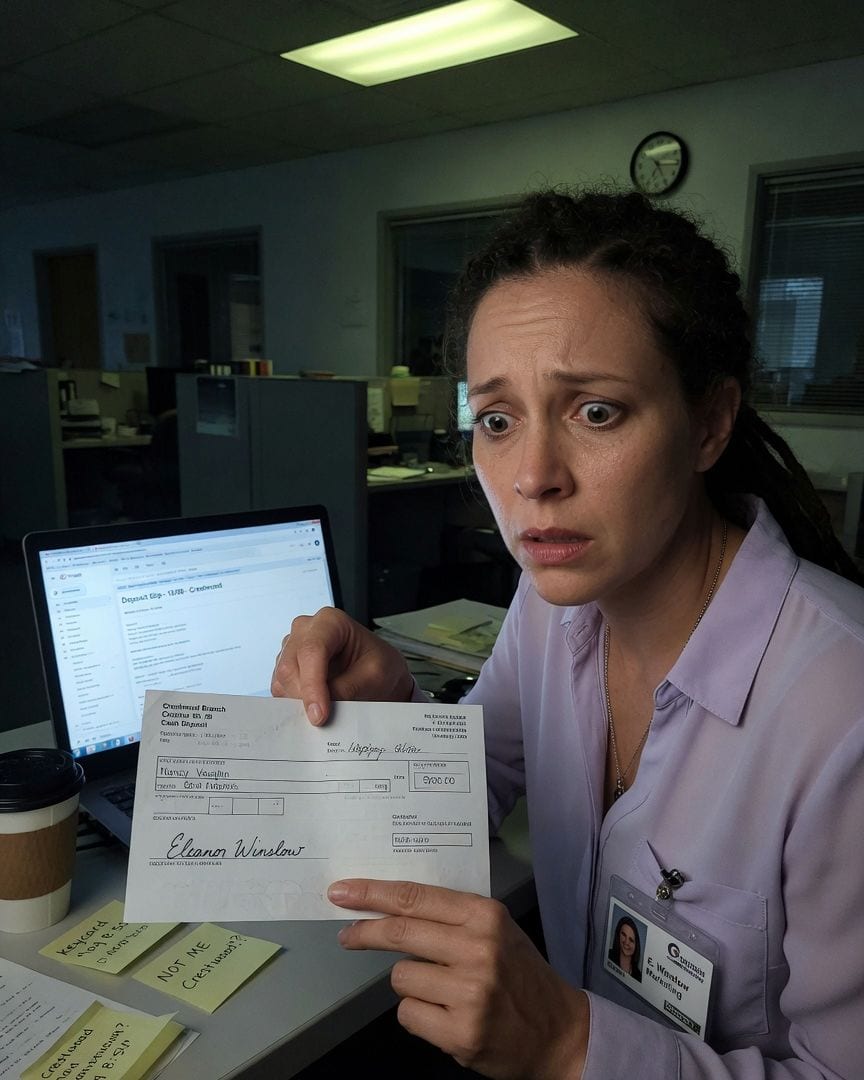
My bank statement shows a $900 cash deposit made in a town I've never set foot in, at 10:40 AM on a workday. I was at my desk, badged in. Two more landed since.
My bank statement showed a $900 cash deposit from a town I'd never visited, 150 miles away. I was at my desk, logged into work, all three times. But the scanned deposit slip arrived, clear as day, showing my own flawless signature.
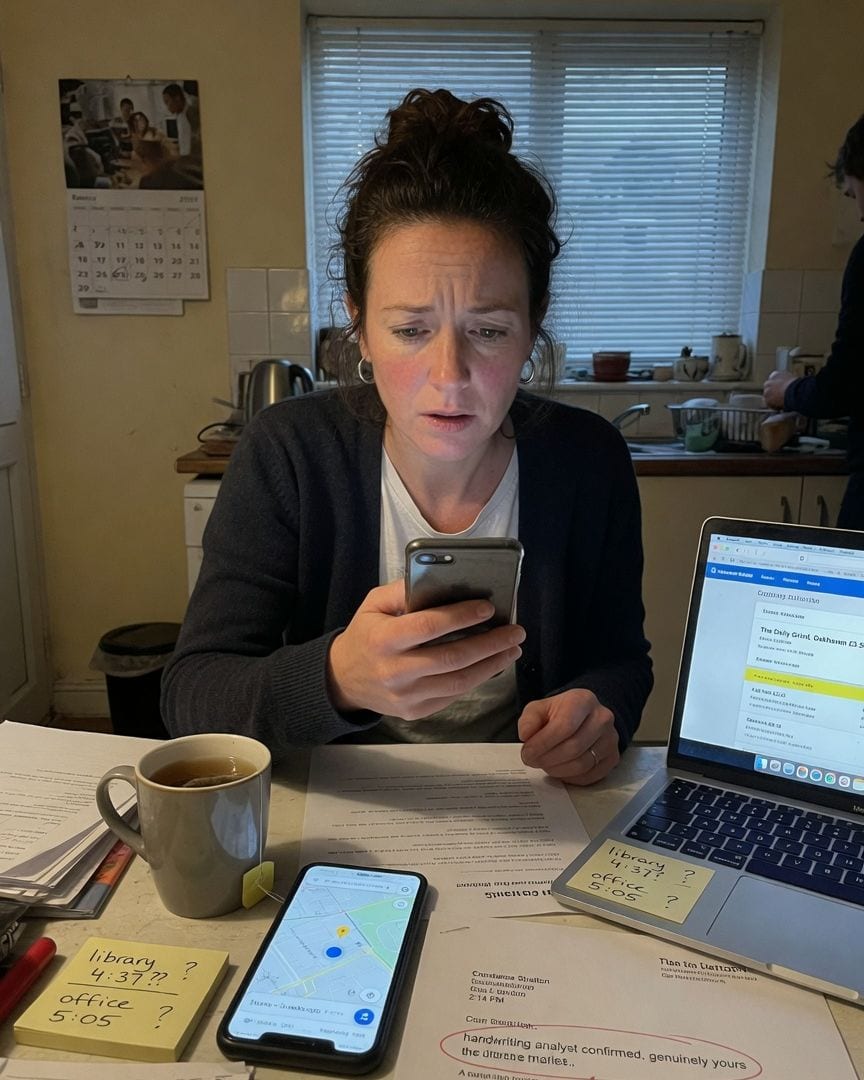
My signature covers a twelve-thousand-pound loan agreement. It's witnessed three hundred miles away, the day my phone confirms I was home.
My afternoon takes a chilling turn when the bank calls about a £12,000 loan, signed with my own handwriting in a town 300 miles away. My phone proves I was at my kitchen table at the time, yet a handwriting analyst confirms the signature is genuinely mine. The impossible truth deepens when a keycard log places me 100 miles away, just minutes before I entered my office.
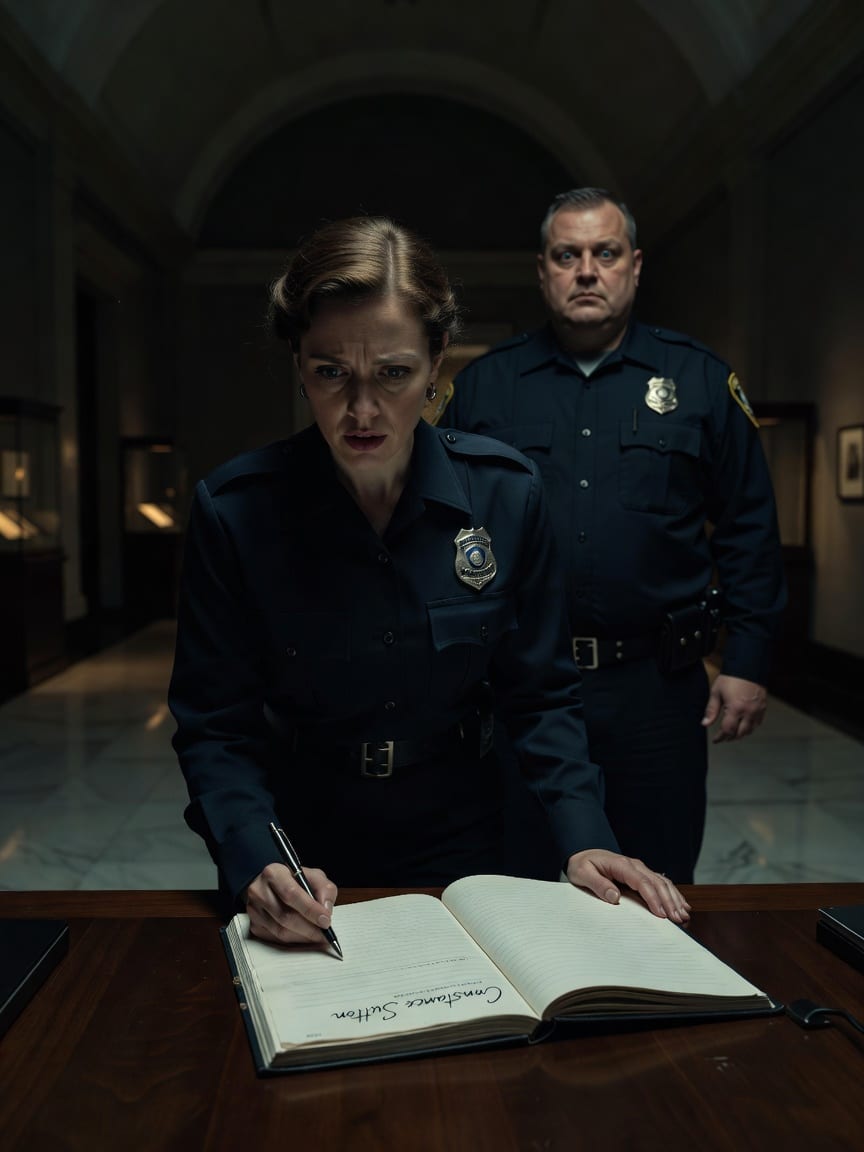
My relief guard Anton always signed in green ink. The police pulled the handover book: no Anton, no green ink, ever.
For two years, my routine as a night guard at the Prescott Museum has been a comforting rhythm, ending with the arrival of Anton Kowalski. But after a small theft, the police reveal Anton doesn't exist and his name isn't in the handover book. Now, I've found my own signature in that book for a night I was explicitly off duty.
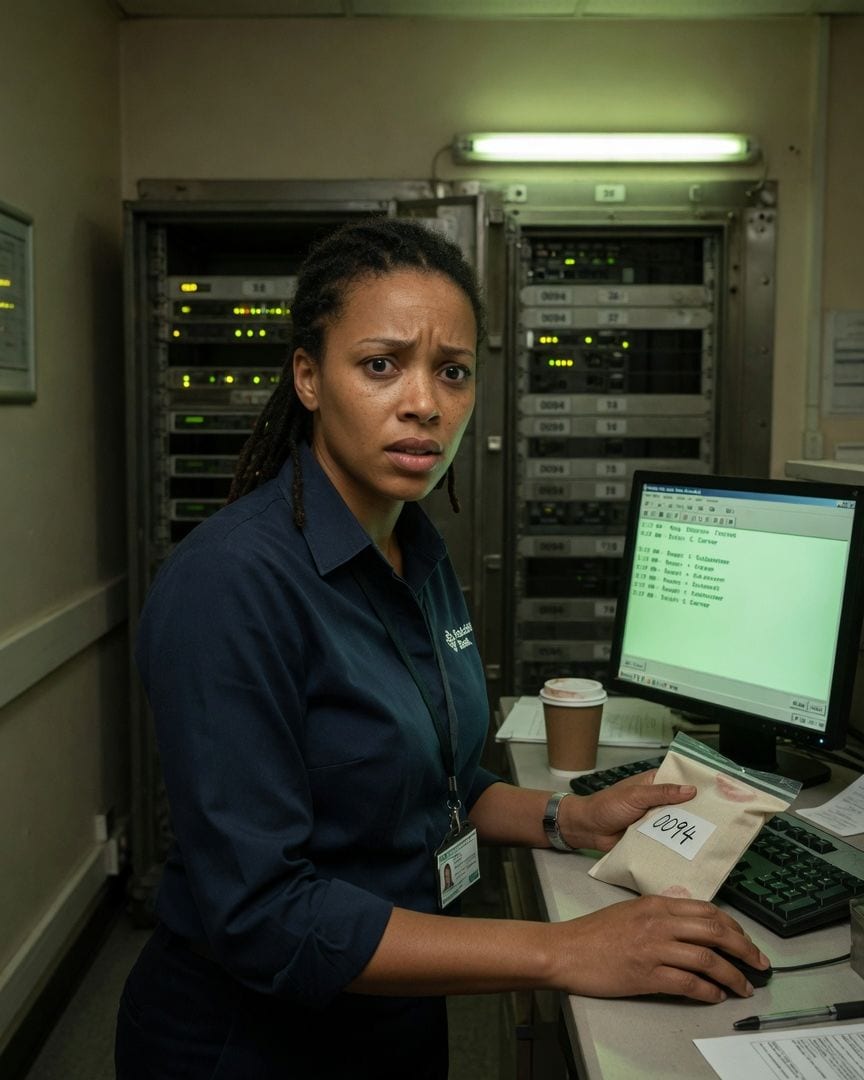
My night-deposit log shows a bag posted at 3:17 AM. My teller number, my count. Bag 0094 is still sealed in the safe, untouched.
I prided myself on precision as a night teller, logging every entry. But at 3:17 AM, a deposit appeared logged under my teller number that I never processed. Security footage then revealed a figure in my uniform, wearing my ID badge, with a blank photo slot.
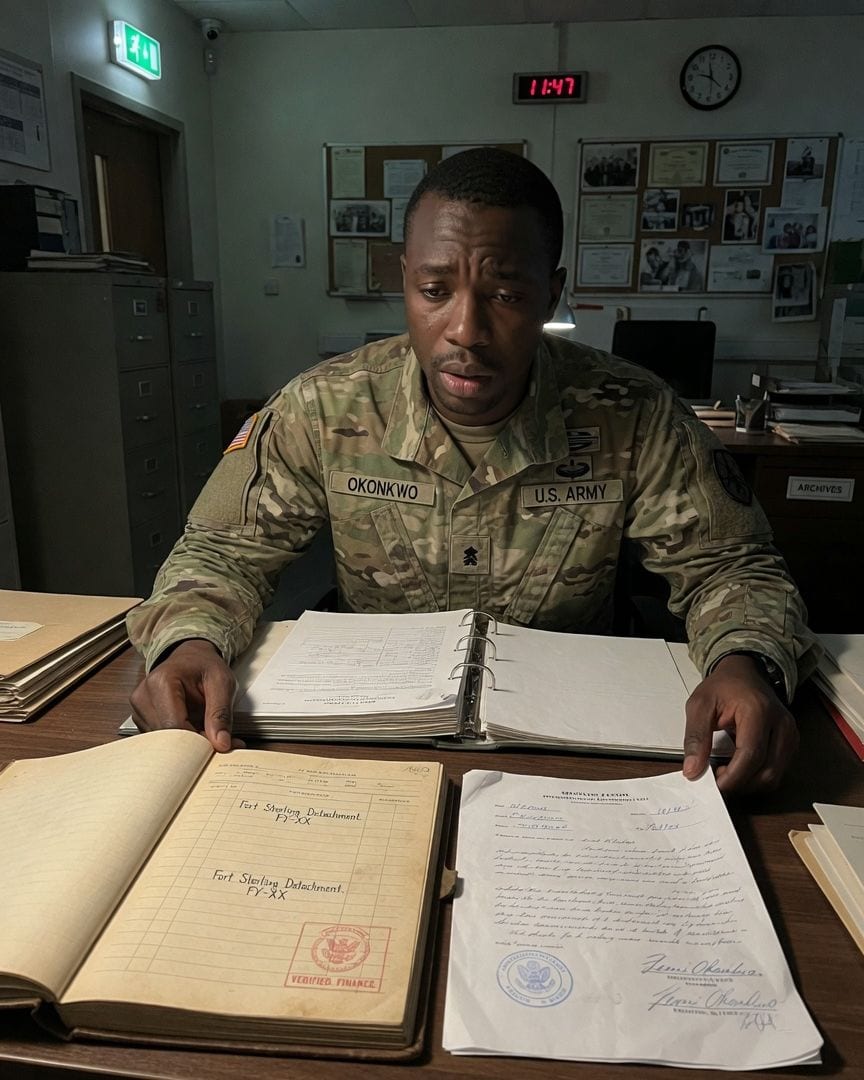
An old deployment ledger bore Specialist Femi Okonkwo's name, but the elegant signature was not his own.
Specialist Femi Okonkwo, an Air Force cargo hauler, stared at an earnings statement that contradicted his entire four-year enlistment. It listed nine months of jump pay and a mountain duty station in Colorado—places he’d never been, operations he’d never completed. Finance and HR records, seemingly impeccable, confirmed every detail of his impossible deployment. But when Femi finally retrieved the physical sign-in ledger, the faded blue ink of his supposed signature revealed the true, chilling discrepancy: the neat, elegant hand on the official document was unequivocally not his own. Who signed for Specialist Okonkwo’s impossible deployment, and why was it so meticulously verified?
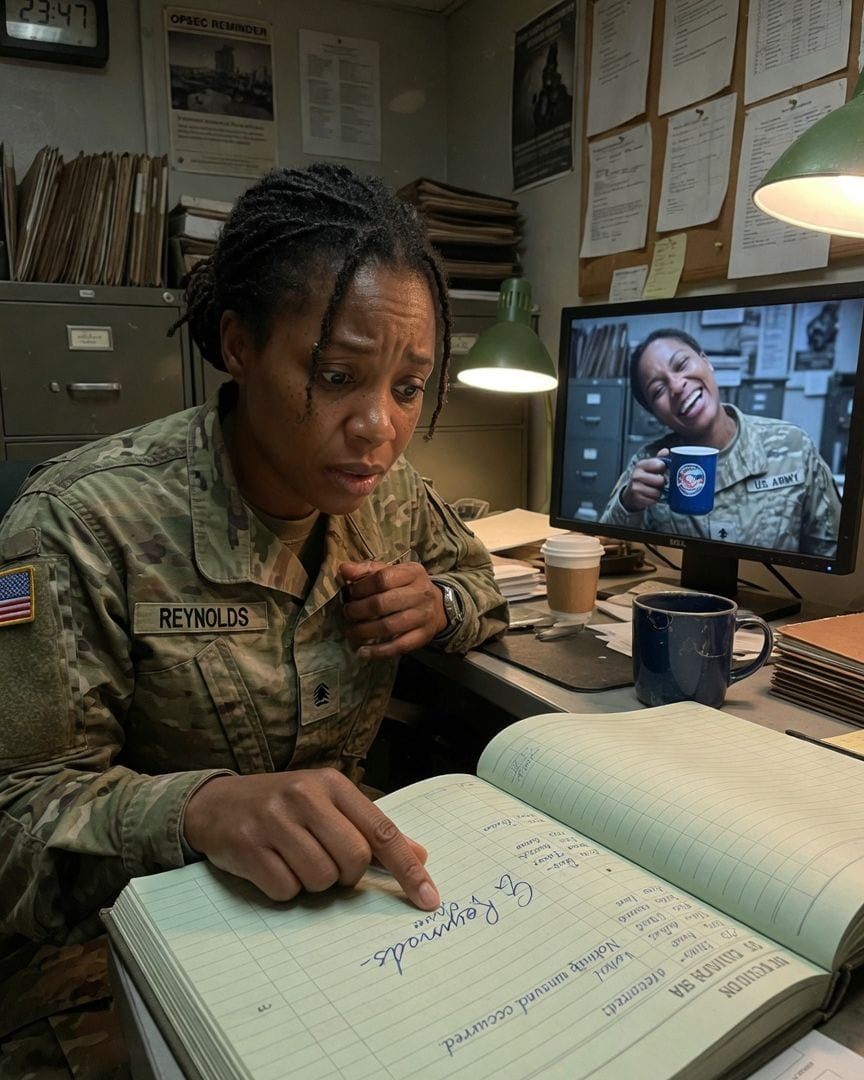
Lieutenant Grace Reynolds saw her own signature in the staff-duty log for a shift she never worked. The security footage then showed 'her' leaving a coffee mug she’d never once seen.
Lieutenant Grace Reynolds hunched over the battalion staff-duty log, the fluorescent hum of the records room a monotonous backdrop to her dry inventory audit. Her gaze snagged on an entry from three weeks prior: her own unmistakable signature, closing out a full 24-hour staff-duty shift she knew she had never worked. Security camera footage only deepened her unease, showing 'Grace Reynolds' moving with her familiar stride, laughing a shade too brightly, her head tilting a fraction too precise, like a flawless, chilling performance. But as the imposter turned to leave, she picked up and rinsed a chipped, dark blue ceramic coffee mug with a faded diner logo—a mug Lieutenant Reynolds had never once seen in her life. The air in the quiet room grew heavy, thick with the unspoken wrongness: if that wasn't her, then who was it?