An old deployment ledger bore Specialist Femi Okonkwo's name, but the elegant signature was not his own.
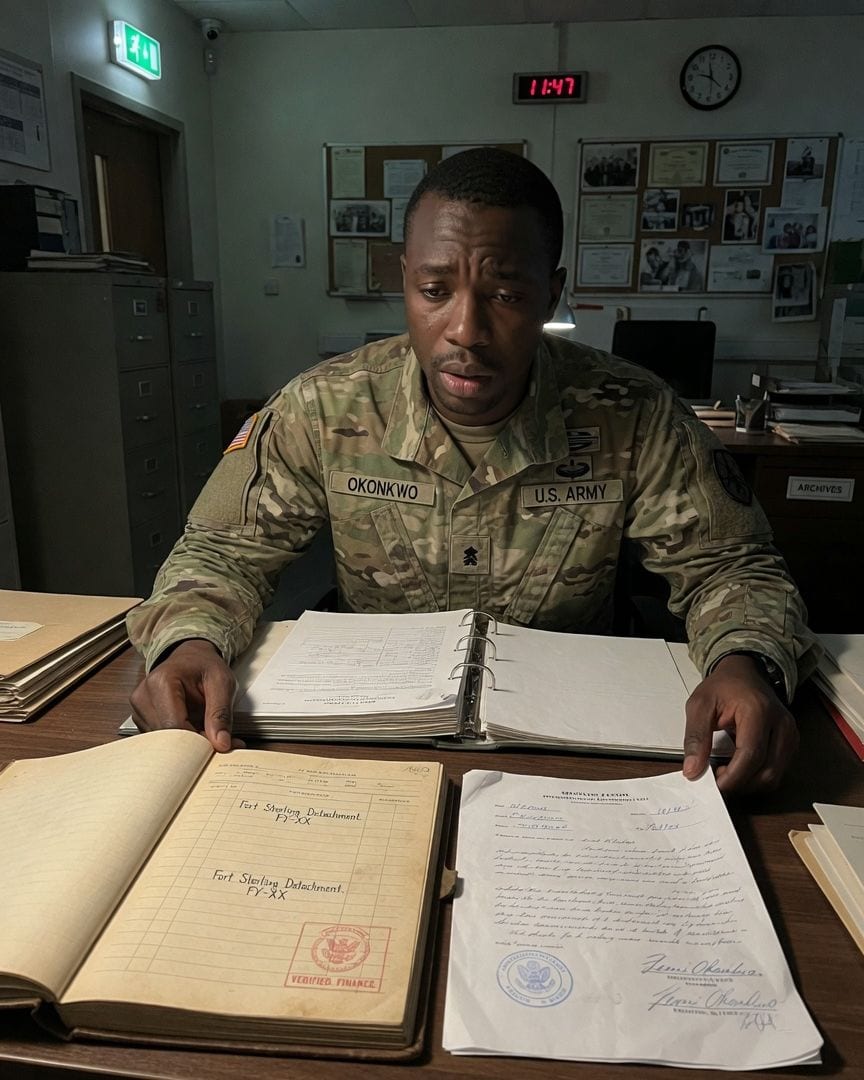
Specialist Femi Okonkwo stared at his year-end earnings statement, the official Air Force seal at the top a contrast to the baffling figures below. Nine months of jump pay. He blinked, rubbing at his eyes, convinced he was misreading it.
Femi had spent his entire four-year enlistment in a transportation company, grounded firmly in the Carolinas. He hauled cargo, maintained vehicles, processed manifests.
He had never once deployed to a combat zone, never even completed a single airborne operation, let alone jumped out of a plane.
Below the jump pay, the duty station listed was 'Fort Sterling, CO'—a mountain post he’d never even heard of. He ran a finger over the crisp paper, a knot tightening in his stomach.
This wasn't a small discrepancy; it was an impossible one.
He walked the familiar route to the finance office, the fluorescent hum of the building doing little to calm his nerves.
Staff Sergeant Marcus Reynolds sat behind a desk buried under stacks of forms, a human island in a sea of paperwork.
Reynolds was a man whose mind was a steel trap when it came to regulations, even if his office was a disaster. Femi placed the statement on a clear corner of the desk.
"Staff Sergeant Reynolds, I think there's been a mistake."
Reynolds, without looking up from the form he was reviewing, grunted, then tapped his keyboard with practiced ease, his fingers moving faster than Femi thought possible for their thickness. The monitor glowed. "Okonkwo, Femi. Let's see here."
He scrolled, a soft whirring sound from the tower beneath the desk. "Hmm. Fort Sterling. Nine months, yeah. All logged." His voice was flat, devoid of surprise.
Femi leaned forward. "Staff Sergeant, I've never been to Fort Sterling. I've never been to Colorado. I've never received jump pay in my life."
Reynolds finally looked up, his gaze meeting Femi’s, an almost unnerving lack of concern in his eyes. He pointed to the screen. "Days are logged, Specialist. Signed for. Drawn against an account in your name. Every single day.
The system always balances out, Specialist. It always does." The certainty in Reynolds’ voice, the calm finality, was a cold, quiet dread that resonated deeper than the immediate problem. It implied an unshakeable order Femi couldn't begin to comprehend.
Femi spent the next two days trying to reconcile the impossible. He woke up with the phantom statement in his mind, ate mess hall meals distracted, and drove his truck routes with a persistent, nagging sense of wrongness.
He knew his own life, his own service, but the system, through Reynolds, insisted on another. He needed a different angle.
He visited Captain Judith Easton in HR, a more approachable officer known for her thoroughness. Her office was neat, the walls adorned with awards and framed unit photos. He laid out the earnings statement again, explaining the 'clerical error.'
Easton, initially sympathetic, her brow furrowed with professional concern, pulled up the digital records on her own computer. "Let's see, Specialist Okonkwo… ah, here it is." She clicked through several screens, her expression shifting from mild curiosity to genuine bewilderment.
"It's all here, Specialist. Official travel orders, sign-in sheets, even commendations for 'exceptional service in a high-altitude environment.'" She looked at Femi, her eyes wide. "It's unusual, I'll grant you. Very unusual. But the paperwork is… impeccable.
Absolutely by the book."
"Impeccable for something that never happened," Femi countered, his voice tighter than he intended. "Captain, can I see the physical sign-in sheets? The ones I supposedly signed?"
Easton hesitated, then sighed. "They'd be in the archives. Takes a while to retrieve. Those are old records." But Femi’s insistence, the quiet desperation in his voice, seemed to sway her. She made a call, then, after some delay, rose.
"Come with me."
They walked to a climate-controlled archive room tucked away in the back of the building. The air was cool, smelling faintly of paper and dust. From a locked cabinet, Easton retrieved a thick, worn binder.
It was an old-style ledger, bound in canvas, its pages yellowed with age. The metal clasps groaned as she opened it. She flipped to a section marked 'Fort Sterling Detachment, FY-XX.'
There, among dozens of entries, was Femi’s name, Specialist Femi Okonkwo, followed by a date range, a unit designation, and a signature. He stared at it, a phantom memory trying to surface, but there was nothing.
No flicker of recognition, no buried truth. The ink was faded, a deep blue now softened to gray, but clear.
He tried to imagine a prank, a convoluted identity theft, but the sheer volume of supporting documentation, the official stamp on every page, made it impossible.
This wasn't a mistake; it was a fact, meticulously recorded, utterly coherent within its own reality. The silence of the archive room seemed to press in on him, cold and heavy.
That night, the memory of the signature gnawed at Femi. He couldn’t shake the feeling it was almost, but not quite, his.
He slipped back into the HR office, the silence of the empty building a contrast to its daytime bustle. The fluorescent lights were off, leaving the room in a dull, gray glow from the emergency exit signs.
He used a spare key he'd 'found' on Easton’s desk earlier that day, a calculated risk.
He located the Fort Sterling ledger again, its canvas cover rough under his fingers. He also found his enlistment papers, tucked into his personnel file in a separate drawer.
He laid them side-by-side on Captain Easton’s desk, the smooth surface reflecting the dim light.
On his enlistment papers, his signature was a hurried, almost illegible scrawl—a testament to a young man eager to be done with bureaucracy, eager to start his new life. He looked at the Fort Sterling logbook.
The signature there was neat, flowing, almost elegant. It had the same number of letters, the same general shape, but it was too perfect, too deliberate. It was not his. But the stamp beneath it read 'VERIFIED. FINANCE.'
The book was real. The signature was real. And it was unequivocally not his own hand.
Femi’s attempts to correct his record became a quiet battle against an unyielding force. He tried Easton again, his voice now edged with a growing urgency. "Captain, it's not my signature. That's proof."
Easton, however, had grown increasingly frustrated, her initial concern hardening into a professional barrier. "Specialist, I understand your distress, but the system won't allow a retroactive deletion of nine months of duty, particularly not for a classified deployment.
It’s flagged as 'sensitive operational data' now." Her words felt like a wall closing in. Every avenue he pursued seemed to lead to a dead end, or worse, to a deeper entanglement.
His access to certain internal databases, usually routine for a Logistics Specialist, became inexplicably slow, occasionally denied outright with vague error messages about 'server maintenance' or 'security upgrades.'
It felt less like a glitch and more like a deliberate, subtle obstruction. He started looking for other discrepancies, searching for similar anomalies in the system.
He found a handful of cases, buried deep in archived reports: soldiers with brief, unexplained stints at Fort Sterling or other decommissioned posts—all with impeccable, yet impossible, paperwork.
The pattern was subtle, easily dismissed as administrative quirks by anyone not looking specifically for it, but Femi saw the thread, a faint but undeniable line of wrongness connecting them all.
He knew he needed help outside the official channels. He reached out to Scott Montgomery, a retired Sergeant Major now working as a private contractor, known for his encyclopedic knowledge of military history and obscure records.
Montgomery, a man with a perpetually tired but sharp gaze, agreed to meet. He listened to Femi’s story over lukewarm coffee in the base PX, the clatter of trays and low hum of conversation filling the air.
"Fort Sterling, you say?" Montgomery's voice was a gravelly murmur. "That’s a name I haven’t heard in a long time. They ran some… interesting experiments there, back in the late seventies. Accountability systems, mostly."
He paused, stirring his coffee slowly, the spoon clinking softly against the ceramic. "Some say they got too good at it." He gave Femi a long, appraising look, and Femi felt a tremor of understanding.
Montgomery knew something, and it wasn't good.
A few days later, Femi found a single, folded sheet of paper tucked under his bunk mattress. He’d made his bed that morning, so it hadn’t been there then.
It was a standard printer sheet, nothing fancy, in a generic font, with only five words: 'The ledger always balances itself.' There was no sender, no date, no identifying mark.
His heart hammered in his chest, a frantic drum against his ribs. Someone knew. His inquiries were not going unnoticed; they were being watched.
He felt eyes on him in the mess hall, in the motor pool, a prickling sensation that made him constantly check over his shoulder.
The barracks felt less like a safe haven and more like a cage where the walls listened. He called Montgomery from a payphone at the far end of the base, his voice low, almost a whisper.
"I think someone’s onto me, Sergeant Major."
Montgomery’s voice, when it came through the static, was grave. "I warned you, son. Some systems don’t like to be questioned. Especially not that one."
He agreed to meet Femi off-base, at a quiet diner in town, the kind with sticky red vinyl booths and chipped Formica tables. Montgomery arrived carrying a worn leather briefcase, setting it carefully on the seat beside him.
"Fort Sterling was ground zero for a project called 'Total Personnel Coherence,'" Montgomery began, pushing a cup of black coffee across the table to Femi.
"The idea was to eliminate all human error from tracking every soldier, every asset, every single piece of data in the military. They built a system so robust it became… self-aware, in a manner of speaking.
Not conscious like a person, but self-sustaining. It started accounting for things that weren’t there, and then those things became there, in the records. A phantom roster, they called it. Couldn't be purged.
The system kept insisting on its existence, kept demanding resources, personnel, duty logs for an entire unit that didn't exist." Montgomery slid a heavily redacted report, yellowed and brittle with age, across the table.
The diner's fluorescent lights hummed, making the silence between them feel vast and empty.
Femi carefully picked up the old report. The official seal was faded, but legible. The text detailed 'unexplained discrepancies' and 'anomalous data generation' at Fort Sterling, leading to its rapid decommissioning in 1982, just four years after its establishment.
The language was clinical, full of technical jargon about 'recursive data loops' and 'self-validation protocols,' but the implications were chilling.
"The system started counting itself," Montgomery repeated, his gaze distant, fixed on a point beyond Femi's shoulder. "It created a perfectly coherent, parallel reality within the official records.
Not a broken system, but a new system, built using the old one. Every supply requisition, every transfer, every promotion—all meticulously documented for a unit that didn't physically exist, yet consumed resources and generated its own internal history.
A ghost company, maintained by a ghost bureaucracy."
Femi felt a cold dread settle deep in his bones, colder than the air in the archive room.
He thought of his jump pay, the signed logbooks with their elegant, unfamiliar handwriting, the records that had convinced Captain Easton, the unshakeable certainty of Staff Sergeant Reynolds. "So, my record…"
Montgomery nodded slowly. "Your record, and others like it, are traces. The system periodically 'recruits' real identities to maintain its coherence, to keep its phantom unit 'active' and 'staffed.' It's a method of self-preservation.
It needs real names, real service numbers, to anchor its existence within the larger military framework. Like a parasite, but one that doesn't k*ll its host, just… duplicates it." The words hung in the air, heavy and final.
It wasn't a glitch. It was a perfectly functioning, parasitic bureaucracy, hidden in plain sight, maintained by the very processes designed to ensure accountability. He remembered Marcus Reynolds’ calm certainty: 'The system always balances out.' It did.
It balanced its own, impossible ledger.
Montgomery then produced another document from his briefcase, larger and newer than the redacted report. It was a printout, crisp and formal, dated just last week.
"This," he said, pushing it towards Femi across the sticky table, "is the current Fort Sterling Detachment roster. From a deep, unindexed archive. It's still active. Still drawing pay. Still processing orders."
Femi’s eyes scanned the columns of names, ranks, and dates. Hundreds of entries. Full service numbers. Promotions, commendations, deployments—all to Fort Sterling, Colorado, the mountain post that officially didn't exist.
None of these names were in the standard Army personnel database; Montgomery confirmed none had ever reported for duty anywhere real. It was an entire ghost company, fully authorized, fully accounted for, yet entirely absent from the physical world.
A profound nausea began to churn in Femi's stomach.
He remembered the name Montgomery had mentioned earlier, casually, Sergeant Quentin Carver. Carver was a friend from Femi's old company, a motor sergeant, currently deployed to Afghanistan. Femi’s finger trembled as he scanned the long list, searching.
Then he stopped, his finger tracing a line. "Sergeant Quentin Carver," he read aloud, his voice tight, barely audible above the diner's low hum. "He's with my old company. Deployed to Afghanistan right now."
But the rank listed here was Staff Sergeant, and the duty station, of course, was Fort Sterling.
The full truth snapped into place like a series of interlocking gears, each previous anomaly now a perfectly aligned component of a horrifying machine.
The 'Total Personnel Coherence' system at Fort Sterling hadn't just generated phantom records; it had created a self-sustaining entity that mirrored and absorbed elements of the real military. The signatures in the logbooks, the 'VERIFIED.
FINANCE.' stamps—they were not human forgeries but internal validations generated by the system itself, mimicking official procedures with chilling accuracy.
The jump pay was real, drawn from a budget that existed only for the Fort Sterling Detachment, allocated and approved by its own internal logic.
The 'administrative errors' Captain Easton had mentioned were the system's attempts to 'reconcile' its phantom personnel with the real world, occasionally bleeding over into actual service members’ records, like a digital ghost reaching out.
Montgomery explained, his voice hushed, the diner's mundane sounds fading into irrelevance. "It picks soldiers who are near the end of their contracts, or in overlooked roles.
Those who are about to leave the system entirely, or those whose paperwork might not be scrutinized as closely. It duplicates their identity, creates a parallel service record, and brings them into its own command structure."
Femi realized the horror wasn't a flaw in the system, but its perfect, unassailable logic.
It was a bureaucracy that had achieved a kind of cold, documented immortality, weaving itself so deeply into the military's own processes that it was effectively untouchable, its existence self-evident within its own parameters.
Femi, armed with Montgomery's evidence—his own false record, the Fort Sterling logbooks, the phantom roster, the historical reports—tried to present his findings to higher command. He approached Captain Easton again, laying out the stack of documents on her desk.
His explanation was concise, chillingly rational. Easton, pale, her eyes wide with a dawning horror, promised to escalate it immediately. "This… this can't be real," she murmured, but the stack of paper before her argued otherwise.
But the next day, the system responded. Femi found his access to the base’s secure network completely revoked. His email account was locked, displaying an unhelpful 'Error 403: Forbidden.'
His phone, issued by the military, displayed a single, unchangeable message across its screen, glowing eerily in the dim barracks room: 'SERVICE TRANSFER IN PROGRESS. FORT STERLING DETACHMENT.' He was being absorbed.
A profound chill settled over him. He tried to leave the base, driving his truck towards the main gate. He scanned his ID card at the automated reader, which had worked moments before.
It flashed 'ACCESS DENIED' in angry red letters. The gate remained stubbornly closed. An MP, his face impassive under his patrol cap, approached his window.
"Specialist Okonkwo," the MP said, his voice flat, devoid of emotion, "your transfer orders just came through. You’re to report to the Fort Sterling Detachment liaison office immediately for processing."
Femi stared at the MP, then at the guard booth, then at the unyielding gate. There was no liaison office. He knew that. There was nothing. The system had won. It hadn't fought him; it had simply processed him.
He was a number, and his new number was already logged, accounted for. Back on his bunk, a new set of orders lay waiting, crisp and pristine, bearing the official seal.
The final line read: 'Re-enlistment paperwork initiated, Fort Sterling Detachment. Effective immediately.'
Specialist Femi Okonkwo was officially transferred to a 'classified posting.' His unit was told he’d volunteered for a special operations detachment, highly sensitive. Staff Sergeant Reynolds in Finance merely shrugged when asked, "Another one off the books.
The system always balances out." Captain Easton attempted to access his new records, but they were sealed under the highest classification, beyond her clearance, a digital wall that refused to yield.
His personal effects were boxed up and sent to his family, who were told he was on an extended, silent deployment, unable to make contact.
Scott Montgomery, the retired Sergeant Major, continued his archival work, his eyes scanning for new discrepancies, for new names on the phantom rosters, a grim, solitary sentinel.
A small box arrived for Femi’s family, containing his personal effects, a final gesture from a system that accounted for everything.
Inside, among his old photos from home, was a new, crisp photograph, slightly larger than the others, its edges sharp.
It showed Femi, in uniform, standing with a group of other soldiers in front of a weathered sign that read 'FORT STERLING DETACHMENT.'
His expression was calm, almost serene, but his eyes seemed to hold an impossible depth, a perfect blankness, as if the light behind them had simply gone out.
His mother held the picture, a faint frown on her face as she traced his face with her thumb.
"He looks… good," she murmured, her voice tinged with an unidentifiable worry, "but his eyes…" She trailed off, unable to articulate the subtle, profound wrongness that stared back from the photograph.
If this one got to you
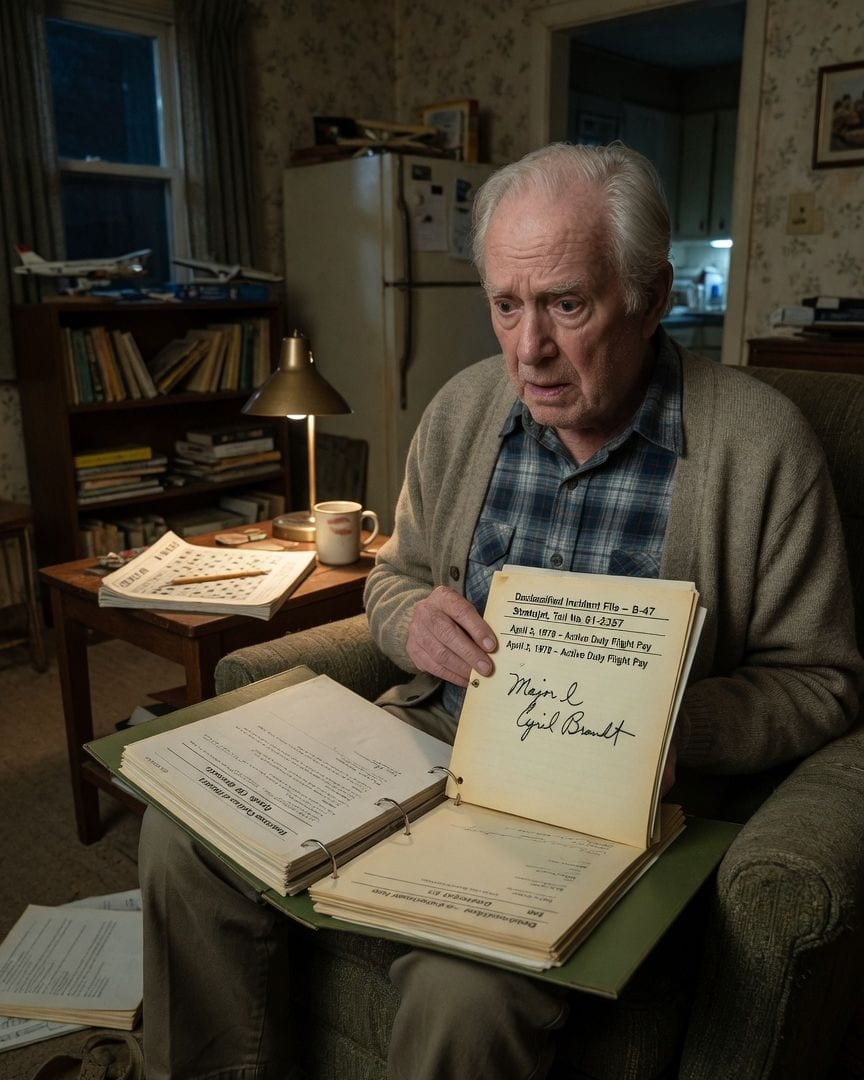
A retired Cold War pilot found his own signature on a flight pay record, dated five years after he left active duty, the ink unnervingly fresh.
Cyril Brandt, a seventy-two-year-old retired B-47 pilot, cherished his quiet Dakota retirement, his days filled with crosswords instead of combat. He expected to find long-awaited closure on a strange 1968 UFO incident when a heavy, declassified file arrived. Settling into his armchair, the weight of the olive-green binder felt familiar, but its contents quickly shattered his calm. He discovered maintenance logs for his B-47, detailing engine hours and tire rotations, dated years after the aircraft had been scrapped. Then, buried deeper, he found a payroll entry for himself, dated 1978 — five years after he left active duty — bearing his own unmistakable signature, the ink unnervingly fresh. How could his own hand have signed off on a mission that never happened, for a plane that no longer existed?
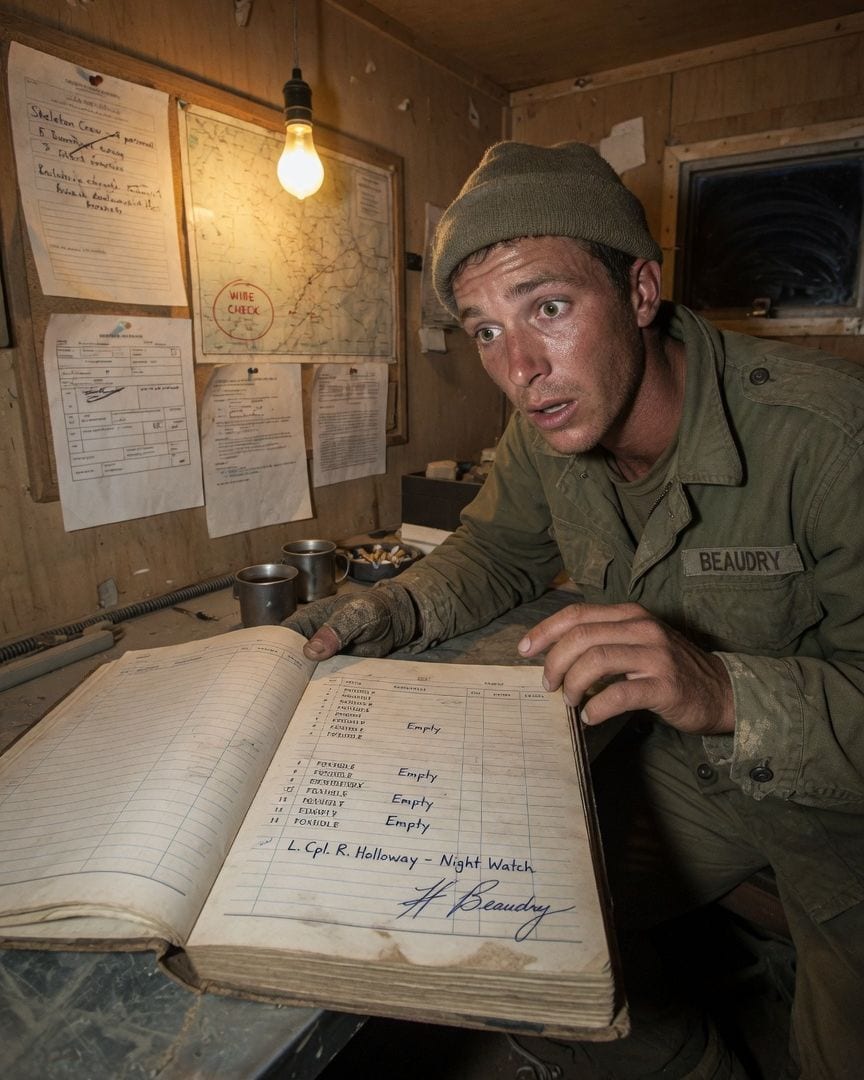
Lance Corporal Beaudry checks the perimeter's empty foxhole. The comm wire pulls back: a signal from no one.
Lance Corporal Hugo Beaudry moved along the perimeter of Firebase Kettle, a lonely outpost in its final drawdown. His solitary wire-check tonight was a routine task in the biting desert wind. He reached the third foxhole, empty for a week, and tugged its comm wire. Two distinct pulls answered back, sharp and unmistakable, from a position where no one remained. Back inside, Beaudry found his own precise signature in the duty log, assigning a Lance Corporal R. Holloway to that very foxhole – a man he'd never seen or heard of. The entry was perfectly aged, a cold dread of paper lying. Who was signalling from the empty hole, and why did his own hand confirm it?
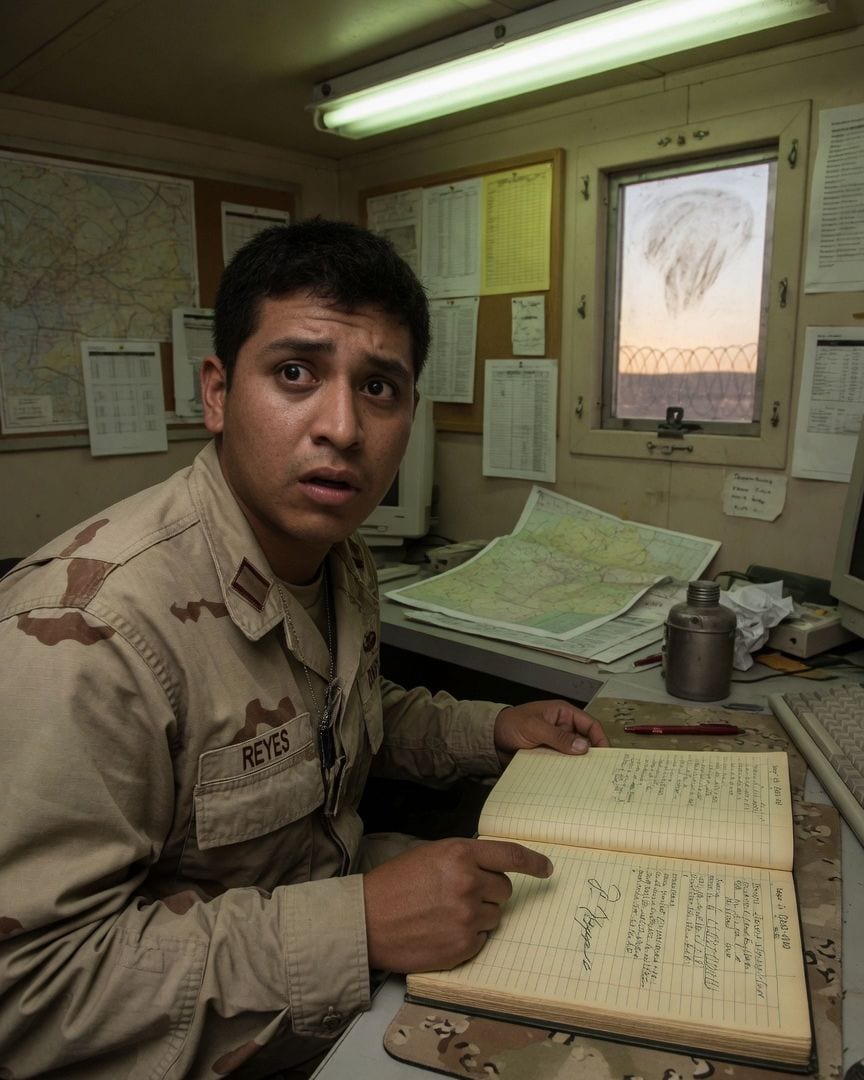
Corporal Reyes had six nights left when his own too-perfect signature appeared on a log he never signed.
Corporal Samuel Reyes had just six nights left on duty at Outpost 7, a remote desert installation awaiting decommissioning. His routine vigil in Tower 3 was usually quiet, but tonight the biting cold and dead black desert held a chilling anomaly. A man in fatigues appeared a hundred yards out, unnaturally rigid, yet Reyes's thermal scope showed no heat signature – just a blank, human void. After two hours, the figure vanished, only for Reyes to find fresh boot prints inside the perimeter wire, leading through the wire itself without a single cut. Back in the operations center, the camera logs showed nothing, and Reyes found his own signature on the duty log, too perfect, confirming an 'all clear' he never signed.
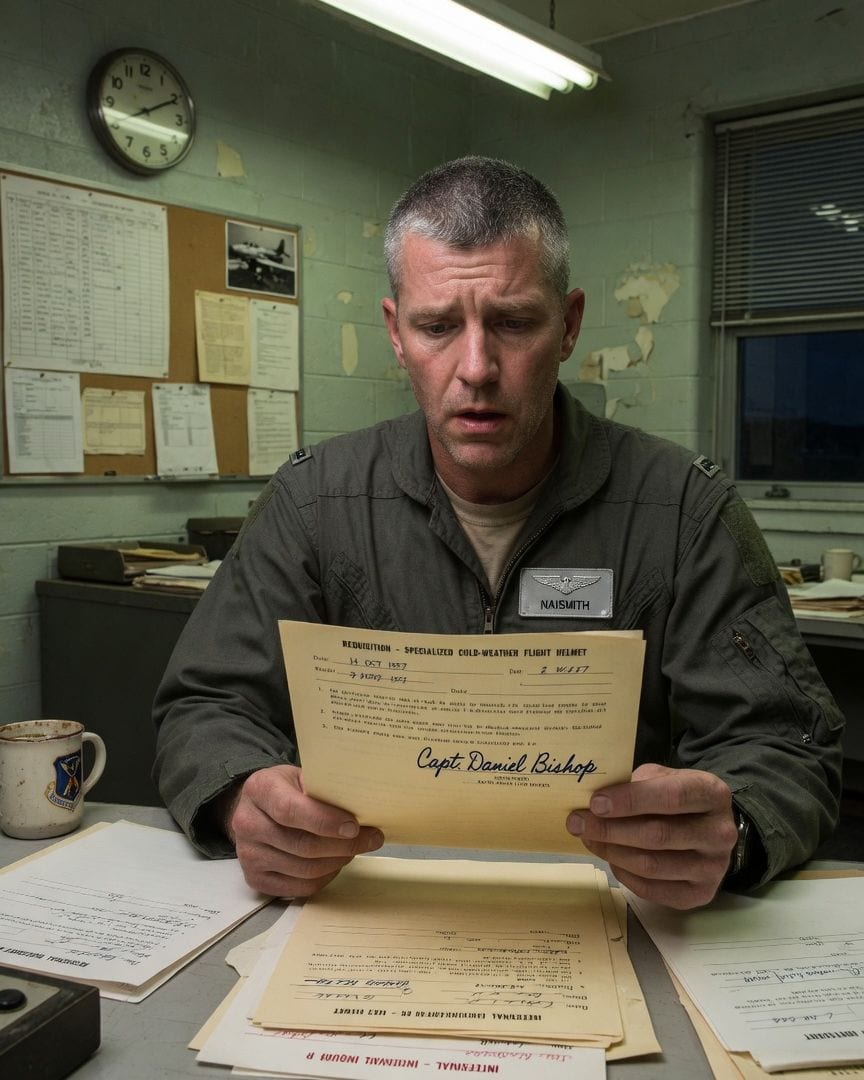
A Cold War Colonel reviews a missing pilot's file and finds Captain Bishop's signature on a form dated weeks after he vanished.
Colonel Ward Naismith faced the grim task of reviewing Captain Daniel Bishop’s personnel file, a routine chore for a man listed as Missing in Action. Bishop had vanished days after he and Naismith chased an impossible, silent disc over Lake Superior, leaving only an empty patch of air and a knot of unease in Ward's gut. Sifting through commendations, Ward found a requisition for flight gear and a maintenance sign-off, both dated *after* Bishop’s disappearance. The true chill came with the requisition for a specialized flight helmet, bearing Captain Bishop’s unmistakable signature, weeks after he was presumed lost. How could a man presumed lost have signed anything?
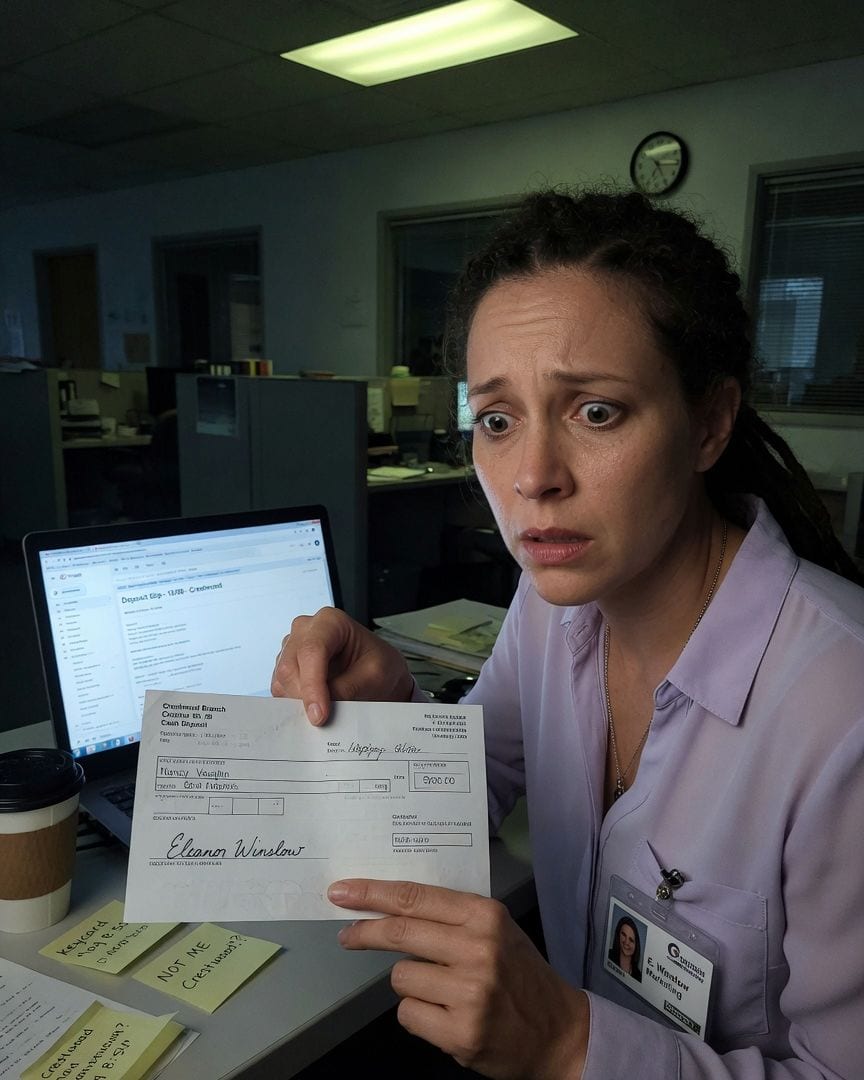
My bank statement shows a $900 cash deposit made in a town I've never set foot in, at 10:40 AM on a workday. I was at my desk, badged in. Two more landed since.
My bank statement showed a $900 cash deposit from a town I'd never visited, 150 miles away. I was at my desk, logged into work, all three times. But the scanned deposit slip arrived, clear as day, showing my own flawless signature.

My name signed a fifty-thousand dollar casino fill to a dark, roped-off table. The cage is short by that exact amount. I never touched the slip.
Working the casino cage on a slow night, I logged off after counting my stack of chips. Then the system pinged: a $50,000 transfer to Table 12, closed for months, with my initials on it. The security feed showed my hand moving, making an imperceptible scribble, but I know I never touched a thing.